160801-3939-IJVIPNS-IJENS © February 2016 IJENS
I J E N S
Multi-Image Encryption Technique Based on
Permutation of Chaotic System
Noora Shihab Ahmed
Collage of Science, Department of Computer Science, Halabja University
Halabja, Kurdistan, Iraq [email protected]
Abstract--
The key stream generator is the key design issue of an encryption system. In this work presents an n-array three key stream generators (KSI, KSII and KSIII), Based on permutation of three chaotic maps (Logistic map, Kent map and tent map). This work reviews of some image encryption algorithm and finally investigate three methods for image encryption. First algorithm is encryption of original image by using KSI system. Second algorithm relies on KSII system to randomly generate two sequences of numbers by means of selecting proper factors along with seed value. Afterwards, the randomly produced numbers are employed to permute the image by means of shuffling its rows, columns and pixels sequentially in a manner by which first sequence is utilized to shuffle rows while second sequence is utilized to shuffle columns. Afterwards masking process is achieved by means of basic XOR processes between neighboring rows and columns. This technique employs the values of the two sequences together to shuffle the pixels. Third algorithm relies on KSIII system when the same procedures returned on image encryption. The results shows that the proposed algorithm has a high security, speed and gives perfect reconstruction of the decrypted image
Index Term--
Chaotic maps, Image encryption, Key stream generation, Security.
1. INTRODUCTION
In the last decays, the very quick evolution in the dispatch of digitized images through the World Wide Web and wireless networks came as a sequence to the interesting progress in network communication and the processing of digital images as well. Protecting the data of the transmitted images from any sort of unauthorized access takes the much concern of those who seek for security systems characterized by being trust worthy, rapid and robust in order to safe keep and send important confidential database images like military images, online personal photo album, medical-purposes images, video conference…etc. there are substantial characteristics of digital images among those, huge information capacity and intense correlation amongst neighboring pixels. Consequently most common ciphering techniques such as AES (Advanced Encryption Standard), IDEA (International Data Encryption Algorithm), DES (Data Encryption Standard) and so on are not descent for encrypting digital images in traditional ways because of the lack of low-level effectiveness when ciphering images [1].
Chaotic algorithms have proven effectiveness and enhanced performance in image encryption [2-3]. Chaotic algorithms possess attributes such as ergodicity, responsiveness to initial states, pseudo-random action in addition to control factors. Which are similar to those of cryptography such as diffusion and confusion as well. Due to its attributes, chaotic systems have become a prospective selection when establishing cryptographical systems. In general, any chaotic schema to encrypt images involves two phases, one for permutation and another for diffusion. The reason behind permutation operation is to lessen the correlation among pixels of an image. In the other hand, the aim of diffusion process is to alter gray values of a pixel consecutively with diffusion actions. Therefor a very little alteration for any pixel can extend to nearly whole pixels all-over the image. A proper permutation operation should come up with superior shuffling result. Moreover, a proper diffusion operation should make significant amendments over the encrypted image no matter whether being minor alteration for only single pixel in the encrypted image.
In 1989 Mathews was the first who employed chaotic system to construct a cryptographical algorithm [4]. The literature has suggested a large number of schemas to encrypt digital images based on chaos. The one-dimensional chaotic system in addition to two-dimensional have emerged amongst those schemas to encrypt image. The commonly used one-dimensional and two-one-dimensional chaotic systems due to being simple are Arnold map, Logistic map, standard map, skew tent map and baker map [5-6]. Recently, several image encryption techniques which are based on chaotic algorithms show lack of security and are prone to penetration because their key spaces and not sufficiently large [7-8] to make them hold out against cipher attack such as ‘brute force attack’ in contrast to proper encryption schemas which are very responsive to cipher keys;
160801-3939-IJVIPNS-IJENS © February 2016 IJENS
I J E N S
both one and two dimensions, numerous efforts have beenmade to enhance cryptosystems based on chaos with taking into consideration larger key spaces in addition to perfect diffusion methods. Among these efforts, an algorithm suggested by Behnia et al. aims to improve security known as of chaotic encryption based on piecewise nonlinear algorithm [9]. Lately, Zhang et al. suggested a method to encrypt image on basis of skew tent algorithm and permutation-diffusion construction [10] in which a P-box is generated with identical size of the original image besides shuffling whole locations of pixels in the image. This method utilizes various key streams based on the original image in the diffusion operation. Therefore this method achieved better security in terms of repelling chosen-plan attack (CPA).
Zhu et al. [11] suggested a novel permutation technique concerning bit-level. This method able to perform image confusion simultaneously. Later Liu and Wang [12] presented a novel permutation technique concerning bit-level. This method able to perform image diffusion and confusion simultaneously. Later, Liu and Wang [12] enhanced the schema reviewed in [11] in order to achieve color image encryption. Changing the bits order of image took the much interest of the authors. In this method all green, blue and red color bits of all components are mixed together. During permutation process, the authors used PWLCM chaotic algorithm in replacement for Arnold cat algorithm. Additional enhancements have been made. For instance using hyper chaotic systems, coupled map lattice systems (CML) and multiple chaotic systems based image encryption [13-14].
2.DYNAMIC CHAOTIC SYSTEMS
Chaos can be fined as an obvious fact that appears in nonlinear known systems responsive to initial states along with having pseudo random activity. In condition that chaotic dynamical systems encounter Lyapunov exponential function they will continue stabilized in chaos mode. Pseudo random conduct draw the attention of several cryptographic systems to this discernible fact. Pseudo random character helps to make the clear data of a system appear random to attacker sight. However, it appears observable to the intended recipient and possibly be decrypted up to now a number of chaos algorithms which based on cryptography are proposed. Actually many of them are utilized in one way or another to encrypt image and text as well. It is necessary for an encryption system to have proper speed to be able to cipher an image of enormous data. As a matter of fact it is improper to use text encryption techniques when encrypting an image. Practically, to transfer a reasonable amount of data, it demands a wide range sample. Afterwards this implicates a vast number of keys. As a consequence, serious management problems would be at keys delivery stage. Therefore chaotic system came with solutions. Amongst its pros is the tactic of simplified key management. For the reason that, this just demand to guard and assure the
security of the private key transmission in which parameters and initial states of chaotic system are included. The private key has moderate size. As a consequence, a little memory is required to keep the private key as well as more insurance is available during key transmission. Above of that, the unauthorized access to keys of short length is remarkably less probable as compared with keys of long length throughout data transmission over the unsecured medium.
2.1 The Logistic mapping
Logistic mapping is a paradigmatic exemplification of chaotic mapping. In spite of the fact that logistic mapping is one dimensional, however the control reaction is quite perfect. The following equation represents the logistic formula:
( ) (
) ( )
In the equation, an is denoted to the variable, also λ is a denotation to system parameter whereas λ (0,4], an [0,1].In case that 1≤ λ < 3 the system takes the act of 'fixed point'. If λ
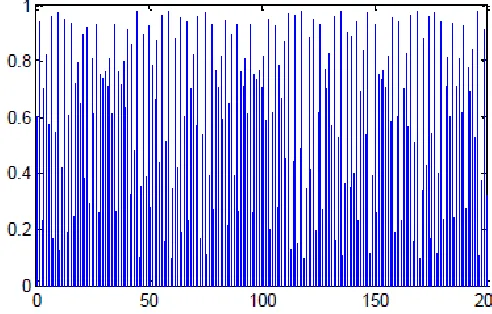
= 3 the system startes the transmission phase. When λ = 3.5699456, the system undertakes a chaotic condition. In case λ = 3.9 the starting value of an is 0.6. In logistic mapping extent, repeating the process for 200 times with chaotic ordered collection (sequence values) comes up with the products shown in figure 1.
Fig. 1. Iterative Sequence Value of Logistic Mapping
2.2 Kent mapping
Another type of logistic mapping is ‘Kent mapping’. This map is characterized by short-term anticipated and long-term unexpected, meanwhile Kent map is very responsive to initial state. The formula bellow shows Kent equation.
160801-3939-IJVIPNS-IJENS © February 2016 IJENS
I J E N S
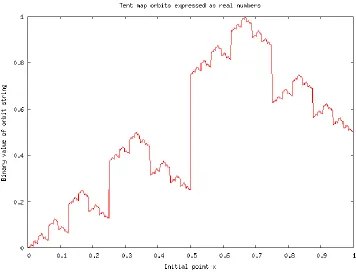
Where bn is denoted to the variable, also a is a denotation tosystem parameter whereasλ (0,4], bn [0,1]. In case that a = 0.6 , the starting value of bn is 0.6. In logistic mapping extent, repeating the process for 200 times with chaotic ordered collection (sequence values) comes up with the products shown in figure 2.
Fig. 2. Iterative Sequence Value of Kent Mapping
2.3 The tent map
Mathematically, the tent map is real-valued formula based on μ parameter, and is denoted be fμ. Tent map equation can be expressed by:
{ }
The reason behind its naming is the likeness of its graph to tent shape. By setting the parameter μ with values from 0 up to 2, fμ charts the
( ) {
( ) (3)
Where μ is a positive real invariable (constant). Setting for example the parameter μ=2, the outcome of the function fμ is possibly be discernible as the product of the process of bending the unit duration in twin, thereafter extending the product duration [0,1/2] to get back the duration [0,1]. Repeating the process, each point proposes the new upcoming locations as mentioned above, making a sequence cn.
The μ=2 state of tent mapping is a non-linear transmission of bit shift mapping and state r=4 of logistic mapping as well.
160801-3939-IJVIPNS-IJENS © February 2016 IJENS
I J E N S
3.THE PROPOSED ALGORITHMThe proposed multi-image encryption algorithm consists of two stages iterative (multi-level) block permutation and nonlinear keystream chipper
3.1 The Proposed Non Linear keystream
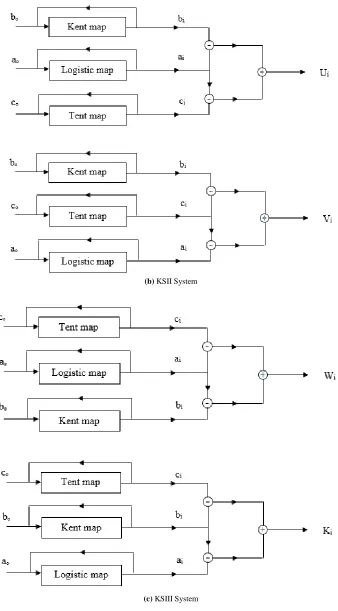
In the first stage, stream cipher based on permutation chaotic maps process was depended. Three kinds of generators processes called keystream I (KSI), keystream II (KSII) and keystream III (KSIII) are used in proposed system in shown in the figure 5 and its equivalent description is as follows:
Step 1
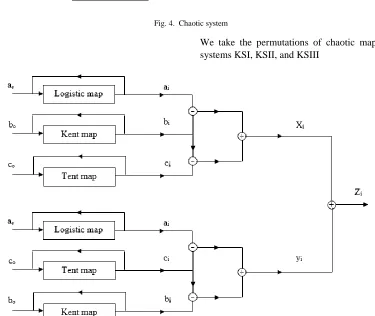
In this step we show a method in construct a system depending on three chaotic maps: Logistic map (eq1), Kent map (eq2), and Tent map (eq3). The system producing m-sequences ai , bi , and ci , keystream bit xi is generated using the Boolean function
xi = (ai . bi) + (bi . ci)
This means that xi = ai if bi = 1, xi = ci otherwise, For an illustration of the system, see figure 4
Fig. 4. Chaotic system
Step 2 We take the permutations of chaotic maps for building the
systems KSI, KSII, and KSIII
160801-3939-IJVIPNS-IJENS © February 2016 IJENS
I J E N S
(b) KSII System(c) KSIII System
160801-3939-IJVIPNS-IJENS © February 2016 IJENS
I J E N S
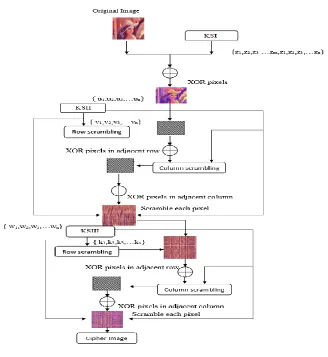
3.2 Encryption processThe proposed multi-image encryption algorithm can be summarized in the following steps:
Step 1 Image Encryption Using KSII system
This technique relies on KSII system to randomly generate two sequences of numbers by means of selecting proper factors along with seed value. Afterwards, the randomly produced numbers are employed to permute the image by means of shuffling its rows, columns and pixels sequentially in a manner by which first sequence is utilized to shuffle rows while second sequence is utilized to shuffle columns. Afterwards masking process is achieved by means of basic XOR processes between neighboring rows and columns. This technique employs the values of the two sequences together to shuffle the pixels. The overall procedure can be expressed by the following formula:
Cimg = Epixel (Ecolumn (Erow (plainim)))
Whereas: Erow is denoted to encryption as a consequence to shuffle and mask the rows. Whilst Ecolumn refers to encryption resulted from column shuffling and masking.
Epixel is denoted to the encryption of shuffling the pixels. Step 2 Image Encryption Using KSIII system.
This technique relies on KSIII system to randomly generate two sequences of numbers. One of the sequences is utilized to shuffle row while the other is utilized to shuffle column. Same as illustrated in technique step 1, pixel shuffling is achieved by employing the two sequences. After accomplishment of row and column shuffle process, masking procedure is achieved by doing basic XOR processes between neighboring rows and columns. The overall process can be expressed by the following formula:
Cimg = Epixel (Ecolumn (Erow (plainim)))
Whereas: Erow is denoted to encryption as a consequence to shuffle the rows in addition to masking. Whilst Ecolumn refers to encryption resulted from column shuffling and masking. Epixel is denoted to the encryption of shuffling the pixels.
Flowchart of multi-image encryption algorithm is shows in figure 6
160801-3939-IJVIPNS-IJENS © February 2016 IJENS
I J E N S
4.EXPERIMENTAL RESULTS AND SECURITY ANALYSISSimulation results and performance analysis of the proposed multi-image encryption scheme as provided in this section.
The original image “Lina_color” is shown below in part (a) of figure 7. This RGB image is encrypted by our proposed algorithm. The encrypted result of proposed algorithm is
shown in the part (b) of figure given below. The encryption is done using KSI. Part (c) of the figure is the output of reverse encryption using KSII. Part (d) in the same figure encrypted using KSIII
(a) (b) (c) (d)
Fig. 7 (a). Original image of picture “Lina_color” (b) Encrypted image by KSI system (c) Encrypted image by using KSII system (d) Encrypted image by using KSIII system
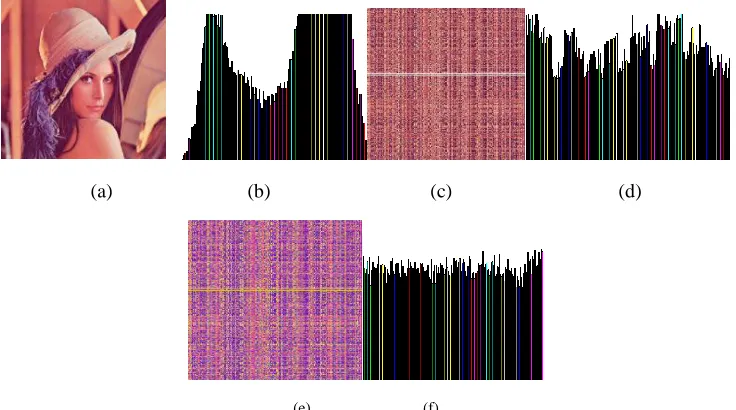
Figure 8(a) Original image and 8(b) shows histogram of original image, 8(c) shows encryption image using the proposed KSII system, 8(d) shows the histogram of encryption image, 8(e) shows the Multi-image encryption using KSIII and 8(f) shows histogram of the Multi-image encryption.
(a) (b) (c) (d)
(e) (f)
Fig. 8. (a) Original image of picture (b) Histogram of original image (c) encryption image using KSII system (d) Histogram of encryption image using KSII system (e) encryption image using KSIII system (f) Histogram of encryption image using KSIII system
From analysis of figure 8, it is clearly reflected that histogram of original image, encrypted image and Multi-encryption image are entirely different. Statistical analysis of histogram cannot give any information about original image.
Entropy Analysis
The entropy H of a symbol source S can be calculated by following equation.
160801-3939-IJVIPNS-IJENS © February 2016 IJENS
I J E N S
Table IEntropy of original image and image encryption
Original image Level One Encryption Level Two Encryption Mulita level encrypted image
Using KSI Using KSII Using KSIII
Row Column
Entropy 7.2718 7.2712 7.2596 7.29159 7.2915
Correlation
Table 2 shows the correlation coefficient in the horizontal direction and vertical direction to Level 1, Level 2 and Level 3 image encryption after testing by Visual Basic. The experimental results show that the correlation of neighboring points are very small. At the same time the chart of the pixels correlation of plaintext and cipher text plaintext shows, encryption adjacent pixel gray has no relevance after encryption. The secrecy of cipher text is very good.
Table II
Correlation coefficient of Multi-Image Encryption Level One
Encryption Level Two Encryption
Mulita level Encryption
Using KSI Using KSII Using KSIII
Row Column
Vertical 0.9637 0.8795 0.8761 0.8389
Horizontal 0.9735 0.9882 0.8921 0.8604
Fig. 9. Correlations of Adjacent Pixels in (a) the Plain Image; (b) the one level image encryption.
0 50 100 150 200 250 0 50 100 150 200 250 0 50 100 150 200 250 300 0 100 200 300
P
ixel
gra
y
valu
e
lo
ca
tio
n
(x+
1
,y
)
P
ixel
gr
ay
val
u
e l
o
ca
tio
n
(x+
1,y
)
160801-3939-IJVIPNS-IJENS © February 2016 IJENS
I J E N S
Fig. 10. Correlations of Adjacent Pixels in (a) the second level encryption (Row); (b) the second level encryption (Column)
Fig. 11. Correlations of Adjacent Pixels of the third level encryption.
5.CONCLUSION
In this work, a multi-image encryption scheme based on permutation at chaotic maps is proposed. The chaotic systems principle has a large key space and its implementation is quite simple. The algorithm is based on the concept of shuffling the pixels in the image. The experiments results and analysis show that the proposed multi-image encryption system has a very large key space, high sensitivity to secret keys has low correlation coefficients close to ideal value 0, good entropy value.
REFERENCES
[1] Schneier, B., Cryptography: Theory and Practice, CRC Press, Boca Raton, 1995.
[2] Fridrich, J., Symmetric ciphers based on two-dimensional chaotic maps, International Journal of Bifurcation and Chaos, 1998, 8: 1259–1284.
[3] Chen, G. R., Mao, Y. B., Chui, C. K., A symmetric image encryption scheme based on 3D chaotic cat maps. Chaos, Solitons & Fractals, 2004, 21: 749-761.
[4] Matthews, R., On the derivation of a chaotic encryption algorithm, Cryptologia, 1989, 8: 29-41.
[5] Guan, Z.-H., Huang, F., Guan, W., Chaos-based image encryption algorithm, Physics Letters A, 2005, 346: 153-157. [6] Kocarev, L., Chaos-based cryptography: a brief overview, IEEE
Circuits and Systems Magazine, 2001, 1: 6-21.
[7] Li, S., Zheng, X., Cryptanalysis of a chaotic image encryption method, in: Proc. IEEE Int. Symposium on Circuits and Systems, vol. II, 2002, pp. 708-711.
[8] Rhouma, R., Solak, E., Belghith, S., Cryptanalysis of a new substitution-diffusion based image cipher,Commun. Nonlinear Sci. Numer. Simulat., 2010, 15: 1887-1892.
0 50 100 150 200 250 300 0 50 100 150 200 250 300 0 50 100 150 200 250 0 50 100 150 200 250 0 50 100 150 200 250 300 0 50 100 150 200 250 300
P
ixel
g
ray
valu
e
lo
ca
tio
n
(x
,y
+1
)
P
ixel
g
ray
valu
e
lo
ca
tio
n
(x
,y
+1
)
a. Pixel gray value location(x,y)
b. Pixel gray value location(x,y)
P
ixel
g
ray
valu
e
lo
ca
tio
n
(x+
1
,y
+1
)
160801-3939-IJVIPNS-IJENS © February 2016 IJENS
I J E N S
[9] Behnia, S., Akhshani, A., Ahadpour, S., Mahmodi H., AkhavanA., A fast chaotic encryption scheme based on piecewise nonlinear chaotic maps, Physics Letters A, 2007, 366: 391-396. [10] Zhang, G. J., Liu, Q., A novel image encryption method based on total shuffling scheme. Opt. Commun. 2011, 284: 2775-2780.
[11] Zhu, Z. L., Zhang, W., Wong, K. W., Yu H., A chaos-based symmetric image encryption scheme using a bit-level permutation, Information Sci., 2010, 181: 1171-1186. [12] Liu, H., Wang, X., Color image encryption using spatial
bit-level permutation and high-dimension chaotic system, Opt. Commun. 2011, 284: 3895-3903.
[13] Gao, T., Chen, Z., A new image encryption algorithm based on hyper-chaos, Physics Letters A, 2008, 372: 394-400.