
Improved Diversity Analysis of Coded OFDM
in Frequency Selective Channels
Koshy G1, Soumya J. W2
PG Scholar (Communication Engineering), Dept. of ECE, CAARMEL Engineering College, Mahatma Gandhi
University, Kerala, India1
Assistant Professor, Dept. of ECE, CAARMEL Engineering College, Mahatma Gandhi University, Kerala, India 2
ABSTRACT: For broadband wireless communication systems, Multi-Input Multi-Output (MIMO) techniques have
been incorporated with Orthogonal Frequency Division Multiplexing (OFDM). Beamforming is a input multi-output technique utilizing the channel knowledge both at the transmitter and the receiver. Multiple beamforming uses more than one subchannel to improve the capacity. For frequency selective channels, to achieve Inter Symbol Interference and achieve spatial diversity combine beamforming with OFDM. Also by adding channel coding spatial diversity and multipath diversity can be achieved. The diversity analysis of BICMB-OFDM-SG is limited to ≤1 where L is the number of channel taps, S is the number of parallel streams transmitted at each subcarrier and Rc is the code rate. In this paper precoding technique is employed to overcome this limitation. Also precoding provides better performance. Also LDPC coding techniques is introduced for improved diversity.
KEYWORDS:MIMO systems, Beamforming, diversity methods, subcarrier multiplexing.
I. INTRODUCTION
High spectral efficiency and performance for a given bandwidth can be achieved by Input Multiple-Output (MIMO) systems.In flat fading MIMO channels, single beamforming carryingonly one symbol at a time achieves full diversity but spatial multiplexing without channel codingresults in the loss of the full diversity order. Bit-Interleaved Coded Multiple Beamforming (BICMB) overcomes the performance degradation.
If the channel is in frequency selective fading, OrthogonalFrequency Division Multiplexing (OFDM) can be used tocombat the Inter-Symbol Interference (ISI) caused by multipath propagation. Along with this for MIMO channels beamforming achieves multipath diversity and spatial diversity. Advantage of OFDM is that it has high spectral efficiency. Byadding channel coding multipath diversity can be achieved. Both spatialdiversity and multipath diversity can be achieved by addingchannel coding. The subcarrier groupingtechnique is employed to provide multi-user compatibility.Bit-Interleaved Coded Multiple Beamforming OrthogonalFrequency Division Multiplexing with Subcarrier Grouping (BICMB-OFDM-SG) technique exploits these properties.For broadbandwireless communication BICMB-OFDM be an importanttechnique.In this paper, the diversity analysis of BICMB-OFDM-SGwith precodingiscarried out.
II.RELATED WORK
by the frequency-selective channels[6].Designed a bit interleaved coded modulations including a partial algebraic precoder in order totransmit several spatial streams with full diversity over a transmit beamformed MIMO channel[7]. Orthogonal frequency division multiplexing (OFDM) has beenshown to get ISI very well by converting the frequency selective channel into parallel at fadingchannels [9].The combination of bit interleaved coded modulation (BICM) and OFDM achieves the full frequency diversity ordered by a frequency selectivechannel with any kind of power delay profile [10].The use of channel knowledge at the transmitter, the technique known as beamforming, achieves themaximum diversity in space when the best Eigenmode is used (single beamforming)[11].
II. SYSTEM MODEL
Consider a BICMB-OFDM-SG system employing Nt transmit and Nr receive antennas, a convolutional code of code rate Rc, and transmitting S parallel data streams.
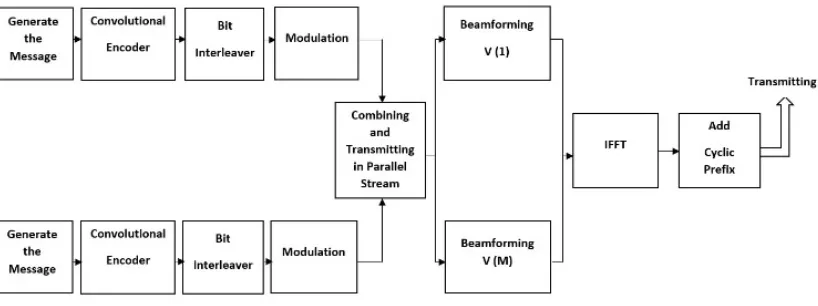
First, generate the binary message and it is encoded using convolution encoder of code rate Rc. Trellis Structure is used to create required code rate, for ahigh rate punctured code a perforation matrix is combined. From the information bits this generates the bit codeword c. The code word is given to bit interleaver. For burst error-correction, interleaving is widely used. Here random bit interleaver is used.
In digital communication and storage systems, to improve the performance of forward error correcting codes interleaving is used frequently. Many communication channels in now a days are not memoryless. So errors typically occur in bursts rather than independently. It fails to recover the original code word,if the number of errors within a code word exceeds the error-correcting code's capability. Interleaving creates a more uniform distribution of errorsby shuffling source symbols across several code words.Interleaving inmulti carrier communication also provide frequency diversity e.g., to mitigate frequency-selective fading or narrowband interference.
Fig. 1: Bit Interleaved Coded Multiple Beamforming with Subcarrier Grouping transmitter side
The interleaved bit sequence is then modulated, hereQuadrature Amplitude Modulation (QAM) is used. Let the number of streams transmitted for each subcarrier be ≤ { , }where Nt and Nr be the number of transmit and receive antennas. The symbol sequence is transmittedthrough M subcarriers. Hence, an × 1 symbol vector
( ) is transmitted through the mth
subcarrier at the kth time instant with m = 1, . . .,M. Inverse Fourier Transform is applied to the sequence. Then Cyclic Prefix is added to the sequence. Thelength of Cyclic Prefix (CP) is ≥ with L denoting the number of channel taps. Cyclic prefix is employed by OFDM tocombat ISI caused by multipath propagation. It is then transmitted.
Let the quasi-static flat fading MIMO channel observedat the mthsubcarrierbe H(m). The frequency selective fading MIMO channel is assumed to be Rayleigh fading channel. For each subcarrier the Singular Value Decompositionbeamforming is carried out. Thebeamforming matrices at the mth subcarrier are determinedby SVD of H(m),
wherethe U(m)matrix has order of Nr ×Nr and the V(m) matrix of Nt×Nt areunitary, and the Nr×Nt matrix
Λ(m) is diagonal rectangular matrix. When Sstreams are transmitted at the same time, U (m) and V (m) are chosen
asbeamforming matrices at the receiver and transmitter at themth subcarrier, respectively. The multiplications with beamforming matrices are carried outfor each subcarrier.
The system input-output relation for the mth subcarrier at the kthtime instant is , ( ) = ( ) , ( ) + , ( )
with s = 1, . . . , S, where , ( ) and , ( ) are the sthelement of the S × 1 received symbol vector ( ) and the transmitted symbol vector ( ) respectively, and , ( ) is the additive white Gaussian noise with zero mean.
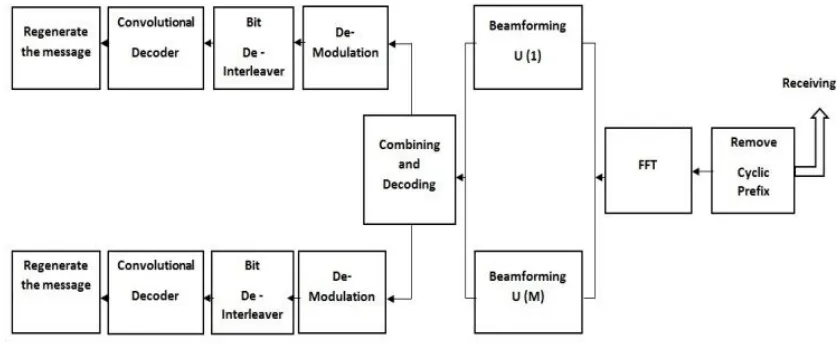
In the receiver side the received data contains added white noise. Cylic prefix is being removed from the received data. Then fourier transform is applied to the sequence. Using the Beamforming matrix U (m), information is retrieved. The data is then separated to different encoders. Each encoding section consist of QAM demodulator, Random Bit De-interleaver, and Viterbi decoder. The output obtained from the decoder is the recreated message.
Finally, the Viterbi decoder, which applies the soft-input Viterbidecoding to find the information bit sequence the message formthecodeword with the minimum sumweight.
The Maximum Likelihood (ML) bit metrics at the receiver for = ∈ {0, 1}as ∆ , ( ), = min
∈ ,
( )− ( )
and makes decisionsaccording to
̂= arg min ∆( , ( ), )
In the receiver side the received data contains added white noise. Cylic prefix is being removed from the received data. Then fourier transform is applied to the sequence. Using the Beamforming matrix U (m), information is retrieved.The data is then separated to different encoders. Each encoding section consist of QAM demodulator, Random Bit De-interleaver, and Viterbi decoder. The output obtained from the decoder is the recreated message.
Fig. 2: Bit Interleaved Coded Multiple Beamforming with Subcarrier Grouping receiver side
Finally, the Viterbi decoder, which applies the soft-input Viterbidecoding to find the information bit sequence the message formthecodeword with the minimum sumweight.
The Maximum Likelihood (ML) bit metrics at the receiver for = ∈ {0, 1}as ∆ , ( ), = min
∈ ,
( )− ( )
and makes decisionsaccording to
In practice, number of subcarriers M is always much larger than number of taps L. There exists correlation among subcarriers. Due to subcarrier correlation it will cause performance degradation. Subcarrier grouping is done to overcome the performance degradation. The subcarrier grouping technique is to transmitinformation through multiple group of subcarriers through multiple streams.The advantages of using OFDM are multi-user interferenceelimination, complexity reduction and Peak-to-Average Ratio (PAR) reduction.
For L < M, although there exists among subcarriers some subcarrierscould be uncorrelated numbers. There are G = M/Lgroups of uncorrelated subcarriers. So transmit multiplestreams of bit codewords through these G different groups ofuncorrelated subcarriers
The diversity of BIMB-OFDM_SG is limited to ≤1. In the caseof > 1, there always exists at least an error pathwith no errored bits transmitted through the first subchannelof a subcarrier. Proof of the limitationis explained in [2].
III. PROPOSED METHOD
Fig.3: BICMB-OFDM_SG with precoding transmitter side
The precoding technique can be applied to each subcarrier. As compared to BICMBOFDM-SG in Fig. 1, two more precoding blocks are added along with the channelcoding, bit interleaver, and modulation. At the receiver side post decoding is done. Using this precoding technique it is able to overcome the criteria BICMB-OFDM-SG of
≤1.So it provides better performance with the same transmission rate and offers multi-user compatibility.
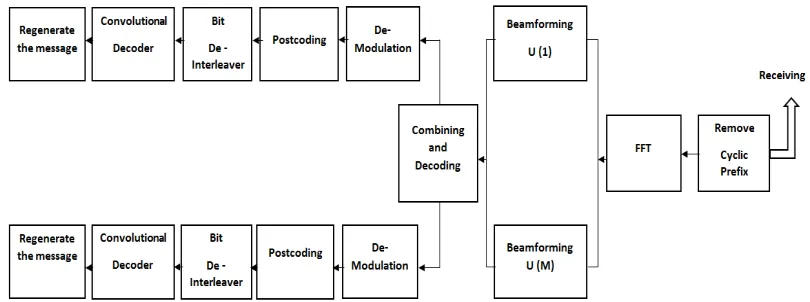
Fig. 3 and fig. 4represents the structure of BICMB-OFDM-SG withprecoding. In MIMO antenna communications precoding is a generalization of beamforming to support multi-stream transmission.
In precoding data from the interleaver is being previously coded before transmitting. The precoded data is then combined, beamformed and transmitted. At the receiving side after receiving the data, the postcoding technique is done. Information obtained after postcoding is given to demodulator, deinterleaver and decoder.
Fig.5: Improved BICMB-OFDM-SG transmitter side
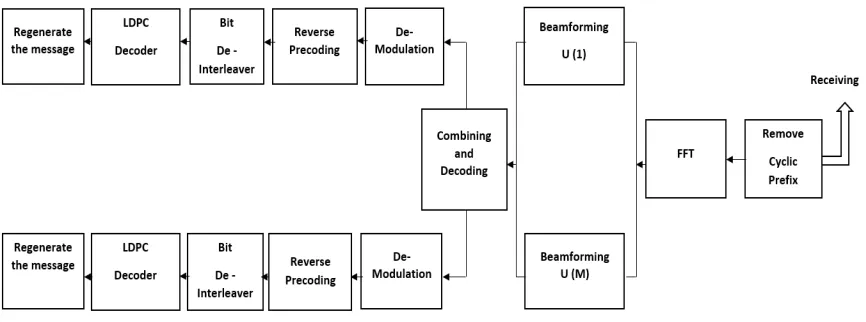
For further improvement convolutional coding scheme is replaced low-density parity-check (LDPC) code. LDPC coding scheme has many advantages over convolutional codes. LDPC is a linear error correcting code. LDPC enables the transmission of a message over a noisy transmission. LDPC achieves shanon limit, so thes codes are called as capacity-approaching codes. Probability of lost information is very less. Figure 5 and 6 shows the transmitter and reciever of improved BICMB-OFDM-SG.
IV. SIMULATION RESULTS
The simulation is done on MATLAB 2010. To verify the diversity analysis, using these values with number of taps L = 1,number of subcarriers M = 64 using 16-QAM are consideredfor simulations. The number of employed subchannels for eachsubcarrier is assumed to be the same. The generator polynomialsin octal for the convolutional codes with = ½ is (5, 7) respectively. The length of CP is Lcp= 8. Number of parallel streams are S=1 and S=2 is
being considered.
For improved BICMB-OFDM-SG there requires creation of parity sparse matrix. The parity matrix used is of the order 4096 x 12288 with number of information bit n= 4096 and number of encoded bits k=8192.
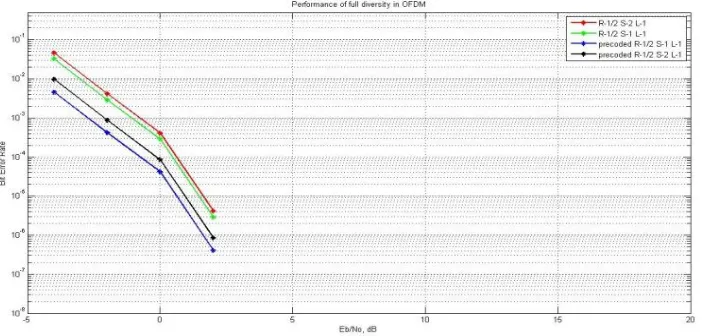
The figure 1 and 2 shows the existing system of BICMB-OFDM-SG transmitting side and receiving side. Figure 3 and 4 shows the BICMB-OFDM-SG with precoding transmitting side and receiving side. Figure 7 shows the BER vs. SNR for BICMB-OFDM-SG with and without precoding over equal power channel taps.
Fig.7: BER vs. SNR for BICMB-OFDM-SG with and without precoding over equal power channel taps.
Figure 5 and 6 shows the Improved BICMB-OFDM-SG with precoding transmitting side and receiving side. Figure 7 shows the BER vs. SNR for BICMB-OFDM-SG for Convolutional codes and LDPC over equal power channel taps.
V. CONCLUSION
For frequency selectivefading MIMO channels BICMB-OFDM_SG combines MIMO and OFDM to achievespatial diversity, multipath diversity, spatial multiplexing, andfrequency multiplexing. For broadband wireless communication it is an important technique. The comparison of BICMB-OFDM-SG and BICMB-OFDM-SG with precoding is carried out in this paper.
A sufficient and necessary condition in BICMB-OFDM-SG for achieving full diversity was ≤ 1. So using this precoding technique it is able to overcome the limitation and provides better result. Precodng also provide multi-usercompatibility. So it is very important technique in practical application. Futher improvement in diversity analysis can be done by using Turbo Codes instead of LDPC.
REFERENCES
[1] L. Zheng and D. Tse, “Diversity and multiplexing: a fundamental tradeoff in multiple-antenna channels”, IEEE Trans. Inf. Theory, Vol.49,
No.5, pp.1073-1096, May 2003.
[2] Boyu Li and Ender Ayanoglu, “Diversity Analysis of Bit-Interleaved Coded Multiple Beamforming with Orthogonal Frequency Division
Multiplexing”, IEEE Trans. Communications, Vol.61, No.9, September 2013.
[3] E. Sengul, E. Akay and E. Ayanoglu, “Diversity analysis of single and multiple beamforming”, IEEE Trans. Commun., Vol.54, No.6,
pp.990-993, June 2006.
[4] L. G. Ordoez, D. P. Palomar, A. Pages-Zamora and J. R. Fonollosa, “High-SNR analytical performance of spatial multiplexing MIMO
systems with CSI”, IEEE Trans. Signal Process.", Vol.55, No.11, pp.5447-5463, November 2007.
[5] E. Akay, E. Sengul and E. Ayanoglu, “Achieving full spatial multiplexing and full diversity in wireless communications”, IEEE WCNC,
pp.2046-2050, 2006.
[6] EnisAkay, ErsinSengul and Ender Ayanoglu“Bit-interleaved coded multiple Beamforming”, IEEE Trans. Commun., Vol.55, No.9,
pp.1802-1811, Sep. 2007.
[7] N. Gresset and M. Khanfouci, “Precoded BICM design for MIMO transmit beamforming and associated low-complexity algebraic
receivers”, IEEE GLOBECOM, 2008.
[8] H. J. Park and E. Ayanoglu, “Diversity analysis of bit-interleaved coded multiple Beamforming”, IEEE ICC,2009.
[9] EnisAkay and Ender Ayanoglu, “Full Frequency Diversity Codes for Single Input Single Output Systems”,IEEE VTC Fall, Vol.3,
pp.1870-1874, 2004.
[10] EnisAkay and Ender Ayanoglu, “Achieving Full Frequency and Space Diversity in Wireless Systems via BICM, OFDM, STBC and
Viterbi Decoding”, IEEE Trans. Commun., Vol.54, No. 2, pp.2164-2172, Dec. 2006.
[11] E. Akay, E. Sengul and E. Ayanoglu, “Performance analysis of beamforming for MIMO OFDM with BICM”,IEEE ICC, Vol.1,
pp.613-617, 2005
[12] Z. Wang and G. B. Giannakis, “Wireless multicarrier communications: where Fourier meets Shannon”, IEEE Signal Process. Mag., Vol.
17, No. 3, pp.29-48, May 2000.
[13] D. L. Goeckel and G. Ananthaswamy, “On the design of multidimensional signal sets for OFDM systems”, IEEE Trans. Commun., Vol.50,
No.3, pp.442-452, Mar. 2002.
[14] Z. Liu, Y. Xin, and G. B. Giannakis, "Linear constellation precoding for OFDM with maximum multipath diversity and coding gains, IEEE
Trans. Commun., Vol.51, No.3, pp.416-427, Mar. 2003.
[15] D. Haccoun and G. Begin, “High-rate punctured convolutional codes for Viterbi and sequential decoding”, IEEE Trans. Commun., Vol.37,
No.11, pp. 1113-1125, Nov. 1989.
[16] I. Lee, A. M. Chan, and C.-E. W. Sundberg, “Space-time bit-interleaved coded modulation for OFDM systems”, IEEE Trans. Signal
Process., Vol.52, No.3, pp.820-825, Mar. 2004.
[17] Z. Liu, Y. Xin, and G. B. Giannakis, “Space-time-frequency coded OFDM over frequency- selective fading channels”, IEEE Trans. Signal
![trans Tetraaquabis{(E) 2 cyano 1 [(ethoxycarbonyl)methylsulfanyl] 2 (1 naphthylaminocarbonyl)ethene 1 thiolato}calcium(II) diethyl ether disolvate](data:image/gif;base64,R0lGODlhAQABAIAAAP///wAAACH5BAEAAAAALAAAAAABAAEAAAICRAEAOw==)