Abstract—In this study, the change of the material flow involved in Kitakyushu Eco-town and the factor of distance according to substance are analyzed along with the result of the material flow investigation over multiple years. Furthermore, this can be deleted the rate of reduction for natural resources, the rate of usage for energy and the rate of reduction for final disposal are also analyzed. The subjects of this research are 18 enterprises located in Kitakyushu Eco-town in 2005 and 23 enterprises located in Kitakyushu Eco-town in 2010. The results show that not only material flow and haul distance but also environmental indicators were changed by companies located in Eco-town.
Index Terms—Kitakyushu eco-town, material flow, resources circulation, transition.
I. RESEARCH BACKGROUND AND OBJECTIVES Industrial symbiosis is the concept which involves a collective approach to competitive advantage through the physical exchange of materials, energy, water and/or byproducts, or the shared use of assets, logistics and information. Regarding this concept, many cases have been reported around the world [1]-[7]. The Eco-town Initiative which was discussed in this paper is positioned in one of the types of industry symbiosis.
The Eco-town Initiative, begun in 1997, has gained acceptance in 26 regions throughout Japan and has exhibited continuing progress in the project‘s activities, particularly the reuse and recycling of waste products and production by-products. Based on the 2008 ―Second Plan for Promoting the Establishment of a Recycling Society,‖ the initiative takes its place in the national effort to build a recycling society carried out regionally, and Eco-town encompasses a particularly wide area of activities related to materials circulation. In order to increase the functionality of Eco-town as an effective basis for resource circulation, it is essential to grasp and analyze the situation in terms of environmental, social, and economic aspects. However, it cannot yet be claimed that actual conditions have been precisely grasped. After more than 18 years of activity, the changes in
Manuscript received November 26, 2015; revised March 21, 2016. This work was supported in part by the Environmental Bureau of the city government of Kitakyushu.
T. Tsuruta is with Environmental Technology Service Co., Ltd., Kitakyushu, 804-0003 Japan (e-mail: [email protected]).
Y. Honda and T. Matsumoto are with the University of Kitakyushu, Kitakyushu, 808-0135, Japan (e-mail: [email protected], [email protected]).
A. Fujiyama is with Hokkaido University, Sapporo, 060-8628 Japan (e-mail: [email protected]).
Eco-town‘s enterprise call for quantitative understanding and analysis of major factors.
With this background, and given the fact that even more Eco-town enterprises are being initiated nationally, the present research is based on the long experience of Kitakyushu Eco-town, which was the first to sign the agreement back in 1997. Specifically, this research addresses changes in materials costs and transportation distance, based on two questionnaire surveys (conducted at two different points in time) and also interview to ascertain the flow data. In addition, factor analysis was conducted in relation to these changes, and the recycle initiative‘s CO2 reduction results were evaluated, in terms of life cycle assessment (LCA).
II. RESEARCH METHODS
A. Prior Research
Most of the prior research studies which quantitatively evaluate Eco-town materials circulation are based on fundamental research methodologies, MFA and LCA, and are of value, but in each case they are based on data from one point in time [8]. There is an Environmental Ministry survey which is multi-year, based on a comparison of investigations in 2008 and 2013 [9]. The study includes more than 170 enterprise locations, but the response ratio from the enterprises was only 50%, thus making evaluation difficult. The number of enterprises providing data in both years was no more than 48. Turning to overseas locations such as EIP (Eco-industrial Park), Kalundborg [10], USA [11], the Netherlands [11], Tianjin [12], Ulsan [13], [14], Daedeok Technovalley [15], and Rio de Janeiro [16], research has been pursued on the development process, providing valuable quantitative data concerning the number of enterprise locations and related changes, but research is still lacking concerning specific materials flow data analyzed over time.
B. Survey Methods
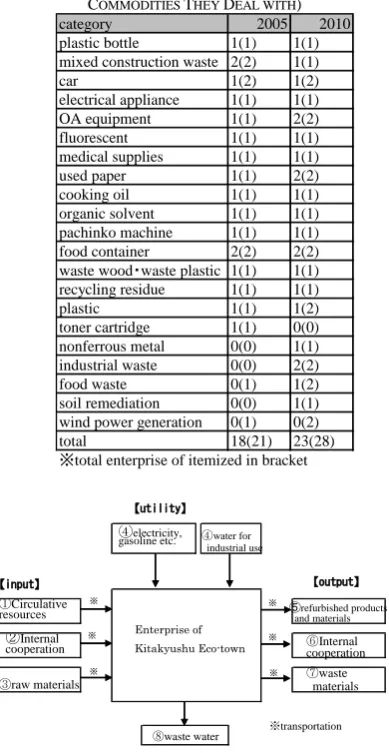
Focusing on the Kitakyushu Eco-town enterprise locations, questionnaire surveys and interview were utilized twice, once in 2005 and again in 2010 [17], [18]. All enterprise locations in the Kitakyushu Eco-town were considered, but the totals for valid responses were as follows: for the 2005 survey (April to September), 18 of 21 total locations, and for the 2010 survey (January to March), 23 out of 28 total locations. Table I shows the valid response data for enterprises, organized according to the commodities they deal with.
Various factors led to changes in the number of valid responses from enterprise locations, such as enterprises newly entering the program or withdrawing from it, but the number of enterprises with valid responses in both the 2005 and 2010
Structural Changes in the Kitakyushu Eco-Town Initiative
Based on a Multi-Year Survey of Materials Flow
surveys totaled 15.
The surveys included the following items:
1) quantity of waste material received from outside Eco-town
2) quantity of waste material received from within Eco-town
3) new inputs of materials for processing etc. 4) amount of energy use
5) amount of refurbished products and materials shipped from Eco-town
6) amount of refurbished products and materials shipped within Eco-town
7) amount of waste material discharged 8) amount discharged as waste water
Fig. 1 shows a visual representation of these measured items.
TABLEI:VALID RESPONSE DATA FOR ENTERPRISES (ACCORDING TO THE COMMODITIES THEY DEAL WITH)
category 2005 2010
plastic bottle 1(1) 1(1)
mixed construction waste 2(2) 1(1)
car 1(2) 1(2)
electrical appliance 1(1) 1(1)
OA equipment 1(1) 2(2)
fluorescent 1(1) 1(1)
medical supplies 1(1) 1(1)
used paper 1(1) 2(2)
cooking oil 1(1) 1(1)
organic solvent 1(1) 1(1)
pachinko machine 1(1) 1(1)
food container 2(2) 2(2)
waste wood・waste plastic 1(1) 1(1)
recycling residue 1(1) 1(1)
plastic 1(1) 1(2)
toner cartridge 1(1) 0(0)
nonferrous metal 0(0) 1(1)
industrial waste 0(0) 2(2)
food waste 0(1) 1(2)
soil remediation 0(0) 1(1)
wind power generation 0(1) 0(2)
total 18(21) 23(28)
※total enterprise of itemized in bracket
【input】 【output】
①Circulative
resources ⑤ and materials refurbished products
②Internal
cooperation ⑥cooperation Internal ③raw materials
⑦waste materials
【utility】
Enterprise of Kitakyushu Eco-town ④electricity, gasoline etc. ④water for
industrial use
※transportation
⑧waste water
※ ※
※ ※
※
※
Fig. 1. Visual representation of these measured items.
However, items 2 and 6, which both deal with internal connections, were only included in the 2005 survey. These waste products etc. are indicators of waste and resource circulation, and refurbished products and materials are indicators of waste that has been processed for use.
III. CHANGES IN MATERIALS FLOW
A. Changes in Investment and Structures of Production
The tabulated data from enterprises with valid responses is provided in Fig. 2 and 3. As for the Kitakyushu Eco-town enterprises‘ resource circulation inputs, the 2005 survey showed an annual amount of approximately 254,000 tons, and the outputs of refurbished products and materials totaled 219,000 tons; in contrast, for the 2010 survey the respective totals were 475,000 tons and 368,000 tons.
Comparing the changes in inputs and outputs, it can be seen that the 2005 results for resource circulation increased by about 87%, and the produced quantities of refurbished products and materials increased by about 68%.
B. Changes in Transportation Quantities According to
Distance
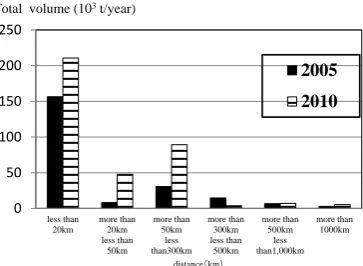
The data from each of the enterprises were tabulated, sorted according to distance, and analyzed as seen in Fig. 4 and 5. Distance was measured using Kitakyushu Eco-town as the center, and categorized as less than 20km, 50km, 300km, 500km, 1000km, and more than 1000km. Consequently, the categories correspond to areas within Eco-town, within Kitakyushu City, within Fukuoka Prefecture, within Kyushu, as far as Tokyo, and beyond Tokyo. On the input side, results increased except for the 50km band and the 1000+km group. For 2005 the 50km band had the highest results, but in 2010 it was the 300km band. On the other hand, for the production side, there were increases in all categories except for the 500km band, and for both 2005 and 2010 the highest data were found in the 20km category.
IV. CHANGES IN EFFECTS OF REDUCTION OF ENVIRONMENTAL BURDENS (LCA)
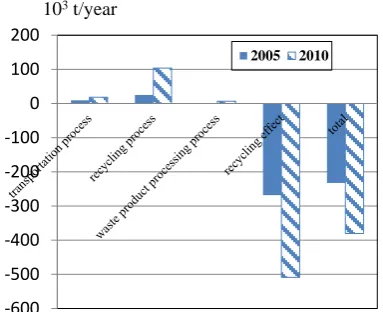
Based on materials flow data from both 2005 and 2010, an analysis was carried out of LCCO2, and the results are shown in Fig. 6. Compared to results for 2005, 2010 data for the transportation process, the recycling process, waste product processing process all showed increases. The natural resources exchange results for the recycling process showed an 86.7% increase over the results for 2005.
V. ANALYSIS OF STRUCTURAL CHANGES IN CO2REDUCTION
A. Factor Analysis Inclusive of All Stages
In order to conduct a factor analysis of CO2 emissions level changes, based on 2005 and 2010 materials flow data, a factor analysis model with the following intermediate term parameters was constructed.
First, the following identity was used to define CO2 emissions amounts based on the type of business involved.
CO2=
6 2
1
i
CO i
Mi
Ri
Mi
Ri
(1)Here, CO2 = Amounts of CO2 emitted;
i = Type of business, numbered 1 to 7; M = annual emissions; R = number of employees
Mi/Ri…Factor 2: Annual inputs per company employee Ri …Factor 3: Inputs
Next, a differential equation (see below) based on Equation (1) was used to create a factor analysis model of changes in the amounts of carbon emissions. The results are shown in Fig. 7.
Eco-town
Plastic bottle, car, electrical OA equipment, cooking oil organic solvent, used paper, food container, pollution soil , appliance, etc. (23 enterprise)
Recycling:
364,000t
CO2emission:
102,000 t
Residue:9,000 t
Discharge of sewage water
3,629,000t
Fuel, electricity:
71,300TOE
Virgin materials:
17,000 t
Service water
:5,092,000 t
Evaporation: 463,000t Resources circulative : 477,000 t
electricity:28,000 MWh
Carbon for combustion
Input of resources
Emission influence
Fig. 2. Material flows in the Kitakyusyu Eco-town (2005).
Internal cooperation:2,200 t
Eco-town
Plastic bottle, car, electrical appliance, OA equipment, fluorescent, cooking oil organic solvent, food container, recycling etc. (18 enterprise) Recycling: 219,000 t
CO2 emission:
52,000 t
Residue: 14,000 t Discharge of sewage water
31,000 t Fuel, electricity:
17,600 TOE
Virgin materials:
7,500 t Service water
:116,000 t
Evaporation:
85,000 t
Resources circulative
:257,000 t
electricity:25,000MWh
Carbon for combustion
Input of resources
Emission influence
Fig. 3. Material flows in the Kitakyusyu eco-town (2010).
0 50 100 150 200 250 300 350 400 less than 20km more than 20km less than 50km more than 50km less than300km more than 300km less than 500km more than 500km less than1,000km morethan 1000km
distance(km)
2005 2010
Total volume (103t/year)
Fig. 4. Waste product inputs according to distance.
0 50 100 150 200 250 less than 20km more than 20km less than 50km more than 50km less than300km more than 300km less than 500km more than 500km less than1,000km more than 1000km
distance(km)
2005
2010
Total volume (103t/year)
Fig. 5. Recycled material outputs according to distance.
From these results it was learned that the changes in carbon emissions for the electrical appliances and machines group showed a large reduction, amounting to 50,000 tons. In addition, the metallic waste category also showed large changes overall.
ΔCO2=
6 2 1 6 2 1 6 6 2 i i i
CO i Mi
Ri Mi Ri CO Mi Ri Mi Ri CO Mi Ri Mi Ri
+ residual term (2)
B. Factor Analysis of the Transportation Stage
The following equation was proposed for the factor analysis of the transportation stage.
CO2= 6 2
1 i
CO i
ti kmi
ti
fi
ti kmi
ti
fi
(3)Here, CO2 = Amount of carbon emitted in transportation stage; i = Type of business, numbered 1 to 6; t = Annual inputs;
km = Shipping distance; f = Shipping frequency. Factors 1 to 4 were defined as follows.
(CO2 i)/(ti・kmi)…Factor 1: Ton/kilometer units (ti・kmi)/ti…Factor 2: Transportation distance ti/fi…Factor 3: Quantity per shipping instance fi…Factor 4: Transportation frequency
Next, a differential equation was derived from Eq. 3, to establish the following factor analysis model of changes in CO2 emissions during the transportation stage. The results are shown in Fig. 8.
ΔCO2=
6 2 1 6 2 1 6 2 6 2 i i i
CO i ti kmi ti
Ri
ti kmi ti fi
CO ti kmi ti
fi
ti kmi ti fi
CO ti kmi ti
fi
ti kmi ti fi
CO ti kmi
ti kmi ti
6 6 i ti fi fi
+ residual term (4) Looking first at the totals, it can be seen that although all other factors increased, the first factor significantly decreased, meaning that overall carbon emissions decreased during the transportation stage.
containers one company showed about a 30% decrease in inputs, which was a major factor.
-600 -500 -400 -300 -200 -100 0 100 200
2005 2010 103t/year
Fig. 6. Effects of LCCO2 reduction in the Kitakyusyu eco-town.
CO2emission (103t/year)
-140 -120 -100 -80 -60 -40 -20 0 20 40 60
Factor 3
Factor 2
Factor 1
Fig. 7. Result of factor analysis of CO2 emission (all stages).
CO2emission (t/year)
-30,000 -25,000 -20,000 -15,000 -10,000 -5,000
0 5,000 10,000 15,000 20,000 25,000
Factor 4 Factor 3 Factor 2 Factor 1
Fig. 8. Result of factor analysis of CO2 emission (transportation stage).
C. Factor Analysis of the Recycling Processing Stage
The factor analysis equation for the transportation stage was defined as follows.
CO2=
6
1
2
i Mi Mi
Ei Ei
i
CO (5)
Here, CO2 = the amount of CO2 discharged during recycling processing; i = the business category involved (among 6 possibilities); M = annual inputs; E = energy consumed during recycling processing.
The three factors for analysis are defined as follows. (CO2 i)/Ei…Factor 1: Extent of Carbon Accumulation Ei/Mi…Factor 2: Energy consumed per unit of inputs Mi…Factor 3: Quantity of inputs
As was the case with the transportation stage, Equation 5 was differentiated, yielding a factor analysis model of CO2 emissions changes related to the recycling processing stage, as shown below. The results are shown in Fig. 9.
-20,000
0 20,000 40,000 60,000 80,000 100,000 120,000 140,000
Factor 3
Factor 2
Factor 1
CO2emission (t/year)
Fig. 9. Result of factor analysis of CO2 emission (recycling processing
stage).
ΔCO2=
6 2
1
6 2
1
6 2
6
i
i
i
CO i Ei
Mi
Ei Mi
CO Ei
Mi
Ei Mi
CO Ei
Mi
Ei Mi
+residual term (6) Looking first at the overall totals, it became evident that because Factors 2 and 3 showed large increases, the recycling processing stage overall also showed increases in CO2 emissions amounts.
Looking next at the business categories, it can be seen that there were large changes in CO2 emissions related to biomass and other waste products. Examining the various factors, it became evident that although the changes in Factor 1 were small, all other factors showed large changes.
As for the large changes in CO2 emissions for biomass and other waste products, and particularly concerning Factor 3, this was due to the large increase in annual inputs, as a result of the fact that 2010 saw two additional companies tied to biomass and four related to other waste products. Furthermore, as for Factor 2, both biomass and other waste products areas saw increases in energy expenditures per unit of inflow, due to a newly relocated enterprise with large energy expenditures.
Three business categories (waste plastic and organic solvents etc.; electrical appliances and devices; and business and transportation machines and tools) showed no changes in the number of enterprises between 2005 and 2010, and as a result there were no large changes in these factors. In the food container category, there was a slight change in CO2, but electric power consumption by one company increased greatly, and also gasoline began to be used, so both Factor 1 and Factor 2 showed changes.
VI. CONCLUDING REMARKS
continue in its role of providing a solid support for regional areas and the overall resource circulation system. Therefore, as we pointed out in the introduction, we are seeking mid- and long-term verification of results. The current research, by means of investigation and comparison of multi-year datasets, was able to demonstrate not merely conditions at a single point in time, but rather the quantitative changes affecting CO2 emissions over time, in accordance with changes in enterprises‘ activities.
By examining the multi-year production flow data, we were able to gain a quantitative understanding of the changes in the number of businesses located in Eco-town and their respective inputs and outputs of waste products, refurbished products and materials, etc.
Based on an analysis of the inputs and outputs associated with the transportation structure, it was also possible to clarify the changes with the greatest influence; in the case of Kitakyushu Eco-town, this meant grasping the roles played by resource circulation in a comparatively broad 300km range, as well as those of the businesses involved and their clients.
Conclusions were also reached based on an analysis of factors relevant to whether the businesses participated in both or only one of the two surveys (2005 and 2010). It was established that a large influence could be found in relation to those enterprises which either left the area during this time or newly located in the area, causing changes in the inflow/output structure and transportation distance.
We are also further aware that as a future research objective it will be necessary to analyze the stability of the Eco-town resource circulation facilities.
ACKNOWLEDGMENT
We wish to express our gratitude to those from the businesses in Kitakyushu Eco-town and the Environmental Bureau of the city government of Kitakyushu, who kindly cooperated in providing information for this study.
REFERENCES
[1] H. Shi, J. Tian, and L. Chen, ―China's quest for eco-industrial parks, Part I: History and distinctiveness,‖ Journal of Industrial Ecology, vol. 16, issue 1, pp. 8-10, 2012.
[2] P. Laybourn and D. R. Lombardi, ―Industrial symbiosis in European policy: Overview of recent progress,‖ Journal of Industrial Ecology, vol. 16, issue 1, pp. 11-12, 2012.
[3] F. Boons and W. Spekkink, ―Levels of institutional capacity and actor expectations about industrial symbiosis: Evidence from the Dutch stimulation program 1999–2004,‖ Journal of Industrial Ecology, vol. 16, issue 1, pp. 61-69, 2012.
[4] R. L. Paquin and J. H.-Grenville, ―The evolution of facilitated industrial symbiosis,‖ Journal of Industrial Ecology, vol. 16, issue 1, pp. 83-93, 2012.
[5] G. F. Brent, D. J. Allen, B. R. Eichler, J. G. Petrie, J. P. Mann, and B. S. Haynes, ―Mineral carbonation as the core of an industrial symbiosis for energy-intensive minerals conversion,‖ Journal of Industrial Ecology, vol. 16, issue 1, pp. 94-104, 2012.
[6] L. Zhou, S.-y. Hu, Y. Li, Y. Jin, and X. Zhang, ―Modeling and optimization of a coal-chemical eco-industrial system in China,‖
Journal of Industrial Ecology, vol. 16, issue 1, pp. 105-118, 2012.
[7] O. Salmi, J. Hukkinen, J. Heino, N. Pajunen, and M. Wierink, ―Governing the interplay between industrial ecosystems and environmental regulation: Heavy industries in the gulf of Bothnia in Finland and Sweden,‖ Journal of Industrial Ecology, vol. 16, issue 1, pp. 119-128, 2012.
[8] S. Fujita, E. Nagasawa, S. Onishi, and S. Sugino, ―Evaluation system for policy scenario of industrially symbiotic technologies in Kawasaki
eco-town,‖ Environmental systems research, vol. 35, pp. 89-100, 2007.
[9] S. Ohnishi, M. Fujii, T. Fujita, T. Matsumoto, L. Dong, H. Akiyama, H. Dong, ―Comparative analysis of recycling industry development in Japan following the eco-Town program for eco-industrial development,‖ Journal of Cleaner Production, April 2015.
[10] N. B. Jacobsen, ―Industrial symbiosis in Kalundborg: A quantitative assessment of economic and environmental aspects,‖ Denmark
Journal of Industrial Ecology, vol. 10, issue 1-2, pp. 239–255, 2006.
[11] R. R. Heeres, W. J. V. Vermeulen, and F. B. de Walle, ―Eco-industrial park initiatives in the USA and the Netherlands: First lessons,‖ Journal
of Cleaner Production, vol. 12, issues 8-10, pp. 985–995, 2004.
[12] H. Shi, M. Chertow, and Y. Song, ―Developing country experience with eco-industrial parks: A case study of the Tianjin economic-technological development area in China,‖ Journal of
Cleaner Production, vol. 18, issue 3, pp. 191-199, 2010.
[13] H.-S. Park, E. R. Rene, S.-M. Choi, and A. S. F. Chiu, ―Strategies for sustainable development of industrial park in Ulsan, South Korea — From spontaneous evolution to systematic expansion of industrial symbiosis,‖ Journal of Environmental Management, vol. 87, issue 1, pp. 1-13, 2008.
[14] S. K. Behera, J.-H. Kim, S.-Y. Lee, S. Suh, and H.-S. Park, ―Evolution of ‗designed‘ industrial symbiosis networks in the Ulsan Eco-industrial Park: ‗research and development into business‘ as the enabling framework,‖ Journal of Cleaner Production, vol. 29–30, pp. 103-112, 2012.
[15] D.-S. Oh, K.-B. Kim, and S.-Y. Jeong, ―Eco-industrial park design: A daedeok technovalley case study,‖ Habitat International, vol. 29, issue 2, pp. 269-284, 2005.
[16] L. B. E. Veiga and A. Magrini, ―Eco-industrial park development in Rio de Janeiro, Brazil: A tool for sustainable development,‖ Journal of
Cleaner Production, vol. 17, issue 7, 2009, pp. 653-661
[17] Toru Matsumoto, ―Progress and evaluation of Kitakyushu EIP as a resource recovery model,‖ Summary and Proceedings of the
Asia-Pacific International Workshop on Industrial Ecology, pp. 28-29,
2008.
[18] T. Matsumoto, E. Katsuhara, T. Tsuruta, and K. Hujiyama, ―Comprehensive assessment in effect of environmental road reduction of regional resource circulation base,‖ Environmental Systems
Research, vol. 37, pp. 321-329, 2009.
Tadashi Tsuruta is the president of Environmental Technology Service Corporation. His study fields are assessment of effect for the resources circulation system, especially the case study of Kitakyushu Eco-town. He is also the PhD candidate of the University of Kitakyushu.
Yuki Honda is undergraduate student at the University of Kitakyushu, Japan.
Atsushi Fujiyama is a research associate at the Hokkaido University, Japan. He received his B.A. (2009), M.Eng. (2011) and D.Eng. (2013) from the University of Kitakyushu, Japan.