AUSTRALIAN JOURNAL OF BASIC AND
APPLIED SCIENCES
ISSN:1991-8178 EISSN: 2309-8414 Journal home page: www.ajbasweb.com
Open Access Journal
Published BY AENSI Publication
© 2016 AENSI Publisher All rights reserved
This work is licensed under the Creative Commons Attribution International License (CC BY).
http://creativecommons.org/licenses/by/4.0/
To Cite This Article: S. Ragavan Swaminathan and Dr. E. Nandakumar., Multi-Objective Optimal Power Flow Problem Considering Different Constraints Based on Parallel Non-Dominated Sorting Genetic Algorithm-II. Aust. J. Basic & Appl. Sci., 10(4): 24-33, 2016
Multi-Objective Optimal Power Flow Problem Considering Different
Constraints Based on Parallel Non-Dominated Sorting Genetic
Algorithm-II
1S. Ragavan Swaminathan and 2Dr. E. Nandakumar
1PG Scholar/ EEE (M.E - Power System Engineering), Sri Krishna College of Technology, Coimbatore, Tamilnadu, India 2Associate Professor/ EEE, Sri Krishna College of Technology, Coimbatore, Tamilnadu, India
Address For Correspondence:
Name of correspondence author, Name of University, Name of Department, Name of Faculty, Box.3030.City. Country. E-mail: [email protected]
A R T I C L E I N F O A B S T R A C T
Article history:
Received 12 January 2016 Accepted 22 February 2016 Available online 1 March 2016
Keywords:
In the deregulated environment of power systems, the transmission networks are often operated close to their maximum capacity to achieve transfer of power. Besides, the operators must operate the system to satisfy its dynamic stability constraints under credible contingencies. This paper tackles the multi-objective constraint problem and proposes a Non-dominated Sorting Genetic Algorithm II (NSGA-II) to solve the constraints. Stability is an important constraint in power system operation and the transient stability constrained Optimal Power Flow (OPF) has always received considerable attention in recent years. The defects of the existing models and algorithms around this topic are firstly analyzed as a literature survey, on the basis of which, a multi-objective optimization method is proposed. The basic idea of the proposed method is to model transient stability as an objective function rather than an inequality constraint and consider classic Transient Stability Constrained OPF (TSCOPF) as a tradeoff procedure using Pareto ideology. Second, a parallel elitist Non-dominated Sorting Genetic Algorithm II (NSGA-II) is used to solve the proposed multi-objective optimization problem; the parallel algorithm shows an excellent acceleration effect and provides a set of Pareto optimal solutions for decision makers to select. Case study results demonstrate the proposed multi-objective algorithm in IEEE 39 bus system is quite strategic.
Nomenclature:
The following symbols used that are defined as follows: NSGA-II Non-dominated Sorting Genetic Algorithm – II GA Genetic Algorithm
NR Newton Raphson
TSCOPF Transient Stability Constraint Optimal Power Flow OPF Optimal Power Flow
MW Mega Watt
x, x Network variable / variable vector
y, y System state variable / variable vector
u, u Control variable/variable vector
yn, yn+1 Difference form of system state variable or state Variable value at time n or n+1
n Step counter
T Simulation time length
PGi Active output of the ith generator
NG Number of generators
NB Number of buses
NL Number of branches
NF Number of expected faults
ai, bi, ci Fuel cost coefficients of the ith generator.
δ Rotor angle vector ω Angular speed vector
Rotor angle of kth generator at integration step after the expected fault
Center of inertia of system rotor angles at integration step after the kth expected fault.
Tj Moment of inertia of the jth generator
Maximum of the jth objective function
Minimum of the jth objective function
PL Total active load
INTRODUCTION
Optimal Power Flow (OPF) has been a classic issue in power system since it was proposed in the early 1960s. In traditional OPF equations, stability constraint is usually excluded; however, the system operating at the point suggested by OPF may not be able to maintain transient stable when subject to credible contingencies. Due to the rapid in- crease of electricity demand and the electricity market deregulation, power systems tend to operate closer to stability boundaries. As a consequence, transient stability has been one of the main concerns in power system operation and the Transient Stability Constrained OPF (TSCOPF) was brought into being.
Mathematically, TSCOPF is commonly modeled as a complicated Non-Linear Programming (NLP) problem including massive constraints of differential algebraic equations. The two main approaches to study TSCOPF are simulation based on numerical discretization and constraint transformation. Recently, various methods have also been proposed, including trajectory sensitivity method, semi-infinite programming, transient energy function method, implicit enumeration method, and single-machine equivalent method. Among these approaches, a combination of the numerical discretization with the Interior Point Method (IPM) has been considered as a mainstream.
One important extension of IPM is the so-called reduced-space IPM (RIPM). RIPM has shown a great improvement for solving numerical-discretization based TSCOPF problem. However, dimensionality curse still exists for data-intensive TSCOPF and IPM naturally relies on convexity to obtain the global optimum. However, TSCOPF in realistic modern power system is generally indeed non-convex, so researchers are forced to adopt a set of hypothesis and simplifications, otherwise they may suffer a lot from insolvability or non-convergence problems or get local optimum.
To overcome this problem, Intelligence Algorithms (IA) such as Differential Evolutionary Algorithm (DE) and Particle Swarm Optimization (PSO) were introduced to enhance robustness. The competition between IA and IPM is one of the most active factors in TSCOPF research and is also one of the main lines of this paper.
Though, great progress around TSCOPF has been reported in the existing literatures mentioned above, the mathematical models are always limited to single-objective optimization. Specifically, fuel cost is modeled as the sole objective function, transient stability and voltage or branch load flow are formulated as constraints. However, it must be noted that certain differences do exist between transient stability and static security constraint. Static security constraints are rigid and must be always respected during the power system operation; while, contingencies are not bound to happen, sometimes, to obtain a lower fuel or operation cost, some dispatch centers allow generators to operate under a certain degree of instability in a certain period of time.
Therefore, modeling stability as an inequality constraint is not in accordance with the fact that OPF is a tradeoff procedure among the three factors of cost, security and stability; while, until recently, relevant multi-objective optimization research is inadequate and not systematic, hence multi-multi-objective modification of traditional TSCOPF problem is of significant theoretical and practical value.
transmission expansion planning. NSGA-II provides a set of Pareto optimal solutions for decision makes to select. This is the most important and significant advantage of the proposed method.
II Problem Formulation:
A classic stability-constrained optimal power flow model:
The most common problem of transient stability is to study the post-fault trajectory stability problem. With a given system operating point, it can be expressed as a classic Cauchy problem:
(1)
where dy/dt = f (y) represents the dynamic behavior of the system. is the system state variable value at the fault clearing time. Assumption is made that y`` is a stable equilibrium point of the above problem, a stable region denoted as exists around y``. The basic condition to maintain stability of the above system is: . is subjected to the following two variables: a) power flow control variable u including generator power output, generator terminal voltage and transformer taps, etc. b) network variable x such as nodal voltages and branch
flows. It can be expressed as: . Network variables respect the power flow
equation in problem (1) is also associated with control variable, and it can be written as
with a given u, there is a corresponding stable equilibrium point and a stable region A. To highlight the correlation of stable region A and control variables, the stable region is denoted by Au. Thus, TSCOPF can be
expressed as follows:
(2.1)
(2.2)
h (2.3)
(2.4)
(2.5)
(2.6)
(2.7)
In the above TSCOPF model, (2.1) is the objective function (fuel cost or the modification amount of scheduled contract power generation in deregulated power market); (2.3) is the static security constraints such as thermal constraints of branches and nodal voltage constraints; (2.4) is the constraints of generator power outputs or voltages and the constraints of transformer taps, etc. All kinds of Lyapunov direct methods such as transient energy function method and the extended equal area criterion method are unable to give enough robustness and calculation speed.
On the other hand, engineers have long been accustomed to use simulation method to judge the transient stability. If the simulation time is long enough, simulation method is able to guarantee sufficient accuracy and if the so-called classical model is used, the simulation method is also fast enough.
According to the basic idea of the simulation method reported, by application of the trapezoidal integration principle on (2.6), TSCOPF can be transformed into a general nonlinear programming problem. Specifically, the infinite time constraint (2.7) is transformed into the following finite time algebraic constraint:
(3)
If is long enough, as long as the rotor angle is limited (such as the maximum relative rotor angle is less than 150), the transient stability of the system can be guaranteed. (2.1) – (2.6) and (3) actually is an optimal parameter selection under a fixed terminal in optimal control theory. Equation (2.6) can be converted into the following difference equation:
(4)
Where n = 1, 2, 3. . . T/∆t. Now, constraint (3) of limited time and infinite dimension is completely
converted into finite dimensional algebraic constraint: and TSCOPF is modeled as a conventional
nonlinear programming problem as follows:
(5.1)
(5.2)
(5.3)
(5.4)
B Multi-Objective OPF Model Considering Transient Stability (Fitness Function Constraints):
solution. In this way, transient stability is modeled as one of OPF optimization objectives, rather than a constraint. To meet practical application, additional power flow optimization objectives can also be incorporated into the model. The multi-objective OPF model can be expressed as follows:
(6.1)
(6.2)
(6.3)
(6.4)
(6.5)
F1 is always modeled as the total cost of fuel consumed by generators:
(7)
PGi - Active output of the ith generator ai, bi, ci - Fuel cost coefficients of the i
th
generator.
F2 is the objective function quantifying transient stability, and can be of various modeling approaches. Here, we only consider the rotor angle stability and adopt the following penalty function:
(8)
is sorted again based on non-domination and only the best.
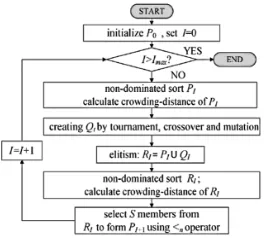
Fig. 1: Flowchart of the working principle of NSGA-II.
Among these, NSGA proposed by Srinivas was considered generally as a direct expression of Goldberg’s idea and of the best performance. Based on NSGA, Deb further proposed NSGA-II with an elitism strategy, which achieves a calculation complexity decrease and avoids the setting of sharing parameter.
NSGA-II has been demonstrated to be among the most efficient algorithms for multi-objective optimization on a number of benchmark problems. Its detailed implementation procedure can be found in; a brief description of NSGA-II procedure is shown in figure 1.
The population is initialized as usual and then sorted based on non-domination levels in to fronts. The first front is a set of chromosomes being completely non-dominant or not dominated by any other individuals in the current population, the second front being dominated by the chromosomes in the first front only and the front goes so on. In addition to front rank, a new parameter called crowding distance is calculated for each chromosome. The crowding distance is a measure of how close a chromosome is to its neighbors. Large average crowding distance will result in better diversity in the population. Parents are selected from the population by using Binary Tournament Selection based on operator Հn. Հn is based on front rank and crowding distance as follows:
a) The chromosome with the higher front rank value is greater than the other regardless of crowding distance, and is selected;
b) The chromosome with the larger crowding distance is greater than the others located in the same front, and is selected.
The selected parent population generates off-springs after the operation of crossover and mutation operators. The population with the current population and current off-springs is sorted again based on non-domination and only the best N individuals are selected, so elitism is guaranteed, where N is the population size. The selection is also based on front rank and the crowding distance on the last front.
III Non-Dominent Sorting Genetic Algorithm - II (NSGA-II):
to constitute the first non-dominated front in the population and assigned a large dummy fitness value. The same fitness value is assigned to give an equal reproductive potential to all these non-dominated individuals. To maintain the diversity in the population these classified individuals are then shared with their dummy fitness values.
After sharing, these non-dominated individuals are ignored temporarily to process the rest of the population in the same way to identify individuals for the second non-dominated front. These non-dominated points are then assigned a new dummy fitness value that is kept smaller than the minimum shared dummy fitness of the previous front. This process is continued until the entire population is classified into several fronts.
The population is then reproduced according to the dummy fitness values. A stochastic remainder proportionate selection is used in this study. Since individuals in the first front have the maximum fitness value, they always get more copies than the rest of the population. The population is ranked on the basis of an individual’s non-dominated. This was intended to search for non-dominated regions or Pareto-optimal fronts. This results in quick convergence of the population toward non-dominated regions, and sharing helps to distribute it over this region. By emphasizing non-dominated points, NSGA favors the schemata representing Pareto-optimal regions. The efficiency of NSGA lies in the way multiple objectives are reduced to a dummy fitness function using a non-dominated sorting procedure
The Non-dominated Sorting Genetic Algorithm NSGAII uses a faster sorting procedure, an elitism preserving approach and a parameter less niching operator. The population is initialized as usual and then sorted based on non-domination levels in to fronts. The NSGA-II has been used for a wide variety of applications in a number of different fields. For some applications the NSGA-II has been used in its basic form whereas for some applications it has been modified in different ways.
A) Components of NSGA-II:
The major components of GA are required to create the new generation from the current population as follows:
i) Initial population:
NSGA-II starts with a large group of randomly selected chromosomes know as initial population. The population is then reproduced according to the dummy fitness function values. A stochastic remainder proportionate selection is used in this study. Since individuals in the first front have the maximum fitness value they always get more copies than the rest of population. This was intended to search for non-dominated regions or Pareto optimal fronts.
ii) Ranking:
The population is ranked on the basis of an individual’s non-dominated. The non-dominated individuals are assumed to constitute the first non-dominated front in the population and assigned a large dummy fitness value. The same fitness value is assigned to give an equal reproductive potential to all these non-dominated individuals. To maintain the diversity in the population these classified individuals are then shared with their dummy fitness values
iii) Selection:
In original NSGA II Binary Tournament Selection (BTS) is used, where tournament is played between two solutions and better is selected and placed in mating pool. Two other solutions are again taken and another slot in mating pool is filled. It is carried in such a way that every solution can be made to participate in exactly 2 tournaments. Selects the parents with high fitness from the current population and insert them in a mating pool to create new offspring’s. Some of the selection procedures are stochastic, uniform, remainder, roulette wheel, Tournament, rank selection, etc.
iv) Crossover:
In NSGA II Simulated Binary Crossover (SBX) is used, which works with two parents solutions and create two offspring. Crossover plays a major role in convergence speed of NSGA-II. After selecting the parents with higher fitness, select an appropriate site to perform recombination process and the contents to the right of the site is exchanged. Some of the crossover schemes are scattered, intermediate, arithmetic, single point, multipoint or uniform crossover have been used. Figure 2.1 and 2.2 gives the operation of crossover.
v) Mutation:
probability. Gaussian, uniform, adaptive feasible are some of the options of mutations. Mutation probability specifies how often parts of chromosomes will be mutated.
Fig. 2.1: One site crossover operation.
Fig. 2.2: Two site crossover operation.
vi) Crowded Tournament Selection:
To get an estimation of the density of solutions close to a particular solution ‘i’ in the population, we take the average of the two solutions on the either side of solution ‘i’ along each of the objective. This quantity ‘di’ is the Crowding Distance. A following algorithm is used to calculate the crowding distance of each point in the set ‘Ƒ’.
vii) Elitism:
Elitism operator selects the best of the obtained population. This elitism process is obtained by relating the successor offspring to the ancestor parent and again obtaining the new population which is quite strategic than the mutated offspring’s.
B) Step By Step Procedure For NSGA-II:
Fig. 3: NSGA-II procedure.
NSGA operation in IEEE 39 bus, the following steps are to be followed: Step 1: Initially create a population
First string = fuel cost
Second string = transient stability
Step 2: Perform power flow program. Newton power flow program for IEEE 39 bus system Step 3: Find the fitness values for each individual fitness value
Step 4: Based on the fitness values, a new population has been selected from the old population based on the evaluation function as given.
Step5: Genetic operators (crossover and mutation) applied to the population that has been selected to create new solutions.
Step6: Fitness value is evaluated for new chromosomes and use them into the population.
Step7: Crowing tournament selection is evaluated and the crowing distance is obtained. As shown in figure 3. Step8: Elitism operation is conducted, best of the offspring’s is selected and elitism process is done
C NSGA-II Terminology:
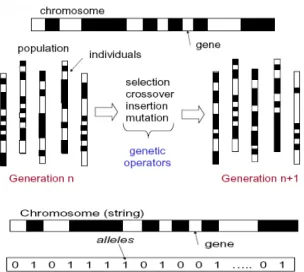
Fig. 4: NSGA-II terminology.
Binary Encoding uses 0’s and 1’s in a chromosome
Each bit corresponds to a gene. The values for a given gene are alleles Individual - Any possible solution
Ranking - The individual’s is ranked (total population) Population - Group of all individuals
Search Space - All possible solutions to the problem Chromosome - Blueprint for an individual
Locus - The position of a gene on the chromosome Genome - Collection of all chromosomes for an individual
Selection - Individuals chosen for later breeding. Crossover - Selecting genes from parent chromosomes and creating new off springs.
Mutation - Randomly changes the resulting offspring from crossover.
Elitism - Best of the obtained offspring Crowding
Distance - estimate the density of the solution.
3.4.4 Objectives:
The multi-objective model proposed in this paper as an effective quantitative analysis tool for Optimal Power Flow (OPF) associated with cost, transient stability and security a Non-dominated Sorting Genetic Algorithm-II (NSGS-II) is introduced to search the Pareto optimal solution. NSGA-II belongs to a class of evolutionary algorithms is used as an in this paper. The parallel algorithm shows an excellent acceleration effect and provides a set of Pareto optimal solutions for decision makers to select.
IV Simulation Results:
IEEE 39 bus system was used for testing Non-dominated Sorting Genetic Algorithm-II (NSGA-II) and genetic Algorithm (GA), the result were obtained. A multi-objective model is proposed in this paper as an effective quantitative analysis tool for Optimal Power Flow (OPF) associated with cost, security and transient stability. The obtained Parento optimal solution set, rather than a single strictly transient stable solution for decision makers to select their ideal schemes according to different preference. This is essentially different from traditional TSCOPF and the proposed method is considered to be able to get a theoretically strictly transient stable solution as well if enough iterations of evolution are carried out. The objective such as minimizing fuel cost and improvement of voltage in power system ware obtained. The parameter used by NSGA-II is shown in Table 1. The results prove the NSGA-II is more efficient than the conventional method.
Table 1: NSGA-II Parameters
Dimension of search space 3
Population size 8
Number of generation 50
Mutation 0.2
Fig. 5: Flowchart of the working principle of NSGA-II.
4.1 Convergence speed of NSGA-II:
Fig. 6.1: Convergence Speed of NSGA-II.
4.2 Rotor angle curve of NSGA-II:
Fig. 6.2: Rotor angle curve of NSGA-II.
4.3 Voltage profile for IEEE 39 bus system:
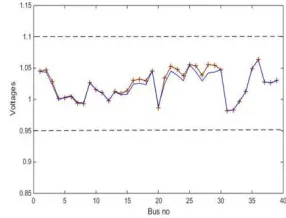
The voltage profile in IEEE 39 bus system before and after fault is shown in fig.6.3, where the red plot indicates the voltage profile before fault and the blue plot indicated after fault voltage profile of the bus system.
.
Voltage comparison before and after fault: Red plot - before fault
Blue plot - after fault
Conclusion:
The results shows that voltage profile is enhanced at buses and fuel cost are considerably decreased, model transient stability as an objective function rather than an inequality constraint and consider classic Transient Stability Constrained OPF (TSCOPF) as a tradeoff procedure using Pareto ideology and minimization of generation cost. Thus it proves that the efficiency of NSGA-II is better than the conventional method.
The multi-objective model proposed in this paper as an effective quantitative analysis tool for Optimal Power Flow (OPF) associated with cost, transient stability and security a Non-dominated Sorting Genetic Algorithm-II (NSGS-II) is introduced to search the Pareto optimal solution. NSGA-II belongs to a class of evolutionary algorithms is used as an in this paper.
The experimental results show that NSGA-II is competitive across all test problems. It gives good results by producing a set of non-dominated solutions (Pareto optimal solution) for the user to choose the most appropriate one rather than restricting to a single solution. It can also be seen that the addition or deletion of constraints or objectives does not affect the performance of NSGA-II much because each objective function is treated separately. Hence, NSGA-II is appropriate for the transient stability constrained Optimal Power Flow (OPF).
Future Scope:
Future scope can be carried on with Parallel Non-dominated Sorting Genetic Algorithm and a cutting-edge algorithm, also voltage profile of each buses and speed convergence will be displayed for the above algorithms. Here we have considered the IEEE39 bus system, further this implementation can be implemented in higher bus systems such as IEEE 57, IEEE 118, IEEE 300 & IEEE 1000 etc.
Static power flow objective function is reserved in the proposed multi-objective OPF model, and NSGA-II is naturally not sensitive to the number of objective functions, so more objective functions such as loss, in addition to fuel cost and transient stability can be considered. To shorten the overhead for communication and further improve optimization speed, the implementation of the parallel algorithm on a supercomputer rather than PC cluster is a worth trying method.
REFERENCES
Cheng-Jin Ye and Min-Xiang Huang, 2015. “Multi-Objective Optimal Power Flow Considering Transient Stability Based on Parallel NSGA-II” Accepted for the publication in IEEE transactions on Power System in.
Nekooei, K., M.M. Farsangi, H.N. Pour, K.Y. Lee, 2013. "An improved multi-objective harmony search for optimal placement of DGs in distribution systems," IEEE Trans. Smart Grid, 4(1): 557-567.
Bhattacharya, A. and P.K. Roy, 2012.“Solution of multi-objective optimal power flow using gravitational search algorithm,” IET Gen., Transm., Distrib., 6(8): 751–763.
Geng, G. and Q. Jiang, 2012. “A two-level parallel decomposition approach for transient stability constrained optimal power flow,” IEEE Trans. Power Syst., 27(4): 2063–2073.
Zaro, F.R. and M.A. Abido, 2011. “Multi-objective particle swarm optimization for optimal power flow in a deregulated environment of power systems,” in Proc. 11th Int. Conf. Intelligent Systems Design and Applications.
Al-Hajri, M.T. and M.A. Abido, 2011. "Multi-objective optimal power flow using improved strength Pareto evolutionary algorithm (SPEA2)," in Proc. 11th Int. Conf. Intelligent Systems Design and Applications, 1097-1103.
Xin, H., D. Gan, Z. Huang, K. Zhuang, L. Cao, 2010. "Applications of stability-constrained optimal power flow in the east China system," IEEE Trans. Power Syst., 25(3): 1423-1433.
Pizano-Martinez, A., C.R. Fuerte-Esquivel, D. Ruiz-Vega, 2010. "Global transient stability-constrained optimal power flow using an OMIB reference trajectory," IEEE Trans. Power Syst., 25(1): 392-403.
Jiang, Q. and G. Geng, 2010. "A reduced-space interior point method for transient stability constrained optimal power flow," IEEE Trans. Power Syst., 25(3): 1232-1240.
Maghouli, P. and S.H. Hosseini, 2009. "Multi-objective framework for transmission expansion planning in deregulated environments," IEEE Trans. Power Syst., 24(2): 1051-1061.
Li, Y., Y.J. Cao, Z.Y. Liu, L. Yi, Q.Y. Jiang, 2009. "Dynamic optimal re- active power dispatch based on parallel particle swarm optimization algorithm," Comput. Math. Applicat, 5(7): 1835-1842.
Cai, H.R., C.Y. Chung, K.P. Wong, 2008. "Application of differential evolution algorithm for transient stability constrained optimal power flow," IEEE Trans. Power Syst., 23(2): 719-728.
Xia, Y. and W. Ka, 2006. "Dynamic constrained optimal power flow using semi-infinite programming," IEEE Trans. Power Syst., 21(3): 1455-l457.
Huneault, M. and F.D. Galiana, 1991. "A survey of the optimal power flow literature," IEEE Trans. Power Syst., 6(2): 762-770.
Sergio, G., 1994. "Optimal reactive dispatch through interior point methods" IEEE Trans. Power Syst., 9(1): 136-146.
Gan, D., R.J. Thomas, R.D. Zimmerman, 2000. "Stability-constrained optimal power flow," IEEE Trans. Power Syst., 15(2): 535-540.
Chen, L., Y. Taka, H. Okamoto, R. Tanabe, A. Ono, 2001. "Optimal operation solutions of power systems with transient stability constraints," IEEE Trans. Circuits Syst., 48(3): 327-339.
Nguyen, T. and M.A. Pai, 2003. "Dynamic security-constrained rescheduling of power systems using trajectory sensitivities," IEEE Trans. Power Syst., 18(2): 848-854.
Khalil, H.K., 1996. Nonlinear Systems, seconded. Upper Saddle River, NJ, USA: Prentice Hall.
Gan, D., D. Chattopadhyay, X. Luo, 2003. "An improved method for optimal operation under stability constraints," in Proc. IEEE PES Transmission and Distribution Conf., Dallas, TX, USA.
Xue, Y., T. Van Cutsem, M. Ribbens-Pavella, 1988. "A simple direct method for fast transient stability assessment of power systems," IEEE Trans. Power Syst., 3(2): 400-412.
Tong, J., H.D. Chiang, T.P. Conneen, 1993. "A Sensitivity-based BCU method for fast derivation of stability limits in electric power systems," IEEE Trans. Power Syst., 8(4): 1418-1428.
Xia, D. and G.T. Heydt, 1983. "On-line transient stability assessment using higher-order Taylor expansion," IEEE Trans. Power App. Syst., vol. PAS-102, 7: 2038-2046.
Pontryagin, L.S., 1962. “The Mathematical Theory of Optimal Processes”. New York, NY, USA: Wiley Interscience.
Goldberg, D.E., 1989. Genetic Algorithm for Search, Optimization, Machine Learning. Boston, MA, USA: Addison-Wesley Longman.
Srinivas, N. and K. Deb, 1994. "Multi-objective optimization using non-dominated sorting in genetic algorithms," Evol. Computat., 2(3): 221-248.