Volume 2009, Article ID 652050,16pages doi:10.1155/2009/652050
Research Article
Human Motion Analysis via Statistical Motion Processing and
Sequential Change Detection
Alexia Briassouli, Vagia Tsiminaki, and Ioannis Kompatsiaris
Centre for Research and Technology Hellas, Informatics and Telematics Institute, Thermi-Thessaloniki, 57001, Greece Correspondence should be addressed to Alexia Briassouli,[email protected]
Received 31 January 2009; Revised 29 May 2009; Accepted 15 July 2009
Recommended by Yoichi Sato
The widespread use of digital multimedia in applications, such as security, surveillance, and the semantic web, has made the automated characterization of human activity necessary. In this work, a method for the characterization of multiple human activities based on statistical processing of the video data is presented. First the active pixels of the video are detected, resulting in a binary mask called the Activity Area. Sequential change detection is then applied to the data examined in order to detect at which time instants there are changes in the activity taking place. This leads to the separation of the video sequence into segments with different activities. The change times are examined for periodicity or repetitiveness in the human actions. The Activity Areas and their temporal weighted versions, the Activity History Areas, for the extracted subsequences are used for activity recognition. Experiments with a wide range of indoors and outdoors videos of various human motions, including challenging videos with dynamic backgrounds, demonstrate the proposed system’s good performance.
Copyright © 2009 Alexia Briassouli et al. This is an open access article distributed under the Creative Commons Attribution License, which permits unrestricted use, distribution, and reproduction in any medium, provided the original work is properly cited.
1. Introduction
The area of human motion analysis is one of the most active research areas in computer vision, with applications in numerous fields such as surveillance, content-based retrieval, storage, and virtual reality. A wide range of methods has been developed over the years to deal with problems like human detection, tracking, recognition, the analysis of activity in video, and the characterization of human motions [1].
One large category of approaches for the analysis of human motions is structure-based, using cues from the human body for tracking and action recognition [2]. The human body can be modeled in 2D or 3D, with or without explicit shape models [3]. Model-based methods include the representation of humans as stick figures [4], cardboard models [5], volumetric models [6], as well as hybrid methods that track both edges and regions [7]. Structure-based approaches that do not use explicit models detect features [8], objects [9], or silhouettes [10], which are then tracked and their motion is classified. Feature-based methods are sensitive to local noise and occlusions, and the number of features is not always sufficient for tracking or recognition.
Statistical shape models such as Active Contours have also been examined for human motion analysis [11], but they are sensitive to occlusions and require good initialization.
Change
point detection Kurtosis
for AA Illumination
changes Activity area
AA, AHA of subactivities for
recognition
20 60 100 140 20
40 60
80 100 120
20 60 100 140 20
40 60
80 100 120
Figure1: Proposed system: initially, kurtosis-based processing provides the binary Activity Area. Sequential change detection then finds
change points in the video. The subsequences between the change points are processed to find their Activity Areas (AA) and Activity History Areas (AHA) that are used for activity recognition.
characteristics are specific to human actions, limiting the method to this domain only. Additionally, the translational component of motions cannot be dealt with in [16].
Both structure and motion information can be taken into account for human action analysis using Hidden Markov Models (HMMs), which model the temporal evolution of events [17, 18]. However, the HMM approach requires significant training to perform well [19] and, like all model-based methods, its performance depends on how well the chosen model parameters represent the human action.
In this work, a novel, motion-based nonparametric approach to the problem of human motion analysis is presented. Since it is not model-based, it does not suffer from sensitivity to the correct choice of model, nor is it constrained by it. Additionally, it is based on generally applicable statistical techniques, so it can be extended to a wide range of videos, in various domains. Finally, it does not require extensive training for recognition, so it is not computationally intensive, nor dependent on the training data available.
1.1. Proposed Framework. The proposed system is based on statistical processing of video data in order to detect times and locations of activity changes (Figure 1). The first stage of the system involves the extraction of the Activity Area, a binary mask of pixels which are active throughout the sequence. Only these pixels are processed in the subsequent stages, leading to a lower computational cost, and also a reduction in the possibility of errors in the motion analysis. The extraction of the Activity Area can be considered as a preprocessing step, which can be omitted for real-time processing.
The second stage of the system is one of the main novel points of this framework, as it leads to the detection of changes in activity in a non ad-hoc manner. In the current literature, temporal changes in video are only found in the context of shot detection, where the video is separated into subsequences that have been filmed in different manners. However, this separation is not always useful, as a shot may contain several activities. The proposed approach separates the video in a meaningful manner, into subsequences corresponding to different activities by applying sequential change detection methods. The input, that is, interframe
illumination variations, is processed sequentially as it arrives, to decide if a change has occurred at each frame. Thus, changes in activity can be detected in the real time, and the video sequence can then be separated into segments that contain different actions. The times of change are further examined to see if periodicity or repetitiveness is present in the actions.
After the change detection step, the data in each sub-sequence between the detected change points is processed for more detailed analysis of the activity in it. Activity Areas and a temporally weighted version of them called the Activity History Areas are extracted for the resulting subsequences. The shape of the Activity Areas is used for recognition of the activities taking place: the outline of each Activity Area is described by the Fourier Shape Descriptors (see Section 5), which are compared to each other using the Euclidean distance, for recognition. When different activities have a similar Activity Area (e.g., a person walking and running), the Activity History Areas (AHAs) are used to discriminate between them, as they contain information about the temporal evolution of these actions. This is achieved by estimating the Mahalanobis distance between appropriate features of the AHAs, like their slope and magnitude (see Section 5 for details). It is important to note that Activity History Areas would have the same limitations as MHIs [15] if they were applied on the entire video sequence: the repetitions of an activity would overwrite the previous activity history information, so the Activity History Area would not provide any new information. This issue is overcome in the proposed system, as the video is already divided into segments containing different activities, so that Activity History Areas are extracted for each repeating component of the motion separately, and no overwriting takes place.
2. Motion Analysis: Activity Area
0 0.5 1 1.5 2 2.5 3 3.5 4 4.5 ×10⁷
0 200 400 600 800 1000 1200 1400
(a)
0 1 2 3 4 5 6 7 8 9 10 ×105
0 2000 4000 6000 8000 10000 12000 14000 16000 18000 (b)
Figure2: Kurtosis estimates from a real video of a person boxing for (a) active and (b) static pixels.
and small background motions. Interframe illumination variations, resulting from frame differences or optical flow estimates (both referred to as “illumination variations” in the sequel), can be mapped to the following two hypotheses:
H0:v0k(r)=zk(r),
H1:v1k(r)=uk(r) +zk(r),
(1)
where vi
k(r), i = 0, 1 are the illumination variations for a static/active pixel, respectively, at framek and pixel r. The termzk(r) corresponds to measurement noise anduk(r) is caused by pixel motion. The background is considered to be static, so only the pixels of moving objects correspond to
H1. The distribution of the measurement noise is unknown,
however, it can be sufficiently well modeled by a Gaussian distribution, as in [20,21]. In literature, the background is often modeled by mixtures of Gaussian distributions [22], but this modeling is computationally costly and not reliable in the presence of significant background changes (e.g., a change in lighting), as it does not always adapt to them quickly enough. The method used here is actually robust to deviations of the data from the simple Gaussian model [23,24], so even in such cases, it provides accurate, reliable results at a much lower computational cost.
The illumination variations of static pixels are caused by measurement noise, so their values over time should follow a Gaussian distribution. A classical test of data Gaussianity is the kurtosis [24], which is equal to zero for Gaussian data, and defined as
kurty=Ey4−3E[y2]2. (2) In order to find the active pixels, that is, Activity Areas, the illumination variations at each pixel are accumulated over the entire video and their kurtosis is estimated from (2). Even if in practice the static pixels do not follow a strictly Gaussian distribution, their kurtosis is still significantly lower (by orders of magnitude) than that of active pixels. This is
clearly obvious in the experimental results, where the regions of activity are indeed correctly localized, as well as in the simulations that follow.
As a practical example with a real sequence, we estimate the kurtosis of all active pixels and that of all static pixels, taken from the real video of a person boxing (Section 6.2), where the ground truth for the active and static pixels is extracted manually. The kurtosis values of active and static pixels are plotted inFigure 2, where it can be seen that the active pixels’ kurtosis is significantly higher than that of the static pixels; note that the y-axis onFigure 2(a)is from 0 to 4.5×10⁷, while onFigure 2(b), its range is from 0 to 106(for
clarity of presentation). In the static pixels of Figure 2(b), the kurtosis is almost zero in almost all of them. It obtains higher values in pixels 8000–10000, most likely due to the presence of local noise, but even these values are much lower than those of the active pixels. Indeed, the mean value of the kurtosis for the active pixels is found to be 1.34×10⁶
and for the static ones it is equal to 669.54. Results like this motivate us to compare the relative values of pixels’ kurtosis in practice, in order to determine if a pixel is active or static, rather than their absolute value.
0 5 10 15 20 25
0 100 200 300 400 500
(a)
0 5 10 15 20 25
0 100 200 300 400 500
(b)
5 10 15 20 25
0 100 200 300 400 500
(c)
Figure3: Kurtosis estimates for data following a Gaussian, an MoG, and an Exponential distribution.
(a) (b)
120 100 80 60 40 20
20 60 100 140 (c)
120 100 80 60 40 20
20 60 100 140 (d)
Figure4: Person running: (a) Frame 10, (b) AA. AHA for motion: (c) to the right, (d) to the left. The AHA has higher values in the regions
of the Activity Area that were active most recently, represented by warm colors, and lower values in pixels that were active in the past, corresponding to cooler colors.
3. Motion Analysis: Activity History Area
As mentioned inSection 1.1, the Activity Area is not always sufficient for recognizing activities, as some actions can lead to Activity Areas with very similar shapes. For example, different translational motions like jogging, running, and walking have similar Activity Areas, although they evolve differently in time. Thus, information about their temporal evolution should be used to discriminate amongst them. The temporal evolution of activities is captured by the Activity History Area (AHA), which is similar to the Motion History Area of [15], but extracted using the kurtosis, as in
Section 2, rather than straightforward frame differencing. If
the Activity Area value (binarized kurtosis value) on pixelr
isAA(r) at framet, the AHA is defined as
AHA(r,t)=
⎧ ⎨ ⎩
τ, if AA(r)=1;
max(0, AHA(r,t−1)−1), else.
(3)
Essentially, the AHA is a time-weighted version of the Activity Area, with higher weights given to the pixels which were active more recently. This introduces information about an activity’s evolution with time, which can be particularly helpful for the classification of different actions. As an example, Figure 4 shows the Activity Area and AHA of a person running to the right and the same person running to the left. It is obvious that the direction of motion is captured by the AHA, which obtains higher values in the
most recently activated pixels, but not by the Activity Area, which is a binary mask, and, therefore, can only provide spatial localization. InFigure 4, the AHA values have warmer colors (darker in grayscale) for the most recently activated pixels, while cooler colors (lighter in grayscale) represent pixels that were active in the past.
4. Sequential Change Detection
One of the main novel points of the proposed system is the detection of the times at which the activity taking place changes. The input data for the change detection is a sequence of illumination variations from frame k0 to k,
that is,vk0,k=[vk0,vk0+1,. . .,vk]. If only the pixels inside the
Activity Area are being examined, the data from each frame
k∗contains the illumination variations of that frame’s pixels, for the pixels inside the Activity Area. Thus, if the activity area containsNapixels, we havevk∗ =[vk∗(1),. . .,vk∗(Na)]. In this work we examine the case where only the pixels inside the Activity Area are processed. It is considered that the data follows a distribution f0before a change occurs, and f1after
the change, at an unknown time instantkch. This is expressed by the following two hypotheses:
H0:vk0,k∼ f0, H1:vk0,k∼ f1.
(4)
At each frame k, vk0,k is an input into a test statistic to
as detailed inSection 4.1. If a change is detected, only the data after framekis processed to detect new changes, and this is repeated until the entire video has been examined.
4.1. Cumulative Sum (CUSUM) for Change Detection. The sequential change detection algorithm [26] uses the log-likelihood ratio (LLRT) of the input data as a test statistic. For the detection of a change between framesk0 andk, we
estimate
Tk=LLRTk
f1||f0
=ln f1
vk0,k
f0
vk0,k
=ln k
i=k0 f1(vi)
f0(vi)= k
i=k0
ln f1(vi)
f0(vi) ,
(5)
where it has been assumed that the frame samples vi
are identically independently distributed (i.i.d.) under each hypothesis, so that fH(vk0,k) =
k
i=k0fH(vi), H = 0, 1.
Similarly, it is assumed that the illumination variations of the pixels inside the Activity Area are i.i.d., so fH(vi) =
Na
n=1fH(vi(n)), H=0, 1,i=k0,. . .,k.
Pixels in highly textured areas can be considered to have i.i.d. values of illumination variations, as they correspond to areas of the moving object with a different appearance, which may be subject to local sources of noise, shadow, or occlusion. In homogeneous image regions that move in the same manner this assumption does not necessarily hold, however, even these pixels can be subject to local sources of noise, which remove correlations between them. The approximation of the data distribution for data that is not considered i.i.d. is very cumbersome, making this assumption necessary for practical purposes as well. Such assumptions are often made in the change detection litera-ture to ensure tractability of the likelihood test.
Under the i.i.d. assumption, the test statistic of (5) obtains the recursive form [26]:
Tk=max
0,Tk−1+ ln
f1(vk)
f0(vk)
, (6)
where vk = [vk(1),. . .,vk(Na)] is the data from the active pixels in the current framek. Then, (5) can also be written as
Tk= k
i=k0
Na
n=1
ln f1(vi(n))
f0(vi(n))
, (7)
and(6) becomes
Tk=max
⎛
⎝0,Tk−1+Na
n=1
ln f1(vk(n))
f0(vk(n))
⎞
⎠. (8)
A change is detected at this frame when the test statistic becomes higher than a predefined threshold. Unlike the threshold for sequential probability likelihood ratio testing [27, 28], the threshold for the CUSUM testing procedure cannot be determined in a closed form manner. It has been proven in [29] that the optimal threshold for the CUSUM
test for a predefined false alarm γ is the threshold that leads to an average number of changes equal to γ under
H0, that is, when there are no real changes. In the general
case examined here, the optimal threshold needs to be estimated empirically from the data being analyzed [30]. In
Section 6we provide more details about how we determine the threshold experimentally.
In practice, illumination variations of only one pixel over time do not provide enough samples to detect changes effectively, so the illumination variations of all active pixels in each frame are used. If an Activity Area containsNapixels, this givesNa×(k−k0+ 1) samples from framek0tok, which
leads to improved approximations of the data distributions, as well as better change detection performance.
4.2. Data Modeling. As (6) shows, in order to implement the CUSUM test, knowledge about the family of distributions before and after the change is needed, even if the time of change itself is not known. For the case where only the pixels in the Activity Area are being examined, it is known that they are active, and hence do not follow a Gaussian distribution (seeSection 2). The distribution of active pixels over time contains outliers introduced by a pixel’s change in motion, which lead to a more heavy-tailed distribution than the Gaussian, such as the Laplacian or generalized Gaussian [31]. The Laplacian distribution is given by
f(x)= 1
2bexp
−x−μ
b
, (9)
where μ is the data mean and b = σ/√2 is its scale, for varianceσ2. The tails of this distribution decay more slowly
than those of the Gaussian, since its exponent contains an absolute difference instead of the difference squared. Its tails are consequently heavier, indicating that data following the Laplace distribution contains more outlier values than Gaussian data. The test statistic of (7) for N data samples can then be written as
Tk= k
i=k0
Na
n=1
ln b0 b1 exp
−vi(n)−μ1
b1
+vi(n)−μ0
b0
=NNalnb0
b1
+ k
i=k0
Na
n=1
−vi(n)−μ1
b1
+vi(n)−μ0
b0
.
(10)
provides a better fit. Modeling experiments are conducted on all the videos used in the experiments, but have not been included inTable 1for reasons of space and readability. The mean RMS estimated from all the video sequences examined is 0.0915 for the Gaussian and 0.0270 for the Laplacian model, justifying the choice of the latter as a better fit for our data. The data could be modeled even more accurately by heavier tailed distributions, such as alpha-stable distributions [32]. However, these do not exist in closed form, so they cannot be used in the likelihood ratio test. A closed form distribution from the alpha-stable family, namely, the Cauchy, describes the data well in the DCT domain [33], but the Laplacian has been shown to better describe quantized image data [34].
5. Recognition
The proposed system detects when activities change in a video, based on sequential processing of the interframe illumination variations. After change points are detected, the subsequences resulting inbetween them are further processed in order to characterize and recognize the activities taking place in them. We focus on the case where there is a preprocessing stage that extracts the active pixels, as this reduces the system’s overall computational cost and increases its reliability, since it does not look for activity changes in static pixels. The complete system consists of the following stages.
(1) Activity areas are extracted to find the active pixels. (2) The illumination variations of the pixels inside the
activity area over time are estimated.
(3) Sequential change detection is applied to the illumi-nation variations, to detect changes.
(4) If the change points are (nearly) equidistant, the motion is considered to be (near) periodic.
(5) The Activity Areas and Activity History Areas for the frames (subsequences) between change points are extracted. The shape of the Activity Areas and the direction and magnitude of motion are derived from the Activity History Area, to be used for recognition. (6) False alarms are removed: if motion characteristics of successive subsequences are similar, those subse-quences are merged and the change point between them is deleted.
(7) Multiple Activity Areas and Activity History Areas originating from the same activity are detected and merged if their motion and periodicity characteristics coincide.
(8) Shape descriptors of the resulting Activity Areas and motion information from the Activity History Areas are used for recognition.
The detection of different activities between change points increases the usefulness and accuracy of the system for many reasons. The proposed system avoids the drawback of “overwriting” that characterizes MHIs that are extracted
using the entire sequence. In periodic motions, for example, where an activity takes place from left to right, then from right to left, and so on, all intermediate changes of direction are lost in the temporal history image if the all video frames are used. This is overcome in our approach, as Activity History Areas are estimated over segments with one kind of activity, giving a clear indication of the activity’s direction and temporal evolution. This also allows the extraction of details about the activity taking place, such as the direction of translational motions, periodicity of motions like boxing, or of more complex periodic motions, containing similarly repeating components (seeSection 6.2). Finally, the application of recognition techniques to the extracted sequences would not be meaningful if the sequence had not been correctly separated into subsequences with one activity each.
Both the shape of the Activity Area and motion infor-mation from the Activity History Area are used for accurate activity recognition, as detailed in the sections that follow.
5.1. Fourier Shape Descriptors of Activity Area. The shape of the Activity Areas can be described by estimating the Fourier Descriptors (FDs) [35] of their outlines. The FDs are preferred as they provide better classification results than other shape descriptors [36]. Additionally, they are rotation, translation, and scale invariant, and inherently capture some perceptual shape characteristics: their lower frequencies correspond to the average shape, while higher frequencies describe shape details [36]. The FDs are derived from the Fourier Transform (FT) F1,F2,. . .,FN of each shape outline’s boundary coordinates. The DC component
F1 is not used, as it only indicates the shape position. All
values are divided by the magnitude of|F1|to achieve scale
invariance, and rotation invariance is guaranteed by using their magnitude. Thus, the FDs are given by
f =
| F2|
|F1|
,|F3|
|F1|
,. . .,|FN|
|F1|
. (11)
Only the 20 first terms of the FD, corresponding to the 20 lowest frequencies, are used in the recognition experiments, as they capture the most important shape information. The comparison of the FDs for different activities takes place by estimating their Euclidean distance, since they are scale, translation, and rotation invariant. WhenL = 20 elements of the FDs are retained, the Euclidean distance between two FDs fA, fBis given by
dEucl= L
k=1
fA(k)− fB(k), (12)
and each activity is matched to that with the shortest Euclidean distance.
0 0.1 0.2 0.3 0.4 0.5 0.6 0.7 0.8 0.9 1
0 20 40 60 80 100
Gauss model
Empirical distribution
Laplace model
(a)
0 0.1 0.2 0.3 0.4 0.5 0.6 0.7 0.8 0.9 1
0 20 40 60 80 100
Gauss model
Empirical distribution
Laplace model
(b)
0 0.1 0.2 0.3 0.4 0.5 0.6 0.7 0.8 0.9 1
0 20 40 60 80 100
Gauss model
Empirical distribution
Laplace model
(c)
0 0.1 0.2 0.3 0.4 0.5 0.6 0.7 0.8 0.9 1
0 20 40 60 80 100
Gauss model
Empirical distribution
Laplace model
(d)
0 0.1 0.2 0.3 0.4 0.5 0.6 0.7 0.8 0.9 1
0 20 40 60 80 100
Gauss model
Empirical distribution
Laplace model
(e)
0 0.1 0.2 0.3 0.4 0.5 0.6 0.7 0.8 0.9 1
0 20 40 60 80 100
Gauss model
Empirical distribution
Laplace model
(f)
Figure5: Empirical distribution, Laplace and Gaussian data modeling for: (a) Daria Jump, (b) Denis Jack, (c) Eli Jump in place, (d) Moshe
Run, (e) Daria Walk, (f) Moshe Skip.
Table1: Gaussian and laplace modeling errors.
Model/Video Lyova Run Eli Run Daria Run Denis Run Moshe Run Shahar Run Lena2 Run
Gaussian 0.0913 0.0976 0.1077 0.0898 0.1010 0.0975 0.1128
Laplace 0.0239 0.0265 0.0344 0.0253 0.0310 0.0295 0.0409
Model/Video Lena1 Run Ira Run Ido Run Daria Jack Denis Jack Eli Jack Ido Jack
Gaussian 0.1206 0.0801 0.0933 0.1026 0.1031 0.1105 0.0879
Laplace 0.0433 0.018 0.0253 0.0371 0.0333 0.042 0.0257
Model/Video Ira Jack Lena Jack Lyova Jack Moshe Jack Shahar Jack Daria Jump Denis Jump
Gaussian 0.1129 0.0864 0.108 0.1081 0.1057 0.0815 0.0734
Laplace 0.047 0.0307 0.0359 0.0368 0.0383 0.0179 0.0153
Model/Video Eli Jump Ido Jump Ira Jump Lena Jump Lyova Jump Moshe Jump Shahar Jump
Gaussian 0.094 0.0827 0.0680 0.0956 0.0788 0.0947 0.0984
Laplace 0.0228 0.0237 0.0219 0.0239 0.0207 0.027 0.0234
encountered in practice is that of translational motions, whose Activity Area covers a linear region (horizontally, vertically, or diagonally). It is seen in Figures 6, 14(e)–
14(g) that this shape is linear for different translational
motions, such as walking or running, so it is insufficient for discriminating amongst them. However, this linearity property can be used to separate translations from other kinds of motions. The linearity can be derived from its mean in the horizontal direction. Activities that do not contain a translational component, such as waving, lead to a local concentration of pixel activity, which makes sense since they take place over a confined area (last image pairs ofFigure 6). In order to separate translational motions from each other, the Activity History Areas (Figure 7) are used. Motion direction and magnitude information is extracted
by estimating the mean of the Activity History Area in the horizontal and vertical directions. In this work all translational motions are horizontal, so only the horizontal mean of the AHA is estimated. This mean forms a line whose slope provides valuable information about the direction and magnitude of motion.
(i) The sign of the slope shows the direction of motion: it is negative for a person moving to the left and positive for motion to the right.
(ii) The magnitude of the slope is inversely proportional to the velocity, that is, higher magnitudes correspond to slower activities.
(a)
1 1.52 2.53 3.54 4.55
0 40 80 120 160
(b) (c)
1 1.52 2.53 3.54 4.55
0 40 80 120 160 (d)
(e)
0 0.005.1 0.015.2 0.25 0.3 0.35 0.4 0.45
0 40 80 120 160 (f)
Figure6: Activity Area outlines and their mean in horizontal direction for walking, running, waving. The mean AA outline is linear for
translational motions.
120 100 80 60 40 20
20 60 100 140 (a)
0 5 10 15 20 25 30 35 40 45
0 50 100 150
(b)
120 100 80 60 40 20
20 60 100 140 (c)
0 2 4 6 8 10 12 14
0 20 40 60 80 100 120140 (d)
Figure7: Activity History Areas and their means for translational motions to the left and right: walking left, running right. Direction and
magnitude information is included in these areas.
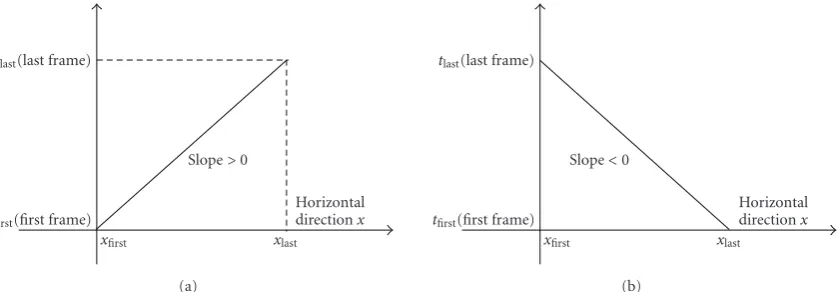
correspond to the horizontal axis, and the slope is estimated by
slope= tlast−tfirst
xlast−xfirst
, (13)
where tfirst is the frame at which the first horizontal pixel
(the leftmostx location here) is activated, andtlastthe frame
where the last horizontal pixel is activated (the rightmostx
location). This can be seen in Figures8(a),8(b)for motions to the right and left, respectively: motion to the right leads to a positive slope since the rightmost pixel is activated at the most recent frame, while motion to the left leads to a negative slope.
The Activity History Area of a fast activity (e.g., running) contains a small range of frames (from tfirst to tlast), since
it takes place in a short time, whereas the Activity History Area of a slow activity occurs during more frames, since the motion lasts longer. In order to objectively discriminate between fast and slow actions, the same number of pixels must be traversed in each direction. Thus, in (13),xlast–xfirst
is the same for all activities, and tlast–tfirst has high values
for slow actions and low values for fast ones. Consequently, higher magnitudes of the slope of (13) correspond to slower motions and lower magnitudes correspond to faster ones.
Table2: Slope magnitude of mean AHA for baseline Translational
Videos.
Motion Run Jog Walk
AHA slope 0.1192±0.0358 0.1651±0.0455 0.27248±0.054625
The activities examined are horizontal walking, jogging, running, and cover the same distance, so that the slope magnitude can be objectively used to discriminate among them. For comparison, the Activity History Area is extracted from a set of baseline translation videos, and its horizontal mean is estimated. The slope of the mean is found from (13) and its magnitude is given in Table 2 for each activity. As expected, the slope has higher values for slower motions.
For the classification of a test video, its Activity History Area is extracted, and its mean is estimated. The sign of its slope indicates whether the person is moving to the right or left and its magnitude is compared to the average slope of the three baseline categories of Table 2 using the Mahalanobis distance. For a baseline set with mean μ = [μ1,. . .,μN]
and covariance matrix Σ, the Mahalanobis distance of
data y = [y1,. . .,yN] from it is defined as dMahal(y) =
tlast(last frame)
tfirst(first frame)
xfirst xlast
Slope>0
Horizontal directionx
(a)
tlast(last frame)
tfirst(first frame)
xfirst xlast
Slope<0
Horizontal directionx
(b)
Figure8: Mean of Activity History Area in horizontal direction for motion to the right and left.
a distance metric as it incorporates data covariance, which is not taken into account by the Euclidean distance. In this case the data is one dimensional (the slope) so its variance is used instead of the covariance matrix.
6. Experiments for Recognition
Experiments with real videos take place to examine the per-formance of the change detection module. These videos can be found on http://mklab.iti.gr/content/temporal-templates-human-activity-recognition, so that the reader can observe the ground truth and verify the validity of the experiments. The ground truth for the times of change is extracted manually and compared to the estimated change points to evaluate the detection performance.
We model the data by a Laplacian distribution (Section 4.2) to approximate f0 and f1 of (5), which are
unknown and need to be estimated from the datavk0,kat each
timek. The distribution of the “current” data f0is extracted
from the firstw0samples ofvk0,k, in order to take into account
samples that belong to the old distribution, while f1 is
approximated using the most recentw1samples. There could
be a change during the firstw0samples used to approximate
f0, but there is no way to determine this a priori, so there is
the implicit assumption that no change takes place in the first
w0frames. Currently, there is no theoretically founded way to
determine the optimal length of the windowsw0andw1, as
stated in the change detection literature [37]. Consequently, the best possible solution is to empirically determine the window lengths that give the best change detection results for certain categories of videos, and use them accordingly. After extensive experimentation,w0=10 andw1=5 are found to
give the best detection results with the fewest false alarms, for detecting a change between successive activities. For periodic motions, the changes occur more often, so smaller windows are used, namelyw0=w1=4.
At each frame k, the test statistic Tk is estimated and compared against a threshold in order to determine whether or not a change has occurred. Due to the sequential nature of the system, there is no closed form expression for this threshold, so an optimal value cannot be determined for it a priori [38]. It is found empirically that for videos of human
motions like the ones examined here, the threshold which leads to the highest detection rate with the fewest false alarms is given by
ηopt=μT+ 2.3·σT, (14)
whereμT andσTare the mean and standard deviation of the test statisticTkuntil framek.
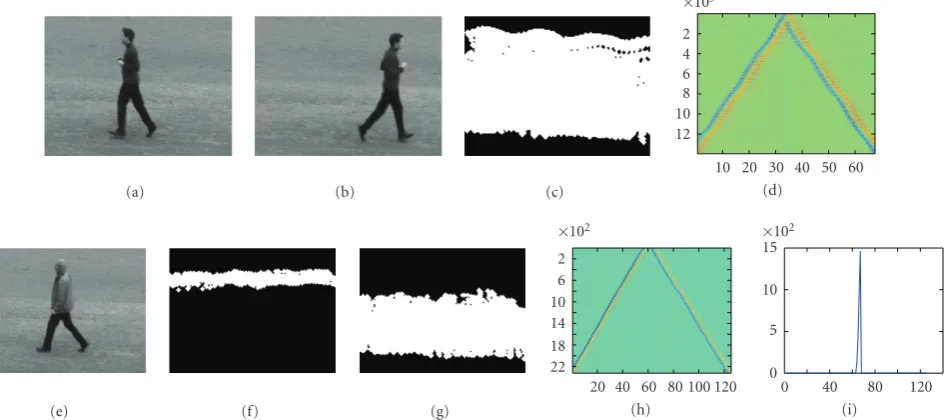
6.1. Experiments with Translational Motions. In this sec-tion, experimental results for videos containing transla-tional motions, namely, walking, jogging, and running, are presented. Characteristic frames of some videos, the corresponding activity area and the likelihood ratio over time are shown inFigure 9and all the videos examined can be seen on http://mklab.iti.gr/content/temporal-templates-human-activity-recognition. The activity areas correctly cap-ture the pixels that are active in each video and the likelihood ratio values change at the time when the actual change occurs. In total, change points are correctly detected for 16 videos with translational motions, as shown inTable 3, but for three of the videos false alarms are also detected. These false alarms are easily eliminated by examining the average motion and its variance for each extracted subsequences as they do not change significantly before and after a false alarm. In this manner, no false alarms remain and only the correct change points are detected, shown in bold fonts in
Table 3(for the cases where there were false alarms). In the table, LR indicates that an activity takes place from left to right, HD means “horizontally-diagonally”, LRL is left-right-left and LRLR is left-right-left-right-left-right-left-right. The numbers (e.g., Jog LR1) distinguish between different videos of the same activity. The last two videos, Walk LRL and Walk LRLR have two and three change points, respectively, which are correctly detected in both cases, with no false alarms.
Figures 9(e)–9(i) contains frames from a walking
(a) (b) (c)
12 10 8 6 4 2 ×10³
10 20 30 40 50 60 (d)
(e) (f) (g)
22 18 14 10 6 2 ×10²
20 40 60 80 100 120 (h)
0 5 10 15 ×102
0 40 80 120
(i)
Figure9: (a), (b) Frames of person jogging left, right, (c) Activity Area, (d) likelihood ratio values for each active pixel, over all frames, (e) person walking left, right, (f), (g) activity areas for head and body, (h) likelihood ratio (LRT) values for each active pixel (in the body area), over all frames, (i) LRT values for all pixels (in the body area), showing change times.
Table3: Change points for videos with translational motions.
Video Jog LR 1 Jog LR 2 Run LR 1 Run LR 2 Walk HD Walk LR 1 Walk LR 2 Walk LR 3
Change points 35 33 23 20 57 58 61 18, 30,89
Video Walk LR 4 Walk LR 5 Walk LR 6 Walk LR 7 Walk LR 8 Walk LR 9 Walk LRL Walk LRLR
Change points 37-93-134 58-71 49 67 74 70 58, 102 35, 69, 104
activity taking place. In this example, the area corresponding to the head is too small to provide enough samples for a reliable estimate of the change-point, so only the likelihood ratio values for the Activity Area corresponding to the body of the person with the coat are shown in Figures9(h),9(i). Even in this case, the change points are correctly found.
6.2. Experiments with Nontranslational Motions. Combina-tions of nontranslational moCombina-tions are examined in this section. The first video contains a person clapping, fol-lowed by a person boxing, and the second shows a per-son waving followed by a perper-son clapping (see Figure 10
and http://mklab.iti.gr/content/temporal-templates-human-activity-recognition). The resulting Activity Areas contain the pixels that move in both activities and the likelihood ratio values estimated over all active pixels lead to correct change point detection. For the clapping-boxing sequence, the correct change point is detected at frame 99, but there are also false alarms at frames 65, 85, 123, 159, 176, 200, introduced because of changes in the individual repeating activities (clapping only or boxing only). As inSection 6.1, these false alarms are eliminated by simply estimating the motion characteristics of the extracted subsequences, which undergo significant change only at frame 99. In the handwaving-handclapping video, the true change point is found at frame 127, but false alarms are also detected
at frames 11, 35, 56, 75, 89, 141, 225, which are removed as before, leading to the detection of only the correct change point. It should be emphasized that the relative height of the likelihood ratio values is not taken into account for the elimination of false alarms. Instead, the motion characteristics of the resulting subsequences are measured, as explained earlier.
6.2.1. Periodic Motions. The values of the data windows
w0,w1, chosen for approximating f0,f1, respectively, affect
the resolution of the system. Whenw0,w1have higher values,
they detect changes at a coarse granularity, but at the cost of missing small changes inside each individual activity. In this section, we present experiments where these windows are set tow0 = w1 = 4, enabling the detection of changes
in repeating activities with good accuracy.
(a) (b) (c)
2.5 2 1.5 1 0.5 ×10³
20 60 100 140 180 (d)
0 1 2 3 4 5 6 7 8 9 10 ×103
0 50 100 150 200 250 (e)
(f) (g) (h)
2.5 2 1.5 1 0.5 ×10³
50 100 150 200 250 (i)
0 0.5 1 1.5 2 2.5 3 ×10³
0 50 100 150 200 250 300 (j)
Figure10: Handclapping-boxing video: (a) frame 30, (b) frame 100, (c) Activity Area of clapping and boxing, (d) likelihood ratio estimated
for each pixel, (e) likelihood ratio values for all pixels, handwaving-handclapping video: (f) frame 10, (g) frame 254, (h) Activity Area, (i) likelihood ratio estimated for each pixel, (j) likelihood ratio values for all pixels, used for change detection.
0 50 100 150 200 250
0 100 200 300 400 500 600
0 50 100 150 200 250
0 0.51 1.52 2.53 3.54
0 10 20 30 40 50 60 70
0 10 20 30 40 50 60 0
100 200 300 400 500
0 10 20 30 40 50 60 0
20 40 60
80 100 120 140 160 180
0 100 200 300 400
×103
0 0.51 1.52 2.53 3.5 4.5 4 ×10³
0 0.5 1 1.5 2 2.5 ×10³
Figure11: First row: boxing, second row: jumping, third row: jumping in place, fourth row: composite walking sequence. Each row shows
20 40 60 80 100 120 140 20 40 60 80 100 120 140 2
4 6
8
10 12 14
1 2 3 4 5 6 7
8
9
0 50 100 150
0 0.5 1 1.5 2 2.5
0 50 100 150
0 1 2 3 4 5 6 7
8
9
10 20 30 40 50 60 7080
0.5 1 1.5 2 2.5 3 3.5
0 10 20 30 40 50 60 7080 90
0 50 100 150 200 250 300
10 20 30 40 50 60 7080 90 1
2 3 4 5 6
0 20 40 60 80 100
0 50 100 150 200 250 300
×103 ×103 ×103
×103
×103
×107
Figure12: Videos with multiple Activity Areas: first two rows, people walking, two separate activity areas, third row, crossing ladies, fourth
row, beach. The activity area from rows 3 and 4 contains both motions, but change points are correctly found. Each row shows video frames, the activity area, likelihood ratio values, and likelihood ratio values for all pixels.
Table4: Change points for periodic motions, extracted period.
Video Change points Period
Box 8, 13, 18, 23,. . ., 203, 208, 213 5 Jump 10, 15, 20, 15,. . ., 46, 51, 56 5 Jump in place 6, 11, 18, 26, 34, 42, 50 8 Walk 22, 19, 56, 44, 22, 19, 56, 44, 22, 19, 56, 44 3
same activity.Table 4shows the detected change points for each video and the resulting period. The last video is more complex, containing 3 identical subsequences of a person walking left-right-left: all change points are found, and form a pattern that repeats 3 times.
6.3. Experiments with Multiple Activity Areas. A video of two people performing different activities at different, but overlapping, time intervals, is examined (Figure 12, top two rows). The Activity Area consists of two distinct binary masks, corresponding to the different activities, so the sequential change detection takes place in each area separately. For both Activity Areas, the likelihood ratios for all pixels inside them correctly locate the times of change
20 40 60 80 100 120 140 160 180 0.5
1
1.5
2
2.5
10 20 30 40 50 60
20 40 60 80 100 120 140 160
1
2
3
4
5
6 ×10³
0.5
1
1.5
2
2.5 ×103
×103
Figure13: Videos with dynamic backgrounds. First two rows, videos with trees moving in the wind, last row a video with moving water
surface. Each row shows video frames, activity area, likelihood ratio values, likelihood ratio values for all pixels.
6.4. Experiments with Dynamic Backgrounds. Several chal-lenging videos involving dynamic backgrounds are exam-ined. Despite the moving background, the activity areas are found with accuracy, as seen inFigure 13. The change detec-tion results are extracted from the last column ofFigure 13
and are tabulated inTable 5. All change points are detected correctly, along with a few false alarms, which are in italics inTable 5. The false alarms are easily removed by comparing the motion characteristics between estimated change points: before and after a false alarm, the motion characteristics do not change, so those change points are eliminated.
7. Experiments for Recognition
Experimental results for recognition based on the Activity Area and Activity History Area information are presented here. It should be emphasized that the activity recognition results are good although there is no training stage, so the proposed method is applicable to various kinds of activity, without restrictions imposed by the training set.
Table5: Change points for dynamic backgrounds.
Video Change points
Trees 2 23, 39, 61, 72, 80
Trees 5 15, 62, 77, 87,110, 130, 153
Trees 6 14, 28
Trees 7 10,17, 23, 37, 45,56
Water surface 13,40, 58, 68, 81,110, 121,133, 146
Table6: Recognition for boxing, handclapping, handwaving (%).
Activity Box Handclap Handwave
Box 75.49 24.51 0
Handclap 17.39 79.45 3.16
Handwave 0 12.85 87.15
(a) (b) (c) (d)
(e) (f) (g)
Figure14: Activity Area outlines for (a) boxing, (b) clapping, (c), (d) waving, (e) walking, (f) jogging, (g) running.
Table7: Mahalanobis distance for running videos.
Motion Run 1 left Run 1 right Run 2 left Run 2 right
AHA slope −0.1030 0.0801 −0.0794 0.0822
dMahalfrom Run 0.4524 1.0926 1.1122 1.0339
dMahalfrom Jog 1.3661 1.8695 1.8849 1.8233
dMahalfrom Walk 3.1026 3.5218 3.5346 3.4834
Table8: Mahalanobis distance for jogging videos.
Motion Jog 1 left Jog 1 right Jog 2 left Jog 2 right
AHA slope −0.1602 0.1527 −0.1438 0.1448
dMahalfrom Run 1.1467 0.9370 0.6882 0.7162
dMahalfrom Jog 0.1088 0.2736 0.4693 0.4473
dMahalfrom Walk 2.0554 2.1927 2.3557 2.3374
boxing, handclapping and handwaving, with Activity Area outlines like those in Figures14(a)–14(f). The comparison of the FDs for 23 videos of boxing, handclapping and handwaving each, lead to the correct classification of 75.49% of the boxing, 79.45% of the handclapping and 87.15% of the handwaving sequences as can be seen in Table 6. This makes intuitive sense, as the outlines of the Activity Areas for the boxing videos have a blob-like shape, which is not as descriptive as the other boundaries. Indeed, the best recognition results are achieved for the handclapping video, whose Activity Area outlines have a very characteristic shape. Additionally, the boxing and handclapping motions are more often confused with each other than with the handwaving, as expected, since the latter’s Activity Area has a very distinctive shape.
Different methods have also used this dataset for activity recognition. In [39], excellent recognition results of 98% for boxing, 91.9% for clapping, and 91.7% for waving
Table9: Mahalanobis distance for walking videos.
Motion Walk 1 L Walk 1 R Walk 2 L Walk 2 R Walk 3 L Walk 3 R Walk 4 L Walk 4 R AHA slope −0.3138 0.4112 −0.3676 0.3511 −0.3518 0.3887 −0.2729 0.3980 dMahalfrom Run 5.4408 8.1638 6.9449 6.4836 6.5032 7.5348 4.2974 7.7948 dMahalfrom Jog 3.2675 5.4085 4.4501 4.0874 4.1028 4.9139 2.368 55.1183 dMahalfrom Walk 0.7565 2.5395 1.7414 1.4393 1.4521 2.1276 0.0077 2.2979
7.2. Recognition Using Activity History Area Features. For translational motion classification, we examine the subse-quences extracted from the walking, jogging, and running videos ofSection 6.1 after change detection. The direction of motion in each one is correctly found for all data. The Mahalanobis distance of the slope magnitude from the test values for each video is shown in Tables7–9, where it can be seen that correct classification is achieved in all cases, both for the direction and for the type of motion.
8. Conclusions
In this work, a novel approach for the analysis of human motion in video is presented. The kurtosis of interframe illumination variations leads to binary masks, the Activity Areas, which indicate which pixels are active throughout the video. The temporal evolution of the activities is character-ized by temporally weighted versions of the Activity Areas, the Activity History Areas. Changes in the activity taking place are detected via sequential change detection, applied on the interframe illumination variations. This separates the video into sequences containing different activities, based on changes in their motion. The activity taking place in each subsequence is then characterized by the shape of its Activity Area or on its magnitude and direction, derived from the Activity History Area. For nontranslational activities, Fourier Shape Descriptors represent the shape of each Activity Area, and are compared with each other, for recognition. Translational motions are characterized based on their relative magnitude and direction, which are retrieved from their Activity History Areas. The combined use of the aforementioned recognition techniques with the proposed sequential change detection for the separation of the video in sequences containing separate activities leads to successful recognition results at a low computational cost. Future work includes the development of more sophisticated and complex recognition methods, so as to achieve even better recognition rates. The application of change detection on video is also to be extended to a wider range of videos, as it is a generally applicable method, not limited to the domain of human actions.
Acknowledgments
The research leading to these results has received fund-ing from the European Communitys Seventh Framework Programme FP7/2007-2013 under grant agreement FP7-214306-JUMAS, from FP6 under contract no. 027685-MESH and FP6-027026-K-Space.
References
[1] L. Wang, W. Hu, and T. Tan, “Recent developments in human motion analysis,”Pattern Recognition, vol. 36, no. 3, pp. 585– 601, 2003.
[2] J. K. Aggarwal and Q. Cai, “Human motion analysis: a review,” Computer Vision and Image Understanding, vol. 73, no. 3, pp. 428–440, 1999.
[3] D. M. Gavrila, “The visual analysis of human movement: a survey,”Computer Vision and Image Understanding, vol. 73, no. 1, pp. 82–98, 1999.
[4] K. Akita, “Image sequence analysis of real world human motion,”Pattern Recognition, vol. 17, no. 1, pp. 73–83, 1984. [5] I. Haritaoglu, D. Harwood, and L. S. Davis, “W4: real-time
surveillance of people and their activities,”IEEE Transactions on Pattern Analysis and Machine Intelligence, vol. 22, no. 8, pp. 809–830, 2000.
[6] A. Bottino and A. Laurentini, “A silhouette based technique for the reconstruction of human movement,”Computer Vision and Image Understanding, vol. 83, pp. 79–95, 2001.
[7] R. D. Green and L. Guan, “Quantifying and recognizing human movement patterns from monocular video imagespart I: a new framework for modeling human motion,” IEEE Transactions on Circuits and Systems for Video Technology, vol. 14, no. 2, pp. 179–189, 2004.
[8] I. Laptev and T. Lindeberg, “Space-time interest points,” in Proceedings of the 9th IEEE International Conference on Computer Vision (ICCV ’03), vol. 1, pp. 432–439, Nice, France, October 2003.
[9] M. Oren, C. Papageorgiou, P. Sinha, E. Osuna, and T. Poggio, “Pedestrian detection using wavelet templates,” inProceedings of the IEEE Computer Society Conference on Computer Vision and Pattern Recognition (CVPR ’97), pp. 193–199, San Juan, Puerto Rico, USA, June 1997.
[10] M. Singh, A. Basu, and M. Mandal, “Human activity recogni-tion based on silhouette direcrecogni-tionality,”IEEE Transactions on Circuits and Systems for Video Technology, vol. 18, no. 9, pp. 1280–1292, 2008.
[11] T. Cootes, C. Taylor, D. Cooper, and J. Graham, “Active shape models-their training and application,”Computer Vision and Image Understanding, vol. 61, no. 1, pp. 38–59, 1995. [12] C. Cedras and M. Shah, “Motion-based recognition a survey,”
Image and Vision Computing, vol. 13, no. 2, pp. 129–155, 1995. [13] J. Boyd and J. Little, “Global versus structured interpretation of motion: moving light displays,” inProceedings of the IEEE Workshop on Motion of Non-Rigid and Articulated Objects (NAM ’97), pp. 18–25, 1997.
[15] A. F. Bobick and J. W. Davis, “The recognition of human movement using temporal templates,”IEEE Transactions on Pattern Analysis and Machine Intelligence, vol. 23, no. 3, pp. 257–267, 2001.
[16] L. Gorelick, M. Blank, E. Shechtman, M. Irani, and R. Basri, “Actions as space-time shapes,”IEEE Transactions on Pattern Analysis and Machine Intelligence, vol. 29, no. 12, pp. 2247– 2253, 2007.
[17] J. Yamato, J. Obya, and K. Ishii, “Recognizing human action in time sequential images using hidden markov model,” in Proceedings of the IEEE International Conference on Computer Vision and Pattern Recognition (CVPR ’92), pp. 379–385, The Hague, The Netherlands, 1992.
[18] A. Kale, A. Sundaresan, A. N. Rajagopalan, et al., “Identi-fication of humans using gait,”IEEE Transactions on Image Processing, vol. 13, no. 9, pp. 1163–1173, 2004.
[19] X. Sun, C. W. Chen, and B. S. Manjunath, “Probabilistic motion parameter models for human activity recognition,” in Proceedings of the International Conference on Pattern Recognition (ICPR ’02), vol. 16, no. 1, pp. 443–446, Quebec, Canada, August 2002.
[20] C. R. Wren, A. Azarbayejani, T. Darrell, and A. P. Pentland, “P finder: real-time tracking of the human body,” IEEE Transactions on Pattern Analysis and Machine Intelligence, vol. 19, no. 7, pp. 780–785, 1997.
[21] T. Aach, L. D¨umbgen, R. Mester, and D. Toth, “Bayesian illumination-invariant motion detection,” inProceedings of the IEEE International Conference on Image Processing (ICIP ’01), vol. 3, pp. 640–643, Thessaloniki, Greece, October 2001. [22] C. Stauffer and W. Grimson, “Adaptive background mixture
models for real-time tracking,” in Proceedings of the IEEE Computer Society Conference on Computer Vision and Pattern Recognition (CVPR ’99), vol. 2, pp. 246–252, Fort Collins, Colo, USA, June 1999.
[23] M. El Hassouni, H. Cherifi, and D. Aboutajdine, “HOS-based image sequence noise removal,”IEEE Transactions on Image Processing, vol. 15, no. 3, pp. 572–581, 2006.
[24] G. B. Giannakis and M. K. Tsatsanis, “Time-domain tests for Gaussianity and time-reversibility,”IEEE Transactions on Signal Processing, vol. 42, no. 12, pp. 3460–3472, 1994. [25] C. Stauffer and W. Grimson, “Adaptive background mixture
models for real-time tracking,” in Proceedings of the IEEE Computer Society Conference on Computer Vision and Pattern Recognition (CVPR ’99), vol. 2, pp. 246–252, Fort Collins, Colo, USA, June 1999.
[26] E. S. Page, “Continuous inspection scheme,”Biometrika, vol. 41, no. 1, pp. 100–115, 1954.
[27] H. V. Poor,An Introduction to Signal Detection and Estimation, Springer, New York, NY, USA, 2nd edition, 1994.
[28] A. Wald,Sequential Analysis, Dover Publications, New York, NY, USA, 2004.
[29] G. V. Moustakides, “Optimal stopping times for detecting changes in distributions,”Annals of Statistics, vol. 14, no. 4, pp. 1379–1387, 1986.
[30] M. Basseville and I. Nikiforov,Detection of Abrupt Changes: Theory and Application, Prentice-Hall, Englewood Cliffs, NJ, USA, 1993.
[31] B. Aiazzi, L. Alparone, and S. Baronti, “Estimation based on entropy matching for generalized Gaussian PDF modeling,” IEEE Signal Processing Letters, vol. 6, no. 6, pp. 138–140, 1999. [32] J. P. Nolan,Stable Distributions—Models for Heavy Tailed Data,
chapter 1, Birkh¨auser, Boston, Mass, USA, 2010.
[33] A. Briassouli, P. Tsakalides, and A. Stouraitis, “Hidden mes-sages in heavy-tails:DCT-domain watermark detection using alpha-stable models,”IEEE Transactions on Multimedia, vol. 7, pp. 700–715, 2005.
[34] D. Simitopoulos, S. A. Tsaftaris, N. V. Boulgouris, A. Brias-souli, and M. G. Strintzis, “Fast watermarking of MPEG-1/2 streams using compressed-domain perceptual embedding and a generalized correlator detector,”EURASIP Journal on Applied Signal Processing, vol. 8, pp. 1088–1106, 2004.
[35] M. Bober, “MPEG-7 visual shape descriptors,”IEEE Transac-tions on Circuits and Systems for Video Technology, vol. 11, no. 6, pp. 716–719, 2001.
[36] D. S. Zhang and G. Lu, “A comparative study of Fourier descriptors for shape representation and retrieval,” in Proceed-ings of the 5th Asian Conference on Computer Vision (ACCV ’02), pp. 646–651, Melbourne, Australia, Januray 2002. [37] C. Hory, A. Kokaram, and W. J. Christmas, “Threshold
learning from samples drawn from the null hypothesis for the generalized likelihood ratio CUSUM test,” inProceedings of the IEEE Workshop on Machine Learning for Signal Processing, pp. 111–116, September 2005.
[38] I. V. Nikiforov, “A generalized change detection problem,” IEEE Transactions on Information Theory, vol. 41, no. 1, pp. 171–187, 1995.
[39] Z. M. Zhang, Y. Q. Hu, S. Chan, and L. T. Chia, “Motion context: a new representation for human action recognition,” inProceedings of the European Conference on Computer Vision (ECCV ’08), vol. 5305 ofLecture Notes in Computer Science, pp. 817–829, Marseille, France, October 2008.
[40] C. Schuldt, I. Laptev, and B. Caputo, “Recognizing human actions: a local SVM approach,” in Proceedings of the 17th International Conference on Pattern Recognition, Cambridge, UK, August 2004.