Software Defined Network-based Scalable Resource
Discovery for Internet of Things
Mahbuba
Afrin
1,
Redowan
Mahmud
11DepartmentofComputer Science and Engineering, University ofDhaka, Bangladesh,
email: [email protected], [email protected]
Abstract
Geo-distributed and heterog eneous Internet of Things (IoT) devices can gener ate hug e amoun t of data. Inefficien t manag emen t of IoT-data promotes netw ork cong estion and increases computa tional overhead on the data-processing entities. Traditional netw orking architecture, tha t is lack of functional abstr action and monitoring capabilities, often fails to meet the dynamics of IoT. Softw are Define Netw ork (SDN) can be a viable alterna tiv e of the traditional netw orking architecture while dealing with IoT. In SDN, manag emen t, monitoring and context sensing of the connected componen ts are simplifie and can be customized. In this paper , SDN-sensed contextual informa tion of differen t componen ts (computa tional entities, netw ork, IoT devices) are combined together to facilita te scalable resource discov ery in IoT. The proposed policy targ ets balanced processing and cong estion-less forw arding of IoT-data. Through simula tion studies, it has been demonstr ated tha t the SDN-based resource discov ery in IoT outperf orms the traditional netw orking based approaches in terms of resource discov ery time and Quality of Service (QoS) satisf action rate.
Received on 09 April 2017; accepted on 13 July 2017; published on 25 September 2017
Keywords: Internet of Things, Resource Discov ery, Softw are define netw ork, Scalability , Service QoS
Copyright © 2017 Mahbuba Afrin and Redowan Mahmud, licensed to EAI. This is an open access article distributed under the terms of the Creative Commons Attribution license (http://creativecommons.org/licenses/by/3.0/),
which permits unlimited use, distribution and reproduction in any medium so long as the original work is properly cited. doi:10.4108/eai.25-9-2017.153149
1. Introduction
In recen t years, the Internet of Things (IoT) has drawn significa t research interest. Due to rapid enhancemen t in hardw are and comm unica tion technol ogy, it is predicted tha t by 2020, there will be more than 50 billion activ e IoT devices [1]. IoT devices are geo-distributed, energy constr ained and heterog eneous. The configu ations, applicability and sensing frequency of IoT devices are also div ersified
Most of the IoT devices participa te in real- time data sensing. As a consequence, the devices can gener ate hug e amoun t of data within a minimal time. When a larg e number of IoT devices send data simultaneousl y tow ards the computa tional entities (e.g. Cloud, Fog nodes, Edg e serv ers), it is more likel y to crea te netw ork cong estion. Besides, random placemen t
HPlease ensure tha t you use the most up to date class file available from EAI at http://doc.eai.eu/publications/transactions/ latex/
∗Corresponding author . Email: [email protected]
of IoT-data can increase processing overhead on the computa tional entities. In such scenario, efficiency of the under lying netw ork in managing incoming IoT-data (IoT-data processing, IoT-data forw arding) is very crucial. However, due to lack of functional abstr action and inability in monitoring internal oper ations of the connected componen ts (IoT devices, computa tional entities), the traditional netw orking architecture is not suitable for efficien t IoT-data manag emen t. In this case, Softw are Define Netw ork (SDN) can be adopted to overcome the shortcomings of traditional netw orking architecture in respect of IoT [2].
SDN is a very recen t innov ation in netw orking tech-nology tha t oper ates through softw are system in place of specialized and dedica ted hardw are. It offers pro-grammability of netw orking elemen ts by decoupling netw ork control plane and data forw arding plane [3]. In SDN, there exists a centralized entity tha t perceiv es the topol ogy and sta tus of the netw ork. Based on per-ception, the centralized controller entity determines the data forw arding rules and notifie the rules to the data forw arding entities. Through abstr action of lower lev el
Research
Article
netw orking functionalities, SDN can set up, adminis-trate, alter, and manag e netw ork beha vior dynamicall y. In differen t computing par adigms (e.g. Cloud com-puting, Mobile edg e computing), SDN based solutions have been expl ored extensiv ely to meet auto-ma ted, on-demand service requests, handle mobility issues, ensure netw ork reliability , etc. [4]. SDN-based solutions promotes virtualiza tion of netw ork, ensures flexibilit in resource utiliza tion, monitors internal oper ations of the connected componen ts, senses contextual informa-tion, minimizes both capital and oper ational expenses. Although, netw orking among the sensors is the fun-damen tal factor for IoT [5], SDN-based solutions for IoT have not been enlightened significa tly. From the perspectiv e of IoT, SDN-based solutions can pla y vital roles in resource discov ery and load balancing.
Gener all y, resource discov ery in IoT refers to fin appropria te resources for processing IoT-data and its associa te routing path to forw ard the data. In tra-ditional netw orking architecture, the computa tional entities for processing IoT-data and the associa te con-nections are predefine and sta tic. Theref ore, tradi-tional sta tic netw ork architecture can not cope with the increasing number of IoT devices and their uncer -tain data load. As a resul t, QoS degr ada tion in terms of netw ork bandwid th and service deliv ery is widel y observ ed. Taking cognizance of this fact, we investig ate how SDN-based solutions can facilita te resource dis-covery in IoT. The proposed SDN-based solution incor-porates contextual informa tion from three differen t aspects (computa tional entities, netw ork, IoT devices) while dealing with resource discov ery in IoT to facilita te flexibl data processing and cong estion-less data for-warding. Besides, the proposed policy ensures dynamic manag emen t of IoT-data in SDN tha t can be scalable to certain exten t according to the situa tion.
The major contribution of the paper are listed as: • SDN-based solution for scalable IoT-resource
dis-covery to facilita te unin terrupted data processing and data forw arding.
• Expl ored the applicability of SDN-sensed contex-tual informa tion in managing uncertain load of IoT-data.
• Compar ativ e study betw een SDN-based IoT resource discov ery and traditional sta tic netw ork based approach in terms of resource discov ery time and QoS satisf action rate.
In the following section, sev eral rela ted works in this fie d are highlighted (Section. 2). In Section. 3 and 4 the system model and SDN-based IoT-resource discov ery are discussed respectiv ely. In Section. 5 perf ormance evaluation is demonstr ated. Section. 6 concl udes the paper .
2. Related Works
Sev eral research works on SDN has already been cond ucted in differen t areas of computa tion and netw orking. In [6], authors design a SDN-supported cloud computing environmen t through OpenFLow switches and controllers. They extend the features of OpenFLow controller in order to facilita te load balancing, less energy usag e, and service monitoring. Besides, a queuing model is dev eloped to claim the feasibility of the system. The SDN based solution aims at providing QoS satisfie cloud computing services.
In [7] some poten tial architectures of SDN-based Mobile Cloud has been proposed. The authors of the paper focus on iden tifying basic componen ts of SDN-based Mobile Cloud tha t can deal with mobility and uncertain netw ork sta tus. Sev eral frequency selection methods for data transmission have also been discussed. The feasibility of the SDN-based solution has been highlighted in terms of high packet deliv ery rate and system overhead.
The authors in [8] argued tha t with dense depl oymen t of mobile devices and limited netw ork bandwid th, it becomes difficul t to assign radio resources for processing service requests. Besides, manag emen t of interf erence and load balancing betw een base sta tions get tough. To overcome these issues, authors propose a softw are define radio access layer named "SoftRAN" . It works as the centralized control plane for radio access netw ork. According to the authors, SoftRAN can efficien tly handle load distribution, manag e interf erence within the netw ork maximize the netw orking throughput.
In respect of scalability in SDN, the authors of [9], claimed tha t SDN scalability is free from inheren t bottleneck. In tha t paper , the scalability of SDN controller has been discussed in details. Besides, the authors investig ate the scalability in SDN in terms of overhead and fault toler ance. Since SDN red uces netw ork progr amming and manag emen t complexity , SDN enhances the lev el of flexibilit to accommoda te netw ork progr amming and manag emen t at any scale.
The impact of SDN in IoT has also been expl ored in sev eral research works. In [10] a softw are define framew ork is proposed tha t simplifie manag emen t of IoT-driv en process and deals with dynamic challenging aspects of IoT in terms of forw arding, storing and securing sensed IoT-data. The framew ork integr ates the softw are define netw ork, softw are define stor age, and softw are define security into a single softw are define based control model.
this case, a hash-based distributed overlay structure helps to main tain netw ork scalability and consistency . Fault toler ance and load balancing are also handled by UbiFl ow. Besides, it provides visibility over under lying netw ork and optimizes the selection process of access poin ts within multi-netw orks so tha t QoS satisfie IoT dataf ow can be ensured.
However, in the aforemen tioned works, the impact of SDN-sensed contextual informa tion in IoT resource discov ery has not been enlightened. Resource discov ery pla ys an importan t role in not only ensuring QoS-satisfie processing of IoT-data but also managing netw ork from being cong ested due uncertain load. Theref ore, the paper aims at SDN-based resource discov ery for IoT so tha t scalability in resource discov ery for IoT-data processing and forw arding can be ensured.
3. System Model
IoT-devices are geo-distributed and heterog eneous in terms of data sensing frequency and applica tion-specific tion. Due to energy constr aint, IoT-devices cannot process any sensed data but using comm u-nica tion protocols like Constr ained Applica tion Pro-tocol (CoAP), Sim ple Netw ork Manag emen t ProPro-tocol (SNMP), etc. can forw ard the sensed data tow ards Cloud or Fog for further processing. However, here we assumed tha t, the IoT-devices and the computa tional entities can interact through SDN.
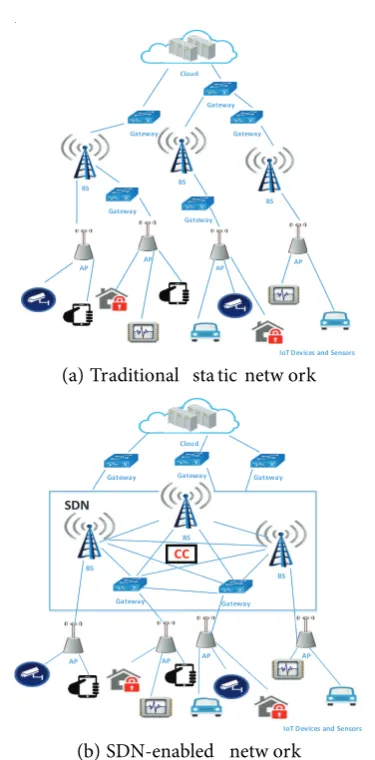
Unlike traditional sta tic netw orking architecture (as shown in Fig. 1.a), in SDN (as shown in Fig. 1.b), data forw arding plane is decoupled from the controller plane. Here, a Centralized Controller componen t (CC) determines the routing path and data forw arding rules. The other netw orking entities like switches, gatew ays, access poin ts, base sta tions, etc. forw ards the data according the guidelines of the CC.
In order to iden tify the efficien t data routing path and computa tional entity, the CCsenses the contextual informa tion and monitors the internal oper ations of netw ork, computa tional entities and IoT devices. In gener al, contextual informa tion provides enriched perception reg arding differen t system componen ts [12]. Here, the contextual informa tion incl udes:
– Curren t traffic load (netw ork throughput) on differen t routing paths.
– Curren t data processing load (size of queued data) on each computa tional entity.
– Data sensing frequency (data transmission rate) of IoT devices.
As the componen ts of the modelled system interacts with each other through SDN, it is possible to tarck the context of each componen ts. Ref erence of sev eral
.
AP AP
AP
AP
BS BS
BS Gateway
Cloud
Gateway Gateway
Gateway
Gateway
IoT Devices and Sensors (a) Traditional sta tic netw ork .
BS
BS Cloud
Gateway
Gateway Gateway
IoT Devices and Sensors
BS
BS Gatewayy Gateway
AP AP AP
CC BS SDN
Gateway Gateway
AP
(b) SDN-enabled netw ork
Figure 1. Networking architecture for IoT.
context -sensing framew ork for SDN is available in the liter ature [13] [14]. Any of the framew orks can be applied to track the aforemen tioned contextual informa tion of the computa tional entities, under lying netw ork and IoT devices. The sensed contextual informa tion helps CC to perceiv e the whole system efficien tly and enhance the visibility over each of the componen ts.
entity as it does not provide any virtualized settings. As a resul t it becomes very difficul t to achiev e scalability in the traditional netw ork.
Necessary nota tion for modelling the system has been provided in Table. 1
Table 1. Notations
Symbol Definitio
E Set of all computa tional entities.
αe Data processing capacity of computa tional entity e,e∈E
φe Curren t data processing load on computa-tional entity e,e∈E
P Set of all comm unica tion paths.
Pe Set of all comm unica tion paths to compu-tational entity e,e∈E;Pe⊂P
βp Data transmission capacity of comm unica-tion pathp,p∈P
ωp Curren t data transmission load of comm u-nica tion path p,p∈P
λn Data transmission rate of any IoT device n.
µn Sensed data by any IoT device n.
4. SDN-based IoT-resource discovery
The proposed SDN-based IoT-resource discov er policy
executes in the CC. Whenev er an IoT-device n
sensed any data µn from the external environmen t, it forw ards the data µn through SDN to CC. Besides, the contextual informa tion of IoT-device n reg arding its
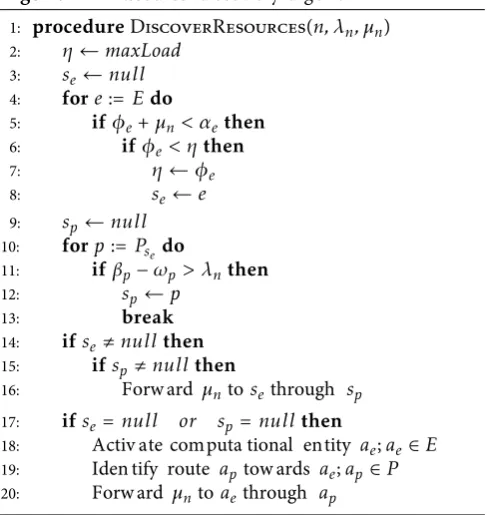
data transmission rate λn is also sent to CC. Based on the receiv ed informa tion, CCruns theDiscoverResources proced ure as shown in Algorithm. 1.
The DiscoverResources proced ure is consist of four basic steps. The steps can be describes as follows:
1. At firs , for each of the computa tional entity (line 4), it is checked whether the incl usion of µn to its curren t data processing load exceeds the capacity of the corresponding computa tional entity (line 5). If it satisfies then the computa tional entity with minim um data processing load is selected as the targ et entity for processing µn (line 6-8). This approach can be termed as the best -fi selection of computa tional entity.
2. Later, from the available routing paths the suitable routing path tow ards the selected computa tional entity is iden tifie (line 10-13). In this case, the firs route is selected tha t cannot be cong ested due to per unit time data transmission from the IoT device n(line 11). This is
considered as the firs -fi selection of the routing path. 3. In this step the sensed data µn of IoT-device n is forw arded tow ards the selected computa tion entity through a cong estion-less routing path (line 14-16).
4. If no feasible computa tional entity or routing path is found, CC can dynamicall y initia te any idle
Algorithm 1Resource discov ery algorithm 1: procedureDiscoverResources(n, λn, µn)
2: η←maxLoad
3: se←null
4: fore:= Edo
5: ifφe+µn < αethen
6: ifφe< ηthen
7: η←φe
8: se←e
9: sp←null
10: forp:=Psedo
11: ifβp−ωp> λnthen
12: sp←p
13: break
14: ifse,nullthen
15: ifsp,nullthen
16: Forw ard µntosethrough sp
17: ifse=null or sp =nullthen
18: Activ ate computa tional entity ae;ae∈E
19: Iden tify route aptow ards ae;ap∈P
20: Forw ard µntoaethrough ap
computa tional entity and iden tify route tow ards the entity so tha t the sensed data µn can be forw arded for processing.
The DiscoverResources proced ure combines best -fi and firs -fi selection approach (step 1-2) within it. Gener all y, the complexity of this algorithm will increase linear ly as the number of computa tional entity increases. However, due to step 1 and 2, it becomes easier to iden tify appropria te computa tional resources and associa ted routing path (step 3). Moreov er, due to basic features of SDN, it is also possible to accommoda te increasing service demand to idle computa tion entities (step 4). As a resul t, scalability issues in resource discov ery for IoT become attainable.
Since the DiscoverResources proced ure facilita tes resource discov ery and scalability , it pla y crucial role in minimizing resource discov ery time and in enhancing QoS satisf action for increasing number of IoT-service requests. Besides, not only in IoT, the proposed SDN-based approach can be extended to any sort of oper ations [15] where real- time interactions are involved.
5. Performance Evaluation
5.1. Simulation Environment
The system model has been simula ted using iFogSim [16] simula tion toolkit. iFogSim simula tion toolkit has been dev eloped upon the CloudSim framew ork which has been used extensiv ely to simula te Cloud, Mobile Cloud, Vehicular Cloud environmen t.
In the simula tion, Fog nodes are considered as the computa tional entities and CCis a specialized Fog node to cond uct basic oper ations on SDN. In the modelled simula tion environmen t, IoT-devices can be placed at any location and the devices can ask for processing their sensed data by following poisson distribution.
As the compatible real- world workload is not cur-rently available, in the simula tion, syn thetic workload has been used. The workload and modelled system can be easil y re-constructible. Simula tion par ameters and units are represen ted in Table. 2.
Table 2. Simulation parameters
Parameter Value
Simula tion Dur ation 100 s
Processing capacity of Fog nodes 20 - 30 Mbps
Service request size 0.5 - 1 Mb
Link bandwid th capacity 7 - 10 Mbps
Transmission rate of IoT devices 2 - 3 Mbps
Service deliv ery deadline 1 - 2 s
5.2. Simulation Results
The required time for iden tifying suitable computa-tional resources is considered as one of the perf ormance metrics. In order to model resource discov ery time Eq. 1 has been applied. Here, the summa tion of data propag ation time (δt) from source IoT device to targ et Fog node and waiting time (νt) in Fog node has been iden tifie as total resource discov ery time (RDt) for a data processing request.
RDt=δt+νt (1)
Fig. 2 depicts tha t, resource discov ery time for IoT in sta tic netw ork is higher compared to SDN-based policy . Although in SDN-based approach, a certain amoun t of time is required by CC to iden tify appropria te targ et Fog node and the associa te routing path, the policy helps to red uce data processing waiting time and data propag ation time to a grea t exten t. In fact, the SDN-based solution selects tha t Fog node and tha t routing path as processing and comm unica tion medium in which processing load and netw ork cong estion is compar ativ ely less. That’s why in SDN-based solution resource discov ery time gets minimized. Conversel y, in sta tic netw ork based approach neither data processing overhead of Fog nodes nor netw ork cong estion is taken
1000 1500 2000 2500 3000 3500 4000 0.2
0.4 0.6 0.8 1.0 1.2 1.4 1.6 1.8
R
e
s
o
u
r
c
e
d
i
s
c
o
v
e
r
y
t
i
m
e
(
s
e
c
)
Number of generated service requests SDN-based IoT
Static network based IoT
Figure 2. Resource discovery time vs number of service requests
in to accoun t. As a resul t, a high amoun t of time is required for resource discov ery.
In addition to resource discov ery time, the percen tag e of QoS-sa tisfie data processing requests is considered as another perf ormance metric. Here, the deadline satisfie service deliv ery is taken into accoun t as a QoS par ameter . A data processing request satisfie QoS when the following condition is satisfied here ∆t is
the service deliv ery deadline, τt is the service response time.
∆t> τt (2)
Fig.3 represen ts tha t, the percen tag e of QoS satis-fie service requests in sta tic netw ork decreases sig-nifica tly as the number of service requests increases. In SDN-based IoT, as scalable resource discov ery for increasing number of service requests is ensured, the percen tag e of QoS satisfie service requests alw ays
1000 1500 2000 2500 3000 3500 4000 70
75 80 85 90 95 100
SDN-based IoT
Static network based IoT
Number of generated service requests
Q
o
S
s
a
t
i
s
f
i
e
d
s
e
r
v
i
c
e
r
e
q
u
e
s
t
s
(
%
)
remains in high. However, a very less amoun t of down-fall in the percen tag e of QoS satisfie service request is also experienced in SDN-based IoT as the number of service request rises. It happens due to run time activ ation of idle Fog nodes to meet the service demand. The required time for activ ating an idle Fog node has adv erse effect of the QoS satisfie service deliv ery of some requests.
6. Conclusion
The domain of IoT is expanding at a grea t pace. It is also experiencing differen t type of challeng es in its way of practical applicability . We have targ eted one of such challeng es of IoT in respect of scalable resource discov ery. Here, the proposed SDN-based resource discov er policy for IoT uses contextual informa tion of computa tional entities, netw orks and IoT devices to iden tify suitable resources and routing path to process and forw ard IoT-data. The policy is independen t of increasing number of data processing (service) requests tha t comes from geo-distributed IoT-devices. In consequence, the policy facilita tes scalable resource discov ery in IoT. Moreov er, sev eral simula tion studies also claim the feasibility of the proposed policy in respect of resource discov ery time and QoS satisf action rate of service requests. The SDN-based solution is substan tiall y efficien t compared to the sta tic netw ork based resource discov ery for IoT.
In future we aim at extending SDN-based solutions to other aspects of IoT such as SDN-based IoT netw ork manag emen t, SDN-assisted content distribution in IoT, applica tion depl oymen t in SDN-enabled IoT.
References
[1] Qin, Y., Sheng, Q.Z., Falkner, N.J.G., Dustdar, S.,
Wang, H. and Vasilakos, A.V. (2014) When things
matter: A data-cen tric view of the internet of things. CoRR abs/1407.2704. URL http://arxiv.org/abs/ 1407.2704.
[2] Liu, J., Li, Y., Chen, M., Dong, W. and Jin, D. (2015)
Softw are-define internet of things for smart urban sensing. IEEE Communications Magazine 53(9): 55–63.
doi:10.1109/MC OM.2015.7263373 .
[3] Kirkpatrick, K. (2013) Softw are-define netw orking.
Commun. ACM56(9): 16–19.
[4] Govindarajan, K., Meng, K.C., Ong, H., Tat, W.M.,
Sivanand, S.and Leong, L.S.(2014) Realizing the quality
of service (qos) in softw are-define netw orking (sdn) based cloud infr astructure. In 2014 2nd International Conference on Information and Communication Technology (ICoICT): 505–510.
[5] Zhang, Y., Shen, Y., Wang, H., Yong, J. and Jiang,
X. (2016) On secure wireless comm unica tions for iot under eavesdropper coll usion. IEEE Transactions on
Automation Science and Engineering 13(3): 1281–1293.
doi:10.1109/T ASE.2015.2497663 .
[6] Yen, T.C. and Su, C.S. (2014) An sdn-based cloud computing architecture and its mathema tical model.
In 2014 International Conference on Information Science,
Electronics and Electrical Engineering, 3: 1728–1731.
[7] Ku, I., Lu, Y. and Gerla, M. (2014) Softw are-define
mobile cloud: Architecture, services and use cases. In 2014 International Wireless Communications and Mobile Computing Conference (IWCMC): 1–6.
[8] Gudipati, A.,Perry, D.,Li, L.E.and Katti, S.(2013)
Sof-tran: Softw are define radio access netw ork. In Proceed-ings of the Second ACM SIGCOMM Workshop on Hot Topics in Software Defined Networking, HotSDN ’13 (New York, NY, USA: ACM): 25–30. doi:10.1145/2491185.2491207 , URL http://doi.acm.org/10.1145/2491185.2491207.
[9] Yeganeh, S.H.,Tootoonchian, A.andGanjali, Y.(2013)
On scalability of softw are-define netw orking. IEEE
Communications Magazine51(2): 136–141.
[10] Jararweh, Y.,Al-Ayyoub, M.,Darabseh, A.,Benkhelifa,
E., Vouk, M. and Rindos, A. (2015) Sdiot: a softw are
define based internet of things framew ork. Journal of
Ambient Intelligence and Humanized Computing6(4): 453–
461.
[11] Wu, D., Arkhipov, D.I., Asmare, E., Qin, Z. and
McCann, J.A. (2015) Ubif ow: Mobility manag emen t
in urban-scale softw are define iot. In 2015 IEEE Conference on Computer Communications (INFOCOM): 208–216.
[12] Mahmud, M.R., Afrin, M., Razzaque, M.A., Hassan,
M.M., Alelaiwi, A. and Alrubaian, M. (2016)
Max-imizing quality of experience through context -aware mobile applica tion sched uling in cloudlet infr astruc-ture. Software: Practice and Experience 46(11): 1525– 1545. doi:10.1002/spe.2392 , URL http://dx.doi.org/ 10.1002/spe.2392. Spe.2392.
[13] d. Silva, M.P., NazÃąrio, D.C., Dantas, M.A.R.,
GonÃğalves, A.L., Pinto, A.R., Manerichi, G. and
Vanelli, B.(2016) Context manag emen t and distribution
architecture using softw are-define netw orking. In 2016 IEEE 25th International Conference on Enabling Technologies: Infrastructure for Collaborative Enterprises
(WETICE): 185–190.
[14] Savarese, G., Vaser, M. and Ruggieri, M. (2013)
A softw are define netw orking-based context -aware framew ork combining 4g cell ular netw orks with m2m.
In 2013 16th International Symposium on Wireless
Personal Multimedia Communications (WPMC): 1–6.
[15] Afrin, M., Mahmud, M.R.and Razzaque, M.A. (2015)
Real time detection of speed breakers and warning system for on-road driv ers. In 2015 IEEE International WIE Conference on Electrical and Computer
Engineer-ing (WIECON-ECE): 495–498. doi:10.1109/WIEC
ON-ECE.2015.7443976 .
[16] Gupta, H.,Vahid Dastjerdi, A.,Ghosh, S.K.and Buyya,
R. ifogsim: A toolkit for modeling and simula tion of resource manag emen t techniques in the internet of things, edg e and fog computing environmen ts.Software: