Synthesis and Characterization of
Novel Photoactive Poly(ether-amide)s
Based on Highly Substituted Phenanthrimidazole
Aryannezhad, Maryam; Behmadi, Hossein*
+Department of Chemistry, Mashhad Branch, Islamic Azad University, Mashhad, I.R. IRAN
Saadati, Seyed Mahdi
Department of Chemistry, Bojnourd Branch, Islamic Azad University, Bojnourd, I.R. IRAN
Poormorteza, Narges; Amini Moghaddam, Zahra
Department of Chemistry, Mashhad Branch, Islamic Azad University, Mashhad, I.R. IRAN
ABSTRACT: A new aromatic diamine monomer containing ether linkage based on the phenanthrimidazole ring, 1,1´-(4,4´- oxy bis(1,4-phenylene))bis(2-(4-aminophenyl)-1H-phenanthro[9,10-d]imidazole) was synthesized through four-components condensation of 4,4´-diamino diphenyl ether, 4-nitrobenzaldehyde, phenanthrene-9,10-dione and ammonium acetate in presence of acetic acid, followed by palladium-catalyzed hydrazine monohydrate reduction.
This new monomer was further confirmed by FT-IR, 1H NMR, and 13C NMR spectroscopy. A series of new aromatic polyamides containing phenanthrimidazole ring in the main chain was prepared by direct polycondensation of the prepared diamine with four commercially available aromatic and aliphatic diacids. These polymers are essentially amorphous and were soluble in polar aprotic solvents such as DMF, NMP, DMAc, and DMSO. Inherent viscosities of polyamides were in the range 0.42–0.53 dL/g indicating the formation of medium molecular weight polymers. Polyamides exhibited glass-transition temperature (Tg) in the range 260-280 °C. The 10% weight loss
temperature in air atmosphere measured by TGA was in the range 454-526 °C indicating their good thermal stabilities. The photophysical properties of diamine and polyamides were investigated
by UV-Vsible and fluorescence spectroscopy.
KEYWORDS:Polyamides; Polycondensation; Bis-phenanthrimidazole; Thermal stability.
INTRODUCTION
Aromatic polyamides are thermally stable polymers with an attractive combination of excellent chemical, physical and mechanical properties that make them
practical as high-performance materials for advanced technologies [1-6]. However, the applications of aromatic polyamides are often hampered by problems in their
*To whom correspondence should be addressed. +E-mail: [email protected]
fabrication due to their high glass transition temperatures (Tg), or high melting temperatures (Tm), and limited solubility in organic solvents [7, 8]. To get the better of these limitations, the modification of the macromolecule structure is necessary. The properties of polyamides can be dramatically altered by minor variations in the structures of the diacid and diamine monomers. Due to, much of research efforts have been focused on the synthesis of structurally modified aromatic polyamides having improved solubility and processability with retention of their high thermal stability [9-13].
In general, many efforts have been devoted to enhancing the solubility of polyamides, and this has included the introduction of noncoplanar groups, incorporation of unsymmetrical structure, and the introduction of bulky side groups into the polymer backbone.It is known that ether linkages inserted in aromatic main chains provide them with a significantly lower energy of internal rotation. Aramids containing ether linkages or asymmetrical groups are significantly more flexible and soluble than conventional polyamides [13-16]. These modifications work by breaking chain symmetry and regularity and by destroying hydrogen bonding, generally leading to better solubility and processability.
On the other hand, the synthesis and characterization of the macromolecules restrain heterocyclic rings in the main chain has been the topic of considerable interest, because of their relatively good thermal stability with improved solubility and some attractive novel properties. Among different heterocycles, imidazole can be readily obtained by condensation of 1,2-diketone, aldehyde, amine and ammonium acetate in presence of acetic acid. So in order to prepare novel processable polyamides with enhanced thermal stabilities, new diamine monomer containing ether linkage based on phenanthrimidazole ring and bearing bulky aromatic pendant groups in the 1, 2-positions of the phenanthrimidazole ring was synthesized and used for the preparation of polyamides. The incorporation of aryl groups and ether linkage into the polymer backbone is expected to affect their properties as well as enhance the solubility in organic solvents and improve the processability.
EXPERIMENTAL SECTION Materials
All chemicals were purchased from Merck. N-methyl-2-pyrrolidinone (NMP) was purified by distillation over
calcium hydride under reduced pressure and stored over 4 Å molecular sieves. Other materials were used as received without any purification.
Instruments
1H and 13C NMR spectra were recorded on a 400 MHz
Bruker Advance DRX instrument using DMSO-d6 as a solvent and tetramethyl silane as an internal standard. FT-IR spectra were recorded using a Bruker Tensor 27 spectrometer on KBr pellets. Thermal Gravimetric Analysis (TGA) and Differential Scanning Calorimetry (DSC) analysis were performed using TGA-50 and Mettler Toledo 822e in an air atmosphere, respectively. The inherent viscosities of the polymers were determined for the solutions of 0.5 g/dL in NMP at 25 °C using an ubbelohde viscometer. Absorption and fluorescence spectra were recorded on a Varian Cary Eclipse spectrophotometer.
Monomer Synthesis
Synthesis of 4-(1-(4-(4-(2-(4-aminophenyl)-1H-phenanthro [9,10-d]imidazol-1-yl)phenoxy)phenyl)-1H-phenanthro[9,10-d]imidazol-2-yl)benzenamine (DABPI):
1-(4-(4-(2-(4-nitrophenyl)-1H-phenanthro[9,10- d]imidazol-1-yl)phenoxy)phenyl)-2-(4-nitrophenyl)-1H-phenanthro[9,10-d]imidazole (DNBPI) was prepared according to the literature [17]. DABPI was synthesized according to the following procedure as shown in scheme 1: To a 250-mL three-necked flask equipped with a dropping funnel and a reflux condenser (5gr, 5.9 mmol) of DNBPI and 0.3 g of palladium on activated carbon (Pd/C, 10%), were dispersed in 100 mL of ethanol. The suspension solution was heated to reflux, and 10 mL of hydrazine monohydrate was added slowly to the mixture. After a further 5 h of reflux, the solution was filtered hot to remove Pd/C, and the filtrate was cooled to precipitate orange crystals. The product was collected by filtration and dried in vacuum at 80 °C. The yield of the reaction was 83% (3.60 g), and the melting point was 273–275 °C.
Polymer synthesis
Scheme 1: Synthesis of DABPI.
Scheme 2: Synthesis of polyamides (PA).
A flask was charged with a mixture of DABPI (0.259 g, 0.33 mmol), dicarboxylic acid (0.33 mmol), triphenylphosphite (0.3 mL), pyridine (0.3 mL), NMP (5 mL) and LiCl (0.3 g). The reaction mixture was maintained at 130 °C under N2 atmosphere for 12 h. After cooling, the reaction mixture was poured into a large amount of methanol, producing a precipitate. The precipitate was filtered, washed with hot methanol and
then with hot water several times, which afforded polyamide.
RESULTS AND DISCUSSION
Monomer synthesis and characterization
The objective of this study was the preparation of novel thermally stable PAs with improved solubility containing substituted bis-phenanthrimidazole rings
O O
O H
NO2
O N
H2 NH2 NH4OAc
HOAc
Reflux
NH2NH2, EtOH
Pd/C, Reflux
N N
NH2
N
N O
NH2
DABPI N
N NO2
N
N O
NO2
DNBPI + 2
2 + +
N N
NH2
N
N O
NH2
DABPI
HO2C Ar CO2H
P(OPh)3, Py.
LiCl, NMP
N N
N H
O
N
N O
N
H Ar n
Ar PA
N
CH2 4
PA
N +
PA-a
PA-b
PA-c
Fig. 1: FT-IR spectra of (DNBPI) and (DABPI). Fig. 2: The 1H NMR spectrum of DABPI.
in the main chain. For this purpose, a new diamine (DABPI) was synthesized through a two-step procedure, as illustrated in Scheme 1. Firstly, DNBPI was synthesized according to the literature [17]. DABPI was readily obtained in high yield by the Pd/C-catalyzed reduction of the DNBPI with hydrazine monohydrate in refluxing ethanol. The purity of all compounds was checked by thin-layer chromatography, which showed one spot in ethylacetate/n-hexane mixture (2:8). The structure of DABPI was characterized by FT-IR and 1H NMR spectroscopic techniques. The nitro groups of compound (DNBPI) showed two characteristic absorption bands at 1341 and 1545 cm-1 (-NO
2 asymmetric and symmetric stretching). After reduction, these absorption peaks disappeared and the primary amino group in compound (DABPI) showed the typical absorption pair at 3476 and 3377 cm-1 because of N-H stretching. The FT-IR spectra of compounds DNBPI and DABPI were presented in Fig. 1.
The FT-IR spectra of DABPI exhibited 3476, 3377 cm-1 (unsymmetrical and symmetrical stretching of NH2); 1609 cm-1 (C=N stretching); 1499, 1472 cm-1 (C=C stretching) and 1235 cm-1 (C−O stretching) absorptions.
The 1H NMR spectrum of compound DABPI was presented in Fig. 2. The signal at 5.39 ppm is due to the -NH2 protons. Aromatic protons at 6.46-8.89 ppm showed the expected multiplicity and integration values.
Polymers synthesis and characterization
New classes of polyamides were prepared from the direct polycondensation of DABPI with dicarboxylic acids by means of triphenyl phosphite, pyridine, and LiCl.
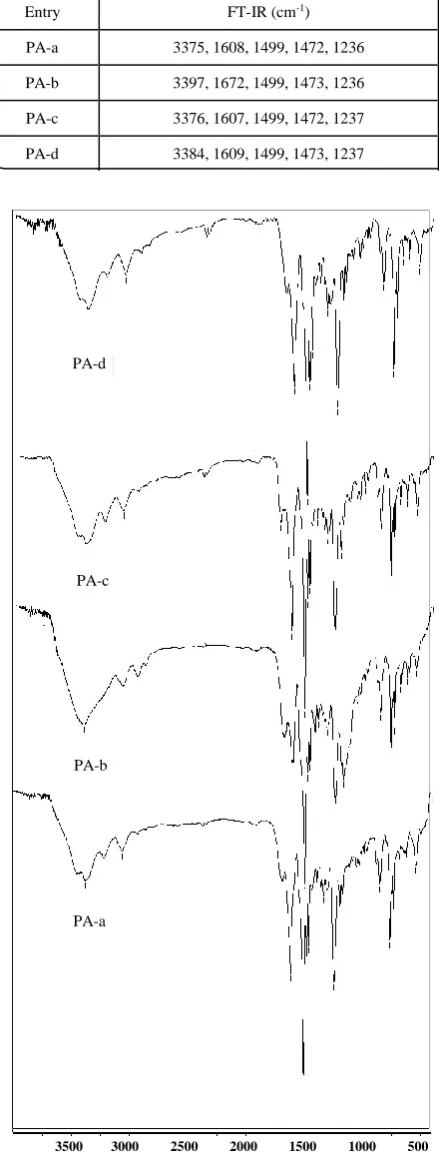
The prepared polyamides with the yields of 90–95% showed inherent viscosities (ηinh) in the range of 0.48– 0.53 dL/g. All of the polymers were characterized by using FT-IR and 1H NMR. The spectroscopic data of PAs is shown in Table 1. The characteristic FT-IR absorptions of the polymers (Fig. 3) are about 3400 cm-1 related to N– H, 1660 cm-1 due to C=O in amide groups, 1600 cm-1 (C=N stretching), 1500 cm-1 (C=C stretching) and 1240 cm-1 (C−O stretching). The signal at about 11 ppm in 1H NMR is due to the -NH proton of the amide group. Aromatic protons appeared at 6.5-8.8 ppm in all PAs. The signals at 1.5 and 2.3 ppm in PA-b are related to protons of the methylene groups.
Thermal properties of PAs
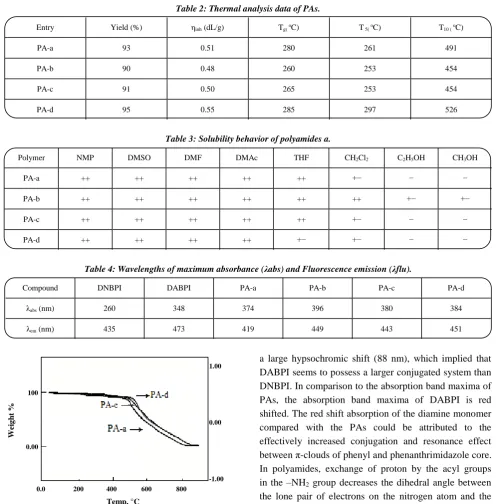
The thermal behaviors of PAs were evaluated by Differential Scanning Calorimetry (DSC) and Thermo Gravimetric Analysis (TGA). Thermal analysis data of PAs is shown in Table 2. There were no melting peaks detected in DSC which support the generally amorphous nature of the polymers. The DSC thermograms of polymers showed Tg in the range of 260–280 °C. PA-b that obtained from adipic acid as an aliphatic dicarboxylic acid, showed lower Tgbecause of the presence of flexible aliphatic unit between the aromatic amide units and low rotation barrier of its diacid residue, and the highest Tg of 285 °C was observed for PA-d derived from diphenic acid because of the highest rigidity which inhibited the molecular motion.
The thermal stability of polymers was evaluated by TGA in an air atmosphere (Fig. 4). To compare thermal
9.0 8.5 8.0 7.5 7.0 6.5 6.0 5.5
ppm
Table 1: Spectroscopic data of polyamides.
Entry FT-IR (cm-1) 1H NMR (DMSO, 400 MHz, ppm)
PA-a 3375, 1608, 1499, 1472, 1236 6.5-7.8 (m, 35H aromatic), 11 (br, 2H amide)
PA-b 3397, 1672, 1499, 1473, 1236 1.5 (t, 4H), 2.3 (t, 4H), 7.7-8.8 (m, 32H aromatic), 11(br, 2H amide)
PA-c 3376, 1607, 1499, 1472, 1237 6.5-8.9 (m, 35H aromatic), 11 (br, 2H amide)
PA-d 3384, 1609, 1499, 1473, 1237 7.2-7.7 (m, 40H aromatic), 10 (br, 2H amide)
Fig. 3: FT-IR spectra of polyamides.
behavior, the temperatures of 5% weight loss (T5) and the temperatures of 10% weight loss (T10) values were determined from the original TGA curves. The temperatures for 10% weight loss, which are important criteria for evaluating the thermal stability of the polymers, were in the range of 454-526 °C indicating their high thermal stability.
Polymer solubility
The solubility of PAs was tested qualitatively in various organic solvents and the results were tabulated in Table 3. Almost all of the prepared PAs exhibited excellent solubility in polar aprotic solvents such as NMP, DMAc, DMF, and DMSO at room temperature. The good solubility of these PAs was governed by the structural modification through the incorporation of bulky aryl pendant groups in the polymer backbone which resulted in increased chain-packing distances and decreased inter-chain interactions. These factors and also the amorphous nature contributed to the enhanced solubility of these PAs through better penetration of solvent molecules, the formation of H-bonding and dipole-dipole interaction with polar molecules of organic solvents.
Photophysical properties of polyamides
The photophysical properties of diamine (DABPI) and PAs were investigated by UV-Visible and fluorescence spectroscopy in NMP solution. The UV-Vis absorption and emission spectra of diamine (DABPI) (0.2 g/dL=10-3 M) and PA-c (0.2 g/dL) in NMP solutions were shown in Fig. 5 and Fig. 6, respectively. The extracted data were listed in Table 4.
The diamine (DABPI) with an extended conjugated system showed wide range absorption peak with a maximum at 348 nm corresponding to the π-π* transition of the aromatic chromophores. As seen from Scheme 1, the DNBPI and DABPI are related, but their chemical 3500 3000 2500 2000 1500 1000 500
Table2: Thermal analysis data of PAs.
Entry Yield (%) ηinh (dL/g) Tg( oC) T 5( oC) T10 ( oC)
PA-a 93 0.51 280 261 491
PA-b 90 0.48 260 253 454
PA-c 91 0.50 265 253 454
PA-d 95 0.55 285 297 526
Table 3: Solubility behavior of polyamides a.
Polymer NMP DMSO DMF DMAc THF CH2Cl2 C2H5OH CH3OH
PA-a ++ ++ ++ ++ ++ +− − −
PA-b ++ ++ ++ ++ ++ ++ +− +−
PA-c ++ ++ ++ ++ ++ +− − −
PA-d ++ ++ ++ ++ +− +− − −
Table 4: Wavelengths of maximum absorbance (λabs) and Fluorescence emission (λflu).
Compound DNBPI DABPI PA-a PA-b PA-c PA-d
λabs (nm) 260 348 374 396 380 384
λem (nm) 435 473 419 449 443 451
Fig. 4: TGA thermograms of PAs.
structures are differentiated by introducing various substituents, for instance, nitro or amine. Such a structural modification could be expected to result in some changes in the π-conjugated length and in the absorption and emission spectra. It was also noted that replacement of nitro group with an amine donor in phenyl moiety of the phenanthro[9,10-d]imidazole molecules resulted in
a large hypsochromic shift (88 nm), which implied that DABPI seems to possess a larger conjugated system than DNBPI. In comparison to the absorption band maxima of PAs, the absorption band maxima of DABPI is red shifted. The red shift absorption of the diamine monomer compared with the PAs could be attributed to the effectively increased conjugation and resonance effect between π-clouds of phenyl and phenanthrimidazole core. In polyamides, exchange of proton by the acyl groups in the –NH2 group decreases the dihedral angle between the lone pair of electrons on the nitrogen atom and the p-electrons on the carbon atom of the C-N bond (from 23° to 17°), as well as, the dihedral angle between the phenyl and phenanthrimidazole ring (from 35° to 30°) [19].
CONCLUSIONS
A series of new polyamides were readily prepared via direct polycondensation of a new diamine and various aromatic and aliphatic dicarboxylic acids. The introduction of a bulky moiety of bis-phenanthrimidazole into the polymer backbone resulted in polyamides 0.0 200 400 600 800
Temp. °C
100
0.00
We
ig
h
t
%
1.00
0.00
Fig. 5: UV-vis spectrum of diamine (- -) and PA-c (__). Fig. 4: Fluorescence emission spectrum of diamine (- -) and
PA-c (__).
with good solubility in polar aprotic solvents because of a decrease in the ability for polymer chains to pack and reduction of inter-chain interactions, and this also
increased Tg of the polymer up to 260 °C, as a result of a decrease in the segmental mobility due to side chain-side chain and side chain-main chain interaction through H-bonding. They had useful levels of thermal stability associated with relatively high temperatures of 10% weight loss (T10) in the range of 454-526 °C in an air atmosphere.
Received: Sep. 19, 2016; Accepted: May 8, 2017
REFERENCES
[1] Mallakpour S., Taghavi M., A Facile, Microwave-Assisted Synthesis of Novel Optically Active
Polyamides Derived from
5-(3-methyl-2-Phthalimidylpentanoylamino)Isophthalic Acid and
Different Diisocyanates, Eur. Polym. J.,44 (1):
87-97 (2008).
[2] Majo M.A., Alla A., Bou J.J., Herranz C.,
Munoz-Guerra S., Synthesis and Characterization of
Polyamides Obtained from Tartaric Acid and
l-Lysine, Eur. Polym. J.,40 (12): 2699-2708 (2004).
[3] Behniafar H., Banihashemi A., Synthesis and
Characterization of New Soluble and Thermally Stable Aromatic Poly(amide-imide)s Based on
N-[3,5-bis(N-trimellitoyl)phenyl]phthalimide, Eur.
Polym. J.40 (7): 1409-1415 (2004).
[4] Cui X., Li W., Yan D., Yuan C., Di Silvestro G., Synthesis and Characterization of Polyamides X 18,
J. Appl. Polym. Sci.,98 (4): 1565-1571 (2005).
[5] Hearle J.W.S., "High-Performance Fibres", Woodhead Publishing Ltd, Cambridge (2001). [6] Mark H.F., "Encyclopedia of Polymer Science and
Technology", Wiley Interscience, 12 Volume Set,
3rd Edition, New York (2004).
[7] Imai Y., Recent Advances in Synthesis of
High-Temperature Aromatic Polymers, React. Funct.
Polym.,30 (1-3): 3-15 (1996).
[8] Liou G.Sh., Fang Y.K., Yen H.J., Synthesis, and Properties of Noncoplanar Rigid-rod Aromatic
Polyamides Containing Phenyl or Naphthyl
Substituents, J. Polym. Res.,14 (2): 147-155 (2007).
[9] Amini Nasab S.M., Ghaemy M., Synthesis and
Characterization of New Polyamides and Polyimides Containing Dioxypyrimidine Moiety in the Main Chain with Bulky Imidazole Pendent Group:
Solubility, Thermal and Photophysical Properties,
J. Polym. Res.,18 (6): 1575-1586 (2011).
[10] Ghaemy M., Alizadeh R., Behmadi H.,Synthesis of
Soluble and Thermally Stable Polyimide from New Diamine Bearing N-[4-(9H-carbazol-9-yl)phenyl]
Formamide Pendent Group, Eur. Polym. J., 45 (11):
3108-3115 (2009).
[11] Sava I., Iosip M.D., Bruma M., Hamciuc C., Robison J., Okrasa L., Aromatic Polyamides with Pendent Acetoxybenzamide Groups and Thin Films Made
Therefrom, Eur. Polym. J., 39 (4): 725-738 (2003).
[12] Faghihi Kh., Mozaffari Z., New Polyamides Based on 2,5-bis[(4-carboxyanilino) carbonyl] Pyridine and Aromatic Diamines: Synthesis and
Characterization, J. Appl. Polym. Sci.,108 (2):
1152-1158 (2008). 800 700 600 500 400 300 200 100 0 Fl o u re sc em ce i n te n si ty ( a .u .)
400 450 500 550 600 200 300 400 500
[13] In I., Kim S.Y., Soluble Wholly Aromatic Polyamides Containing Unsymmetrical Pyridyl
Ether linkages, Polymer, 47 (2): 547-552 (2006).
[14] Abdolmaleki A., Novel Aromatic Poly(amide-hydrazide)s Based on the Bipyridine. Part I:
Synthesis, Characterization and Thermal Stability,
Polym. Degrad. Stab., 92 (2): 292-298 (2007). [15] Bottino F.A., Di Pasquale G., Scalia L., Pollicino L.A.,
Synthesis and Characterisation of New Polyamides Containing 6,6′-oxy or 6,6′-Carbonyldiquinoline
Units, Polymer, 42 (8): 3323-3332 (2001).
[16] Bottino F.A., Di Pasquale G., Pollicino A., Scalia L., Synthesis and Characterization of New Polyamides
Containing 6,6′-Methylenediquinoline Units,
Polymer, 39 (20): 4949-4954 (1998).
[17] Saadati S.M., Mosslemin M.H., Behmadi H., Shams A.,
Synthesis, Characterisation and Fluorescence
Studies of New Bis-phenanthrimidazole Derivatives, J. Chem. Res., 37 (8): 487-512 (2013).
[18] Yamazaki N., Higashi F., Kawataba J., Studies on Reactions of the N-phosphonium Salts of Pyridines. XI. Preparation of Polypeptides and Polyamides by
Means of Triaryl Phosphites in Pyridine, J. Polym.
Sci. A: Polym. Chem., 12 (9): 2149-2154 (1974). [19] Dey J., Dogra S.K., Dual Fluorescence in
2-(4’-N,N-Dimethylamino-phenyl)benzazole and its
Benzimidazole Analog – Effect of Solvent and pH
on Electronic Spectra, J. Phys. Chem., 98 (14):