DEVELOPMENT OF CHARACTERIZATION PROTOCOL FOR MIXED LIQUID RADIOACTIVE WASTE CLASSIFICATION
Norasalwa Zakaria1, Syed Asraf Wafa2, Yii Mei Wo3, Sarimah Mahat4 and Mohamad Annuar Assadat Husain5
1
Waste Technology Development Centre, 2Radioisotop Technology and Innovation Group,
3
Radiochemistry and Environment Group, 4Material Technology Group, Malaysian Nuclear Agency, 43000 Kajang, Selangor, Malaysia
5
Atomic Energy Licensing Board, Batu 24, 43000 Dengkil, Selangor, Malaysia Correspondence author: [email protected]
ABSTRACT
Mixed organic liquid waste generated from health-care and research activities containing tritium, carbon-14, and other radionuclide posed specific challenges in its management. Often, this waste becomes legacy waste in many nuclear facilities and being considered as ‘problematic’ waste. One of the most important recommendations made by IAEA is to perform multistage processes aiming at declassification of the waste. At this moment, approximately 3000 bottles of mixed liquid waste, with estimated volume of 6000 litres are currently stored at the National Radioactive Waste Management Centre, Malaysia and some have been stored for more than 25 years. The aim of this study is to develop a characterization protocol towards reclassification of these wastes. The characterization protocol entails waste identification, waste screening and segregation, and analytical radionuclides profiling using analytical procedures involving gross alpha beta, and gamma spectrometry. The results obtained from the characterization protocol are used to establish criteria for speedy classification of the waste.
Keywords: Characterization, classification, organic liquid waste, radioactive materials
INTRODUCTION
Mixed organic liquid waste is referring to organic solvent which is hazardous in nature and contains radioactive material. Sources of liquid organic radioactive waste may include spent oil, spent scintillation liquid and spent solvents (Bogdanovich et al., 2008). Of these three sources, spent scintillation liquid is the most commonly produced by research institutions and hospitals due to scintillation application for detecting low beta emitter. Typical radionuclide found in spent scintillation liquid wastes includes tritium (3H), carbon-14 (14C) and phosphorus-32 (32P). Typical features of organic waste are volatility, combustibility or flammable, radiolytic instability and biotoxicity. As such, management of mixed organic liquid radioactive waste should take full account of both its radioactive and organic nature. The International Atomic Energy Agency (IAEA) regards this waste as one of the ‘problematic’ wastes and it often becomes legacy waste in many nuclear facilities (IAEA, 2007).
19
been rebottled due to degradation of the caps, or the container itself. Most of the bottles have faded label while proper record and documentation on the sources origin, including record for the type of radionuclide constituents and year of generation are missing and not available.
From the perspective of chemical waste, organic solvent like xylene and toluene is categorized as non-halogenated organic solvents, coded as SW 322 under the Environmental Quality (Scheduled Wastes) Regulations, P.U (A) 294/2005. Currently, incineration at prescribed facility is the only approved and adopted method to treat and dispose hazardous waste in Malaysia. However, the challenge remains with the radioactive content in the waste. Generally, several options are suitable for the treatment of mixed liquid scintillation waste for instance incineration, emulsification, solidification, distillation and oxidation. Except when the radioactive level of the waste has fall below the clearance limit, the waste may be reclassified as cleared waste that allows to be handled as conventional chemical waste or hazardous waste.
Considering the inventory of the mixed liquid waste currently stored, and the poor condition of the waste containers, a speedy characterization protocol need to be established. It is expected that most of the waste has reached clearance limit, thus the aim of this study is to establish a characterization protocol that facilitate quick decision on whether the waste enters an extended storage period or would be reclassified as cleared waste and can be disposed of as chemical waste.
Characteristics of Mixed Organic Liquid Waste
Most of the liquid organic radioactive wastes are contained in the standard 2.5 litre and 4 litre amber bottles, while some are contained in HDPE container of various capacities. Early works revealed that the waste is chemically corrosive, and thermally instable. Xylene, toluene and methanol are among the type of solvent indicated on the bottle, but precaution is exercised as the label may not indicate the actual solvent in the bottle as mixing of spent solvent is likely to occur at the wastes generation source point.
MATERIALS AND METHODS
20
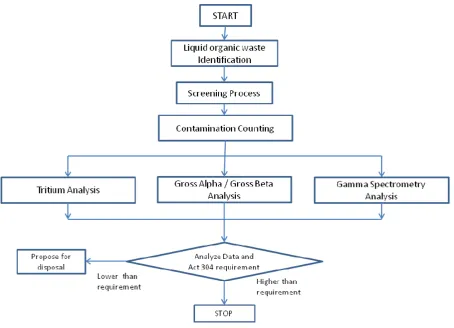
Figure 1: Flowchart of the characterization protocol for mixed organic liquid waste
Waste identification is the first step in the characterization process where all information on the label on the bottle, if available, is recorded. The bottle was weighed and net weight was recorded in order to compute the remaining volume in the bottle without the unnecessary exposure to toxic fumes and other risks if waste transferring is exercised. Other observation was also recorded such as present of precipitate and general condition of the bottles. A new Identification Code was marked for each bottle. External dose rate for each bottle was determined using survey meter (Ludlum 2241-2).
During screening, it is conservative to assume all mixed organic waste in the storage area consists of spent liquid scintillant. As such, contamination screening by means of swipe sampling was performed and counted using Geiger Muller Ludlum model 185-8 (GM). Counting was carried out for 1 minute per sample and was repeated 5 times. It involves very short counting time, i.e 1 minute per sample, as compared to the Gross alpha/beta count which requires an approximate 60 minutes of counting time using low background counting system. Three reference sources were used for the Geiger Muller Counting system; Americium-241 to represents alpha contaminants, Strontium-90 for beta contaminants and Caesium-137 for gamma contaminants.
21
minutes and counting was repeated 3 times. Gamma activities were measured using spectroscopy with a co-axial high purity germanium detector (Ortec, GEM25-76-XLB-C). A 25 ml liquid sample was collected in container and left for equilibrium for four weeks. Counting was performed for 13 hours. For Liquid Scintillation Counting (LSC) analysis, a 10 ml of sample was mixed with 10 ml of liquid scintillation cocktail (Ultima Gold LLT and analysed using Liquid Scintillation Counting System (Perkin Elmer Quantulus 1220 series). Samples were then counted to determine the concentration of tritium content.
RESULTS AND DISCUSSION
Waste Identification, Screening and Contamination Count
A total of 270 bottles with a net weight of 624 kg were screened and swipe samples for contamination counting were collected. Most of the bottles had external doses less than twice of the background dose rate. While most of the bottles have no indication of the type of the radionuclides on the label, there are bottles with labels indicating Iodine, 131I (t1/2 = 8 days), Neptunium, 237Np (t1/2
= 2.14 million years), and Tritium, 3H (t1/2 = 13 years). There were also 2 trunks filled with amber
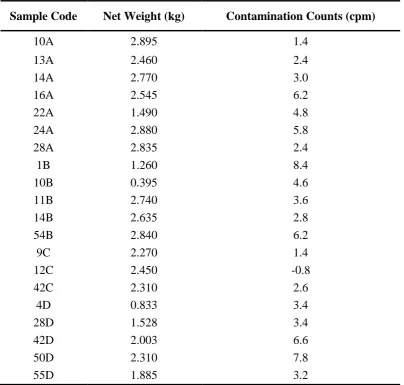
bottles with labels still intact, depicting the type of radionuclide as Tritium (3H), as well as information of the source origin, date of waste generated, and name of the person in charge. Random selection of samples was picked and swipe sampling was performed to determine level of contamination. Table 1 summarizes the net contamination counts for selected samples whereby positive value indicates contamination level is above the background while negative value indicates contamination is at background level.
22
Table 1: Results of net contamination counts for some selected samples
Table 2: Activity and specific activity of contaminants as determined using Geiger Muller during contamination counting step
Waste Code
Weight Sample
(g)
Activity of Contaminants (Bq)
Specific Activity of Contaminants (Bq/g)
Alpha Gamma Beta Alpha Gamma Beta
1E 2.3030 998.15 97.51 51.90 433.40 42.34 22.54
2E 2.6780 30.13 2.94 1.57 11.25 1.10 2.32
42D 1.7080 64.00 6.26 3.33 37.47 37.47 1.95
55D 1.7030 79.05 7.73 4.11 46.42 4.54 2.41
Laboratory Analysis
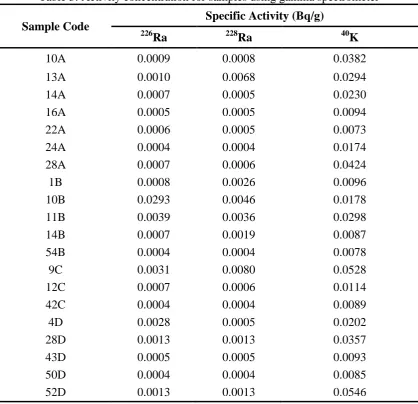
From the 270 samples screened, samples were selected for detail laboratory analysis. The samples selected were representing the range of activity concentration frequently encountered during the study. Detail laboratory analysis is required to measure the concentration of radionuclide present in the samples. Analysis for specific activity concentration for samples using gamma spectrometer is
Sample Code Net Weight (kg) Contamination Counts (cpm)
10A 2.895 1.4
13A 2.460 2.4
14A 2.770 3.0
16A 2.545 6.2
22A 1.490 4.8
24A 2.880 5.8
28A 2.835 2.4
1B 1.260 8.4
10B 0.395 4.6
11B 2.740 3.6
14B 2.635 2.8
54B 2.840 6.2
9C 2.270 1.4
12C 2.450 -0.8
42C 2.310 2.6
4D 0.833 3.4
28D 1.528 3.4
42D 2.003 6.6
50D 2.310 7.8
23
shown in Table 3. Three main radionuclides which are naturally occurring radionuclides were detected in the spectrum namely 226Ra, 228Ra and 40K.
Table 3: Activity concentration for samples using gamma spectrometer
Sample Code Specific Activity (Bq/g)
226
Ra 228Ra 40K
10A 0.0009 0.0008 0.0382
13A 0.0010 0.0068 0.0294
14A 0.0007 0.0005 0.0230
16A 0.0005 0.0005 0.0094
22A 0.0006 0.0005 0.0073
24A 0.0004 0.0004 0.0174
28A 0.0007 0.0006 0.0424
1B 0.0008 0.0026 0.0096
10B 0.0293 0.0046 0.0178
11B 0.0039 0.0036 0.0298
14B 0.0007 0.0019 0.0087
54B 0.0004 0.0004 0.0078
9C 0.0031 0.0080 0.0528
12C 0.0007 0.0006 0.0114
42C 0.0004 0.0004 0.0089
4D 0.0028 0.0005 0.0202
28D 0.0013 0.0013 0.0357
43D 0.0005 0.0005 0.0093
50D 0.0004 0.0004 0.0085
52D 0.0013 0.0013 0.0546
24
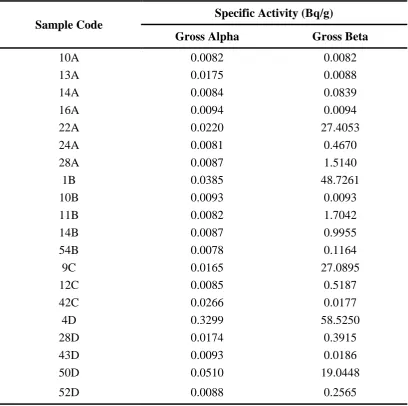
Table 4: Specific activity concentration for samples using gross alpha/beta counting
Sample Code
Specific Activity (Bq/g)
Gross Alpha Gross Beta
10A 0.0082 0.0082
13A 0.0175 0.0088
14A 0.0084 0.0839
16A 0.0094 0.0094
22A 0.0220 27.4053
24A 0.0081 0.4670
28A 0.0087 1.5140
1B 0.0385 48.7261
10B 0.0093 0.0093
11B 0.0082 1.7042
14B 0.0087 0.9955
54B 0.0078 0.1164
9C 0.0165 27.0895
12C 0.0085 0.5187
42C 0.0266 0.0177
4D 0.3299 58.5250
28D 0.0174 0.3915
43D 0.0093 0.0186
50D 0.0510 19.0448
52D 0.0088 0.2565
25
Table 5: Activity concentration of Tritium in samples as analysed using LSC
Sample Code Specific Activity of 3H (Bq/g)
10A 5.34
13A 0.01
14A 0.04
16A 2.98
22A 1191.78
24A 2.00
28A 20.74
1B 903.24
10B 0.02
11B 0.00
14B 0.01
54B 0.02
9C 709.15
12C 50.01
42C 0.03
4D 0.03
28D 8.53
43D 0.03
50D 0.02
52D 9.79
Declassification and Clearance Limit
In this study, a correlation is sought between the contamination count and the gross alpha/ beta count, substantiated with the gamma spectrometry and LSC analysis. If such correlation is established, a cut off contamination count could be resolute for the waste, by which any contamination count below this cut off count, the particular waste can be deemed cleared. This would facilitate quick decision during the screening step, without the need to undergo a more elaborate analysis of gross alpha/beta, gamma spectrometry and LSC analysis. As such, a characterization protocol could be developed for the purpose of declassification of the waste. Upon declassification, the organic liquid wastes are no longer classified as radioactive waste and could be cleared. According to Safety Reports Series 67 (IAEA, 2012), clearance refers to the radiation risks arising from the cleared material are sufficiently low as not to warrant regulatory control, and a continued regulatory control of the material would yield no net benefit, in terms of reduction of individual doses or reduction of health risks.
26
Table 6: Radioactive waste clearance level for selected nuclides
Nuclide Activity Concentration (Bq/g) Activity (Bq)
3
H 1x10⁶ 1x10⁹
14
C 1x10⁴ 1x10⁷
22
Na 10 1x10⁶
32
P 1000 1x10⁵
137
Cs 10 1x10⁴
Source: Atomic Energy Licensing Board (2011)
This study suggests that the characterization protocol of the mixed liquid organic could apply contamination counting step as the quick decision tool to sort between cleared, declassified waste and radioactive waste. Upon conservatism, the following values are proposed as the cut off limit: 2.4 Bq/g for beta emitter contaminants and 46 Bq/g for alpha emitter contaminants. When this cut off values are applied, 253 bottles of mixed organic liquid waste can be declassified and cleared, which makes up 93.7% of the samples screened. These wastes can then be treated as the conventional chemical wastes.
CONCLUSIONS
A characterization protocol as a quick decision tool to declassify mixed liquid organic radioactive waste is developed in this study. Contamination count using Geiger Muller Model 185-8 with three reference source was used as the key indicative parameter in declassifying the mixed waste as cleared waste. This study suggests a cut off limit of 2.4 Bg/g for beta emitter contaminants and 46 Bq/g for alpha emitter contaminants. This lead to the clearance of 253 bottles of mixed organic liquid waste which makes up 93.7% of the samples screened. With the set values established, characterization for the purpose of declassification is suffix to use the contamination count without the need to undergo more complex and time-consuming laboratory analysis.
ACKNOWLEDGEMENTS
The authors wish to express gratitude to Nur Azna, Nor Fazlina, Amran, Sahar, KFK group and Industrial Training students for their help in conducting screening and characterization works. Also thanks to Nuclear Malaysia for funding this project under PQRD project NM-R&D-13-04.
REFERENCES
Atomic Energy Licensing Board. (2011). Radioactive and Waste Management Regulations 2011.
27
IAEA, (2007). New developments and improvements in processing of ‘problematic’ radioactive waste, TECDOC 1579. Vienna.