Correspondence author: [email protected]
DEVELOPMENT OF SMART WIRELESS DETECTOR SYSTEM
FOR GAMMA RAY DETECTION
Nolida Yussup1, Nur Aira Abd. Rahman1, Ismail Mustapha2, Jaafar Abdullah2,
Mohd. Ashhar Hj. Khalid1, Hearie Hassan2 and Chong Foh Yoong1
1Instrumentation and Automation Centre (IAC), Technical Support Division 2Plant Assessment Technology Group (PAT), Industrial Technology Division
Malaysian Nuclear Agency Bangi, 43000 Kajang, Selangor, Malaysia.
ABSTRACT
Data transmission in field works especially that is related to industry, gas and chemical is paramount importance to ensure data accuracy and delivery time. A development of wireless detector system for remote data acquisition to be applied in conducting fieldwork in industry is described in this paper. A wireless communication which is applied in the project development is a viable and cost-effective method of transmitting data from the detector to the laptop on the site to facilitate data storage and analysis automatically, which can be used in various applications such as column scanning. The project involves hardware design for the detector and electronics parts besides programming for control board and user interface. A prototype of a wireless gamma scintillation detector is developed with capabilities of transmitting data to computer via radio frequency (RF) and recording the data within the 433MHz band at baud rate of 19200.
Keywords: gamma detector, radio frequency (RF), wireless
INTRODUCTION
Today, the industries is moving toward the implementation of wireless sensors that can operate in demanding environments and provide clear advantages in cost, size, power, flexibility and safety. By applying a wireless technology in the system, data will be transmitted by radio frequency (RF) links. Wireless communication is a viable and cost-effective method of transmitting data from the detector. For example, in the column scanning application, the wireless detector is placed on one side of the column direct to the laptop on the ground to facilitate data storage and analysis automatically. This work involves hardware design for the detector and electronics parts besides programming for control board and user interface.
44
METHODS
The smart wireless detector system can be divided into two parts, which are the component for the detector and the component for personal computer (PC). The component for detector consists of RF circuit with embedded PIC microcontroller, voltage divider and 12 V battery pack. Meanwhile for the computer part, the RF circuit is connected via RS-232 interface. The architecture of the system is shown in Fig. 1.
RF circuit with PIC Voltage divider 12V battery pack Detector RS-232 Data Command PC/User interface RF circuit with RS-232 interface
Fig. 1: System diagram
Detector Specification
The scintillation probe used consists of a 38 x 38 mm NaI(Tl) scintillation crystal optically coupled to a 38 mm diameter photomultiplier tube (PMT) [1]. NaI(TI) crystals belongs to inorganic scintillation crystal detector and the size can vary. The PMT converts the fluorescence to voltage pulse [2]. The PMT has a built-in voltage generator based on Cockroft-Walton principle directly mounted on the pins of the PMT [1]. Besides a built-in voltage generator, the detector is also composed of built-in spectroscopic shaping amplifier. Pulses exiting the amplifier circuit are converted into logic-level pulses for the counting circuit [3]. The counting circuit which is single channel analyzer (SCA) produces transistor-transistor logic (TTL) output pulses. The unit is powered with 12 V from two 6 V photo lithium batteries. The remote detector board combines three basic components needed to detect gamma rays which are signal generation, bias supply and a digital data acquisition. The gamma ray released from the radiation source is converted to respectively voltage signal, and then be send to data acquisition module via wireless interface.
Wireless Module
45
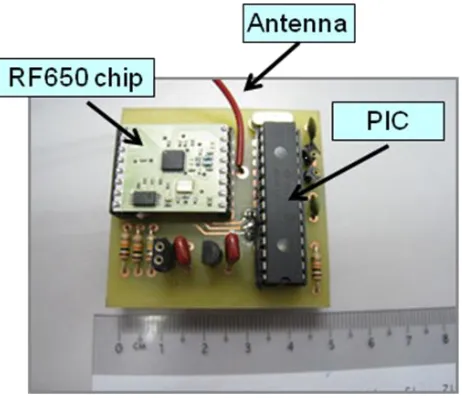
The signals coming from the detector are sent to the PIC microcontroller (Fig. 2) and transmitted to the PC’s transceiver module (Fig. 3) where the counts are displayed and stored by the data logging software running on the PC. A PIC microcontroller is applied as an embedded controller for the detector. A data protocol is created and it is programmed to receive commands sent by PC and transmit the response data. The PIC microcontroller embedded in the detector’s wireless module is programmed to be able to set count time of the detector, view current RF configuration of the wireless module and configure the RF channel besides stop and start counting for wireless communication with PC. Since the detector consists of a built-in voltage generator and SCA, voltage divider is designed and included in the detector’s transceiver module to control the lower level discriminator (LLD), upper level discriminator (ULD) and high voltage (HV) of the detector. The integration of a transceiver module, the detector and electronics, operates for point-to-point data communication with the transceiver module connected to PC, all powered up by two 6 V photo lithium batteries. The PC’s transceiver module is powered up by a single 9 V battery.
Fig. 2: Wireless circuit for detector Fig. 3: Wireless module for computer
(c) DATA LOGGING SOFTWARE
46
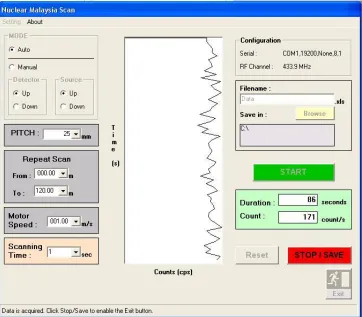
Fig. 4: Software user interface
The software is also capable of displaying the trend of data in real-time. Therefore, faults and defects in the column can be detected during the scanning process where users can see glitches in the data trend.
RESULT AND DISCUSSION
47
Fig. 5: Detector pleteau curve
The plateau curve is the characteristic of the scintillation detector. The result shows the stability of the detector where the plateau lies in the advised range of high voltage. Therefore, the wireless detector is capable of receiving the instructions from the PC and transmitting the gamma count to PC for display and storage. The wireless transmission using RF does not require a line-of-sight clearance.
CONCLUSIONS
A prototype of wireless detector and data acquisition system which composed of hardware and software has successfully been developed. A gamma detection system composed of detector based on wireless technology has been demonstrated. The prototype system is based on compact and low power wireless module with RF connectivity. The detector is having not only detection capability but also a built-in high voltage and discriminator circuits powered by 12 V input supply voltage. The system is not only wireless but also portable as the prototype arrangement operates on batteries. Besides column scanning application,the developed system can also be used in a wide range of applications, such as security task, environmental monitoring and nuclear waste control where it is vital to minimize personnel exposure radiation. The smart and wireless detector system can be expanded in several ways using commercially available components.
REFERENCES
Datasheet of NaI(Tl) scintillation probes. Bunnik, Netherlands, Scionix Holland B. V., 2005.
D.S. McGregor, S.L. Bellinger, D. Bruno et. al., (2007), Wireless Neutron and Gamma Ray Detector Modules for Dosimetry and Remote Monitoring, In. IEEE Nuclear Science Symposium Conference Record,
Knoll, G. F. (2000), Radiation Detection and Measurement. 3rd ed., John Wiley & Sons. Ye Mei, (2010), A Design of Gamma Ray Detecting System Based on ARM, In. IEEE.