The DiEusion
of
Hydrogen
through
-
Palladium
By
A.
s.
Darling,
Ph.D., A.M.1.Mech.E.The high rate a t which hydrogen can
diffuse through heated palladium was first
demonstrated by Thomas Graham. His
experiments on gases in metals began in 1866, when he was Master of the Mint ( I ) . Three years earlier, in 1863, Sainte-Claire
Deville and Troost (2) had shown that
hydrogen dif!hed rapidly through homo- geneous plates of fused iron and platinum. Graham's original objective appears to have been to confirm the findings of these workers, to improve upon their experimental methods, and to study the effects of gases on other metals.
He showed that the only gas capable of diffusing through platinum was hydrogen. Appreciable quantities of this gas permeated through the walls of a platinum tube a t a
dull red heat. The solubility of hydrogen in platinum was considerable. I n one instance
a fused platinum rod heated at 23oOC in
hydrogen was found to absorb 1.45 times its
own volume of the gas.
Graham's
Experiments
These surprising results led to a similar
series of experiments with palladium. Graham
relates that the only specimen of this metal he was at first able to obtain was in foil
form and weighed 1.58 gm. After first
degassing in vucuo it was allowed to cool slowly in hydrogen from z45"C, and was found at room temperature to have dissolved
526 times its own volume of this gas. Further
heating a t g0-97"C in hydrogen increased the room temperature solubility to 643 relative volumes.
By this time a compact tube of palladium
I mm in thickness had been made by George
Matthey. This tube had been rolled up
and hammer welded from sheet made from powder and forged near the melting point of the metal. It was 115 mm in length and
12 mm in internal diameter. One end was
closed by a thick plate of platinum which was
soldered on. The other end was connected
to a Sprengel pump by means of a platinum
tube. The complete assembly was sur-
rounded by a porcelain tube and a continuous
current of hydrogen was passed through the annular gap. The palladium tube became permeable to hydrogen at 240°C and a t a slightly higher temperature the rate of diffusion was several cc per minute. Only hydrogen was able to penetrate the tube, which was capable, however, of extracting this element preferentially from mixtures such as coal-gas.
Graham was greatly impressed by the extraordinary affinity of palladium for hydro-
gen. Because the amount of dissolved
hydrogen varied over a wide range he concluded that the effects could not be explained by the formation of a definite compound, and that the
''
occluded " gas (a term specially invented by him to describe the effect) probably formed a true alloy with the palladium.In order to account for the large increases of volume which resulted when palladium was heavily charged with hydrogen, tremen- dous mechanical forces would be required. Graham concluded that hydrogen could only exert such forces when present as a metal, which he called hydrogenium. The density of hydrogenium, calculated from that of fully
charged palladium, appeared to be 1.708 gm
It was believed that the metallic hydrogen concept was supported by the rcsults of experiments on meteoric irons which in some instances contained nearly three times
their own volume of this gas. Ordinary
wrought iron could not be induced to dissolve more than its own volume of hydrogen at
atmospheric pressure. These facts, sup-
ported by spectroscopic evidence, led to the hypothesis of hydrogenium as an essential constituent of many types of star.
Other Early Researches
Troost and Hautefeuille (3) were led by the
results of their researches in 1874 to conclude that hydrogen reacted with palladium to
form a definite compound Pd,H. This
compound, once formed, was supposed to dissolve large volumes of hydrogen, thus explaining the wide composition range en- countered. Hoitsema (4) in 1895 was able to show with the aid of some previously unpublished results of Roozeboom that the pressure solubility data could only be satis- factorily interpreted in terms of the formation of two non-miscible solid solutions. This is
precisely the view now held. The more
detailed X-ray and metallographic evidence now available confirms Hoitsema’s original conception of the equilibrium diagram of the palladium hydrogen system.
Ramsay (5) suggested in 1894 that the
hydrogen, during its passage through the walls of palladium membrane, was probably
in atomic form. This hypothesis was
confirmed by Winkelmann (6) in 1901, who
showed that this dissociation of molecules
into atoms on the surface of the palladium explained why the diffusion rate varied as the square root of the pressure difference across the membrane.
Much of the subsequent research work on palladium hydrogen dealt with more theo- retical aspects of the system. Very exact determinations of the equilibrium solubilities and phase relationships have been made and much attention has been devoted to the pro-
nounced hysteresis effects observed when the two phases are present simultaneously.
Attempts to utilise the remarkable perme- ability of palladium to hydrogen for industrial purposes have not been energetically pursued
until comparatively recently. Palladium
thimbles were of course used for purposes such as the introduction of small quantities of pure hydrogen into gas analysis apparatus. I n these instances the palladium septum was used only intermittently and the rate of diffusion was usually a secondary considera-
tion. The metal, when cooled down,
dissolved large volumes of pure hydrogen which could be discharged to the evacuated side of the system merely by gentle reheating. The palladium under these conditions acts merely as a pump.
Under steady conditions, however, the rate of diffusion of hydrogen was very variable. Barrer reported in several of his papers that palladium, depending upon the treatment it had received, might be either permeable or impermeable to hydrogen, and Lombard (7) stated that the permeability could be reduced by more than a hundredfold merely by heating the metal.
This capricious behaviour made palladium unsuitable for industrial applications, since it
meant that the performance of a diffusion
unit would be unpredictable. The metal was expensive and potential industrial applica- tions rather limited. These factors did not encourage extensive research on the variable permeability of palladium to hydrogen in the years before 1939.
Potential Industrial Applications
Developments of the immediate post-war
period altered to some extent the basic problems of chemical engineering with the result that considerable interest is now being displayed in the behaviour of palladium as a semi-permeable membrane.
Obvious applications occur in the field of atomic energy where the separation of
hydrogen isotopes is an essential process.
1
I
T O VACUUM
P U M P S
HYDROGEN
I N L E T T H E R M O C O U P L E
T O VACUUM
E X I T F O R
H Y D R O G E N
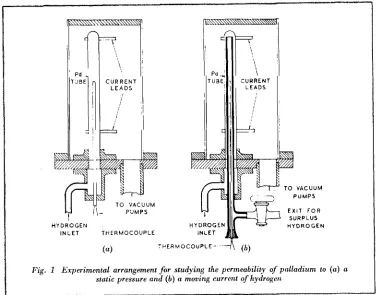
Fig. 1 Experimental arrang~ment f o r studying the permeability of palladium to (a) a static pressure and ( b ) a moving current of hydrogen
isotope through palkddium facilitates the separation process whether this is carried out directly from the gas phase at high pressure or at atmospheric pressure in electrolytic cells. The hydrogen deuterium separation factor is between four and five at room temperature and, by utilising the electrolytic migration of hydrogen through palladium membranes, the electrical require-
ments for electrolytic separation
can
bereduced considerably (8).
Potential large scale applications for palla- dium are also associated with the development of new refining methods in the petroleum industry. Efficient methods for the control
and removal of hydrogen which builds up in
cracking units and restrains the catalytic action are required, and the use of palladium has been suggested in this connection.
What is perhaps the most intriguing
possibility is concerned with the direct
production of power by electrochemical methods. The efficiency with which elec-
trical energy can be derived from fuel by mechanical methods is limited by restrictions imposed directly by Carnot’s cycle and the Second Law of Thermodynamics, with the
result that even the most modern power
stations can utilise successfully only about one-third of the fuel with which they are
supplied. Voltaic cells, which produce
electrical energy by the oxidation of metal plates,
can
under certain conditions have a‘‘
thermal ” efficiency approaching IOO per cent. Primary cells of this type have, ofcourse, been used for many years hut are
generally considered to be unsuitable for the economic production of electricity on a large
scale. This world shortage of’ fuel has,
however, stimulated interest in the possi- bilities of “ fuel cells ” in which electrical energy is produced directly by the oxidation of coal, gas and oil under carefully controlled conditions (9, 10, 11).
the fuel electrode and thkir transfer, via an external path, to the oxidising electrode by which they are consumed. An essential feature of the electrolyte employed is that it should prevent the molecular forms of the fuel and oxidant from mixing and transferring their electrons directly. In view of the semi-
permeable character of palladium it is
inevitable that it should have been considered as a material of great potential value for this
type of work. It is doubtful whether any
commercially successful cell will ever utilise
pure hydrogen as a fuel. A semi-permeable
membrane evolved for industrial use will have to deal with impure hydrogen and hydrocarbon vapours if it is to be successful.
Recent Experimental
Work
Factors likely to have some bearing on the
rather unpredictable permeability of palla-
dium have been made the subject of a recent
investigation in the Johnson Matthey Re-
search Laboratories. Attention has been
directed primarily toward determinations of
the specific permeability to hydrogen after the establishment of conditions necessary for reproducible behaviour. Circumstances leading towards the severe distortion and cracking which frequently results in the destruction of palladium diffusion membranes have
aIso been studied. Although the research has not yet been completed, it is felt that some of the results at present available are of sufficient interest to justify their inclusion in this article.
The first experiments were made usingan apparatussimilartothat shown
in Fig. I (a). Hydrogen of commercial
qualitywas fed at atmosphericpressure, via a flowmeter, to the interior of a palladium tube with a closed end. This tube was heated by the direct passage of a heavy current and temperatures were measured by the internal thermocouple shown. The space sur- rounding the palladium tube was evacuated. Measurements of the rate
of diffusion of hydrogen through the walls of the tube were obtained from the flow-meter and confirmed by the rate of rise of pressure
on the evacuated side of the system when this
was sealed off from the pumps.
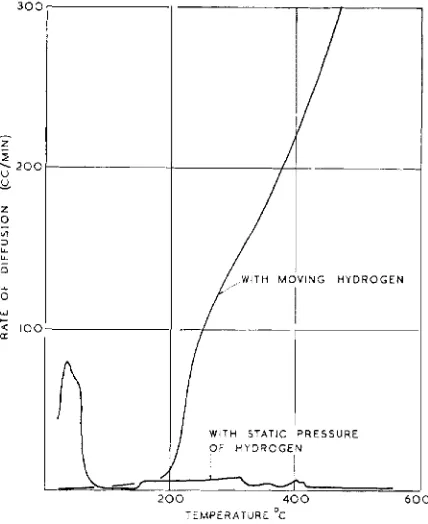
The results obtained with this arrangement were rather surprising because it was found that very little hydrogen diffused through the
tube. The permeability increased to a
maximum at about 115°C after which it
decreased rapidly. Whenever the tempera- ture was held constant the permeability
decreased until overnight annealing at 700°C
reduced the amount of hydrogen diffusing through the tube walls to a negligible value.
The tube was then vacuum annealed in situ
at 800°C and retested. This annealing
treatment reduced the rate of diffusion at lower temperatures still further.
These results were typical of many which were obtained using several different tubes and the experimental arrangement shown in Fig. I ( a ) . Although confirming to some extent the findings of previous workers, the
W I T H S T A T I C PRESSURE
2 0 0 4 0 0 t 0
T E M P E R A T J R E "C
Fig. 2 Permeability of palladium tubr with static
results were difficult to understand because it was known that in many applications large
volumes of hydrogen diffused continuously
through palladium. It was felt that the
palladium was becoming poisoned in some
way. Oxidation followed by reduction,
suggested by Lombard as a reactivation technique, was found to produce only small temporary improvements in permeability.
A paper by Davies (12) which became
available at this stage suggested that hydro- carbon vapours were the chief factors causing poisoning of palladium. Experiments were therefore undertaken in which sources of organic vapours were eliminated from the apparatus by the use of mercury pumps and liquid air traps. I n spite of these precautions
it was not possible to maintain a high degree
of permeability through a palladium tube at temperatures much above 150°C.
Experiments with a
Moving
Hydrogen
Atmosphere
Palladium tubes in gas analysis apparatus are frequently heated under conditions which permit slight oxidation of the outer surface. This suggested a new approach to the
problem and led to a number of ad hoc
experiments in which evacuated palladium tubes were gently heated externally with an oxy-hydrogen flame. All the tubes tested in
this manner allowed large volumes of hydro-
gen to diffuse through from the flame but
LL 3
T I M E IN H O U R S
-
22 MINUTESI
limitations of the apparatus prevented any
determination of the quantities involved.
The results were sufficient to show that high rates of diffusion were possible when oxygen was present in a hydrogen atmosphere which was in continuous movement over the surface o f the tube.
Subsequent experiments showed that the
presence of oxygen was not necessary and
that high rates of diffusion were maintained so long as the hydrogen atmosphere surround- ing the tube was in constant movement. I n order to investigate the effect in greater detail
the original apparatus w a s modified to
provide the arrangement shown diagram- matically in Fig. I (b).
With this arrangement either a static
pressure or a continuous flow of hydrogen could be maintained inside the diffusion tube. Fig. 2 illustrates some typicaI results obtained with and without an internal gas flow through the tube. The beneficial results
of gas circulation are very evident from this illustration.
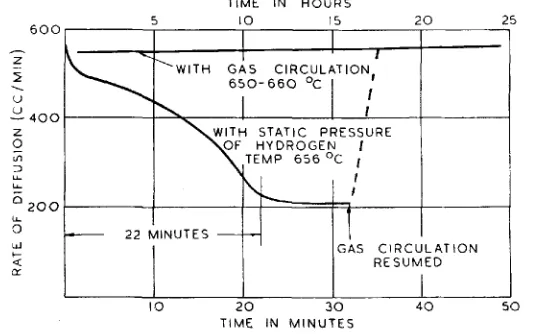
The rate of gas circulation required to maintain a high degree of permeability was surprisingly small and corresponded roughly
to an excess flow rate of 25 cc per minute when hydrogen was diffusing through the walls of the palladium tube at a rate of
500 to 600 cc per minute. When this
excess flow rate was completely stopped so that a static hydrogen pressure was main-
2 0
Z5 6 'WITH G A S O CIRCULATION. 0
I
Z 6 5 0 - 6 6 0 OC.
W I T H S T A T I C P R E S S U R E
m T E M P 6 5 6 O C
3
L
Fig. 3 Curves showing ths rapid decrease of permea- bility which occurs without a continuous circulation of
hydrogen
TEMPERATURE OC
Fig. 4 Curves showing the rate of diffusion of hydrogm through palladium tubes at various
tsmperatirres
tained inside the tube, the rate of diffusion decreased rapidly as can be seen from Fig. 3. In this instance the rate of diffusion decreased from 546 to 210 cc per minute in
a period of 32 minutes after the gas circulation had stopped, and regained its original value three minutes after the gas circulation was resumed. The upper curve on this figure shows that no decrease of permeability occurred over a z4-hour period when the gas circulation was maintained.
Results such as these suggest that the low permeability under static conditions is caused not by poisoning in the commonly accepted sense, but more probably by the formation, under stagnant conditions, of an inert layer of impurity gases either on, or near, the surface at which the hydrogen enters the palladium membrane. The impurities res- ponsible for this effect have not yet been
determined. A progressive decrease of
permeability occurs under static conditions even when the hydrogen supplied to the tube has been freed from oxygen, nitrogen, and water vapour.
Consistent and reproducible results are,
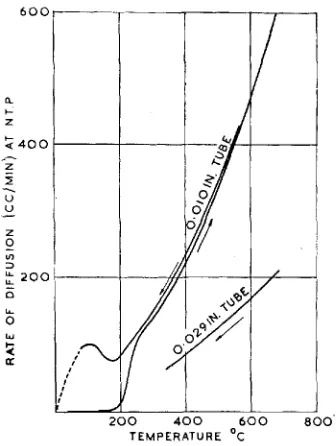
however, obtained with a stream of gas, and Fig. 4 illustrates some typical experimental results. The rate of diffusion was found to vary inversely with the tube thickness and when this factor was allowed for, all the tubes tested had similar degrees of permeability. Fig. 5 , in which the specific permeability, expressed in cc per minute per square cm per mm thickness for a pressure difference of 760 mm, is plotted against the temperature, summarises most of the results of this work. The continuous circulation technique appears therefore at the present time to
provide a satisfactory solution to the perme-
ability problem under certain conditions, although its effectiveness under different types of industrial environment has yet to be assessed.
Effects of Repeated Heating and
Cooling
in
Hydrogen
Palladium diffusion tubes frequently crack and distort badly in service even when they have been kept continuously in hydrogen. Cracks originate at the grain boundaries although they may eventually spread to the interior of the grain, The evidence at present
TEMPERATURE O C
Fig. 5 Speci$c permeability of palladium 10
available suggests that the tendency towards cracking and distortion increases with the grain size of the material.
The dimensional changes which occur when palladium is heated and cooled in hydrogen have been almost completely ignored in the literature, although the general effects were discussed by Graham as early as 1866. Effects produced by the sudden expulsion of hydrogen from electrolytically charged foils and wires were studied by
Loessner (13) in 1911 and by Krause and
Kahlenberg (14) in 1935. D. P. Smith (15)
seems to have been the first to associate these dimensional changes with the accompanying alpha-beta phase transformations. Experi- ments in these laboratories have shown that very spectacular effects can be produced by merely heating and cooling palladium in hydrogen at atmospheric pressure. Under these conditions the critical temperature range is between 100" and 250'C.
Thin sheet specimens were heated electric- ally in hydrogen at atmospheric pressure for
15 minutes at high and low temperatures
alternately. Cycling between room tempera- ture and 700°C resulted in considerable
distortion, blistering and thickening of the sheet. Similar results were obtained when
the temperature was cycled between ZO'C
and 35o'C. Temperature changes between
700°C and 3so-C produced relatively little
effect, however, and distortion of the specimen
cycled between 700°C and 250°C occurred
only at the ends which, being held in copper clamps, were probably well below the average specimen temperature.
Considerable distortion occurred when the
specimen was allowed to cool to IOOOC, and
when the lower temperature was reduced to 75°C blistering, thickening and general change of shape were very pronounced.
The damage at atmospheric pressure appears therefore to be caused by phase transformations in the temperature range 10o-25ocC. The value of the critical tem- perature will depend upon the operating
pressure. As the beta phase is unstable
above 310°C even at the highest pressures,
it appears reasonable to suggest that the effective life of industrial diffusion units could be considerably prolonged by main-
taining them continuously above this
temperature.
References
I
2
3 4 5 6 7
8
9
I 0
I1
I2
I 3 I4 I 5
T. Graham
H. Sainte-Claire Deville and . . . , L. Troost and P. Hautefeuille
C. Hoitsema . , . .
. .
..
W. Ramsay . . . . . . . .
A. Winkelmann
. .
. . . .V. Lombard, C . Eichner and M. Albert
0. N. Salmon . . . . . . . .
R. G. H. Watson
.
. . . I.A. P. Paton . . .. . . . .
Pittsburgh Consolidation Coal Co.
.
, W. D. Davies . . . . . . . .L. Troost
. .
Collected Chemical and Physical Researches, Ed.
Campt. rend., 1863,56,977-983;
Compt. rend., 1874, 78, 686-690
Z. physikal. Chem., 1895, 17, 1-42
Phil. Mug., 1894, 38, 206-218
Ann. Physik., 1901, 6, 104-115
Bull. SOL. Chim. France, 1936, 3, 2203-2220
U.S. Atomic Energy Comm., Report KAPL-1272
Research, 1954, 7, 34-40
Elect. Rev., 1952, 151, 888-890
British Patents 680, 982 (1951) and 690, 544 (1952) R. Angus Smith, Edinburgh, 1876
1863,571 965-967
U.S. Atomic Energy Comm., Reports KAPL-1227
and KAPL-1375
F. Loessner ,
.
. . . . . . Dissertn., Leipzig 1911W. Krause and L. Kahlenberg
D. P. Smith
. .
. .
, . ,.
Hydrogen in Metals, University of Chicago Press,. . Trans. Electrochem Soc., 1935, 68, 449-469