Modelling of the Downstream Processing of a
Recombinant Intracellular Enzyme
A thesis submitted to the University o f London for the degree o f
DOCTOR OF PHILOSOPHY
by
Edward George Varga B.Eng (Hons)
September 1997
Advanced Centre for Biochemical Engineering
Department o f Chemical and Biochemical Engineering University College London
ProQuest Number: 10017762
All rights reserved
INFORMATION TO ALL USERS
The quality of this reproduction is dependent upon the quality of the copy submitted.
In the unlikely event that the author did not send a complete manuscript and there are missing pages, these will be noted. Also, if material had to be removed,
a note will indicate the deletion.
uest.
ProQuest 10017762
Published by ProQuest LLC(2016). Copyright of the Dissertation is held by the Author.
All rights reserved.
This work is protected against unauthorized copying under Title 17, United States Code. Microform Edition © ProQuest LLC.
ProQuest LLC
789 East Eisenhower Parkway P.O. Box 1346
ABSTRACT
This thesis examines the generation and verification o f robust and predictive models for key unit operations in the downstream processing o f a recombinant intracellular enzyme. Computer models are becoming increasingly used in the biotechnology industry to assess process feasibility, ensure appropriate specification and achieve efficient operation o f bioprocesses. With increasing pressure to bring bioproducts to market in the shortest possible time and at low cost, it is essential that these models can be generated early in the development cycle with a minimum o f time and expense. Regulatory concerns over the use o f recombinant systems also require a highly consistent product and a large degree o f confidence in any final design. Models must therefore be verified against real process data in order to demonstrate and improve their validity.
The specific operations under study were cell disruption by high pressure homogenisation, enzyme fractionation and concentration by ammonium sulphate precipitation, and cell harvesting, debris removal and precipitate separation by disc stack centrifugation. Existing models based on the recovery o f alcohol dehydrogenase (ADH) from natural bakers' yeast were applied to the processing o f a protein engineered form o f the enzyme (pe-ADH) and their validity assessed by comparison with experimental data obtained from small amounts o f fermented recombinant material. Differences were observed in the processing o f the natural and protein engineered enzyme and, although parameter re-evaluation was generally required to maintain model accuracy, the models were found to be generic in nature. Individual unit models were then arranged and linked in a modular fashion to produce a whole process model. Verification o f the process model based on recombinant system parameters against pilot-scale data showed sufficient accuracy for use in feasibility studies (±30%). The inability to describe precipitant breakage in the disc stack centrifuge feed-zone was the major source o f model inaccuracy.
ACKNOWLEDGEMENTS
I would like to thank my supervisor Professor Peter Dunnill and my advisor Dr. Nigel J. Titchener-Hooker for their guidance, encouragement and support throughout the preparation o f this thesis.
I would also like to thank Kirsty Sinclair, Dr. Peter Piper, Dr. Sian Shore and Dr. John Ward for their work on recombinant strains that have subsequently been examined in this thesis and much helpful advice. The assistance o f Somaiya Siddiqi, Dr. Mitra Deghani, Dr. Andrew Clarkson and Dr. Mark Bulmer with initial work was also appreciated.
I am also very grateful for financial support provided by the BBSRC sponsored Advanced Centre for Biochemical Engineering and the ORS Award scheme.
Special thanks must go to John Maybury and Dr. Emma Fischer for many useful discussions and help with experimental work. I would also like to express my gratitude to Billy Doyle, Chris Seaton and Alison Clayton for all their time and assistance in the UCL pilot plant, and to Nasreen Adibi for her help in completing analytical work. Thanks also go to the many others I have worked with at UCL, particularly on the 1 st and 2nd floors o f the Engineering building.
TABLE OF CONTENTS
Abstract 2
Acknowledgments 3
Table o f Contents 4
List o f Figures 9
List o f Tables 13
Abbreviations 15
1.0 Introduction 17
1.1 Background 17
1.2 Intracellular Enzyme Downstream Processing 18
1.2.1 Overview o f Protein Production 18
1.2.1.1 Cell Separation 19
1.2.1.2 Cell Disruption 20
1.2.1.3 Debris Removal 21
1.2.1.4 Solubilisation and Refolding 21
1.2.1.5 Enrichment Techniques 22
1.2.1.6 High Resolution Techniques 23
1.2.1.7 Polishing and Finishing Operations 23 1.2.1.8 Commonly Utilised Operations 24 1.2.2 Typical Intracellular Enzyme Recovery Process 24 1.2.3 Downstream Process Unit Operations 25 1.2.3.1 High Pressure Homogenisation 25 1.2.3.2 Neutral Salt Protein Precipitation 29 1.2.3.3 Disc Stack Centrifugation 33 1.3 Impact o f Recombinant Techniques on Downstream Processing 35 1.3.1 Protein Production from Recombinant Cells 35
1.3.2 Protein Engineering 40
1.4 Bioprocess Simulation 44
1.4.1 Process Simulation 44
1.4.2 Simulation in Process Design and Operation 47 1.4.3 Possible Improvements to Process Simulators 51 1.4.4 Simulation o f Biochemical Processes 51 1.4.5 Application of Simulation to
Protein Downstream Processing 54
1.5 Experimental System 58
1.5.1 Saccharomyces cerevisiae Strain M CI 60
1.5.2 ADH Overexpressing Strain 61
1.5.3 Transformed Escherichia coli Strain WL2 62
1.6 Aims o f Research 62
1.7 Summary 63
2.0 Bioprocess Model Development 64
2.2 Process Modelling 64
2.3 Bioprocess Models 69
2.3.1 Current Approaches to Bioprocess Model Development 69 2.3.2 Use o f Verification Studies for Model Extension 71
2.4 Available Modelling Software Packages 74
2.4.1 Spreadsheets 74
2.4.2 Computer Languages 74
2.4.3 Special Application Packages 74
2.4.4 General Purpose Simulators 75
2.4.5 Process Simulators specifically for Bioprocesses 75
2.4.6 Selected Software Packages 75
2.5 Conclusions 76
3.0 Materials and Methods 77
3.1 Introduction 77
3.2 Analysis Techniques 77
3.2.1 Assays 77
3.2.1.1 Alcohol Dehydrogenase 77
3.2.1.2 Total Protein 78
3.2.1.3 Glucose 79
3.2.1.4 Ethanol 80
3.2.2 Dry Weight Determination 81
3.2.2.1 Filtered Dry Weight 81
3.2.2.2 Microtube Dry Weight 81
3.2.3 Optical Density Determination 82
3.2.4 Microscopic Counts 82
3.2.5 Aqueous Fraction Determination 82
3.2.5.1 Centrifuge Method 82
3.2.5.2 Dilution Method 83
3.2.6 Gel Electrophoresis 83
3.2.6.1 Protein Gels 83
3.2.6.2 ADH Activity Gels 85
3.2.7 Particle Size Analysis 86
3.2.7.1 Elzone Method 86
3.2.7.2 Laser Sizing 88
3.2.8 Physical Property Determination 91
3.2.8.1 Liquid Density 91
3.2.8.2 Particle Density using Percoll gradients 91 3.2.8.3 Precipitate Density using
Disc Centrifugal Photosedimentation 92
3.2.8.4 Viscosity 94
3.3 Cell Culture and Fermentations 95
3.3.1 Yeast Strains 95
3.3.2 Culture o f Saccharomyces cerevisiae Strain M C 1 95
3.3.2.2 Shake Flask Culture 97
3.3.2.3 Fermentations 97
3.3.3 Culture o f Escherichia coli Strain WL2 98 3.3.4 Culture o f the ADH Overexpressor and Wild Type 99
3.3.5 Monitoring during Cell Culture 101
3.3.5.1 Cell Optical Density 101
3.3.5.2 Cell Dry Weight 101
3.3.5.3 ADH Activity and Total Protein Level 101
3.3.5.4 Ethanol Level 102
3.3.5.5 Glucose Level 102
3.3.5.6 Checks for Contamination 102
3.3.5.7 Plasmid Stability 104
3.3.5.8 Gas Analysis 105
3.4 Downstream Processing 105
3.4.1 High Pressure Homogenisation Studies 105 3.4.1.1 Characterisation using a Scale-down Unit 105 3.4.1.2 Pilot-Scale Homogenisation 106 3.4.1.3 Homogenisation Monitoring 107 3.4.2 Neutral Salt Protein Precipitation Studies 108
3.4.2.1 Solubility Profiles 108
3.4.2.2 Two-cut Precipitation 109
3.4.2.3 Precipitation Monitoring 110
3.4.3 Disc Stack Centrifugation Studies 111 3.4.3.1 Cell Harvesting and Washing 112
3.4.3.2 Debris Removal 113
3.4.3.3 Precipitate Separation 114
3.4.3.4 Recovery and Grade Efficiency Determination 114
3.4.4 Full Process Runs 115
3.5 Data Analysis and Modelling 116
4.0 Comparison o f Recombinant Strains and Fermentation Characterisation 118
4.1 Introduction 118
4.2 Shake Flask Comparison o f Recombinant Strains 118
4.2.1 Escherichia coli Strain WL2 120
4.2.2 Saccharomyces cerevisiae Strain MC 1 121
4.2.3 ADH Overexpressor 122
4.3 MCI Strain Fermentation Characterisation 122
4.3.1 Typical Fermentation Trends 126
4.3.2 Consistency o f Fermentation Results 126 4.3.3 Intermediate Storage o f M CI Strain Cells 129 4.3.4 Comparison o f MCI Strain and Bakers' Yeast 129
4.4 Summary 132
5.0 Modelling o f High Pressure Homogenisation 134
5.2 Existing Models for Yeast Homogenisation 134 5.3 Application o f Existing Homogenisation Models to the M CI Strain 138 5.4 Utilisation o f a Scaled-down Homogeniser 139
5.5 Results and Discussion 140
5.5.1 Homogenisation Characterisation with a Scale-down Unit 140 5.5.1.1 Aqueous Fraction and Maximum Release 140 5.5.1.2 Soluble Protein andp e -A D R Release 142
5.5.1.3 Debris PSD Modelling 145
5.5.1.4 Changes in Homogenate Physical Properties 149 5.4.2 Scalability o f Homogenisation Models 151
5.6 Conclusions 153
6.0 Modelling o f Protein Precipitation 155
6.1 Introduction 155
6.2 Existing Models for Protein Precipitation 156 6.2.1 Protein Solubility Behaviour in Aqueous Salt Solutions 156
6.2.1.1 Empirical Models 156
6.2.1.2 Theoretical Models 157
6.2.1.3 Mixing Considerations 162
6.2.2 Description and Optimisation o f Fractional Precipitation 164 6.2.3 Protein Precipitate Particle Size Distribution 167 6.2.3.1 Modelling o f Nucléation and Perikinetic Growth 167 6.2.3.2 Modelling o f Orthokinetic Growth 169 6.2.3.3 Modelling o f Shear-Induced Breakage 170 6.2.3.4 The Population Balance Model 172 6.2.3.5 The Discretised Population Balance 175 6.3 Application o f Existing Precipitation Models to the M CI Strain 178 6.3.1 Description o f Solubility Profiles and ADH Fractionation 178 6.3.2 Modelling changes in Particle Size Distribution 179 6.3.3 Prediction o f Solubility Changes for the
Protein Engineered System 180
6.4 Results and Discussion 181
6.4.1 Precipitation Characterisation using a Small Scale System 181
6.4.1.1 Solubility Behaviour 181
6.4.1.2 Fractional Precipitation 189 6.4.2 Modelling o f the Precipitate Particle Size Distribution 191 6.4.3 Precipitate Physical Properties 195 6.4.4 Scalability o f the Solubility Models 197
6.5 Conclusions 200
7.0 Modelling o f Disc Stack Centrifugation 202
7.1 Introduction 202
7.2.2 The Sigma Concept 204
7.2.3 The Grade Efficiency Concept 208
7.2.4 Accounting for Hindered Settling 210
7.2.5 Breakage o f Biological Particles 212 7.3 Implementation o f Models for Disc Stack Centrifugation 213 7.4 Utilisation o f a Scaled-Down Disc Stack 217
7.5 Results and Discussion 217
7.5.1 Feed Stream Properties and Calculated Critical Diameter 217 7.5.2 Separation o f Recombinant Whole Cells and Cell Debris 219 7.5.3 Separation o f Recombinant Protein Precipitate 228
7.6 Conclusions 231
8.0 Modelling o f the Whole Process 233
8.1 Introduction 233
8.2 Modelling o f a Downstream Processing Sequence 233 8.3 Implementation o f a Whole Process Model 234 8.3.1 High Pressure Homogenisation Module 235
8.3.2 Protein Precipitation Module 235
8.3.3 Disc Stack Centrifugation Module 236
8.3.4 Describing the Whole Process 236
8.4 Results and Discussion 238
8.4.1 Comparison o f Model and Experimental Results 238 8.4.2 Process Interactions and Sensitivity 242 8.4.3 Generic Nature o f Bioprocess Models 245 8.4.4 Utility o f Small Scale and Scale-Down Systems for
Model Extension 246
8.4.5 Modelling as part o f Process Development 247
8.5 Conclusions 249
9.0 Overall Conclusions 250
10.0 Recommendations for Future Work 252
Nomenclature 253
References 258
Appendix 1: Listing o f MATEAB two-cut fractional precipitation
optimisation program 275
Appendix 2: Typical small scale precipitation material balances 277
Appendix 3; Listing o f MATLAB precipitation population balance model 279
Appendix 4: Listing o f MATLAB time-step disc stack centrifuge
LIST OF FIGURES
1.1 Outline of protein production. 19
1.2 Typical intracellular enzyme recovery process. 25 1.3 Cross section through a high pressure homogeniser valve,
from Wheelwright (1991). 25
1.4 Diagram o f various valve configurations used for disrupting
microorganisms, from Wheelwright (1991). 25
1.5 Flow o f liquid and particles within the discs o f a disc stack centrifuge. 34 1.6 Synthesis and isolation o f fusion proteins produced by bacteria,
from Brewer et al. (1991). 42
1.7 Structure o f process simulators, from Biegler (1989). 46
1.8 Formation o f the MCI strain. 61
2.1 Traditional approach to model development. 66
2.2 Model extension approach. 73
3.1 Schematic o f Elzone 280 PC Particle Sizer. 87
3.2 Schematic o f Laser Sizer. 90
3.3 Disc Centrifuge Photosedimentometer operation,
from Middelberg and Bogle (1990). 94
4.1 Trends in dry weight, glucose concentration and ethanol concentration
for a 1000 L fermentation o f Saccharomyces cerevisiae strain MC 1. 124 4.2 Trends in DOT, OUR, CER and RQ for a 1000 L fermentation
o f Saccharomyces cerevisiae strain MC 1. 124 4.3 Cell number and geometric mean diameter during a 30 L fermentation o f
Saccharomyces cerevisiae strain MCI with a stirrer speed o f 500 rpm
and 1.0 mL.L*' PPG antifoam. 125
4.4 Percentage of cells containing the plasmid during Saccharomyces cerevisiae
strain MC 1 culture. 125
4.5 SDS-PAGE comparison o f protein from Saccharomyces cerevisiae
4.6 Native-PAGE comparison o f protein from Saccharomyces cerevisiae
strain MC 1, packed bakers' yeast and pure yeast ADH. 131 4.7 Activity gel comparison o f ADH from Saccharomyces cerevisiae
strain MC 1 and packed bakers' yeast. 132
5.1 Aqueous fraction plotted against soluble protein assay result. 141 5.2 M CI strain soluble protein release at 1200 barg plotted against
the number o f passes. 141
5.3 M CI strain percentage o f soluble protein released plotted
against percentage ofpg-ADH released. 143
5.4 M CI strain normalised log soluble protein release at 280 g.L '
and 450 g.L‘‘ plotted against the number o f passes. 144 5.5 MCI strain normalised log soluble protein release plotted against
the number o f passes. 144
5.6 MCI strain homogenisation at 280 g.L'' and 500 barg relative
(undersize) volume PSD. 147
5.7 MCI strain debris Boltzman average diameter plotted against the
number of homogenisation passes. 147
5.8 MCI strain debris Boltzman constant w plotted against the number
o f homogenisation passes. 148
5.9 M CI strain homogenisation cumulative (undersize) relative volume
PSD at 280 g.L*'and 500 barg. 148
5.10 MCI strain homogenate viscosity at 500 barg plotted against the
number o f batch passes. 150
5.11 M CI strain normalised log soluble protein release at 280 g.L*'
and 500 barg for various scales o f operation. 152 5.12 M CI strain cumulative (undersize) volume PSDs after 5 passes
at 280 g.L*' and 500 barg for various scales o f operation. 153
6.1 Typical enzyme-total protein fractionation diagram. 165 6.2 Fractional solubility o f fermented recombinant yeast a) total protein
6.3 Fractional solubility o f packed bakers' yeast a) total protein and
b) ADH under various processing conditions. 184
6.4 Solubility profiles for a) total protein and b) ADH for various initial
yeast concentrations. 187
6.5 : Fitted Cohn parameter P plotted against initial ADH activity. 188 6.6 Fitted Cohn parameter plotted against initial ADH activity. 188 6.7 Optimum a) 1st Cut and b) 2nd Cut points at various ADH yields for
a two-cut fractional precipitation. 190
6.8 Maximum purification factor at various ADH yields for a two-cut
fractional precipitation. 191
6.9 40% cut point precipitate particle diameter plotted against time for batch
ageing at a shear rate o f a) 100 s’’ and b) 5 s''. 193 6.10 60% cut point precipitate particle diameter plotted against time for batch
ageing at a shear rate o f a) 100 s'' and b) 5 s''. 194 6.11 Protein engineered system precipitate particle density plotted against
particle diameter. 196
6.12 Large scale protein engineered system fractional solubility o f a) total
protein and b) ADH for each cut point over the batch ageing period. 199
7.1 Flow through the disc space o f a disc stack centrifuge. 206 7.2 Typical grade efficiencies for disc stack centrifugation. 210 7.3 Sedimentation o f spherical particles, from Mannweiler (1989). 211 7.4 Schematic o f solid mass balance over the disc stack centrifuge
for each time step. 215
7.5 Calculated steady state recovery efficiency at various values o f Q/E
from bakers' yeast properties and from recombinant yeast properties. 219
7.6 Recombinant whole cell grade efficiencies. 220
7.7 1% (w/v) recombinant debris grade efficiencies. 222 7.8 Recombinant debris scale-down grade efficiencies. 222 7.9 Recovery efficiency plotted against time for scale-down debris removal
7.10 Mass balance model recovery efficiencies plotted against time for scale-down debris removal at 10 L.h'% no discharge and initial
280 g.L ' yeast. 227
8.1 Whole process model for the large pilot-scale recovery o f pe-ADW
from a fermented recombinant yeast. 237
8.2 Total protein andp e-A D R experimental mass balances for large
pilot-scale process run PPW 1. 239
8.3 Experimental and simulatedpe-A D R step yield for the large pilot-scale
recovery o f pe-AiDR from fermented recombinant yeast broth. 240 8.4 Solid concentration in supernatant following debris removal predicted by
the recombinant whole process model for a range o f homogenisation
LIST OF TABLES
1.1 Parameters that determine the solubility o f proteins, from Foster (1994). 31 1.2 Application o f dynamic simulation in various project phases,
from Naess et al. ( 1993) 50
1.3 Alcohol oxidation rates for natural and protein engineered yeast ADH. 61
3.1 Percoll standard solutions. 91
3.2 Culture media for storage of Saccharomyces cerevisiae strain M C I. 96 3.3 CovayAQx mQÔmm fox Saccharomyces cerevisiae sXiamMCl fermentations. 96 3.4 M CI strain fermenter operating parameters. 98 3.5 Culture media for storage o f Escherichia coli strain M C I. 98
3.6 Culture media for the ADH overexpressor. 100
3.7 Saccharomyces cerevisiae strain MCI ‘CDM’ defined media components. 103
3.8 Batch precipitation reactor dimensions. 109
4.1 Escherichia coli strain WL2 complex media shake flask results. 119 4.2 Saccharomyces cerevisiae strain MCI complex media shake flask results. 119 4.3 ADH overexpressor defined media shake flask results. 120 4.4 Typical levels o f ADH and total protein for bakers' yeast. 120 4.5 Typical results for Saccharomyces cerevisiae strain M CI complex media
shake flask culture and fermentations at various scales. 123 4.6 Power input per unit volume for fermentations at various scales. 127 4.7 Variability o f 30 L fermentation results (24 h results used in all cases). 128 4.8 Comparison o f properties of Saccharomyces cerevisiae strain M CI cells
and natural bakers' yeast cells. 130
5.1 Experimentally determined liquid and particle densities for homogenisation o f 280 g.L'' MCI strain yeast after various
homogeniser passes at 500 barg. 151
6.1 Two cut fractional precipitation optimisation routine o f Richardson (1987). 166
6.3 Aggregation kernels. 176
7.1 Summary o f centrifuge feed material properties and calculated d^ g^p
values at 50 L.h'’ for the recombinant process. 218 7.2 Experimental and calculated steady state solids recovery for full
pilot scale recombinant cell harvesting. 220
7.3 Experimental and calculated steady state solids recovery for full
pilot scale recombinant cell washing. 221
7.4 Experimental and calculated steady state solids recovery for full
pilot scale recombinant debris removal at the process concentration. 223 7.5 Experimental and calculated discharged solids concentration and
soluble product yield for each centrifugation stage. 225 7.6 Experimental and calculated overall solids recovery for debris removal
at process concentration with and without solids breakthrough. 226 7.7 Experimental and predicted overall recovery efficiency for large pilot-scale
precipitate separation at 50 L.h ' and discharges at 0.167 h. 230 7.8 Experimental overall recovery efficiency for small pilot-scale precipitate
separation. 230
8.1 Experimental and whole process model results for the large pilot-scale
recovery o f pg-ADH from 500 L o f fermented recombinant yeast broth. 241
A2.1 MCI strain precipitation ADH balance. 277
ABBREVIATIONS
ADH alcohol dehydrogenase Al-DH aldehyde dehydrogenase ATP adenosine tri-phosphate
CER carbon dioxide evolution rate (mm ol.L''.h’*)
CDM Saccharomyces cerevisiae strain M CI defined media CDH Saccharomyces cerevisiae strain M CI defined media with
added histidine
CDTH Saccharomyces cerevisiae strain MC 1 defined media with added tryptophan and histidine
CSTR continuous stirred tank reactor
DOT dissolved oxygen tension (% saturation) DNA deoxyribonucleic acid
DM defined media for ADH overexpressor strain
DUC defined media for ADH overexpressor strain with added uracil and Casamino acids
DUCT defined media for ADH overexpressor strain with added uracil, Casamino acids and tryptophan
G-6-P glucose-6-phosphate
G-6-PDH glucose-6-phosphate dehydrogenase
HIS histidine
HK hexokinase
HLADH horse liver alcohol dehydrogenase IPTG isopropylthiogalactoside
OUR oxygen uptake rate (mmol.L '.h’') NAD nicotinamide adenine dinucleotide
NADH reduced form o f nicotinamide adenine dinucleotide PAGE polyacrylamide gel electrophoresis
pe-AD W protein engineered alcohol dehydrogenase PPG polypropylene glycol
PSD particle size distribution
rpm revolutions per minute RQ respiratory quotient SDS sodium dodecyl sulphate
SQP successive quadratic programming t-PA tissue plasminogen activator
TRP tryptophan
YADH yeast alcohol dehydrogenase
1.0 INTRODUCTION
1.1 Background
Downstream processing is an important part of protein production and involves isolating a protein o f a desired purity, quantity and biological activity. Traditionally, the design and operation o f downstream processes has been carried out using empirical approaches such as scale-up methods (Clarkson, 1994). However, as pressures to bring a protein to market in the shortest possible time increase and the number o f process alternatives grow there is rising recognition that the application o f simulation and modelling can speed up bioprocess design and produce a more effective operating process (Cooney et ai, 1988; Gritsis and Titchener-Hooker, 1989; Petrides et ai, 1989; Narodoslawsky, 1991).
One o f the main obstacles to a greater use of simulation in this area has been the lack o f robust, predictive models (Gritsis and Titchener-Hooker, 1989). This has come about due to the complex nature o f biochemical systems, which has led to a lack o f available physical property data and poorly understood unit operations. Process interactions are also significant (Fish and Lilly, 1984) and must be incorporated into models to enable determination of overall process performance (Siddiqi et al, 1991; Clarkson et al, 1993; Middelberg et al, 1992a; Middelberg 1995b; Zhou et a l, 1997). The increasing use of recombinant systems in the bioprocess industries to increase protein production and simplify downstream processing provides additional challenges to model development and the use o f simulation. Although it has become possible to control the rate and location o f protein production within an organism, or the structure o f the protein itself, a highly consistent product and a large degree o f confidence in any final process are required to satisfy safety and regulatory concerns.
In the next section the downstream processing o f intracellular enzymes is outlined. In Section 1.3 the application o f recombinant techniques during protein production and its effect on downstream processing is examined. In Section 1.4 process simulation is described and its application and implementation for biochemical processes and downstream processing in particular are explored. A description o f the experimental systems utilised is given in Section 1.5 and aims o f the research are then listed in Section 1.6.
1.2 Intracellular E nzym e D ow nstream Processing
1.2.1 Overview of Protein Production
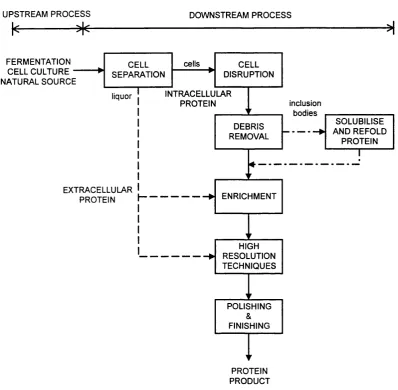
Commercially, proteins are widely used as therapeutic agents, as pharmaceuticals and for medical diagnosis. They also have industrial applications in food processing and as catalytic enzymes. The steps required for the production o f a protein are outlined in Figure 1.1 overleaf. The actual recovery o f a protein product from the source is termed "downstream processing" and involves isolating the protein to a desired purity, quantity and biological activity, i.e. with the correct structure. The importance o f downstream processing in the overall production o f a protein is illustrated by the fact that the recovery costs for an enzyme product such as P-galactosidase are approximately twice that o f the fermentation costs (Datar, 1986) and are even higher for pharmaceutical and diagnostic proteins such as monoclonal antibodies (Siletti, 1988).
whether inclusion bodies are produced when a recombinant system is utilised (Section 1.3).
UPSTREAM PROCESS
M— — —
DOWNSTREAM PROCESS
FERMENTATION CELL CULTURE “ NATURAL SOURCE
c e l l s
INTRACELLULAR PROTEIN
liq uor
in c lu s io n b o d i e s
EXTRACELLULAR
PROTEIN ENRICHMENT
POLISHING FINISHING
HIGH RESOLUTION TECHNIQUES
DEBRIS REMOVAL
CELL DISRUPTION CELL
SEPARATION
SOLUBILISE AND REFOLD
PROTEIN
PROTEIN PRODUCT Figure 1.1: Outline o f protein production.
A number of extensive reviews o f the various downstream processing operations used during protein production are available in the literature (Scawen and Melling, 1985; Atkinson et al, 1987; Belter et a l, 1988; Ogez et al, 1989; Hamel and Hunter, 1990; Liddel, 1994). A brief outline o f some o f the main operations is therefore given below, with the specific intracellular enzyme recovery process and unit operations considered in this thesis described in more detail in Sections 1.2.2 and 1.2.3 respectively.
1.2.1.1 Cell Separation
Centrifugation involves the application o f a centrifugal force to the cell suspension which causes the cells to sediment. A number o f different centrifuge configurations are available. Fixed-volume and ultra centrifuges are operated as batch machines and are generally used on the laboratory scale (Hamel and Hunter, 1990). At larger scales, semi batch machines such as the tubular bowl and multichamber centrifuge and continuous machines such as the disc stack and decanter centrifuge are more often employed. Filtration is a commonly used alternative to centrifugation and either conventional or membrane filtration can be used (Ogez et al, 1989).
In the case of an extracellular product, the clarified liquid is then processed to obtain the desired protein. For an intracellular product, the separated cells must first be disrupted before enrichment and high resolution operations can be carried out. The reduction in volume produced by cell separation in the case o f an intracellular product has the advantage o f significantly reducing the scale o f subsequent processing stages.
1.2.1.2 Cell Disruption
and for use in combination with mechanical methods to reduce power requirements (Middelberg, 1995a).
1.2.1.3 Debris Removal
A debris removal stage typically follows cell disruption. The aim o f this stage is to remove cell fragments which have been produced during cell disruption in order to prevent fouling o f subsequent process operations (Hearle et a l, 1993). The same unit operations can be used for separation o f the debris as for cell separation i.e. centrifugation and filtration. However, in comparison to the recovery o f cells from fermentation broth during cell harvesting, cell debris is more difficult to remove because:
• the viscosity and density o f the liquid phase is increased due to the release o f cellular components during cell disruption (Mosqueira et al, 1981)
• the cellular debris has a reduced particle size compared to whole cells due to the rupture and possible micronisation o f cells during disruption.
• the disrupted stream is often more concentrated since a reduction in volume is achieved during cell harvesting.
A balance must therefore be realised between the cell disruption conditions employed and the ease o f subsequent debris removal (Siddiqi et al, 1991; Middelberg, 1995a; Zhou et al, 1997). When recombinant expression systems have been used and the protein product is in the form o f inclusion bodies or virus-like particles (Section 1.3) the conditions used during debris removal operations must be carefully considered to ensure separation o f the dense protein particles from other cell components and debris.
1.2.1.4 Solubilisation and Refolding
compounds to disrupt disulphide bridges and convert polypeptides into a totally random structure (Ogez et a l, 1989; Heinrikson and Tomasselli, 1991). The perturbing influence is then removed and the polypeptides transferred to a buffer under oxidising conditions, often by using dialysis or diafiltration, to allow the protein to refold into the correct structure. Although the processing o f inclusion bodies requires extra process stages, the protein within inclusion bodies is often relatively pure and therefore some simplification in subsequent purification operations can be achieved. The impact o f recombinant techniques on protein production is examined in more detail in Section 1.3.
1.2.1.5 Enrichment Techniques
Protein enrichment is usually the first step in separating a specific protein fi-om a mixture o f other proteins and contaminants. The aim o f protein enrichment is to concentrate the desired protein, either in a solid or liquid phase. The main advantage o f using protein enrichment techniques is that the scale of subsequent high resolution operations is significantly reduced, thereby providing savings in both capital and operating costs. Commonly used enrichment operations include ultrafiltration, precipitation and extraction.
1.2.1.6 High Resolution Techniques
High resolution techniques are employed to increase the purity o f the protein product to an acceptable level. The most widely used and versatile high resolution technique is chromatography, which involves the flow o f a fluid through a column o f material which selectively retards certain components o f the fluid. It thereby becomes possible to separate a target protein from other proteins and contaminants with a high selectivity. Various types o f chromatography are possible, including gel filtration, ion exchange, hydrophobic interaction (HIC), affinity and high performance liquid chromatography (HPLC). Electrophoresis can also be applied as a high resolution technique. The operation is based on the acceleration o f charged proteins in an electric field and enables the separation o f proteins with a different net charge. The use o f electrophoresis has generally been limited to small scale protein purification due to scale-up difficulties that arise from product heating (Liddell, 1994).
1.2.1.7 Polishing and Finishing Operations
1.2.1.8 Commonly Utilised Operations
A review o f 100 papers on protein purification published in 1984 by Bonneijea et al.
(1986) revealed that, on average, four purification steps were required to purify proteins to homogeneity with an overall yield o f 28% and a purification factor o f 6,380. Just under 10% o f the papers reported the use o f recombinant systems. Ion exchange chromatography was the most commonly used operation, occurring in 75% o f purification schemes. The most frequently employed first step in a purification process was homogenisation, with precipitation the most common second step. Three quarters o f the precipitation methods used ammonium sulphate as the precipitant. It should be noted that a number o f novel techniques are currently being developed, including magnetic separation, electrically assisted filtration and supercritical fluid extraction, which may become more widely used during protein production in the future (Liddell, 1994).
1.2.2 Typical Intracellular Enzyme Recovery Process
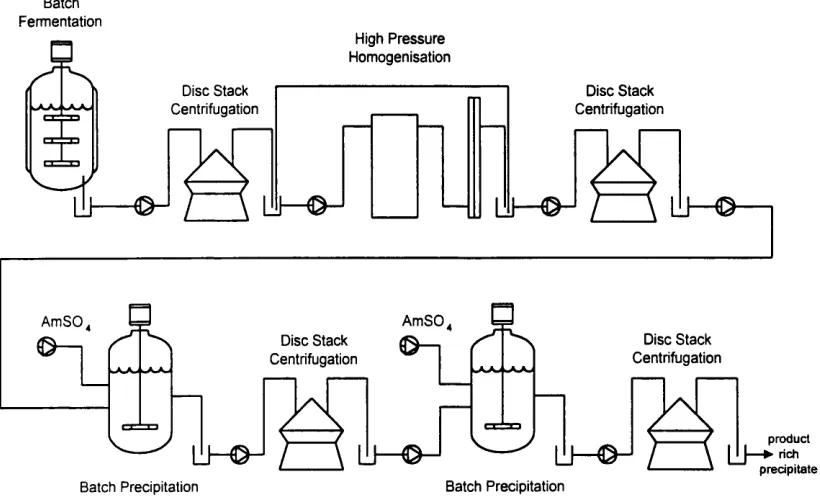
In this thesis, the typical intracellular enzyme recovery process shown in Figure 1.2 overleaf is considered. Cells are grown in a batch fermentation and separated from the fermentation broth using a disc stack centrifuge. If required, the recovered cells are also washed to reduce the carryover of contaminants from the fermentation stage by mixing with buffer and re-centrifuging. Cell disruption to release the target enzyme is achieved using a high pressure homogeniser operated in discreet pass mode, with subsequent debris removal carried out by disc stack centrifugation. Enrichment and purification is achieved using batch ammonium sulphate precipitation. A two stage fractional precipitation procedure is used, with batch ageing being carried out for each precipitation stage prior to precipitate separation using a disc stack centrifuge. The final product o f the process is an enzyme rich precipitate. The unit operations o f high pressure homogenisation, neutral salt protein precipitation and disc stack centrifugation used in this process are considered in more detail in Section 1.2.3.
heat treatment step after the debris removal stage for the precipitation o f nucleic acids, was used by Higgins et al. (1978) for the initial pilot-scale recovery o f P-galactosidase from
Escherichia coli.
Batch Fermentation
High P ressu re Hom ogenisation Disc Stack
Centrifugation
D isc Stack Centrifugation
U—
A m S O , A m S O ,
D isc Stack Centrifugation D isc Stack
Centrifugation
product I I— ► rich
precipitate
u —0 -1
Batch Precipitation Batch Precipitation
Figure 1.2: Typical intracellular enzyme recovery process.
1.2.3 Downstream Process Unit Operations
A general description o f the unit operations considered in this thesis is given below. For an examination of the modelling o f high pressure homogenisation, protein precipitation using neutral salts and disc stack centrifugation refer to Chapters 5.0, 6.0 and 7.0 respectively.
1.2.3.1 High Pressure Homogenisation
piston driven positive displacement pump is used to push the cell suspension between the valve seat and valve rod so that it impinges on the impact ring at high velocity of the order 200 to 300 m.s ' (Middelberg, 1995a). The valve rod is spring loaded or an automatic hydraulic system is employed to maintain a given clearance from the valve seat. The operating pressure of the equipment (as high as 2000 bar) can be adjusted by altering the distance between the valve rod and valve seat. Various designs for the valve seat can be used and typical designs for the disruption of micoorganisms are shown in Figure 1.4.
OUTLET
VALVE
ROD
INLET
VALVE
---SEAT
[
IMPACT
RING
Figure 1.3: Cross section through a high pressure homogeniser valve, from Wheelwright (1991).
CELL
DISRUPTION
CELL
RUPTURE
STANDARD
VALVE
GROOVED
VALVE
Figure 1.4: Diagram o f various valve configurations used for disrupting microorganisms, from Wheelwright (1991).
Large-scale high pressure homogenisers with capacities as large as 5700 L.h'' (Wheelwright, 1991) and small-scale models that handle samples as small as 0.04 L are commercially available. High pressure homogenisers can either be operated with discrete passes (in which all of the processed cells are collected and passed through the homogeniser again) or with a recycle stream. The effectiveness o f disruption can be assessed by monitoring the degree o f cell breakage (Atkinson et a l, 1987) and/or the release o f protein products. The actual level o f disruption achieved will depend on the type o f organism (Engler, 1985; Wheelwright, 1991), the conditions o f cell growth (Engler and Robinson, 1981; Harrison, 1991), the operating pressure, the number o f discrete passes or recycle rate and the operating temperature (Hetherington et al, 1971 ; Keshavarz, 1990). To achieve cell breakage o f 90% or more, multiple passes are usually required (Wheelwright, 1991). For natural bakers' yeast, the release o f over 90% o f soluble protein is achieved using 5 discreet passes at an operating pressure o f 500 bar for cell concentrations between 30% and 60% (v/v) wet weight yeast (Hetherington et a l, 1971).
The mechanisms o f disruption during high pressure homogenisation are difficult to determine because o f the complex fluid dynamics involved. Wheelwright (1991) gives the three most likely mechanisms as cavitation, turbulence and shearing, while Harrison (1991) lists rapid pressure release, impingement and cavitation as the significant mechanisms causing initial cell rupture. In an early study o f bakers' yeast disruption, Brookman (1974) gave the magnitude o f the pressure release as the major factor in cell disruption. Kesharvarz-Moore et a l (1990) have shown a decrease in bakers' yeast cell disruption with increasing impact ring distances and attributed 80% o f the disruption to impingement, indicating that this is the main mechanism for disruption. More recently, however, Shamlou et a l (1995) have concluded that the effects o f elongational stresses prior to impingement best correlate the breakage o f packed bakers' yeast. It is likely that a combination o f stresses act to cause cell disruption and that the dominant stress depends on the organism and valve fluid dynamics (Middelberg, 1995a). Further research is clearly required in this area.
peptidoglycan than Gram-positive bacteria (Engler, 1985). It is thought that the major resistance to disruption is this peptidoglycan matrix.
Yeast cell walls have a more complicated structure and are thicker than bacterial cell walls. In the case o f bakers' yeast, the wall thickness is approximately 70 nm and increases with age (Engler, 1995). The precise structure o f yeast cell walls has not been fiilly characterised, but the primary components are glucan, mannoprotein and chitin (Middelberg, 1995a). The resistance o f the cell wall to disruption appears to be a function o f how tightly cross-linked and how thick the structural portion o f the cell wall is (Engler, 1985). The presence o f budding scars, which cause local areas o f weakness in the cell wall, may also influence the degree o f breakage achieved (Engler and Robinson, 1981). The use o f micromanipulation techniques has enabled the compressive force required to rupture yeast cells to be determined, with values o f 40 pN and 90 pN obtained for brewers’ yeast in the exponential and stationary phases o f growth respectively (Roberts et al, 1994). Mammalian cells, on the other hand, have a cell membrane but no cell wall and are therefore shear sensitive, only requiring a minimal energy input for disruption (Wheelwright, 1991).
Some o f the main considerations when operating a high pressure homogenisers are:
• large amounts o f heat are generated and cooling is therefore required to maintain enzyme activity.
• small debris are produced at high pressures and/or after repeated passes which may be hard to remove during subsequent processing stages. A trade-off between high pressure homogeniser operating conditions and the effectiveness o f subsequent debris removal stages must therefore be realised (Zhou et a l, 1997).
• valve blockages may occur when filamentous organisms are disrupted at high cell concentrations.
1.2.3.2 Neutral Salt Protein Precipitation
Precipitation has been used in the industrial scale production o f proteins for over 130 years and is well established in the separation o f proteins from blood plasma, microbial extracts and plant extracts (Foster, 1994). The method exploits differences in protein solubility behaviour in order to achieve separation, with proteins being precipitated as a non crystalline solid. Effective recovery o f the precipitate is therefore required and can be achieved using either centrifugation or filtration. Some o f the characteristic features o f protein precipitation given by Foster (1994) are that:
• a 10 to 50 fold reduction in process volumes can be achieved.
• protein precipitates are compact and stable, thereby allowing the recovery process to be held at an intermediate stage.
• a more stable environment is established for the protein product by the rapid separation from proteolytic enzymes and other biologically active substances.
• protein precipitation can be used as an aid to chromatography by achieving a degree o f pre-purification.
which are no longer favourable to the solution phase, precipitation o f a solid phase occurs (Foster, 1994). The initial formation o f primary precipitate particles is known as nucléation. Subsequent growth o f the primary particles then continues due to a diffusion- controlled mechanism, known as perikinetic growth. Above a limiting size, shear controlled aggregation (and breakage), known as orthokinetic growth, becomes the dominant mechanism.
The relative effectiveness of neutral salts in salting out, in particular the anions, is given by the lyotropic or Hofmeister series:
citrate > phosphate > sulphate > acetate >chloride > nitrate > thiocyanate
In practice, the most commonly used salt is ammonium sulphate due to its high solubility, cheapness and stabilising effect on some enzymes. However, ammonium sulphate is also corrosive when impure and evolves ammonia at high pH, making it difficult to handle at the large industrial scale (Richardson, 1987).
The main factors which are generally regarded as determining protein solubility and hence the extent o f precipitation achieved are listed in Table 1.1. Mixing conditions and the rate and mode o f salt addition may also have an effect (Foster, 1972; Foster et a l, 1976; Iyer and Przybycien, 1994). With the advent o f recombinant techniques such as protein engineering it is now possible to alter protein characteristics (Section 1.3.2) and thereby influence solubility behaviour.
Protein Characteristics Solution Properties
Size o f molecule Solvent availability e.g. water
Amino acid composition pH
Amino acid sequence Ionic strength
Number o f ionisable residues Dielectric constant Ratio of polar/non-polar residues Temperature Distribution o f polar/non-polar residues Specific ion effects Chemical nature o f amino acid residues
Dissociation constants Protein conformation
Protein charge Ion binding properties
Table 1.1: Parameters that determine the solubility o f proteins, from Foster (1994).
with values o f G from 10 to 100 s'* are recommended in the water treatment field for the formation o f floes in stirred tanks (Bell et al, 1983).
Bell and Dunnill (1982a) found that Gt correlated the strength o f isoelectric soya protein precipitate prepared in a batch reactor. The improved strength at Gt values o f about 10^ was thought to be due to rearrangement and infilling with smaller particles giving a closer, denser and more stable packing. Hoare (1982a) examined the batch ageing o f ammonium sulphate precipitated casein and found that the maximum stable precipitate size was achieved at a Gt value o f 10^ While Clarkson et a l (1996a) found bakers' yeast protein precipitate at an ammonium sulphate saturation o f 40% showed a reduction in fine aggregates o f approximately 1.5 pm and an increase in the proportion o f larger aggregates o f 2 to 4 pm at a shear rate o f 40 s'" and Camp number o f 10\
1.2.3.3 Disc Stack Centrifugation
The disc stack centrifuge is one o f the most commonly employed machines for the separation o f biological materials in the biotechnology industry. Applications include the separation o f cells from fermentation broth (Higgins et al, 1978; Datar and Rosen, 1987), the removal o f cell debris after cell disruption (Mosqueira et a l, 1981; Clarkson et al,
1993), and the recovery o f inclusion bodies (Jin et al, 1994) and precipitates (Bell et a l,
1983; Clarkson et al, 1996b).
The disc stack centrifuge consists o f a bowl containing a series o f discs around a central cone. During centrifuge operation the bowl is spim and liquid flowing through the discs is split into thin layers, with the sedimenting solids being thrown outwards, impinging on the underside o f the coned discs and collected on the bowl wall (Figure 1.5 overleaf). This configuration provides a large settling area and a constant flow path which, unlike the tubular bowl or chamber centrifuges, is not reduced by the sedimenting solids (Atkinson et a l, 1987). The flow between the discs is also usually laminar which makes particle settling easier and drastically reduces the settling distance (Axelsson, 1985). However, high shear forces may exist in the centrifuge feed zone which can damage shear sensitive materials (Mannweiler et al, 1989).
Solids retaining disc stack centrifuges are operated in a semi-batch manner, while intermittent-discharge disc stack centrifuges achieve continuous operation using a hydraulic bowl opening mechanism which allows for periodic discharging o f the collecting solids. Nozzle disc stack centrifuges use nozzles fitted to the bottom o f the bowl to continuously discharge the collecting solids. Disc stack centrifuges develop a relative centrifugal force (Section 7.2.1) in the range of 5,000-15,000 g (Brunner and Hemfort, 1988) and are operated on the industrial scale with bowl capacities o f up to 60 L (Wheelwright, 1991). Flowrates through these centrifuges o f up to 150,000 L.h"' are possible, compared to 15,000 L.h ' and 600 L.h ' for chamber centrifuges and tube centrifuges respectively (Wheelwright, 1991).
• the properties o f the material being separated, which include the particle size, the density difference between solid and liquid phases, the suspension viscosity and the particle concentration.
• the centrifuge design and operating conditions, which include the number o f discs and disc design, the bowl capacity, the discharge type and frequency, the bowl speed and the flowrate.
Centrifugation equipment currently used in the production o f proteins and the biotechnology industry in general has mostly been adapted from existing centrifuge designs. Modifications which have been made include the use o f contained systems to prevent the release o f aerosols, bowl cooling to prevent thermal damage o f heat sensitive materials, the introduction of "soft" feedzones to prevent air-liquid interfaces which cause shear damage, improved metallurgy to achieve higher acceleration forces and the capability o f clean in place (CIP) and steam sterilisation (Erikson 1984).
CLARIFIED LOW
SEDIMENTED PARTICLES
DENSITY LIQUID
centre
rotation
^ RISER CHANNELS
1.3 Im pact o f R ecom binant T echniques on D ow nstream P rocessing
1.3.1 Protein Production from Recombinant Cells
The ability to modify an organism through the manipulation o f its genetic material, known as genetic engineering, has great potential to improve the production o f proteins. It is now possible to develop "recombinant" cultures which are capable o f producing valuable proteins such as human insulin, human growth hormone, interferon, antibody fragments, vaccines and industrial enzymes. Large scale microbial fermentations can then be used to produce these proteins, thereby increasing production volumes while lowering costs. The rate o f protein production within cells, its location, control and the structure o f the protein itself (Section 1.3.2) can also be modified to increase production, simplify downstream processing and reduce costs. Although the use o f recombinant systems in the production o f proteins can give many benefits, a number o f safety and regulatory issues must also be considered.
The advances which have contributed to the development o f genetic engineering given by Brock et a l (1988) include:
• the understanding of the composition and structure o f deoxyribonucleic acid (DNA), the genetic material o f cells.
• the understanding o f the synthesis o f proteins within cells and the role o f DNA in this process.
• the development o f procedures for the isolation, sequencing and synthesis o f DNA.
• the discovery o f restriction endonuclease enzymes, DNA ligases and DNA polymerases which can be used to manipulate DNA.
• the discovery o f transformation methods, which allow free DNA to enter cells.
In terms o f downstream processing, most o f the advantages o f a recombinant protein are due to its relative abundance with respect to contaminating proteins, especially when produced in bacterial or yeast systems (Heinrikson and Tomasselli, 1991). To ensure that this occurs it is essential that the protein is properly expressed or, if possible, overexpressed. The choice o f a host organism is therefore important, since the correct replication o f plasmids and their structural stability are influenced by the rate o f mutation and the gene repair facilities o f the host (Flaschel and Friehs, 1993). The type o f plasmid used will also have an affect. By using so called multi-copy plasmids, for example, the number o f plasmids per cell and hence the rate o f gene expression can be increased. Incorporation of more than one copy o f a gene into the plasmid may also increase the rate o f expression.
To achieve efficient protein synthesis from a given gene, it is also essential to insert a promoter-operator system and termination sequence into the plasmid. The use o f a strong promoter will give a high transcription rate. The control o f transcription can be achieved by using an inducible promoter-operator system. In this case certain conditions, such as the introduction o f a chemical or temperature change, are required for transcription to occur. Synthesis of a recombinant protein can then be induced only after the growth phase o f the culture is complete, thereby avoiding possible breakdown o f the desired product during cell growth. The best known inducible promoter-operator systems are those using operators derived from the lac system (which normally controls P-galactosidase and is induced using isopropylthiogalactoside), the trp system (which normally controls tryptophan synthetase and is induced using indolylacrylic acid) and the lamda system (which normally regulates lamda virus production and is temperature induced) (Flaschel and Friehs, 1993).
plasmid stability, while the use o f complex growth medium has been found to stabilise some plasmids during cultivation (Kumar et al, 1991).
After the synthesis o f a recombinant protein, the stability o f the protein in the host cell will determine the level o f obtainable protein product. This largely depends on the susceptibility o f the protein to proteolytic decomposition (Flaschel and Friehs, 1993). Strategies for reducing or preventing proteolysis include the selection o f mutation strains which are protease deficient or the deletion o f genes for proteins which regulate proteolysis such as ubiquitin. Sinclair (1997) has shown an 8 fold overexpression o f the enzyme alcohol dehydrogenase-II using a recombinant strain o f Saccharomyces cerevisiae
in which the gene for ubiquitin-4 production has been deleted.
Although it is difficult to predict what will happen when a mammalian protein is expressed in a bacteria, in many cases the protein aggregates together to form insoluble aggregates known as "inclusion bodies". In the case o f yeast, proteins may also aggregate into small particles with antigenic properties known as virus like particles (VLPs). Expression o f hepatitis B surface antigen in yeast results in the formation o f VLPs which are processed to produce a vaccine preparation against hepatitis (Goodey et a l, 1987). Proteins contained in inclusion bodies are largely resistant to proteolysis (Brewer et al,
1991). Inclusions also offer advantages for downstream processing, since they can easily be separated from other intracellular proteins. The reason why inclusion bodies form appears to be related to a high rate o f expression and the inability o f the protein to fold into the correct structure in the physiological conditions inside a bacterial cell (Brewer et al,
1991). The main disadvantage o f inclusions is that, because the protein is produced in a biologically inactive form, refolding is required to give the protein the correct structure. As part o f the refolding procedure, the insoluble protein in the inclusion bodies must be denatured under extreme conditions in order to become solubilised (Flaschel and Friehs,
1993).
protein may also be incorrectly folded, especially in the case o f eukaryotic proteins synthesized by bacteria (Flaschel and Friehs, 1993). Transport o f the protein into the periplasm o f Gram negative bacteria is also possible. In the case o f Escherichia coli, the periplasmic space represents 20 to 40% o f the cellular volume and is large enough to accumulate high levels o f protein. The application o f gentle disruption techniques which only remove the cell capsule and outer membrane can then prevent contamination by proteolytic enzymes and other contents o f the cytoplasm. For protein secretion to occur, the gene o f the desired protein product must be coupled with an appropriate sequence o f bases called a "signal leader" which, when translated to a polypeptide chain, initiates protein transport. The host organism must also have an appropriate transport system and the recombinant protein cannot have any properties which prevent secretion.
Many natural proteins, in particular eucaryotic proteins o f pharmaceutical interest, require post-translational modifications to form the biologically active protein. Such modifications may consist o f phosphorylation, glycosylation, the cleavage o f sequences which enable protein secretion or the cleavage o f the primary protein chain (Flaschel and Friehs, 1993). Although the transfer o f genetic material from eucaryotic organisms to bacteria can readily be achieved and large amounts o f protein obtained as a result, bacteria are not able to glycosylate the protein. If glycosylation is crucial for biological activity, another host system such as yeast may need to be used. However, although yeast cells have the ability to glycosylate proteins, they may use different glycosylic residues than those required. Because it is still not possible to use genetic engineering to incorporate post-translational modification into bacterial and yeast expression systems, cells o f animal or human origin remain the system o f choice for producing proteins requiring post- translational processing (Flaschel and Friehs, 1993).
Some important safety and regulatory issues must be considered when a recombinant system is to be used to produce a protein. These issues relate to:
• the ability o f the recombinant system and subsequent recovery process to produce a consistent product.
• the effect o f the final protein product on the end user. This is particularly important in the case o f proteins intended for human use.
Because the synthesis o f a recombinant protein takes place intracellularly it cannot be controlled directly but only through environmental parameters such as temperature, oxygen supply, pH, metabolic products, phosphate regulation or feed back inhibition (Werner and Langlouis-Gau, 1989). Concerns may therefore arise over the stability o f the system. This is illustrated by the production o f tissue plasminogen activator (t-PA). Depending on the conditions a one chain t-PA or two chain t-PA can be synthesized, while preferentially glycosylated or sialic acid free t-PA may also be obtained (Werner and Langlouis-Gau, 1989). Because of this, characterisation o f recombinant cell lines and validation o f recombinant protein production process is required to maintain a consistent product. Process validation involves providing a written protocol for the validation procedure, including the number o f runs that will demonstrate reproducibility, and documentary evidence of the suitability o f materials, the monitoring o f process variables and the performance and reliability of systems and equipment (Giorgio, 1988). Obtaining regulatory approval for the recombinant protein will depend on carrying out these steps. It is important to note, however, that regulatory approval will be given for the recombinant product and the specific process that produced it (Spalding, 1991). It is therefore essential that there is a high degree o f confidence in the final design since any major change to the as-built process will require re-validation and re-approval.
human growth hormone, do not show any evidence o f gene transfer and the high cell densities used during production give no advantage for surviving in the outside environment (Kane, 1993). However, a conservative approach to risk is taken in the biopharmaceutical industry and containment levels above those required are often used (Miller and Bergmann, 1993).
For recombinant proteins used as human pharmaceuticals and therapeutic agents it is often essential that the final product is identical to the natural protein to avoid allergic reactions in the user. However, this is often not the case for recombinant proteins produced by bacteria since the methionine at the N-terminus o f the protein may be formylated to a variable extent (Brewer et a l, 1991). The authentic protein can be recovered by adding a particular sequence o f bases at the start o f the appropriate gene which, when translated, will give a chain o f amino acids that are cleaved by a given enzyme. For example, Brewer
et al. (1991) cite the case o f recombinant human growth hormone produced with a N- terminal sequence cleaved by aminopeptidase I to give the authentic growth hormone. The absence of post-translational modifications in the products o f bacterial and yeast systems may also make a recombinant protein unsuitable for use. The regulatory approval and licensing o f a recombinant protein will depend on demonstrating the effectiveness o f the product and a lack of adverse reactions.
1.3.2 Protein Engineering
The field o f protein engineering has been described by Brewer et al. (1991) as the application o f scientific knowledge to the practical design and construction o f proteins. Some common aims o f protein engineering are to;
• alter the action o f a protein so that a more desirable action is obtained.
• allow a protein to function in a new environment in which protein action is desired.
• simplify the recovery of a protein to lower costs and/or reduce production time.
These aims are typically achieved by modification o f a natural protein through the alteration o f its amino acid sequence or the attachment o f an additional polypeptide chain.
Site-directed mutagenesis is a method o f producing very specific changes in the amino acid sequence o f a protein. It involves synthesizing a short DNA fragment containing the code for the desired change to the amino acid sequence and allowing this to pair with a single-stranded DNA containing the gene which expresses the protein o f interest. The short single-stranded fragment of synthetic DNA is then extended using the enzyme DNA polymerase which copies the rest o f the gene. The double stranded DNA molecule produced will be complete except for the short region o f mismatch. This is then inserted into a host cell by transformation so that the modified DNA can be incorporated. Mutants producing the protein with the desired change are then selected. Brewer et al. (1991) describe the use o f this technique to enable P-interferon to be isolated in an active form. The p-interferon was produced in an inclusion body and could not be refolded to the correct specific activity because it preferred to form the wrong disulphide pair. Site- directed mutagenesis was used to replace the miss pairing cysteine with a serine. This allowed the recombinant protein to be isolated with the correct activity.
Weijers and Van't Riet (1992) have described how the replacement o f serine and threonine residues by cysteines in the enzyme substilisin increased thermostability, while the replacement o f a methione residue by serine, alanine or leucine increased stability against oxidation although catalytic activity also decreased. Creaser et al. (1990) and Murali and Creaser (1986) have used site-directed mutagenesis to increase the activity o f yeast alcohol dehydrogenase I towards alcohols larger than ethanol. This was achieved by replacing two amino acids in the substrate pocket with smaller amino acids, thereby increasing the size o f the substrate pocket which enables the enzyme to oxidise larger alcohols. It should be noted that the structure o f alcohol dehydrogenase has been widely studied in a number o f organisms and that part o f the full amino acid sequence is known for yeast (Williamson et al, 1980). This highlights the point that a rational and consistently successful approach to protein engineering using site-directed mutagenesis requires a high level o f understanding about the protein in question or alternatively a particularly simple strategy (Arnold, 1993).
mutations in the gene expressing the protein by exposing it to radiation or chemical agents, thereby producing changes in the protein's amino acid sequence. Testing o f the protein obtained from specific mutants is than carried out to see if it displays the desired behaviour. Screening is employed rather than selection (the survival of only those cells producing the protein with the property of interest) since the organisms producing the protein may be damaged or killed by the non-natural environments (Arnold, 1993). This method is well suited to producing proteins with features not required in vivo, thereby allowing these proteins to function in new and unusual environments. Examples listed by Arnold (1993) include a-amylase from Bacillus licheniformis produced with enhanced thermal stability and improvements in the activity of substilisin E in high concentrations of the organic solvent dimethyl formamide.
Recombinant DNA teclmiques can be used to insert the DNA coding sequence for a polypeptide chain into the gene expressing a given protein, thereby producing a "fusion protein", i.e. the natural protein with an attached polypeptide chain (Figure 1.6).
DNA
Plasmid
Control Region
Translation
Iransciption Stop Translation Stop
Fusion
Protein S e q u en ce
C leavage S eq u en ce
Transciption
(RNA Polymerase, ribonuclear triposptiates)
Initiator S eq u en ce
Translation Stop
mRNA
Translation Initiator
NH3"
COO-Isolation and Processing
coo-NH3* Native Protein NH3" Translation
(Ribosom es, aminoacyl-tRNA, GTP)
COO-Fusion Protein
Figure 1.6: Synthesis and isolation o f fusion proteins p ro d u ced by bacteria, from Brewer et al. (1991).