Open Access Journal of Clinical Trials
Dovepress
S T u dy P r O T O C O l
open access to scientific and medical research
Open Access Full Text Article
randomized controlled trial of a positive affect
intervention to reduce stress in people newly
diagnosed with HIV; protocol and design for the
IrISS study
Judith Tedlie Moskowitz1
Adam W Carrico2
Michael A Cohn3
larissa G duncan4
Cori Bussolari5
Kristin layous6
Jen r Hult7
Alex Brousset8
Paul Cotten3
Stephanie Maurer3
Martha E Pietrucha3
Michael Acree3
Judith Wrubel3
Mallory O Johnson9,10
Frederick M Hecht3
Susan Folkman9,10
1department of Medical Social Sciences, Feinberg
School of Medicine, Northwestern university, Evanston, Il, 2Community Health Systems,
School of Nursing, university of California San Francisco, San Francisco, CA, 3Osher Center for
Integrative Medicine, university of California San Francisco, San Francisco, CA, 4department of
Family and Community Medicine, Osher Center for Integrative Medicine, university of California San Francisco, San Francisco, CA, 5department
of Counseling Psychology, School of Education, university of San Francisco, San Francisco, CA, 6department of Psychology, university of
California riverside, riverside, CA, 7Institute for
Health Policy Studies, university of California San Francisco, San Francisco, CA, 8Center for HIV
Education Studies and Training, City university of New york, New york, Ny, 9Osher Center for
Integrative Medicine, university of California San Francisco, San Francisco, CA, 10department of
Medicine, university of California San Francisco, San Francisco, CA, uSA
Correspondence: Judith T Moskowitz department of Medical Social Sciences, 633 N. St. Clair, Suite 1900, Chicago, Il 60611, uSA
Email judith.moskowitz@northwestern. edu
Abstract: Increasing evidence suggests that positive affect plays an important role in adaptation to chronic illness, independent of levels of negative affects like depression. Positive affect may be especially beneficial for people in the midst of severe stress, such as the diagnosis of human immu-nodeficiency virus (HIV). As medical treatments for HIV have improved, the number of people living with HIV has increased, and prevention strategies tailored specifically to people living with HIV have become a priority. There is a need for effective, creative, client-centered interventions that can be easily disseminated to community treatment settings, but there are currently few established interventions for people who are newly diagnosed with HIV. We present the design and methods for a randomized trial in which we test the efficacy of one such skills-based intervention that targets positive affect as a novel mechanism of change. The proposed research builds on observational findings of the important unique functions of positive affect. We aim to determine whether a five-session theory- and evidence-based intervention designed to teach skills for increasing the frequency and intensity of daily positive affect does so, and whether this intervention has beneficial effects on subsequent psychological well-being, health behaviors, and physical health up to 15 months after diagnosis with HIV. This is a randomized controlled trial in a sample of adults recruited within 12 weeks of testing positive for HIV. The control group is attention-matched, and follow up assessments will be conducted immediately post intervention (approximately 5 months post diagnosis) and at 10 and 15 months post diagnosis. This study is an important next step in research concerning the adaptive functions of positive affect for people coping with HIV or other health-related life stress.
Keywords: positive affect, HIV diagnosis, stress, coping, RCT, intervention, physical health
Introduction
Depression is common in people living with human immunodeficiency virus1 (HIV) and
is associated with substance abuse,2–4 suboptimal medication adherence,5–7 increased
HIV transmission risk behavior,3 and hastened HIV disease progression.8–10
Depres-sion, however, is only part of the emotion picture. Increasing evidence suggests that positive affect plays an important role in adaptation to chronic illness, independent of
levels of negative affects like depression.11,12 Positive affect may be especially beneficial
for people in the midst of severe stress, such as the diagnosis of HIV.13–16 A growing
body of research shows that positive affect has unique beneficial associations with
psychological and physical health in the context of health-related stress.13,17–21
In the era of HIV treatment as prevention (TaSP), initiating anti-retroviral therapy (ART) immediately following HIV diagnosis has the potential to optimize health
out-comes and reduce transmission rates by promoting sustained HIV viral suppression.22
Open Access Journal of Clinical Trials downloaded from https://www.dovepress.com/ by 118.70.13.36 on 26-Aug-2020
For personal use only.
Number of times this article has been viewed
This article was published in the following Dove Press journal: Open Access Journal of Clinical Trials
Dovepress
Moskowitz et al
However, newly diagnosed HIV-positive persons experience substantial barriers such as depression and substance use that
hinder linkage to and engagement in HIV medical care.23
Interventions for people with HIV targeting depression, stress, and associated HIV risk behaviors have shown modest
effects,24–28 but there remains a clear need for improvement.29
The prevalence of comorbid depression in HIV remains
elevated,30 HIV incidence has not dropped appreciably,31 and
a significant proportion of people living with HIV continue to engage in behaviors that put them at risk for other sexually transmitted diseases and their partners at risk of infection
with HIV.32
There is a need for effective, creative, client-centered interventions to realize the potential benefits of TasP and to facilitate optimal adjustment to HIV. We present the clinical trial design and rationale for a skills-based inter-vention for people newly diagnosed with HIV that targets positive affect as a fundamental and novel mechanism of change, and promotes resilience in the midst of serious life stress. This randomized controlled trial (RCT) tests whether a five-session theory- and evidence-based interven-tion designed to teach skills for increasing the frequency and intensity of daily positive affect does so, and whether these intervention-related increases in positive affect have beneficial effects on subsequent psychological well-being, health behaviors, and physical health up to 15 months after diagnosis with HIV.
The stress of being
diagnosed with HIV
People newly diagnosed with HIV are in the acute phase of a major stressful life event and face significant challenges including the need to interact with a complex health care system; constraints on sexual behavior; decision-making around disclosure of serostatus to friends, family, and sexual partners; stigma; and in many cases a struggle to come to
terms with a new identity as someone living with HIV.33,34
The period immediately following human
immunodefi-ciency virus positive (HIV+) serostatus notification is
charac-terized by increases in depression and anxiety.35–41 Even years
after diagnosis, people living with HIV are at elevated risk of
depression,1 which is associated with a number of negative
outcomes including increased sexual risk behavior3 and more
rapid HIV disease progression.8–10 Although interventions
designed to reduce depression in people living with HIV
have met with some moderate success,24,28,42 very few have
targeted those who are newly diagnosed with HIV.
Stress and the relevance
of positive affect
The intervention we present here focuses on positive affect. Both theory and research support this approach. We use the term “affect” broadly, to include any positively or negatively valenced subjective feeling state. Examples of positive affects are: happiness, contentment, joy, satisfaction, gratitude, relief, and pleasure. These are differentiated from negative affects such as sadness, anger, fear, disgust, shame, and distress. We are interested in the impact of the intervention on the frequency and intensity of positive affects and their impact on subsequent health behaviors and well-being.
Positive affect co-occurs with negative
affect during stressful periods
Positive affect can occur with relatively high frequency, even in the midst of dire stressful circumstances, and can occur at the same time that symptoms of depression and distress are significantly elevated. In our study of caregiver partners of men with Acquired Immune Deficiency Syndrome (AIDS), the depression scores of the caregivers in the study were in the range that would classify them as at risk for clinical depression,
both during caregiving and after the death of the partner.43
However, with the exception of the time immediately surround-ing the death of the partner, when asked to report how often they experienced various positive and negative affects in the previous week, the participants reported experiencing overall positive affect as least as frequently as they experienced overall
negative affect.13 Three years after the death of the partner, the
mean depression score of the bereaved caregivers was still
significantly higher than the general population mean.44 Again,
however, positive affect was prevalent.
Adaptational significance of positive
affect during stressful periods
The fact that positive affect co-occurs with negative affect suggests that positive affect is adaptive in the context
of stress.13–16,45–47 Several empirical studies support this
hypothesis. For example, in a 12-week study of women with arthritis or fibromyalgia, positive affect was associated with reduced pain and lowered negative affect, and this relation-ship was stronger during weeks when participants reported
higher levels of stress.48 Similarly, in a longitudinal study of
widows, daily positive affect buffered the effect of stress on negative affect. Compared to periods of low stress, positive affect in periods of high stress predicted lower levels of
negative affect.49
Open Access Journal of Clinical Trials downloaded from https://www.dovepress.com/ by 118.70.13.36 on 26-Aug-2020
Dovepress Positive affect intervention for those recently diagnosed with HIV
Laboratory and epidemiological studies suggest positive affect may also affect physiological outcomes, morbidity, and mortality. For example, laboratory studies suggest that positive affect may have beneficial physiological effects in
the context of stress. Fredrickson and Levenson50 induced
negative affect in subjects by showing them a film that elicited fear. Subjects were then shown one of four films designed to elicit contentment or amusement (positive affect), sadness (negative affect), or no affect (neutral condition). Measures of cardiovascular reactivity indicated that those individuals who were shown the contentment or amusement film had faster recovery to baseline than subjects shown the sad or neutral film.
With respect to morbidity and mortality, studies have indicated that positive affect is uniquely associated with lower risk of morbidity and mortality across both chronically
ill and healthy samples.12,51 Mroczek et al52 demonstrated
that although levels of positive and negative affect over the course of an 8-day diary study were not predictive of 10-year mortality risk, positive affect reactivity (the extent to which positive affect dropped in response to a stressful event) was. Participants who maintained their normal level of positive affect during days in which they experienced a stressor had lower mortality than those whose positive affect dropped.
In a sample of men with AIDS, participants with higher average scores on the positive affect subscale from the Center for Epidemiological Studies Depression scale (CES-D) had lower risk (RR) of mortality compared to those with lower
positive affect: RR = 0.89, 95% CI –0.84–0.95.20 When risk
estimates were adjusted for the time-dependent covariates of CD4, antiretroviral use, and the other subscales of the CES-D, positive affect remained significantly predictive of
lower risk of AIDS mortality (RR =0.90, CI =0.85–0.97).
These provocative, observational studies suggest that positive affect may counteract some of the negative physiological and psychological effects associated with stress and, ultimately, lead to better health outcomes.
Mechanisms through which
positive affect might influence
clinical outcomes
One pathway through which positive affect may buffer adverse effects of stress is by increasing coping resources, such as social support, that enable the individual to cope
better with the stress of HIV in a variety of ways.53 Positive
affect is hypothesized to facilitate social support, and social support has been shown to be associated with longer survival
and slower progression of HIV.54,55 In HIV-negative samples,
positive affect is associated with greater social connected-ness, when controlling for negative affect and other potential
confounders.56 In another study, Keltner and Bonanno57
found that bereaved individuals who showed genuine laughs or smiles (as determined by coding of facial expressions), while describing their relationship with their deceased spouse, elicited more positive affect and less frustration in observers than bereaved individuals who did not show the genuine laughs or smiles. Perhaps more importantly, untrained observers indicated that they would be more likely to offer comfort to those individuals who showed the genuine laughs or smiles. These findings suggest that individuals may elicit social support from others by their displays of positive affect.
Positive affect may influence risk of mortality by bolster-ing the immune system directly. Various immune parameters have been shown to be susceptible to influence by experi-mentally induced, as well as naturally occurring, affective
states.58,59 These findings may not fully generalize to
individu-als with HIV, but HIV-specific studies suggest that similar
processes occur. Ickovics et al60 found that psychological
resources (an index that combined positive affect, positive health expectancies, and finding meaning) were associated with lower risk of mortality and slower CD4 decline, suggest-ing a possible immune mediator of the link between positive psychological states and physical health in people with HIV. Work by Antoni et al demonstrates that stress management
interventions designed to reduce distress in HIV+ samples
improve immune function (eg, increased CD4/CD8 ratio,
increased natural killer [NK] cytotoxicity).54,61–64 Although
stress management interventions both increase positive affect and decrease negative affect, positive affect has not been explicitly assessed as a mediator of the association of stress reduction interventions and improvement in immune parameters.
Positive affect may also lower risk of morbidity and mortal-ity via improved health behaviors. A study of daily affect and sexual risk behavior in men who have sex with men (MSM) demonstrated a unique effect of positive affect: participants who reported higher positive affect were less likely to engage in risky sexual behavior, controlling for negative affect and
sexual feelings.65 Positive affect is associated with
subse-quent reductions in stimulant use among MSM,66 and recent
work demonstrates that positive affect predicts subsequent engagement in health care among people newly diagnosed
with HIV.17 Positive affect may facilitate attention to and
Open Access Journal of Clinical Trials downloaded from https://www.dovepress.com/ by 118.70.13.36 on 26-Aug-2020
Dovepress
Moskowitz et al
processing of health-relevant information, which is a crucial
step in health-promoting behaviors.67,68 These findings extend
evidence on the effects of positive affect into the realm of health behavior, suggest the possibility that increases in positive affect
may help HIV+ individuals attend to information regarding
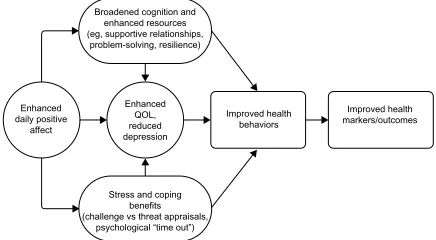
their health, and perhaps facilitate more effective health care utilization. We hypothesize that a positive affect intervention will increase positive affect which will, in turn, be associated with improved health behaviors (Figure 1).
Theoretical foundation
of the intervention
The intervention is based on revised stress and coping
theory13,69 and the broaden-and-build theory of positive
emotion.53 Folkman13 proposed a revision to stress and coping
theory that explicitly posits a role for positive affect in the
coping process. According to the original theory,70 the
cop-ing process begins when an event is appraised as threatencop-ing, harmful, or challenging. These appraisals are associated with affect (negative affect in response to threat or harm, a mix of positive and negative in response to challenge), and prompt coping. If the event is resolved favorably, a positive affective state is the result. If the event is resolved unfavor-ably or if it is unresolved, a negative affective state results and the coping process continues through reappraisal and another round of coping. The revised model suggests that the negative affect associated with unfavorable resolution motivates coping processes that draw on important goals and values, including positive reappraisal and goal-directed problem-focused coping. These coping processes result in positive affect, which serves important coping functions: positive affect provides a psychological “time-out” from the distress associated with chronic stress, and it helps motivate and sustain ongoing efforts to cope with the negative effects of the chronic stress. In the context of a new HIV diagnosis,
positive affect may facilitate more adaptive coping such as positive reappraisals where individuals change their thoughts about stressful circumstances to see them in a more positive light (eg, “this has made me a stronger person.”) It may also be that positive affect leads to decreased reliance on avoidant-oriented coping strategies (eg, stimulant and other drug use, and unsafe sexual behavior).
Fredrickson53 proposed the “broaden-and-build” model
of the function of positive affect that complements revised stress and coping theory. In this model the “broadening” function of positive affect enables the individual to see beyond the immediate stressor and possibly come up with creative alternative solutions to problems. The “building” function helps to rebuild resources (such as self-esteem and social support) depleted by enduring stressful conditions. In contrast to the narrowing of attention and specific action tendencies associated with negative affect, positive affect
broadens the individual’s attentional focus71–73 and
behav-ioral repertoire.71,74 Repeated experiences of positive affect
build social, intellectual and physical resources that buffer
against the deleterious effects of stress.45,75–77 Although the
broaden-and-build model is not specific to stress, under stressful conditions the functions of positive affect suggested by the model become especially important. In the context of a new HIV diagnosis, positive affect may support adjustment to living with this chronic illness, and enhance receptivity to health promotion messages (the broadening function) in the critical period when newly diagnosed individuals are establishing new self-care behaviors, including engagement in health care and safer sexual behaviors.
Design and methods
The study, called IRISS (Intervention for those Recently Informed of their Seropositive Status), is a five-session positive affect skills intervention compared to an attention-matched control condition, in which participants have five sessions of interviews concerning coping and affect. Both intervention and control sessions are approximately one hour long and are administered one-on-one by trained facilitators. Participants in both conditions have daily home practice over the 5 weeks of the intervention. At the end of the 15-month assessment period, participants in the control condition are offered the opportunity to learn the skills in a self-paced online format.
Participants
Eligibility
To be enrolled in this RCT, participants must: 1) have been informed they were HIV positive within the past 12 weeks;
Improved health behaviors Enhanced
QOL, reduced depression Enhanced
daily positive affect
Broadened cognition and enhanced resources (eg, supportive relationships,
problem-solving, resilience)
Stress and coping benefits (challenge vs threat appraisals,
psychological “time out”)
Improved health markers/outcomes
Figure 1 Theoretical model of pathways through which positive affect is associated with health.
Abbreviation: QOl, quality of life.
Open Access Journal of Clinical Trials downloaded from https://www.dovepress.com/ by 118.70.13.36 on 26-Aug-2020
Dovepress Positive affect intervention for those recently diagnosed with HIV
2) speak English or Spanish; 3) be 18 years or older; and 4) have the ability to provide informed consent to be a research participant. Exclusion criteria include: 1) Inability to provide informed consent, as evidenced by cognitive impairment; 2) active psychosis; and 3) unmedicated bipo-lar disorder. All procedures were approved by the relevant Human Subjects Committees, and all participants provided written informed consent.
Study procedures
recruitment
Participants were recruited through HIV testing sites and clinics, community based organizations, newsletters, and fliers. Potential participants were informed that the goal of the study was to find out what’s effective in helping people cope with a new diagnosis. Study materials and consent
forms explained that participants would be assigned to one of two conditions in which they would either “learn skills to better manage your mood” or “talk about what’s going on since testing positive.” They were also told they would have three blood draws to measure CD4 and viral load, and would receive up to $250 for completing nine visits over 15 months. Interested participants were referred to the study for screening. Participants who were eligible were then scheduled for their first assessment session.
Consent, assessments, and randomization
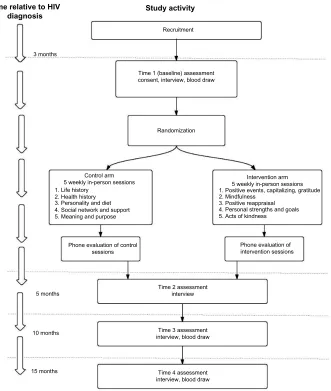
Scheduled assessments take place at four points: Time 1 (baseline) at entry into the study within approximately 3 months post diagnosis; Time 2, at one week intervention (approximately 5 months post diagnosis); Time 3 (approximately 10 months post diagnosis);
Time relative to HIV
diagnosis Study activity
Recruitment
3 months
5 months
10 months
15 months
Time 2 assessment interview
Time 3 assessment interview, blood draw
Time 4 assessment interview, blood draw Time 1 (baseline) assessment consent, interview, blood draw
Randomization
Control arm
5 weekly in-person sessions 5 weekly in-person sessionsIntervention arm 1. Life history 1. Positive events, capitalizing, gratitude 2. Health history 2. Mindfulness
3. Positive reappraisal 4. Personal strengths and goals 5. Acts of kindness 3. Personality and diet
4. Social network and support 5. Meaning and purpose
Phone evaluation of control
sessions intervention sessionsPhone evaluation of
Figure 2 Study recruitment and assessment timeline. Abbreviation: HIV, human immunodeficiency virus.
Open Access Journal of Clinical Trials downloaded from https://www.dovepress.com/ by 118.70.13.36 on 26-Aug-2020
Dovepress
Moskowitz et al
and Time 4 (approximately 15 months post diagnosis.) CD4 and viral load are collected at Time 1,Time 3, and Time 4 (15 months post diagnosis). See Figure 2.
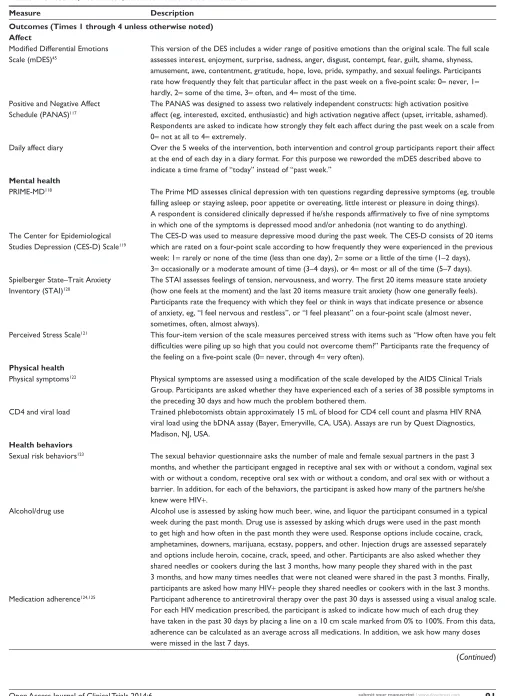
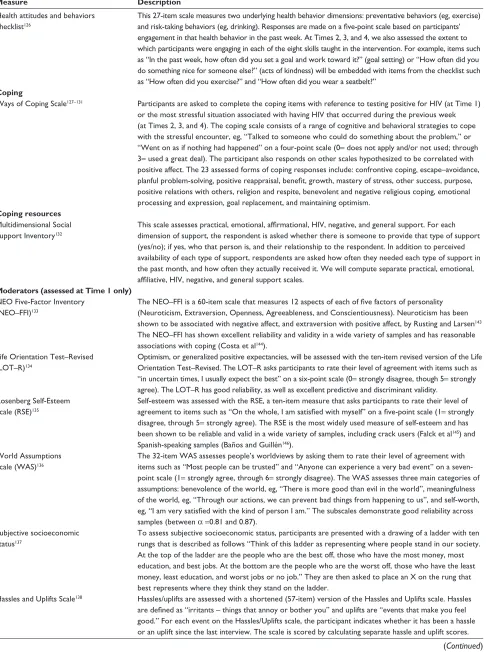
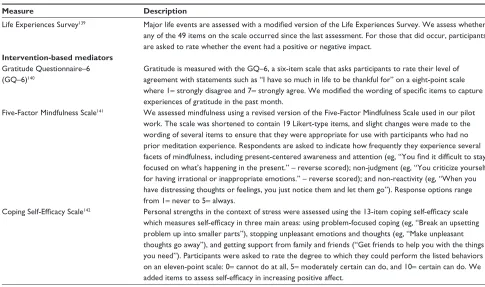
Assessments are conducted one-on-one by trained inter-viewers who are blind to whether the participant was in the intervention or the control condition. Assessments consist of quantitative self-reports on positive and negative affect, health behaviors, physical health, coping, social support, and personality; measures are shown in Table 1. Qualitative data are collected on recent HIV-related stressful events. We use com-puter assisted personal interviewing and all interviews are audio recorded for quality control and later transcription and analysis of the narrative portions. Participants are video recorded during their stressful event narrative at Times 1, 2, and 4 for coding of facial expressions of emotion. All study materials have been translated into Spanish by a certified translator.
At the first assessment session, participants complete informed consent procedures, have an initial blood draw for CD4 and viral load, and complete the baseline interview. Once the baseline assessment is completed, the participant is randomly assigned to the intervention or control condition using block randomization with randomly-varying block sizes of two, four, or six.
Content of the intervention
Elsewhere, we have detailed the rationale for inclusion of each of the positive affect skills.78 Briefly, the IRISS
intervention consists of five in-person sessions and one phone session in which facilitators teach participants eight empirically-supported behavioral and cognitive “skills” for increasing positive affect. The eight skills are: 1) noting daily
positive events;79 –82 2) capitalizing on or savoring positive
events;83,84 3) gratitude;85–87 4) mindfulness;88–91 5) positive
reappraisal;13,24,42,92–96 6) focusing on personal strengths;97–99
7) setting and working toward attainable goals;42,95,100–103 and
8) small acts of kindness.104–108
The first session begins with an overview of the interven-tion approach and philosophy. We explicitly acknowledge to the participant that testing positive for HIV is very stressful for most people and that we are not advocating a simplistic “don’t worry – be happy” approach. We explain to participants that although this is a structured, positive affect skills-building intervention, they should feel free to discuss their HIV status or other stressors in the sessions if and when it feels comfort-able to them. We also do not require participants to discuss these issues. We emphasize that our goal is to help participants give time and attention to the positive experiences and associ-ated emotions, even in the context of serious life stress.
Session 1
In the first session, we focus on positive events, capitaliz-ing, and gratitude. The facilitator explains that even under extremely stressful conditions, people have the capacity to experience positive events. The purpose of this part of the session is to help participants recognize positive events and the associated positive affect associated with those events. During this part of the session, the facilitator helps partici-pants understand that when they experience a positive event, they may capitalize on it by “turning up the volume” (ie, increasing the intensity) of the associated positive affect by telling someone about it, writing about it, or simply
reflect-ing on the event and re-experiencreflect-ing it.83 The home practice
after Session 1 consists of the participant noting a positive event each day and writing about it (capitalizing), and start-ing a daily gratitude journal in which the participant lists at least one thing to be grateful for that day. The gratitude list continues through the rest of the 5-week intervention period. Participants are encouraged to list small things (eg, a good cup of coffee, a smile from a stranger) as well as bigger things. Finally, participants are asked to complete a daily brief measure of positive and negative affect on their own (control group participants also complete this measure).
Session 2
The focus in Session 2 is mindfulness, a state in which one focuses on the present moment, accepting and acknowledging it without getting caught up in emotional reactions or rumina-tive thoughts about the situation. During this session, the facili-tator discusses the concept of developing mindfulness through formal practice, and then practices a formal mindfulness activ-ity with the participant, eg, sitting quietly and paying attention to the breath, guided by a 10-minute “breath awareness” audio recording. The audio instructions and the discussion follow-ing the breath awareness activity emphasize nonjudgment of thoughts and feelings that arise during the activity. We give participants a copy of the audio recording to use for their home practice (and loan them an audio listening device if they do not have one readily available for their use). This is followed by discussion and practice of informal mindfulness (mindfulness of daily activities such as a phone conversation, walking or driving, or doing a household chore). Home practice for the week following Session 2 consists of daily informal mindful-ness activities, the 10-minute formal breath awaremindful-ness activity, and continuing the gratitude journal and daily emotion reports that were started in the first week. Participants are instructed to continue the daily breath awareness activity throughout the remaining weeks of the intervention.
Open Access Journal of Clinical Trials downloaded from https://www.dovepress.com/ by 118.70.13.36 on 26-Aug-2020
Dovepress Positive affect intervention for those recently diagnosed with HIV
Table 1 Outcome, moderator, and intervention-based measures
Measure Description
Outcomes (Times 1 through 4 unless otherwise noted) Affect
Modified Differential Emotions Scale (mdES)45
This version of the dES includes a wider range of positive emotions than the original scale. The full scale assesses interest, enjoyment, surprise, sadness, anger, disgust, contempt, fear, guilt, shame, shyness, amusement, awe, contentment, gratitude, hope, love, pride, sympathy, and sexual feelings. Participants rate how frequently they felt that particular affect in the past week on a five-point scale: 0= never, 1=
hardly, 2= some of the time, 3= often, and 4= most of the time. Positive and Negative Affect
Schedule (PANAS)117
The PANAS was designed to assess two relatively independent constructs: high activation positive affect (eg, interested, excited, enthusiastic) and high activation negative affect (upset, irritable, ashamed). respondents are asked to indicate how strongly they felt each affect during the past week on a scale from 0= not at all to 4= extremely.
daily affect diary Over the 5 weeks of the intervention, both intervention and control group participants report their affect at the end of each day in a diary format. For this purpose we reworded the mdES described above to indicate a time frame of “today” instead of “past week.”
Mental health
PrIME-Md118 The Prime Md assesses clinical depression with ten questions regarding depressive symptoms (eg, trouble
falling asleep or staying asleep, poor appetite or overeating, little interest or pleasure in doing things). A respondent is considered clinically depressed if he/she responds affirmatively to five of nine symptoms in which one of the symptoms is depressed mood and/or anhedonia (not wanting to do anything). The Center for Epidemiological
Studies depression (CES-d) Scale119
The CES-d was used to measure depressive mood during the past week. The CES-d consists of 20 items which are rated on a four-point scale according to how frequently they were experienced in the previous week: 1= rarely or none of the time (less than one day), 2= some or a little of the time (1–2 days), 3= occasionally or a moderate amount of time (3–4 days), or 4= most or all of the time (5–7 days). Spielberger State–Trait Anxiety
Inventory (STAI)120
The STAI assesses feelings of tension, nervousness, and worry. The first 20 items measure state anxiety (how one feels at the moment) and the last 20 items measure trait anxiety (how one generally feels). Participants rate the frequency with which they feel or think in ways that indicate presence or absence of anxiety, eg, “I feel nervous and restless”, or “I feel pleasant” on a four-point scale (almost never, sometimes, often, almost always).
Perceived Stress Scale121 This four-item version of the scale measures perceived stress with items such as “How often have you felt
difficulties were piling up so high that you could not overcome them?” Participants rate the frequency of the feeling on a five-point scale (0= never, through 4= very often).
Physical health
Physical symptoms122 Physical symptoms are assessed using a modification of the scale developed by the AIDS Clinical Trials
Group. Participants are asked whether they have experienced each of a series of 38 possible symptoms in the preceding 30 days and how much the problem bothered them.
Cd4 and viral load Trained phlebotomists obtain approximately 15 ml of blood for Cd4 cell count and plasma HIV rNA viral load using the bdNA assay (Bayer, Emeryville, CA, uSA). Assays are run by Quest diagnostics, Madison, NJ, uSA.
Health behaviors
Sexual risk behaviors123 The sexual behavior questionnaire asks the number of male and female sexual partners in the past 3
months, and whether the participant engaged in receptive anal sex with or without a condom, vaginal sex with or without a condom, receptive oral sex with or without a condom, and oral sex with or without a barrier. In addition, for each of the behaviors, the participant is asked how many of the partners he/she knew were HIV+.
Alcohol/drug use Alcohol use is assessed by asking how much beer, wine, and liquor the participant consumed in a typical week during the past month. drug use is assessed by asking which drugs were used in the past month to get high and how often in the past month they were used. response options include cocaine, crack, amphetamines, downers, marijuana, ecstasy, poppers, and other. Injection drugs are assessed separately and options include heroin, cocaine, crack, speed, and other. Participants are also asked whether they shared needles or cookers during the last 3 months, how many people they shared with in the past 3 months, and how many times needles that were not cleaned were shared in the past 3 months. Finally, participants are asked how many HIV+ people they shared needles or cookers with in the last 3 months. Medication adherence124,125 Participant adherence to antiretroviral therapy over the past 30 days is assessed using a visual analog scale.
For each HIV medication prescribed, the participant is asked to indicate how much of each drug they have taken in the past 30 days by placing a line on a 10 cm scale marked from 0% to 100%. From this data, adherence can be calculated as an average across all medications. In addition, we ask how many doses were missed in the last 7 days.
(Continued)
Open Access Journal of Clinical Trials downloaded from https://www.dovepress.com/ by 118.70.13.36 on 26-Aug-2020
Dovepress
Moskowitz et al
Table 1 (Continued)
Measure Description
Health attitudes and behaviors checklist126
This 27-item scale measures two underlying health behavior dimensions: preventative behaviors (eg, exercise) and risk-taking behaviors (eg, drinking). Responses are made on a five-point scale based on participants’ engagement in that health behavior in the past week. At Times 2, 3, and 4, we also assessed the extent to which participants were engaging in each of the eight skills taught in the intervention. For example, items such as “In the past week, how often did you set a goal and work toward it?” (goal setting) or “How often did you do something nice for someone else?” (acts of kindness) will be embedded with items from the checklist such as “How often did you exercise?” and “How often did you wear a seatbelt?”
Coping
Ways of Coping Scale127–131 Participants are asked to complete the coping items with reference to testing positive for HIV (at Time 1)
or the most stressful situation associated with having HIV that occurred during the previous week (at Times 2, 3, and 4). The coping scale consists of a range of cognitive and behavioral strategies to cope with the stressful encounter, eg, “Talked to someone who could do something about the problem,” or “Went on as if nothing had happened” on a four-point scale (0= does not apply and/or not used; through 3= used a great deal). The participant also responds on other scales hypothesized to be correlated with positive affect. The 23 assessed forms of coping responses include: confrontive coping, escape–avoidance, planful problem-solving, positive reappraisal, benefit, growth, mastery of stress, other success, purpose, positive relations with others, religion and respite, benevolent and negative religious coping, emotional processing and expression, goal replacement, and maintaining optimism.
Coping resources
Multidimensional Social Support Inventory132
This scale assesses practical, emotional, affirmational, HIV, negative, and general support. For each dimension of support, the respondent is asked whether there is someone to provide that type of support (yes/no); if yes, who that person is, and their relationship to the respondent. In addition to perceived availability of each type of support, respondents are asked how often they needed each type of support in the past month, and how often they actually received it. We will compute separate practical, emotional, affiliative, HIV, negative, and general support scales.
Moderators (assessed at Time 1 only)
NEO Five-Factor Inventory (NEO–FFI)133
The NEO–FFI is a 60-item scale that measures 12 aspects of each of five factors of personality (Neuroticism, Extraversion, Openness, Agreeableness, and Conscientiousness). Neuroticism has been shown to be associated with negative affect, and extraversion with positive affect, by rusting and larsen143
The NEO–FFI has shown excellent reliability and validity in a wide variety of samples and has reasonable associations with coping (Costa et al144).
life Orientation Test–revised (lOT–r)134
Optimism, or generalized positive expectancies, will be assessed with the ten-item revised version of the life Orientation Test–revised. The lOT–r asks participants to rate their level of agreement with items such as “in uncertain times, I usually expect the best” on a six-point scale (0= strongly disagree, though 5= strongly agree). The lOT–r has good reliability, as well as excellent predictive and discriminant validity.
rosenberg Self-Esteem Scale (rSE)135
Self-esteem was assessed with the rSE, a ten-item measure that asks participants to rate their level of agreement to items such as “On the whole, I am satisfied with myself” on a five-point scale (1= strongly disagree, through 5= strongly agree). The rSE is the most widely used measure of self-esteem and has been shown to be reliable and valid in a wide variety of samples, including crack users (Falck et al145) and
Spanish-speaking samples (Baños and Guillén146).
World Assumptions Scale (WAS)136
The 32-item WAS assesses people’s worldviews by asking them to rate their level of agreement with items such as “Most people can be trusted” and “Anyone can experience a very bad event” on a seven-point scale (1= strongly agree, through 6= strongly disagree). The WAS assesses three main categories of assumptions: benevolence of the world, eg, “There is more good than evil in the world”, meaningfulness of the world, eg, “Through our actions, we can prevent bad things from happening to us”, and self-worth, eg, “I am very satisfied with the kind of person I am.” The subscales demonstrate good reliability across samples (between α=0.81 and 0.87).
Subjective socioeconomic status137
To assess subjective socioeconomic status, participants are presented with a drawing of a ladder with ten rungs that is described as follows “Think of this ladder as representing where people stand in our society. At the top of the ladder are the people who are the best off, those who have the most money, most education, and best jobs. At the bottom are the people who are the worst off, those who have the least money, least education, and worst jobs or no job.” They are then asked to place an X on the rung that best represents where they think they stand on the ladder.
Hassles and uplifts Scale138 Hassles/uplifts are assessed with a shortened (57-item) version of the Hassles and uplifts scale. Hassles
are defined as “irritants – things that annoy or bother you” and uplifts are “events that make you feel good.” For each event on the Hassles/uplifts scale, the participant indicates whether it has been a hassle or an uplift since the last interview. The scale is scored by calculating separate hassle and uplift scores.
(Continued)
Open Access Journal of Clinical Trials downloaded from https://www.dovepress.com/ by 118.70.13.36 on 26-Aug-2020
Dovepress Positive affect intervention for those recently diagnosed with HIV
Table 1 (Continued)
Measure Description
life Experiences Survey139 Major life events are assessed with a modified version of the Life Experiences Survey. We assess whether
any of the 49 items on the scale occurred since the last assessment. For those that did occur, participants are asked to rate whether the event had a positive or negative impact.
Intervention-based mediators
Gratitude Questionnaire–6 (GQ–6)140
Gratitude is measured with the GQ–6, a six-item scale that asks participants to rate their level of agreement with statements such as “I have so much in life to be thankful for” on a eight-point scale where 1= strongly disagree and 7= strongly agree. We modified the wording of specific items to capture experiences of gratitude in the past month.
Five-Factor Mindfulness Scale141 We assessed mindfulness using a revised version of the Five-Factor Mindfulness Scale used in our pilot
work. The scale was shortened to contain 19 likert-type items, and slight changes were made to the wording of several items to ensure that they were appropriate for use with participants who had no prior meditation experience. respondents are asked to indicate how frequently they experience several facets of mindfulness, including present-centered awareness and attention (eg, “You find it difficult to stay focused on what’s happening in the present.” – reverse scored); non-judgment (eg, “You criticize yourself for having irrational or inappropriate emotions.” – reverse scored); and non-reactivity (eg, “When you have distressing thoughts or feelings, you just notice them and let them go”). response options range from 1= never to 5= always.
Coping Self-Efficacy Scale142 Personal strengths in the context of stress were assessed using the 13-item coping self-efficacy scale
which measures self-efficacy in three main areas: using problem-focused coping (eg, “Break an upsetting problem up into smaller parts”), stopping unpleasant emotions and thoughts (eg, “Make unpleasant thoughts go away”), and getting support from family and friends (“Get friends to help you with the things you need”). Participants were asked to rate the degree to which they could perform the listed behaviors on an eleven-point scale: 0= cannot do at all, 5= moderately certain can do, and 10= certain can do. We added items to assess self-efficacy in increasing positive affect.
Abbreviations: AIDS, acquired immune deficiency syndrome; HIV, human immunodeficiency virus; HIV+, human immunodeficiency virus positive; RNA, ribonucleic acid; bdNA, branched deoxyribonucleic acid.
Session 3
In Session 3, we focus on the coping skill of positive reappraisal. The participant is introduced to the concept of appraisal, a person’s interpretation or judgment about the personal significance of an event. The facilitator explains that because our appraisals determine our emotional reaction to an event, if we can change our appraisals, we can change how we feel. Positive reappraisal is a way of dealing with stress in which the individual makes a positive change in how an event is interpreted or appraised. Noting that the event may not be as bad as originally thought, was not as bad as it could have been, or noting something positive that may come out of the event are all forms of positive reappraisal that are likely to be related to increased positive affect in the face of stress. The facilitator and participant then practice reappraising recent small events in the participant’s life. We explicitly do not focus on trying to reappraise the experi-ence of testing positive for HIV. Instead we start with small, relatively minor events (eg, being late to work; encountering a rude person on the street; traffic) to develop the skill of positive reappraisal. Although it is not a proximal goal of the present intervention given its brief duration, with continued practice an individual can learn to positively reappraise
virtually any event.109 Home practice consists of reporting a
relatively minor stressor each day, then listing ways in which the event can be positively reappraised. The daily formal mindfulness practice (10 minutes of mindful breathing), the daily gratitude journal, and the brief emotion reports continue.
Session 4
In Session 4, we focus on the participant’s personal strengths and the process of setting (and attaining) achievable goals. The facilitator asks the participant to list his or her personal strengths or positive qualities. After the participant lists them, the facilitator then lists strengths that he has seen in the participant over the 4 weeks of the intervention. In our pilot work, this was a powerful positive experience for participants. It was particularly effective given that participants were in the midst of the stressful early months after HIV diagnosis. The next portion of the session concerns defining and setting attainable goals. We define attainable goals as having four characteristics: 1) they are realistic and can be reasonably completed in the allotted time; 2) they are clear; 3) they are challenging but not impossible or too global; and 4) they have a clear end point so it is obvious when the goal has been successfully completed. The facilitator then works with the participant to set some attainable goals for the coming week.
Open Access Journal of Clinical Trials downloaded from https://www.dovepress.com/ by 118.70.13.36 on 26-Aug-2020
Dovepress
Moskowitz et al
The home practice for Session 4 consists of listing a strength each day and how it was “expressed” behaviorally that day, working toward one of the goals each day, and noting progress each day. The 10-minute mindful breathing, the gratitude journal, and the daily affect reports continue this week.
Session 5
The focus in Session 5 is on altruistic behaviors or small acts of kindness. The previous 4 sessions encourage partici-pants to focus on themselves. The purpose of Session 5 is to intentionally focus on other people. The facilitator empha-sizes that even though the participant may be going through a very difficult time in his or her life, he/she can still help other people through small acts of kindness (including expressing gratitude to people who performed acts of kindness or helped care for them). In addition to the mindful breathing, daily gratitude journal, and daily affect reports, the home practice for Session 5 consists of doing one small act of kindness each day and noting it.
Session 6
Session 6 is conducted by phone and focuses on reviewing the previous week’s home practice, evaluation of each of the eight skills, evaluation of the intervention overall, and plan-ning for continued practice of the skills.
Content of the control sessions
Participants in the control condition also have five one-on-one sessions with a facilitator. The sessions are comparable in length to the intervention sessions (approximately one hour) but consist of an interview and do not have didactic portions or skills practice. These sessions were designed to remove the positive affect component of the intervention, while maintaining any nonspecific effects arising from one-on-one contact with a sympathetic facilitator and an opportunity to share one’s personal stories and concerns. The interviews include 1) life history (qualitative); 2) health history (qualitative), including use of complementary and alternative medicine and physical activity; 3) personality and diet questionnaires; 4) social support and social network; 5) meaning and purpose; 6) (via telephone) the ranking of sessions as to whether participants would recommend the sessions to a friend; and 7) (via telephone) the participant’s rating of enjoyment of sessions.
Home practice for the control group consists of brief daily affect reports over the 5 weeks of the control sessions. At the start of sessions two through five, the facilitator reviews the previous week’s affect diary with the participant.
After the Time 4 assessment (15 months post-diagnosis), participants in the control condition are given the opportunity to access an online, self-paced version of the intervention.
Payment of participants
Participants are paid $20 for each intervention/control ses-sion, $25 for the first two assessments, and $50 for each of the assessments at Time 3 and Time 4, for a total of $250 for completing the entire study. In addition, we reimburse for transportation (eg, cab fare, bus fare, or parking) and provide a snack for each assessment and intervention/control session.
Training and intervention fidelity
There were two groups of staff, each of whom required different training: assessment interviewers (assessors) and session facilitators. All staff members received a minimum of 30 hours of training which took place over several weeks and included: 1) privacy and confidentiality training in Health Insurance Portability and Accountability Act (HIPAA) secu-rity practices and human subjects protection; 2) technology training, including use of laptops, computer-assisted personal interview programs, digital audio software, and data tracking procedures on the study website; 3) training in interviewing techniques, which addressed building rapport, working with diverse populations, cultural sensitivity, population-specific issues and referrals, and basic quantitative and qualitative interview skills; 4) suicidality assessment protocol; 5) interview/session roleplays; and 6) site visits to locations where assessments and control/intervention sessions took place. Ongoing training provided updates on HIV treatment and weekly group supervision, and as-needed individual supervision to address individual cases and procedural issues for assessors and facilitators. Assessors received additional training in obtaining informed consent and the video recording protocol. Facilitators attended a separate training that included detailed overviews of the intervention approach and procedures. Specific techniques for adhering to a manualized intervention while allowing for flexibility to address individual participant needs were taught, role-played, and supplemented by instructional readings. Assessors and facilitators were bilingual and bicultural. The majority of staff conducting Spanish-language interventions and assessments were native Spanish speakers.
Following the training, staff conducted mock sessions. The audio recordings of these sessions were reviewed by the principal investigator and project director, who then met one-on-one with interviewers/facilitators to provide feedback on
Open Access Journal of Clinical Trials downloaded from https://www.dovepress.com/ by 118.70.13.36 on 26-Aug-2020
Dovepress Positive affect intervention for those recently diagnosed with HIV
interviewing and intervention techniques. Mock interviews were repeated until assessors/facilitators were proficient with using software, familiar with delivery of quantitative questionnaires, skilled at conducting the qualitative portion of the interview and, for the intervention facilitators, were comfortable and familiar with each of the five intervention sessions.
Intervention fidelity training
and monitoring
Monitoring of fidelity of intervention and control sessions during the course of the study included: 1) development of detailed curriculum manuals for each of the sessions; 2) inten-sive training; 3) incorporation of mock training sessions that enabled us to ensure all facilitators met performance criteria for intervention/control session delivery; and 4) audio record-ing of sessions. Audio recordrecord-ings of facilitator sessions were reviewed by the project director to assess adherence to the protocol, delivery, interpersonal skills, facilitator/participant rapport, and session flow.
Measures
Detailed descriptions of the measures are provided in Table 1.
Planned analyses
The primary outcome measure is positive affect. Our first aim is to determine the efficacy of the intervention for increasing positive affect at Times 2, 3, and 4. The second aim tests posi-tive affect as a mediator of intervention effects on psychologi-cal well-being (eg, depression), health behaviors (eg, HIV transmission risk, engagement in care, medication adherence) and physical health (eg, CD4, viral load, symptoms). The third aim tests moderation of intervention effects by baseline characteristics such as gender, race/ ethnicity, and personality (see Figure 1).
We will first examine baseline characteristics of the sample, stratified by experimental group, to ensure that key variables (positive affect, mental and physical health, and demographics) are indeed evenly distributed in the randomization. Before testing hypotheses, we will also examine the proportion of missing data at each time point in order to address any concern regarding possible bias due to differential attrition. Completers and dropouts will be
compared on baseline variables using independent t and
Fisher’s exact tests. Variables showing substantial group differences at baseline will be candidates for inclusion as covariates in tests of hypotheses.
Given that this study is a treatment evaluation, we will conduct intention-to-treat analyses. We will supplement these analyses with dose-response analyses, using ordinary or logistic regression, depending on whether outcomes are continuous or dichotomous, to test whether various measures of participation (eg, number of sessions attended, days of homework completed) affect outcomes.
Aim 1. Determine the efficacy of the Intervention for those Recently Informed of their Seropositive Status (IRISS) to increase frequency and intensity of our primary outcome, positive affect, during the intervention and at 5, 10, and 15 months after diagnosis. Tests of intervention effects will be conducted with multiple-group growth models, with coef-ficients chosen to reflect the hypothesized pattern of change. We expect frequency and intensity of positive affect, as measured, respectively, by the modified Differential Emotions Scale (mDES) and Positive and Negative Affect Schedule (PANAS) (see Table 1), to increase for the intervention group over the course of the intervention, and to be maintained thereafter. The most specific manifest-variable test of the hypothesis as a whole is the difference between groups on the contrast between baseline and the following three time points. On a more piecemeal basis, differences in means
or in change scores can be tested with independent t-tests
comparing the intervention to the control group.
Aim 2. Test the effects of IRISS on psychological and physical health and health behaviors, and determine whether increases in positive affect are responsible for improvements in these outcomes. The tests of effects here are the same as those in Aim 1, with different outcome variables. Some, like clinical depression, are binary, but these can be handled by Mplus (Muthén and Muthén, Los Angeles, CA, USA) through probit regression. Others, like viral load, are known to have strong positive skew and will be (log) transformed before analysis. Determining whether increases in positive affect are responsible for these changes requires mediation analysis. Since we expect both the outcomes and these potential “mediators” to be products of the intervention, with perhaps no clear separation in time, the first step in these analyses will be to examine whether changes in positive affect precede or
coincide with changes in the outcomes. MacKinnon et al110
conducted a Monte Carlo study of 14 procedures for testing mediation effects, found the classic method of Baron and
Kenny111 unacceptably weak, and recommended testing the
product of the coefficients in the mediation path by refer-ence to the distribution of the product of two normal variates (which is not itself normal). As recommended by Shrout and
Bolger112 we will use Mplus to bootstrap the product term.
Open Access Journal of Clinical Trials downloaded from https://www.dovepress.com/ by 118.70.13.36 on 26-Aug-2020
Dovepress
Moskowitz et al
Given the dependency of indirect effects on the time interval, for multiwave models we will compute overall, rather than
time-specific, indirect effects.113
Aim 3. Evaluate the extent to which personality, sex, or race/ethnicity moderate the effects of IRISS on these out-comes. Since we will be exploring moderation and mediation separately, moderation can be tested simply by the addition of interaction terms, with components appropriately centered.
Discussion
The first few months after HIV diagnosis provide a window of opportunity for intervention in which participants are establishing new patterns of sexual risk and health behaviors. Although the period immediately following diagnosis is associated with significantly elevated levels of depression and anxiety, there are few interventions designed expressly for people newly diagnosed with HIV.
Based on increasing evidence from our research team and others that positive affect has adaptive functions in the context of health-related stress, we developed and are testing a theory-based positive affect skills intervention for people newly diagnosed with HIV. By emphasizing the importance of positive affect in the stress process we may appear to minimize the pain and serious individual and societal consequences associated with major stressful events. We are not advocating a simplistic “don’t worry, be happy” approach, nor do we believe that simply increasing positive affect will prove to be a cure-all for the very real and complex issues facing people newly diagnosed with HIV. Such a stance could easily degenerate into blam-ing the victim for not thinkblam-ing the positive thoughts that may prevent depression or other negative consequence of enduring stress.
However, an intervention to increase positive affect in the months after testing positive for HIV may set the stage for a cascade of adaptive consequences. In addition, the focus on positive affect will likely make the proposed interven-tion more attractive to providers and participants alike, and serve as an antidote to the increasingly pervasive “prevention fatigue”.114–116
Further, in pilot testing this intervention we learned that participants were not the only ones whose positive affect increased; facilitators, staff, and investigators also experi-enced increases in positive affect. Ultimately, given the high levels of stress, distress, and depression documented in this population of people newly diagnosed with HIV, we consider increasing positive affect to be an inherently worthwhile intervention goal.
Acknowledgements
This work was funded by R01MH084723 and K24MH093225 from the National Institute of Mental Health, and by K01AT005270 from the National Center for Complementary
and Alternative Medicine. It is registered at clinicaltrials.gov
as registration number NCT00720733.
Disclosure
The authors report no conflicts of interest in this work.
References
1. Bing EG, Burnam MA, Longshore D, et al. Psychiatric disorders and drug use among human immunodeficiency virus-infected adults in the
United States. Arch Gen Psychiatry. 2001;58(8):721–728.
2. Walker RD, Howard MO, Lambert MD, Suchinsky R. Psychiatric and
medical comorbidities of veterans with substance use disorders. Hosp
Community Psychiatry. 1994;45(3):232–237.
3. Marks G, Bingman CR, Duval TS. Negative affect and unsafe sex in
HIV-positive men. AIDS and Behavior. 1998;2(2):89–99.
4. Latkin C, Mandell W. Depression as an antecedent of frequency of
intravenous drug use in an urban, nontreatment sample. Int J Addict.
1993;28:1601–1612.
5. Gordillo V, del Amo J, Soriano V, González-Lahoz J. Sociodemographic and psychological variables influencing adherence to antiretroviral
therapy. AIDS. 1999;13(13):1763–1769.
6. Holzemer WL, Corless IB, Nokes KM, et al. Predictors of self-reported
adherence in persons living with HIV disease. AIDS Patient Care STDS.
1999;13(3):185–197.
7. Paterson DL, Swindells S, Mohr J, et al. Adherence to protease inhibitor
therapy and outcomes in patients with HIV infection. Ann Intern Med.
2000;133(1):21–30.
8. Ickovics JR, Hamburger ME, Vlahov D, et al. Mortality, CD4 cell count decline, and depressive symptoms among HIV-seropositive women: longitudinal analysis from the HIV Epidemiology Research Study.
Jama. 2001;285(11):1466–1474.
9. Leserman J. The effects of depression, stressful life events, social
sup-port, and coping on the progression of HIV infection. Curr Psychiatry
Rep. 2000;2(6):495–502.
10. Mayne TJ, Vittinghoff E, Chesney MA, Barrett DC, Coates TJ. Depressive affect and survival among gay and bisexual men infected
with HIV. Arch Intern Med. 1996;156(19):2233–2238.
11. Lyubomirsky S, King L, Diener E. The benefits of frequent positive affect: does happiness lead to success? Psychol Bull. 2005;131(6): 803–855.
12. Pressman SD, Cohen S. Does positive affect influence health? Psychol
Bull. 2005;131(6):925–971.
13. Folkman S. Positive psychological states and coping with severe stress.
Soc Sci Med. 1997;45:1207–1221.
14. Folkman S, Moskowitz JT. Positive affect and the other side of coping.
Am Psychol. 2000;55(6):647–654.
15. Fredrickson BL, Joiner T. Positive emotions trigger upward spirals
toward emotional well-being. Psychol Sci. 2002;13(2):172–175.
16. Zautra A, Smith B, Affleck G, Tennen H. Examinations of chronic pain and affect relationships: applications of a dynamic model of affect.
J Consult Clinical Psychol. 2001;69(5):786–795.
17. Carrico AW, Moskowitz JT. Positive affect promotes engagement in
care after HIV diagnosis. Health Psychol. 2014;33(7):686–689.
18. Folkman S, Chesney MA, Christopher-Richards A. Stress and coping
in caregiving partners of men with AIDS. Psychiatr Clin North Am.
1994;17(1):35–53.
19. Folkman S, Chesney MA, Pollack L, Coates T. Stress, control, coping, and depressive mood in human immunodeficiency virus-positive and -negative
gay men in San Francisco. J Nerv Ment Dis. 1993;181(7):409–416.
Open Access Journal of Clinical Trials downloaded from https://www.dovepress.com/ by 118.70.13.36 on 26-Aug-2020