Licensed under Creative Common Page 173
http://ijecm.co.uk/
ISSN 2348 0386
EFFECT OF ENTREPRENEURIAL SKILLS ON COMPETITIVE
ADVANTAGE AMONG SMALL AND MEDIUM SIZE ENTERPRISES
John Onditi Omare
School of Business and Economics, Daystar University, Nairobi, Kenya
Joanes Kaleli Kyongo
School of Business and Economics, Daystar University, Nairobi, Kenya [email protected]
Abstract
The objective of the study was to establish the effect of entrepreneurial skills on competitive
advantage among small and medium enterprises in Kawangware Division, Nairobi County in
Kenya and the corresponding hypothesis was formulated and tested. A descriptive survey
design was adopted for the study. Convenience sampling was used. The study targeted 102
proprietors of SMEs and 75 of them responded. SPSS Version 21 was used to analyze data
using simple regression analysis. Research findings from the test of the hypothesis established
that entrepreneurial skills lead to creation of competitive advantage among small and medium
size enterprises. The study findings support the Resource Based View which explains how
specific entrepreneurial skills, which are intangible resources combine with other tangible
resources to enable SMEs to be competitive in the market. The research recommends further
investigation of the study variables SMEs in other parts of Kenya.
Keywords: Entrepreneurial skills, competitive advantage, small and medium enterprises,
Resource Based View
INTRODUCTION
Licensed under Creative Common Page 174 1991). Although previous studies indicate a link between entrepreneurial skills and competitive advantage, the studies are inconclusive because the variables were operationalized differently and were examined in different contexts (Jagogo & Kinyua, 2013, Martin & Namusonge, 2014, Njoroge & Gathungu, 2014 ). Further, since most enterprises fail due to lack of entrepreneurial skills, among other things, this study is timely to address the problem (Fatoki, 2014).
Entrepreneurial Skills
The modern business operating environment has become highly volatile following increased competition and ever changing customer tastes and preferences. Therefore, businesses and in particular, SMEs have to cope with the changes by embracing entrepreneurial skills in order to gain a competitive edge against competitors to survive in the competitive environment. Entrepreneurial skills enable an entrepreneur to identify customer needs, technical and market opportunities (Hayton, 2015), generate ideas, develop products /services to meet the needs, and acquire information about the potential opportunity domain and knowledge (Chell, 2013) . Personal entrepreneurial skills gives entrepreneurs the ability to create new products or services and subsequent launch in the market. This is referred to as innovation according to Schumpeter (1942).
Self - motivation is another skill which is personal in nature and plays a key role in the creation of new businesses according to Segal, Borgia, and Schoenfeld (2005). The entrepreneur is motivated by the reward in the economy to run and sustain business in the long run (Baumol, 1990) . Networking is another entrepreneurial skill which is a key source of social capital (Lessor, 2000).
Competitive Advantage
Competitive advantage can arise when an organization does its business differently from its competitors who have no knowledge of the firm’s activities (Kotler, 2000). Competitive
advantage is considered as an objective of strategic plan (Porter, 1985). A firm is considered having competitive advantage when its creating much economic value than its competitors (Karanja & Osmani, 2013).
Licensed under Creative Common Page 175 counter these market forces (Brien & Marakas, 2011). In reference to the aforementioned therefore, linking information technology and customer focused innovation strategies to Porter’s
three generic strategies of cost, differentiation and focus which is attributable to innovation will support gaining competitive advantage.
Competitive advantage in a firm is indicated by its sustainability (Barney,1991), the analysis of items that are measured through firstly, the existence of strategies which cannot be imitated and implemented by the current or future competitors, secondly, the strategies giving competitive advantage cannot be copied nor imitated by rivals (Collins & Montgomery, 1985). The current study operationalized competitive advantage by market share, customer perception and innovation (Sultan, 2007).
Small and Medium Size Enterprises in Nairobi County, Kenya
Nairobi County has the largest concentration of SMEs in Kenyan urban centers (UNDP, 2015) according to the 1999 National SME Baseline Survey by Central Bureau of Statistics International Center for Economic Growth (ICEG), and K-Rep Holdings Ltd. These SMEs are spread across the sectors of the economy including, transport, manufacturing, retail service among other sectors (Ong'olo & Awino, 2013). The small and medium enterprise (SME) sector make significant contribution to GDP and in job creation, new products in the market and general economic growth for the industrialized and developing economies (Robson & Bennett, 2000). The sessional paper No. 2 of 2005 outlines the vital role played by SMEs in Kenya in the development of Micro and Small enterprises as a catalyst for economic development (GOK, 2005).The emphasis of SMEs on solving social economic issues in Kenya is a key priority of Vision 2030 which emphasizes on economic development expects SMES to achieve this growth through entrepreneurship (Vision 2030). SMEs offer employment to over 74% of the total jobs in Kenya and contributes 18.4% of the Country’ s GDP (Ong'olo & Awino, 2013). The Kenyan government has put legislations and mechanisms in regulating the development of SMEs according to the SMEs Act (GOK, 2012).The Act specifies the registration, recognition and positioning of the firms in doing government tenders.
Small and Medium Enterprises in Kawangware Division, Nairobi County
Licensed under Creative Common Page 176 sales, and motor vehicle garages, spares shops in electrical, and automotive, county market mainly trading in grains, fresh produce and household goods, and the enterprises are mostly run by proprietors who are managers and employ few staff.
Entrepreneurial Skills and Competitive Advantage
Martin and Namusonge (2014) did a research on SMEs located in Nakuru County in Kenya and established a perceived link between innovation and business growth. According to Notebook (1994), innovations done by small firms increased sales due to number of patents released to the market and therefore they should pursue product innovation strategies emerging in the market. The study had similarities to the research done on the basis of innovations and growth of SMEs, however they differ in knowledge and in context because of geographical locations and industries in that the extant study is on SMEs spread across the several industries.
In a similar study carried out by Jagogo and Kinyua (2013) to establish the effect of social media on the growth of SMEs, the findings from the study were that most SMEs did not have sufficient knowledge on use of social media as a strategy for business growth while for those that have embraced social media revolution are able to expand their market and improve customer care management (Evans, & McKee, 2010). While the research is similar to the proposed study because social media is a management skill and a component of entrepreneurial skill, the knowledge established differs from the one for this study. Thus the hypothesis, H1: entrepreneurial skills have a significant effect on competitive advantage among
small and medium size enterprises.
METHODOLOGY
The study adopted descriptive survey design. Data was collected using structured questionnaire from the proprietors of 102 selected SMEs in Kawangware Division, Nairobi County, Kenya. For this, a convenience sampling method was used. A pre-test was done, and based on the pre-test results, the instrument was amended accordingly. The study used descriptive and inferential statistics to analyze data. Data was analyzed using SPSS version 21 and the results have been presented using tables.
ANALYSIS AND FINDINGS
Licensed under Creative Common Page 177 the amount of change in the dependent variable attributable to the amount of change in the predictor variable. The F-statistics measure the goodness of fit of the model. The statistical significance of the hypothesized relationship was interpreted based on R2, F, t, β and p values. The regression model used was: Y= β0+ β 1X1+ϵ, where Y= Competitive advantage; β0=
Intercept; β1=Coefficients;X1 =entrepreneurial skills and ϵ=Error term.
Study Response Rate
The target population from which the sample was selected were employees in SMEs in Kawangware division and 75 out of 102 responded thus the response rate was 75 % which was sufficient enough and representative of the population because it conforms to Mugenda and Mugenda (2003) recommendation that a response rate of over 70% is acceptable.
Level of Education
The study sought to determine the highest educational level of the respondents. The finding is presented in Table 1.
Table 1: Educational Levels of the Respondents
Frequency Percent
Primary school 13 17.3
Secondary Level 20 26.7
Advance A Level 15 20.0
College graduate 12 16.0
University First Degree 9 12.0
Masters Degree 6 8.0
Total 75 100.0
From the responses, 13 (17.3%) of the respondents had primary level of education, 20 (26.7%) had secondary level, 15 (20%) had A level education, 12 (16%) were college graduates, 9 (12%) had university first degree and 6 (8%) had masters degree. This implied the respondents had relevant knowledge thus they had ease in answering the questions and provided the correct response.
Type of Business
Licensed under Creative Common Page 178 Table 2: Type of business
Frequency Percent
Retail stores/Supermarket/Shop 29 38.7
Hardware /Timsales/Sand 8 10.7
IT shops /Mpesa/book shop 14 18.7
Real estate developers 9 12.0
Motor vehicle spares/Garage 12 16.0
Schools /Colleges 3 4.0
Total 75 100.0
From the responses, 29 (38.7%) had Retail stores/Supermarket/Shop, 8 (10.7%) had Hardware /Tim sale/Sand, 14 (18.7%) had IT shops / Mpesa / book shop, 9 (12%) were Real estate developers, 12 (16%) had Motor vehicle spares/garage and 3 (4%) had Schools /Colleges. This shows that the respondents in the area engage in different business ventures hence the respondents information was relevant according the research besides being reliable
Test of the Hypothesis
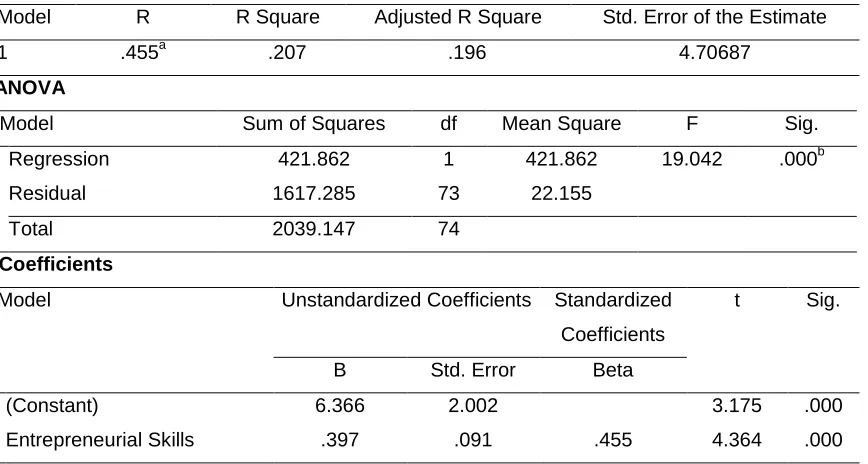
Simple linear regression analysis was conducted to establish the effect of entrepreneurial skills on gaining competitive advantage among SMEs in Kawangware Division in Nairobi County.
Table 3: Effects of Entrepreneurial Skills on Competitive Advantage
Model Summary
Model R R Square Adjusted R Square Std. Error of the Estimate
1 .455a .207 .196 4.70687
ANOVA
Model Sum of Squares df Mean Square F Sig.
Regression 421.862 1 421.862 19.042 .000b
Residual 1617.285 73 22.155
Total 2039.147 74
Coefficients
Model Unstandardized Coefficients Standardized Coefficients
t Sig.
B Std. Error Beta
(Constant) 6.366 2.002 3.175 .000
Licensed under Creative Common Page 179 DISCUSSION
From the finding in Table 3, R2 was 0.207 implying that only 20.7% of the dependent variable (competitive advantage) was explained by the independent variable (entrepreneurial skills) while 79.3% of the variations were due to other factors not in the study. The ANOVA results show a significant value of 0.000 showing that the model is statistically significant in predicting the relationship between the dependent and the independent variable. The F, critical at 5% level of significance was 3.97. Since F calculated (value = 19.042) is greater than the F critical (3.97), this shows that the overall model was significant. The established regression equation becomes;
Y = 6.366 + 0.397X1 + ε, Where: Y= competitive advantage, X1= Entrepreneurial Skills and ε =
Error Term.
The regression coefficients indicate that for every one unit increase in the use of entrepreneurial skills, competitive advantage increased by 0.397.
CONCLUSION
The study sought to establish the effect of entrepreneurial skills on competitive advantage among SMEs in Kawangware division of Nairobi County in Kenya. The study was conducted through a descriptive design. The study adopted both descriptive and inferential statistics to analyze the data. The study tested and confirmed the hypothesis that entrepreneurial skills have a significant effect on competitive advantage. This means that entrepreneurs who wish to succeed must embrace and inculcate entrepreneurial skills among their employees.
The study was limited to SMEs in Kawangware Division of Nairobi County and hence its findings may not be generalized to other parts of Kenya. Therefore, the study suggests further research to be undertaken to cover other parts of the county.
REFERENCES
Barney. (1991). Competitive Advantage. New York: Mass Addition Wesley.
Barney, J. (2002). Gaining and Sustaining Competitive Advantage,. New York: Mass, Addition-Wesley. Barney, J., & Hesterly, W. (1991). Strategic Management and competitive advantage. Nwe Jersey: Pearson Prentice Hall.
Berisha-Shaqiri, A. (2015). Impact of Information Technology and Internet in Businesses. Academic Journal of Business, Administration, Law and Social Sciences 1,1, 73-74.
Brien, J. A., & Marakas. (2011). Management information System. New York: Mc Graw.
Chell, E. (2013). Review of skill and the entrepreneurial process. International Journal of Entrepreneurial Behaviour and Research,19(1), 6-31.
Licensed under Creative Common Page 180 Collins, D., & Montgomery, C. (1985). Competing on resources: Strategy in the 90's. Harvard Business Review , 73, 118-128.
Evans:, D., & McKee, J. (2010). Social Media Marketing: The Next Generation of Business Engagement . Indiana USA: Wiley Publishing Incl.
Fatoki, O. (2014). The Causes of the Failure of New Small and Medium Entreprises in South Africa. Mediterranean Journal Of Social Sciences 5 (20), 924-927.
GOK. (2005). Draft Sessional Paper on Development of Micro and Small Enterprises for Wealth and Employment Creation for Poverty Reduction. Nairobi: Government Printer.
GOK. (2012). The Micro and Small Enterprises Act. Nairobi: Government Printer.
Hayton, J. (2015). Leadership and Management Skills In SMEs. Warwik Business School Department of Business, Industry and Skills.
Hayton, J. (2015). Leadership and Management Skills In SMEs. In J. Hayton, Leadership and Management Skills In SMEs. UK: Warwick Business School.
Hisrich, R., & Peter, M. (2002). Entrepreneurship. Boston: Mc Graw Hill Higher Education.
Jagogo, A., & Kinyua, C. (2013). The Social Media and Entrepreneurship Growth:A New Business Communication Paradigm among SMEs. International Journal of Humanities and Social Science 3 (10), 213-227.
Karanja, Y., & Osmani, E. (2013). Competitive Advantage and its impact in Small and Medium Enterprise (Case of Albania). European Scientific Journal 9 (16), 76-85.
Kotler, P. (2000). Principles of Marketing Management. New Jersey: Prentice Hall. Lessor, E. (2000). Knowledge and Social Capital. Butterwoth: Heinmann.
Mugenda, O., & Mugenda, A. G. (2003). Research methods: Quantitative and qualitative approaches. Nairobi: Acts Press.
Nooteboom. (1994). Innovation and Diffusion In Small Firms: Theory and evidence. Small Business Economics, 6 , 327-347.
Ndome, C. B., Ekwu, A. O., & Ateb, A. A. (2011). Effect of feeding frequency on feed consumption, growth and feed conversion of Clarias gariepinus x Heterobranchus longifilis hybrids. American-Eurasian Journal of Scientific Research, 6(1), 06-12.
Ong'olo, D., & Awino, S. (2013). Small and Medium Enterprises and Devolved Government System: an Assessment of the Regulatory and Institutional Challenges Affecting the SMEs Development in Kenya. Nairobi: Trust Africa.
Porter, M. (1985). Competitive Advantage: creating and sustaining superior performance. NY: Free Press. Robson, P., & Bennett, R. J. (2000). SME Growth: The Relationship with Business Advice and External Collaboration. Small Business Economics 15(3), 193-208.
Schumpeter,J. (1942).Capitalism, Socialism and Democracy. New York: Hamper brothers.
Segal, G., Borgia, D.,& Schoenfeld, J. (2005). The motivation to become an entrepreneur. International Journal of Enterpreneurial Behaviour&Research,11(1), 42-57.
Sultan, S. S. (2007). The Competitive advantage of Small and Medium Sized Enterprises. Hebron, Palestine: Datwyse/unIversitaire Pers Maastricht.
UNDP (2015). Micro ,Small and Medium Size Enterprises (MSMEs)as suppliers to the extractive Industry. Nairobi -Kenya: UNDP.
Uzzi, B., & Dunlap, S. (2005). Managing yourself How to build your network. Harvard Business Review 83(12), 53-61.