Underwater Sensor Networks: A Heuristic
Approach For Void Avoidance And Selection Of
Best Forwarder
Kamal Kumar Gola, Bhumika Gupta, Gulista KhanAbstract— This work presents a routing algorithm based on heuristic function to avoid the void region in underwater sensor networks. A void region has become a serious issue in underwater sensor networks where a sensor node does not have a forwarder node to forward the data packet. Hence, results is packet loss, sometimes may be delay that affects the overall performance of the networks. The objective of this work to address the void region problem without any delay. This work bypass the void region by selecting the best forwarder based on heuristic function, depth, distance and holding time etc. This work ignores all the routes that leading to void region. The simulation results show a better performance in terms of void region as compared to existing E2RV algorithm.
Index Terms— Heuristic Function, Best Forwarder, Depth, Holding Time, Void Region etc.
—————————— ——————————
1 I
NTRODUCTION In today’s era, an underwater sensor network has become one of the most interesting areas for the researchers. A numerous application of underwater sensor networks makes its most interesting which includes ocean monitoring, geological process, navigation assistance, mineral extraction etc. In UWSNs, sensor nodes sense the environment, and information is sent to one of the sink node and then finally to the base station for processing [1]. These sensor nodes are deployed at water surface at different depth of water. In UWSNs this is the challenging task to send the data timely and efficiently because of its complex underwater environment. As radio signals are not fruitful in underwater environment because of radio signal’s rapid attenuation in underwater environment [2]. So acoustic signals are used for communication in underwater. When the data reaches at sink then radio wave is used to forward those data packets to the base station [3]. There are some challenges related to the acoustic communication as compared to the electromagnetic waves like: path loss, high error rate, propagation delay lower bandwidth etc. [4] [5].2
U
NDERWATERS
ENSORN
ODESA
NDC
OMMUNICATION In [6] the authors have proposed the selective multiple acknowledgement schemes to reduce the data transmission amount in an underwater environment. This method is based on the multiple acknowledgements. This transmission technique can transmit the acknowledgement or negative acknowledgement to get the presence and absence of the transmission errors. Both type of acknowledgement are included in beacon frame. A cluster head is also used to monitor the data collection and scheduling. Data collection is done within the cluster via uplink transmission. The authors reformed the structure of transmission frame and consider this into the underwater physical characteristics. This method reduces the frame length and number of transmission. Proposed method produces the excellent result and compared with the block response, block acknowledgement, conventional automatic repeat request and MA methods. The proposed method shows good performance when the number of transmission increases. Thus the proposed method improves the uplink data.In [7] the authors have proposed a novel multiple query merging scheme based on the relational database model. This scheme is familiar to the real-world restriction that affects the underwater communication environment. The proposed scheme provides the data on demand to the multiple users in an underwater sensor networks with low energy consumption. The authors also developed a message payload setup which is capable to maintain the robustness in the unpredicted communication failures. Simulation results shows that this scheme reduces the redundant message transmission and power consumption and increases the network lifetime.
In [8] the authors have studied about the impact of acoustic propagation model on the performance of the high level communication protocols. First analysis is done on the development of underwater acoustic prediction model. Second analysis is done on the performance behavior of the different MAC protocols and also analyzed the impact of the environmental changes on the network. The analysis is done on the bases of delay, collisions and throughput. The authors also tested different high layer MAC and routing protocols
————————————————
Kamal Kumar Gola is a Ph.D. Scholar in Uttarakhand Technical University, Dehradun, India. . His main research interests are Wireless Sensor Networks, Algorithms and Security. Presently he is working as Assistant Professor in Faculty of Engineering, Teerthanker Mahaveer University, Moradabad, India. Email Id: [email protected]
Dr. Bhumika Gupta is working as Associate Professor in Computer Science and Engineering Department, GB Pant Institute of Engineering & Technology, Uttarakhand, Pauri Garhwal, India. Her research interests are Image Processing, Wireless sensor Networks and Computer Networks.
Email Id: [email protected]
Gulista Khan is working as Assistant Professor in Faculty of Engineering, Teerthanker Mahaveer University, Moradabad, India. Her main research interests are Wireless Sensor Networks, Security.
and got the results that high layer protocols are very sensitive with different scenario like: location, ocean surface activity etc. In this work, the authors also found that low complexity and accurate model is required to achieve the reliable results with different scenario and parameters.
3 RELATED WORK
This section presents a detailed survey on routing algorithm. Many researchers have proposed the routing algorithms for underwater sensor networks. Some routing algorithms show good results but still there is so much area for the researchers to do the work in the field of underwater sensor networks [9][10].
In [11] the authors have proposed the avoiding void node with adaptive hop by hop vector based forwarding protocol to overcome the problem of VBF protocol. This protocol improves the vector based forwarding protocol in three ways. In first way, each node forwards the data packets with the condition that next hop should not be void region. The void region means that only one neighbor node exist from the source node. In this scenario, sender node drops the data packets rather than forwarding. This process helps to reduce the energy consumption at expense of packet loss. In second way, relay node’s depth is also considers to receives the packets and forward that packets to the sink node. In third way, for each hop, holding time is consider and number of neighbors are also consider for the packets. This process helps to reduce the end to end delay. The drawback of the protocol is that nodes in the pipeline are overloaded by the data traffic.
In [12] the authors have proposed a routing algorithm with depth adjustment. Here, the source node forwards the data packets to the destination node in the greedy and opportunistic fashion. On the bases of packet advancement, source node chooses the set of forwarding nodes. This protocol calculates the distance between source node to destination node and distance between neighbor node and destination node. The difference between these two is used to calculate the packet advancement. A recovery node is also initiated when a node finds itself as a void region. In this process, node shares this information with the two hops neighbors. On the bases of this information, new depth location is identified to avoid the void region. The forwarder set selection is done at source node, relay node or receiver side’s node. The coordination is done among the forwarder nodes are either timer based or control packet based. This protocol selects the nodes that are closer to the water surface.
In [13] the authors have proposed an energy hole and coverage avoidance routing to reduce the issue of coverage hole and energy. If a node’s residual energy falls below to the certain threshold then it broadcasts the status to the neighbors’ node. The neighbors’ node further broadcast the message to other nodes. Now other nodes having energy lower than the threshold move towards the position of the node. This process overcomes the problem of holes. Before taking the position by high residual energy node, it may be possible that hole may change its position due to high propagation delay and communication that occurs among the nodes.
In [14] the authors have proposed forward layered
whole network is divided into layers and source node always placed at bottom layers. Initially all the sensor nodes are in sleeping mode and deployed in random fashion. Whenever a node receives the data packets then it comes in active mode. In first algorithm, it ensures that forwarder nodes have at least two hops neighbors’ node while in second algorithm it ensures that forwarder nodes have at least three hops neighbors’ nodes. This process controls the absence of the forwarder node and also reduces the data loss. It also reduces the unwanted forwarding of packets which reduces the energy consumption. But end to end delay increases due to checking of hops of neighbors’ nodes.
In [15] the authors have proposed a vector based void avoidance routing protocol to address the problem of void region in three dimensional underwater networks. There are two features of this protocol used to cope with void issue. Firstly, a vector shift is used that direct the flow of data with the boundary of void. Secondly, a back pressure strategy is used to reverse the data packets back to the path when concave void is along the way. This protocol uses the two features for void handling that’s why energy consumption is not optimal as these features consume extra energy to select the path.
In [16] the authors have proposed a cluster based routing protocol. Here the whole networks divided into numbers of sectors. Each sector has cluster head to collect the data from their respective cluster members which reduces the multi hoping. Two mobile sinks are deployed to monitor the sparse and dense area of the network. The member of cluster can send the data directly to the sink. Sink node collects the data from the cluster heads. This protocol increases the network lifetime while cluster head died quickly due to overload which causes the data packet loss. Cluster head’s movements are one of the major issues of this protocol for packet loss.
In [17] the authors have proposed received signal strength based routing protocol. A vector is established by source node between itself and sink node. The distance between the source node and sink node is used as a measure of the intensity of beacon signal. The sink node broadcast the beacon signal to communicate the sensor nodes. A source node decides the election of a forwarder node based on the intensity of beacon signal at forwarder node and hello packet. Periodically, nodes broadcast the hello packets to share the vital information to each other’s. Sensor nodes that exist in the void region are ignored to forward the data packets. The protocol achieves the good results in terms of energy efficiency and end to end delay.
In [19] the authors have proposed a routing algorithm that uses the residual energy and depth variance for void avoidance (E2RV). The proposed approach uses the two hopes node information to remove the void holes in the networks. It also uses the depth and remaining energy of the node to transfer the data from source to destination. On the bases of depth difference, this approach finds the best node to forward the data packets. This approach also calculates the packet holding time in the networks for a particular node. The proposed approach reduces the overall energy consumption and increases the network lifetime by distributing the loads. Simulation results show a good performance in energy consumption, network lifetime and packet delivery ratio. It also reduces the data duplicity but this approach is having a high delay which is the disadvantages of the proposed approach.
In [20] the authors have proposed an efficient node deployment technique to provide the better connectivity and coverage in the networks. A tree structure is formed and root selection method is proposed here. In this work, a depth is calculated on the bases of signal strength to provide the full connectivity and coverage in the networks. Simulation results show a good results in terms of connectivity and coverage.
4 PROPOSED WORK
In this approach, sensor nodes are deployed with the help of depth calculation method. Here best forwarder node will be elected based on depth information, distance to next, holding time and residual energy. Thus active and short link are combined to transmit the data packets from source to destination. The proposed approach works in two phases likely: Depth Calculation and best forwarder selection. In the proposed approach, multiple surface station are assumed at water surface.
4.1 Depth Calculation
Initially all nodes are placed at the surface of water where the z coordinate is assumed to be zero. Here the surface station act as a root and all other nodes will be left child or right child of surface station. This process will make a connected tree structure and sensor nodes having highest depth will transfer their data to its upper node. That upper node will act as sub root node for the same node. To calculate the depth for sensor node, firstly the value of z coordinate for all sensor nodes set to be zero.
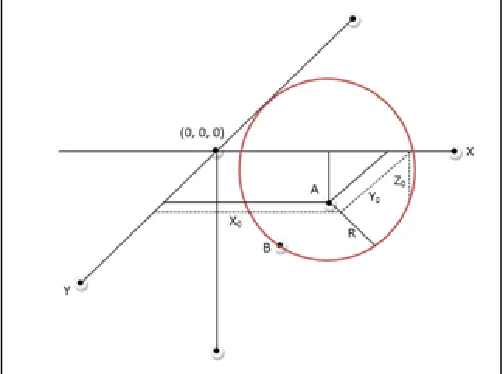
Here, R is the radius of the sphere and A is the center of the sphere. The coordinate of sensor node A (x0, y0, z0) and coordinate of sensor node B (x, y, z). Initially the value of z-coordinate for both sensor nodes is zero. The value of x and y coordinate for sensor node B will remain same when it will drift into the water but the value of z-coordinate will be change.
Figure 2. Deployment based on Depth
The equation of the sphere:
2 2 2 2
0 0 0
2 2 2 2
0 0 0
1 / 2
2 2
2
0 0 0
x x y y z z R
z z R x x y y
z z R x x y y
Using above equation, the value of the z-coordinate can be determined with the condition if x and y coordinates of sensor node B is known.
4.2 Selection of Best Forwarder
It is assumed that node having greatest value of heuristic function will be best forwarder and the estimation of heuristic value is expressed in the following ways.
( ) ( ) * ( )
f n g n h n
Calculation of g (n) function
The calculation of function g (n) is expressed in the following way:
( ) ( )
( ) r f * d iffe r e n c e * s f
g n E d e p th d
Where, represents the residual energy of the forwarding node, depth represents the difference of vertical difference from the forwarding node and sending node to the surface and dsf is the distance from sending node to forwarding node.
Fig. 1. Depth Based Deployment
Calculation of h (n) function
The calculation of function g (n) is expressed in the following way:
( )
( ) 1 / fd n o d e
h n d
Where, d is the distance from forwarding node to destination node. Here, h (n) is estimated as inverse of distance from forwarding node to sink node because less distance shows best node to forward the packet.
From the equation of 2 and 3, the heuristic function stands in the following ways:
( ) ( ) ( )
( ) ( r f * d iffe r e n c e * s f) / fd n o d e
f n E d e p th d d
Estimation of Holding Time
To estimate the holding time, first set the priority P to the forwarder node which is expressed in the following way:
1 / ( )
P g n
The estimation of holding time is done in the following way:
t
H K P
Where, p is the priority and the value of K is calculated by D/V. Here D is the maximum distance which comes under the range of sender node and V is the velocity of sound. The value of D is estimated in the following ways:
2 2
1 [{ ( s ) f} { s f)} ]
D x R x y y
2 2
2 [{ ( s ) f} { s f)} ]
D x R x y y
1 2
m a x ( , )
D D D
5 RESULTS AND DISCUSSIONS
The proposed work considers the three dimensional network area of 1km width and length and having depth of 2km. in this work, all sensor nodes are homogenous having range from 600m to 1000m. Multiple sink are placed at water surface to receive the data from the cluster head. All member nodes are deployed at different depths using deployment technique. The comparison of proposed algorithm is done with the existing technique named E2RV. Same parameters like in E2RV are
simulation, 60 sensor nodes, in second simulation 120 and in third simulation 180 sensor nodes.
To transfer the k bits from one node to another at distance d meters is calculated by given equation:
2, * * *
E x k d E e le c k E a m p k d
Here E e le c is required power to send the one bit data.
E a m p is required power to amplify the signals.
To receive the k bit data from node, the required energy is calculated by given equation:
*
E r x E e le c k
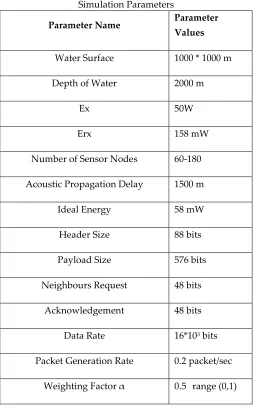
According the energy model, following Table 1 shows the simulation parameters.
TABLE 1 Simulation Parameters
Parameter Name Parameter
Values
Water Surface 1000 * 1000 m
Depth of Water 2000 m
Ex 50W
Erx 158 mW
Number of Sensor Nodes 60-180
Acoustic Propagation Delay 1500 m
Ideal Energy 58 mW
Header Size 88 bits
Payload Size 576 bits
Neighbours Request 48 bits
Acknowledgement 48 bits
Data Rate 16*103 bits
Packet Generation Rate 0.2 packet/sec
5.1 Packet Delivery Ratio
Packet delivery ratio is calculated by given formula:
Here n is total number of generated packets; m is defined as total number of sinks. As the total number of generated packets is directly proportional to network size. If the data packet generation is high then collision chances is increases. Figure. 2 shows that packet delivery ratio is increase slightly as network size increases
Fig. 2. PDR vs Number of Nodes
5.2 Total Energy Consumption
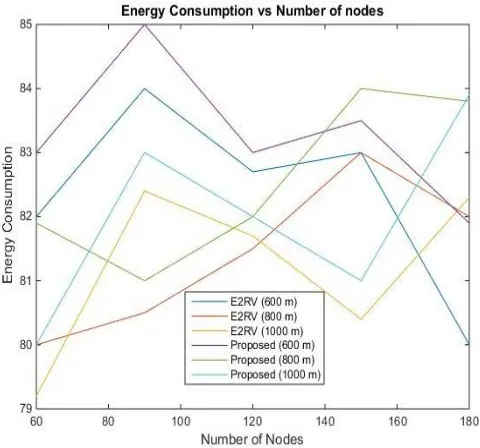
Total energy consumption includes the transmission energy, receiving energy and idle energy. Figure. 3 shows that total energy consumption is less as compared to existing algorithm named E2RV where network size is fixed.
Fig. 3 . Energy Consumption vs Number of Nodes
5.3 Average Number of Dead Nodes
A node is said to be dead nodes when battery power of the same node is completely used and no power is available to perform the task. Total number of dead nodes depends on the network size. As network size increases, number of dead nodes also increases as shown in Figure. 4.
6 CONCLUSION
This work presents a heuristic approach for void avoidance and selection of best forwarder. The concept of best forwarder node is used to overcome the problem of void region. For selecting the best forwarder, this approach uses the depth information, distance to next, residual energy and holding time. The node having the short distance and maximum residual energy will be selected as best forwarder to transmit the data packet. The concept of two hop acknowledgement is also used for successful delivery of data packets at sink node. The comparison is done with E2RV to analyze the performance of the proposed approach.
R
EFERENCES[1] Jin-Young Lee, Nam-Yeol Yun, Sardorbek Muminov, Soo-Young Shin, Young-Sun Ryuh & Soo-Hyun Park, A Focus on Practical Assessment of MAC Protocols for Underwater Acoustic Communication with Regard to Network Architecture, IETE Technical Review, 30:5, 375-381, 2-13. DOI: 10.4103/0256-4602.123119.
[2] Rahman Zandi, Mahmoud Kamarei, Hadi Amiri & Forough Yaghoubi, Underwater Sensor Network Positioning Using an AUV Moving on a Random Waypoint Path, IETE Journal of Research, 61:6, 693-698, 2015. DOI: 10.1080/03772063.2015.1034196.
[3] A. Muhammad, B. Imran, A. Azween, and F. Ibrahima. A Survey on routing tehcniques in underwater wireless sensor networks. Journal of Network and Computer Applications. Elsevier. vol. 34, issue 6, 1908-1927 (2011).
[4] Kamal Gola, Kumar and Gupta, Bhumika. Underwater sensor networks routings (UWSN-R) ―a comprehensive survey‖. Sensor letters, Vol 15, Number 11, 2017.
[5] G. Khan, K. K. Gola and W. Ali, "Energy Efficient Routing Algorithm for UWSN - A Clustering Approach," 2015 Second International Conference on Advances in Computing and Communication Engineering, Dehradun, 2015, pp. 150-155.
[6] Shin, S.-Y.; Park, S.-H. A Cost Effective Block Framing Scheme for Underwater Communication. Sensors 2011, 11, 11717–11735. [7] Kim, Y.; Park, S.-H. A Query Result Merging Scheme for Providing
Energy Efficiency in Underwater Sensor Networks. Sensors 2011, 11, 11833–11855.
[8] Llor, J.; Malumbres, M.P. Underwater Wireless Sensor Networks: How Do Acoustic Propagation Models Impact the Performance of Higher-Level Protocols? Sensors 2012, 12, 1312–1335.
[9] Khan, A.; Ali, I.; Ghani, A.; Khan, N.; Alsaqer, M.; Rahman, A.U.; Mahmood, H. Routing Protocols for Underwater Wireless Sensor Networks: Taxonomy, Research Challenges, Routing Strategies and Future Directions. Sensors 2018, 18, 1619.
[10] Khan G., Dwivedi R.K., Gola K.K. (2019) Comparative Analysis of Routing Algorithms for Underwater Sensor Network. In: Bhargava D., Vyas S. (eds) Pervasive Computing: A Networking Perspective and Future Directions. Springer, Singapore.
[11] Hafeez, T.; Javaid, N.; Hameed, A.R.; Sher, A.; Khan, Z.A.; Qasim, U. AVN-AHH-VBF: Avoiding void node with adaptive hop-by-hop vector based forwarding for underwater wireless sensor networks. In Proceedings of the IEEE 10th International Conference on Innovative Mobile and Internet Services in Ubiquitous Computing, Fukuoka,
[12] Coutinho, R.W.L.; Boukerche, A.; Vieira, L.F.M.; Loureiro, A.A.F. Geographic and opportunistic routing for uderwater snsor networks. IEEE Trans. Comput. 2016, 65, 548–561.
[13] Latif, K.; Javaid, N.; Ahmad, A.; Khan, Z.A.; Alrajeh, N.; Khan, M.I. On energy hole and coverage avoidance in underwater wireless sensor networks. IEEE Sens. J. 2016, 16, 4431–4442.
[14] Ali, B.; Sher, A.; Javaid, N.; Islam, S.; Aurangzeb, K.; Haider, S.I. Retransmission avoidance for reliable data delivery in underwater WSNs. Sensors 2018, 18, 149.
[15] Xie, P.; Zhou, Z.; Peng, Z.; Cui, J.-H.; Chi, Z. Void Avoidance in three-dimensional mobile underwater sensor networks. In Proceedings of the 4th International Conference on Wireless Algorithms, Systems and Applications, Boston, MA, USA, 16–18 August 2009.
[16] Majid, A.; Azam, I.; Waheed, A.; Abidin, M.Z.; Hafeez, T.; Khan, Z.A.; Qasim, U.; Javaid, N. An energy efficient and balanced energy consumption cluster based routing protocol for underwater wireless sensor networks. In Proceedings of the IEEE 30th International Conference on Advanced Information Networking and Applications, Crans-Montana, Switzerland, 23–25 March 2016.
[17] Li, M.; Du, X.; Huang, K.; Hou, S.; Liu, X. A routing protocol based on received signal strength for underwater wireless sensor networks (UWSNs). Information 2017, 8, 153.
[18] Hyder,W.; Poncela, J.; Otero, P. Self-organized routing for radial underwater networks. In Proceedings of the IEEE 13th International Conference on Computing for Sustainable Global Development, New Delhi, India, 11–13 March 2016.
[19] Khan, Gulista and Dwivedi, R. K., Energy efficient routing algorithm for void avoidance in UWSNs using residual energy and depth variance. IJCNC, Vol. 10, No. 4 july, 2018.