Evaluation and Development of Potentially Better Practices for Improving
Family-Centered Care in Neonatal Intensive Care Units
Roger P. Saunders, RN, MSN, PNP*; Marie R. Abraham, MA‡; Mary Jo Crosby, RNC, NNP, MS§;
Karen Thomas, APRN, BC
储
; and William H. Edwards, MD¶
ABSTRACT. Objective. Technological and scientific advances have progressively decreased neonatal morbid-ity and mortalmorbid-ity. Less attention has been given to meet-ing the psychosocial needs of the infant and family than on meeting the infant’s physical needs. Parents’ partici-pation in making decisions and caring for their child has often been limited. Environments designed for efficient technological care may not be optimal for nurturing the growth and development of sick neonates or their fami-lies. Eleven centers collaborating on quality improve-ment tried to make the care of families better by focusing on understanding and improving family-centered care.
Methods. Through internal process analysis, review of the evidence, collaborative learning, and benchmark-ing site visits to centers of excellence in family-centered care, a list of potentially better practices was developed. Choice of which practices to implement and methods of implementation were center specific. Improvement goals were in 3 areas: parent-reported outcomes, staff beliefs and practices, and clinical outcomes in length of stay and feeding practices. Measurement tools for the first 2 areas were developed and pilots were conducted.
Results. Length of stay and feeding outcomes were not different before the collaboration (1998) and at the formal end of the collaboration (2000).
Conclusions. Prospective parent-reported outcomes are being collected, and the staff beliefs and practices questionnaire will be repeated in all centers to determine the impact of the project in those areas. Pediatrics
2003;111:e437–e449. URL: http://www.pediatrics.org/cgi/ content/full/111/4/e437;family-centered care, parental in-volvement, collaborative quality improvement, multidis-ciplinary, benchmarking, neonatal intensive care, NIC/Q 2000.
ABBREVIATIONS. NICU, neonatal intensive care unit; NIC/Q 2000, Neonatal Intensive Care Unit Quality Improvement Collab-orative Year 2000; VLBW, very low birth weight; PBP, potentially better practice; IFCC, Institute for Family-Centered Care; PO, oral.
KEY POINTS OF ARTICLE
• Family-centered care best practices are not limited
to specific guidelines for family’s presence but
include beliefs about family-centered care by
lead-ers and the organization.
• Making improvements in family-centered care
may require changing the beliefs and culture of
the unit.
• Measurement tools for parent-reported outcomes
and staff beliefs and practices were developed and
piloted in this project.
• Clinical outcomes of length of stay and feeding
were not different before the project began and in
the second year of the project (2000).
APPLYING LESSONS LEARNED TO PRACTICE
• Family-centered care is a concept that must be
integrated into the culture and functioning of a
neonatal intensive care unit (NICU).
• An environment that supports the presence and
involvement of families may enhance
family-cen-tered care.
• A high level of collaboration with families is more
dependent on the attitudes of the care providers
and the relationships that they establish with the
families than on the physical facilities.
• The absence of useful measurement tools at the
outset of the project was a barrier but presented an
opportunity to use the strength of the
collabora-tion to develop them.
T
he field of neonatal intensive care has changed
dramatically in the past 40 years.
Technologi-cal and scientific advances have progressively
decreased neonatal morbidity and mortality.
How-ever, the NICU environment is one of high stress,
crises, and turbulent emotions for the families of
premature and ill neonates.
1– 8Less attention has
been focused on finding the best ways to meet the
psychosocial needs of the infant and family than on
meeting the infant’s physical needs.
9,10Parents play
the central role in providing for most children’s
emo-tional, physical, social, and developmental needs, yet
historically they have been limited in participating in
their child’s care in the NICU.
11–13There is growing
recognition that environments designed to make
de-livery of technological care efficient for staff may not
be optimal for nurturing the growth and
develop-ment of sick neonates or for their families.
14 –16Family-centered care places the needs of the
indi-vidual infant in the context of the family and
rede-fines the relationship between parents and
care-givers. Information sharing and collaboration are
cornerstones of family-centered care, and they shape
From the *Women’s Hospital of Greensboro, Greensboro, North Carolina;‡Institute for Family-Centered Care, Bethesda, Maryland; §Children’s Hos-pitals and Clinics, Minneapolis, Minnesota;储DeVos Children’s Hospital, Grand Rapids, Michigan; and ¶Children’s Hospital at Dartmouth, Lebanon, New Hampshire.
Received for publication Aug 13, 2002; accepted Oct 24, 2002.
Address correspondence to William H. Edwards, MD, Department of Pe-diatrics, Children’s Hospital at Dartmouth, One Medical Center Dr, Leba-non, NH 03756. E-mail: [email protected]
a unit’s culture, policies, programs, and facility
de-sign as well as the day-to-day interactions between
caregivers and families.
17The potential benefits of
family-centered care include improved satisfaction
with care, decreased parental stress, increased
paren-tal comfort and competence with postdischarge care,
improved success with breastfeeding, shortened
hos-pital lengths of stay, decreased readmissions
postdis-charge, and increased staff satisfaction.
18 –21The overall aim of this project was to use Vermont
Oxford Network Neonatal Intensive Care Unit
Qual-ity Improvement Collaborative Year 2000 (NIC/Q
2000) quality improvement methods to foster early
and ongoing family involvement in care, education,
and administrative processes in the NICU. There
were 3 areas that we believed would be improved:
parent-reported outcomes, nursery staff beliefs and
practices about family-centered care, and clinical
outcomes. At the beginning of this project, there
were no available tools for standardized outcome
measurements in the first 2 areas. Part of this project
involved developing these tools. Comparative data
before and after the project are therefore unavailable.
In the third area of clinical outcomes, we used the
population of 401- to 1500-g birth weight infants to
reflect improvements. Two reasons for selecting this
population of infants were that they have long and
complex hospital stays, and historical and current
data would be available in the Vermont Oxford
Net-work database on very low birth weight (VLBW)
infants. Setting clinical improvement goals was
dif-ficult because of the indirect and complex
relation-ships between improved family-centered care and
clinical outcomes. Length of stay and feeding
out-comes were chosen because of previously reported
effects or hypothesized relations, as in support of
feeding choices.
18,19The incidence of chronic lung
disease has been reported to be reduced with
indi-vidualized developmental care.
22–24Because there
is some overlap in family-centered care and
devel-opmental care, the incidence of chronic lung
dis-ease at 36 weeks’ corrected age was analyzed,
al-though no specific improvement goals were set.
Clinical improvements were based on comparing
data from 1998 to outcomes in 2000, except for the
support of feeding plans, which was measured
only for 2000.
The process for improving family-centered care
was similar to that used by all of the NIC/Q 2000
focus groups. This included a detailed internal
pro-cess analysis by each center, an ongoing review of
the evidence base for proposed improvements,
col-laborative learning by conference calls, focus group
activities at joint meetings, and planning and
con-ducting benchmarking site visits to centers of
excel-lence in family-centered care. One goal of these
ac-tivities was to develop a list of potentially better
practices (PBPs) for improving family-centered care.
These evolving concepts were translated into quality
improvement cycles that were individualized at each
center. This article describes the steps taken to define
a list of potentially better family-centered care
prac-tices, the development of measurement tools for
par-ent-reported outcomes and staff beliefs and
prac-tices, and the comparative clinical outcomes.
METHODS Forming the Focus Group
Eleven centers in collaboration with the Institute for Family-Centered Care (IFCC) formed the focus group (Appendix A). A neonatologist led the group, which was also facilitated and sup-ported by Vermont Oxford Network NIC/Q 2000 project faculty. Initial work included the definition of goals for the project, a review of the literature on family-centered care practices, and the development of a process for selecting benchmarks sites of excel-lence in family-centered care for visits. Biweekly teleconferences and communication via electronic mail listserv facilitated collab-oration and project management.
Participating centers completed the “Family-Centered Care in Newborn Intensive Care Units: A Self-Assessment Inventory” de-veloped by the IFCC.25This survey helps a center assess policies,
programs, practices, and the environment of the NICU. We be-lieved that 2 additional areas that were covered less thoroughly by the inventory but also keys to the success of family-centered care were administrative support and continuity of care in the com-munity. The group therefore expanded the survey to include assessment of strengths and opportunities for improvement in these areas as well. Completion of the expanded inventory tool created a common ground for dialogue among centers, as well as helped centers identify individual improvement goals. (After benchmark site visits were completed, the survey was edited to the shorter version in Appendix B.)
Benchmark Site Visits
Identifying benchmark sites of excellence in family-centered care was challenging. There are no standard rating scales for success in delivering family-centered care. Twelve potential cen-ters were identified using published reports of programs, recom-mendations from the IFCC, theNIC/Q 2000 Collaborative Learning Directory, which identifies areas of clinical and organizational excellence, and suggestions by members of the focus group.18,26
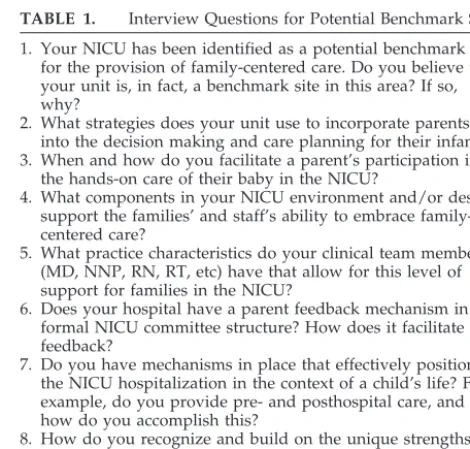
Representatives of each of the 12 potential benchmark centers were interviewed by telephone using a standard set of questions (Table 1). Each of the 8 content areas was scored using a scale of 0 to 5. Four centers with a composite score of 37 or higher out of a maximum possible score of 40 were then contacted to arrange benchmark site visits. The 4 sites selected were the University of Massachusetts Memorial Medical Center (Worcester, MA), Rain-bow Babies and Children Hospital (Cleveland, OH), Utah Valley Regional Medical Center (Provo, UT), and Evergreen Hospital Medical Center (Kirkland, WA).
TABLE 1. Interview Questions for Potential Benchmark Sites
1. Your NICU has been identified as a potential benchmark site for the provision of family-centered care. Do you believe that your unit is, in fact, a benchmark site in this area? If so, why?
2. What strategies does your unit use to incorporate parents into the decision making and care planning for their infant? 3. When and how do you facilitate a parent’s participation in
the hands-on care of their baby in the NICU?
4. What components in your NICU environment and/or design support the families’ and staff’s ability to embrace family-centered care?
5. What practice characteristics do your clinical team members (MD, NNP, RN, RT, etc) have that allow for this level of support for families in the NICU?
6. Does your hospital have a parent feedback mechanism in the formal NICU committee structure? How does it facilitate feedback?
7. Do you have mechanisms in place that effectively position the NICU hospitalization in the context of a child’s life? For example, do you provide pre- and posthospital care, and how do you accomplish this?
Each center was asked to complete the expanded self-assess-ment of family-centered care (Appendix B) and return the re-sponses before the site visit. Benchmark centers were also asked to provide key information about family-centered care, including vision and philosophy statements, visitation policies, and job de-scriptions. Centers were asked whether they would be willing to share specific Vermont Oxford Network VLBW outcomes data for comparison with the family-centered care focus group centers. For each visit, an individual from our focus group collaborated with a contact person at the benchmark site to clarify goals and objectives and to outline the agenda and details for the visit. Each center in the focus group decided which benchmark visits they would make. The composition and size of the visit team was also indi-vidual choice, although the most effective visiting teams were multidisciplinary, consisting at a minimum of physicians, nurses, and parents. Many centers also brought respiratory care techni-cians or other NICU staff. All 11 centers made at least 1 site visit, and most visited all 4. A typical site visit began with an informa-tional presentation including a description of the NIC/Q 2000 project and the specific goals of the family-centered care focus group. Comparative outcome data on clinical outcomes were pre-sented without identification of centers. The subsequent agenda for the day varied among sites but included tours of the unit(s) and support services departments (eg, physical/occupational therapy, family resource center, child care). Breakout sessions with families, administrators, and staff were excellent opportuni-ties for group learning. It was particularly important for site visitors to have an opportunity to spend unstructured time on the unit talking with staff and families. At the end of the day, repre-sentatives from the benchmark site were asked to list the top 10 practices in their NICU that they believed supported and pro-moted family-centered care. The visiting centers then spent an hour discussing what had been learned during the visit. Assign-ments were made to compile all of the information and write a summary report of each visit.
Parent-Reported Outcomes
Outcomes of care as reported by parents were important for assessing the impact of improvements in family-centered care. Although patient satisfaction surveys are now commonly used by hospitals to identify areas for improvement, few have been de-signed specifically for families of NICU patients.27–29Available
instruments were not particularly oriented toward family-cen-tered care, were prohibitively expensive, or were insufficiently developed to use in the time frame of this project. The lack of acceptable tools for this project led us to design one. This tool for parents of NICU patients was based on a well-established and validated group of health status surveys developed by the Dart-mouth COOP project.30,31The tool is web-based and uses
tem-plates and formats of questions used for older age patients (http://www.howsyourbaby.com).
An initial draft of the survey questions was reviewed for con-tent validity with multidisciplinary input from all centers, from representatives from the IFCC, and through focus groups with families of previous NICU patients. A pilot trial of the survey was conducted at 6 of the 11 focus group centers. One site with poor computer access conducted the pilot on paper. A coordinator at each site asked families to complete the computer-based survey. The goals of the pilot were to validate content and determine clarity, ease of use, and general impressions about format. The time to complete each survey was recorded by the site coordina-tor. After revisions, the survey was extended into a more pro-longed trial in which 10 of the 11 centers are participating.
Questions that were designed specifically to address goals of improving family-centered care were as follows:
• How well do you know your infant (personality; likes and dislikes; ways my infant uses to calm himself/herself)? • During your infant’s hospital stay, how often did you feel like
a parent?
• How ready do you feel you are to care for your infant after discharge from the hospital?
• How do you feel about feeding your infant?
• How have you felt about breastfeeding? (for mothers planning to breastfeed)
NICU Care Provider Questionnaire
One area expected to reflect improvements in family-centered care was NICU staff beliefs and practices related to family-cen-tered care.32,33A multidisciplinary subgroup from all 11 hospitals
and a representative from the IFCC reviewed the available litera-ture and measurement tools.34 –36Desirable characteristics were
that the tool be comprehensive, appropriate for all staff who interact directly with infants and families, and able to measure change over time. Because no currently available tool completely met these criteria, a new tool was developed.
The process for developing a new staff beliefs and practices questionnaire began with generating a list of beliefs and practices that the subgroup believed reflected family-centered care. This list served as the basis for a draft questionnaire. The draft underwent several revisions after review by families of NICU graduates, NICU staff, and experts in survey development and family-cen-tered care. A pilot trial of the questionnaire was then adminisfamily-cen-tered to 72 care providers in February 2000. Analysis of the data from the pilot and feedback from the 72 respondents was used to develop a final version of the questionnaire.
Clinical Outcomes
Quantitative clinical improvement goals for this population were 1) a 10% decrease in hospital length of stay, 2) a 10% decrease in the gestational age at which full oral feedings were achieved, and 3) support of family feeding plans resulting in 85% of infants at discharge being fed according to the feeding plan the family declared as their choice within 48 hours of admission. The inci-dence of chronic lung disease was also compared, but no specific improvement goal was set. We used data from the Vermont Oxford Network VLBW database for the clinical outcomes of length of stay and chronic lung disease. Length of stay was de-fined as the number of days to initial discharge home. Infants who were transferred to another hospital rather than discharged from the hospital were excluded. Chronic lung disease was defined as need for oxygen supplementation at 36 weeks’ corrected age. The incidence was imputed for infants who were no longer in the member hospital using a published algorithm in the Vermont Oxford Network Annual NICU Quality Management Report.37
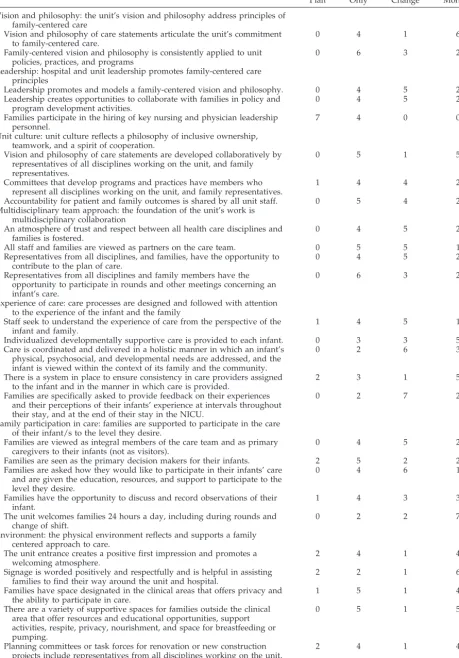
TABLE 2. Family-Centered Care PBPs Center Plans for Implementation of Each Practice No Plan Plan Only Active Change In Place Monitor
Vision and philosophy: the unit’s vision and philosophy address principles of family-centered care
Vision and philosophy of care statements articulate the unit’s commitment to family-centered care.
0 4 1 6
Family-centered vision and philosophy is consistently applied to unit policies, practices, and programs
0 6 3 2
Leadership: hospital and unit leadership promotes family-centered care principles
Leadership promotes and models a family-centered vision and philosophy. 0 4 5 2 Leadership creates opportunities to collaborate with families in policy and
program development activities.
0 4 5 2
Families participate in the hiring of key nursing and physician leadership personnel.
7 4 0 0
Unit culture: unit culture reflects a philosophy of inclusive ownership, teamwork, and a spirit of cooperation.
Vision and philosophy of care statements are developed collaboratively by representatives of all disciplines working on the unit, and family representatives.
0 5 1 5
Committees that develop programs and practices have members who represent all disciplines working on the unit, and family representatives.
1 4 4 2
Accountability for patient and family outcomes is shared by all unit staff. 0 5 4 2 Multidisciplinary team approach: the foundation of the unit’s work is
multidisciplinary collaboration
An atmosphere of trust and respect between all health care disciplines and families is fostered.
0 4 5 2
All staff and families are viewed as partners on the care team. 0 5 5 1
Representatives from all disciplines, and families, have the opportunity to contribute to the plan of care.
0 4 5 2
Representatives from all disciplines and family members have the opportunity to participate in rounds and other meetings concerning an infant’s care.
0 6 3 2
Experience of care: care processes are designed and followed with attention to the experience of the infant and the family
Staff seek to understand the experience of care from the perspective of the infant and family.
1 4 5 1
Individualized developmentally supportive care is provided to each infant. 0 3 3 5 Care is coordinated and delivered in a holistic manner in which an infant’s
physical, psychosocial, and developmental needs are addressed, and the infant is viewed within the context of its family and the community.
0 2 6 3
There is a system in place to ensure consistency in care providers assigned to the infant and in the manner in which care is provided.
2 3 1 5
Families are specifically asked to provide feedback on their experiences and their perceptions of their infants’ experience at intervals throughout their stay, and at the end of their stay in the NICU.
0 2 7 2
Family participation in care: families are supported to participate in the care of their infant/s to the level they desire.
Families are viewed as integral members of the care team and as primary caregivers to their infants (not as visitors).
0 4 5 2
Families are seen as the primary decision makers for their infants. 2 5 2 2 Families are asked how they would like to participate in their infants’ care
and are given the education, resources, and support to participate to the level they desire.
0 4 6 1
Families have the opportunity to discuss and record observations of their infant.
1 4 3 3
The unit welcomes families 24 hours a day, including during rounds and change of shift.
0 2 2 7
Environment: the physical environment reflects and supports a family centered approach to care.
The unit entrance creates a positive first impression and promotes a welcoming atmosphere.
2 4 1 4
Signage is worded positively and respectfully and is helpful in assisting families to find their way around the unit and hospital.
2 2 1 6
Families have space designated in the clinical areas that offers privacy and the ability to participate in care.
1 5 1 4
There are a variety of supportive spaces for families outside the clinical area that offer resources and educational opportunities, support activities, respite, privacy, nourishment, and space for breastfeeding or pumping.
0 5 1 5
Planning committees or task forces for renovation or new construction projects include representatives from all disciplines working on the unit, and families.
RESULTS PBPs and Implementation
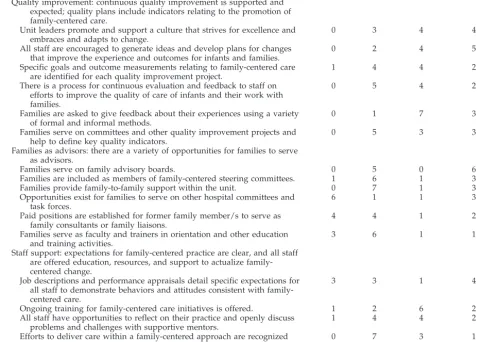
The PBPs developed through this collaborative
quality improvement process are listed in Table 2.
Ten content areas were identified. Within each
con-tent area is a list of more specific practices. Decisions
about which practices to implement as well as how
to prioritize them and which strategies to use to
make improvements was at the discretion of each
participating center. Table 2 also contains a summary
of the implementation status among the centers for
each of the practices at the conclusion of the formal
NIC/Q 2000 project (September 2000). For each
prac-tice, the following possible statuses are tabulated: no
plan (there are no plans to institute this practice),
plan only (this practice will be instituted in the
fu-ture, but no active changes in process), active change
(improvement cycles addressing this practice are in
progress but not completed), and complete (the
prac-tice is fully in place and only being monitored).
Parent-Reported Outcomes
For the pilot trial, 76 surveys were completed at 6
sites. Of parents who completed the pilot surveys,
90.8% believed that all (48.7%) or most (42.1%) of the
questions addressed important issues. Seventy-five
of the 76 parents surveyed believed that the
ques-tions were clear (57.9%) or mostly clear (40.8%). Of
the 69 parents who used the computer form of the
survey, 95.7% believed the survey was very easy
(66.7%) or easy (29.0%) to use. When asked whether
they would be interested in reading more about the
areas identified by the survey as concerns, 53.9%
would like more information on the computer, 86.8%
would like the information as printed handouts, and
75% would like information as a book. The average
time for completion of the survey by computer
var-ied from 10 to 15 minutes, with the variation mostly
related to differences in computer hardware and
con-nection speeds. The longest recorded time to
com-plete was 25 minutes. Pilot center contacts reported
few problems with administering the on-line survey.
NICU Care Provider Questionnaire
A pilot trial of the NICU Care Provider
Question-naire was conducted at 10 of the 11 centers. A contact
at each center selected individuals to complete the
81-item questionnaire and an accompanying
feed-back form. For determining whether the
question-naire was relevant across disciplines, the pilot
in-cluded nurses, neonatologists, unit secretaries,
respiratory therapists, pharmacists, physical and
oc-cupational therapists, social workers, paid parents,
and parent volunteers. Pilot participants represented
TABLE 2. Continued.
No Plan Plan Only Active Change In Place Monitor
Quality improvement: continuous quality improvement is supported and expected; quality plans include indicators relating to the promotion of family-centered care.
Unit leaders promote and support a culture that strives for excellence and embraces and adapts to change.
0 3 4 4
All staff are encouraged to generate ideas and develop plans for changes that improve the experience and outcomes for infants and families.
0 2 4 5
Specific goals and outcome measurements relating to family-centered care are identified for each quality improvement project.
1 4 4 2
There is a process for continuous evaluation and feedback to staff on efforts to improve the quality of care of infants and their work with families.
0 5 4 2
Families are asked to give feedback about their experiences using a variety of formal and informal methods.
0 1 7 3
Families serve on committees and other quality improvement projects and help to define key quality indicators.
0 5 3 3
Families as advisors: there are a variety of opportunities for families to serve as advisors.
Families serve on family advisory boards. 0 5 0 6
Families are included as members of family-centered steering committees. 1 6 1 3
Families provide family-to-family support within the unit. 0 7 1 3
Opportunities exist for families to serve on other hospital committees and task forces.
6 1 1 3
Paid positions are established for former family member/s to serve as family consultants or family liaisons.
4 4 1 2
Families serve as faculty and trainers in orientation and other education and training activities.
3 6 1 1
Staff support: expectations for family-centered practice are clear, and all staff are offered education, resources, and support to actualize family-centered change.
Job descriptions and performance appraisals detail specific expectations for all staff to demonstrate behaviors and attitudes consistent with family-centered care.
3 3 1 4
Ongoing training for family-centered care initiatives is offered. 1 2 6 2 All staff have opportunities to reflect on their practice and openly discuss
problems and challenges with supportive mentors.
1 4 4 2
Efforts to deliver care within a family-centered approach are recognized and rewarded by unit and hospital leadership.
a range of ages as well as years of experience in
neonatal intensive care.
Data from 72 pilot questionnaires and feedback
forms were analyzed and used to guide a final
revi-sion. Respondents evaluated the questionnaire on a
scale of 1 to 4, where 1
⫽
strongly agree and 4
⫽
strongly disagree. Results for 3 attributes of the
ques-tionnaire were 1) directions were clear and easy to
follow (mean: 2.0), 2) questions were easily
under-stood (mean: 2.0), and 3) items were relevant to
family-centered care (mean: 1.8). The questionnaire
was completed on average in 26 minutes. Ten
per-cent of the pilot participants believed that the
ques-tionnaire took too long to complete. The
develop-ment subgroup also believed that reducing the time
for completion would increase acceptance and return
rate for the questionnaire. A detailed review led to
deleting redundant questions and removing those
that were unclear. The final questionnaire uses a
7-point Likert scale to elicit responses across 5 global
areas: nursery environment, preparedness for
tradi-tional care and family-centered care, beliefs in
fami-ly-centered care, famifami-ly-centered practices, and level
of organizational support. In addition, 3 open-ended
questions ask respondents to identify barriers and
challenges
in
practicing
family-centered
care,
changes that they wish to make in their individual
practice, and necessary resources to improve their
work with families.
In May 2000, the revised 72-item questionnaire
was distributed to all staff at the 11 family-centered
care focus group centers, and 1143 surveys were
completed. The questionnaire will be repeated at the
same centers by the end of 2002.
Clinical Outcomes
Clinical outcomes are shown in Table 3. There was
no difference in the gestational age or birth weight
for VLBW infants who were admitted to focus group
hospitals in 1998 compared with 2000. The length of
stay to initial discharge home was the same for both
years. The incidence of chronic lung disease was
31.4% in 2000, compared with 27.3% in 1998. For both
the outcomes of length of stay and chronic lung
disease, great variability existed among centers. The
mean length of stay decreased in 7 of the 11 centers
and increased in 4. The incidence of chronic lung
disease increased in 7 centers and decreased in 4.
Statistical analysis was not performed. There was no
difference in the mean corrected gestational age at
which full oral feedings was reached between 1998
and 2000 (36.2 weeks for both periods). The median
corrected age for reaching full oral feedings varied
among centers from 34.7 to 36.6 weeks. The second
feeding outcome was the concordance between
ad-mission and discharge feeding plans. This outcome
was calculated from prospectively collected data.
The concordance for mothers who planned to
breast-feed for all centers was 67%, with a range among
centers from 51% to 91%. Concordance for formula
feeding was 94% with little variation among centers.
For breastfeeding and formula feeding combined,
the concordance was 74%, with a range among
cen-ters from 68% to 87%.
DISCUSSION
Using quality improvement strategies to improve
the practice of family-centered care proved
challeng-ing. Family-centered care is a concept that must be
integrated into the culture and functioning of an
intensive care unit.
38At the beginning of this
collab-orative project, individual centers were at different
stages of belief in the values of family-centered care
and in practicing according to them. This diversity
was apparent from the internal reviews and as the
participating centers learned about each other’s
strengths and challenges through collaboration. The
time frame for this project was relatively short to
document changes objectively in behavior and
cul-ture. The benchmarking site visits were conducted in
June and November of 1999, with the draft of the
PBPs completed in December. Few of the practice
concepts had been implemented completely by the
time of the formal end of the project (Table 2). Vision
and philosophy of care statements that articulate the
unit’s commitment to family-centered care were in
place in 6 of the 11 centers, with 1 actively in the
process of creating them and 4 centers in the
plan-ning stages. Seven centers had policies that
wel-comed families 24 hours a day, including during
rounds and change of shift, and the other 4 centers
were either actively changing or planning such a
policy. However, only 2 centers believed that
fami-lies were truly viewed as integral members of the
care team and as primary caregivers to their infants
rather than as visitors. Another practice that was
initiated or planned in all centers was the practice of
families serving on family advisory boards for the
TABLE 3. Family-Centered Care Clinical Outcomes
1998 2000
N Mean SD N Mean SD
Gestational age (wk) 1450 28.0⫾2.9 1572 27.9⫾3.0
Birth weight (g) 1450 1028⫾301 1572 1026⫾299
Length of stay 1225 64.0⫾36.6 1103 63.6⫾33.5
Chronic lung disease 1187 27.3% 1322 31.4%
Feeding Outcome Data* Gestational age (wk)
at full PO feed
279† 36.20⫾2.19 723 36.19⫾2.32
SD indicates standard deviation.
unit. For many centers starting such advisory boards,
there was inadequate time to measure actual changes
that those boards might have stimulated. No other
PBPs were completely implemented in even a
major-ity of participating centers, although active change
projects were in progress or planned for most. Many
of the centers have identified major deficits in the
physical environment of the NICU and have initiated
planning processes for renovation or new
construc-tion to address those deficits. It became clear
partic-ularly through site visits that an environment that
supports the presence and involvement of families
could enhance family-centered care. It was equally
clear that a high level of collaboration with families
was more dependent on the attitudes of the care
providers and the relationships that they established
with the families of infants in their units than on the
physical facilities. Several centers discovered that
in-cluding families as full participants in their infant’s
care depends on effective functioning of the
multi-disciplinary care team. Those centers have initiated
projects to improve teamwork, projects that in many
ways are as difficult as planning and building new
physical facilities.
Literature supports family-centered care as a
com-pelling philosophy for improving communication
and relationships with families.
1Firm evidence to
support an impact on physical outcomes is sparse.
Families tell us that they want to have a voice in how
they will participate in their children’s care, but there
are few tools to measure how successful we are in
giving them that voice.
39,40Preliminary evidence
from the web-based parent survey developed for this
project suggests that there will be great variation
among centers in how successfully we practice
fam-ily-centered care (data not shown). Comparative
data should lead to better insights into areas for
improvements. Success at supporting breastfeeding
for mothers of VLBW infants is extremely limited.
The proportion of women who provided breast milk
for their VLBW infant varied from 46% to 91%
among centers. Most of these mothers were
provid-ing expressed breast milk. Success at breastfeedprovid-ing
VLBW infants by suckling at the breast at discharge
was rare.
The outcomes chosen at the beginning of this
project were somewhat arbitrary and were based
more on hypothesis than on existing evidence. It is
not particularly surprising that this project was not
associated with demonstrable improvements in
length of stay, feeding, or chronic lung disease.
Changes in parent-reported outcomes and in staff
beliefs are perhaps more likely, but tools to measure
those outcomes before and after the project did not
exist. We plan to repeat the NICU Care Provider
Questionnaire at all of these centers at a time more
likely to reflect changes that have been initiated, as
well as to measure the parent-reported outcomes
over time. We believe that 1 of the successes of this
project will be to make these tools available to other
centers that are interested in improving their care
and in establishing some baseline data from centers
participating in this focus group that can be used for
comparison.
The PBPs that this focus group discovered are a
combination of generic principles of leadership and
teamwork as well as specific guidelines for creating
structures to foster collaboration with families across
all areas of functioning of the NICU. Applying their
practices will lead to a more fulfilling work
environ-ment for care providers and an environenviron-ment where
families are respected as essential partners in the care
of their children.
REFERENCES
1. Van Riper M. Family-provider relationships and well-being in families with preterm infants in the NICU.Heart Lung. 2001;30:74 – 84 2. Affleck G, Tennen H. The effect of newborn intensive care on parents’
psychological well-being.Child Health Care. 1991;20:6 –14
3. Affleck G, Tennen H, Rowe J.Infants in Crisis: How Parents Cope With Newborn Intensive Care and Its Aftermath. New York, NY: Springer-Verlag; 1991
4. Pinch WJ, Spielman ML. Ethics in the neonatal intensive care unit: parental perceptions at four years post discharge.Adv Nurs Sci.1996; 19:72– 85
5. Pinch WJ, Spielman ML. Parental perceptions of ethical issues post-NICU discharge.West J Nurs Res.1993;15:422– 437
6. Pinch WJ, Spielman ML. The parents’ perspective: ethical decision-making in neonatal intensive care.J Adv Nurs.1990;15:712–719 7. Stainton MC, Harvey S, McNeil D.Understanding Uncertain Motherhood:
A Phenomenological Study of Women in High-Risk Perinatal Situations.
Calgary, Alberta, Canada: University of Calgary; 1995
8. Wereszczak J, Miles MS, Holditch-Davis D. Maternal recall of the neo-natal intensive care unit.Neonatal Netw. 1997;16:33– 40
9. Bass LS. What do parents need when their infant is a patient in the NICU?Neonatal Netw. 1991;10:25–33
10. Miles MS, Holditch-Davis D. Parenting the prematurely born child: pathways of influence.Semin Perinatol. 1997;21:254 –266
11. Cuttini M, Rebagliato M, Bortoli P, et al. Parental visiting, communica-tion, and participation in ethical decisions: a comparison of neonatal unit policies in Europe.Arch Dis Child Fetal Neonatal Ed.1999;81:F84 –F91 12. Giganti AW. Families in pediatric critical care: the best option.Pediatr
Nurs. 1998;24:261–265
13. Reid M, Andersen E. Variations in family visiting policies in neonatal intensive care units in eleven EC countries. EC Study Group of Parental Involvement in Neonatal Care.Pediatr Perinat Epidemiol. 1994;8:41–52 14. Smith J, White R. Nurturing design: a look at recommended newborn
ICU standards.Health Facil Manage.2001;14:28 –31
15. Acton LP, Aoun A, Dennis E, et al. Children’s health design: designing for family-centered care.J Healthc Des.1997;9:129 –135
16. Committee to Establish Recommended Standards for Newborn ICU Design. Recommended standards for newborn ICU design.J Perinatol. 1999;19(pt 2):S2–S12
17. Hanson JL, Jeppson ES, Johnson BH, Thomas J.Newborn Intensive Care: Resources for Family-Centered Practice.Bethesda, MD: Institute for Fam-ily-Centered Care; 1997
18. Forsythe P. New practices in the transitional care center improve out-comes for babies and their families.J Perinatol. 1998;18(6 pt 2 suppl): S13–S17
19. Meyer EC, Coll CT, Lester BM, Boukydis CF, McDonough SM, Oh W. Family-based intervention improves maternal psychological well being and feeding interaction of preterm infants.Pediatrics.1994;93:241–246 20. O’Brien M, Dale D. Family-centered services in the neonatal intensive
care unit: a review of research.J Early Interv. 1994;18:78 –90
21. McKlindon D, Barnsteiner JH. Therapeutic relationships: evolution of the Children’s Hospital of Philadelphia model.MCN Am J Matern Child Nurs.1999;24:237–243
22. Als H, Gilkerson L. The role of relationship-based developmentally supportive newborn intensive care in strengthening outcomes of pre-term infants.Semin Perinatol. 1997;21:178 –189
23. Als H, Lawhon G, Brown E, et al. Individualized behavioral and envi-ronmental care for the very low birth weight preterm infant at high risk for bronchopulmonary dysplasia: neonatal intensive care unit and de-velopmental outcome.Pediatrics.1986;78:1123–1132
24. Als H, Duffy FH, McAnulty GB. Effectiveness of individualized neuro-developmental care in the newborn intensive care unit (NICU).Acta Paediatr Suppl. 1996;416:21–30
Intensive Care Units: A Self-Assessment Inventory. Bethesda, MD: Institute for Family-Centered Care; 1997
26. Vermont Oxford Network.NIC/Q 2000 Collaborative Learning Directory.
Burlington, VT: Vermont Oxford Network
27. Conner JM, Nelson EC. Neonatal intensive care: satisfaction measured from a parent’s perspective.Pediatrics. 1999;103(1 suppl):336 –349 28. Mitchell-DiCenso A, Guyatt G, Paes B, et al. A new measure of parent
satisfaction with medical care provided in the neonatal intensive care unit.J Clin Epidemiol. 1996;49:313–318
29. Blackington SM, McLauchlan T. Continuous quality improvement in the neonatal intensive care unit: evaluating parent satisfaction.J Nurs Care Qual. 1995;9:78 – 85
30. Wasson JH, Kairys SW, Nelson EC, Kalishman N, Baribeau P. A short survey for assessing health and social problems of adolescents.J Fam Pract.1994;38:489 – 494
31. Wasson JH, Kairys SW, Nelson EC, Kalishman N, Baribeau P, Wasson E. Adolescent health and social problems: a method for detection and early management. The Dartmouth Primary Care Cooperative Informa-tion Project (COOP).Arch Fam Med.1995;4:51–56
32. Ahmann E. Examining assumptions underlying nursing practice with children and families.Pediatr Nurs. 1998;24:467– 469
33. Bruce B, Ritchie J. Nurses’ practices and perceptions of family-centered care.J Pediatr Nurs. 1997;12:214 –222
34. McWilliam PJ.Brass Tacks: A Self-Rating of Family-Centered Practices in Early Intervention: Neonatal Intensive Care. Chapel Hill, NC: Frank Porter Graham Child Development Center, University of North Carolina; 1992
35. King S, Rosenbaum P, King G.The Measure of Processes of Care (MPOC): A Means to Assess Family-Centered Behaviors of Health Care Providers.
Hamilton, Ontario, Canada: Neurodevelopmental Clinical Research Unit, McMaster University; 1995
36. Hanson JL, Randall VF. Evaluating and improving the practice of family-centered care.Pediatr Nurs.1999;25:445– 449
37. Horbar JD, Rogowski J, Plsek PE, et al. Collaborative quality improve-ment for neonatal intensive care. NIC/Q Project Investigators of the Vermont Oxford Network.Pediatrics.2001;107:14 –22
38. Cohen JJ. Moving from provider-centered toward family-centered care.
Acad Med. 1999;74:425
39. Sweeney MM. The value of a family-centered approach in the NICU and PICU: one family’s perspective.Pediatr Nurs. 1997;23:64 – 66 40. Harrison H. The principles of family-centered neonatal care.Pediatrics.