ARTICLE
Functional Outcomes and Participation in Young
Adulthood for Very Preterm and Very Low Birth
Weight Infants: The Dutch Project on Preterm and
Small for Gestational Age Infants at 19 Years of Age
Elyse´e T. M. Hille, PhDa,b, Nynke Weisglas-Kuperus, MD, PhDa, J. B. van Goudoever, MD, PhDa, Gert W. Jacobusse, MScb,
Martina H. Ens-Dokkum, MD, PhDc, Laila de Groot, PhD, MCSPd, Jan M. Wit, MD, PhDe, Wil B. Geven, MD, PhDf, Joke H. Kok, MD, PhDg, Martin J. K. de Kleine, MD, PhDh, Louis A. A. Kolle´e, MD, PhDi, A. L. M. Mulder, MD, PhDj, H. L. M. van Straaten, MD, PhDk,
Linda S. de Vries, MD, PhDl, Mirjam M. van Weissenbruch, MD, PhDd, S. Pauline Verloove-Vanhorick, MD, PhDb,e, for the Dutch Collaborative POPS 19 Study Group
aDivision of Neonatology, Department of Pediatrics, Erasmus Medical Center–Sophia Children’s Hospital, Rotterdam, Netherlands;bBusiness Unit Prevention and
Healthcare, Netherlands Organization for Applied Research Quality of Life, Leiden, Netherlands;cRoyal Effatha Guyot Group, Zoetermeer, Netherlands;dVU University
Medical Center, Amsterdam, Netherlands;eLeiden University Medical Center, Leiden, Netherlands;fUniversity Medical Center Groningen, Beatrix Children’s Hospital,
Groningen, Netherlands;gEmma Children’s Hospital Academic Medical Center, Amsterdam, Netherlands;hMa´xima Medical Center, Veldhoven, Netherlands;iUniversity
Medical Center St Radboud, Nijmegen, Netherlands;jUniversity Hospital Maastricht, Maastricht, Netherlands;kIsala Clinics, Zwolle, Netherlands;lWilhelmina Children’s
Hospital, University Medical Center, Utrecht, Netherlands
The authors have indicated they have no financial relationships relevant to this article to disclose.
ABSTRACT
OBJECTIVE.Young adults who were born very preterm or with a very low birth weight remain at risk for physical and neurodevelopmental problems and lower academic achievement scores. Data, however, are scarce, hospital based, mostly done in small populations, and need additional confirmation.
METHODS.Infants who were born at ⬍32 weeks of gestation and/or with a birth weight of⬍1500 g in the Netherlands in 1983 (Project on Preterm and Small for Gestational Age Infants) were reexamined at age 19. Outcomes were adjusted for nonrespondents using multiple imputation and categorized into none, mild, mod-erate, or severe problems.
RESULTS.Of 959 surviving young adults, 74% were assessed and/or completed the questionnaires. Moderate or severe problems were present in 4.3% for cognition, 1.8% for hearing, 1.9% for vision, and 8.1% for neuromotor functioning. Using the Health Utility Index and the London Handicap Scale, we found 2.0% and 4.5%, respectively, of the young adults to haveⱖ3 affected areas in activities and participation. Special education or lesser level was completed by 24%, and 7.6% neither had a paid job nor followed any education. Overall, 31.7% had ⱖ1 moderate or severe problems in the assessed areas.
CONCLUSIONS.A total of 12.6% of young adults who were born very preterm and/or with a very low birth weight had moderate or severe problems in cognitive or neurosensory functioning. Compared with the general Dutch population, twice as many young adults who were born very preterm and/or with a very low birth weight were poorly educated, and 3 times as many were neither employed nor in school at age 19.
www.pediatrics.org/cgi/doi/10.1542/ peds.2006-2407
doi:10.1542/peds.2006-2407
Key Words
very low birth weight infants, very preterm infants, young adulthood, long-term outcome, cognitive function, neurosensory function, quality of life, education, employment
Abbreviations
VLBW—very low birth weight POPS—Project on Premature and Small for Gestational Age Infants
WHO—World Health Organization HUI3—Health Utility Index Mark 3 LHS—London Handicap Scale CI— confidence interval
P
RETERM BIRTH MAY have long-lasting effects. Al-though most preterm infants survive without major disabilities, follow-up studies at preschool age have re-vealed major disabilities such as cerebral palsy, mental retardation, blindness, and deafness.1,2Follow-up studies at school age have shown socioemotional, cognitive, and learning problems in addition.3,4 The first studies in young adults who were born preterm in the 1970s re-ported risk for physical and neurodevelopmental prob-lems, higher incidence of chronic illness, and lower IQ and academic achievement scores in comparison with term-born young adults.5–9 Regrettably, virtually all in-formation on outcomes in adulthood has been collected from small numbers of infants in individual hospitals. Multicenter studies in individuals from defined geo-graphic regions are now being recommended.10 More-over, ranges of functional outcomes among successive cohorts of very low birth weight (VLBW) and very pre-term infants have been lacking uniformity.11The Dutch nationwide follow-up study, Project on Premature and Small for Gestational Age Infants (POPS), ongoing since 1983, gave us the opportunity to investi-gate cognitive and neurosensory functioning as well as activities and participation in society in relation to envi-ronmental and personal factors.12–15 We examined the degree to which these survivors from the early era of neonatal intensive care have become fully independent and satisfied with their role in society.12–15
METHODS
Study Population
The original POPS cohort comprised 1338 individuals who were live-born very preterm (at ⬍32 weeks of gestation) and/or had a VLBW (⬍1500 g) in the Neth-erlands in 1983.13 As a total of 379 children did not survive to their 19th year; 959 young adults aged 19 years were eligible for this follow-up study that exam-ined long-term effects of preterm birth on various med-ical, psychologmed-ical, and social parameters (Fig 1).
Assessment
Shortly after their 19th birthday individuals were invited to participate in the study. Participation involved stan-dard assessment at 1 of the 10 participating hospitals and completion of a set of questionnaires. Parents completed the questionnaires when individuals were incapable. As-sessments were conducted by trained nurses; details, logistics, and response rate were reported previously.16
Ethical Approval and Informed Consent
The respective medical ethics review boards approved the study protocol. All participants provided written in-formed consent to participate in the study before assess-ment started.
Measures at 19 Years of Age
Cognitive and neurosensory functioning as well as ac-tivities and participation in society at 19 years of age were classified according to the World Health Organiza-tion’s (WHO’s) International Classification of Function-ing, Disability and Health.17For each of these areas, we ascertained possible problems, and, when present, we rated them as mild, moderate, or severe.
With regard to cognitive and neurosensory function-ing, the WHO defines impairments as a significant devi-ation or loss. Four areas were assessed: cognition, hear-ing, vision, and neuromotor function.
Cognition was assessed with the use of the computer version of the Multicultural Capacity Test–Intermediate Level developed by Bleichrodt and Berg.18This test pro-vides an overview of a person’s capacity and skills, covering a fairly broad spectrum of intelligence factors: verbal and numerical factors, appreciation of spatial di-mensions, fluent speech, memory, reasoning, and speed of perception. Cognition was classified according to the SD scores of the general population (IQ ⱖ85, no prob-lem; IQⱖ70 and⬍85, mild problem; IQⱖ55 and⬍70, moderate problem; IQ⬍55, severe problem).
Hearing was tested for each ear separately by pure-tone audiometry with a hand-held audiometer, fitted for air and bone conduction. We determined auditory sen-sitivity as the mean of the threshold levels at 500, 1000, 2000, and 4000 Hz. Classification was according to the definitions of the WHO’s International Classification of Impairments, Disabilities and Handicaps (loss in the best ear ⱕ25 dB, no problem; ⬎25 and ⱕ55 dB, moderate problem;⬎55 dB, severe problem).19
Vision status was ascertained from the participant’s self-report. Being blind or having severe visually impair-ment was classified as a moderate problem.
Neuromotor function assessment was based on Tou-wen’s examination of minor neurologic dysfunction,20as revised by Samsom et al.21This examination focuses on 5 subcategories of function— hand function, quality of FIGURE 1
walking, coordination, posture, and passive muscle tone—resulting in 5 scores on the subcategories and a total score of the summed subcategories of 68 points. Outcome was expressed on a 3-point scale: the items were classified in an ordinal scale as being optimal (2 points), slightly deviant (1 point), or poor (0 points). Classification was according to the percentile scores of the mean of the Dutch norm group (score: 96%–100% [total score: 59.50 – 68.00], no problem; score: 76%–95% [total score: 46.98 –59.49], mild problem; score: 51%–75% [total score: 31.32– 46.97], moderate problem; score:
ⱕ50% [total score:ⱕ31.31], severe problem).22
Individuals may experience limitations in activities and participation in society. The WHO defines activity limitations as difficulties that an individual may have in executing activities; participation restrictions are prob-lems that an individual may experience in involvement in life situation.17We assessed 4 areas that are relevant to this domain: health status, perceived health, education, and occupation.
Health status was determined with use of the Health Utilities Index Mark 3 (HUI3). Focusing on functional capacity, the HUI3 consists of 8 attributes of health status (vision, hearing, speech, ambulation, dexterity, emotion, cognition, and pain) with 5 or 6 levels per attribute.23
Perceived health was measured by the London Hand-icap Scale (LHS), a generic (utility) measure of disability. The LHS is based on the first version of theInternational Classification of Impairments, Disabilities and Handicaps. It incorporates a 6-point hierarchical scale of disadvantages for each of 6 dimensions of disability: mobility, physical independence (self-care), occupation (daily activities), social integration, orientation, and economic self-suffi-ciency.24
HUI3 attributes and LHS dimensions tend to be ex-tremely skewed; as a result, relevant differences in dis-tributions may go undetected. This is why we dichoto-mized HUI3 and LHS scores: scores 1 and 2 were considered to reflect no problem or a mild problem and scoresⱖ3 to reflect a moderate or severe problem. Total scores of 6 HUI attributes (we excluded emotion and pain as being subjective measures) and the 6 LHS dimen-sions were then classified as follows: 0 affected, no prob-lem; 1 to 2 affected, mild probprob-lem; 3 to 4 affected, moderate problem; and 5 to 6 affected, severe problem. Information concerning educational attainment and current enrollment in an educational program was as-certained from the participant’s self-report. Graduation from or enrollment in university, higher vocational ed-ucation, or senior or general secondary education was considered to reflect no problem; special education or junior secondary vocational education was a moderate problem; primary school and no certificate or current education on any level was a severe problem.
Occupational activities were ascertained from the par-ticipant’s self-report and were classified as follows:
full-time (ⱖ32 hours/week) job or full-time education or part-time education with a job for 16 to 31 hours/week, no problem; part-time education with a job for ⬍16 hours/week or only a job for ⬍32 hours/week, mild problem; part-time job and/or education with a disability allowance, moderate problem; no paid job and no edu-cation (with or without disability allowance), severe problem. Both education and occupation were classified according to the level of education and expectations of the general population for a 19-year-old individual.
In addition, we established the following environ-mental and personal factors: gender (male versus fe-male), gestational age (ⱖ32, 31, 30, 29, 28, 27, or 26 to 25 completed weeks of gestation), birth weight (ⱖ1500, 1000 to 1500, or⬍1000 g at birth), and highest level of parental education (low [primary school or junior sec-ondary vocational education], middle [general or senior secondary education], or high [higher vocational educa-tion, or university]).
Multiple Imputation and Data and Statistical Analyses
Multiple imputation25was applied to adjust for missing values in some or all of the variables at age 19. This simulation-based approach creates a number of imputed (completed) data sets by “filling in” plausible values for the missing data. The imputations are based on a model that uses information from other variables to achieve optimal estimates. Only imputations for the missing val-ues between the lowest and highest valval-ues of the mea-sured outcome variable are valid. Uncertainty about the model estimates is reflected in differences between im-putations in the different completed data sets. Realistic complete data estimates can be attained through pooling results from the completed data sets.
We used the MICE (Multivariate Imputation by Chained Equations) software program26 to create 5 im-puted data sets, based on the environmental and per-sonal factors mentioned, as well as maternal age at delivery; disability status at 5 years of age; available outcome-specific data at ages 5, 10, and 14 years; and all other outcomes at 19 years of age. We applied predictive mean matching27to create multiple imputations. CIs for the outcomes were estimated through pooling of the multiple imputations in S-plus.
Role of the Funding Source
The organizations that sponsored the study, mentioned in the acknowledgments, had no involvement in study design, data collection, analysis, interpretation of the data, or writing of the report.
RESULTS
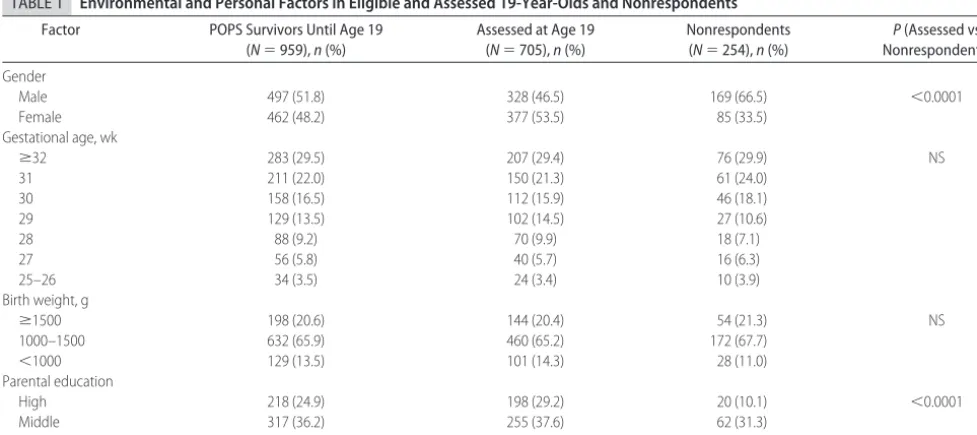
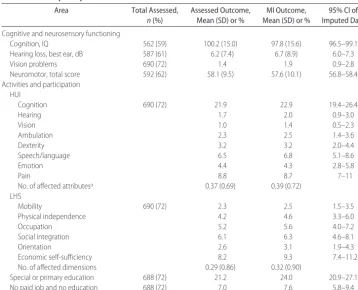
Of the 959 POPS cohort survivors, 705 (74%) completed the questionnaires, and 596 (62% of total) of these underwent full assessment at the hospital as well. The mean age of the 705 respondents was 19.3 years (SD: 0.2 years). The group of 254 (26% nonrespondents) was found to include significantly more men and more chil-dren of low-educated parents (Table 1). Individuals with disabilities were overrepresented among respondents who did not undergo assessment and among nonrespon-dents.16 Multiple imputation indeed slightly increased the abnormal outcomes on all areas (Table 2). For IQ, the average from the naive analysis lies outside the 95% confidence interval (CI) that accounts for the nonre-sponse.
Moderate or severe problems for cognition were es-tablished in 4.3% of the survivors, for hearing in 1.8%, for vision in 1.9%, and for neuromotor function in 8.1%. Thus, for the overall domain of cognitive and neurosensory functioning, 12.6% were found to show moderate or severe problems (Table 3). Three or more affected areas of health status (as measured by the HUI3) or of perceived health (as measured by the LHS) were noted in 2.0% and 4.5% of survivors, respectively. Mod-erate or severe problems in education were found in 24%. Nearly 8% of survivors stated that they neither to had a paid job nor followed any educational program. Overall, 31.7% of survivors had moderate or severe
problems in functioning, activities, and participation (Table 3). Furthermore, 40% had problems in ⱖareas (data not shown). Half of the individuals with moderate or severe problems in education had full-time jobs, and 62% of those who neither had a paid job nor were enrolled in an educational program reported no or only mild problems with respect to health status and per-ceived health (data not shown).
We found clear associations between cognitive or neurosensory functioning problem severity and mean numbers of affected HUI3 attributes or LHS dimensions (Table 4). Furthermore, proportions of survivors with special or primary education and those without a paid job or education increased with increasing cognitive and neurosensory functioning problem severity (Table 4). Most of the survivors who were neither employed nor in school at age 19 and had severe problems in cognitive or neurosensory functioning had cerebral palsy. All survi-vors with problems in cognitive and neurosensory func-tioning (from mild to severe) experienced more activity limitations and participation restrictions than did survi-vors with no problems in this domain (Table 4).
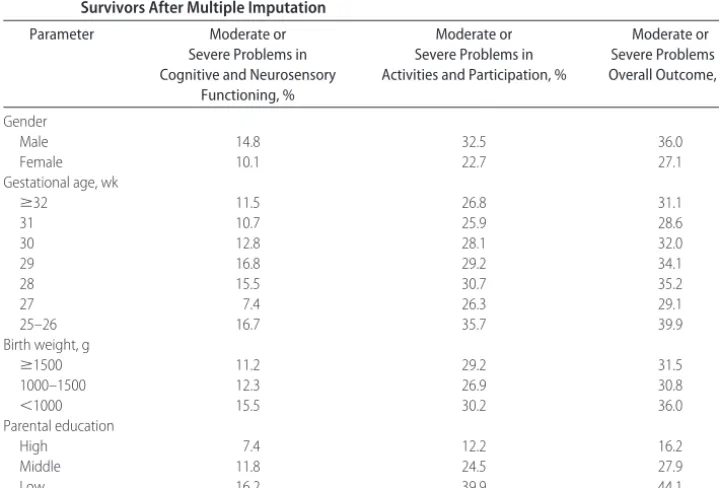
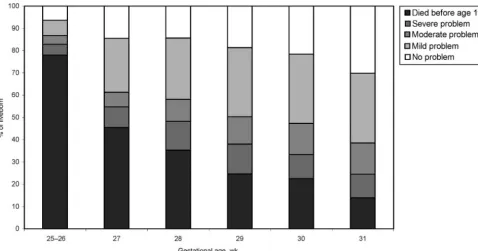
As shown in Table 5, most of the impairments in cognitive and neurosensory functioning, activity limita-tions, and participation restrictions were related to en-vironmental and personal factors. Most striking is the impact of parental education level: the lower the level, the higher the proportion of problems in any domain or overall. Figure 2 shows the relations between overall problem severity with mortality included and gestational age. It seems that only 13.2% of infants who were live born at 25 to 26 weeks of gestation had no or just mild problems at 19 years of age (78% mortality), compared with 61.5% of those who were live born at 31 weeks of
TABLE 1 Environmental and Personal Factors in Eligible and Assessed 19-Year-Olds and Nonrespondents
Factor POPS Survivors Until Age 19 (N⫽959),n(%)
Assessed at Age 19 (N⫽705),n(%)
Nonrespondents (N⫽254),n(%)
P(Assessed vs Nonrespondents)
Gender
Male 497 (51.8) 328 (46.5) 169 (66.5) ⬍0.0001
Female 462 (48.2) 377 (53.5) 85 (33.5)
Gestational age, wk
ⱖ32 283 (29.5) 207 (29.4) 76 (29.9) NS
31 211 (22.0) 150 (21.3) 61 (24.0)
30 158 (16.5) 112 (15.9) 46 (18.1)
29 129 (13.5) 102 (14.5) 27 (10.6)
28 88 (9.2) 70 (9.9) 18 (7.1)
27 56 (5.8) 40 (5.7) 16 (6.3)
25–26 34 (3.5) 24 (3.4) 10 (3.9)
Birth weight, g
ⱖ1500 198 (20.6) 144 (20.4) 54 (21.3) NS
1000–1500 632 (65.9) 460 (65.2) 172 (67.7)
⬍1000 129 (13.5) 101 (14.3) 28 (11.0)
Parental education
High 218 (24.9) 198 (29.2) 20 (10.1) ⬍0.0001
Middle 317 (36.2) 255 (37.6) 62 (31.3)
Low 341 (38.9) 225 (33.2) 116 (58.6)
gestation (14% mortality). Excluding mortality, the overall percentage of adverse outcome (moderate and severe problems) decreased for 39.9% of survivors who were born at 25 to 26 weeks of gestation to 28.6% of survivors who were born at 31 weeks of gestation (Table 5).
DISCUSSION
Earlier studies already had established that very preterm and VLBW infants are at risk for neurodevelopmental
problems in young adulthood.6,7,29This study in a geo-graphically defined population of such infants at 19 years of age showed 1 in 8 survivors to experience moderate or severe problems in any cognitive or neuro-sensory function. One in 4 survivors was poorly edu-cated. These outcomes compare well to the outcomes in the POPS cohort at younger age.12,14 Most frequent in this study population were problems in neuromotor functioning, including minor neurologic dysfunction TABLE 2 Outcome in Assessed 19-Year-Olds Compared With Outcome in Survivors at Age 19 After
Multiple Imputation
Area Total Assessed,
n(%)
Assessed Outcome, Mean (SD) or %
MI Outcome, Mean (SD) or %
95% CI of Imputed Data
Cognitive and neurosensory functioning
Cognition, IQ 562 (59) 100.2 (15.0) 97.8 (15.6) 96.5–99.1 Hearing loss, best ear, dB 587 (61) 6.2 (7.4) 6.7 (8.9) 6.0–7.3
Vision problems 690 (72) 1.4 1.9 0.9–2.8
Neuromotor, total score 592 (62) 58.1 (9.5) 57.6 (10.1) 56.8–58.4 Activities and participation
HUI
Cognition 690 (72) 21.9 22.9 19.4–26.4
Hearing 1.7 2.0 0.9–3.0
Vision 1.0 1.4 0.5–2.3
Ambulation 2.3 2.5 1.4–3.6
Dexterity 3.2 3.2 2.0–4.4
Speech/language 6.5 6.8 5.1–8.6
Emotion 4.4 4.3 2.8–5.8
Pain 8.8 8.7 7–11
No. of affected attributesa 0.37 (0.69) 0.39 (0.72)
LHS
Mobility 690 (72) 2.3 2.5 1.5–3.5
Physical independence 4.2 4.6 3.3–6.0
Occupation 5.2 5.6 4.0–7.2
Social integration 6.1 6.3 4.6–8.1
Orientation 2.6 3.1 1.9–4.3
Economic self-sufficiency 8.2 9.3 7.4–11.2
No. of affected dimensions 0.29 (0.86) 0.32 (0.90)
Special or primary education 688 (72) 21.2 24.0 20.9–27.1
No paid job and no education 688 (72) 7.0 7.6 5.8–9.4
MI indicates multiple imputation. aEmotion and pain excluded.
TABLE 3 Outcomes in Cognitive and Neurosensory Functioning, Activities, and Participation in Survivors at Age 19 After Multiple Imputation
Area No Problem,
%
Mild Problem, %
Moderate Problem, %
Severe Problem, %
Cognitive and neurosensory functioning
Cognition 80.8 14.8 4.3
Hearing 98.2 0.9 0.9
Vision 98.1 1.9
Neuromotor 53.5 38.4 4.9 3.2
Overall cognitive and neurosensory functioning 47.1 40.4 8.6 4.0
Activities and participation
HUI affected attributes 71.4 26.6 1.9 0.1
LHS affected dimensions 83.8 11.7 3.3 1.2
Education 76.0 15.0 9.0
Profession/occupation 78.1 10.5 3.8 7.6
Overall activities and participation 47.4 24.8 14.6 13.2
Total overall outcome in functioning, activities, and participation
and abnormalities in the coordination of movement (46.5%). Almost 8% of survivors were neither em-ployed nor in school, which suggests difficulties in be-coming fully independent adults, yet 50% of the poorly educated individuals held full-time jobs. The vast major-ity (⬎95%) of the total study population reported to be satisfied with their activities and participation in society (as measured by HUI3 and LHS). However, when re-stricted to those who were neither employed nor in school, this proportion was 62%.
Because comparison with a formal control group was impossible (because of financial restrictions), we used validated assessments and questionnaires for which norm scores have been established. The mean IQ of 97.8 (95% CI: 96.5–99.1) in our study population did differ significantly from the standard of the adult general pop-ulation (IQ 100).18 The proportion of participants with hearing loss (1.8%) exceeded the norm (0.1%).30 Neu-romotor scores in a norm group ranged from 60 to 66, versus a mean of 57.6 (95% CI: 56.8 –58.4) in our study population.22Data on vision, education, and occupation
of 19-year-olds in the Dutch general population were derived from the Continuous Health Interview Survey 2001 and 2002 conducted by Statistics Netherlands. Fre-quency of self-reported vision problems in our study did not differ significantly from that in 19-year-olds in the general population. Twice as many 19-year-olds in our study population were poorly educated as compared with their age-peers in the general population (24.0% [95% CI: 20.9%– 27.1%] vs 12.8% [95% CI: 10.5%– 15.6%]). Furthermore, thrice as many were neither em-ployed nor in school (7.6% [95% CI: 5.8%–9.4%] vs 2.6% [95% CI: 1.6%– 4.2%]). Scores on the HUI3 and LHS compared well with those in the general popula-tion.31
Earlier studies on very preterm and VLBW children consistently reported lower cognitive scores and lower academic skills in young adulthood as compared with control subjects (or the general population).6–9,32 How-ever, although the findings from our study are consistent with the educational disadvantage observed previously, the mean IQ in our cohort was only 2.2 IQ points lower TABLE 4 Activity Limitations and Participation Restrictions in Relation to Impairments in Cognitive and
Neurosensory Functioning in Survivors at Age 19 Years After Multiple Imputation
Area Cognitive and Neurosensory Functioning, Mean (95% CI)
No Problem Mild Problem Moderate Problem Severe Problem
No. of affected HUI attributes 0.25 (0.20–0.31) 0.35 (0.28–0.43) 0.69 (0.41–0.98) 1.70 (0.97–2.43) No. of affected LHS dimensions 0.11 (0.06–0.17) 0.24 (0.16–0.31) 1.00 (0.58–1.42) 2.06 (1.23–2.88) Special or primary education, % 12.1 (8.7–15.6) 27.4 (20.6–34.1) 56.9 (43.4–70.5) 60.7 (44.0–77.4) No paid job and no education, % 2.8 (0.9–4.6) 7.3 (4.1–10.6) 18.5 (7.9–29.1) 44.0 (25.4–62.7)
TABLE 5 Proportions of Moderate or Severe Problems in Cognitive and Neurosensory Functioning, Activities, and Participation at Age 19 in Relation to Environmental and Personal Factors in Survivors After Multiple Imputation
Parameter Moderate or
Severe Problems in Cognitive and Neurosensory
Functioning, %
Moderate or Severe Problems in Activities and Participation, %
Moderate or Severe Problems in Overall Outcome, %
Gender
Male 14.8 32.5 36.0
Female 10.1 22.7 27.1
Gestational age, wk
ⱖ32 11.5 26.8 31.1
31 10.7 25.9 28.6
30 12.8 28.1 32.0
29 16.8 29.2 34.1
28 15.5 30.7 35.2
27 7.4 26.3 29.1
25–26 16.7 35.7 39.9
Birth weight, g
ⱖ1500 11.2 29.2 31.5
1000–1500 12.3 26.9 30.8
⬍1000 15.5 30.2 36.0
Parental education
High 7.4 12.2 16.2
Middle 11.8 24.5 27.9
than that in the Dutch adult general population. One possible explanation for this surprisingly good result is that individuals with severely disabilities were unable to do the computer test. Furthermore, our result indicates that apart from IQ, several factors, such as socioeco-nomic circumstances, behavior, and neurosensory im-pairments, explain the educational attainment.33
Most earlier studies found a normal perceived quality of life in early adulthood.9,29,34,35Similarly, in our study, health status and perceived health (measured by HUI3 and LHS) were better than expected from the impair-ments in cognitive and neurosensory functioning. Dinesen and Greisen34 reported several reasons for the discrepancy between objective and subjective quality of life: people often neglect needs that they consider unat-tainable; needs that are satisfied with no effort are not considered to be needs; actual needs may differ from person to person.
For reasons of comparability, we based problem se-verity in the overall outcome on the worst area of func-tioning.28 Thus, overall 31.7% of survivors were found to have ⱖ1 moderate or severe problems. Another 41.1% had ⱖ1 mild problems. Seeing that this classifi-cation is arbitrary, we recalculated overall outcome de-finingⱖ2 mild problems (eg, IQ of 75, mild neurologic dysfunction) as a moderate problem. Doing so, 44.1% of survivors would show a moderate or severe problem and 28.7% only 1 mild problem.
A limitation of our study might be that we focused on the traditional areas of functioning, leaving out physio-logic parameters (eg, several chronic diseases36–42).
Therefore, the overall proportion of young adults with a moderate or severe problem of any kind is likely to be underestimated in this study.
A problem that is inherent to long-term follow-up of preterm infants is that outcomes might not be relevant to survivors of current neonatal intensive care. Major changes have occurred since the early days of the devel-opment of intensive care treatment for preterm neo-nates. Since the 1980s, the survival rate has increased significantly. One might speculate that advances in med-ical technology and increased understanding of how to prevent neonatal damage may have led to a reduction in rates of disabilities.43 However, because of these ad-vances, ever-increasing numbers of extremely immature and sick infants now have a chance to survive and may add to the total number of children with problems in functioning in the community.28 Recent Dutch cohort studies confirmed that improvements in perinatal and neonatal care have led to an increased survival of espe-cially extremely preterm infants. However, increased survival has resulted in more morbidity.44–46 We there-fore suggest that our results have relevance to current survivors of current neonatal intensive care.
CONCLUSIONS
Our study documents that 12.6% of very preterm and/or VLBW infants experience moderate or severe problems in cognitive or neurosensory functioning at 19 years of age. Overall, 31.7% were found to experience ⱖ mod-erate or severe problems in the assessed areas. The vast majority (⬎95%) of the total study population reported FIGURE 2
to be satisfied with their activities and participation in society. Compared with the general Dutch population, twice as many very preterm and/or VLBW infants are poorly educated and thrice as many are neither em-ployed nor in school at 19 years of age.
ACKNOWLEDGMENTS
POPS-19 was supported by grants from the Netherlands Organization for Health Research and Development (ZonMw), the Edgar Doncker Foundation, the Founda-tion for Public Health Fundraising Campaigns, the Phelps Foundation, the Swart-van Essen Foundation, the Foundation for Children’s Welfare Stamps, the Neth-erlands Organization for Applied Research Quality of Life, the Netherlands Organization for Scientific Re-search, the Dutch Kidney Foundation, the Sophia Foun-dation for Medical Research, Stichting Astmabestrijding, and the Royal Effatha Guyot group.
The following are members of the Dutch POPS-19 Collaborative Study Group: Netherlands Organization for Applied Research Quality of Life, Leiden (E. T. M. Hille, C. H. de Groot, H. Kloosterboer-Boerrigter, A. L. den Ouden, A. Rijpstra, S. P. Verloove-Vanhorick, J. A. Voge-laar, coordinating center); Emma Children’s Hospital Aca-demic Medical Center, Amsterdam (J. H. Kok, A. Ilsen, M. van der Lans, W. J. C. Boelen-van der Loo, T. Lundqvist, H. S. A. Heymans); University Medical Center Groningen, Beatrix Children’s Hospital, Groningen (E. J. Duiverman, W. B. Geven, M. L. Duiverman, L. I. Geven, E. J. L. E. Vri-jlandt); University Hospital Maastricht, Maastricht (A. L. M. Mulder, A. Gerver); University Medical Center St Radboud, Nijmegen (L. A. A. Kolle´e, L. Reijmers, R. Son-nemans); Leiden University Medical Center, Leiden (J. M. Wit, F. W. Dekker, M. J. J. Finken); Erasmus Medical Center–Sophia Children’s Hospital, University Medical Center Rotterdam (N. Weisglas-Kuperus, M. G. Keijzer-Veen, A. J. van der Heijden, J. B. van Goudoever); VU University Medical Center, Amsterdam (M. M. van Weis-senbruch, A. Cranendonk, H. A. Delemarre-van de Waal, L. de Groot, J. F. Samsom); Wilhelmina Children’s Hospi-tal, University Medical Center, Utrecht (L. S. de Vries, K. J. Rademaker, E. Moerman, M. Voogsgeerd); Ma´xima Med-ical Center, Veldhoven (M. J. K. de Kleine, P. Andriessen, C. C. M. Dielissen-van Helvoirt, I. Mohamed); Isala Clinics, Zwolle (H. L. M. van Straaten, W. Baerts, G. W. Veneklaas Slots-Kloosterboer, E. M. J. Tuller-Pikkemaat); Royal Ef-fatha Guyot Group, Zoetermeer (M. H. Ens-Dokkum); As-sociation for Parents of Premature Infants (G. J. van Steen-brugge).
We thank the young adults and their parents for generosity in participating in our ongoing studies for the past 19 years and J. J. Hagoort for editing the English text.
REFERENCES
1. Escobar GJ, Littenberg B, Petitti DB. Outcome among surviving very low birth weight infants: a meta-analysis.Arch Dis Child.
1991;66:204 –211
2. McCormick MC. Has the prevalence of handicapped infants increased with improved survival of the very low birth weight infant?Clin Perinatol.1993;20:263–277
3. Aylward CP, Pfeiffer SI, Wright A, Verhulst SJ. Outcome stud-ies of low birth weight infants published in the last decade: a meta-analysis.J Pediatr.1989;115:515–520
4. McCormick MC. The outcomes of very low birth weight infants: are we asking the right questions?Pediatrics.1997;99: 869 – 876
5. Bjerager M, Steensberg J, Greisen G. Quality of life among young adults born with very low birth weights.Acta Paediatr.
1995;84:1339 –1343
6. Ericson A, Kallen B. Very low birth weight boys at the age of 19.Arch Dis Child Fetal Neonatal Ed.1998;78:F171–F174 7. Hack M, Flannery DJ, Schluchter M, Cartar L, Borawski E,
Klein N. Outcomes in young adulthood for very-low-birth-weight infants.N Engl J Med.2002;346:149 –157
8. Grunau RE, Whitfield MF, Fay TB. Psychosocial and academic characteristics of extremely low birth weight (ⱕ800 g) adoles-cents who are free of major impairment compared with term-born control subjects. Pediatrics. 2004;114(6). Available at: www.pediatrics.org/cgi/content/full/114/6/e725
9. Cooke RWI. Health, lifestyle, and quality of life for young adults born very preterm.Arch Dis Child.2004;89:201–206 10. Vohr B, Wright LL, Hack M, Aylward G, Hirtz DE. Follow-up care
of high-risk infants.Pediatrics.2004;114(5 pt 2):1377–1397 11. Msall ME, Tremont MR. Measuring functional outcomes after
prematurity: developmental impact of very low birth weight and extremely low birth weight status on childhood disability.
Ment Retard Dev Disabil Res Rev.2002;8:258 –272
12. Veen S, Ens-Dokkum MH, Schreuder AM, Verloove-Vanhorick SP, Brand R, Ruys JH. Impairments, disabilities, and handicaps of very preterm and very-low-birthweight infants at five years of age. The collaboration project on preterm and small for gesta-tional age infants (POPS) in the Netherlands.Lancet.1991;338: 33–36
13. Verloove-Vanhorick SP, Verwey RA, Brand R, Bennebroek Gravenhorst J, Keirse MJNC, Ruys JH. Neonatal mortality in relation to gestational age and birth weight. Results of a na-tional survey of preterm and very-low-birth weight infants in the Netherlands.Lancet.1986:55–57
14. Walther FJ, Ouden den AL, Verloove-Vanhorick SP. Looking back in time: outcome of a national cohort of very preterm infants born in The Netherlands in 1983.Early Hum Dev.2000; 59:175–191
15. Zeben van-van der Aa TM, Verloove-Vanhorick SP, Brand R, Ruys JH. Morbidity of very low birth weight infants at cor-rected age of two years in a geographically defined population. Report from Project On Preterm and Small for gestational age Infants in the Netherlands.Lancet.1989;1:253–255
16. Hille ET, Elbertse L, Gravenhorst JB, Brand R, Verloove-Vanhorick SP. Nonresponse bias in a follow-up study of 19-year-old adolescents born as preterm infants.Pediatrics.2005; 116(5). Available at: www.pediatrics.org/cgi/content/full/116/ 5/e662
17. World Health Organization. International Classification of Func-tioning, Disability and Health. Geneva, Switzerland: World Health Organization; 2001
assessment of preterm infants at the age of 5 years: use of the WHO classification of impairments, disabilities and handicaps. Report from the collaborative Project on Preterm and Small for gestational age infants (POPS) in the Netherlands, 1983.
Paediatr Perinat Epidemiol.1992;6:363–380
20. Touwen BC.The Examination of the Child With Minor Neurological Dysfunction: Clinics in Developmental Medicine Series. Vol. 71. Lon-don, England: Heinemann; 1979
21. Samsom JF, de Groot L, Cranendonk A, Bezemer D, Lafeber HN, Fetter WP. Neuromotor function and school performance in 7-year-old children born as high-risk preterm infants.J Child Neurol.2002;17:325–332
22. Geuskens G.An Instrument for the Detection of Minor Neurological Dysfunction in Adolescents [doctoral thesis]. Amsterdam, Netherlands: VUMC, Faculty of Human Movement Sciences; 2002
23. Feeny D, Furlong W, Torrance GW, et al. Multiattribute and single-attribute utility functions for the health utilities index mark 3 system.Med Care.2002;40:113–128
24. Harwood RH, Rogers A, Dickinson E, Ebrahim S. Measuring handicap: the London Handicap Scale, a new outcome mea-sure for chronic disease.Qual Health Care.1994;3:11–16 25. Rubin DB.Multiple Imputation for Nonresponse in Surveys. New
York, NY: John Wiley & Sons; 1987
26. van Buuren S, Boshuizen HC, Knook DL. Multiple imputation of missing blood pressure covariates in survival analysis.Stat Med.1999;18:681– 694
27. Little R. Missing data adjustment in large surveys.Journal of Business and Economic Statistics.1988;6:287–301
28. Marlow N, Wolke D, Bracewell MA, Samara M. Neurologic and developmental disability at six years of age after extremely preterm birth.N Engl J Med.2005;352:9 –19
29. Tideman E, Ley D, Bjerre I, Forslund M. Longitudinal fol-low-up of children born preterm: somatic and mental health, self-esteem and quality of life at age 19.Early Hum Dev.2001; 61:97–110
30. van Straaten HLM, Hille ETM, Kok JH, Verkerk PH, Dutch NICU Neonatal Hearing Screening Working Group. Imple-mentation of a nation-wide automated auditory brainstem response hearing screening programme in neonatal intensive care units.Acta Paediatr.2003;92:332–338
31. Detmar SB, Hosli EJ, Chorus AM, et al. The development and validation of a handicap questionnaire for children with a chronic illness.Clin Rehabil.2005;19:73– 80
32. Tideman E. Longitudinal follow-up of children born preterm: cognitive development at age 19. Early Hum Dev. 2000;58: 81–90
33. Weisglas-Kuperus N, Hille ETM, Duivenvoorden HJ, et al. The impact of intrauterine growth, prematurity and environment on cognitive function in very preterm and very low birth weight infants in young adulthood. Presented at: annual meeting of the European Academy of Pediatrics; October 9, 2006; Barcelona, Spain
34. Dinesen SJ, Greisen G. Quality of life in young adults with very low birth weight. Arch Dis Child Fetal Neonatal Ed.2001;85: F165–F169
35. Feingold E, Sheir-Neiss G, Melnychuk J, Bachrach S, Paul D. HRQL and severity of brain ultrasound findings in a cohort of adolescents who were born preterm.J Adolesc Health.2002;31: 234 –239
36. Euser AM, Finken MJ, Keijzer-Veen MG, Hille ET, Wit JM, Dekker FW. Associations between prenatal and infancy weight gain and BMI, fat mass, and fat distribution in young adulthood: a prospective cohort study in males and females born very preterm.Am J Clin Nutr.2005;81:480 – 487 37. Finken MJ, Inderson A, van Montfoort N, et al. Lipid profile
and carotid intima-media thickness in a prospective cohort of very preterm subjects at age 19 years: effects of early growth and current body composition. Pediatr Res. 2006;59(pt 1): 604 – 609
38. Finken MJ, Keijzer-Veen MG, Dekker FW, et al. Preterm birth and later insulin resistance: effects of birth weight and postna-tal growth in a population based longitudinal study from birth into adult life Insulin resistance 19 years after preterm birth.
Diabetologia.2006;49:478 – 485
39. Keijzer-Veen MG, Finken MJ, Nauta J, et al. Is blood pressure increased 19 years after intrauterine growth restriction and preterm birth? A prospective follow-up study in the Nether-lands.Pediatrics.2005;116:725–731
40. Keijzer-Veen MG, Schrevel M, Finken MJ, et al. Microalbu-minuria and lower glomerular filtration rate at young adult age in subjects born very premature and after intrauterine growth retardation.J Am Soc Nephrol.2005;16:2762–2768
41. Vrijlandt EJ, Gerritsen J, Boezen HM, Duiverman EJ. Gender differences in respiratory symptoms in 19-year-old adults born preterm.Respir Res.2005;6:117
42. Vrijlandt EJ, Gerritsen J, Boezen HM, Grevink RG, Duiverman EJ. Lung function and exercise capacity in young adults born prematurely.Am J Respir Crit Care Med.2006;173:890 – 896 43. Young Y. Developmental Care of the Premature Baby. London,
England: Baillie`re-Tindall; 1996
44. de Kleine MJK, den Ouden AL, Kollee LAA, et al. Develop-ment and evaluation of a follow up assessDevelop-ment of preterm infants at 5 years of age.Arch Dis Child.2003;88:870 – 875 45. Stoelhorst GM, Rijken M, Martens SE, et al. Changes in
neonatology: comparison of two cohorts of very preterm in-fants (gestational age⬍32 weeks)—the Project on Preterm and Small for Gestational Age Infants 1983 and the Leiden Fol-low-up Project on Prematurity 1996 –1997. Pediatrics. 2005; 115:396 – 405
DOI: 10.1542/peds.2006-2407
2007;120;e587
Pediatrics
Verloove-Vanhorick
Straaten, Linda S. de Vries, Mirjam M. van Weissenbruch and S. Pauline
H. Kok, Martin J. K. de Kleine, Louis A. A. Kollée, A. L. M. Mulder, H. L. M. van
Jacobusse, Martina H. Ens-Dokkum, Laila de Groot, Jan M. Wit, Wil B. Geven, Joke
Elysée T. M. Hille, Nynke Weisglas-Kuperus, J. B. van Goudoever, Gert W.
for Gestational Age Infants at 19 Years of Age
and Very Low Birth Weight Infants: The Dutch Project on Preterm and Small
Functional Outcomes and Participation in Young Adulthood for Very Preterm
Services
Updated Information &
http://pediatrics.aappublications.org/content/120/3/e587
including high resolution figures, can be found at:
References
http://pediatrics.aappublications.org/content/120/3/e587#BIBL
This article cites 36 articles, 11 of which you can access for free at:
Subspecialty Collections
sub
http://www.aappublications.org/cgi/collection/fetus:newborn_infant_
Fetus/Newborn Infant
milestones_sub
http://www.aappublications.org/cgi/collection/growth:development_
Growth/Development Milestones
al_issues_sub
http://www.aappublications.org/cgi/collection/development:behavior
Developmental/Behavioral Pediatrics
following collection(s):
This article, along with others on similar topics, appears in the
Permissions & Licensing
http://www.aappublications.org/site/misc/Permissions.xhtml
in its entirety can be found online at:
Information about reproducing this article in parts (figures, tables) or
Reprints
http://www.aappublications.org/site/misc/reprints.xhtml
DOI: 10.1542/peds.2006-2407
2007;120;e587
Pediatrics
Verloove-Vanhorick
Straaten, Linda S. de Vries, Mirjam M. van Weissenbruch and S. Pauline
H. Kok, Martin J. K. de Kleine, Louis A. A. Kollée, A. L. M. Mulder, H. L. M. van
Jacobusse, Martina H. Ens-Dokkum, Laila de Groot, Jan M. Wit, Wil B. Geven, Joke
Elysée T. M. Hille, Nynke Weisglas-Kuperus, J. B. van Goudoever, Gert W.
for Gestational Age Infants at 19 Years of Age
and Very Low Birth Weight Infants: The Dutch Project on Preterm and Small
Functional Outcomes and Participation in Young Adulthood for Very Preterm
http://pediatrics.aappublications.org/content/120/3/e587
located on the World Wide Web at:
The online version of this article, along with updated information and services, is
by the American Academy of Pediatrics. All rights reserved. Print ISSN: 1073-0397.