
FORMULATION AND EVALUATION OF SOLID LIPID NANOPARTICLES OF A POORLY WATER SOLUBLE MODEL DRUG, IBUPROFEN
6
0
0
Full text
(2) De Pintu Kumar et al. IRJP 2012, 3 (12) Compatibility Study between Drug And Excipients by Fourier Transform Infrared Spectroscopy (FT-IR) 10 FT-IR spectra of pure drug (Ibuprofen), Stearic acid, Phospholipon 80H and their physical mixtures (1:1:1) were recorded by grinding and dispersing the samples with micronized IR grade KBr powder. The mixture was dissolved in chloroform and casted on a sodium chloride disk, and subjected to FT-IR measurement over the range of 4000–600 cm-1 (Perkin Elmer, Model - 78625). Preparation of Ibuprofen SLN by Hot Homogenization technique: 11 Solid Lipid Nanoparticles of Ibuprofen were produced using the lipid (Stearic acid); surfactant (Phospholipon-80H) and stabilizer (Tween-80) in different proportion by hot homozenization technique using the high speed homogenizer [Ultra Turrax T25 (Janke & Kunkel, IKA Labortechnik, Germany)] given in Table No.1. The organic phase was prepared by dissolving the drug and surfactant in dichloromethane and mixing it with the melted stearic acid, which was further, poured into aqueous Tween-80 solution (maintained at the same temperature as that of organic phase) of various concentrations which acts as a stabilizer and stirred with UltraTurrax T25 (UT) on a water bath at 24,000 rpm for 10 minutes. The formulation was then removed from water bath and the dispersion of SLN was mixed gently by slow magnetic stirring (1 h) at room temperature until cooling. Particle size determination Particle size of the solid lipid nanoparticles was analyzed by laser diffractometry using a Mastersizer 2000 instrument (Malvern) equipped with a Hydro 2000MU (A) dispersing unit. In-vitro drug release study10 The release of Ibuprofen from the solid lipid nanoparticles was compared with the pure drug using a dialysis system comprising of a HiMedia Dialysis Membrane-70 mounted over a jacketed dialysis beaker. The dialysis membrane was filled with 2 ml of solid lipid nanoparticles, clipped and exposed to diffusion medium containing Phosphate buffer pH (7.2), stirred magnetically & maintained at a constant Batch No. SLN-1 SLN-2 SLN-3 SLN-4 SLN-5 SLN-6 SLN-7 SLN-8 SLN-9 SLN-10 SLN-11 SLN-12. temperature of 37°C ± 0.5°C. Aliquots were drawn at specified time intervals and analyzed using a UV spectrophotometer (Shimadzu-1700). Drug Entrapment Efficiency10 The percentage of incorporated Ibuprofen (entrapment efficiency) was determined spectrophotometrically at 221 nm. After centrifugation of the aqueous suspension, amount of the free drug was detected in the supernatant and the amount of incorporated drug was determined as the result of the initial drug minus the free drug. The entrapment efficiency can be calculated using the following formula:. Differential Scanning Calorimetry (DSC) DSC scan of about 5mg, accurately weighed ibuprofen and physical mixture (lipids and surfactant) and the SLN formulation were performed by using an automatic thermal analyzer system. (DSC60 Shimadzu Corporation, Japan) Sealed and perforated aluminium pans were used in the experiments for all the samples. Temperature calibrations were performed using indium as standard. An empty pan sealed in the same way as for the sample was used as a reference. The entire samples were run at a scanning rate of 10°C/min from 25-300°C. Lyophilization The SLN were lyophilized using an MAC Lyophilizer. The cryoprotectant was added to the SLN liquid. The SLN liquid was frozen at a temperature of –40°C for 4 h in cold trap and lyophilized for 24 h. The freeze-dried powder was resuspended in water and characterized. Stability Testing Studies The intermediate stability testing studies for SLN-3 was performed for 6 months according to the ICH Guidelines. The SLN of Ibuprofen was kept at 30 °C ± 2 °C and 65% ± 5 % Relative humidity in stability chamber. Particle size measurement, Drug entrapment and Drug release were fixed as physical parameters for stability testing.. Table 1 Composition of different SLN formulations prepared by Hot Homogenization technique. [ Drug ] [ Lipid ] [Surfactant] DichloroWater Ibuprofen (mg) Stearic acid (mg) Phospholipon-80H (mg) methane (ml) (ml) 300 300 300 10 100 300 300 300 10 100 300 300 300 10 100 300 300 300 10 100 300 300 300 10 100 300 300 600 10 100 300 600 300 10 100 600 300 300 10 100 300 300 150 10 100 300 150 300 10 100 150 300 300 10 100 300 300 10 100 No of month 0 3 6. Table: 2 Parameters for stability evaluation of Ibuprofen SLN Temp. Particle size in nano range Drug entrapment 30°C ± 2 °C 36 volume % 80.35% 30°C ± 2 °C 37 volume % 80.02% 30°C ± 2 °C 35 volume % 79.85%. [ Stabilizer ] Tween-80 (ml) .5 1 1.5 2 2.5 1.5 1.5 1.5 1.5 1.5 1.5 1.5. Drug release up to 6 hr. 75.58% 74.78% 74.31%. Page 133.
(3) De Pintu Kumar et al. IRJP 2012, 3 (12). Figure 1: FTIR Spectra of pure Ibuprofen. Figure 2: FT-IR Spectra of Physical Mixture of Ibuprofen with Stearic acid and Phospholipon 80H. Figure 3: Particle size distribution of SLN-3 containing optimum stabilizer (Tween 1.5%). Figure 4: Particle size distribution of SLN-6 containing higher ratio of surfactant.. Page 134.
(4) De Pintu Kumar et al. IRJP 2012, 3 (12). Figure 5: Particle size distribution of SLN-10 containing lower ratio of Lipid. Figure 9: DSC thermogram of the pure drug Ibuprofen. Page 135.
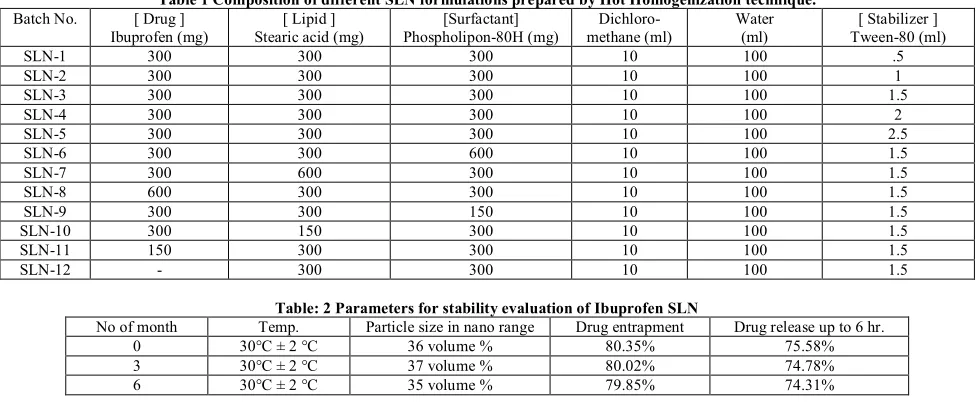
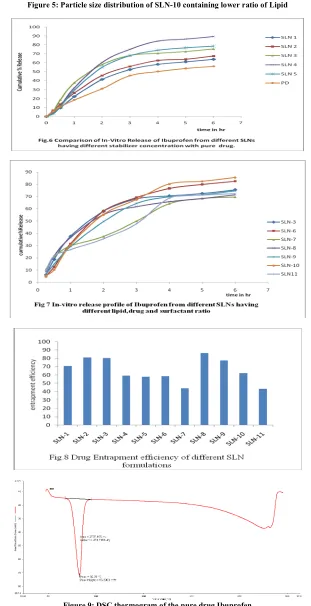
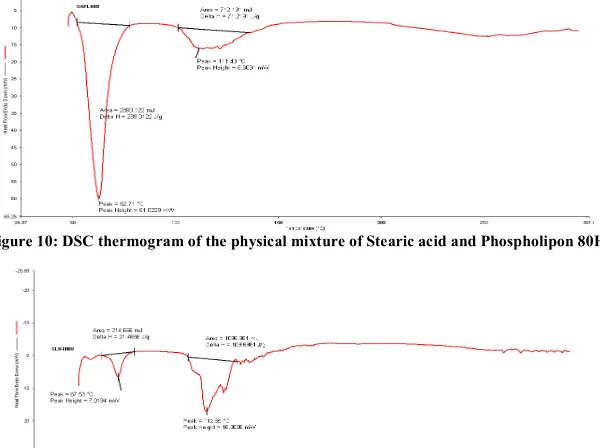
(5) De Pintu Kumar et al. IRJP 2012, 3 (12). Figure 10: DSC thermogram of the physical mixture of Stearic acid and Phospholipon 80H. Figure 11: DSC thermogram of the Ibuprofen SLN. RESULTS AND DISCUSSION Compatibility study by FT-IR The FTIR Spectra of pure Ibuprofen and the physical mixture (1:1:1) of drug with Stearic acid and Phospholipon80H given in the Fig.1 and Fig.2 respectively .The IR spectra of pure drug shows principle peaks at 1721 cm-1 (C=O stretching vibration of –COOH group), 870, 779 cm-1 (Aromatic stretching bending vibration). The physical mixture on the other hand shows peaks at 1720.72, 865.51 and 779.83 cm-1. Thus, it is concluded that the physical mixture of the drug, Ibuprofen does not show any major interactions with the formulation components like lipid (Stearic acid) and surfactant Phospholipon80H. Particle Size determination: Particle size of the solid lipid nanoparticles was analyzed by laser diffractometry using a Mastersizer 2000 instrument (Malvern) equipped with a Hydro 2000MU (A) dispersing unit. The particle size distribution of SLN-3 showed [Fig. 3] that about 36% volume of the particles are in nano range (below 1m) and the rest of the particles are in between 1 to 100m . Further modification in the formulation SLN-6 (increase in surfactant ratio) cause higher volume % of particle fall in nano size (56 volume %) as shown in Fig. 4. but when the lipid ratio is increased in SLN-10 the particle size distribution becomes less in nano range only 27% volume in Fig. 5 In-vitro drug release study:In-vitro drug release study of ibuprofen from various SLN formulations was done by using dialysis membrane. Cumulative % drug release when plotted against time for pure drug (PD) and formulation SLN- 1 to SLN-5 with different stabilizer concentration (0.5-2.5%) in the [Fig. 6] it has been found that from the SLN formulations the drug release is much higher than the pure drug and SLN-3 with the stabilizer concentration 1.5% gives 75.58% drug release up to 6 hr period with higher dissolution rate in the initial period than other four formulations. Hence 1.5% stabilizer concentration (Tween 80) is considered as an optimum concentration for this type of formulations. Keeping the. stabilizer concentration (1.5%) fixed in the formulations SLN-6 to SLN-11 drug lipid and surfactant ratio is changed. The formulation SLN-12 is prepared without the drug which is also studied for diffusion and the samples were taken as blank. Cumulative % drug release from SLN-6 to SLN-11 is compared against the optimum formulation SLN-3 and plotted against time [Fig. No 7]. The effect of surfactant concentration was studied by changing the ratio of surfactant (Drug:Lipid:Surfactant=1:1:1 in SLN-3) in the SLN-6 (Drug:Lipid:Surfactant=1:1:2) and SLN-9 (Drug:Lipid:Surfactant=1:1:0.5). There is slight enhancement in the release (82.56) with increasing the surfactant (SLN-6) and also the release is decreased (74.87%) with decrease in concentration of surfactant (SLN-9). The effect of drug loading is found in SLN-8 (Drug:Lipid:Surfactant=2:1:1) and in SLN-11 (Drug:Lipid:Surfactant=0.5:1:1). Change in drug loading cause no further increase in release of drug. Lipid ratio is changed in SLN-7 (Drug:Lipid:Surfactant=1:2:1) and SLN10 (Drug:Lipid:Surfactant=1:0.5:1). Increase in the lipid ratio in SLN-7 cause decrease (69.58%) in the release of drug. Drug Entrapment Efficiency:The percentage of entrapped Ibuprofen in different SLN formulations with different drug, lipid, surfactant and stabilizer ratio was found spectrophotometrically. The results are given in the following Fig.8 Highest entrapment 86.32% is found in SLN-8 (Drug: Lipid: Surfactant=2:1:1) and the lowest 43.3% is found in SLN-11 (Drug: Lipid: Surfactant=0.5:1:1). Hence increase in drug loading increase the percentage of drug entrapped and decrease in drug loading cause decrease in entrapment efficiency. Differential Scanning Calorimetry (DSC) DSC thermogram of pure drug, Ibuprofen (Fig.9) exhibits a sharp endothermic peak at 82.76°C. The DSC curve for physical mixture of lipid (Stearic acid) and the surfactant (phospholipion 80 H) showed the presence of endothermic peaks at about 62.71°C and 111.43°C (Fig.10). On the other Page 136.
(6) De Pintu Kumar et al. IRJP 2012, 3 (12) hand, the SLN thermogram of Ibuprofen (Fig.11) displayed complete disappearance of characteristic peak Ibuprofen, but it shows both the characteristic peaks of lipid (Stearic acid) and the surfactant (phospholipion 80 H) at 67.53°C and 112.65°C with minimum shifting. The disappearance of the characteristic peak of Ibuprofen is due to the fact that the drug is molecularly dispersed within the lipid matrix as found for rizatriptan by Rahul Nair et.al. 10. Lyophilization In recent years, lyophilization has been widely used to improve the chemical and physical stability of SLN over a long period of time. However, it may destroy the surfactant film around the nanoparticles due to a “freezeout” effect, and lead to particle aggregation during the resolubilization or redispersion process. The polymers could not provide a sufficient protective effect. The mean particle size increased significantly after lyophilization without any cryoprotectant, so effective cryoprotectants should be chosen to avoid these problems associated with lyophilization. There are many kinds of cryoprotective agents that can be used for lyophilization, such as sorbitol, glucose, fructose, mannose, mannitol, maltose, dextran, and trehalose. The most effective cryoprotectant in all is mannitol. It could prevent the nanoparticles from aggregating effectively during the lyophilization process. Mannitol could form a film around the surface of the nanoparticles, which prevents nanoparticles from aggregating, so there was no significant change in particle size before and after lyophilization. SLN was redispersed in aqueous media. Stability Testing Studies The intermediate stability testing studies for SLN-3 was performed for 6 months according to the ICH Guidelines. The SLN-3 of Ibuprofen was kept at 30 °C ± 2 °C and 65% ± 5 % Relative Humidity in stability chamber. Particle size measurement, Drug entrapment and Drug release were fixed as physical parameters for stability testing. The results are given in Table 2. After performing the stability study it was observed that at intermediate stability testing conditions there was no change in the particle size distribution, drug entrapment and drug release of the optimized formulation. At zero days the cumulative % drug release was found to be 75.58% and after three months it was 74.78% and after six months the release comes to 74.31%. This change in drug release is very negligible. The particle size which generally increases with the age of formulation is also observed with very little change. So from this study we can conclude that the prepared SLN of ibuprofen will be stable during storage.. CONCLUSION Solid Lipid Nanoparticles of Ibuprofen, a poorly water soluble model drug is prepared by hot homogenization technique using stearic acid (lipid) Phospholipon 80 H (surfactant) and Tween-80 as stabilizer. The preformulation study shows the compatibility (FTIR study) of Ibuprofen with the other formulation ingredients and the drug is molecularly dispersed (DSC study) into the lipid. The particle size determinations confirm the particle size distribution in the nanoparticular range. In-vitro drug release through the dialysis membrane from the prepared SLNs is much higher than the pure drug. The stability study indicates the stability of the formulations without changing its performance on storage. Hence formulation of Ibuprofen in SLN enhances the dissolution rate as well as it will enhance the bioavailability of the drug which could be stabilized during storage. ACKNOWLEDGMENT: The authors are thankful to the management of Dr. B.C. Roy College of Pharmacy and AHS for providing the necessary facilities for carrying out the research work and Lipoid (Ludwigshafen, Germany) for providing Phospholipon 80 H. REFERENCES 1. Sakaeda T, Okamura N, Nagata S, Yagami T, Horinouchi M, et al. Molecular and pharmacokinetic properties of 222 commercially available oral drugs in humans. Biol Pharm Bull 2001;24: 935-940. 2. Vieth M, Siegel MG, Higgs RE, Watson IA, Robertson DH, et al. Characteristic physical properties and structural fragments of marketed oral drugs. J Med Chem 2004;47: 224-232. 3. Wenlock MC, Austin RP, Barton P, Davis AM, Leeson PD. A comparison of physiochemical property profiles of development and marketed oral drugs. J Med Chem 2003;46: 1250-1256 4. Vieth M, Siegel MG, Higgs RE, Watson IA, Robertson DH, et al. Characteristic physical properties and structural fragments of marketed oral drugs. J Med Chem 2004;47: 224-232 5. Nagi A, Abdullah R, Ibrahim S, Bustamam A. Tamoxifen Drug Loading Solid Lipid Nanoparticles Prepared by Hot High Pressure Homogenization Techniques. Journal of Pharmacology and Toxicology 2008;3 (3): 219-224 6. MacGregor KJ, Embl eton JK, Lacy JE, et al. Influence of lipolysis on drug absorption from the gastro-intestinal tract. Adv Drug Deliver Rev. 1997; 25: 33-46. 7. Mukherjee S, Ray S , Thakur R.S ; Solid Lipid Nanoparticles: A Modern Formulation Approach in Drug Delivery System ; Indian Journal of Pharmaceutical Sciences, July-August 2009;349-357 8. Muller RH, Lucks JS, Arzneistofftra”geravs festen Lipidteilchen, Feste Lipidnanospha”ren (SLN), European Patent No. EP 0605497(1996) 9. Kamboj S, Bala S, Nair AB Solid Lipid Nanoparticles: An effective lipid based technology for poorly water soluble drugs International Journal of Pharmaceutical Sciences Review and Research. 2010;5(2) 10. Rahul Nair, K.S.Arun Kumar, K.Vishnu priya, T.Md.Badivaddin, Sevukarajan M Preparation and Characterization of Rizatriptan Loaded Solid Lipid Nanoparticles J Biomed Sci and Res.,2011;3(2):392-396 11. Nagi A. ALHaj, Rasedee Abdullah, Siddig Ibrahim and Ahmad Bustamam, Tamoxifen Drug Loading Solid Lipid Nanoparticles Prepared by Hot High Pressure Homogenization Techniques, American Journal of Pharmacology and Toxicology 2008;3 (3): 219-224. Source of support: Nil, Conflict of interest: None Declared. IRJP is an official publication of Moksha Publishing House. Website: www.mokshaph.com. All rights reserved.. Page 137.
(7)
Figure

Related documents
Then, podocyte study showed that curcumin signi fi cantly increased the expression levels of beclin1, UVRAG and ATG5 and decreased the expression of p62 in dose-dependent manner
These selectable markers will help promote genetic and molecular biology studies of otherwise oner- ous drug-resistant strains, while avoiding the generation of pathogenic
Results of this procedure were compared with the solutions obtained by the governing parameter method (Kojic and Bathe 2005), as well as with the results obtained by the
Abstract: Aquagenic urticaria (AU) is a rare inducible form of physical urticaria, which occurs in response to cutaneous exposure to water, including sweat and tears..
Keywords: real exchange rate, Swiss franc, government consumption, terms of trade, net foreign assets, GDP per capita, Balassa-Samuelson, productivity,
Keywords: Lhermitte-Duclos disease, Cowden syndrome, Breast cancer, Hereditary breast cancer, PTEN
Calhoun, Shawn P., "The Effects of Using Multimedia Presentations and Modular Worked-out Examples as Instructional Methodologies to Manage the Cognitive Processing Associated
conditions in place, 'Cargo Freight Insurance General Conditions' and 'Ship Policy',. in the field of
