Indiall J. Plant PhYliol •• Vol. XXIX, No.3, pp. 256-261 (September. 1986)
EFFECT OF CONTINUOUS FREEZE ON BUD MORTALITY IN SUGARCANE
ONKAR SINGH AND R. S. KANWAR PAU Sugarcane Research Station, JaJandhar
SUMMARY
Studies carried out 10 investigate the duration effect of simulated freeze at-2.S::f:().2°C on bud damage of sugarcane varieties, revealed that in all the varieties, "bud mortality increased with an increase in duration of freeze exposure from 3 hours to 6 hours, which was higher in bottom followed by middle than in top portion, especialIy in varieties Co US8 and Co J 70. Continuous freue exposure of 6 hr. was deterimental to the buds than the same duration of freeze in two equal spells. In different durations of freeze exposures, buds ofstripped setts suffered bigher mortality than unstripped ones thereby indicating that leaf sheath plays a protective role against freeze injury. Under low temperature stress, varieties Co J 64 and Co 1148, however, suffered less as compared to rest of the varieties.
INTRODUCTION
Sugarcane varieties show remarkable variation regarding their ability to
withstand freeze induced bud mortality (Mathur & Tomar, 1965; Singh et ai,
1971; Singh and Kansar, 1978; Singh et al., 1981 and Singh and Kanwar, 1983).
But information on whether inherent moisture mitigates the effect of freeze on bud mortality, whether the leaf sheath protects the buds from freeze injury aQd which portion of cane stalk suffers with severity by freezing temperature, is not available, especially under varying freez.:: exposures at the same tempera ture. These aspects have been dealt in this paper.
MATERIALS AN 0 METHODS
Studies were carried out in split plot design with three replications at Punjab Agricultural University, Research Station, Jalandhar. The treatments comprised. sugarcane varieties (Co J 64 and Co J 70 as early maturing; Co J 67 and Co 1158 as mid season and Co J46 and Co 1148 as late maturing) in main
Ui Y '
r'"
£
!l
BUD MORTALITY IN SUGARCANE 257
exposure in two equal spells of 3 hr each. second exposure 24 hr after first spell of 3 h rand 6 hr exposure in one spelI). cane setts state (stripped setts and un stripped seUs) and cane stalk portions (top. middle and bottom) in the sub plots.
Ten randomly selected three budded setts per treatment were taken from the mother shoots of twelve montlls old crop (February). Crop was raised adopting complete package of practices (Anon, 1979). The cane seUs material was obtained from the mother stalks of uniform length and girth, free from insect-pests, diseases, frost injury and mechanical damage with buds intact. Setts from the upper and basal 1/5th portions of stalks were designated as top and btoom setls. respectively and those from the intermediate 3/5th portion as middle setts. Accordingly, the setts were subjected to simulated freeze in freez ing chamber at -2.S±0.2°C for different durations as detailed above. The setts were planted immediately after treatments in well prepared pre-irrigated soil (10% soil moisture) without any fungicide and insecticide treatments. The bud mortality per cent was calculated 30 days after planting of sefts as detailed below:
BI-Bs
Bud mortality per cent = - - - - -x 100
where. BI = Number of freeze treated buds planted.
B,
=
Number of buds germinated. 30 days after planting.The &eU moisture per cent was determined gravimetrically, keeping 10 setts from each portion of cane of each variety in hot air oven at 90°C, till the constant weight of sample. For statistical analysis, the percentage data were
- I
converted into angles through the Arc since transformation table (Snedecor. 1948) and significance test was applied to such values only.
RESULTS AND DISCUSSION
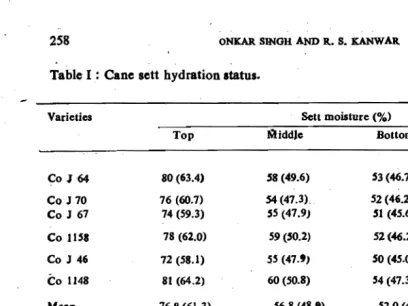
It rna y be seen from the data (Table I) that inherent sett moisture content was significantly higher in top portions of cane stalk tban those of middle and bottom portions. Sugarcane varieties did not differ significantly in their hydra tioll status. The interaction effect was also non-significant.
258 ONKAR SINGH AND R.. 8. KANWAR.
Table I : Cane sett hydration .tatus.
Varieties Sett moisture (%)
Top l\'liddle BoUom Mean
Co 164 80 (63.4) 58 (49.6) 53 (46.7) 63.7 (53.3)
Co J70 76 (60.7) 54(47.3), 52 (46.2) 60.7 (51.4)
Co J 67 74 (59.3) 55 (47.9) 51 (45.6) 60.0 (50.9)
Co lU, 78 (62.0> 59 (50.2) 52(46.2) 63.0 (52.8)
Co J 46 72 (58.1) 55 (47.') SO (45.01 59.0 (50.3)
Co 1148 81 (64.2) 60 (50.8) 54 (47.3) 65.0 (54.1) Mean 76.8 (61.3) 56.8 (48.') 52.0 (46.2)
C.D. at 5% for Varieties = N.S. Seed stalk portions= 3.61 Interaction ... N.S.
Note: Data in parenthesis are angle values.
suffered significantly less bud mortality when compared with Co J 46, Co 1158
and Co J 70. Furtber, the unstiipped setts suffered significantly less bud mortality than stripped setts. Interaction effect revealed tbat each variety suffered significantly lower bud mortality in un stripped setts than stripped setts. While in stripped setts, all the varieties differed significantly, in unstripped setts, Co J 64, Co J 67 and Co 1148 showed significantly lower,bud mortality than Co 1158 and Co J 10. Variety Co J 46 which was at par with r~st of the varieties bad significantly: lower mortality than Co J 70. The above results. therefore, indicate that variety Co J 64 was most resistant while Co J 70 susceptible to freeze injury. Bud mortality range of 3.0-10.6 and 9.8-36.9 per cent in stripped and unstripped setts. respectively. suggested that leaf sheaths played a protec tive role to underlying buds from the freeze injury. especially in varieties Co J 64 and Co 1148.
Freeze "treatment differed significantly for bud mortality as the highest bud mortality was recorded in 6 hours freeze exposure in single spell (25.3%) followed by same duration of freeze exposure in two equal spells of 3 hr. each, (12.8%) and lowest in 3 hrfreeze exposure in single spell (1.2%). This shows . that continuous low temperature stress for a longer period was more detremental ':tban the same duration of stress in two',equal spells at -2.S±0.2°C. The inter
'." ~ '-..
-"I'"
,
" Table II : Varietal response to bud mortality (%) as influenced by stripping. freeze durations and seed stalk portions. See<l sett states Freeze dur~tions Seed stalk portions Varieties Mean Stripped Unstripped 3 hours 3+3 hours 6 hours Top Middle Bottom CoJ64 9.8 (18.2) 3.0 ( 9.9) 0.0 ( 0.0) 5.2 (13.2) 14.0 (22.0) 4.2 (11.8) 6.2 (14.4) 8.8 (17.7) 6.4 (14.7) CoJ 70 , 36.9 (36.9) 10.6 (19.0) 3.8 (11.2) 23.8 (29.2) 43.5 (41 :3) 14.8 (20.6) 22.7 (28.5) 33.7 (35.5) 23.7 (29.1)~
"
CoJ67 Co
1158 I Co J46 Co 1148 IS.8 (23.1)
•
27.4 (31.6) 20.8 (27.1) 13.2 (21.3) 3.7 (11.1) 7.0 (15.8) 5.1 (13.1) 3.8 {ll.2) 0.7 ( 4.8) 0.7 ( 4.8) 0.7 ( 4.8) 1.2 ( 6.3) 9.2 (17.7) 19.2 (26.0) 11.9 (20.2) 7.5 (15.9) 19.4 (26.1) 31.7 (34.4) 26.3 (30.9) 16.9 (24.8) 5.2 (13.2) 9.8 (18.2) 7.2 (15.6) 4.2 (24.8) 9.7 (18.2) 16.3 (23.8) 14.7 (22.6) 7.5 (15.9)14.5(22.4) 25.5
(30.3) 17.0 (20.4) 13.8 (21.8) 9.8 (18.2) 17.2 (24.5) 13.0 (21.3) 8;5 (17.0)
~
§
2
U!I8
> ~Mean 20.6 (27.0) 5.5 (13.6) 1.2 ( 6.3) 12,8 (21.0) 25.3 (30.2) 7.6 (15.9) 12.9 (20.5) 18.9 (25.3)
i
C. D. at 5% SeU state Frreze duration Seed stalk portions Sett state X Varieties Frreze duration X Varieties Seed stalk portionsxVarletles-(N·S.) Varietiesto.) ~
260
,112
ONKAR SINGH AND R. S. KANW AR
freeze treatments as well as in treatment, variety Co 1158 followed by Co J 67 and Co J 46 suffered the most.
Bud mortality in top setts of cane stalk was significantly lower than middle and bottom portions, possibly due to higher sett moisture in the top followed by middle than in bottom portions of stalk. Middle setts also recorded less bud mortality than the bottom setts. Interaction effect of varieties X seed setts, however, was non-significant. This emplies that varieties did not differ in their stalk portion response to freeze injury in respect' of bud mortality, possibly due to non-significant varia tal variation in moisture content of their different stalk portions.
The effect of seed sett state X freeze duration and seed stalk portion X freeze duration (Table III) as well as seed sett state X seed stalk portion (Table IV) were significant for vertical and horizontal comparisons of differences, except middle and bottom sett~ of seed stalk at 3 hr. freeze duration.
Table III: Response of seed sett state and portions to bud mortality as influe
nced by freeze durations.
Freeze Seed sett state Stalk portion
duration
---
---Stripped Unstripped Top Mid Bottom
3 br 1.6 (7.0) 0.0 (0.0) 0.0 (0.0) ].2 (6.3) 1.3 (6.6) 3+3 br 23.3 (28.9) 3.2 (10.3) 6.4 (14.6) 13.1 (21.2) 2004 (36.9)
6 br 37.0 (37.5) 13.4 (24.5) 16.3 (23.8) 24.3 (29.5) 35.] (36.3)
C.D. at 5% Seed sett statex freeze Stalk portions x freeze duration-(1976) durlltions =(2.lS)
Table IV: Response of seed stalk portions to bud mortality as influenced by seed sett state.
Seed stalk portions Sett state
Top Middle Bottom
Stripped ]2.9 (2t.l) 20.2 (26.7) 211.8 (32.S)
Unsttipped 2.1 (8.3) 5.6 (13.7) 9.0 (17.5)
I
BUD MORTA~IN SUGARCANE 261
•
This indicates that at 3 hr freeze duration, while middle and bottom did not differ in their bud mortality, top portion differed significantly with both the ,
•
portions. The difference of response due to interaction, was also evident fromthe remaining factors. Of the six varieties, Co J 64 followed by Co 1148 and
r
Co J 67 suffered less under low temperature stress.~ :
REFERENCES
Anon (1979). Package of Practices for Kharif crop of Punjab. pp. 46-S7.
Mathur. O. P. and Tomar. P.S. (1965). Effect of frost on buds of different sugarcane varieties. Ind. Sugar •• 9: 121-122.
Singh, Onkar, Gill. H. S. and Babu, C. N. (1971). Comparative assessment of forst tolerance
in some important sugarcane varieties with reference to the effect on buds. Ind. Sugar., 21 : 483-485.
Singh, Onkar and Kanwar, R. S. (1978). Physiological.evaluation of sugarcane germplasm for frost resistance. InternDtional Sugar I., 80 : 139-141.
Singh, Onkar;Kanwar, R.S. and Sharm\l, K. K. (1981). Screening'ofsome sugarcane varie ties for cold resistance. Ind. J. Plant Phy,;ol., 24 : 1924.
Singh, Onkar and Kanwar, R. S. (1983). Evalution of Sugarcane lenotypes for frost resis tance. Maharashtra Sugar., 8: 67·75.
Snedecor, G. W. (1948). 'Standard Methods' IOWA State College Press, Ames, IOWA, pp.