University of Pennsylvania
ScholarlyCommons
Publicly Accessible Penn Dissertations
1-1-2015
Dynamic Contracting With Unobserved Progress
Zehao Hu
University of Pennsylvania, [email protected]
Follow this and additional works at:http://repository.upenn.edu/edissertations
Part of theEconomics Commons
This paper is posted at ScholarlyCommons.http://repository.upenn.edu/edissertations/1770 For more information, please [email protected].
Recommended Citation
Hu, Zehao, "Dynamic Contracting With Unobserved Progress" (2015).Publicly Accessible Penn Dissertations. 1770.
Dynamic Contracting With Unobserved Progress
Abstract
This thesis investigates agency problems in projects whereas the principal cannot effectively monitor the progress. In Chapter 2, the baseline model is studied. It is assumed that the success of innovation requires an intermediate breakthrough and a final breakthrough, but the occurrence of the intermediate breakthrough is privately known to the agent. The principal provides incentives to the agent through a termination date and a reward for the final success. Two properties of optimal contracts are identified. First, conditional on the termination date, the optimal contract induces efficient actions from the agent. Second, the reward for success to the agent is in general non-monotone in success time and later success may be rewarded more.
In Chapter 3, I consider several modifications to the modeling assumptions and discuss their implications. First, I study the case that the two breakthroughs need not be in a particular order, and the agent can choose which task to work on first. It is shown that it is optimal to induce the agent to work on the more difficult task first. Second, I consider the scenario where there is an ex ante probability that the project is a bad one and breakthroughs never come. The optimal contract is no longer efficient conditional on the termination date. Last, I allow the principal to receive informative signals on whether the intermediate breakthrough has occurred.
In Chapter 4, I extend the baseline model by introducing randomly arriving buyers and apply it to study the financing of startup firms with opportunities to be acquired. I show that the potential acquisition increases the cost of providing incentives. Since an agent with low level of progress is ``bailed out" when an offer is made to acquire firms with both high and low levels of progress, the agent has more incentive to shirk. In response, the principal reduces the likelihood that the firm with high level of progress is sold. Moreover, the total financing provided by the principal is less compared to the environment without buyers.
Degree Type Dissertation
Degree Name
Doctor of Philosophy (PhD)
Graduate Group Economics
First Advisor George J. Mailath
DYNAMIC CONTRACTING WITH UNOBSERVED PROGRESS
Zehao Hu
A DISSERTATION in
Economics
Presented to the Faculties of the University of Pennsylvania in
Partial Fulfillment of the Requirements for the Degree of Doctor of Philosophy
2015
Supervisor of Dissertation _____________________ George J. Mailath
Walter H. Annenberg Professor in the Social Sciences
Graduate Group Chairperson ______________________ Jesús Fernández-Villaverde Professor of Economics
Dissertation Committee:
Steven Matthews, Professor of Economics
DYNAMIC CONTRACTING WITH UNOBSERVED PROGRESS c COPYRIGHT
Acknowledgements
I would like to express my gratitude to my advisor Professor George Mailath for his
guidance, support and encouragement. I have benefited so much from numerous meetings
with him through my years at Penn, from how to look for and answer questions in the field
of economic theory to small habits that good economists should possess. His advising
guided me through of ups and downs. I could not feel luckier and be more thankful to
have such a dedicated, insightful, patient and rigorous advisor.
I am grateful to Professor Andy Postlewaite for all the insights and encouragement he
has offered. His warm support has helped me greatly during the times that I struggled. I
thank Professor Steve Matthews for his kind comments and suggestions.
During most of my time at Penn, I have been supported by George and Andy’s NSF
grant, without which I would not have the opportunity to complete the program. For that
I would like to thank them again.
I thank all my friends, both in and outside the department, for their company. The
time we spent together has certainly become the sweet parts of my memory.
I am grateful to my parents for their unconditional love in the past 28 years. I am
thankful for their supportiveness on my decision to pursue further education at Penn, and
for their understanding that I was not able to stay closer.
Finally, I would like to thank my wife Wei, to whom the thesis is dedicated, for always
standing with me and holding my hands. I would not be able to come to this point without
ABSTRACT
DYNAMIC CONTRACTING WITH UNOBSERVED PROGRESS
Zehao Hu
George Mailath
This thesis investigates agency problems in projects whereas the principal cannot
ef-fectively monitor the progress. In Chapter 2, the baseline model is studied. It is assumed
that the success of innovation requires an intermediate breakthrough and a final
break-through, but the occurrence of the intermediate breakthrough is privately known to the
agent. The principal provides incentives to the agent through a termination date and a
reward for the final success. Two properties of optimal contracts are identified. First,
con-ditional on the termination date, the optimal contract induces efficient actions from the
agent. Second, the reward for success to the agent is in general non-monotone in success
time and later success may be rewarded more.
In Chapter 3, I consider several modifications to the modeling assumptions and
dis-cuss their implications. First, I study the case that the two breakthroughs need not be
in a particular order, and the agent can choose which task to work on first. It is shown
that it is optimal to induce the agent to work on the more difficult task first. Second, I
consider the scenario where there is an ex ante probability that the project is a bad one
the termination date. Last, I allow the principal to receive informative signals on whether
the intermediate breakthrough has occurred.
In Chapter 4, I extend the baseline model by introducing randomly arriving buyers
and apply it to study the financing of startup firms with opportunities to be acquired. I
show that the potential acquisition increases the cost of providing incentives. Since an
agent with low level of progress is “bailed out” when an offer is made to acquire firms
with both high and low levels of progress, the agent has more incentive to shirk. In
response, the principal reduces the likelihood that the firm with high level of progress
is sold. Moreover, the total financing provided by the principal is less compared to the
Contents
1 Introduction 1
1.1 Preview of the Models and Results . . . 4
1.1.1 Baseline . . . 4
1.1.2 Extensions and Discussions . . . 7
1.1.3 Application: Acquisition Offers . . . 8
1.2 Literature . . . 10
2 Baseline 13 2.1 Model . . . 13
2.2 Optimal Contracts . . . 15
2.2.1 FixedT . . . 20
2.2.2 Finding OptimalT . . . 30
2.3 Implications of Unobserved Progress . . . 34
2.3.1 Efficiency from Ignorance . . . 34
3 Extensions and Discussions 41
3.1 Which Task First: the Easy or the Difficult? . . . 41
3.2 Possibility of Bad Project . . . 45
3.2.1 Characterizing Values and Rewards . . . 46
3.2.2 Comparison with the Baseline . . . 50
3.3 Noisy Signals of the Progress . . . 52
4 Application: Acquisition Offers 60 4.1 Incentive Cost Minimization Given(TB,t0B,p0,p1): Acquisition Rent . . . 67
4.2 Optimality on(p0,p1): Moral Hazard Premiums . . . 72
4.3 Investment Choices(TB,t0B) . . . 75
4.4 Discussion: Strategic Buyers . . . 77
A Appendices to Chapter 2 81 A.1 Characterization of Optimal Contracts . . . 81
A.2 Implications of Unobserved Innovation Progress . . . 93
B Appendices to Chapter 3 100 B.1 Difficult Task Go First . . . 100
B.2 Ex ante Possibility of Bad Project . . . 105
B.3 Impefect Monitoring of Progress . . . 107
List of Figures
2.1 Total surplus functionPn
t . . . 23
2.2 Example 1: Value and reward functions . . . 29
2.3 Example 2: Value and reward functions . . . 30
2.4 Finding opitmal terminationT⇤ . . . 33
Chapter 1
Introduction
Most projects require continuing effort exerted or investment made before they succeed.
Examples include scientists conducting scientific research, researchers working on R&D
in a company, and entrepreneurs developing startup firms. Agency problems naturally
arise in such contexts, and previous work has provided useful insights on how the agent
should be incentivized (e.g., Bergemann and Hege (1998), Bergemann and Hege (2005),
Manso (2011), H¨orner and Samuelson (2013) and Halac, Liu, and Kartik (2013)). In
existing literature, the success of a project is often modeled as a random arrival
pro-cess as effort are being exerted. This treatment ignores an important feature of such
projects: Typically a project consists of multiple steps and the success requires several
breakthroughs rather than being one-shot. In other words, before the agent can work
to-ward the final breakthrough that brings success, some intermediate breakthroughs must
she may have to first find a way to produce an important intermediate chemical.
The multi-step nature of a project may have significant implications on how contracts
should be designed. What complicates the agency problem even more is that the agent
often has better knowledge about the progress of the project than the principal. After the
final breakthrough, the outcome is observable to all and performance can be tested. But
before that, it may be difficult for people outside the team, including the principal, to
monitor the level of progress. For example, Keil, Smith, Iacovou, and Thompson (2014b)
review a series of 14 studies, including Snow, Keil, and Wallace (2007), Keil, Smith,
Ia-covou, and Thompson (2014a) and IaIa-covou, Thompson, and Smith (2009), which
demon-strate the difficulties in monitoring the progress of IT projects. They conclude that project
staff tend to misreport information on project status. Moreover, it does not necessarily
help track the project progress to use an audit team or to have a senior executive involved
in the project; in fact, misreporting may increase in some cases.
In such environment, the progress of the project and chance of future success depend
(stochastically) on the agent’s past actions. Since the agent is better informed of the
project progress, information asymmetry endogenously arises along the way, even if ex
ante it is a problem of pure moral hazard. This creates difficulties for the principal to
design contracts and to provide incentives. The agent’s incentive to work depends on
the level of the progress (which affects the probability of future success). Ideally, the
principal would like to choose different financing decisions and reward schemes based on
with different levels of progress, the contract terms have to be the same for agents with
different levels of progress;1 yet their relevant incentives conditions have to be satisfied
simultaneously under the contract.
In this thesis, I investigate this agency problem in the context of a model of two-step
project, and study how the principal provides incentives to the agent when she cannot
monitor the intermediate progress of the project. By contrasting with the case where the
progress is observable and the case where the success only requires one breakthrough,
I highlight the implications of the unobserved progress on the contract structure. The
information asymmetry about the progress can actually lead to more efficient actions
induced in an optimal contract. Moreover, it results in possible non-monotonicity in the
reward schedule: later success may be rewarded more. Thus, the unobserved progress not
only is a more realistic assumption, but also allows us to gain additional insights.
I also extend the model to investigate a more complex contracting environment in
which the agent’s private knowledge about the progress of innovation is an important
concern. The application I consider is the financing of startup companies in the presence
of occasionally arriving buyers that make acquisition offers. A large portion of startups
end up being acquired or merged by other firms, and whether to “get big” or “get bought”
is an important choice. The startup’s founder usually knows better than the investor or
outside buyers about how much progress has been made on innovation and the future
prospects of the startup if not sold. In such an environment, the agent’s private
infor-1In principle, the contract can induce reports from the agent on the innovation progress, but in this
mation about the progress matters both for incentives to work and for decision-making
on acquisition bids. These two aspects interact with each other: the principal would like
to provide proper incentives so that the agent can use his information for better decisions
about selling the company, but also needs to take into account that the incentives provided
upon acquisition offers will in turn affect the moral hazard problem in innovation. I thus
analyze the impact of potential acquisitions on agent’s incentives to innovate and
princi-pal’s finance decisions. Moreover, I examine how moral hazard in the innovation project
affects company sale decisions.
In the rest of the introduction, I preview the models and results of each chapter in
section 1.1, and discuss related literature in section 1.2.
1.1 Preview of the Models and Results
1.1.1 Baseline
Chapter 2 studies the baseline model. A principal finances an agent on an innovation
project (e.g., an investor finances an entrepreneur to launch a startup company). The
suc-cess of innovation requires two breakthroughs. In each period, if and only if a costly
investment is made,onebreakthrough occurs with positive probability.2 Success is
pub-licly observable, but only the agent observes the first breakthrough. In each period, the
principal finances the agent with the cost of investment. There is a moral hazard problem:
2This feature that an action in a period affects the probability of the arrivial of some event is related to
the agent can shirk and divert funds for his private consumption instead of truly investing
in the project. As the project goes on, the agent develops into two possible types. I call
the agent that has made the first breakthrough thestage 1 agentand the one that has made
no breakthrough the stage 0 agent. The principal and agent can commit to a long-term
contract, but payments and financing decisions can only depend on the event of success
(but not the intermediate breakthrough).
In the first best outcome, the project is financed as long as success has not occurred,3
but this is not optimal for the principal because it gives the agent too much rent. In an
optimal contract, the principal chooses to finance the project until some termination time,
and rewards the agent depending on the date of success. The stage 1 agent will exert effort
as long as he is financed. In contrast, the stage 0 agent will stop investment and start fund
diversion some time before the termination date. This is because it becomes too expensive
to induce effort from the agent with no progress when it is close to the termination date.
The reward has to be very high because the probability of making two breakthroughs
becomes very low as time moves close to the termination time. Moreover, whenever the
stage 0 agent is induced to work, his incentive compatibility constraints are binding and
he is kept indifferent between working and shirking. In this way, the principal’s cost of
providing incentives is minimized.
I identify two properties of optimal contracts driven by the multi-step nature of the
innovation and the agent’s private knowledge of the project progress.
First, given the termination time of the principal’s financing, the induced agent’s
ac-tions maximize the total social surplus. In other words, the stage 1 agent always works
and the stage 0 agent is induced to work if and only if it is socially efficient to do so.
The reasons are as follows: Since financing cannot terminate only for the stage 0 agent
(because the principal does not know whether the agent is at stage 0 or stage 1), the total
rent available to the agent is independent of when the stage 0 agent stops working. Given
the total investment financed by the principal, the agent’s ex ante payoff is fixed. In order
to maximize the principal’s payoff, the contract needs to induce actions from the agent so
that the total social surplus from the project is maximized. I refer to this asefficiency from
ignorance, because this efficiency result will not hold if the first breakthrough is public
and contractible. In that environment, the principal prefers to terminates financing the
stage 0 agent earlier than socially optimal to provide extra incentives to work in earlier
periods. This comparison needs to be interpreted with caveats, because when the first
breakthrough is contractible, the total financing provided by the principal is different, and
depends on when the first breakthrough occurs. However, if there is a binding exogenous
deadline for innovation, due to either time or budget constraint, then the principal’s
in-ability to monitor the agent’s progress turns out to be beneficial from a social point of
view.4
4Theefficiency from ignoranceresult resonates with the desirability of an arm’s-length relationship
Second, the reward scheme that minimizes incentive cost is non-monotonic in the date
of success. That is to say, the agent is not necessarily rewarded more for achieving success
earlier. If success only requires one breakthrough, the reward is strictly decreasing in the
date of success which H¨orner and Samuelson (2013) identifies as the dynamic agency
cost. In that setting, earlier success needs to be rewarded more throughout the contracting
periods, because by working and possibly making success happen early, the agent gives
up the opportunity to divert a large amount of funds in the future. Back to the setting of
this paper, in the periods when the stage 0 agent is induced to work, the reward for success
is decreasing due to the dynamic agency cost. However, in some of the periods after the
stage 0 agent stops working, the reward for success is higher than if success happens in
earlier dates. The intuition is that as time passes, it becomes increasingly difficult for
stage 0 to reach success, so the increase in reward provides the extra incentive needed for
him to work when it is socially efficient to do so. Moreover, this is the most cost-effective
way to provide incentives because only the stage 1 agent will have a chance to achieve
success and get the higher rewards in these periods. The non-monotonicity of reward is
consistent with the use of time-vested stocks as part of the compensation for entrepreneurs
in startup companies.
1.1.2 Extensions and Discussions
In Chapter 3, I consider several modifications to the modeling assumptions and discuss
First, I study the case that the two breakthroughs need not be in a particular order, and
the agent can choose which task to work on first. It is shown that it is optimal to induce
the agent to work on the more difficult task first.
Second, I consider the scenario where there is an ex ante probability that the project
is a bad one and breakthroughs never come.The optimal contract is no longer efficient
conditional on the termination date.
Next, I allow the principal to receive informative signals on whether the intermediate
breakthrough has occurred. The social surplus generated is between the baseline case and
the perfectly observable progress case.
1.1.3 Application: Acquisition Offers
In Chapter 4, the model is extended to study the role of potential acquisitions in the
financing of startups. In addition to the baseline model discussed, I assume that at the
end of each period, a buyer randomly arrives and makes an offer to acquire the company,
and the agent decides to accept or reject it. The agent has a tendency to keep the firm
independent, since by doing so he will continue to have access to the funds and may get
rewarded for success in the future. This tendency is stronger for the stage 1 agent due to
a larger probability of success. To induce the agent to accept an offer, the contract has to
specify a severance payment no less than the agent’s continuation value after the offer is
rejected. In an optimal contract, in addition to the termination time of financing and the
that certain offers will be accepted.5 In each period there is a pair of price cutoffs for the
stage 0 and 1 agents such that the agent accepts an offer if and only if the offer is higher
than the corresponding cutoff. Since the continuation value for the stage 1 agent is higher,
his cutoff price for acceptance is also higher.
I show that the possibility of acquisitions incurs additional cost to incentivize
inno-vation. If the agent always shirks from the beginning, not only does he consume funds
financed by the principal, but there is also a chance that a high enough acquisition offer
ar-rives such that the company should be sold no matter it is at stage 0 or stage 1. In that case,
the stage 0 agent receives a severance pay equal to what the stage 1 agent would receive,
which is higher than his continuation value for keeping the company unsold. Therefore,
the agent receives a acquisition rent, and his value from always shirking is higher than
without acquisition offers. To induce effort, the principal needs to provide higher rewards
for success.
The increased incentive cost due to potential buyers has an impact on the company
sale decisions induced by the optimal contract. In the case without agency problem, an
offer should be accepted if and only if it is higher than the continuation surplus to be
generated when the company is not sold in that period. However, because of the moral
hazard problem, acquisition rent arises due to the possibility that the stage 0 agent may get
the stage 1 agent’s continuation value when the stage 1 company is sold. In order to reduce
5The use of severance pay to induce the agent’s optimal use of his private information is related to work
the incentive cost and the agent’s acquisition rent, the principal would like to reduce the
likelihood that the stage 1 company is sold, and the cutoff offer for the stage 1 company
is higher than the continuation surplus after rejecting the offer. Selling only the stage 0
company does not affect the agent’s payoff, and thus the cutoff offer for stage 0 is equal to
the continuation surplus of the project. In other words, the company with more progress
is only sold at a premium over its value if kept independent. I call this premium the
moral hazard premium. This result suggests that the moral hazard and the agent’s private
information about the innovation progress may together aggravate the lemon problem in
the market for startups.
Finally, the possibility of acquisitions will also affect the principal’s optimal amount
of financing. On the one hand, it is more costly to induce one more period of investment
due to the acquisition rent; on the other hand, the benefit of financing investment for one
more period is smaller, because it is possible that the company has already been sold off
and there is no need for the additional investment. As a result, the total investment will
be less than when there are no buyers.
1.2 Literature
The closest paper to this thesis is a contemporaneous work by Green and Taylor (2014).
They study a continuous time model with no discounting where (as here) the success of
a project takes two breakthroughs. The key difference between their model and mine is
financed by the principal while in my model the agent can divert funds efficiently. In their
case, even without a public randomizing device, it is no longer without loss generality
to only consider contracts with no reports, and they focus on the role of communication
between the principal and the agent. My model allows me to have the optimal contract in a
simpler form and to highlight the insights we obtain by introducing unobserved progress:
efficiency from ignorance and rewards for later success. Moreover, without the need
to consider communication and randomization, we can extend the model to study more
complex applications such as the financing of startups with arriving acquisition offers.
This thesis contributes to the literature on agency problems in innovation and
exper-imentation. Bergemann and Hege (1998), Bergemann and Hege (2005) and H¨orner and
Samuelson (2013) study experimentation models where there is an ex ante probability
that the project is of bad quality. Breakthrough happens in one shot and there is a lack
of commitment power. These papers highlight the impact of learning about the quality of
the project on the agent’s incentives to work. Halac, Liu, and Kartik (2013) look at long
term contracts for experimentations and allow for agent’s private information about his
own ability, but they do not impose limited liability on the agent. Manso (2011) looks at
a different innovation problem which consists of two periods. Apart from working and
innovating, the agent has a safe option, and he found that to motivate innovation, the
in-centive scheme needs to be tolerant with early failure. Our key novelty is to model the
innovation as a multi-step process, and it enables us to study implications of the
resonate the desirability of an arm’s-length relationship between principal and agent
illus-trated by Cr´emer (1995) and Bergemann and Hege (2005). In their settings, the benefit of
loose monitoring comes from lack of commitment, and arm’s-length relationship makes
threat of termination more credible. In our environment, no monitoring is socially
effi-cient under some circumstances even under full commitment.
The paper is also broadly related papers on principal-agent problems where the
prof-itability in each period depends on the value of a changing state. For example, Kwon
(2014) and DeMarzo and Sannikov (2011) look at problems where the principal and the
agent share common initial beliefs and the state evolve exogenously over time. The agent
can interfere with the principal’s learning by private deviations in effort. Garrett and
Pa-van (2012) and Garrett and PaPa-van (2013) consider the case where the productivity of the
agent is his own private information, and focus the mechanism design aspect.
The application of our framework on the financing of startups with randomly arrived
buyers connects with the literature on takeovers. Grossman and Hart (1980) shows that
takeovers can play a disciplinary role for the management, because the company of a
manager with poor performance may get taken over. The raider profits from the takeover
and incumbent manager loses his job. On contrary, Stein (1988) argues that if
stockhold-ers are imperfectly informed, the takeover threat will lead to managerial myopia, but the
conclusion is reached with the assumption of no agency problem. This result is often
used as a justification for entrenchment. But our result shows that the principal’s lack of
takeover rent, and investment level will decrease, which is more inefficient.
Finally, the use of severance pay to induce agent’s private information is related to
Chapter 2
Baseline
2.1 Model
A principal (she) hires an agent (he) to work on an innovation project. Time is discrete
t =0,1,2, ...,•. The principal and the agent share a common discount factord 2(0,1]
and are both risk neutral. There is no ex ante uncertainty about either the type of the
agent or the type of the principal. The project requires two breakthroughs to succeed.
Once successful, the project generates a positive constant flow profit per period; before
success, the profit generated is 0. The discounted value of cash flows for a successful
project isY. I say the project or the agent is at stage n if exactly n2 breakthroughs
have been made. In each period, if an investment is made to develop the project, then
stage 2 (successful) with probability q2.1 The cost of investment per period is fixed at
c>0. Once the project is successful, no further investment is needed. The agent does
not have financial resources and must acquire funding for the investment cost from the
principal. If the agent receives the investment costcin a periodt, he can choose to make
the investment honestly for a chance of a breakthrough (denoted by at= 1), or to divert
it for his own private consumption, (at =0).2 Alternatively, I refer to making honest
investment asworkingorexerting effort, and fund diversion asshirking.
Without the agency problem, the social planner’s problem is straightforward. If the
value of the successful projectY is large enough compared to the cost of investmentcand
the probabilities of breakthroughsq1andq2, the planner would like to keep on investing
until success. Otherwise, the planner will not invest at all. I assume that it is socially
efficient to invest in the project, i.e., the expected discounted value of profits from the
project is greater than the expected cost of investment. See the Appendix for the detailed
calculations.
Assumption 1(Efficiency).
Y [1 d+dd(q1+q2)]
q1q2 c.
The agent observes each breakthrough and thus knows exactly the stage of the project,
1In the experimentation literature (e.g.,H¨orner and Samuelson (2013)), there is an ex ante probability of
a poor quality project where investment will never lead to a breakthrough. I will discuss the implication of it in Section 3.2.
2It makes no difference if we allow the agent to invest a portion of the investment funds and divert the
but the principal observes the final success. At any time t, there are two kinds of
con-tractible histories: either the success has not occurred by timet, or the success happened
in some periodt0<t. The agent cannot make reports about the progress to the principal.
In section A.1, I show that this restriction on the space of contracts is without loss of
generality as long as there is no public randomizing device in the sense that contracting
on reports cannot improve the principal’s payoff in an optimal contract. If a public
ran-domizing device is available and reports are contractible, then the principal can indeed
obtain a higher payoff.
Ex ante, the principal and the agent can commit to a long-term contract that
speci-fies in each period the funding decision (whether the principal advances the investment
costcto the agent) and an additional payment, contingent on contractible histories. The
agent has limited liability: all payments must be non-negative. The principal’s payoff is
the (discounted) total profits from the project minus payments to the agent and
invest-ment costs transferred, whereas the agent’s payoff is the value of total funds diverted plus
payments received.
2.2 Optimal Contracts
I begin by defining a class of contracts that I callcutoff contracts.
Definition 1. A contract is a cutoff contract if there exists someT >0 such that the agent
In cutoff contracts, the agent is financed until some termination dateT, and there is no
delay of financing. I first restrict attention to the class of cutoff contracts. Proposition 2
characterizes the optimal cutoff contract given a fixed termination dateT, and Proposition
3 characterizes the optimal termination date. Then in Proposition 4, it is shown that
the restriction to cutoff contracts is without loss of generality. The proof consists of
two parts. First, it can be shown that conditional on a deterministic financing strategy,
it is suboptimal to delay financing. Loosely speaking, if the continued financing after
suspension is profitable for the principal, then he would rather not delay financing so that
he can collect the profits earlier; if the continued financing is not profitable, then he is
better off by terminating financing instead of delaying it. Second, we need to show that
randomized financing strategy cannot improve the principal’s payoff.
The lemma below helps further restrict the set of contracts that need to be considered.
Lemma 1. In an optimal contract, the agent receives a positive payment (apart from the
investment cost) only when success occurs.
Intuitively, unconditional payments to the agent do not help providing incentives to
work. An unconditional payment in some period can be replaced by some payment
con-ditional on success such that the agent’s incentives will still be satisfied, but the total
expected payment to the agent is smaller.
I now focus on contracts that consist of two components: i) a termination time of
investmentT; ii) a reward schedulew={wt}tT=0that specifies a paymentwtif the success
Denote the agent working (shirking) at stagen in periodt by atn=1 (ant =0). Take
any contract (T,w). For any sequence of actions of the agent a={atn}, a probability
distribution PT,a is induced over the time of the first breakthrough and the time of final
successt⇤. Letntbe the stage of the project in periodt. If success does occur, i.e.,t⇤T,
the ex post payoffs of the principal (u) and the agent (v), and the total surplus (p) are
given by
u=dt⇤(Y wt⇤) 1 d
t⇤+1
1 d c;
v=dt⇤wt⇤+
t⇤
Â
t=0
dt(1 ant
t )c;
p=dt⇤Y
t⇤
Â
t=0
dtant
t c.
If success does not occur, then
u= 1 d
T
1 d c;
v=
T
Â
t=0
dt(1 ant
t )c;
p=
t⇤
Â
t=0
dtant
t c.
The corresponding ex ante values U, V, P are calculated by taking expectations with
respect toPT,a.
In principle, the agent’s strategy depends not only on calendar timet and whether the
including his past actions and when the intermediate breakthrough occurred. He may also
choose a mixed strategy. Nevertheless, the probability distributionPT,a over the time of
breakthroughs is uniquely pinned down by the termination dateT and the realized choice
of actions of the agent a={atn}. Similarly, the total surplusP is determined byT and
a ={ant}, with the additional terms of the contract of the rewards w determining the
agent’s payoffV and the principal’s payoffU.
The contract maximizes the principal’s ex ante payoffU. Formally, it solves the
fol-lowing problem
max
T,a,wU(a,w,T) =EPT,au
s.t. V(a,w,T) V(a0,w,T), 8a0 (IC)
wt 0, 8t. (LL)
The design of optimal contracts must address the following questions:
1. What are the proper incentives to provide to the agents with different levels of
progress, or in other words, should an agent at stage n in periodt be induced to
work or not?
2. Is it possible to provide those incentives using only rewards for success and threat
of termination without knowing the agent’s progress?
The principal’s ex ante payoff is a complicated function ofT,aandw. Moreover, the
reward schedule and the termination date have to satisfy the IC constraint that consists a
set of inequalities. Rather than solving the principal’s problem directly, it is more
conve-nient to look at the problem from another angle. Since the principal and the agent share
the same discount factor,U=P V. Given termination timeT, the induced action profile
a determines the total surplus of the projectP. The reward schedulewhas to make the
inducedaincentive compatible for the agent. The agent will receive an expected payoff
V, and this measures the principal’s cost of providing incentives. In general, a tradeoff
would be expected between the social surplus and the cost of providing incentives. A
more socially efficient action profile may also be more costly to induce. However, in this
model it turns out that given T the socially optimal action profile ˆais no more costly to
induce than others. More specifically, defineV(T) =c(1 dT+1)/(1 d). This is the ex
ante payoff that the agent can receive if he always shirks and diverts funds, and is a lower
bound for the incentive cost for all action profiles. It turns out that the efficient ˆacan be
induced at a cost ofV(T).
In the remainder of this section, I characterize the optimal contract through the
fol-lowing steps. To start, I look for the optimal cutoff contract for fixed termination timeT.
To do that, I first solve for the action profile ˆathat maximizes the total surplusP. Next,
I show that there indeed exists a reward schedulewthat induces ˆaand gives the agent a
payoff ofV(T). Therefore, (aˆ,w) maximizes the principal’s payoffU given T because
(a0,w0). Then, I solve for the optimal termination timeT⇤. Finally, I show that the optimal
cutoff contract is also optimal among all contracts.
2.2.1 Fixed
T
2.2.1.1 Efficient Actions
Given Assumption 1, if the project is at stage 1 and has only one breakthrough to be
made, then it is socially optimal for the agent to work instead of shirking for all tT.
So ˆat1=1 for allt T. However, if the player is at stage 0, then as time moves closer
to the termination time T, working becomes suboptimal compared to shirking. This is
because when it is closer to the termination time, there is less and less chance to make
two breakthroughs that are necessary for success, and the expected return from investment
becomes smaller than the cost of investment. Therefore, it is socially more efficient to let
the agent divert the funds for private consumption. In particular, if the stage is 0 in period
T, then there is no chance to succeed because only one breakthrough is possible per
period. It is therefore more efficient for the agent to consume the fund rather than invest
it for no return.
UsePn
t to denote the maximum social surplus available if the project is at stage nat
the beginning of periodt given termination timeT. First note that
P2
At stage 1, working is always efficient. Therefore, the social surplus at stage 1 is
characterized recursively by
P1
t =q2Y+d(1 q2)P1t+1 c,
with boundary conditionP1
T+1=0. Solving the recursive equation gives us
P1
t = 1 qd2Y c(1 q
2)(1 [d(1 q2)]
T t+1). (2.1)
In periodt at stage 0,
P0
t =max{|d(q1Pt1+1+ (1{z q1)Pt0+1) c}
Working
, dP0t+1
| {z }
Shirking
}.
Working is efficient if and only if
P1
t+1 P0t+1
c
dq1. (2.2)
At stage 0, in period T it is efficient to shirk, because it is impossible to achieve
success; or we can also see it by condition (2.2): P1
T+1 P0T+1=0< dcq1. So P
0
T =0.
Check condition (2.2) again for periodT 1: if
P1
T P0T = (q2Y c) 0> dcq
then it is efficient to work in periodT 1, and
P0
T 1=d(q1P1T+ (1 q1)P0T) c;
otherwise, it is still efficient to shirk, and
P0
T 1=dP0T =0.
As we go back in time, as long as it is efficient to shirk at stage 0 in periodt,P0
t stays at 0.
On the other hand, from equation (2.1), we can see that P1
t becomes larger ast becomes
smaller. Define
t0=max{t:Pt1+1
c
dq1}, (2.3)
whereP1
t is determined by equation (2.1). Thent0 is the last period in which condition
(2.2) holds, i.e., the last period in which it is efficient to work if the stage is 0. It is shown
in the proof to proposition 1 that fort t0, it is always efficient to work at stage 0, and
the total surplus functions satisfy
P0
t =d(q1Pt1+1+ (1 q1)Pt0+1) c. (2.4)
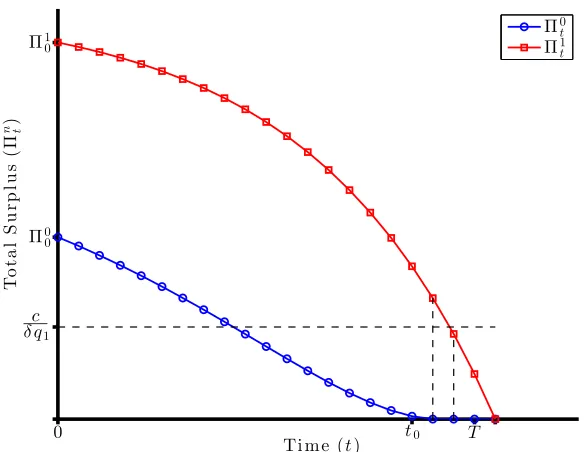
The following proposition summarizes the results above. See Figure 2.1 for an
illus-tration.
Ti me (t)
To
ta
l
S
u
rp
lu
s
(
Π
n)t
c
δq1
Π0 0
Π10
0 t0 T
Π0t
Π1
t
Figure 2.1: Total surplus functionPn t
(Y =60,q1=q2=0.1,c=1,d =0.99,T =20)
1) It is socially efficient to work at stage 1 for all t T ; it is socially efficient to work at
stage 0 if and only if t0.
2) At stage1, the social surplus of the project P1
t is characterized by(2.1). At stage 0,
the social surplusP0
t equals0for t>t0; for t<t0,P0t is characterized by(2.4).
2.2.1.2 Values and Rewards
Now that we have determined the socially optimal action choices are ˆa1
t =1 for allt and
ˆ
a0
t =1 if and only ift t0, we will show that there exists a reward schedule w={wt}
that induces ˆafrom the agent, while giving the agent a payoff ofV.
Given termination timeT, letVn
a contract that induces the socially optimal action profile ˆacharacterized in proposition
1. The agent’s ex ante payoff isV =V00. The agent’s value in any period only depends
on the stage of the project n2{0,1}and his future actions. The agent’s IC constraint is
equivalent to a set of one-shot IC conditions at both stage 0 and 1 in all periods. At stage
0, the agent’s value function follows
Vt0=max{|d(q1Vt1+1+ ({z1 q1)Vt0+1})
Value from working
, c+dVt0+1 | {z }
Value from shirking
}, 8t=0, ...,T
It is optimal for him to work if and only if
Vt1+1 Vt0+1 c
dq1.
So the one-shot IC conditions for the stage 0 agent are
Vt1+1 Vt0+1 c
dq1, 8tt0;
Vt1+1 Vt0+1 dcq
1, 8t>t0.
Stage 0 agent’s value function satisfies
Vt0=d(q1Vt1+1+ (1 q1)Vt0+1) c+dVt0+1,8tt0;
To minimize the agent’s ex ante payoffV =V00, we need to make the IC constraint binding
for allt t0, so that his payoff is the same no matter whether he works or shirks. For
t>t0, his IC constraints are not satisfied, and shirking is optimal. Then his ex ante payoff
V is exactly equal to the payoff he can receive if he always shirks:
V =V00=c+dV10=···=c
T
Â
t=0
dt=V,
and stage 0 agent’s payoff at anytT is
Vt0=c
T t
Â
i=0
di.
Next we solve for the agent’s value function at stage 1. First fortt0+1, the binding
IC constraints at stage 0 fortt0pins downVt1:
d(q1Vt1+ (1 q1)Vt0) =c+dVt0,
or
Vt1=Vt0+dc
q1.
Note that for anytt0, if stage 0 agent’s IC constraints are binding, then IC constraints
for anyd 2(0,1):
Vt1 dVt1+1= (Vt0+ c
dq1) (dV 0
t+1+qc
1) =c+ (1 d)
c
dq1 >c.
Fort>t0+1, we needVt1Vt0+dcq1 so that stage 0 agent has incentive to shirk int>t0.
Also, it is necessary thatVt11 c+dVt1 so that the IC constraints for stage 1 agent are
satisfied for t t0+1. But optimality does not pin down the value function of stage 1
agent fort >t0+1, and value functionsVt0 andVt1are consistent with optimal contracts
as long as the above conditions are satisfied.
Given any{Vt1}Tt=1andVT1+1=0, the reward schedule{wt}can be derived from the
recursive equations of the agent’s value at stage 1:
Vt1=q2wt+d(1 q2)Vt1+1,
or
wt=dVt1+1+q1 2(V
1
t dVt1+1),8t=1, ...,T.
Note that stage 1 agent’s IC conditionsVt11 c+dVt1 automatically imply the limited
liability constraintswt 0.
The following proposition summarizes properties of the optimal contracts given
ter-mination timeT.
An action profilea, a reward schedulewand the agent’s value function Vtnare consistent
with an optimal cutoff contract if and only if the following holds:
1) a0
t =1if and only if tt0; at1=1,8t T .
2) For all t >T , Vtn=0, n=0,1.
At stage 0,
Vt0=c
T t
Â
i=0
di, 8tT.
At stage 1, for all t2[1,t0+1],
Vt1=Vt0+ c
dq1 =c
T t
Â
i=0
di+ 1 dq1
!
;
for all t 2(t0+1,T], Vt1satisfies
(a) V1
t Vt0+dcq1 :No incentive to work for stage 0 agent;
(b) V1
t 1 c+dVt1: IC conditions for stage 1 agent;
3) For all t 2[1,T], wt satisfies
wt =dVt1+1+ 1
q2(V 1
t dVt1+1).
In particular,8t2[1,t0],
wt =c T t
Â
i=1
di+ 1
q1+
1
q2+
1 d dq1q2
!
In an optimal contract, the agent’s induced actionsamaximizes the total surplus and is
generically unique. Stage 0 agent’s value functionV0
t is also unique for allt. It is equal to
the discounted value of future transfers of investment cost. We can uniquely determined
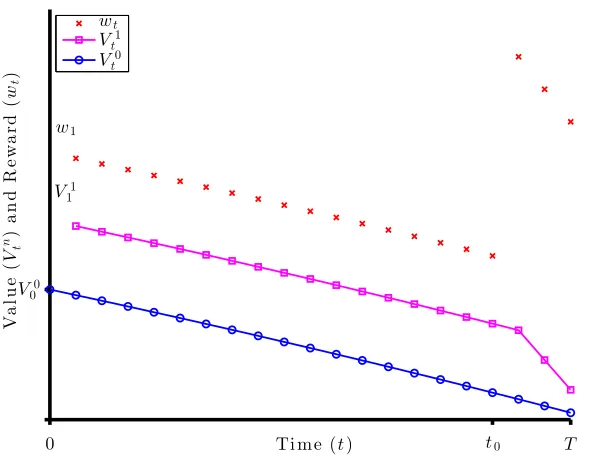
Vt1fortt0+1 andwt fortt0, which are also strictly decreasing.
There are multiple values ofV1
t fort>t0+1 and multiple values ofwt fort>t0that
are consistent with optimal contracts. This is because optimality only requires minimizing
theex antevalue of the agent. Given an optimal contract, suppose we increase the reward
in somet>t0but decrease the reward in anothert0>t0. Since the IC conditions for agents
at either stage do not bind in general, the incentive to work (or shirk) for stage 1 (or 0)
agent will still hold. So as long as the perturbation generates the same value for stage 1
agent in periodt0+1, then all incentives fortt0will not be affected and the agent’s ex
ante payoff remains the same. The perturbed contract is still optimal. Next, we show two
examples of optimal contracts with differentVt1 andwt fort t0. In one example, stage
1 agent’s valueV1
t is maximized fort>t0+1 while in the otherVt1is minimized.
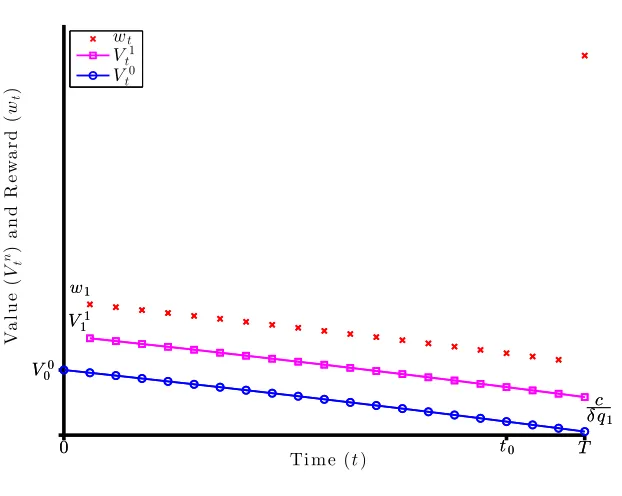
Example 1. (Figure 2.2) SetV1
t =Vt0+c/dq1 fort >t0+1. Therefore, stage 0 agent
is still indifferent between working and shirking for t>t0 but chooses to shirk. Stage 1
agent has a strict incentive to work in every period. Then
wt=c T t
Â
i=1
di+ 1
q1+
1
q2+
1 d dq1q2
!
,8t2[1,T 1]; wT =qc
2 ✓
1+ 1
dq1 ◆
.
Ti me (t) Va lu e ( V
n)at
n d R e w a rd ( wt )
V00 V11
w1
0 t0 T
c
δq1
V00 V11
w1
0 t0 T
c
δq1
wt
Vt1
V0
t
Figure 2.2: E.g.1: Value and reward functions (Y =60,q1=q2=0.1,c=1,d =0.99,T =20)
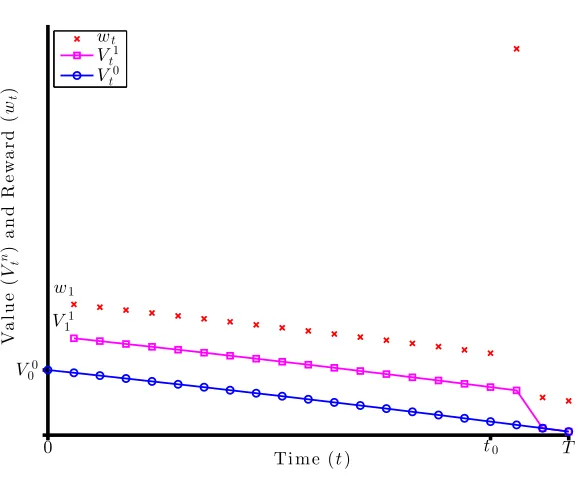
Example 2. (Figure 2.3) SetV1
t =Vt0fort>t0+1. In other words, we choose the reward
schedule such that stage 1 agent’s IC constraints are binding fort >t0+1. Stage 0 agent
strictly prefers to shirk fort>t0because the continuation value for working and shirking
are the same. The implied reward schedule is
wt=
8 > > > > > > > > < > > > > > > > > :
c⇣ÂT ti=1di+q11 +
1
q2+
1 d dq1q2
⌘
1tt0
c⇣ÂT ti=1di+q12 +
1
dq1q2
⌘
t=t0+1
c⇣ÂT ti=1di+q12
⌘
t0+1<t T
Ti me (t)
Va
lu
e
(
V
n)at
n
d
R
e
w
a
rd
(
wt
)
V00 V11
w1
0 t0 T
wt
Vt1
V0
t
Figure 2.3: E.g.2: Value and reward functions (Y =60,q1=q2=0.1,c=1,d =0.99,T =20)
As we can see, in the two examples, the rewardwt’s are different fort>t0. However,
under both reward schedules, the relevant IC conditions are satisfied and the same actions
will be induced. Moreover, the agent will receive the same expected payment. Thus both
contracts are optimal.
2.2.2 Finding Optimal
T
To fully characterize the optimal contracts, it remains to solve for the optimal time of
terminationT. In first best scenario,T should be infinity, i.e., investment should always
be made until success. However, with the moral hazard problem, it is suboptimal to invest
previous section, for a givenT, the agent’s ex ante payoff is equal to the discounted value
of the T periods’ investment costs. Suppose the contract specifies one more period of
investment, changing fromT 1 toT. It leads to an increase of the agent’s payoff bydTc.
This is the marginal cost for the principal to commit to one more period of investment.
On the other hand, the marginal benefit is an increase in the probability of success of
the project. As we can see, as T increases, the marginal cost remains constant if we
ignore discounting. However, the marginal benefit diminishes, because when T goes to
infinity, with probability almost 1 success can occur beforeT. Increasing investment for
one more period will hardly increase the overall probability of success. Then the optimal
termination timeT is the last period that the marginal benefit of investment is larger than
the marginal cost.
Define
Q01(t) = (1 q1)t;
Q02(t) = (1 q2)t;
Q1(t) =
t 1
Â
i=0
(1 q1)iq1(1 q2)t i.
So Q01(t) is the probability that the first breakthrough does not occur withint periods;
Q(02)(t)is the probability that the second breakthrough does not occur withint periods
after the first has occurred. Q1(t)is the probability that only the first breakthrough occurs
withint periods.
and then decreases. These values converge to 0 astgoes to infinity.
GivenT, letPn
t,T andVtn,T be the total surplus functions and the agent’s value functions
under optimal contracts, and lett0,T be stage 0 agent’s last working period under optimal
contracts. From howt0,T is calculated in proposition 1, we can see that for any termination
time T, T t0,T is constant. Let ˆt =T t0,T. This will be the number of periods of
financing after stage 0 agent stops working. So one more period of investment will induce
both stage 0 and stage 1 agent to work for one more period. Also note that the total surplus
P1
t,T at stage 1 in timet when termination time is T only depends on T t+1, i.e., the
number of periods left for investment. Define P1(t) =P1
T t+1,T to be the total surplus
when the project is at stage 1 when there aret periods of investment left. From equation
(2.1) in 2.2.1.1, we know that
P1(t) = q2Y c
1 d(1 q2)(1 [d(1 q2)]
t).
Proposition 3. Define
T⇤=max
T {T :P
0
0,T P00,T 1 dTc}3,
where
P0
0,T P00,T 1=Q1(t0,T)Q02(tˆ)dT(dq2Y c) +Q01(t0,T)dt0,T(dq1P1(tˆ) c).
Then T⇤>0is the termination time in the optimal cutoff contract.
Termi n ati on Ti me T
0 T⋆
Ex A n te T o ta l S u rp lu s ( Π
0 0)A
g e n t’ s V a lu e ( V
0 0)
V0 0
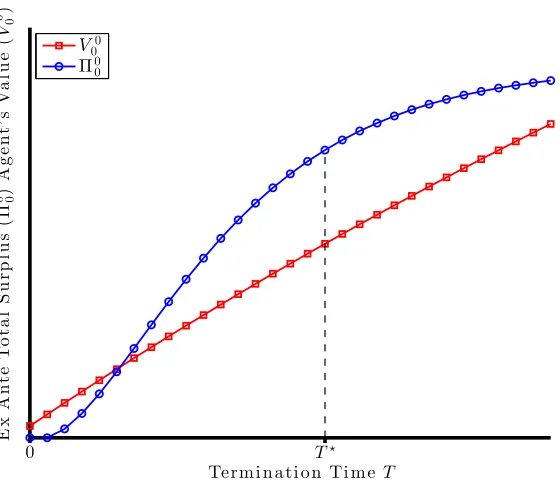
Π00
Figure 2.4: Finding opitmal terminationT⇤
(Y =50,q1=q2=0.15,c=1,d =0.99,T⇤=17)
Figure 2.4 illustrates how to determine the optimal termination time. AsT increases,
the difference between the ex ante total surplus and the agent’s payoff P0
0,T V00,T first
increases and then decreases. The optimalT⇤is where the gap is the largest if the
differ-ence is ever positive. IfP0
0,T V00,T is always negative, then the project is not profitable
to finance for the principal.
Proposition 4. Conditional on the optimal cutoff contract yields non-negative payoff to
the principal, the optimal cutoff contract is also optimal in unrestricted class of contracts.
2.3 Implications of Unobserved Progress
In this section, I discuss in more detail the properties of optimal contracts characterized
in section 2.2. Comparing the results to models where the progress is observable and
contractible, or where only one breakthrough is required for success (so that the progress
of innovation is not modeled), I highlight the implications of progress being unobservable
to the principal on incentives and on the contract structure.
2.3.1 Efficiency from Ignorance
From section 2.2, we already know that fixing the termination timeT, profit-maximizing
contracts for the principal actually induce actions from the agent that maximize the total
surplus. However, the optimal termination timeT⇤is not efficient because first best will
require always investing until success. But if there is a binding exogenous deadline ˜T
T⇤for innovation due to either time or budget constraint such that investment cannot be
made after ¯T, then the optimal contract is socially efficient.
This efficiency result is precisely because progress is unobservable, and we will call it
efficiency from ignorance. Since the agent with no progress cannot be distinguished from
the one with some progress, he will continue collect the rent from diverting the funds
when he is supposed to shirk int>t0. Therefore, it does not help providing incentives to
choose a earlier stopping time of working for the stage 0 agent. Given the final investment
termination time T, the agent is always guaranteed a payoff ofV from always shirking.
maximize the total surplus.
This will not be the case when progress is observable and contractible. In that
envi-ronment, the agent’s value is no longer independent of the stopping time of investment at
stage 0 because the principal can observe whether the first breakthrough has occurred or
not. If the principal wants stage 0 agent to stop working after some period ˜t0, but wants
stage 1 agent to continue working untilT, she can do so simply by stopping financing the
project if the stage is still 0 after ˜t0. The smaller ˜t0 is, the less money he can divert by
always shirking. In other words, earlier termination ˜t0provides more incentive for stage
0 agent to work. Less reward is needed upon success, and inducing working becomes
cheaper. As a result, given the termination time T, the principal may be better off by
choosing a ˜t0 that is smaller than the socially efficient t0, although it reduces the total
possible surplus.
Proposition 5. Suppose the first breakthrough is observable and contractible, and there
is an exogenous deadline for innovation T T⇤.4 The optimal contract the following
feature: conditional on the first breakthrough does not occur, the agent is financed if and
only if t t˜0 for some t˜0<T .; conditional on the first breakthrough has occurred, the
agent is financed until the deadline T .
Moreover, t˜0 t0, where t0 is the efficient stopping time of investment for stage 0
project characterized in Proposition 1. The inequality is strict under some parameters.
It is worth noting that although, under some conditions, the outcome is less efficient
when the principal can monitor and contract on the progress, she is still strictly better
off than if the progress is not contractible. She can always induce the efficient actions
and have stage 0 agent stop in period t0. Unlike the case where progress is private, she
does not need to finance the stage 0 agent after t0, and the agent’s share of the surplus
is strictly smaller. However, if the innovation project is funded by a principal that aims
to maximize social welfare, such as the government, and there is a binding deadline for
innovation, then there is an optimal contract where the principal chooses not to monitor
the progress even when monitoring is costless. Another interpretation of the result is
that, under some circumstances, the regulator in the economy may choose to impose
regulations that prevent tight monitoring of the progress of some projects, although it will
hurt the financier.
2.3.2 Non-monotone Rewards
In an optimal contract, the reward function wt is strictly decreasing in the success time
t for t t0+1. This is reminiscent of the dynamic agency cost identified by H¨orner
and Samuelson (2013).5 Intuitively, when success happens early, the agent loses the
opportunity to divert a large amount of fund in the future. So for him to be willing to
work for success in early periods, the agent has to be rewarded by more for earlier success.
However, as illustrated by example 1 and 2, the rewardwt may jump up in some periods 5In their setting, an additional source of the dynamic agency cost is due to the uncertainty of the quality
aftert0, and later success can be rewarded by more.6 This possible non-monotonicity of
wt ont 2[t0,T]is again driven by the features that innovation takes more that one step
and that the progress is unobservable to the principal. If the success of innovation only
requires one breakthrough, and thus there is no information asymmetry about the progress
then the optimal reward will be strictly decreasing for alltT. As a comparison, we state
the result for the case where innovation requires only one breakthrough in the following
proposition.
Proposition 6. When innovation only requires one breakthrough, the optimal contract
(w,T)is characterized by
wt=c T t
Â
i=1
di+1
q
!
,8t=0, ...,T;
and
T = log1 q c
qY c
⌫
,
whereb·cis the floor function: bxc ⌘min{k2N:kx}.
Mathematically, the reason that wt may be monotone is the following. As shown in
figure 2.2 and 2.3, V0
t decreases gradually in t and is equal to 0 when t =T+1. For
t t0+1, Vt1 is strictly larger than Vt0 by c/dq; but at t =T +1, Vt1 =Vt0 =0. So
betweent0+1 andT+1, stage 1 agent’s value functionVt1shifts fromVt0+c/dqdown
toV0
t , and has to decrease at a higher rate than in periodstt0. In example 1,Vt1 drops 6For all parameters, there exists an optimal contract in which the rewards are non-monotone. Moreover,
down att =T+1, and in example 2,Vt1 drops att =t0+2. A faster decrease ofVt1 in
t corresponds to a highwt. In general, the shift can be more gradual, the the jump in wt
will be less drastic as in the two examples. See figure 2.5 for an example.
Ti me (t)
Va
lu
e
(
V
n)at
n
d
R
e
w
a
rd
(
wt
)
V00
V11
w1
0 t0 T
wt
Vt1
Vt0
Figure 2.5: E.g.3: Value and reward functions (Y =60,q1=q2=0.1,c=1,d =0.99,T =20)
The result of non-monotone rewards can also be interpreted from the perspective of
capital structure implementation. In the one-breakthrough case, the decreasing reward
functionwt=c ÂT ti=1di+1/q is equivalent to the following arrangement. The principal
commits to transfer c to the agent in each period for either investment or consumption
until T, even if success has already occurred. When the project is successful, the agent
receives a fixed share of the value of successc/qand the principal gets the restY c/q;
future transfers after success, he has no incentive to delay investment. The sharec/q is
the minimum reward needed for the agent to be willing to work in a static problem. The
optimal contract can be simply implemented by granting a fixed share of stock to the
agent.
One might conjecture a similar argument will hold for the two-breakthrough case.
Indeed, fortt0,
wt=c T t
Â
i=1
di+ 1
q1+
1
q2+
1 d dq1q2
!
. (2.5)
The structure is similar to the one-breakthrough case, except now the fixed share granted
to the agent becomesc⇣ÂT ti=1 di+q11+
1
q2+
1 d dq1q2
⌘
. However, ifwtfollows equation (2.5)
for alltT, some of the incentive conditions for the agent will be violated. Remember
that in an optimal contract, stage 0 agent is supposed to work until t0, where t0 is the
socially efficient time to stop investing in stage 0 project when the value of success isY.
If the agent is givencin each period untilT and gets a fixed share
FS=c
T t
Â
i=1
di+ 1
q1+
1
q2+
1 d dq1q2
!
when the project succeeds, then he will act as if he is a social planner that manages a
project that is worthFS upon success. SinceFS<Y, the agent of stage 0 would like to
stop investing earlier than the efficient timet0. In order to induce stage 0 agent to invest
for longer time, the principal could increase the fixed share of the value of success granted
ante payoff. Instead, the optimal contract does not use a fixed share of stock. Fort t0,
the share given to the agent isc⇣ÂT ti=1di+q11 +q12 +d1q1dq2
⌘
; in one or more periods from
t0+1 to T, the reward function wt jumps up, corresponding to a larger share of stock
given to the agent. This provides stage 0 agent more incentive to work fortt0without
giving him a larger ex ante payoff.
The result is consistent with the wide use of time-vested restricted stock units (RSU).
Usually time-vested RSU is understood as a tool to provide incentives for employees
to stay on the job. Indeed, this is its main role for workers at middle to low levels in
large companies, where individuals’ effort have little impact on the overall profitability,
and moral hazard may not be the main concern. On the other hand, this model stresses
that in contexts such as incentivizing founders of startups, time-vested stocks as part
of the compensation scheme not only help retain founders on the project, but also give
them more incentives to exert effort before the stocks vest. This extra bit of incentive is
especially important if the progress has been slow. The founder will want to work to make
Chapter 3
Extensions and Discussions
3.1 Which Task First: the Easy or the Difficult?
In this section, suppose the two breakthroughs required for the success of the project do
not need to be in a particular order. In other words, there are two tasks that need to be
completed, taskD(ifficult) and taskE(asy). In each period, the agent can choose to work
on task DorE. If taskiis worked on in a period, the probability that it is completed is
qi, withqE >qD. The costs for investing in the two tasks are the same,c. For simplicity,
assume there is no discounting, i.e.,d =1. The contractible histories remain the same as
in the baseline case. Now a contract specifies at each history a financing decision, a reward
for final success and which task to work on. There is an additional set of IC constraints
for the agent that he does not deviate to working on the other task. The question is, in the
Again, it is helpful to consider the planner’s problem first. Given a termination time
T, if the planner works on taskE first, she will exert effort up to somet0 to complete
taskE. If taskE is completed byt0, she will work untilT on taskD; otherwise she stops
working. LetP(ED)denote the social surplus when the planner works on taskE first and
uses the optimalt0. LetP(DE) denote the social surplus when taskDis done first and
the planner uses the samet0that is optimal for the sequenceED.
Lemma 2.
P(DE)>P(ED).
The above lemma states that planner obtains a higher payoff by doing task D first
even she uses a dropout timet0at stage 0 that may not be optimal. Therefore, it is always
optimal for the planner to work on the difficult task first. To see the intuition behind the
result, think about an extreme case whereqE=1 andqD<1. If taskEis carried out first,
it is immediately completed with certainty att=0. Thus, the choice oft0does not matter
and it can be set to T 1. Now compare the planner’s payoffs under the following two
strategies: 1) complete task E at t =0 and use the remaining T periods to work on D;
or 2) work on taskDfirst forT periods fromt=0 toT 1, and if taskDis completed,
do task E and succeed; otherwise do not work at t = T. Note that the two strategies
lead to the same probability of success: under both strategies, success requires task D
be completed withinT periods. In fact, the two strategies result in the same distribution
over success time. Therefore, in the event of success, the payoffs of the planner are the
periods (with probability (1 qD)T), working on Dfirst saves the planner one period’s
investment cost compared to working onE first. Lemma 2 proves that the intuition from
the extreme case holds in general.
Another way to interpret this result is that the continuation value of having completed
the difficult task is higher. It is not yet obvious that the difficult task should be worked on
first because the probability is lower. The proof shows that even taking into account the
lower probability, working on the difficult task still gives higher return.
The next proposition shows that working on the difficult task first is not only efficient,
but also generates higher payoff for the principal.
Proposition 7. The optimal contract induces the agent to work on task D first.
Proof. Consider best contract that induces the agent to work on task E first. It has a
termination date T and a stage 0 dropout timet0. LetU(ED) be the principal’s payoff
(U(DE)defined respectively). ThenU(ED)P(ED) (T+1)c. Now suppose the agent
is restricted to do task Dfirst. Consider the contract describe in Example 2 in Chapter 2
with the sameT andt0, andq1=qD,q2=qE. By proposition 2,
U(DE) =P(DE) (T+1)c.
Therefore,U(DE)>U(ED).
Lastly, it can be verified that when the wages are defined as in Example 2, the agent