University of Pennsylvania
ScholarlyCommons
Publicly Accessible Penn Dissertations
2015
Prosodic Focus Within and Across Languages
Yong-cheol LeeUniversity of Pennsylvania, [email protected]
Follow this and additional works at:http://repository.upenn.edu/edissertations
Part of theDiscourse and Text Linguistics Commons, and thePhonetics and Phonology Commons
This paper is posted at ScholarlyCommons.http://repository.upenn.edu/edissertations/1534 For more information, please [email protected].
Recommended Citation
Prosodic Focus Within and Across Languages
Abstract
The fact that "purely" prosodic marking of focus may be weaker in some languages than in others, and that it varies in certain circumstances even within a single language, has not been commonly recognized. Therefore, this dissertation investigated whether and how purely prosodic marking of focus varies within and across languages. We conducted production and perception experiments using a paradigm of 10-digit phone-number strings in which the same material and discourse contexts were used in different languages.
The results demonstrated that prosodic marking of focus varied across languages. Speakers of American English, Mandarin Chinese, and Standard French clearly modulated duration, pitch, and intensity to indicate the position of corrective focus. Listeners of these languages recognized the focus position with high accuracy. Conversely, speakers of Seoul Korean, South Kyungsang Korean, Tokyo Japanese, and Suzhou Wu produced a weak and ambiguous modulation by focus, resulting in a poor identification performance.
This dissertation also revealed that prosodic marking of focus varied even within a single language. In Mandarin Chinese, a focused low/dipping tone (tone 3) received a relatively poor identification rate compared to other focused tones (about 77% vs. 91%). This lower identification performance was due to the smaller capacity of tone 3 for pitch range expansion and local dissimilatory effects around tone 3 focus. In Seoul Korean, prosodic marking of focus differed based on the tonal contrast (post-lexical low vs. high tones). The identification rate of high tones was twice as high than that of low tones (about 24% vs. 51%), the reason being that low tones had a smaller capacity for pitch range expansion than high tones.
All things considered, this dissertation demonstrates that prosodic focus is not always expressed by concomitant increased duration, pitch, and intensity. Accordingly, "purely" prosodic marking of focus is neither completely universal nor automatic, but rather is expressed through the prosodic structure of each language. Since the striking difference in focus-marking success does not seem to be determined by any previously-described typological feature, this must be regarded as an indicator of a new typological dimension, or as a function of a new typological space.
Degree Type Dissertation
Degree Name
Doctor of Philosophy (PhD)
Graduate Group Linguistics
First Advisor Mark Liberman
Keywords
focus, identification, perception, production, prosody, typology
Subject Categories
Discourse and Text Linguistics | Phonetics and Phonology
PROSODIC FOCUS WITHIN AND ACROSS LANGUAGES
Yong-cheol Lee
A DISSERTATION
in
Linguistics
Presented to the Faculties of the University of Pennsylvania in Partial
Fulfillment of the Requirements for the Degree of Doctor of Philosophy
2015
Supervisor of Dissertation __________________________ Mark Liberman
Christopher H. Browne Distinguished Professor of Linguistics
Graduate Group Chairperson __________________________ Eugene Buckley
Associate Professor of Linguistics
Dissertation Committee
PROSODIC FOCUS WITHIN AND ACROSS LANGUAGES
COPYRIGHT
2015
iii
iv
Acknowledgements
I have always waited for this moment to come – the moment dedicated to thanking all my
teachers, colleagues, friends, and families for the great support and prayers they have
poured into me during my PhD life. It has been a long, tough journey, but it would have
been even harder without them. If I missed any names below, please kindly forgive me –
you know you are greatly appreciated.
First and foremost, I would like to express my deepest gratitude to my advisor,
Mark Liberman, for being a great source of inspiration and guidance. When I came to
him with undeveloped ideas, he pointed me in the right direction and helped me
formulate my raw ideas into coherent and articulate ones. During our meetings, he always
provided me with brilliant ideas far beyond my capacity and constructive suggestions for
this dissertation as well as other projects. Without him, my dissertation would not have
been possible.
In addition, many special thanks go to committee members Florian Schwarz and
Jianjing Kuang, who willingly dedicated time for our regular meetings and continued to
provide me with constructive feedback and suggestions on my dissertation throughout the
time I was working on it. They both challenged and stimulated me intellectually, pushing
me to go beyond what I had prepared for, which ultimately led me to think more critically
v
I have had many great teachers over the years since I started my career in
linguistics. Jiahong Yuan and Georgia Zellou were generous and kind to me and were
always willing to share their knowledge. Their influence had a positive impact during my
PhD study. Yi Xu and Sun-Ah Jun also deserve a mention. Although they are not Penn
faculty members, they helped me outside of school through email correspondence. I am
also very grateful to my Korean teachers and mentors, Kyutae Jung, Misun Seo, and
Yong-hun Lee, who always inspired me to go beyond my limits and encouraged me with
supportive words when I felt overwhelmed.
I also owe many thanks to my cohort-mates: Meredith Tamminga, Hilary Prichard,
Kobey Shwayder, and Claire Crawford. As an international student, I was confronted
with many obstacles both academically and socially when I first started studying at Penn.
Through those tough times, they helped me overcome hardships both inside and outside
of class. We share many memories of doing homework assignments and projects together
and having regular meetings throughout the years.
I have been very fortunate to meet many wonderful people at Penn. I would like to
single out Marielle Lerner for special thanks. She has played many roles for me
throughout our friendship, including English teacher, proofreader, and amazing friend. I
also want to express special thanks to Gayeon Son, Soohyun Kwon, and Sunghye Cho,
who have provided me with endless encouragement, support, and love. Believe it or not, I
often got the feeling that they bought me meals just to make sure that I wasn‘t skipping
any. It was a great joy to have such friends at Penn. Furthermore, I must also mention my
vi
meetings, we discussed and shared many ideas on various projects and developed those
initial ideas into presentable and publishable ones.
For the past six years, my colleagues and friends inside and outside the department
provided me with a friendly and pleasant environment and also offered me so much help.
The following people I would like to thank are alphabetically ordered by their first name:
Aaron Ecay, Amy Forsyth, Anton Ingason, Aviad Eilam, Betsy Sneller, Blenda Im,
Brittany McLaughlin, Catherine Lai, Chang Woon Jang, Chris Ahern, Chris Park,
Constantine Lignos, Dimka Atanassov, Einar Freyr Sigurðsson, EunHae Grace Kim,
Haitao Cai, Hannah Gajari, Ingrid Heidelberger, Jae Kim, Jane Kim, Jeehwan Cho, Ji Yea
Kim, Jingjing Tan, Jinmin Lee, Jon Scott Stevens, Josef Fruehwald, Josep Folta, Joshua
Tauberer, Karen Tseng, Katelyn HyunJin Cheon, Laurel MacKenzie, Mao-Hsu Chen,
Marielle Lerner, Michael Falcetano, Rebecca Tomkinson Marsh, Rinho Kim, Robert
Wilder, Sabriya Fisher, Saem Kim, SangHoon Chong, Yanyan Sui, Yixuan Guo, Young
Ah Do, Young Hwang, and Yusuke Yoda.
I have had many unforgettable memories in Philadelphia. One of the best times
came with my life at Brown Street. My landlady Doris Blendinger was always concerned
about my career and success in the field of linguistics and in my personal life in general.
She was also willing to proofread many pieces of my work on this project and others with
greatest pleasure. Tyrell McCurbin and Ravi Akki, who were my house mates, also
deserve special thanks. We had great times together with many interesting conversations
and wonderful dinners. This precious time will last forever in my memory!
I also want to thank my family from the bottom of my heart. My wife, Sora Kang,
vii
She was always there for me day in and day out. Words simply cannot describe the level
of my gratitude towards her for her sacrifice and love for me. Thanks a lot honey! In
addition, I sincerely thank both my parents and parents-in-law for their ongoing support
and prayers for me.
Needless to say, special thanks go to both the Fulbright Fellowship, the Benjamin
Franklin Fellowship, and the George L. Harrison Fellowship, through which I have been
able to focus on my PhD courses, a series of research projects, and of course this
dissertation without any financial hassles.
Last but not least, parts of this project are based on joint work with many other
scholars. Without their help, this dissertation would never have reached the finish line.
Therefore, I extend my sincere thanks to all my collaborators: Ting Wanag at Tongji
University, Sunghye Cho at Penn, Bei Wang and Sisi Chen at Minzu University of China,
Martine Adda-Decker and Angélique Amelot at Sorbonne Nouvelle, and Satoshi Nambu
at National Institute for Japanese Language and Linguistics. A preliminary version of
Chapter 4 was presented at ICASSP 2015 and is forthcoming in the proceedings. Earlier
versions of Chapters 5 and 6 were presented at LSA 2015 and PLC 39, respectively. Parts
viii ABSTRACT
PROSODIC FOCUS WITHIN AND ACROSS LANGUAGES
Yong-cheol Lee
Mark Liberman
The fact that ―purely‖ prosodic marking of focus may be weaker in some languages than
in others, and that it varies in certain circumstances even within a single language, has
not been commonly recognized. Therefore, this dissertation investigated whether and
how purely prosodic marking of focus varies within and across languages. We conducted
production and perception experiments using a paradigm of 10-digit phone-number
strings in which the same material and discourse contexts were used in different
languages.
The results demonstrated that prosodic marking of focus varied across languages.
Speakers of American English, Mandarin Chinese, and Standard French clearly
modulated duration, pitch, and intensity to indicate the position of corrective focus.
Listeners of these languages recognized the focus position with high accuracy.
Conversely, speakers of Seoul Korean, South Kyungsang Korean, Tokyo Japanese, and
Suzhou Wu produced a weak and ambiguous modulation by focus, resulting in a poor
identification performance.
This dissertation also revealed that prosodic marking of focus varied even within a
single language. In Mandarin Chinese, a focused low/dipping tone (tone 3) received a
ix
This lower identification performance was due to the smaller capacity of tone 3 for pitch
range expansion and local dissimilatory effects around tone 3 focus. In Seoul Korean,
prosodic marking of focus differed based on the tonal contrast (post-lexical low vs. high
tones). The identification rate of high tones was twice as high than that of low tones
(about 24% vs. 51%), the reason being that low tones had a smaller capacity for pitch
range expansion than high tones.
All things considered, this dissertation demonstrates that prosodic focus is not
always expressed by concomitant increased duration, pitch, and intensity. Accordingly,
―purely‖ prosodic marking of focus is neither completely universal nor automatic, but
rather is expressed through the prosodic structure of each language. Since the striking
difference in focus-marking success does not seem to be determined by any
previously-described typological feature, this must be regarded as an indicator of a new typological
x
Contents
Acknowledgements ... iv
Abstract ... viiiviii Contents ...x
List of Tables ... xiv
List of Figures ... xvii
1. Introduction ...1
1.1. Focus types ...2
1.2. Some terminology issues ...4
1.3. Three basic approaches to focus marking ...8
1.4. Current study ...13
1.5. Research questions and approaches...18
1.6. Outline of this dissertation ...20
2. Methods – Spoken telephone numbers ...22
2.1. Production ...25
2.1.1. Speech materials ...25
2.1.2. Participants ...27
2.1.3. Recording procedure ...28
2.2. Perception ...31
xi
2.2.2. Participants ...32
2.2.3. Procedure ...32
3. Prosodic structures of languages under study ...35
3.1. Prosodic structures of each language ...35
3.1.1. American English ...35
3.1.2. Mandarin Chinese ...36
3.1.3. Seoul Korean ...37
3.1.4. South Kyungsang Korean...39
3.1.5. Tokyo Japanese ...41
3.1.6. Standard French...44
3.1.7. Suzhou Wu ...45
3.2. Three types of prosodic typologies ...48
3.2.1. Rhythm-based typology ...48
3.2.2. Accent-based typology ...50
3.2.3. Prominence-based typology ...53
4. A cross-linguistic study of prosodic focus ...57
4.1. Introduction ...57
4.2. Production ...60
4.2.1. Data collection...60
4.2.2. Acoustic measurements ...61
4.2.3. Analyses ...61
4.2.4. Results ...63
4.2.4.1. American English and Seoul Korean ...63
4.2.4.2. Mandarin Chinese and South Kyungsang Korean ...65
4.2.4.3. Standard French and Tokyo Japanese ...67
4.2.4.4. Suzhou Wu ...69
4.2.4.5. The phonological unit that carries prosodic focus ...71
xii
4.3.1. Data collection and analyses ...74
4.3.2. Results ...74
4.3.2.1. American English and Seoul Korean ...74
4.3.2.2. Mandarin Chinese and South Kyungsang Korean ...77
4.3.2.3. Standard French and Tokyo Japanese ...81
4.3.2.4. Suzhou Wu ...83
4.4. Discussion ...84
5. Production and perception of tone 3 focus in Mandarin Chinese ...93
5.1. Introduction ...93
5.1.1. A brief overview of four lexical tones in Mandarin Chinese ...94
5.1.2. Production and perception of focus in Mandarin Chinese ...95
5.1.3. The current study ...97
5.2. Production ...99
5.2.1. Stimuli ...99
5.2.2. Subjects and recording procedure ...100
5.2.3. A sketch of pitch contours ...100
5.2.4. Acoustic measurements ...103
5.2.5. Analyses and results ...104
5.3. Perception ... 110
5.3.1. Data collection... 110
5.3.2. Results ... 111
5.4. Discussion ... 113
6. An interaction effect between tonogenesis and prosodic focus in Seoul Korean ... 117
6.1. Introduction ... 117
6.2. Production ...121
6.2.1. Stimuli ...121
xiii
6.2.3. Analyses and results ...124
6.3. Perception ...128
6.3.1. Data collection...128
6.3.2. Results ...129
6.4. Discussion ...132
7. General discussion, future directions, and conclusion ...136
7.1. Main findings ...136
7.2. Limitations of existing prosodic typologies ...141
7.3. Implications ...144
7.4. Future directions ...147
7.5. Conclusion ...153
Appendix A ...154
Appendix B ...155
Appendix C ...157
Appendix D ...159
xiv
List of Tables
1.1. Focus morphemes in Chickasaw ... 11
2.1 Different pronunciations of the numerical digits from 0 to 9 in each language. We
used the IPA for the two varieties of Korean, the Romaji system for TJ, the Pinyin
Romanization system for Mandarin Chinese, and the IPA for Suzhou Wu. (AE:
American English, MC: Mandarin Chinese, SF: Standard French, SK: Seoul
Korean, SKK: South Kyungsang Korean, TJ: Tokyo Japanese, SW: Suzhou Wu) ....
...27
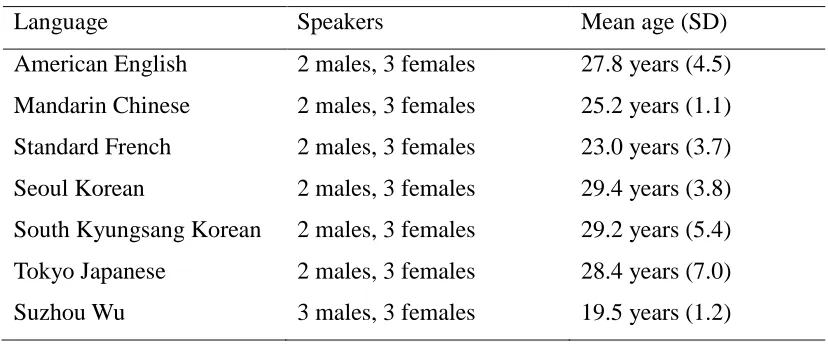
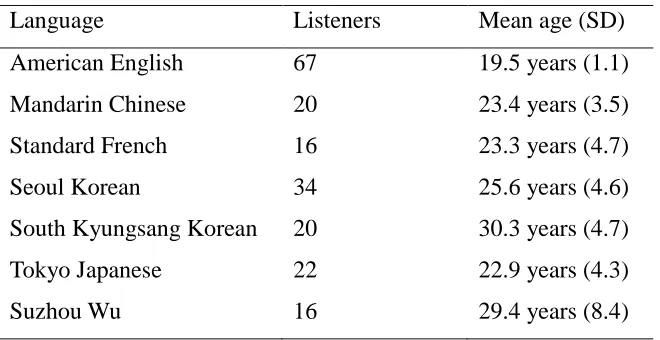
2.2 The number of speakers and the mean age (SD) of each language ...28
2.3 The number of listeners and the mean age (SD) of each language ...32
3.1. The possible tone patterns of monosyllabic, disyllabic, trisyllabic, and
quadrisyllabic words in South Kyungsang Korean ...40
3.2. The numerical digits of South Kyungsang Korean, together with IPA and the tone
pattern of each digit ...41
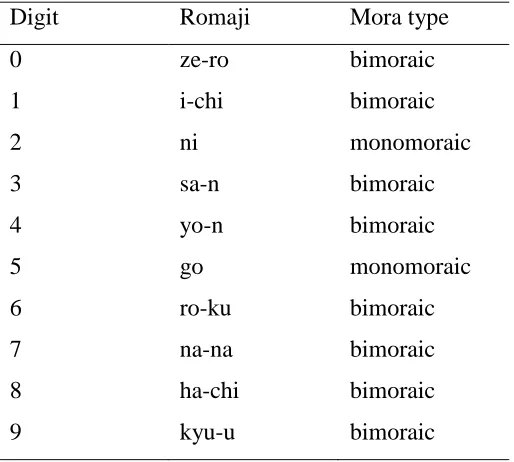
3.3. The numerical digits of Tokyo Japanese, together with Romaji and the mora type
of each digit. A dash (-) indicates a mora boundary ...43
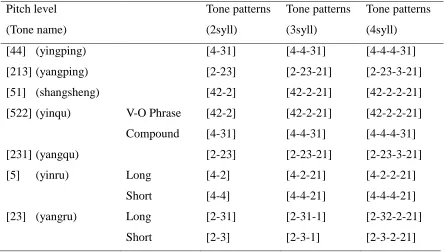
3.4. Seven citation tones and their tones names in Suzhou Wu. The pitch level is based
on the actual normalized pitch contour in Lau (2002) ...46
3.5. The phonetic representations of seven citation tones and tone patterns of
disyllables, trisyllables, and quadrisyllables (Based on Lau, 2002, p. 140) ...47
3.6. The rhythmic unit of each language ...50
3.7. A typology based on the distinctions between stress vs. non-stress accent and
between lexical vs. post-lexical pitch accent (Ladd, 1996, p. 156) ...51
3.8. A typology of factors determining pitch accents, after Ladd (1996, p. 156),
expanded to include the type represented by Wolof (Lindström & Remijsen, 2005,
xv
3.9. The classification of the seven languages according to the accent-type typology
(AE: American English, TJ: Tokyo Japanese, SKK: South Kyungsang Korean)...54
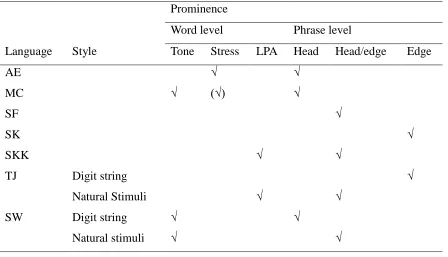
3.10. The classification of languages based on the types of prominence marking at the
word level and at the phrase level (AE: American English, MC: Mandarin Chinese,
SF: Standard French, SK: Seoul Korean, SKK: South Kyungsang Korean, TJ:
Tokyo Japanese, SW: Suzhou Wu; LPA: lexical pitch accent, Head:
Head-prominent, Head-edge: Head/edge-Head-prominent, Edge: Edge-prominent) ...55
4.1. Confusion matrix of corrective focus perception (percentage values). Numbers
highlighted in gray indicate correct identification rates. Dotted lines indicate a
phrase boundary in a string. (Top panel: American English; Bottom panel: Seoul
Korean) ...76
4.2. The phrase-by-phrase confusion matrix for Seoul Korean ...77
4.3. Confusion matrix of corrective focus perception for Mandarin Chinese
(percentage values). Numbers highlighted in gray indicate correct identification
rates. Dotted lines indicate a phrase boundary in a string ...78
4.4. Position-by-position identification rates of tones 1-4 ...79
4.5. Confusion matrix of corrective focus perception for South Kyungsang Korean
(percentage values). Numbers highlighted in gray indicate correct identification
rates. Dotted lines indicate a phrase boundary in a string ...80
4.6. The phrase-by-phrase confusion matrix for South Kyungsang Korean ...80
4.7. Confusion matrix of corrective focus perception (percentage values). Numbers
highlighted in gray indicate correct identification rates. Dotted lines indicate a
phrase boundary in a string. (Top panel: Standard French, Bottom panel: Tokyo
Japanese) ...82
4.8. The phrase-by-phrase confusion matrix for Tokyo Japanese ...83
4.9. Confusion matrix of corrective focus perception for Suzhou Wu (percentage
values). Numbers highlighted in gray indicate correct identification rates. Dotted
lines indicate a phrase boundary in a string ...84
5.1. The numerical digits of Mandarin and the lexical tone of each digit together with
xvi
5.2. The duration, mean intensity, and target pitch values of the broad-focus and
corrective-focus condition for each tone type (BF and CF are abbreviations for
broad focus and corrective focus, respectively) ...107
5.3. Position-by-position identification rates of tones 1-4 ... 111
5.4. Confusion matrix of corrective focus perception for tone 3 digits (percentage
values). Cells highlighted in black indicate focused positions. Cells highlighted in
gray refer to pre- or post-focus positions across the phrase boundary. Vertical lines
refer to phrase boundaries ... 113
5.5. The mean intensity of tones 1-4. BF and CF are abbreviations for broad focus and
corrective focus, respectively ... 115
6.1. The onset consonant type of each digit and the tone group depending on the tonal
contrast that each digit shows ...122
6.2. The output of the linear mixed effects model. Broad focus in the Low tone group
is the reference category ...127
6.3. Confusion matrix of corrective focus perception (percentage values). Numbers
highlighted in gray indicate correct identification rates. Dotted lines indicate a
phrase boundary in a string. (Top panel: the Low tone group, Bottom panel: the
High tone group) ...130
6.4. The phrase-by-phrase confusion matrix (Top panel: Low tone group, Bottom panel:
High tone group) ...132
6.i. The mean identification rate (%) for each digit. The areas shaded in gray refer to
the High tone group ...129
7.1. The classification of languages based on rhythmic unit and type of prominence
marking at the word level and at the phrase level. Languages above the dotted line
produced clear prosodic marking of focus, whereas languages below that line did
not produce such a clear prosodic marking of focus (AE: American English, MC:
Mandarin Chinese, SF: Standard French, LPA: lexical pitch accent, Head:
xvii
List of Figures
1.1. Time-normalized average pitch contours of 36 repetitions of the sentence Jonathan
remembered Jessica (left panel) and Minsuga manduɾɨl mʌknɨnda (‗Minswu is
eating dumplings‘) (right panel) by six speakers. The first area of each panel
contains a target word (Raw data from Lee (2009) for the left panel and from Lee &
Xu (2010) for the right panel) ...15
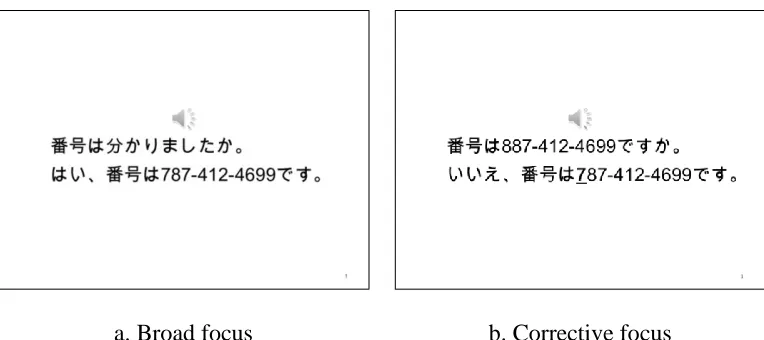
2.1. Screenshots of the perception experiment for AE (Left panel: broad-focus condition,
Right panel: corrective-focus condition) ...30
2.2. Screenshots of the perception experiment for Tokyo Japanese (Left panel:
broad-focus condition, Right panel: corrective-broad-focus condition) ...31
2.3. A screenshot of the instructions for the survey in Qualtrics ...33
2.4. A screenshot of part of the survey in Qualtrics ...34
3.1. Time-normalized mean pitch contours of 36 repetitions by six speakers. The
sentence is Minsuga manduɾɨl mʌknɨnda (Raw data from Lee & Xu, 2010) ...38
3.2. Time-normalized average pitch contours of five repetitions of the string
(105)-(601)-(2318) by five speakers. The red fonts indicate a digit string. The dotted
vertical lines demarcate phrases. The area shaded in gray represents a string
position with an accentual peak ...44
3.3. Time-normalized average pitch contours of the string (980)-(673)-(2518). The
dotted vertical lines demarcate phrases. The red digits indicate a digit string and the
green digits the citation tone of each digit ...48
4.1. Prosodic differences between broad and corrective focus in American English when
position 1 is focused. Character 1 represents focus position ...62
4.2. Prosodic differences between focused digits and broad-focus counterparts in
American English and Seoul Korean. Characters 1-A refer to positions 1 to 10 ...65
xviii
Mandarin Chinese and South Kyungsang Korean. Characters 1-A refer to positions
1 to 10 ...67
4.4. Prosodic differences between focused digits and broad-focus counterparts in
Standard French and Tokyo Japanese. Characters 1-A refer to positions 1 to 10 ....69
4.5. Prosodic differences between focused digits and broad-focus counterparts in
Suzhou Wu. Characters 1, 3, 4, 5, and A indicate positions 1, 3, 4, 5, and 10 ...70
4.6. The mean pitch contours of the broad- and corrective-focus conditions. Each pitch
contour includes focus in position 1. The area shaded in gray refers to a prosodic
phrase that includes the first three digits ...72
4.7. The mean intensity values of the broad-focus and corrective-focus conditions.
Positions 5 and 10 are the target positions that include prosodic focus ...88
4.8. The pitch and intensity values of the broad-focus and corrective focus conditions in
two languages: American English and Mandarin Chinese. The target position is
position 10 ...90
5.1. Sample pitch contours for tone 3 digits in two focus conditions. BF and CF are
abbreviations for broad focus and corrective focus, respectively ...102
5.2. Pitch trajectories of tones 1-4 in two focus conditions. BF and CF are abbreviations
for broad focus and corrective focus, respectively ...103
5.3. Duration, mean intensity, and target pitch of all tone types in two focus conditions
(BF: broad focus, CF: corrective focus; T1: Tone 1, T2: Tone 2, T3: Tone 3, T4:
Tone 4). The downward arrow of the third panel indicates that tone 3 focus is
expressed by lowering its pitch point ...106
5.4. Duration, mean intensity, and mean pitch values of the pre-focus position of tone 3
digits, separated by final vs. non-final positions. BF and CF are abbreviations for
broad focus and corrective focus, respectively ...108
5.5. Duration, mean intensity, and mean pitch values of the post-focus position of tone 3
digits, separated by initial vs. non-initial positions. BF and CF are abbreviations for
broad focus and corrective focus, respectively ... 110
6.1. Intonation model of Seoul Korean (Adapted from Jun & Cha, 2011) ... 118
xix
indicates the focus position (Raw data from Lee & Xu, 2010). The sentence is
minsuga manduɾɨl mʌknɨnda (Minsu is eating dumplings) ...120
6.3. Sample pitch contours for the Low and High tone groups in two focus conditions.
BF and CF are abbreviations for broad focus and corrective focus, respectively ..124
6.4. Top panel: Points indicate mean values of each position, Bottom panel: Points
indicate mean values and bars standard errors ...126
6.5. Means by corrective focus minus broad focus. Characters 1-A indicate focus
position from 1 to 10 ...128
7.1. Time-normalized pitch contours, where the area in gray indicates a focus position.
Figure 1a includes a natural sentence Minsuga manduɾɨl mʌknɨnda (‗Minswu is
eating dumplings‘); Figure 1b consists of a digit string 637-686-7664.
Abbreviations are BF (broad focus), DF (discourse-new focus), and CF (corrective
focus) ...147
7.2. Time-normalized pitch contours, where the first area includes a focused digit and
the dotted lines refer to a digit boundary. BF and CF abbreviate broad focus and
1
Chapter 1
Introduction
The primary purpose of communication is to convey information. The delivery of this
information is expected to be systematic and understandable. A speaker makes
assumptions about the hearer‘s knowledge and behaves accordingly. He then structures
sentences to integrate new information with given information he believes the listener is
familiar with. This kind of structure is known as information structure (IS) (e.g., Halliday,
1967; Krifka, 2008; Lambrecht, 1994; Vallduví, 1990). Consider the brief dialogue in (1).
(1) a. What does John drink?
b. John drinks beer.
In (1b), John drinks is old information since it repeats content from the question, and
beer – the answer to the question – is new information. In the context of the dialogue, the
informative part (beer) is the focus, which indicates a discourse function that emphasizes
a particular piece of information in a sentence (Ladd, 1984; Xu & Xu, 2005).
In this dissertation, our main goal is to gain a better understanding of the
similarities and differences in prosodic marking of focus both within and across
2
researchers, and even different languages employ different means of focus marking.
Therefore, before setting up the research questions, it is necessary to untangle the
terminology that surrounds focus. We first describe different focus types in Section 1.1.
In Section 1.2, some of the issues regarding focus that still remain a matter of discussion
are analyzed. Section 1.3 examines different focus-encoding mechanisms across
languages, while Section 1.4 lays out the research questions. Finally, Section 1.5 outlines
the remaining parts of the dissertation.
1.1. Focus types
Depending on the context where it is used, focus is divided into several types, such as
discourse-new focus, contrastive focus, and corrective focus. We describe these three
types of focus in turn.
(2) a. What is your name?
b. My name is [x]F.
The variable x in (2b) represents new information, thus receiving discourse-new focus.
This new information is not recoverable from prior context (Halliday, 1967; Kuno, 1972)
and is not shared between speaker and hearer (Jackendoff, 1972).
Newness is not the only source of focus; focus can also derive from contrastiveness.
This type of focus is called contrastive focus, meaning that it indicates an exhaustive
3
(3) a. Between pizza and noodles for lunch, which one do you prefer to have?
b. I [VP prefer [pizza]F].
Although pizza (3b) is old information since it has already been stated in (3a), it contrasts
with noodles. Following alternative semantics for focus (Rooth, 1992), the focus
semantic value for the VP prefer pizza consists of the following set of alternatives:{prefer
pizza, prefer noodles}. Since pizza is singled out in the response, it receives contrastive
focus.
The constituent associated with only is also assured an exhaustive interpretation, as
shown in (4).
(4) Eva only gave xerox copies to [the graduate students]F. (Partee, 1991, p. 179)
Sentence (4) means that Eva gave xerox copies to the graduate students and no one else.
The constituent associated with only, the graduate students, is an exhaustive choice
between many potential beneficiaries, and accordingly it receives contrastive focus by
virtue of being associated with only.
The third type, corrective focus, is illustrated in (5). This focus is similar to
contrastive focus in that it reflects contrast but differs in that it corrects wrong
information. In (5b), the focused digit 9 (that contrasts with 7) is used to correct the
4
(5) a. Mary‘s phone number is 264-872-8618. Right?
b. No, Mary‘s phone number is 264-8[9]F2-8618.
1.2. Some terminology issues
Although the term ―focus‖ has received considerable attention, the notion and definition
of focus have not been coherent in the literature (Gundel, 1999; Levinson, 1983; Matić &
Wedgwood, 2012; Schwarz, 2003). In this section, we address some of the issues that still
remain a matter of discussion. These issues include: the oldness/newness distinction; a
debate over the status of discourse-new focus; IS partitions; and different theoretical
frameworks for focus. We will address these issues one by one.
First, the oldness/newness dichotomy is not simple to define. In Prince (1992), new
information is labeled as discourse-new or hearer-new depending on whether it is new to
a discourse or a hearer. Both discourse-new and hearer-new information represent purely
new information since they have not been previously evoked or known to a hearer. A
discourse-new entity like Sandy Thompson and the moon in (6) can be hearer-old since
presumably they are already familiar or known to a hearer (Prince, 1992; Ward & Birner,
2003). Conventional wisdom is that hearer-old (e.g., inferable) information is not new
despite being discourse-new at the time of speech (Birner, 2003; Hietaranta, 1984; Prince,
1981, 1992; Ward & Birner, 1995, 1997, 2003). However, Ward and Birner (1995, 1997)
point out that hearer-old information can be marked as hearer-new, especially when the
entity is used to recall information from a hearer‘s memory. Overall, there is no clear-cut
5
on many other factors, such as hearer‘s mental representation, assumed familiarity
between speaker and hearer, and others.
(6) a. I‘m waiting for it to be noon so I can call Sandy Thompson.
(Prince, 1992, p. 309)
b. Last night the moon was so pretty that I called a friend on the phone and told
him to go outside and look. (Ward & Birner, 2003, p. 121)
Second, a debate has emerged recently over the status of discourse-new focus (aka
information focus). It has been claimed that discourse-new information does not have a
focus marking in syntax, and thus is not considered to be a type of focus (Katz & Selkirk,
2011; Rochemont, 2013; Selkirk, 2008b). The motivation for this is that in English,
discourse-new information does not bear maximal prominence in a sentence,
distinguishing it from contrastive focus in terms of prosodic prominence (Katz & Selkirk,
2011). Calhoun (2010b), however, argues that discourse-new information does receive
focus, and discourse-new focus and contrastive focus are distinguished by different
pitch-accent types, for example, a peak pitch-accent (H*) for discourse-new focus and a rising peak
accent (L+H*) for contrastive focus in the ToBI system. The main difference is that
contrastive focus is characterized by a sharp rise immediately preceded by a valley.
Third, IS has been partitioned in a number of different ways. There indeed exist
terminological profusion and confusion in the IS partitions, such as topic-comment
(Gundel, 1988, 1999), topic-focus (Sgall, Hajicová, & Panevová, 1986),
presupposition-focus (Jackendoff, 1972), ground-presupposition-focus (Vallduví, 1990), and theme-rheme (Halliday,
6
about and comment is what the speaker says about it (Gundel, 1988, 1999). Examples in
(7) (Vallduví, 1990, p. 38) illustrate the topic-comment relation, where the vertical line (|)
demarcates the topic from the comment. In (7a), the sentence is about John, so he is the
topic and ran away is the comment. In (7b), the sentence is about that new book by
Thomas Guernsey, and the speaker makes the comment by saying I haven’t read yet
about the topic.
(7) a. John | ran away.
b. That new book by Thomas Guernsey | I haven‘t read yet.
In the topic-focus framework, topic refers to what has already been mentioned in
prior context, and focus indicates new, important information. Consider the brief dialogue
in (8). In (8b), the topic is his name is in that it has already been stated in the previous
discourse, and the focus is Paul in that it is the informative part of the sentence.
(8) a. What is his name?
b. His name is [Paul]F.
The definition of topic in the topic-comment articulation does not correspond to the
one in the topic-focus structure. Example (9) demonstrates the difference, where John is
the topic in (9bi), whereas John drinks is the topic in (9bii). In the topic-comment
7
(9) a. What does John drink?
b. i. John | drinks beer. (topic | comment)
ii. John drinks | beer. (topic | focus)
In the remaining IS partitions, the ground-focus (Vallduví, 1990),
presupposition-focus (Jackendoff, 1972), and theme-rheme (Firbas, 1964) relations are more or less
equivalent to the topic-focus relations. Halliday‘s (1967) and Steedman‘s (2000)
theme-rheme relations are similar to Gundel‘s (1988, 1999) topic-comment relation.
Finally, focus has been treated in different theoretical frameworks. There are two
main streams of focus theories: the structured meanings approach and alternative
semantics. In the structured meanings (SM) approach, the meaning of a sentence is based
on the meanings of its parts and how the parts are combined in a structured way (e.g.,
Jackendoff, 1972; Krifka, 1992). Examples (10aii) and (10bii) are truth-conditionally
equivalent – they express the same proposition, introduce(John, Bill, Sue) – but they
differ by the information status of each proposition. The SM approach assumes that focus
partitions the sentence into two parts: presupposition and focus. For example, in (10aii),
introduced Bill to Sue is the presupposition and John is the focus. The structure of this
sentence has a presuppositional skeleton like (11ai) (Jackendoff, 1972), and it can be
represented by lambda expressions in (11aii). The focus interpretation can be obtained by
8
(10) a. i. Who introduced Bill to Sue?
ii. [John]F introduced Bill to Sue.
b. i. Who did John introduce Bill to?
ii. John introduced Bill to [Sue]F.
(11) a. i. x introduced Bill to Sue.
ii. <x [introduce (x, bill, Sue)], john> b. i. John introduced Bill to z.
ii. <z [introduce (john, bill, z)], sue>
In the alternative semantics approach (Rooth, 1985, 1992), the semantic value of
focus has a contrastive function to stand out among the set of alternatives. The semantic
value of the sentence (12a) has a proposition, like(John, Sue), whereas the focus semantic
value of the sentence (12b) refers to the set of propositions, {like(John, y) | yE}, where
E indicates the domain of all individuals. This set of propositions contains a set of
alternatives: {like(John, Sue), like(John, Mary), like(John, Amy), etc.}. Since Sue is
singled out among many alternatives, the meaning of (12b) becomes that John likes Sue
and no one else.
(12) a. John likes Sue.
b. John likes [Sue]F.
9
Different languages employ different means of focus marking. Focus is encoded largely
by prosodic, syntactic, and/or morphological means (Lambrecht, 1994; Nakanishi, 2001;
Zubizarreta, 1998). In stress-based languages, such as English (Birch & Clifton, 1995;
Cohan, 2000; Gussenhoven, 2007; Ladd, 1996; Xu & Xu, 2005), Dutch (Swerts, Krahmer,
& Avesani, 2002), and German (Baumann, Grice, & Steindamm, 2006), focus is
primarily encoded by prosody using a nuclear pitch accent. Consider the following Q&A
pairs.
Context Target
(13) a. What does John like? John likes [pizza]F.
b. John hates pizza. (No,) John [likes]F pizza.
c. Who likes pizza? [John]F likes pizza.
The examples in (13) illustrate three different placements of focus depending on the
context; (13a) exhibits focus on the object NP, (13b) on the verb, and (13c) on the subject
NP. These examples demonstrate that focus can be conveyed purely by prosodic means
by simply shifting the placement of prominence while keeping the syntactic structure the
same.
With respect to prosodic focus, it is important to note that focus includes prosodic
emphasis on the material that seems important and prosodic minimization of more-or-less
redundant material. For example, in (13a) above, the focused item pizza becomes
prosodically emphasized, and the redundant material John likes becomes prosodically
10
destressing (e.g., Calhoun, 2010a; Graf, 2012; Naylor, 1975; Wagner & McCurdy, 2010;
Wagner, 2012; Williams, 1997).
Next, there are languages that employ syntactic means in encoding focus.
Languages like Catalan (Estebas-Vilaplana, 2000; Vallduví, 1990) and Hungarian
(Balogh, 2007; Brody, 1990; Onea, 2009) belong to this category. In Catalan, a syntactic
rearrangement is required to get prominence that is specifically derived from clause-final
position (Estebas-Vilaplana, 2000; Vallduví, 1990). Example (14) shows this syntactic
rearrangement.
(14) L‘amo li‘ [odia]F ti, el bròquili
the boss Obj-cl 3s-hate the broccoli
‗The boss [hates]F broccoli.‘ (Vallduví, 1990, p. 6)
As shown in (14), when the verb odia is focused, the object NP el bròquil is detached
from its base position, leaving the empty position (t) and a pronominal clitic (l’). The
detached phrase is right-dislocated and occurs outside the ―core‖ clause boundary.
Although the focused element odia appears to be clause-medial, there is a disjuncture
between odia and el bròquil; the comma indicates that el bròquil is right-dislocated from
its base position (Vallduví, 1990), thereby the focused element occurs in clause-final
position and receives prominence.
Hungarian also requires a syntactic rearrangement for focus marking. It differs
from Catalan in that the syntactic rearrangement only relates to contrastive focus.
Example (15b) demonstrates this syntactic operation – an object NP like Marit (15b)
11
(15) a. Péter szereti Marit.
Peter loves Mary.Acc
‗Peter loves Mary.‘
b. Péter [Mariti]F szereti ti.
‗Peter loves Mary (and no one else).‘ (Onea, 2009, p. 53)
Additionally, languages such as Buli(Schwarz, 2009), Chickasaw (Gordon, 2007),
Ewe (Fiedler & Jannedy, 2013), and Wolof (Rialland & Robert, 2001) mark focus by
means of morphology. Among them, we describe Chickasaw and Ewe as examples.
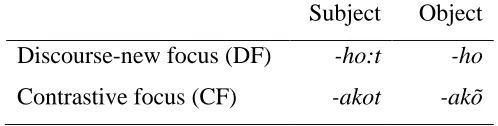
Chickasaw has focus morphemes suffixed to NPs (Gordon, 2007). The suffixation of
focus morphemes differs by the syntactic category of a focused element (subject vs.
object) and by the type of focus (discourse-new vs. contrastive). Table 1.1 displays the
focus morphemes, and examples in (16) display three different focus conditions (Gordon,
2007, p. 67).
Table 1.1. Focus morphemes in Chickasaw.
Subject Object
Discourse-new focus (DF) -ho:t -ho
12
(16) a. hat:ak-at koni(ã) pisa. (Broad focus)
man-Nom skunk.Acc sees
‗The man sees the skunk.‘
b. [hat:ak-akot]F koni(ã) pisa. (Contrastive focus on the subject NP)
man-FM.Nom skunk.Acc sees
‗[The man]F sees the skunk.‘
c. hat:ak-at [koni-akõ]F pisa. (Contrastive focus on the object NP)
man-Nom skunk-FM.Acc sees
‗The man sees [the skunk]CF.‘
Sentence (16a) does not include a focus morpheme suffixed to either a subject or an
object, whereas (16b) has a CF morpheme suffixed to a subject NP and (16c) to an object
NP.
Let us now turn to Ewe. In this language, focus is encoded by word order variation
and/or a focus morpheme. Ewe marks focus morpho-syntactically by placing a focus
morpheme -(y)é after a subject or a preposed object. An object NP is focused in two ways:
in situ or ex situ. The use of the focus morpheme -(y)é is obligatory for a focused subject
NP but optional for a focused object NP. Example (17) shows in situ focus on the object
NP, (18) ex situ focus on the object NP, and (19) focus on the subject NP.
(17) SV[O]F = in situ focus on the object NP
Context: What did the woman buy?
é ɸl [àɖìb F.
3sg buy pawpaw
13
(18) [O-(y)é]FSV = ex situ focus on the object NP
Context: The woman bought this banana. , [àk ɖ m (y F w ɸl .
no banana Dem (FM) 3sg. Dep buy
‗No, she bought [that banana]F.‘ (Fiedler & Jannedy, 2013, p. 7)
(19) [S-(y)é]FVO = focus on the subject NP
Context: Mary bought a banana. , [ n y F ɸl k ɖ .
no Susan FM buy banana
‗No, [Susan]F bought a banana.‘ (Fiedler & Jannedy, 2013, p. 8)
1.4. Current study
It is well known that particular syntactic or morphological encoding of focus may be
required in some languages, but optional or non-existent in other languages. It is also well
known that a focused element is more prominent than its adjacent elements in the same
domain (Samek-Lodovici, 2005; Truckenbrodt, 1995). This is formalized in terms of the
Stress-Focus constraint below (Samek-Lodovici, 2005, p. 697).
(20) The Stress-Focus constraint
For any XPF and YP in the focus domain of XPF, XPF is prosodically more
prominent than YP.
Previous studies have revealed the relationship between focus and prominence in
14
Jun & Lee, 1998; Lee & Xu, 2010, Mandarin: Xu, 1999, Japanese: Lee & Xu, 2012). In
these studies, a focused element was more prominent than its adjacent elements by being
realized with a longer duration, higher pitch, and higher intensity. Therefore, it has been
long and widely believed that increased vocal efforts associated with focus are assumed
to be a sort of universal phonetic symbolism – a focused element exhibiting the
concomitant increased duration, intensity, and pitch range.
However, it is less commonly recognized that purely prosodic marking of focus
may be weaker in some languages compared to others. A basic question arises here: is
prosodic modulation by focus similar across languages? To pursue the answer, we
examine to what extent modulation by focus varies between American English and Seoul
Korean. Figure 1.1 displays broad focus and discourse-new focus conditions in American
English (left panel) and Seoul Korean (right panel). These focus conditions were
produced in an experimental setting, where six native speakers of each language read
target sentences in isolation for broad focus and produced the same sentences in a Q&A
dialogue for discourse-new focus.1 The stimuli were repeated six times for both conditions.
1 The questions used are Who remembered Jessica? (English) and Who is eating dumplings? (Korean), and
15
Figure 1.1. Time-normalized average pitch contours of 36 repetitions of the sentence
Jonathan remembered Jessica (left panel) and Minsuga manduɾɨl mʌknɨnda (‗Minswu is
eating dumplings‘) (right panel) by six speakers.2 The first area of each panel contains a target word (Raw data from Lee (2009) for the left panel and from Lee & Xu (2010) for
the right panel).
In both languages, discourse-new focus produced a more expanded pitch range
than broad focus. However, it seems like the modulation by focus is greater in American
English than in Seoul Korean. To test this, we conducted a pairwise t-test analysis
comparing the difference in maximum pitch between the focus conditions in each
language (the peak difference: 2.52 st in American English, 1.18 st in Seoul Korean). The
result demonstrated that American English employed a more expanded pitch range (p <
0.05). Here, an important point is that the pitch expansion via focus is fairly small in
Seoul Korean – just 1.18 st extra pitch. The value of 1.18 st is quite similar to the interval
between the notes C and C# on a musical scale. This implies that prosodic marking of
2 In this figure, the dotted vertical line demarcates each word of the sentence. Each word was
16
focus in Seoul Korean may not be perceptually salient for listeners. As a consequence, we
assume that prosodic marking of focus is neither completely universal nor automatic, but
instead it differs according to the prosodic system of each language.
Furthermore, it is less recognized that prosodic marking of focus may differ even
within the same language. Mandarin Chinese consists of four lexical tones: a high-level
tone, a rising tone, a low/dipping tone, and a falling tone. Among these tones, a
low/dipping tone may behave differently in marking prosodic focus since it is marked by
lowering a pitch target (Chao, 1968; Chen & Gussenhoven, 2008; Xu, 1999). We assume
that a focused low/dipping tone shows a smaller capacity for pitch expansion because
lowering a pitch target seems physiologically more limited than raising a pitch target. The
rationale behind this assumption is recognizing that a human‘s pitch range is fairly small
– within 100 Hz (Baken & Orlikoff, 2000; Keating & Kuo, 2012; Kuang, 2013), and a
low/dipping tone is produced towards the low end of the pitch range. In addition, Seoul
Korean is known for its tonogenesis-like sound change depending on the laryngeal
articulations of consonants (Jun, 2005; Kang, 2014; Kingston, 2011; Silva, 2006; Wright,
2007): consonants with [+aspiration/tense] create a high pitch; those with
[−aspiration/tense create a low pitch. We speculate that consonants with
[+aspiration/tense] would be more effective in marking prosodic focus than those with
[−aspiration/tense . Again, we continue to assume that prosodic marking of focus is
neither completely universal nor automatic even within the same language.
Another area not fully understood is that of the phonological units which carry
various prosodic focus effects across languages. Figure 1.1 above demonstrates that
17
in American English, prosodic focus is expressed by a stressed syllable of Jonathan and
post-focus compression occurs immediately after the stressed syllable, whereas in Seoul
Korean, a focus effect spans over the entire phrase (Minsuga) and post-focus
compression appears outside the focused phrase. On the basis of the prosodic patterns in
Figure 1.1, it seems like a syllable is the smallest phonological unit that carries prosodic
focus in American English, and a phrase is the smallest phonological unit that carries
prosodic focus in Seoul Korean. However, this may not always be the case in Seoul
Korean. Consider a situation in (21), in which the underlined digit 2 is used to correct the
wrong digit 1.
(21) Q: Is the number 367-810-8717?
A: No, it is 367-820-8717.
In this case, it is not clear whether only the single digit 2 carries prosodic prominence or
the focus effect spans over the entire phrase. If only the single digit carries prosodic
prominence, the phonological unit of carrying prosodic focus would be a word (i.e., each
digit) rather than a phrase.3 In comparison, if prominence spans over the entire phrase, the phonological unit carrying prosodic focus would be a phrase, and listeners would
have difficulty identifying the corrected digit. Another ambiguous issue is where
post-focus compression occurs. It may occur right after the post-focused digit 2 if the phonological
unit carrying prosodic focus is a word. Alternatively, it may occur across the phrase if the
3
In a phone-number string, each digit is monosyllabic in Seoul Korean. However, since each digit is
already a word (bigger than a syllable but smaller than a phrase), we cannot say if the smallest phonological
18
phonological unit carrying prosodic focus is a phrase.
Finally, another question that needs to be examined is whether or not prosodic
marking of focus varies with different pitch-scaling conditions. Liberman and
Pierrehumbert (1984) suggest that downstepping F0 patterns appear to show exponential
decay. This is obviously not to 0 Hz, but rather to a value that we can refer to as a
speaker‘s baseline B. This suggests that the scaling of F0 values, rather than being purely
a matter of ratios, as in the semitone scale, should be evaluated as ―baseline units above
the baseline,‖ i.e., the scaled intonational value ―Int‖ would be:
Int = (F0 - B) / B
or in the other direction
F0 = Int x B + B
Other considerations, such as the relationship between similar tone/intonational
patterns in different pitch ranges or in the speech or different speakers, also suggest that
F0 scaling has an additive as well as a multiplicative component. If emphasis or focus has
a multiplicative effect on the ―Int‖ value, then we predict that the impact should be much
greater in terms of F0 ratios (as well as absolute amounts) for higher as opposed to lower
pitches. Therefore, we assume that higher pitches in a speaker‘s vocal range are more
effective in marking prosodic focus than lower pitches in both production and perception.
19
As previously stated, this dissertation aims to enhance our understanding of the nature of
prosodic focus both cross- and intra-linguistically. Since we assume that prosodic
marking of focus is expressed through the respective prosodic system of each language, it
is ideal to collect data from prosodically diverse languages, which may range from lexical
stress languages to phrase-final stress languages to lexical pitch-accent languages to tone
languages to languages with none of these. Therefore, our comparison includes seven
languages: American English, Mandarin Chinese, Seoul Korean, South Kyungsang
Korean, Tokyo Japanese, Standard French, and Suzhou Wu.4 American English is a lexical stress language. Standard French is a phrase-final stress language. South
Kyungsang Korean and Tokyo Japanese are lexical pitch-accent languages. Mandarin
Chinese and Suzhou Wu are tone languages. Seoul Korean has none of these features. By
comparing prosodically diverse languages, this dissertation raises and attempts to answer
the following four questions.
Q1. Does prosodic marking of focus differ across languages both in production and
perception? If so, how does it vary across languages?
Q2. Does prosodic marking of focus also differ even within the same language? If so,
how does it vary within a given language?
Q3. What are the phonological units that carry various prosodic focus effects, such as
prosodic focus marking and post-focus compression across languages?
Q4. Are higher pitches more effective in marking prosodic focus than lower pitches in
both production and perception?
20
Reliable (quantitative) cross-linguistic comparisons of prosodic focus are difficult
to quantify, given all of the many relevant ways that languages can differ. Therefore, in
order to obtain comparable data across languages, we have developed a method based on
corrective focus in phone-number strings, as shown in (22).
(22) a. Mary‘s phone number is 264-872-8618. Right?
b. No, Mary‘s phone number is [3 F64-872-8618.
Although this method is not entirely free of the issue of anaphoric destressing given that a
limited set of digits were used repeatedly in the stimuli, please note that we have limited
consideration to the specific situation of corrective focus using randomly generated
phone-number strings. This method actually includes several advantages over natural
stimuli:
Digit strings are possible in every (modern) language;
Any order and phrasing of digit strings is possible;
Syntactic and morphological revisions are completely ruled out;
All of the positions are equally susceptible to focusing;
Only prosodic modulation can be used to mark a focused item.
We have applied this method to seven languages for both production and perception
experiments.
21
The remainder of this dissertation is organized into six chapters. Chapter 2 depicts how
we conducted production and perception experiments using a phone-number string.
Chapter 3 briefly describes the prosodic system of each language and introduces three
types of prosodic typologies: 1) based on speech rhythm (stress-timed, syllable-timed,
and mora-timed), 2) based on the distinctions between stress vs. non-stress accent and
between lexical vs. post-lexical vs. no pitch accent, and 3) based on the types of
prominence marking at the word level (stress, tone, or lexical pitch accent) and at the
phrase level (head-prominent, head/edge-prominent, or edge-prominent). We then
attempt to classify seven languages within the framework of each of these three prosodic
typologies. Chapter 4 examines whether and how prosodic marking of focus differs
across languages. Chapters 5 and 6 focus on whether and how prosodic marking of focus
differs within a single language: Chapter 5 reanalyzes the production and perception data
of Mandarin Chinese to illustrate the unique characteristics of tone 3 focus; next, Chapter
6 revisits the production and perception data of Seoul Korean to see whether high-tone
inducing consonants are more effective and more identifiable in marking prosodic focus
than low-tone inducing consonants. Finally, Chapter 7 discusses the main findings of this
dissertation and addresses the potential limitations of existing prosodic typologies with
respect to prosodic focus. The remaining sections of Chapter 7 explore the implications
that this dissertation may have. They provide a series of open questions for future
22
Chapter 2
Method – Spoken telephone numbers
This chapter begins by reviewing five methods of eliciting prosodic focus.
- Q&A dialogue
- Templatic structure
- Discourse context
- Picture task
- Animation task
First, the Q&A dialogue is the most widely used method (e.g., Birch & Clifton,
1995; Cooper, Eady, & Mueller, 1985; Eady & Cooper, 1986; Heldner & Strangert, 2001;
Xu & Xu, 2005; Xu, 1999). This is mainly because this method allows one to construct a
simple dialogue by asking speakers a question that prompts an answer. As exemplified in
(1), John – an answer to what – receives discourse-new focus since it is new, important
information.
(1) a. What is your name?
23
Second, a templatic structure elicits focus by providing contrast (Baltazani & Jun,
1999; Chen, 2006). For example, in the form of ―X, not Y,‖ target words receive
contrastive focus, since position X contrasts with position Y. In (2), tea is focused since it
contrasts with coffee.
(2) I said [tea]F, not coffee.
Third, a target sentence is embedded in a discourse context (Beaver, Clark,
Flemming, Jaeger, & Wolters, 2007; Lee, 2012; Sudhoff, 2010), where focus is elicited
through the context. In (3), Korean Air receives contrastive focus, since it contrasts with
Delta Airlines in the context.
(3) I am attending the University of Pennsylvania in Philadelphia. However, since my
parents live in Korea, I go to Korea to see them every school vacation. I have both
Korean Air and Delta Airline membership cards. When I go to Korea, I only take
[Korean Air]F. (Lee, 2012, p. 98)
Fourth, in a picture task, simple pictures with different types and/or colors are used
to trigger a focus reading (Fernald & Mazzie, 1991; Jannedy, 1997). In the case of
Jannedy‘s (1997) experiment, two pictures were always paired: the first picture was used
for a neutral reading and the second for a focus reading. The experimenter showed the
first picture to the speaker by asking ―What is this?‖ and the speaker answered the
question by saying ―A red ball.‖ The experiment showed the second picture to the
24
saying ―A red [eye]F.‖ In this context, speakers were involved in a natural dialogue
setting and put a focus on the word ―eye.‖
Fifth, Hockey (1998) developed a computer animation task, where different objects
(e.g., airplane, anchor, apple, ax, bed) or different geometric shapes (e.g., circle, square,
rectangle, triangle) were paired with six different colors. In this task, two participants
were paired for a spontaneous dialogue. For example, a participant asked a question (4a)
by watching the static drawing that is missing important information, and the other
participant answered the question (4b) by watching the animation that provides the
missing information (Hockey, 1998, p. 78).
(4) a. Uh what does the black helicopter push?
b. It pushes [the red triangle]F.
Although these methods can successfully elicit prosodic focus in most languages,
they are not appropriate for a cross-linguistic comparison since different languages have
different intrinsic word order and employ different means of focus marking. In an attempt
to obtain comparable data across languages, as previously mentioned in Chapter 1, we
have developed a method implementing 10-digit phone-number strings that are free of
syntactic and morphological means of focus marking. This method has the advantage that
only prosodic modulation can be used to signal the focused item. We have applied this
method in both production and perception. In the remainder of this chapter, we illustrate
25
2.1. Production
2.1.1. Speech materials
Different languages allow different ways of reading phone-number strings. For example,
in French, 10-digit number strings are typically divided into five clusters like
(NN)-(NN)-(NN)-(NN)-(NN). In both Korean and English, the three-digit string 267 can be read as
either ―two hundred sixty-seven‖ or read as individual digits like ―two six seven.‖
Japanese, Chinese, and Spanish speakers read 267 only as individual digits. In order to
obtain comparable data across languages, therefore, we pursued the style of American
telephone numbers – the string was connected as individual digits grouped in the frame of
(NNN)-(NNN)-(NNNN).
By running a Python script, we created sets of 100 10-digit strings, designed so that
i) every digit occurs equally often in every position, and ii) every pair of digits occur
equally often across every pair of positions.1 To elaborate on the second point, there are 9 pairs of adjacent digits in a string of 10 digits: 0-1, 1-2, 2-3, ..., 8-9. Therefore, in the
datasets used in the experiment, each of these nine pairs of adjacent positions has every
possible pair of digits in it. Thus, the first and second position and similarly the second
and third positions, etc. will (in different digit strings) be as follows.
26
(5) 0-0, 0-1, 0-2, ..., 0-9,
1-0, 1-1, 1-2, ..., 1-9,
2-0, 2-1, 2-2, ..., 2-9,
...
9-0, 9-1, 9-2, ..., 9-9.
Speakers produced 100 10-digit strings in isolation for broad focus and in a Q&A
dialogue below for corrective focus, where someone asks whether the phone-number is
correct and the speaker answers the question with a string by correcting the wrong digit.2 (6) Q: Is Mary‘s number 887-412-4699?
A: No, the number is 787-412-4699.
There are two caveats about the experiment. First, for Tokyo Japanese and Suzhou
Wu, target strings were prompted by questions for both broad focus and corrective
focus.3 Second, due to constraints on some Suzhou Wu speakers‘ time, the production material was limited to 10 10-digit sequences, with each digit occurring ten times in each
position, and each string read in six focus conditions, broad focus and focus on the 1st, 3rd, 4th, 5th, and 10th positions.4 In addition, the area code was presented in parentheses, such as (787) 412-4699.
2
Digit strings used for the broad-focus and corrective-focus conditions are in Appendix B and C. The
same strings were used for all the languages except Suzhou Wu.
3
The Q&A structure for broad focus was: Q: Did you get the number?; A: Yes, the number is
787-412-4699.
27
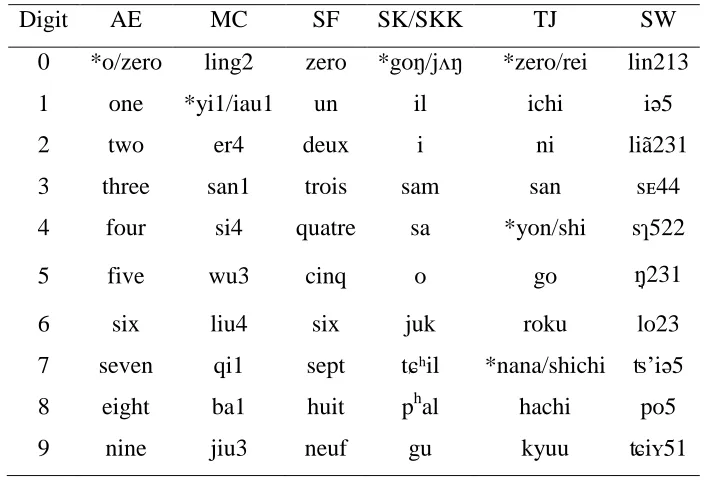
Before moving on, it is necessary to illustrate different pronunciations of the digits
(0 to 9) in each language. As shown in Table 2.1, some languages have two forms of
pronunciation for the same digit. For example, in American English, the digit 0 can be
read as ―O‖ or ―zero.‖ In this case, speakers were instructed to choose the form of
pronunciation with an asterisk (*).
Table 2.1. Different pronunciations of the numerical digits from 0 to 9 in each language. I
used the IPA for the two varieties of Korean, the Romaji system for TJ, the Pinyin
Romanization system for Mandarin Chinese, and the IPA for Suzhou Wu.5 (AE: American English, MC: Mandarin Chinese, SF: Standard French, SK: Seoul Korean,
SKK: South Kyungsang Korean, TJ: Tokyo Japanese, SW: Suzhou Wu)
Digit AE MC SF SK/SKK TJ SW
0 *o/zero ling2 zero *goŋ/jʌŋ *zero/rei lin213
1 one *yi1/iau1 un il ichi iə5
2 two er4 deux i ni liã231
3 three san1 trois sam san sᴇ44
4 four si4 quatre sa *yon/shi sɿ522
5 five wu3 cinq o go ŋ231
6 six liu4 six juk roku lo23
7 seven qi1 sept tɕʰil *nana/shichi ʦ‘iə5
8 eight ba1 huit phal hachi po5 9 nine jiu3 neuf gu kyuu ʨiʏ51
2.1.2. Participants