R E S E A R C H A R T I C L E
Open Access
Methotrexate efficacy, but not its
intolerance, is associated with the dose
and route of administration
J. Frá
ň
ová
1,2,
Š
. Fingerhutová
1, K. Kobrová
1, R. Srp
1, D. N
ě
mcová
1, J. Hoza
1, M. Uher
3, M. Saifridová
1, L. Linková
1and P. Dole
ž
alová
1*Abstract
Background:There is a lack of published evidence on the importance of methotrexate (MTX) dose and route of administration on both its efficacy and adverse events in children with Juvenile Idiopathic Arthritis (JIA). We aimed to document our clinical practice based on the treat-to-target approach in order to support the concept that better therapeutic effect achieved with an optimal dose of parenteral MTX is associated with clinically acceptable adverse effects comparable to those reported for oral treatment.
Methods:Study inclusion criteria were indication of new MTX therapy for active arthritis in confirmed JIA patients younger than 18 years. Eligible patients were evaluated prospectively every 3 months for 1 year using standardized instruments for treatment response (American College of Rheumatology Pediatric (ACRPedi) response, Juvenile Arthritis Disease Activity Score (JADAS) 71, Clinically Inactive Disease (CID)) and adverse events (laboratory monitoring, Methotrexate Intolerance Severity Score (MISS)). MTX responders had to achieve at least ACRPedi 70 response. MTX intolerance was defined by MISS≥6.
Results:In 45/55 patients (81.8 %) MTX was started as subcutaneous injection. The initial median weekly dose was 14. 4 mg/m2in parenteral and 11.7 mg/m2in oral administration. MTX therapy was effective in the level of ACRpedi70 and CID in 50.9 % and 30.9 % of patients at month 6 and in 70.9 % and 56.4 % after 12 months of the treatment, respectively. MTX intolerance at 6 and 12 months was noted in 25.5 % and 30.6 %, respectively. Management of intolerance included change in the dose and/or route of administration, education and councelling. Adverse events led to MTX withdrawal in 5 patients (9 %) due to toxicity (n= 3) and intolerance (n= 2). We did not find any significant predictive factors for either MTX therapeutic response or intolerance.
Conclusion:Subcutaneous MTX weekly dose around 15 mg/m2is associated not only with a high response rate within the first 12 months of treatment, but also with a relatively low rate of significant adverse effects that would lead to the treatment termination. It allows early recognition of MTX non-responders and addition of biologic therapy. Sustainability of therapeutic effect and longer-term evolution of adverse events will be addressed by an ongoing extension of the study.
Keywords:Juvenile idiopathic arthritis, Methotrexate, Efficacy, Intolerance, Toxicity, Quality of life
* Correspondence:[email protected]
1Paediatric Rheumatology Unit, Department of Paediatrics and Adolescent
Medicine, General University Hospital and 1st Medical Faculty, Charles University in Prague, Ke Karlovu 2, Prague, Czech Republic
Full list of author information is available at the end of the article
Background
Over the last decades low-dose weekly methotrexate (MTX) has been commonly used in the treatment of ju-venile idiopathic arthritis (JIA) [1]. It has become an es-sential component of various clinical guidelines and recommendations as a first-line disease-modifying drug for disease unresponsive to nonsteroidals (NSAIDs) and/ or intraarticular corticosteroids [2–4].
MTX efficacy has been reported mainly in polyarticular-course JIA, though its extent varies [5, 6]. Differences in drug dosing and route of administration as well as in the method of efficacy assessment hamper inter-study com-parisons. Most commonly, American College of Rheuma-tology Pediatric (ACRpedi) response criteria have been used to define various levels of therapeutic effect [7]. More recently, a composite measure of disease activity (Juvenile Arthritis Disease Activity Index, JADAS) and its cut-off values for various disease status have been defined [8]. Among factors influencing inter-patient heterogeneity of treatment response, polymorphisms of genes involved in MTX metabolic pathways [9–15], disease phenotype and its previous duration and several biomarkers have been re-ported [16–20]. Moreover, factors related to MTX absorp-tion and kinetics have also been shown to influence treatment efficacy [21–25].
Evaluation of the presence, type and severity of drug adverse events forms a natural part of therapeutic moni-toring. Low-dose MTX has a variety of adverse effects. These include features of MTX antiproliferative effect which are mostly related to its post-dose concentrations [26–30]. MTX affects rapidly dividing cells of gastro-intestinal (GI) tract causing nausea and/or vomiting and bone marrow leading to cytopenia. Mechanisms of hep-atic and central nervous system (CNS) toxicity are more complex and include elevation of liver enzymes, head-aches and behavioral changes [31, 32]. In addition to post-treatment complaints anticipatory and associative symptoms have been described [33–35]. Patients report presence of gastrointestinal symptoms or behavioral changes (cry, irritation, refusal to take the drug) already before or at the time of MTX administration (anticipa-tory intolerance) or even when just thinking about it (associative intolerance). They appear to be more commonly associated with parenteral route of MTX ad-ministration and often lead to precautious termination of otherwise safe and effective treatement [36, 37]. Therefore monitoring of MTX adverse events requires not only regular blood tests for hepatic and marrow tox-icity, but also directed questioning to detect subjective complaints.
This study was driven by the lack of published evi-dence on the importance of MTX dose and route of ad-ministration on both its efficacy and various types of adverse events. We aimed to thoroughly document our
clinical practice based on the treat-to-target approach in order to prove the concept that better therapeutic effect achieved with the higher dose of parenteral MTX is as-sociated with clinically acceptable adverse effects com-parable to those reported in published series using oral treatment.
Methods
Patients and study protocol
Consecutive patients were recruited prospectively from the paediatric rheumatology clinic population of the Department of Paediatrics and Adolescent Medicine, 1st Faculty of Medicine, Charles University in Prague, be-tween October 2013 and January 2015.
This was a sub-study of a large project running at the Unit aim of which was to prospectively collect clinical data on all consecutive JIA patients starting new treat-ments for active disease. The project was approved by the Local Research Ethics Committee of the General University Hospital in Prague and informed consent was obtained from the patients and/or their legal guardians, as appropriate. To become eligible patients must have had a definitive diagnosis of JIA according to the ILAR criteria [38] and exhibit active disease requiring either initiation of treatment for new-onset JIA or for the dis-ease relapse. Active disdis-ease was defined by the presence of at least one joint with synovitis. Treatment options were: intra-articular triamcinolone hexacetonide, MTX, sulphasalazine, TNF-inhibitors and tocilizumab. At our Unit the treatment plan guided by the recently published ACR recommendations [2, 3] is always individually tai-lored to patient needs according to the treating phys-ician. Only patients starting the MTX treatment are included in this report. The MTX therapeutic strategy is based on the following principles: 1. Early start, 2. MTX dose around 15 mg/m2/week administered parenterally using pre-filled syringes (MTX concentration 50 mg/ml), 3. Folic acid supplementation 5–10 mg once weekly 24– 48 h after MTX dose, 4. The same dose which has in-duced disease inactivity is maintained for the minimum of 1 year if no clinically significant adverse events occur. Non-responders at 3–6 months change their treatment, usually by adding a biologic drug. Oral MTX in one weekly single dose is rarely considered in older children with relatively mild disease. Clinical and laboratory data and patient-reported outcomes are recorded within the interval of ± 2 weeks of the first MTX administration and then in 3-monthly intervals.
Assessment of treatment efficacy
ACR Pedi uses the core-set of 6 disease activity variables (active joint count, limited joint count, physician global assessment of disease activity, parent/patient global as-sessment of the patient's well-being, Childhood Health Assessment Questionnaire and ESR/CRP) on 2 distinct occasions resulting in the defined improvement rates of ACR Pedi 30, 50, 70 and 90. These rates are defined as improvement of at least 3 out of 6 variables by a mini-mum of 30, 50, 70 or 90 % and no more than one of the resulting ones deteriorating by more than 30 % [7]. Good clinical response to MTX was defined as reaching the minimum of ACR Pedi 70. JADAS is a numeric score resulting from the values of 4 measures: active joint count (from 10, 27 or 71 joints), physician's global assessment of disease activity (10 cm VAS), parent/pa-tient global assessment of overall well-being (10 cm VAS) and normalized ESR rate (0–10) [8]. JADAS-71 (score range 0–101) was chosen for this study. Addition-ally, disease state at 6 and 12 months was assessed ac-cording to the JADAS cutoff values as inactive disease (≤1) or minimally active disease (≤2 for oligoarthritis and ≤3.8 for polyarthritis) and high disease activity (4.2 for oligoarthritis and 10.5 for polyarthritis) [39–42].
Complete treatment response was also defined apply-ing the Wallace criteria as the presence of inactive dis-ease (clinically inactive disdis-ease, CID). CID is defined by an absence of active synovitis or other active JIA features (incl. uveitis, fever, rash, serositis, hepatosplenomegaly, lymhadenopathy attributable to JIA), normal ESR or CRP, the lowest possible physician global evaluation of disease activity and absence of significant morning stiff-ness (duration≤15 min) [43–45].
Assessment of MTX treatment adverse events
For the purpose of this study MTX adverse events were divided into toxicity and intolerance. Toxic adverse events were further assessed as measurable toxicity (increase of at least one liver transaminase above 2-times of upper normal limit (ULN) or significant cytope-nia or anaemia) and patient-reported toxicity defined as patient complaints developing after MTX administration (gastrointestinal symptoms - abdominal pain, nausea, vomiting, oral ulcers, injection site reaction). Condi-tioned response to MTX-associated toxicity was defined as anticipatory intolerance when gastrointestinal (GI) complaints were present at the time of MTX administra-tion, associative intolerance was considered when GI com-plaints occurred when thinking about MTX administration. On top of that behavioral symptoms at the time of MTX administration were also recorded. Patient-reported symptoms were captured at every visit using the Czech adaptation of the Methotrexate Intolerance Severity Score (MISS), which defines MTX-intolerant patient by the presence of at least 6 out of 36 points
with at least 1 point on anticipatory and/or associative and/or behavioral symptoms [34].
Statistical analysis
Continuous and categorical variables were described using median with 25th and 75th percentile and relative frequencies. Mann–Whitney U test was used when assessing statistical significance of difference in continu-ous variables between two groups (when comparing more than two samples Kruskal-Wallis test with post-hoc Bonferroni correction was applied). Statistical sig-nificance of dependence between categorical variables was assessed with Fisher exact test. Time to treatment response was analyzed using Kaplan-Meier survival ana-lysis method. Univariate logistic regression model was applied to measure association of baseline characteristics with occurrence of MTX intolerance (or treatment re-sponse). Level of statistical significance was set to 0.05 in all analyses.
Results
Characteristics of the patient cohort
MTX therapy
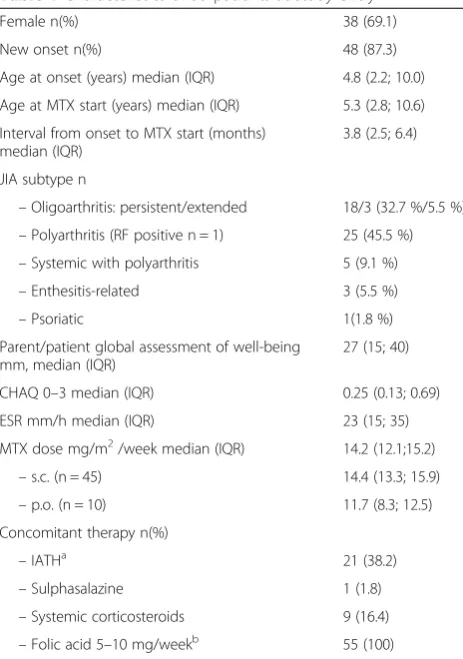
In 45 patients (81,8 %) MTX was started as once weekly subcutaneous injection, 10 patients received oral tablets (Table 1). There was no significant difference in demo-graphic or disease parameters between the groups apart from the age at MTX start which was higher in patients starting oral treatment (median 14,0 years (IQR 11.8; 15.9) when compared to patients treated parenterally (median 4,1 years (IQR 2.6; 7.8) (p< 0,001). Parenteral
MTX was administered in the median weekly dose of 14.4 mg/m2 (IQR 13.3; 15.9), oral MTX dose was 11.7 (8.3; 12.5) (p< 0,001).
Table 2 summarizes treatment changes, their timing and respective disease activity during the follow-up. MTX dose (median (IQR)) was increased from 12.1 (11.1; 13.7) mg/m2at study entry to 14.9 (13.6; 15.6) and 13.8 (12.4; 15.8) mg/m2at 6 and 12 months, respectively, in 18 patients (32.7 %). In 20 children (36.4 %) it was de-creased from 14.3 (12.4; 16.1) to 13.7 (12.2; 15.2) and 10.5 (8.8; 12.8) mg/m2at 6 and 12 months, respectively. Other treatment modifications included change in the route of administration (n= 13; 23.6 %), withdrawal (n= 5; 9.1 %), addition of biological therapy (n= 14; 25.5 %). Increased dose and change from oral to parenteral appli-cation were always due to the persistence of active dis-ease. On the other hand, change from parenteral to oral administration and MTX dose reduction were triggered by combinations of MTX toxicity and intolerance on the background of the decreasing disease activity (Table 2). Treatment changes resulted in the median MTX dose of 14.2 mg/m2(IQR 13.1;15.4) at 6 months and 13.7 mg/ m2 (IQR 11.5;14.4) at 12 months for the whole cohort. At month 12 from 50 patients who were still receiving MTX only 9 had oral tablets.
All 14 patients who received biologic therapy either failed to achieve ACRpedi50 response (n= 11) and/or had resistant uveitis (n= 4). Their median JADAS71 at the time of treatment change was 15.8 (ICQ 6.50; 13.00). Addition of biologics (etanercept = 8, adalimumab = 4, tocilizumab = 2) occured after the median duration of MTX therapy of 3.8 (ICQ 4.0; 8.8) months.
Treatment efficacy and disease activity assessments
MTX therapy was effective in the level of ACRpedi70 and 90 in 50.9 % and 42.9 % of patients at month 6 and in 70.9 % and 63.6 % after 12 months of the treatment, respectively. Clinically inactive disease was reached in 17 (30.9 %) patients at month 6 and in 31 (56.4 %) patients at month 12. There was no difference in the time to inactivity between various JIA subtypes. Patients who re-ceived biologics (n= 14) were considered non-responders to MTX from the time point of starting the biologic including 4 children who achieved CID after
Table 1Characteristics of 55 patients at study entry
Female n(%) 38 (69.1)
New onset n(%) 48 (87.3)
Age at onset (years) median (IQR) 4.8 (2.2; 10.0)
Age at MTX start (years) median (IQR) 5.3 (2.8; 10.6)
Interval from onset to MTX start (months) median (IQR)
3.8 (2.5; 6.4)
JIA subtype n
–Oligoarthritis: persistent/extended 18/3 (32.7 %/5.5 %) –Polyarthritis (RF positive n = 1) 25 (45.5 %) –Systemic with polyarthritis 5 (9.1 %)
–Enthesitis-related 3 (5.5 %)
–Psoriatic 1(1.8 %)
Parent/patient global assessment of well-being mm, median (IQR)
27 (15; 40)
CHAQ 0–3 median (IQR) 0.25 (0.13; 0.69)
ESR mm/h median (IQR) 23 (15; 35)
MTX dose mg/m2/week median (IQR) 14.2 (12.1;15.2)
–s.c. (n = 45) 14.4 (13.3; 15.9)
–p.o. (n = 10) 11.7 (8.3; 12.5)
Concomitant therapy n(%)
–IATHa 21 (38.2)
–Sulphasalazine 1 (1.8)
–Systemic corticosteroids 9 (16.4)
–Folic acid 5–10 mg/weekb 55 (100)
a
Within 1 month prior to or after MTX start b
Once weekly dose 24–48 hours post-MTX administration MTX, Methotrexate
IATH, Intraarticular triamcinolone hexacetonide CHAQ, Childhood Health Assessment Questionnaire
Global assessments in mm on the 100 mm visual analogue scale
Table 2Changes in the treatment during the follow-up
N (%) Time from MTX onset (months)a JADAS71 at the time of changea
↑MTX dose 18 (32.7) 3.0 (3.0; 6.0) 7.0 (4.5; 11.5)
↓MTX dose 20 (36.4) 7.5 (6.0; 9.0) 0.5 (0.0; 2.5)
Change in route of administration 13 (23.6) 6.0 (4.0; 12.0) 2.0 (0.4; 9.9)
Withdrawal 5 (9.1) 9.0 (8.0; 9.0) 3.0 (0.0; 6.5)
Addition of biologic 14 (25.5) 3.8 (4.0; 8.8) 15.8 (6.5; 13.0)
a
biologic medication was added to MTX who were ex-cluded from the evaluation of disease inactivity. Total of 61.8 % patients reached low disease activity according to published JADAS cutoff values for oligo and polyarthri-tis (Table 3).
Table 3 shows evolution of therapeutic response dur-ing 1-year follow-up as expressed by different disease activity measures. There was no significant difference in the proportion of patients who reached high levels of response when measured by either JADAS value (=0) or by fullfilling the CID criteria. Neither the rate or extent of therapeutic response were influenced by JIA onset subtype or by the route of MTX administration (data not shown). Figure 1 illustrates treatment response as expressed by JADAS71 values in persistent oligoarthritis and polyarticular-course JIA patients. Logistic regression analysis of demographic data, disease and treatment characteristics did not reveal any variable that would sig-nificantly influence the likelihood of therapeutic re-sponse (data not shown).
MTX toxicity and intolerance
During the 12 month follow-up measurable toxicity of MTX was recorded in 8 patients (15.4 %): elevation of transaminases in 7 patients and cytopenia in 1 patient. In 3 cases these adverse events led to MTX withdrawal while in the remaining 5 children results normalised after the short treatment interruption or MTX dose re-duction. None of the patients reported significant oral ulcers or injection site reaction.
Presence of patient-reported GI toxicity, associative/ anticipatory intolerance and behavioral symptoms is summarized in Table 4. Only 11/55 patients (20 %) re-ported no adverse events throughout the observational period (MISS = 0 at every visit). Intolerance (MISS≥6) slowly developed during the initial months of the treat-ment and was present in the maximum of 25.5 % of patients at 6 months and remained relatively stable thereafter (30.6 % at 12 months). This cut-off MISS value for the definition of intolerance was reached at least once in 25/55 children (45.5 %). Concomitant treat-ment with biologics did not have any significant impact on the MISS at 12 months (data not shown). In the ma-jority of cases intolerance was managed to the patient
and family satisfaction by treatment modifications and various other actions and their combinations: change in the route and/or timing of MTX administration, MTX dose reduction, addition of antiemetics, councelling. MTX withdrawal was the ultimate solution in 2 patients only (8 %).
Behavioral symptoms were noted in at least one cat-egory in all intolerant patients, but they were present also in 27 (49 %) patients with the MISS lower than 6, regardless the route of MTX administration. The mean MTX dose in intolerant patients was not significantly different from that of tolerant ones (14.2 vs 13,4 mg/m2, OR (95 % CI) = 1,15(0.94;1,40),p= 0,612) (Table 5).
There were no serious adverse events (e.g. infections, pulmonary toxicity) that would require hospital admis-sion throughout the study period. Logistic regresadmis-sion analysis did not demonstrate any significant associations of MTX intolerance with the patient, disease and treat-ment variables (Table 6). There was a trend towards in-creased odds for MTX intolerance in patients treated with parenteral MTX (OR (95 % CI) = 2,44 (0,56;10,65), p= 0,236), polyarticular-course of JIA (OR (95 % CI) = 1,43 (0,36; 5,78),p= 0,612) and higher age at MTX start (OR (95 % CI = 1,45 (0,48; 4,47), p= 0,505). Potential predictive factors of good MTX tolerance were higher CHAQ values, shorter interval from disease onset to treatment and male gender (Table 6).
Discussion
We have reported disease outcome in a single-centre co-hort of patients with early JIA (median disease duration 3.8 months) during the first 12 months of MTX treat-ment. This prospective observational study was triggered by the lack of published evidence on the advantages of the parenteral versus oral route of MTX administration during the induction of remission therapy of JIA. Not-ably, we documented treatment efficacy using up-to-date standard disease assessments along systematic evaluation of MTX adverse events including conditioned effects like associative and anticipatory intolerance. We have shown that subcutaneous MTX weekly dose around 15 mg/m2 is associated not only with a response rate of ACRpedi 70 in over 70 % of patients, but also with a very low rate
Table 3Evolution of the treatment response expressed by different standardised measures
F/U (months) ACRpedi70 (%) ACRpedi90 (%) JADAS inactive (%) JADAS low activity (%) CID (%)
3 28.6 12.7 5.5 21.8 9.1
6 50.9 42.9 32.7 47.2 30.9
9 56.4 50.9 43.6 54.5 47.2
12 70.9 63.6 56.4 61.8 56.4
F/U, Follow-up visit;CID, Clinically Inactive Disease [40]
of significant adverse effects that would lead to the treat-ment termination.
An advent of cytokine inhibitors as well as better handling of standard JIA treatments like MTX have shifted our therapeutic target from reduction of disease activity to its complete elimination defined as disease in-activity and remission [46, 47]. With the constantly growing body of evidence on the biology of chronic arth-ritis it has become evident that time plays an important role in our ability to induce disease inactivity: The shorter disease duration before treatment onset and the more intensive therapeutic regimen used, the bigger is the chance to achieve sustained remission [19, 46, 47]. Such a treat-to-target approach has changed the way we use MTX now from the slow dose-escalation regime to the more aggressive treatment using the optimal effect-ive dose established by Ruperto et al. at 15 mg/m2 [33] from the very beginning. Moreover, pharmacokinetic studies suggesting better bioavailability of parenteral against oral MTX [25, 26] have led us to starting MTX treatment in majority of patients in the form of subcuta-neous injections. This approach allows for early assess-ment of the patient's potential to respond to treatassess-ment and to introduce biologic therapy in non-responders as early as within 3–6 months from starting MTX.
Indeed, in our cohort of 55 patients starting MTX only 10 (18.2 %) received oral tablets. The difference in the
initial MTX dose and route of administration from some recently published series is illustrated in Table 7. Treat-ment response at 6 and/or 12 months is expressed by the percentage of patients achieving ACRpedi70 and/or CID. Proportion of MTX responders at 6 months is similar across most of the studies ranging from 38 to 56 % of patients [33, 44–53], similar to our results. Only a few studies provide information on the rate of inactive disease [43]. The higher rate of CID in our cohort (30.9 %) at 6 months when compared to the studies by Ruperto et al. (12 %) [33] and Wallace et al. (23.3 %) [43] could be explained by higher MTX dose and shorter prior disease duration in our patients. Although the dose of 15 mg/m2is close to 0.5 mg/kg in older children, dos-ing per body weight unit in younger individuals ends up with a lower calculated dose. We believe these reasons together with the parenteral route of MTX administra-tion apply also to the higher rate of responders in our cohort after 1 year of parenteral MTX therapy which exceeded 70 % of patients with the total of 56.4 % reach-ing CID (Table 3). Additionally, the variability of results in different studies also reflects differences in their de-sign (retrospective analysis from the registry, prospective observational, prospective treatment trial).
Multiple studies have dealt with potential biomarkers of response to MTX that could inform our therapeutic decision-making and lead to early introduction of other
Fig. 1Treatment response expressed by JADAS in polyarticular-course and persistent oligoarticular JIA
Table 4Evolution of gastrointestinal toxicity, anticipatory/associative intolerance and behavioral symptoms
Months na MISS O MTX intolerance Anticipatory and/or associative symptoms Gastrointestinal toxicity Behavioral symptoms
n (%) n (%) n (%) n (%) n (%)
3 53 19(3.8 %) 10 (18.5 %) 11 (20.8 %) 16 (30.2 %) 31 (58.5 %)
6 54 13 (24.1 %) 14 (25.5 %) 16 (29.6 %) 25 (46.3 %) 33 (66.1 %)
9 49 17 (34.7 %) 14 (28.0 %) 13 (26.5 %) 20 (40.8 %) 27 (55.1 %)
12 49 18 (36.7 %) 15 (30.6 %) 9 (18.4 %) 16 (32.7 %) 28 (57.1 %)
MISS, Methotrexate Intolerance Severity Score a
Table 5Overall and per domain prevalence of MTX- related gastrointestinal and behavioral adverse events at 6 months
All patients MTX tolerant MTX intolerant Parenteral MTX
Oral
MTX p
-value
(MISS 0–5) (MISS≥6)
Number of patients n= 54 n= 40 n= 14 n= 47 n= 7
Cutoff score≥6 14 (25,9 %) 0 (0,0 %) 14 (100,0 %) 12 (25,5 %) 2 (28,6 %) 1
Cutoff score = 0 13 (24,1 %) 13 (32,5 %) 0 (0,0 %) 12 (25,5 %) 1 (14,3 %) 1
Anticipatory ± associative symptoms 16 (29,6 %) 7 (17,5 %) 9 (64,3 %) 14 (29,8 %) 2 (28,6 %) 1
Gastrointestinal toxicity 25 (46,3 %) 14 (35,0 %) 11 (78,6 %) 20 (42,6 %) 5 (71,4 %) 0,229
Behavioral symptoms 33 (61,1 %) 19 (47,5 %) 14 (100,0 %) 29 (61,7 %) 4 (57,1 %) 1
Abdominal pain 20 (37,0 %) 9 (22,5 %) 11 (78,6 %) 18 (38,3 %) 2 (28,6 %) 1
- after MTX 15 (27,8 %) 7 (17,5 %) 8 (57,1 %) 13 (27,7 %) 2 (28,6 %) 1
- anticipatory 6 (11,1 %) 2 (5,0 %) 4 (28,6 %) 6 (12,8 %) 0 (0,0 %) 1
- associative 4 (7,4 %) 1 (2,5 %) 3 (21,4 %) 4 (8,5 %) 0 (0,0 %) 1
Nausea 25 (46,3 %) 15 (37,5 %) 10 (71,4 %) 21 (44,7 %) 4 (57,1 %) 0,692
- after MTX 21 (38,9 %) 12 (30,0 %) 9 (64,3 %) 17 (36,2 %) 4 (57,1 %) 0,411
- anticipatory 8 (14,8 %) 1 (2,5 %) 7 (50,0 %) 8 (17,0 %) 0 (0,0 %) 0,577
- associative 9 (16,7 %) 4 (10,0 %) 5 (35,7 %) 7 (14,9 %) 2 (28,6 %) 0,33
Vomiting 5 (9,3 %) 2 (5,0 %) 3 (21,4 %) 5 (10,6 %) 0 (0,0 %) 1
- after MTX 5 (9,3 %) 2 (5,0 %) 3 (21,4 %) 5 (10,6 %) 0 (0,0 %) 1
- anticipatory 2 (3,7 %) 1 (2,5 %) 1 (7,1 %) 2 (4,3 %) 0 (0,0 %) 1
Behavioral symptoms 33 (61,1 %) 19 (47,5 %) 14 (100,0 %) 29 (61,7 %) 4 (57,1 %) 1
- restlessness 25 (46,3 %) 13 (32,5 %) 12 (85,7 %) 22 (46,8 %) 3 (42,9 %) 1
- crying 24 (44,4 %) 13 (32,5 %) 11 (78,6 %) 22 (46,8 %) 2 (28,6 %) 0,443
- irritability 21 (38,9 %) 8 (20,0 %) 13 (92,9 %) 19 (40,4 %) 2 (28,6 %) 0,693
- refusal of MTX 14 (25,9 %) 5 (12,5 %) 9 (64,3 %) 13 (27,7 %) 1 (14,3 %) 0,662
Table 6Potential predictors of MTX intolerance (MISS≥6)
MISS intolerance
OR (95 % CI)a p-value
Male 0,70 (0,22; 2,22) 0,546
Age at onset (by 10 yrs) 1,61 (0,51; 5,02) 0,416
Age at MTX start (by 10 yrs) 1,46 (0,48; 4,47) 0,505
Interval from onset to MTX start (by 10 months) 0,41 (0,10; 1,58) 0,194
Uveitis before MTX treatment 0,87 (0,21; 3,67) 0,853
ANA positive 1,49 (0,51; 4,37) 0,465
Active joints (by 10 joints) 1,01 (0,55; 1,84) 0,979
Joints with limitation of motion (by10 joints) 1,12 (0,63; 1,98) 0,695
Physician global assessment of disease activity (by 10 mm) 1,22 (0,87; 1,69) 0,245
Parent/patient global assessment of well-being (by 10 mm) 0,88 (0,68; 1,14) 0,328
FW (by 10 mm/h) 1,26 (0,95; 1,67) 0,111
CRP (by 10 mg/l) 1,09 (0,89; 1,34) 0,409
CHAQ 0,30 (0,08; 1,17) 0,083
JADAS 71(á 10 points) 1,12 (0,68; 1,82) 0,659
Parenteral form of methotrexate 2,44 (0,56; 10,65) 0,236
Initial MTX dose (mg/m2) 1,15 (0,94; 1,40) 0,181
Polyarticular form of JIA 1,43 (0,36; 5,78) 0,612
a
treatments in suspected non-responders, reviewed by Dijkhuizen [5]. Among these high serum concentration of MRP8/14 protein at baseline [51] and long-chain MTX polyglutamates at 3 months of the treatment [52] predicted a favourable response to MTX. From genetic factors single-nucleotide polymorphisms of genes involved in MTX metabolic pathways and some novel candidate genes have been suggested, though their relevance is yet to be confirmed [53–55].
The spectrum of adverse events of MTX therapy has expanded by the recognition and systematic evaluation of so called conditioned response in the form of antici-patory and associative intolerance [34, 35, 56–58]. In this study we have attempted to distinguish toxic adverse events limited to laboratory changes and post-dose GI symptoms from the intolerance featuring GI symptoms around MTX administration (anticipatory) and when thinking about MTX (associative) using a previously val-idated scoring system MISS [34] (Table 5). In addition, behavioral symptoms at MTX administration were also systematically recorded.
Proportion of patients who featured measurable toxic adverse events of transaminase elevation and/or cytope-nia was similar to published series [32, 58–60] and was mild and easy to manage in most cases. Presence of patient-reported GI toxicity as well as intolerance and behavioral symptoms were frequent (Table 4). MTX in-tolerance (MISS≥6) in at least one visit during the 12 months of treatment was recorded in 45.5 % of our patients. This figure is similar to that reported by
Bulatovič and van Dijkhuizen (50.5 % and 41.5 %, re-spectively) despite the fact that our patients received higher MTX doses (14.2 mg/m2versus 10.2 and 9.9 mg/ m2, respectively) administered parenterally in most cases [5, 34]. This finding does not support the presence of direct relationship between MTX dose and route of ad-ministration and its intolerance. This is in agreement with our previous observation where higher doses of MTX associated with increased intracellular MTX con-centrations did not lead to an increased rate of MTX toxicity [15].
Severity of MTX intolerance is difficult to assess due to the subjective nature of patient-reported symptoms. Therefore we believe that an impact of reported adverse events on the treatment itself should serve as the main measure of their clinical significance. Despite the high frequency of complaints in our study they eventually led to MTX withdrawal in 2 patients only. It is our impres-sion that this favourable outcome was associated with the systematic approach to MTX-related complaints in our clinics. MISS form was administered along other patient-reported questionnaires to every patient at rou-tine follow-up visits by the nurse specialist who checked its completion and then discussed with the treating physician who reviewed the ticked items with the patient and/or the accompanying parent and suggested potential solutions tailored to the individual patient characteristics and needs. These discussions covered also the analysis of the risk/benefit ratio of MTX therapy and re-assessment of the future treatment plan. Such a systematic parent/
Table 7MTX efficacy in relation to prior disease duration, dose and route of administration
Publication No of
patients
Prior disease duration
MTX dose (route) ACRpedi70 (%)/CID (%)
Treatment duration (months)
6 12
Ruperto 2004 [33] 595 2.7 yrs (mean) 10 ± 2.3 mg/m2(78 % p.o.) 38/12b
40 14.5 ± 1.3 mg/m2(s.c., i.m.)a 45/12.5b
40 28.5 ± 2.5 mg/m2(s.c., i.m.)a 47.5/10b
Bartoli 2007 [61] 125 1.45 yrs (med) 10 mg/m2(NA) 26.4/NA
Tynjala 2011 [62]c 20 1.5 mo (mean) 15–30 mg/m2(p.o.,s.c.) 60/25
Klein 2012 [50] 259 1.1 yrs (med) 0,4 mg/kg (p.o.) 51/NA 66/NA
152 0.8 yrs (med) 0.42 mg/kg (s.c.) 53/NA
Bulatovič2012 [13] 104 ≥1 yrs 9.8 mg/m2(NA) 38.5/NA 50/NA
Wallace 2012 [43] 43 5.2 mo (mean) 0.5 mg/kg (s.c.) NA/23.3 NA/16.3
Moncrieffe2013 [51] 87 1.3 yrs (med) 10–15 mg/m2(70 % p.o.) 56.3/NA
Pastore 2015 [53] 69 1.0 yrs (med) 15 mg/m2(62 % p.o.) 52.2/NA
Fraňova 2016 55 3.5 mo (med) 14.2 mg/m2(18 % p.o.) 50.9/30.9 70.9/56.4
MTX, Methotrexate
CID, Clinical Inactive Disease [40] NA, Not available
a
Patients were non-responders to the dose of 10 ± 2.3 mg/m2 after the first 6 months b
Criteria for inactive disease: Absence of active arthritis and ESR < 20 mm/h c
patient education and re-assurance served as an add-itional component of intolerance management. In the light of the massive evidence on the efficacy and toler-ance of biologics, MTX adverse effects are becoming more visible than 20 years ago when therapeutic options for JIA were limited. Moreover, incorporation of patient-reported outcomes into the routine disease assessment has led to better appreciation of an impact of subjective complaints including drug intolerance on the patient and family health-related quality of life.
The relatively short duration of follow-up reported here did not allow for assessment of the sustainability of treatment response as well as the long-term evolution of adverse events. Moreover, direct comparison of treat-ment efficacy and adverse events between patients treated with oral versus parenteral MTX was not pos-sible due to relatively small numbers of patients, mainly those treated orally. Small patient number also contrib-uted to the inability to detect any significant variables associated with either treatment response or presence of adverse events (Table 6). Although JIA treatment strat-egy has been established at our Unit the study retained an observational character where therapy was based on the treating physician's decision. Therefore systematic stratification of patients into more homogeneous treat-ment groups that would improve our ability to analyze treatment variables was not possible.
Conclusions
As long as the reliable and widely accessible system of prediction of MTX efficacy and intolerance is not avail-able, optimal clinical approach to MTX therapy remains of upmost importance. This study brings additional evi-dence for the high efficacy of MTX especially in early disease and underlines importance of using the dose around 15 mg/m2administered parenterally in order to evaluate treatment response early in the disease course. Such a treatment strategy does not appear to increase the rate and severity of MTX adverse events when com-pared to oral treatment using lower doses. Limited by short duration of follow-up and relatively small patient number true significance of our findings has yet to be confirmed through the ongoing extension of the study.
Abbreviations
ACR Pedi:American College of Rheumatology Pediatric; CID: Clinically Inactive Disease; CHAQ: Childhood Health Assessment Questionnaire; CRP: C-reactive protein; ESR: Erythrocyte Sedimentation Rate; IATH: Intraarticular triamcinolone hexacetonide; JADAS: Juvenile Arthritis Disease Activity Score; JIA: Juvenile Idiopathic Arthritis; MISS: Methotrexate Intolerance Severity Score; MTX: Methotrexate; NSAID: Non-steroidal Anti-Inflammatory Drugs; TNF: Tumour-Necrosis Factor.
Acknowledgement
This study was supported by the grant from the Ministry of Health of the Czech Republic NT14149-3/2013
Availability of data and materials
We have not developed any new software or assessment tools. The instruments used are widely available and their resources have been appropriately cited. The patient data were entered in the excell spread sheets including their identification as only investigator team had an access to them. Patients have not consented on presenting their full data to any third parties.
Funding
The study was a part of the large departmental, investigator-initiated re-search project supported by the grant from the Ministry of Health of the Czech Republic number NT14149-3/2013.
Authors’contributions
JF participated in patient recruitment and follow-up assessments and in data analysis and drafted the manuscript.ŠF, KK and RS took part in patient recruitment and follow-up assessments and in data analysis. DN and JH par-ticipated in the study design, patient recruitment and follow-up assessments. MU participated in the study design and performed the statistical analysis. MS and LL participated in the study design and its co-ordination and were responsible for the quality of patient-reported outcome data. PD designed and co-ordinated the study, participated in patient recruitment and follow-up assessments and in data analysis and co-drafted the manuscript. All au-thors read and approved the final manuscript.
Competing interests
The authors declare that they have no competing interests.
Author details
1Paediatric Rheumatology Unit, Department of Paediatrics and Adolescent
Medicine, General University Hospital and 1st Medical Faculty, Charles University in Prague, Ke Karlovu 2, Prague, Czech Republic.2Paediatric
Rheumatology Unit, Department of Paediatrics, Children´s Medical Center, Faculty of Medicine, Masaryk University Brno and Faculty Hospital Brno, Černopolní 9, Brno, Czech Republic.3Institute of Biostatistics and Analyses at the Faculty of Medicine and the Faculty of Science of the Masaryk University, Brno, Czech Republic.
Received: 20 April 2016 Accepted: 10 June 2016
References
1. Ravelli A, Martini A. Juvenile idiopathic arthritis. Lancet. 2007;369(9563):767–78. 2. Beukelman T, Patkar NM, Saag KG, Tolleson-Rinehart S, Cron RQ, DeWitt EM, et al. 2011 American College of Rheumatology recommendations for the treatment of juvenile idiopathic arthritis: initiation and safety monitoring of therapeutic agents for the treatment of arthritis and systemic features. Arthritis Care Res (Hoboken). 2011;63(4):465–82. doi:10.1002/acr.20460. 3. Ringold S, Weiss PF, Beukelman T, DeWitt EM, Ilowite NT, Kimura Y, et al.
2013 Update of the 2011 American College of Rheumatology Recommendations for the Treatment of Juvenile Idiopathic Arthritis Recommendations for the Medical Therapy of Children With Systemic Juvenile Idiopathic Arthritis and Tuberculosis Screening Among Children Receiving Biologic Medications. Arthritis Rheum. 2013;65(10):2499–512. doi:10.1002/art.38092.
4. Dueckers G, Guellac N, Arbogast M, Dannecker G, Foeldvari I, Frosch M, et al. Evidence and consensus based GKJR guidelines for the treatment of juvenile idiopathic arthritis. Clin Immunol. 2012;142(2):176–93.
5. van Dijkhuizen EH, Wulffraat NM. Prediction of methotrexate efficacy and adverse events in patients with juvenile idiopathic arthritis: a systematic literature review. Pediatr Rheum. 2014;12:51. doi:10.1186/1546-0096-12-51. 6. Vilca I, Munitis PG, Pistorio A, Ravelli A, Buoncompagni A, et al. Pediatric
Rheumatology International Trials Organisation (PRINTO): Predictors of poor response to methotrexate in polyarticular-course juvenile idiopathic arthritis: analysis of the PRINTO methotrexate trial. Ann Rheum Dis. 2010;69:1479–83. doi:10.1136/ard.2009.120840.
7. Giannini EH, Ruperto N, Ravelli A, Lovell DJ, Felson DT, Martini A. Preliminary definition of improvement in juvenile arthritis. Arthritis Rheum. 1997;40:1202–9. 8. Consolaro A, Ruperto N, Bazso A, Pistorio A, Magni-Manzoni S, Filocamo G,
Juvenile Idiopathic Arthritis. Arthritis Rheum. 2009;61(5):658–66. doi:10.1002/ art.24516.
9. Dervieux T, Greenstein N, Kremer J. Pharmacogenomic and metabolic biomarkers in the folate pathway and their association with methotrexate effects durin dosage escalation in rheumatoid arthritis. Arthritis Rheum. 2006;54(10):3095–102.
10. Becker ML, Van Haandel L, Gaedick R, et al. Analysis of methotrexate polyglutamates in patients with juvenile idiopathic arthritis: effect of route of administration on variability of intracellular methotrexate polyglutamate concentrations. Arthritis Rheum. 2010;62:1803–12.
11. Hroch M, Tukova J, Dolezalova P, Chladek J. An improved high-performance liquid chromatography method for quantification of methotrexate polyglutamates in red blood cells of children with juvenile idiopathic arthritis. Biopharm Drug Dispos. 2009;30(3):138–48. doi:10.1002/bdd.654.10. 1002/art.38092.
12. Hinks A, Moncrieffe H, Martin P, et al. Association of the
five-aminoimidazole-4-carboxamide ribonucleotide transformylase gene with response to methotrexate in juvenile idiopathic arthritis. Ann Rheum Dis. 2011;70(8):1395–400.
13. Bulatovic M, Heijstek M, Van Dijkhuizen EH, Wulffraat N, Pluijm S, De Jonge R. Prediction of clinical nonresponse to methotrexate treatment in juvenile idiopathic arthritis. Ann Rheum Dis. 2012;71(9):1484–9.
14. Dolezalova P, Krijt J, Chladek J, Nemcova D, Hoza J. Adenosine and methotrexate polyglutamate concentrations in patients with juvenile arthritis. Rheumatology (Oxford). 2005;44(1):74–9.
15. Tukova J, Chladek J, Hroch M, Nemcova D, Hoza J, Dolezalova P. 677TT genotype is associated with elevated risk of methotrexate (MTX) toxicity in juvenile idiopathic arthritis: treatment outcome, erythrocyte concentrations of MTX and folates, and MTHFR polymorphisms. J Rheumatol. 2010;37:2180–6. 16. Ravelli A, Viola S, Migliavacca D, Ruperto N, Pistorio A, Martini A. The
oligoarticular subtype is the best predictor of methotrexate efficacy in juvenile idiopathic arthritis. J Pediatr. 1999;135:316–20.
17. Wallace CA, Ruperto N, Giannini E. Childhood Arthritis and Rheumatology Research Alliance; Pediatric Rheumatology International Trials Organization; Pediatric Rheumatology Collaborative Study Group. Preliminary criteria for clinical remission for select categories of juvenile idiopathic arthritis. J Rheumatol. 2004;31(11):2290–4.
18. Albers HM, Wessels JA, van der Straaten RF, Brinkman DM, Suijlekom-Smit LW, Kamphuis SS, et al. Time to treatment as an important factor for the response to methotrexate in juvenile idiopathic arthritis. Arthritis Rheum. 2009;61(1):46–51. doi:10.1002/art.24087.
19. Vilca I, Munitis PG, Pistorio A, Ravelli A, Buoncompagni A, Bica B, et al. Pediatric Rheumatology International Trials Organisation (PRINTO): Predictors of poor response to methotrexate in polyarticular-course juvenile idiopathic arthritis: analysis of the PRINTO methotrexate trial. Ann Rheum Dis. 2010;69:1479–83. doi:10.1136/ard.2009.120840.
20. Albarouni M, Becker I, Horneff G. Predictors of response to methotrexate in juvenile idiopathic arthritis. Pediatr Rheumatol Online J. 2014;12:35. doi:10. 1186/1546-0096-12-35.
21. Ravelli A, DI Fuccia G, Molinaro M, Ramenghi B, Zonta L, Regazzi MB, et al. Plasma levels after oral methotrexate in children with juvenile rheumatoid arthritis. J Rheumatol. 1993;20(9):1573–7.
22. Becker ML, Vhl, Gaedigk R, Lasky A, Hoeltzel MF, Stobaugh J, et al. Analysis of intracellular methotrexate polyglutamates in juvenile idiopathic arthritis: effect of route of administration upon intracellular methotrexate polyglutamate variability. Arthritis Rheum. 2010;62(6):1803–12.
23. Chabner BA, Allegra CJ, Curt GA, Clendeninn NJ, Baram J, Koizumi S, et al. Polyglutamation of methotrexate. Is methotrexate a prodrug? J Clin Invest. 1985;76(3):907–12.
24. Becker ML, Van Haandel L, Gaedigk R, Thomas B, Hoeltzel MF, Lasky A, et al. Red blood cell folate concentrations and polyglutamate distribution in juvenile arthritis: predictors of folate variability. Pharmacogenet Genomics. 2012;22(4):236–46.
25. Tukova J, Chladek J, Nemcova D, Chladkova J, Dolezalova P. Methotrexate bioavailability after oral and subcutaneous administration in children with juvenile idiopathic arthritis. Clin Exp Rheumatol. 2009;27:1047–53. 26. Balis FM, Mirro Jr J, Reaman GH, Evans WE, McCully C, Doherty KM, et al.
Pharmacokinetics of subcutaneous methotrexate. J Clin Onkol. 1988;6:1882–6. 27. Albertioni F, Flatø B, Seideman P, Beck O, Vinje O, Peterson C, et al.
Methotrexate in juvenile rheumatoid arthritis. Evidence of age dependent pharmacokinetics. J Clin Pharmacol. 1995;47(6):507–11.
28. Chladek J, Martinkova J, Simkova M, Vaneckova J. Pharmacokinetics of low doses of methotrexate in patients with psoriasis over the early period of treatment. Eur J Clin Pharmacol. 1998;53:437–44.
29. Hillson JL, Furst DE. Pharmacology and pharmacokinetics of methotrexate in rheumatic disease. Rheum Dis Clin North Am. 1997;23:757–78.
30. Chladek J, Grim J, Martinkova J, Simkova M, Vaneckova J. Low-dose methotrexate pharmacokinetics and pharmacodynamics in the therapy of severe psoriasis. Basic Clin Pharmacol Toxicol. 2005;96:247–8.
31. Becker ML, Rose CD, Cron RQ, Sherry DD, Bilker WB, Lautenbach E. Effectiveness and toxicity of methotrexate in juvenile idiopathic arthritis: comparison of two initial dosing regimens. J Rheumatol. 2010;37(4):870–5. 32. Kocharla L, Taylor J, Weiler J, Wiler T, Ting TV, Luggen M, et al. Monitoring Methotrexate Toxicity in Juvenile Idiopathic Arthritis. J Rheumatol. 2009; 36(12):2813–8.
33. Ruperto N, Murray KJ, Gerloni V, Wulffraat N, de Oliveira SK, Falcini F, et al. Pediatric Rheumatology International Trials Organization a randomized trial of parenteral methotrexate comparing an intermediate dose with higher dose in children with juvenile idiopathic arthritis who failed to respond to standard doses of methotrexate. Arthritis Rheum. 2004;50(7):2191–201. 34. BulatovičM, Heijstek MW, Verkaaik M, van Dijkhuizen EH, Armbrust W, Hoppenreijs EP, et al. High Prevalence of Methotrexate Intolerance in Juvenile Idiopathic Arthritis Development and Validation of a Methotrexate Intolerance Severity Score. Arthritis Rheum. 2011;63(7): 2007–13. doi:10.1002/art.30367.
35. Roscoe JA, Morrow GA, Aapro MS, Molassiotis A, Olver I. Anticipatory nausea and vomiting. Support Care Cancer. 2011;19(10):1533–8.
36. van Dijkhuizen EH, Bulatović Ćalasan M, Pluijm SM, de Rotte MC, Vastert SJ, Kamphuis S, et al. Prediction of methotrexate intolerance in juvenile idiopathic arthritis: a prospective, observational cohort study. Pediatr Rheumatol Online J. 2015;13:5. doi:10.1186/s12969-015-0002-3. 37. van Dijkhuizen P, Pouw J, Scheuern A, Hügle B, Hardt S, Ganser G, et al.
Intolerance in oral versus subcutaneous administration of methotrexate in patients with juvenile idiopathic arthritis: a cross-sectional, observational study. Pediatr Rheumatol Online J. 2014;12 Suppl 1:P131. doi:10.1186/1546-0096-12-S1-P131.
38. Petty RE, Southwood TR, Manners P, Baum J, Glass DN, Goldenberg J, et al. International league of associations for Rheumatology classification of juvenile idiopathic arthritis: 2nd revision, Edmonton, 2001. J Rheumatol. 2004;2:390–2.
39. Consolaro A, Ruperto N, Bracciolini G, Frisina A, Gallo MC, Pistorio A, et al. Defining criteria for high disease activity in juvenile idiopathic arthritis based on the Juvenile Arthritis Disease Activity Score. Ann Rheum Dis. 2014;73(7):1380–3.
40. Consolaro A, Bracciolini G, Ruperto N, Pistorio A, Magni-Manzoni S, Malattia C, et al. Remission, minimal disease activity, and acceptable symptom state in juvenile idiopathic arthritis: Defining criteria based on the juvenile arthritis disease activity score. Arthritis Rheumat. 2012;64(7):2366–74. doi:10. 1002/art.34373.
41. Nordal EB, Zak M, Aalto K, Berntson L, Fasth A, Herlin T, et al. Validity and predictive ability of the juvenile arthritis desease activity score based on CRP versus ESR in a Nordic population-based setting. Ann Rheum Dis. 2012;71:1122–7.
42. McErlane F, Beresford MW, Baildam EM, Chieng EA, Davidson JE, Foster HE, et al. Validity of a three-variable Juvenile Arthritis Disease Activity Score in children with new-onset juvenile idiopathic arthritis. Ann Rheum Dis. 2013; 72(12):1983–8. doi:10.1136/annrheumdis-2012-202031.
43. Wallace CA, Giannini EH, Huang B, Itert L, Ruperto N. Childhood Arthritis Rheumatology Research Alliance; Pediatric Rheumatology Collaborative Study Group; Paediatric Rheumatology International Trials Organisation. American College of Rheumatology provisional criteria for defining clinical inactive disease in select categories of juvenile idiopathic arthritis. Arthritis Care Res (Hoboken). 2011;63(7):929–36. doi:10.1002/acr.20497.
44. Lurati A, Salmaso A, Gerloni V, Gattinara M, Fantini F. Accuracy of Wallace criteria for clinical remission in juvenile idiopathic arthritis: a cohort study of 761 consecutive cases. J Rheumatol. 2009;36(7):1532–5. doi:10.3899/jrheum. 080434.
45. Ravelli A, Martini A. Remission in juvenile idiopathic arthritis. Clin Exp Rheumatol. 2006;24 Suppl 43:S105–10.
47. Consolaro A, Calandra S, Robbiano C, Ravelli A. Treating Juvenile Idiopathic Arthritis According to JADAS-Based Targets. Ann Paediatr Rheum. 2014;3(1): 4–10. doi:10.5455/apr.031720141940.
48. Ravelli A, Gerloni V, Corona F, Falcini F, Lepore L, De Sanctis R, et al. Oral versus intramuscular methotrexate in juvenile chronic arthritis. Clin Exp Rheumatol. 1998;16:181–3.
49. Alsufyani K, Ortiz-Alvarez O, Cabral DA, Tucker LB, Petty RE, Malleson PN. The role of subcutaneous administration of methotrexate in children with juvenile idiopathic arthritis who have failed oral methotrexate. J Rheumatol. 2004;31(1):179–82.
50. Klein A, Kaul I, Foeldvari I, Ganser G, Urban A, Horneff G. Efficacy and safety of oral and parenteral methotrexate therapy in children with juvenile idiopathic arthritis: an observational study with patients from the German Methotrexate Registry. Arthritis Care Res (Hoboken). 2012;64(9):1349–56. doi:10.1002/acr.21697.
51. Moncrieffe H, Ursu S, Holzinger D, Patrick F, Kassoumeri L, Wade A, et al. A subgroup of juvenile idiopathic arthritis patients who respond well to methotrexate are identified by the serum biomarker MRP8/14 protein. Rheumatology (Oxford). 2013;52(8):1467–76. doi:10.1093/rheumatology/ket152. 52. Bulatović Ćalasan M, den Boer E, de Rotte MC, Vastert SJ, Kamphuis S, de
Jonge R, et al. Methotrexate polyglutamates in erythrocytes are associated with lower disease activity in juvenile idiopathic arthritis patients. Ann Rheum Dis. 2015;74:402–7. doi:10.1136/annrheumdis-2013-203723. 53. Pastore S, Stocco G, Favretto D, De Iudicibus S, Taddio A, d’Adamo P, et al.
Genetic determinants for methotrexate response in juvenile idiopathic arthritis. Front Pharmacol. 2015;6:52. doi:10.3389/fphar.2015.00052. 54. Hinks A, Moncrieffe H, Martin P, Ursu S, Lal S, Kassoumeri L, et al.
Association of the 5-aminoimidazole-4-carboxamide ribonucleotide transformylase gene with response to methotrexate in juvenile idiopathic arthritis. Ann Rheum Dis. 2011;70:1395–400. doi:10.1136/ard.2010.146191. 55. de Rotte MC, Bulatovic M, Heijstek MW, Jansen G, Heil SG, van Schaik RH,
et al. ABCB1 and ABCC3 gene polymorphisms are associated with first-year response to methotrexate in juvenile idiopathic arthritis. J Rheumatol. 2012; 39(10):2032–40. doi:10.3899/jrheum.111593.
56. van der Meer A, Wulffraat NM, Prakken BJ, Gijsbers B, Rademaker CM, Sinnema G. Psychological side effects of MTX treatment in juvenile idiopathic arthritis: a pilot study. Clin Exp Rheumatol. 2007;25(3):480–5. 57. Figueroa-Moseley C, Jean-Pierre P, Roscoe JA, Ryan JL, Kohli S, Palesh OG,
et al. Behavioral interventions in treating anticipatory nausea and vomiting. J Natl Compr Canc Netw. 2007;5:44–50.
58. Verkaaik M, BulatovićM, Sinnema G, Rademaker C, Wulffraat NM. Treatment of methotrexate (MTX) intolerance: behavioural therapy, versus switch to parenteral MTX versus oral MTX. Pediatr Rheumatol Online J. 2011;9 Suppl 1: O23. doi:10.1186/1546-0096-9-S1-O23.
59. Becker ML, Rosé CD, Cron RQ, Sherry DD, Bilker WB, Lautenbach E. Effectiveness and Toxicity of Methotrexate in Juvenile Idiopathic Arthritis: Comparison of 2 Inicial Dosing Regimens. Rheumatol. 2010;37(4):870–5. doi: 10.3899/jrheum.090826.
60. Ortiz-Alvarez O, Morishita K, Avery G, Green J, Petty RE, Tucker LB, et al. Guidelines for blood test monitoring of methotrexate toxicity in juvenile idiopathic arthritis. J Rheumatol. 2004;31(12):2501–6.
61. Bartoli M, Tarò M, Magni-Manzoni S, Pistorio A, Traverso F, Viola S, et al. The magnitude of early response to methotrexate therapy predicts long-term outcome of patients with juvenile idiopathic arthritis. Ann Rheum Dis. 2008; 67:370–4. doi:10.1136/ard.2007.073445.
62. Tynjälä P, Vähäsalo P, Tarkiainen M, Kröger L, Aalto K, et al. Aggressive Combination Drug Therapy in Very Early Polyarticular Juvenile Idiopathic Arthritis (ACUTE–JIA): a multicentre randomised open-label clinical trial. Ann Rheum Dis. 2011;70:1605–12. doi:10.1136/ard.2010.143347.
• We accept pre-submission inquiries
• Our selector tool helps you to find the most relevant journal • We provide round the clock customer support
• Convenient online submission • Thorough peer review
• Inclusion in PubMed and all major indexing services • Maximum visibility for your research
Submit your manuscript at www.biomedcentral.com/submit