*Corresponding author: [email protected]
CHANGES IN POTATO TUBER SKIN HISTOLOGY, BEHAVIOUR WITH THE
APPLICATION OF GROWTH REGULATORS IN STORAGE AND ITS PERFORMANCE
UNDER FIELD
G. RAVICHANDRAN1, N. NATARAJAN2, K. VANANGAMUDI2, G. PATHMANABHAN 2 AND K. MANORAMA1 1Central Potato Research Station, Muthorai, The Nilgiris-643004, TN
2Department of Seed Science and Technology and Crop Physiology, Tamil Nadu Agricultural University, Coimbatore-641003, TN Received on 20th August, 2011, Revised and accepted on 15th April, 2012
SUMMARY
Prolonging the shelf life of seed tubers under normal conditions helps the farmers to store their own produce as seed for the subsequent seasons, which in turn reduces the cost of production. Though, many chemicals such as methyl ester of naphthalene acetic acid, maleic hydrazide (MH) and CIPC can be used as sprout suppressants, which kill the sprouts, but as such they are not suitable for use in seed potatoes. Storage behaviour of seed tubers with treatments of chemicals like maleic hydrazide, zeatin, salicylic acid, chlorocholine chloride (CCC), tri-iodo benzoic acid (TIBA) was studied on standing crop and resultant tubers were stored under normal open rack storage condition. CCC followed by MH performed well in controlling the sprout length. The histological studies of transverse section of tuber skin showed differences in thickness of phellem and arrangement of starch granules between control, MH and CCC treatments.
Key words: Growth regulators, seed tubers, skin histology, transpiration, yield
INTRODUCTION
Potato is characterized as a high input and high output crop and can be grown in almost all the states of India under very diverse conditions. Nearly 80 per cent of potatoes in India are grown in Indo - Gangetic plains of North India during short winter days from October to March. Potato seeds are stored in the cold storage from April to September to maintain its viability. About eight per cent area under potato cultivation lies in the hills under long summer days of April to October where cold storage facilities are generally not available and seeds are either purchased from cold stores from plains and increases the cost or needs breaking the dormancy artificially, which sometimes gives poor yields. There is a possibility to keep the potato seed from November to
2002).These chemicals can be used to prolong the shelf life of ware potato but are not suitable for seed potatoes as they suppress the sprouts. Hence, the chemicals, which do not suppress the sprouts but can prolong the dormancy by suppressing the sprout growth, without affecting the yield when planted in the field are to be identified for prolonging the shelf life of seed tubers. Keeping these facts in view, an attempt was made to prolong the shelf life of potato seed tubers under ambient conditions of storage by application of growth regulators and to study its field performance.
MATERIALS AND METHODS
The experiment was conducted at Central Potato Research Station, Muthorai, The Nilgiris Tamil Nadu, India during 2004-2006. The place is located at an elevation of 2140 m above MSL at 11o 24’ North latitude and 74o 4’ East longitude. The normal rainfall of the location is 1300 mm, received an average in 85 rainy days and it is well distributed during both South West and North East monsoons. The mean maximum and minimum temperatures of the region range were between 15 and 230C and 6 and 130C respectively. The climate of the region is moist subhumid type (Manorama 2004). The genetically pure seed tubers of potato cv Kufri Giriraj were obtained from the Central Potato Research Station, Muthorai (PO), The Nilgiris for the present investigation.
The experiment was designed in split-plot, with three replications. In the main plot, there were six growth regulator treatments (G) viz. G1 : maleic hydrazide @ 0.1%, G2 : zeatin (6-benzyl adenine) @ 20 ppm, G3 : salicylic acid @ 150 ppm, G4 : CCC @ 100 ppm, G5 : TIBA (Tri-iodo benzoic acid) @ 50 ppm, G6 : control (water). Sprays were given on 60th and 75th day after planting. In the sub-plots, there were two dates of haulm killing (H), H1: 90 days after planting (DAP) and H2: 105 days after planting (DAP). The plot size was 3 x 2 m2. Seed tubers weighting 45-60 g were planted in the field during 2004, 2005 and 2006 summer (April–May to September–October). Planting was done manually by digging the furrows with an implement called Kotthu, a fork like tool to dismantle the ridges. Fertilizers were applied at recommended dose of 90 kg N, 135kg P2O5, 90 kg K2O/ha. Entire dose of fertilizers were applied as
basal. All the other recommended cultural practices were followed for raising the crop. As per the treatments, the haulms were cut at 90 and 105 days in the respective plots and removed. Then, the tubers were allowed to remain in the soil for 15 -20 days for the skin development. Harvesting was done manually with the help of ‘Kotthu’. Potatoes from individual plots were collected after opening the ridges.
For this study, six kilograms of seed sized tubers harvested from 12 treatments of the experiment as described above were taken and divided into two parts each weighing 3 kg. One part of the tubers (from 6 growth regulators and 2 haulm killing treatments) was soaked with the respective growth regulators of same concentration for 20 min. Another part of the tubers from 12 treatments was taken to the storage experiment as such without seed soaking. The tubers were stored in diffused light storage in open racks for about 7 ½ months. The temperature and RH was recorded. After the storage (from 19-9-2004 to 29-3-2005, from 21-09-2005 to 24-03-2006, and from 10-09-06 to 26-03-2007), the same set of materials was planted in the field during the next main season and tuber number and yield were assessed to know the performance potential of the stored tubers in the field. The storage experiment was set up in CRD with three replications.
The structural changes in the seed tuber skin in the control and after storage in the first two well performed treatments in the experiment were studied by microtome sectioning of tuber skin for two years. The methodology developed by Johnson (1960) was followed for microtome sectioning. Then the photographs of the sections were taken with 40 X magnification.
recorded. The data were pooled and analysed (Gomez and Gomez 1984).
RESULTS AND DISCUSSION
More number of seed sized tubers was observed in CCC (306 ‘000 ha-1). Application of CCC @ 100 ppm recorded higher seed tuber yield among all the treatments. However, total tuber yield was more in zeatin application (33 t ha-1). Killing the haulms at 90 days recorded more number (276 ‘000 ha-1) and higher yield of seed sized tubers (11.7 ha-1). Natural plant hormones are important in the distribution pattern of dry matter in plants. When CCC is applied to a growing crop, haulm growth is restricted initially and tuber growth is stimulated, but later in the season haulm growth is more abundant if the application was made early (Beukema and Zaag 1990) (Table 1).
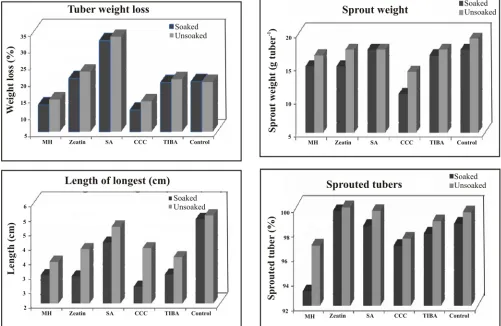
Storage behaviour: Field application of growth regulators effectively reduced the weight loss during maximum being in CCC and followed by MH. Further, soaking the tubers with growth regulators reduced the weight loss in storage by 8.6% over that of non soaking treatment. Among soaking treatments, CCC recorded a very low weight loss of 11.51 per cent and it was closely followed by MH (13.04) .Tuber weight loss was very high with salicylic acid treatment spray in the field and it was followed by zeatin. Among different soaking treatments, the weight loss in CCC was reduced more markedly than the others. No significant effect was observed on weight loss due to dates of haulm killing and also due to interactions. Hence, CCC field application as well as soaking before storage was effective in controlling the storage weight loss of tubers. No rottage of tubers was observed due to growth regulator treatments. No effect on weight loss of rotted tubers was observed due to growth regulator spray treatments. No other factor affected the tuber rottage in the store. Application of CCC in the field @100 ppm in two sprays at 60 and 75 days after planting improved the storage life of tubers by reducing weight loss through reduction in number of sprouts, sprout weight and length of the longest sprout (Fig 1). Respiration, the oxidative breakdown of complex substrates to simple molecules with the concurrent production of energy required to maintain the life process in potato tubers contribute to
loss in weight during storage. Respiration rate of tubers is higher during storage at higher temperature and is influenced by a number of extrinsic factors among which chemical compounds are important ones (Burton et al. 1992). In the present investigation, the tuber samples were stored under normal (room temperature) storage conditions, where the temperature range was between 5.2 to 19.20C and the range of RH was 45.7 to 74.3 per cent. Mehta and Kaul (1997) observed that at 18-300C temperature and RH of 80 to 90 per cent for a storage period of four months, the major factor of weight loss was transpiration. Chemical sprout inhibitors are expected to have an influence on the rate of respiration, if not during the dormant period, then at least after the termination of the formal rest period (Mehta 2004). Hence, the reduction in weight loss, sprouting and sprout weight in the above treatments can be assumed to the impact of chemicals especially, CCC and MH in reducing the respiration and transpiration. This result gains support of Kaul and Mehta (1991), who tried a combination of treatments with MH, CIPC, IPC, and TIXIT-C in a room (20-39oC, 30-80% RH) and evaporatively cooled store (16-30oC, RH 30-80%) during March–June at Jalandhar (India). All treatments were found more effective in controlling sprouting and reducing weight loss in the cooled store than in ordinary room.
Fig 1. Effect of foliar spray of growth regulators and soaking of resultant tubers on tuber quality in storage.
tubers in CCC was very effective in reducing the length of the sprout to a minimum length of 2.58 cm. Date of haulm killing did not show any influence on length of the longest sprout. Significant difference in sprout weight was recorded with different growth regulator spray treatments in the field. Sprout weight was lower than the control in all the growth regulator spray treatments. Control recorded sprout weight of 19.2 g, whereas CCC recorded a lowest sprout weight of 14.2 g. By soaking before storage, CCC reduced the sprout weight effectively (10.8) by 24 per cent. Date of haulm killing did not influence the sprout weight significantly. A major component of managing potato quality in storage is slowing down the sprout growth. Sprouting causes increased weight loss, reduced tuber quality and impedes air movement through the potato pile.
There is evidence that endogenous plant hormones play an essential role in the initiation, maintenance and
termination of potato tuber dormancy (Coleman 1987, Wiltshire and Cobb 1996). The sustained synthesis and action of endogenous ABA are essential for the initiation and maintenance of tuber dormancy (Suttle and Hultstrand 1994). Tuber weight loss was minimum with CCC followed by MH spray in the field as well as by soaking before storage. Number of sprouted tubers was less in MH followed by CCC, in both field spray and soaking before storage. Sprout weight was low in CCC spray followed by MH spray as well as soaking.
crystals was observed. In MH treated tubers, 7 to 11 layers of phellem was seen and the phellem cells were not very thick but the cell walls were found to be thicker and irregular. One or two crystals were seen occasionally in phellem cells. Cortical parenchyma cells were large and starch grains were found scattered. In parenchyma starch type crystals were more. In CCC treated tubers, the epidermal layers were just like MH treated tubers, but the crystals were more in phellem cells. The histological studies indicated that in CCC treated (before storage) tubers, due to the presence of more layers of phellem and presence of more crystals, the shrinkage is expected to be less, even lesser than MH treated tubers, which reduces the transpiration, sprouting and also water loss. This might have improved the storability by reducing the weight loss, sprouting and sprout growth in these treatments (Plate 1).
Field performance
Tuber Number: Soaking of tubers in growth regulators showed a positive response, by improving the small sized tuber number by 35.2 per cent over no soaking. Among different growth regulators tried, CCC recorded high number of small tubers (339 thousands per ha), which was 90.6 per cent higher than the control (178 thousands per ha). In field application of growth regulators, CCC recorded higher value (209 thousands per ha) for seed sized tubers. By soaking the tubers in growth regulators, seed tuber number increased by 17.0 per cent. Soaking in CCC produced higher number of seed tubers (265 thousands per ha) which was 12.7 per cent higher than the control. MH recorded next best value of 244 thousands per ha, in which soaking resulted in 3.80 per cent improvement. Date of haulm killing and interactions were not significant (Table 1). Significant effect of growth regulator application both in the field as well as in store was observed with respect to large sized tuber number. Large tubers were higher with field application of zeatin (91 thousands per ha) as well as with soaking (103 thousands per ha) and very low number of large tubers were recorded with MH, followed by CCC, both in field application and soaking, which was lower than even control. Soaking improved large sized tuber number by 9.7 per cent. Haulm killing and interactions did not
show any significant impact on large sized tuber number. CCC was more effective in producing higher total number (583 thousands per ha) of tubers by application in the field as spray and it was followed by MH (554 thousands per ha), which were 41.8 and 34.8 per cent higher than the control. Zeatin and salicylic acid behaved just like control. Soaking proved better than no soaking in all the treatments. Improvement in tuber number due to soaking was 23.3 per cent (Table 2).
Table 2.
Determining the field performance of seven and a half month old tubers that was harvested from different growth regulator folia
r spray and
soaked with growth regulator and stored under normal condition – Total tuber number and yield in the subsequent season.
---
---Treatments
Total number (‘000 ha
-1)
Total tuber yield (t ha
-1) Over Over H1 H2 S C a ll H1 H2 S C a ll S C Mean S C Mean mean mean mean S C Mean S C Mean mean mean mean --- ---Maleic hydrazide @ 0.1% 4 7 5 4 1 8 4 4 7 4 6 0 4 0 3 4 3 1 4 6 8 4 1 0 439 14.31 1 2.95 13.63 14.04 13.33 13.69 14.18 13.14 13.66
Zeatin @ 20 ppm
3 2 8 2 8 2 3 0 5 3 5 9 2 7 0 3 1 4 3 4 3 2 7 6 309 13.86 1 3.06 13.46 15.67 12.98 14.33 14.77 13.02 13.89
Salicylic acid @ 150 ppm
3 1 7 2 6 0 2 8 8 3 4 0 2 5 7 2 9 9 3 2 8 2 5 9 294 12.10 1 1.54 11.82 12.52 11.18 11.85 12.31 11.36 11.84
CCC @ 100 ppm
5 4 1 4 6 8 5 0 4 5 2 0 4 2 0 4 7 0 5 3 1 4 4 4 487 17.21 1 3.46 15.34 17.10 13.13 15.12 17.16 13.30 15.23
TIBA @ 50 ppm
5 0 5 3 8 3 4 4 4 4 6 9 3 5 2 4 1 0 4 8 7 3 6 7 427 15.59 1 2.39 13.99 14.99 11.58 13.29 15.29 11.99 13.64 Control 3 4 1 2 6 8 3 0 5 3 4 8 2 5 6 3 0 2 3 4 4 2 6 2 303 12.78 1 0.47 11.63 13.41 10.25 11.83 13.10 10.36 11.73 Mean 4 3 6 3 4 2 3 8 9 4 3 6 3 2 3 3 8 0 4 3 6 3 3 2 14.72 1 2.05 13.39 14.94 12.06 13.50 14.83 12.06 S E d CD (P < 0.05) S E d CD (P < 0.05) Growth regulators 4.34 9.45** 0.28 0.61** Haulm killing 2.31 4.95 0.13 N S Soaking 8.32 17.04** 0.19 0.39
Growth regulators x Haulm killing
6.12
13.23
0.37
0.79
Haulm killing x Soaking
6.11
13.10
0.23
N
S
Growth regulator x Soaking
1 6 .1 5 N S 0.46 0.96
Growth regulators x Haulm killing x Soaking
2 2 .4 3 N S 0.55 N S ---
---NS - Non significant, ** - Significant at 1 % level, H1-Haulm killing at 90 days, H2-Haulm killing at 105 days, S - Growth reg
ulator soaking, C- Control
Table 1.
Determining the field performance of seven and a half month old tubers that was harvested from different growth regulator folia
r spray and
soaked with growth regulator and stored under normal condition 30-60 g size tuber number and tuber yield in the subsequent sea
son.
---
---Treatments
30-60 g size tuber number (‘000 ha
-1)
30-60 g size tuber yield (t ha
-1) Over Over H1 H2 S C a ll H1 H2 S C a ll S C Mean S C Mean mean mean mean S C Mean S C Mean mean mean mean ---
---Maleic hydrazide @ 0.1%
1 9 4 1 5 8 1 7 6 1 9 4 1 5 0 1 7 2 1 9 4 1 5 4 174 7.55 7.29 7.42 7.74 7.48 7.61 7.65 7.39 7.52
Zeatin @ 20 ppm
1 4 5 1 5 4 1 5 0 1 7 2 1 5 0 1 6 1 1 5 8 1 5 2 155 6.97 7.39 7.18 8.24 7.48 7.86 7.61 7.44 7.52
Salicylic acid @ 150 ppm
1 5 0 1 4 9 1 4 9 1 6 7 1 5 4 1 6 1 1 5 8 1 5 2 155 6.58 6.88 6.73 7.19 6.93 7.06 6.89 6.91 6.90
CCC @ 100 ppm
2 2 4 1 7 3 1 9 9 2 0 7 1 4 5 1 7 6 2 1 6 1 5 9 187 10.10 6.74 8.42 9.51 6.68 8.10 9.81 6.71 8.26
TIBA @ 50 ppm
1 9 8 1 7 2 1 8 5 1 8 0 1 3 6 1 5 8 1 8 9 1 5 4 172 8.12 7.04 7.58 8.30 5.46 6.88 8.21 6.25 7.23 Control 1 7 6 1 4 5 1 6 1 1 8 0 1 3 2 1 5 6 1 7 8 1 3 9 158 8.10 6.68 7.39 8.30 6.07 7.19 8.20 6.38 7.29 Mean 1 8 1 1 5 8 1 6 9 1 8 4 1 4 7 1 6 6 1 8 3 1 5 2 7.93 6.86 7.40 8.28 6.91 7.60 8.11 6.89 S E d CD (P < 0.05) S E d CD (P < 0.05) Growth regulators 4.57 9.96** 0.27 0.59** Haulm killing 4 2 3 N S 0.12 N S Soaking 5.68 11.63 0.17 0.35
Growth regulators x Haulm killing
9.14
N
S
0.35
0.76
Haulm killing x Soaking
7.08 N S 0.21 N S
Growth regulator x Soaking
1 1 .5 7 N S 0.41 0.86
Growth regulators x Haulm killing x Soaking
1 6 .9 8 N S 0.51 N S ---
---NS - Non significant, ** - Significant at 1 % level, H1-Haulm killing at 90 days, H2-Haulm killing at 105 days, S - Growth reg
as well as by soaking treatment. Small sized tuber yield was higher by spraying CCC (5.02 t ha-1) and it was followed by MH (4.49 t ha-1). The per cent improvement in these treatments over control was 103 and 82 per cent, respectively. Haulm killing did not show any impact on small tuber yield. Interaction between growth regulator spray and soaking was significant. Significant effect of growth regulator spray in the field and soaking in the growth regulators before storage were observed with respect to seed tuber yield. In field application, CCC produced higher yield (9.87 t ha-1) and it was followed by MH (9.76 t ha-1) which was14.1 and 13 per cent higher than the control. Soaking proved advantageous as it improved the overall yield by 10.5 per cent. Soaking the tubers in CCC before storage produced higher seed yield (12.06 t ha-1) followed by TIBA (10.40 t ha-1) which were 23 and 6 per cent higher than the control. Effect of haulm killing date and all the interactions were not significant. Large sized tuber yield was significantly affected by field application as well as soaking with growth regulators. Zeatin spray in the field recorded higher table sized tuber yield (7.71 t ha-1) and it was followed by TIBA (6.34 t ha-1). Soaking in growth regulator provided 13.5 per cent higher yield of large sized tubers. Among the soaking treatments, zeatin recorded higher yield of large tubers (8.95 t ha-1) which was 38 per cent higher than the control. Interaction did not show any significant effect on large sized tuber yield. In field application of growth regulators, CCC recorded significantly higher yield of 22.4 t ha-1 and it was closely followed by zeatin (21.4 t ha-1). Control recorded 18.2 t ha-1. The per cent improvement in total yield of CCC and zeatin was 23 and 18 respectively over control. Soaking improved the tuber yield by 15 per cent. Among the soaking treatments, CCC application was superior to all other treatments. Dates of haulm killing did not show any influence on total yield. Interaction effect of growth regulator spray and soaking was significant. Application of CCC spray and soaking treatment produced higher yield of 24.2 t ha-1 (Table 2).
The widely accepted effects of physiological age at planting can be illustrated by the results of O’Brien et al. (1983) and Moll (1985) who reported that increasing the mean storage temperature, and hence the physiological age of the seed, hastens emergence and
usually the rest of the growth cycle of the crop, but reduces the quantity of foliage formed. Tuber growth is more rapid at first but less later, so that the effect on yield depends on harvest date (Caldiz et al. 1985).
Several investigations have suggested that sprout growth can be limited by the availability of mother tuber reserves (Davies, 1990). The time to emergence is inversely proportional to the amount of substrate available (Moorby 1967, Sadler 1961). In zeatin applied tubers, the weight loss in storage, sprout weight and sprout length were more making the tubers physiologically older, and hence the emergence was hastened, which resulted in early tuber initiation. But, due to more number of sprouts in the storage itself, the food reserves of the tubers were already utilized to a greater extent. Hence, for further development of haulms in the field less food was available in the mother tubers. This made these plants to produce less number of tubers in comparison with other growth retardants. However, due to availability of more time for bulking, most of the tubers formed developed to a good size, compensating for the yield loss due to lesser number of tubers. Of the dry weight lost by tubers during sprouting, the majority (80 to 90 %) appears to be translocated to shoots and roots and only approximately 10% lost by respiration (Headford 1961). Sprout dry weight is positively associated with tuber size in a linear manner, whereas tuber carbohydrate content departs from a linear relation due to relatively greater respiratory losses with a decrease in tuber size (Davies 1990).
ACKNOWLEDGEMENTS
Our sincere thanks to Dr. Rajan (Botany), Survey of Medicinal Plants, Ooty, Tamil Nadu, India for his technical help in the histological studies.
REFERENCES
Beukema, H.P. and van der Zaag. D.E. (1990). Introduction to potato production. PUDOC. Wageningen, The Netherlands.
Burton, W.G., Van Es, A. and Hartmans, K.J. (1992). The physics and physiology of storage. In: P.M.Harris (ed.), The Potato Crop–Scientific Basis for Improvement, 609-727. Chapman and Hall, London.
Caldiz, D.O., Panelo, D.M., Claver, F.K. and Montaldi, E.R. (1985). The effect of two planting dates on the physiological age and yielding potential of seed potatoes grown in a warm temperate climate in
Argentina. Potato Res. 28: 425-434.
Coleman, W.K. (1987). Dormancy release in potato tubers: A
review. Am. Potato J. 64: 57–68
Davies, H.V. (1990). Carbohydrate metabolism during
sprouting. Am. potato J. 67: 815-827.
Gomaz and Gomaz, A.A.(1984).Statistical Procedures for Agricultural Research. John wiley and Sons, New York (USA).
Headford, D.W.R. (1961). Sprout growth of the potato. Ph.D. Thesis, University of Nottingham.
Johanson, D.D. (1960). Plant microtome technique. McGrew Hill, New York.
Kaul, H.N. and Mehta, A. (1991). A riskless sprout suppressant for ware potatoes – Maleic hydrazide, Indian Horti. 36: 10-13.
Kaul, H.N. and Sukumaran, N.P. (1984). A potato store run on passive evaporative cooling. In: Technical bulletin 11, CPRI, Shimla.
Manorama, K. (2004). Weed management in potato in Nilgiris. Potato J. 31: 91-93.
Mehta, A and Kaul, H. N. (1997). Physiological weight loss in potatoes under non refrigerated storage: Contribution of respiration and transpiration. J. Indian Potato Assoc.
24: 106-113.
Mehta, A. (2004). Respiration rate of stored potato tubers: Effect of chemical sprout inhibitors. Indian J. Plant Physiol. 9: 69-74.
Mehta, A., Singh, B. and Ezekiel, R. (2011).Effect of CIPC treatment on keeping and processing attributes during
short term storage. Indian J. Plant Physiol. 16: 85-92.
Moll, A. (1985). Der Einfluss des physiologicschen Alters der Pflanzknollen auf die Ertragsbildung von Kartoffelsorten
verschiedener Reifezeit. Potato Res. 28: 233-250.
Moorby, J. (1967). Inter-stem and inter-tuber competition in
potatoes. European Potato J. 10: 189-205.
O’Brien, P.J., Allen, E.J., Bean, J.N., Griffith, R.L., Jones, S.A. and Jones, J.L. (1983). Accumulated day degrees as a measure of physiological age and the relationships with growth and yield in early potato varieties. J. Agric. Sci.
101: 613-631.
Sadler, E. (1961). Factors influencing the development of
sprouts of the potato. Ph.D. Thesis, University of
Nottingham.
Saptharishi, K. and Azariah, M.D. (1952). Control of sprouting and loss of weight in table potatoes during storage.
Madras Agric. J. 39: 342–45.
Sukumaran, N.P. (2002). Role of chemicals in potato
production, storage and utilization. In: Paul, S.M,
Khurana, Shekhawat, G.S., Pandey, S.K. and Singh, B.P. (eds), Potato, Global Research & Development – Volume II. Pp. 768-775.Central Potato Research Institute, Shimla, India.
Suttle, J.C. and Hultstrand, J.F. (1994). Role of endogenous abscisic acid in potato microtuber dormancy. Plant
Physiol. 105: 891–896.
Wiltshire, J.J. and Cobb, A.H. (1996). A review of the physiology of potato tuber dormancy. Ann. Appl. Biol.