*Corresponding author, E-mail: [email protected]
PROLINE ACCUMULATION, WATER STATUS AND CHLOROPHYLL CONTENT IN
LEAF IN RELATION TO SALT TOLERANCE IN SOYBEAN
M.A. MANNAN1*, M.A. KARIM2, Q.A. KHALIQ2, M.M. HAQUE2, M.A.K. MIAN3 AND J.U. AHMED4 1Department of Agronomy, Patuakhali Science and Technology University, Dumki, Patuakhali-8602, Bangladesh 2Department of Agronomy, Bangabandhu Sheikh Mujibur Rahman Agricultural University, Gazipur-1706, Bangladesh 3Department of Genetics and Plant Breeding, Bangabandhu Sheikh Mujibur Rahman Agricultural University, Gazipur-1706, Bangladesh
4Department of Crop Botany, Bangabandhu Sheikh Mujibur Rahman Agricultural University, Gazipur-1706, Bangladesh
Received on 25 March, 2009, Revised on 12 June, 2009
SUMMARY
An experiment was conducted to study the effect of salinity on proline accumulation, water status and chlorophyll content in leaf of a salt - tolerant (AGS 313) and a salt - susceptible (Shohag) soybean (Glycine max L) genotypes. The plants were grown in pots inside a vinylhouse with 50 and 100 mM NaCl solutions and tap water as a control. Leaf proline accumulation, water uptake capacity (WUC) and concentration of chlorophyll a, b and total chlorophyll of the two genotypes were compared at 15, 30, 45 and 60 days after treatment imposition. Marked variation in accumulation of proline was found between the two genotypes differing in salt tolerance. Proline accumulation was increased with the increasing salinity levels and with duration in both the genotypes. AGS 313 accumulated higher amount of proline under salt stress condition than that of Shohag at all the growth stages. Salinity also increased WUC in both AGS 313 and Shohag. The relative increase in WUC (% of the control) was greater in Shohag than that in AGS 313, which indicated that Shohag suffered more with water deficit than AGS 313. The chlorophyll a, b, and total chlorophyll in leaves of the two genotypes were decreased greatly with the increase in salt concentrations and with duration of exposure to salinity. The relative reduction (% of the control) of chlorophyll content was higher in Shohag than that in AGS 313. It was concluded that relatively higher amount of proline in AGS 313 had a greater osmoregulatory role in maintaining relatively lower WUC and higher leaf chlorophylls than those of Shohag.
Key words: Chlorophylls, proline, salt tolerance, soybean, water uptake capacity.
with plant species, and types and levels of the salinity (Bishnoi et al. 1987). Salinity is also considered as the major abiotic stress that restricts the economic and efficient utilization of available land resources, by affecting adversely soil fertility, and crop productivity and quality (Viswanathan et al. 2005). Salts present in the ambient root environment generally alter a wide array of metabolic processes in plant culminating in stunted growth. Ashraf and Rasul (1988) reported that salinity reduced significantly leaf chlorophylls and also the protein and
INTRODUCTION
carbohydrate contents in different plant parts of mungbean. However, marked genotypic differences in salinity tolerance were also reported for different crops (Blum 1988, Raptan et al. 2001a, Aziz et al 2005, Sultana et al. 2007).
Salinity tolerance is a complex phenomenon that involves many physiological and biochemical processes (Greenway and Munns 1980). It is reported that the tolerant genotypes very often maintain better water relations for osmotic adjustment, lower amount of toxic ion Na+, and higher photosynthetic activity than the
susceptible ones (Lauchli and Wieneke 1979, Greenway and Munns 1980, Raptan et al. 2001b). However, the role of proline- a known compatible osmoticum found in plants under heat and drought stress (Blum 1988), on salinity tolerance of grain legume needs to be well clarified in the long term systematic studies. The present study was undertaken to analyze the magnitude of changes in proline accumulation, water status and chlorophyll content in leaf due to salinity in two soybean genotypes, differing in salinity tolerance, in order to understand the salt tolerance mechanisms of this crop.
MATERIALS AND METHODS
The seeds of soybean (Glycine max L.) genotypes AGS 313 and Shohag were sown in plastic pots of 24cm x 30cm in size, containing 12 kg air dried soil, inside a vinylhouse under natural light at the Environmental Stress Research Site of Bangabandhu Sheikh Mujibur Rahman Agricultural University (BSMRAU), Salna, Gazipur, Bangladesh. In a preliminary experiment the genotype AGS 313 was found more salt tolerant in terms of growth than the genotype Shohag. When the 1st trifoliate
appeared, 1000 ml of 0, 50 mM and 100 mM NaCl solutions were applied in each pot up to 60 days. Salt solutions were prepared by dissolving calculated amount of commercially available NaCl with tap water. Tap water was used as the control. The salt solution was applied stepwise with an increment of 25 mM in every alternate day till respective concentrations were attained. Treatment solutions were applied in excess so that the extra solution dripped out through the holes made at the bottom of the pots. Uppermost fully developed leaves were collected at 15, 30, 45, and 60 days after treatment
imposition to measure proline, water uptake capacity and chlorophyll content. Four leaves from four separate plants in each treatment were considered for each measurement of the parameters. Leaf proline was estimated according to Bates et al. (1973). Water uptake capacity of leaf was measured using the following formula:
Chlorophylls were estimated and expressed as mg g-1 fw using the following equation (Witham et al. 1986):
Chlorophyll a = [12.7 (D663)- 2.69 (D645)] x [V/1000 x W]
Chlorophyll b = [22.9 (D645)- 4.68 (D663)] x [V/1000 x W]
Chlorophyll (total) = [20.2 (D663)- 8.02 (D645)] x [V/1000 x W]
RESULTS AND DISCUSSION
Proline accumulation: Proline accumulation in the NaCl treated plants of the two soybean genotypes was increased with the increasing in plant age till 60 days (Fig. 1). Under control condition, no significant difference in proline accumulation between Shohag and AGS 313 was observed, though Shohag accumulated a slightly higher amount of proline than that of AGS 313. Proline accumulation increased with the increase in salinity levels and with the duration in both the genotypes. However, the rate of increase was higher in the salt tolerant AGS 313 than that of salt sensitive Shohag. Accumulation of proline in response to salinity was also observed by Weimberg et al. (1982) in sorghum and Reddy and Vora (1983) in bajra. The accumulation of proline during salt stress was probably due to the consequence of reduction in cell osmotic potential for the maintenance of osmotic balance between cytoplasm and vacuole (Flowers et al. 1977). The higher amount of proline accumulation in AGS 313 was associated with the better salt tolerance mechanisms of this genotype than that of Shohag.
Water uptake capacity: Water uptake capacity (WUC) of a plant indicates the amount of water required to reach turgid weight (Sangakkara et al. 1996). A higher Turgid weight – Fresh weight
Dry weight Water uptake capacity
value of WUC of a plant means the plant suffers to a greater degree from moisture stress than the plant with a lower WUC. Salinity increased the WUC in both the genotypes as compared to the plants under control, and the WUC increased with the increase in duration of plant exposure to salinity. Between the two genotypes, the susceptible Shohag had higher value of WUC under saline conditions than that of salt tolerant genotype, AGS 313 (Fig. 2). The higher WUC in Shohag indicated that this genotype suffered more from water stress aroused from salinity effect than the genotype AGS 313.
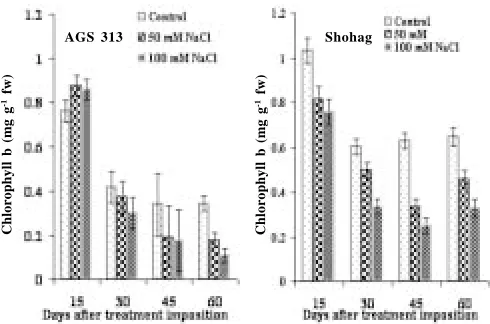
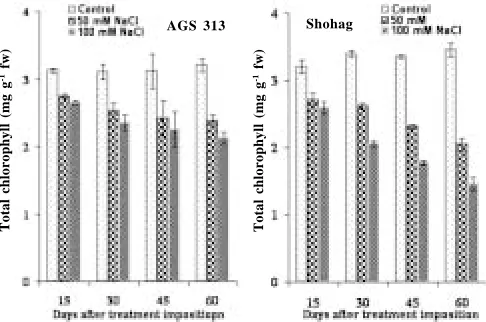
Chlorophyll content: At all the levels of salinity, AGS 313 had greater amount of chlorophyll a and total chlorophyll than those in Shohag; though, chlorophyll b was higher in Shohag than that in AGS 313 (Fig. 3, 4 & 5). In general, chlorophyll contents were reduced by the salinity and the reduction was conspicuous at the higher level of salinity in both the genotypes, though variation in the extent of reduction between the genotypes was evident. Reddy and Vora (1983) reported that a decrease in chlorophyll content in salt affected plants might be attributed due to the increased activity of the
chlorophyll-Proline (
µµµµµ
mol g
-1 fw)
Proline (
µµµµµ
mol g
-1 fw)
Fig. 1. Effect of salinity on proline content (µµµµµ mol g-1 fw) of leaf in salt tolerant (AGS 313) and salt sensitive (Shohag) soybean genotypes at different days after treatment imposition. Bars represent standard error (± SE)
Water uptake capacity (g g
-1 dw)
Fig. 2. Effect of salinity on water uptake capacity of salt tolerant (AGS 313) and salt sensitive (Shohag) soybean genotypes at different days after treatment imposition. Bars represent standard error (± SE)
Water uptake capacity (g g
-1 dw)
Chlorophyll b (mg g
-1 fw)
Fig. 4. Effect of salinity on chlorophyll b (mg g-1 tissue) of salt tolerant (AGS 313) and salt sensitive (Shohag) soybean genotypes at different days after treatment imposition. Bars represent standard error (± SE)
Chlorophyll b (mg g
-1 fw)
Chlorophyll a (mg g
-1 fw)
Fig. 3. Effect of salinity on chlorophyll a (mg g-1 fw) of salt tolerant (AGS 313) and salt sensitive (Shohag) soybean genotypes at different days after treatment imposition. Bars represent standard error (± SE)
Chlorophyll a (mg g
-1 fw)
AGS 313 Shohag
AGS 313 Shohag
degrading enzyme chlorophyllase. Salinity induced reduction in chl. a, chl. b and total chl. was also reported in mungbean (Singh et al. 1994) and black gram (Ashraf 1989). It has been suggested by Strogonov et al., (1970) that the specific enzyme which is responsible for the synthesis of green pigments was suppressed by the effect of salinity. It has also been suggested by the same workers that the synthesis of total chlorophyll and proportion of its components depended on the biology and developmental stage of the plant, and also on the nature and concentration of salts.
Maintenance of osmoregulation is an important mechanism of salinity tolerance, and tolerant plant usually show better osmoregulation than the susceptible one (Greenway 1973, Greenway and Munns 1980). Higher level of proline accumulation due to salinity plays an important role in maintaining better osmoregulation in AGS 313 under condition of comparatively lower WUC and higher chlorophyll content than the genotype Shohag. Thus, AGS 313 suffered less from the salinity stress than that of Shohag.
ACKNOWLEDGEMENTS
The first author is grateful to the University Grants Commission, Bangladesh for providing a fellowship during his Ph. D work. The authors also acknowledge
gratefully the Research Management Committee of BSMRAU, Gazipur, Bangladesh for partially funding this study.
REFERENCES
Ashraf, M. (1989). The effect of NaCl on water relations, chlorophyll and protein and proline contents of two cultivars of blackgram (Vigna mungo L.) Plant Soil.
199: 205-210.
Ashraf, M. and Rasul, E. (1988). Salt tolerance of mungbean (Vigna radiata L. Wilczek) at two growth stages. Plant
Soil. 110: 63-67.
Aziz, M.A., Karim, M.A., Hamid, M.A., Khaliq, Q.A. and Hossain, M. (2005). Salt tolerance in mungbean: growth and yield response of some selected mungbean genotypes to NaCl salinity. Bangladesh J. Agril. Res.
30: 529-535.
Bates, L.S., Waldren R.P. and Teare I.D. (1973). Rapid determination of free proline for water stress studies.
Plant Soil. 39: 205-207.
Bishnoi, N.R. Siddique, S. and Kumar S. (1987). Effect of salinity, salinization and desalinization on the various aspects of dry matter production at vegetative stage in pea and gram. Front. Bot. 1: 1- 11.
Blum, A. (1988). Plant Breeding for Stress Environments. CRC Press, Florida.
Flowers, T.J., Troke, P.F. and Yeo, A.R. (1977). The mechanism of salt tolerance in halophytes. Ann. Rev. Plant Physiol.
28: 89-121.
Greenway, H. (1973). Salinity, plant growth and metabolism.
J. Aust. Inst. Agric. Sci. 39: 24-34.
Greenway, H. and Munns, R. (1980). Mechanisms of salt tolerance in non-halophytes. Annu. Rev. Plant Physiol.
31: 149-190.
Khan, M.G. and Varshney, K.A. (1986). Differential genotypic behaviour of soybean (Glycine max L. Merril) for tolerance to salt stress. Bio. Sci. Res. Bull. 4: 24-32.
Lauchli, A. and Wieneke, J. (1979). Studies on growth and distribution of Na+, K+ and Cl- in soybean varieties differing in salt tolerance. Z. Pflanzen. Bod. 142: 3-13.
Total chlorophyll (mg g
-1 fw)
Fig. 5. Effect of salinity on total chlorophyll (mg g-1 tissue) of salt tolerant (AGS 313) and salt sensitive (Shohag) soybean genotypes at different days after treatment imposition. Bars represent standard error (± SE)
Total chlorophyll (mg g
-1 fw)
Maas, E.V. and Hoffman, G.J. (1977). Crop salt tolerance-current assessment. J. Irrig. Drainage Div. ASCE. 103: 115-134.
Munns, R. and Tester, M. (2008). Mechanisms of salinity tolerance. Annu. Rev. Plant Physiol. 59: 651-81.
Raptan, P.K., Hamid, A., Khaliq, Q.A., Solaiman, A.R.M., Ahmed, J.U. and Karim, M.A. (2001a). Salinity tolerance in blackgram and mungbean: I. Dry matter accumulation in different plant parts. Korean J. Crop Sci. 46: 380-386.
Raptan, P.K., Hamid, A., Khaliq, Q.A., Solaiman, A.R.M., Ahmed, J.U. and Karim, M.A. (2001b). Salinity tolerance in blackgram and mungbean:II. Mineral ions accumulation in different plant parts. Korean J. Crop
Sci. 46: 387-394.
Reddy, M.P. and Vora, A.B. (1983). Effect of chloride and sulphate of sodium and potassium salinity on germination and free proline content of bajra. INSA
Proc. Part B. 49: 702-705.
Sangakkara, U.R., Hartwig, U.A. and Nosberger, J. (1996). Response of root branching and shoot water potential of French bean (Phaseolus vulgaris L.) to soil moisture and fertilizer potassium. J. Agron. Crop Sci. 177: 165-173.
Singh, S.P., Singh, B.B., Singh, M. and Singh, M. (1994). Effect of kinetin on chlorophyll, nitrogen and proline in mungbean (Vigna radiata) under saline condition.
Indian J. Plant Physiol. 37: 37-39.
Strogonov, B.P., Kabanov, V.V., Shevajakova, N.I., Lapina, I.P. and Povov, B.B. (1970). Structure and Function of Plant Cells in Saline Habitats. John Wiley and Sons. Inc., New York.
Sultana, M.S., Karim, M.A. Hossain, F. and Hossain, M.T. (2007). Effect of NaCl on germination and seedling growth of mungbean varieties. Bangladesh J. Life Sci.
19: 1-8.
Viswanathan, C., Jagendorf, A. and Zhu, J. (2005). Understanding and improving salt tolerance in plants.
Crop Sci. 45: 437-448.
Weimberg, R., Lerner, H.R. and Poljakoff-Maybe, A. (1982). A relationship between potassium and proline accumulation in salt stressed Sorghum bicolor. Physiol.
Plant. 55: 5-10.
Witham, H, Blades, D.F. and Devin, R.H. (1986). Exercise in
Plant Physiology (2nd Edition). PWS Publishers, Boston,