Proceedings of the Thirteenth Workshop on Innovative Use of NLP for Building Educational Applications, pages 381–388
Neural sequence modelling for learner error prediction
Zheng Yuan
The ALTA Institute
Department of Computer Science and Technology University of Cambridge
Abstract
This paper describes our use of two recurrent neural network sequence models: sequence la-belling and sequence-to-sequence models, for the prediction of future learner errors in our submission to the 2018 Duolingo Shared Task on Second Language Acquisition Modeling (SLAM). We show that these two models cap-ture complementary information as combining them improves performance. Furthermore, the same network architecture and group of fea-tures can be used directly to build competitive prediction models in all three language tracks, demonstrating that our approach generalises well across languages.
1 Introduction
Most recent work on second language acquisition (SLA) has focused on intermediate-to-advanced learners in assessment settings driven by a series of shared tasks (Dale and Kilgarriff, 2011; Dale et al., 2012; Ng et al., 2013, 2014; Lee et al., 2015,2016;Daudaravicius et al.,2016). The 2018 Duolingo Shared Task on Second Language Ac-quisition Modeling (SLAM) (Settles et al.,2018) targets early stage learners and aims to provide personalised learning instructions. Participating teams are provided with transcripts from exercises submitted by learners over their first 30 days of learning on Duolingo,1which are annotated for
to-ken (word) level errors. The task is to predict what errors each learner will make in the future based on their learning history. There are three language tracks in this shared task:
• en es: native Spanish speakers learning En-glish;
• es en: native English speakers learning Span-ish;
1https://www.duolingo.com
• fr en: native English speakers learning
French.
Teams can either focus on a particular language track, or explore generalised models and features across all three languages.
Inspired by the success of neural sequence models in grammatical error detection and cor-rection (Yuan and Briscoe, 2016; Rei and Yan-nakoudakis, 2016; Yannakoudakis et al., 2017; Schmaltz et al., 2017), we propose two recurrent neural network sequence models for this prob-lem: sequence labelling and sequence-to-sequence modelling. We demonstrate the utility of these two models for the future learner error prediction task. We also provide evidence of performance gains by using an ensemble of these two models, suggest-ing that they are complementary to each other.
For model development, we focus on the En-glish track only and language-specific features are introduced and studied. When it comes to official evaluation, two new prediction systems, one for thees entrack and another for thefr entrack, are built using the same network architecture and the same (hyper-)parameter setting, without tuning for new datasets or languages. Competitive results on all three language tracks show that our approach generalises well and might be used as a generic solution across different languages.
The remainder of this paper is organised as fol-lows: Section 2 describes our approach and two neural sequence models in detail, Section 3 dis-cusses the feature types that we exploit in our models, Section4reports our experiments and re-sults on the development set for the en es track, Section 5 presents our official results on the test sets for all three language tracks. Finally, Sec-tion 6 provides conclusions and ideas for future work.
2 Approach
We introduce two models for the task of fu-ture learner error prediction: a sequence labelling model and a sequence-to-sequence model. The following sections describe these two models.
2.1 Neural sequence labelling
We treat error prediction as a sequence labelling problem. Similar to Yannakoudakis et al. (2017), we construct a bidirectional recurrent neural net-work for detecting future learner errors. Unlike their system, error-free and correct sequences are fed into our model, and the goal is to predict where a learner is likely to make token-level er-rors based on their learning history. The model receives a sequence of tokensx= (x1, x2, ..., xT)
as input, and assigns a label y to each input to-ken x. A bidirectional long short-term memory (LSTM) (Hochreiter and Schmidhuber, 1997) is used to learn context-specific representations:
− →h
t =LSTM(xt,−−→ht−1) (1)
←h−
t =LSTM(xt,←−−ht+1) (2)
ht= [−→ht;←h−t] (3)
where −→ht is the hidden state of the
forward-moving LSTM at time t, that reads the input se-quence from the first token to the last; ←h−t is the
hidden state of the backward-moving LSTM at timet, which reads the input sequence in reverse order; andhtis the concatenation of both hidden
states, that captures both historical and future se-quential information.
A softmax output layer predicts the label distri-bution for each input token, given the whole input sequencex:
p(yt|x) =softmax(Woht) (4)
whereWois an output weight matrix.
We optimise the model by minimising categori-cal cross-entropy between the predicted label dis-tributions and the gold labels:
E =− T X
t=1
logp(yt|x) (5)
2.2 Sequence-to-sequence modelling
We utilise a sequence-to-sequence model with a soft attention mechanism similar to that of Yuan and Briscoe (2016), which contains a bidirectional LSTM encoder and an attention-based LSTM de-coder. An encoder first reads and encodes an input sequence x = (x1, x2, ..., xT) into hidden
state representationsh = (h1, h2, ..., hT), which
is the same as the one used in our sequence la-belling model (see Section 2.1, Equation 3). A decoder then generates an output sequence y = (y1, y2, ..., yT)2 by predicting the next token yt
based on the input sequence x and all the previ-ously generated tokens{y1, y2, ..., yt−1}:
p(yt|{y1, ..., yt−1},x) =softmax(Wost) (6)
where Wo is a decoder output weight matrix,
andstis the hidden state of the LSTM decoder at
decoding timet:
st=LSTM(st−1, yt−1, ct) (7)
wherectis the input sequence representation for
predicting the output token yt, and is calculated
using a soft attention mechanism:
ct= T X
j=1
(αtjhj) (8)
The weight αtj is computed with a softmax
function:
αtj=
exp(etj) PT
k=1exp(etk)
(9)
A feedforward neural network is used to repre-sent the energy function:
etj=tanh(Wαst−1+Uαhj) (10)
where Wα and Uα are attention weight
matri-ces.
3 Feature space
Besides original word tokens, new features (in the form of discrete labels) are introduced, which pro-vide additional exercise and learner information. These features are described briefly below.
3.1 Exercise-level feature set
user: a unique identifier for each learner;
format: the exercise format (reverse translate,
reverse tap, orlisten);3
session: the exercise session type (lesson, prac-tice, ortest);4
client: the learner’s device platform (android,
ios, orweb);
country: the country from which the learner has done the exercise.
3.2 Token-level feature set
part of speech (POS): the POS tag of the word;
dependency edge label (DEP): the grammati-cal relation (GR) between the word and its head.
3.3 Language-specific feature set
CEFR word level: The Common European Framework of Reference (CEFR) (Council of Eu-rope,2011) describes what language learners can do at different stages of their learning and defines language proficiency in six levels: A1, A2, B1, B2, C1 and C2, with A1 being the lowest and C2 the highest. These six CEFR levels can be grouped into three broad levels: basic (A1 and A2), inde-pendent (B1 and B2) and proficient (C1 and C2).
The CEFR levels for all the English words ap-peared in the dataset are extracted from the En-glish Vocabulary Profile (EVP),5 which is based
on the 50-million word Cambridge Learner Cor-pus (CLC) and the 1.2-billion word Cambridge English Corpus (CEC). The EVP is a free on-line vocabulary resource that contains information about which words and phrases are known and used by learners at each CEFR level (Capel,2012). Even though we only focus on English words here, it is worth noting that the CEFR levels were
3reverse translate: learners are asked to read a sentence written in their L1, and then translate it into L2;reverse tap: an easier version of reverse translate, where learners are given a bank of words and distractors; listen: learners are asked to listen to an utterance in L2, and then transcribe it.
4Thelessonsessions (about 77% of all the data) intro-duce new words; thepracticesessions (22%) contain only previously-seen words; and thetestsessions (1%) are quizzes that allow learners to “skip” a particular skill unit of the cur-riculum.
5http://www.englishprofile.org/
wordlists
designed in a way that can be applied to all guages. Therefore, if resources for other lan-guages similar to the EVP became available, we can then make use of this feature for other lan-guages.
CLC error rate: We collect error rate informa-tion from the CLC, which is a large annotated cor-pus of learner English developed by Cambridge University Press and Cambridge English Lan-guage Assessment since 1993 (Nicholls,2003). It comprises examination scripts written by learners of English who took Cambridge English examina-tions around the world with over 80 L1s and rep-resenting all six CEFR levels.
Two criteria are applied to create two sub cor-pora:
• CLC(KET): contains examination scripts for A2 Key, formerly known as Cambridge En-glish: Key (KET)6; and A2 Key for Schools,
formerly known as Cambridge English: Key for Schools (KETfS)7.
KET is the lowest level General English ex-amination in the Cambridge English range, which targets at A2 level. KETfS is at the same level as KET, but its examination con-tent is targeted at the interests and experi-ences of schoolchildren.
• CLC(ES): contains examination scripts
writ-ten by native speakers of Spanish, which ac-count for around 24.6% of the non-native speakers represented in the CLC.
For every wordw, an error rateE(w)is defined
as:
E(w) = count(s6=w,t=w)
count(t=w) (11)
where count(t=w)is the number of times the
wordwis seen in the target side (i.e.corrected ver-sion) of the corpus, and count(s 6= w,t = w)
is the number of times any word exceptwin the source side (i.e. original version) has been cor-rected to the wordwin the target side.
We compute E(w)from the CLC, CLC(KET) and CLC(ES); and then create two new features
CLC-KETandCLC-ES:
6http://www.cambridgeenglish.org/
exams-and-tests/key
7http://www.cambridgeenglish.org/
CLC-KET=
1 if ECLC(KET)E
CLC >1
0 otherwise
(12)
CLC-ES=
1 if ECLC(ES)E
CLC >1
0 otherwise
(13)
All the exercise-level and token-level features are directly extracted from the metadata and pre-processed data provided by the shared task organ-isers. The language-specific features are only gen-erated for the English data to be used in theen es
track.
4 Experiments and results
4.1 Dataset and evaluation
The shared task dataset comprises answers sub-mitted by more than 6,000 Duolingo users over the course of their first 30 days. Token-level binary la-bels are provided:
Correct reference : She is my mother Learner answer: She is mader
Label: 0 0 1 1
Matched tokens are given the label ‘0’; and missing or misspelt tokens (ignoring capitalisa-tion, punctuation and accents) are given the la-bel ‘1’ to indicate an error. Only correct refer-ences and label sequrefer-ences are provided, not orig-inal learners’ responses. Therefore, in our exper-iments, we map correctreference to its label se-quence.
The dataset is partitioned sequentially into training, development and test sets, which all con-tain the same group of learners. The training set contains the first 80% of the sessions for each learner, followed by the next 10% for development and the final 10% for testing. Each learner’s test items are subsequent to their development items, which in turn are all subsequent to their training items.
During development, we focus on learners of English. The training set provided for the en es
track contains approximately 2,622,958 tokens (however, only 13% are labelled with ‘1’) in about 824,012 sentences. The development set in-cludes additional 387,374 tokens in 115,770 sen-tences. All the data has been pre-processed using
the Google SyntaxNet dependency parser8by the
shared task organisers.
System performance is evaluated in terms of area under the ROC curve (AUROC) and F1 (with a threshold of 0.5).
4.2 Training
All our models are built using OpenNMT (Klein et al., 2017). For the sequence labelling model, our training procedure is similar to Yannakoudakis et al. (2017)); while for the sequence-to-sequence model, we follow Yuan and Briscoe (2016). Ad-ditionally, we set the source and target word em-bedding sizes to 750, as well as the LSTM hidden layer size. We no longer limit the vocabulary size or the maximum sentence length as both of them are small enough to train effectively. New features defined in Section3 are added to the models in-crementally and results are presented in the next section.
4.3 Results
Evaluation results on the development set for the
en estrack are reported. We also include a base-line model provided by the shared task organisers for comparison purposes. The baseline model uses L2-regularised logistic regression, trained with stochastic gradient descent (SGD) weighted by frequency (Settles et al.,2018).
Sequence labelling model Results for the se-quence labelling models are presented in Table1, and all our models outperform the baseline (Ta-ble 1 #0). We start by adding exercise-level features incrementally (Table 1 #1-5). Introduc-ing new exercise-level features yields consistent improvements in overall performance. The one trained on all our exercise-level features gives the best AUROC and F1 scores (Table1#5).
Token-level features (Table 1 #6-7) and language-specific features (Table1#8-10) are then added to the current best model. However, none of them yields further gains. A closer inspection of the training data reveals a number of cases where
POS and DEP tags provided by the shared task organises are not reliable, as in the following ex-amples (incorrect tags are marked inred):
8https://github.com/tensorflow/models/
# Feature AUROC F1
0 baseline 0.776 0.173
1 token + user 0.784 0.421
2 token + user + format 0.809 0.453
3 token + user + format + session 0.825 0.470
4 token + user + format + session + client 0.834 0.476 5 token + user + format + session + client + country 0.837 0.480
[image:5.595.99.506.60.231.2]6 token + user + format + session + client + country + POS 0.807 0.447 7 token + user + format + session + client + country + DEP 0.830 0.474 8 token + user + format + session + client + country + CEFR 0.823 0.469 9 token + user + format + session + client + country + CLC-KET 0.825 0.471 10 token + user + format + session + client + country + CLC-ES 0.825 0.470
Table 1: Results of our sequence labelling models on theen esdevelopment set. The results of our best model are marked inbold.
Token POS DEP Label
A DET det 0
man NOUN ROOT 0
a PUNCT punct 0
woman DET det 0
Token POS DEP Label
The DET det 1
judge ADJ amod 1
returns NOUN ROOT 1
Since we use the tags in the dataset directly, without cleaning any noisy data or pre-processing the data again, it is not surprising that adding these features yields worse performance.
In terms of the language-specific features, we also notice that the CEFR word level feature is not very informative as not all the words in the dataset are also in the EVP; and for words that are, most of them turn out to be at either A1 or A2 level.
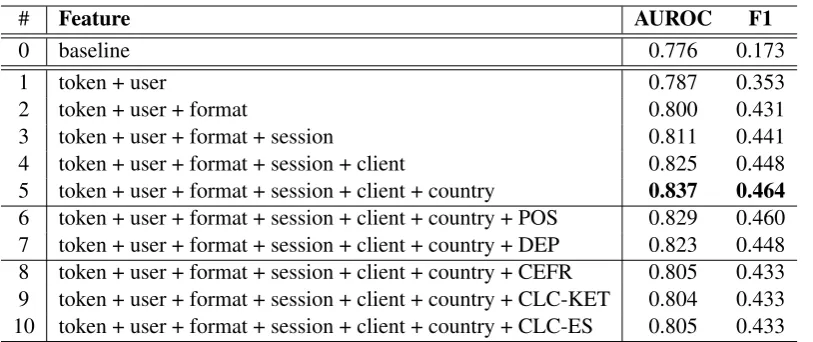
Sequence-to-sequence model We follow the same training procedure to build sequence-to-sequence models - see Table2. Similar results are observed: all our models perform better than the baseline (Table2#0); exercise-level features con-tribute to the overall performance improvements (Table 2 #1-5); and token-level and language-specific features seem to be detrimental and bring performance down (Table 2 #6-10). The best sequence-to-sequence model uses all the exercise-level features, achieving an AUROC score of 0.837 and an F1 score of 0.464 - see Table2#5.
Combining two sequence models Our best se-quence labelling model (seqlabel) and our best sequence-to-sequence model (seq2seq) achieve the same AUROC score of 0.837; while seqlabelyields a better F1 score of 0.480, com-pared to an F1 score of 0.464 forseq2seq.
We further combine these two best models us-ing linear interpolation:
Pcombined= (1−λ)Pseqlabel+λPseq2seq (14)
where Pseqlabel represents the score from the
sequence labelling model, Pseq2seq represents
the score from the sequence-to-sequence model, and λ is a parameter that controls the impact the sequence-to-sequence model has on the final score. After tuningλon the development set, we set it to 0.5.
Results of our best individual models and the fi-nal combined model are reported in Table3. We can see that the combined model yields the overall best results, which suggests that our two individ-ual neural sequence models capture complemen-tary information even though they are both trained on the same group of features.
5 Official evaluation results
Our submissions to the shared task are the results of our best systems. As each participating team is allowed to submit up to 10 runs, we first run our best sequence labelling, sequence-to-sequence and combined systems from the previous section on theen estest set.
# Feature AUROC F1
0 baseline 0.776 0.173
1 token + user 0.787 0.353
2 token + user + format 0.800 0.431
3 token + user + format + session 0.811 0.441
4 token + user + format + session + client 0.825 0.448 5 token + user + format + session + client + country 0.837 0.464
[image:6.595.99.506.60.231.2]6 token + user + format + session + client + country + POS 0.829 0.460 7 token + user + format + session + client + country + DEP 0.823 0.448 8 token + user + format + session + client + country + CEFR 0.805 0.433 9 token + user + format + session + client + country + CLC-KET 0.804 0.433 10 token + user + format + session + client + country + CLC-ES 0.805 0.433
Table 2: Results of our sequence-to-sequence models on theen esdevelopment set. The results of our best model are marked inbold.
Model AUROC F1
seqlabel 0.837 0.480 seq2seq 0.837 0.464 combined 0.843 0.481
Table 3: Results of our best models on theen es de-velopment set. The best results are marked inbold.
thees enandfr entracks using the same network architecture and the same group of features as for
en es. No tuning of (hy)parameters is per-formed for new datasets or languages.
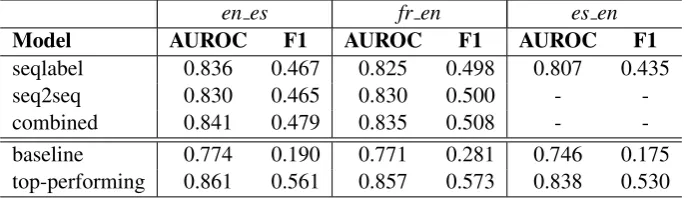
The official results of our submissions for all three language tracks are reported in Table4. Re-sults on the en es test set are similar to those on the en es development set (see Table 3) - no significant drop is observed. The combined model produces the best overall performance, and theseqlabelmodel outperforms theseq2seq model. In the fr en track, the combined model again yields the highest AUROC and F1 scores, followed by theseq2seqmodel and the seqlabelmodel. Our es en seq2seqmodel had not finished training by the shared task sub-mission deadline, therefore, we only submit the
es enseqlabelmodel. Based on the results for the other two language tracks, we expect oures en
results might be further improved by combining a seqlabelmodel and aseq2seqmodel.
6 Conclusions and future work
In this paper, we have described the use of recur-rent neural sequence labelling and sequence-to-sequence models for future learner error
predic-tion. We have provided evidence of further perfor-mance gains by combining them together, showing that these two types of sequence models are com-plementary. We have also explored different types of features, which capture exercise-level, token-level and language-specific information. Further-more, we have demonstrated that the same net-work architecture and group of features can be ap-plied directly to build competitive prediction sys-tems across all three languages, without the need for language-specific parameter tuning.
Results of our best systems on the official test sets yield: AUROC=0.841 (ranked sixth out of the fifteen participating teams) and F1=0.479 (ranked third) for theen estrack; AUROC=0.835 (ranked sixth) and F1=0.508 (ranked third) for fr en; and AUROC=0.807 (ranked sixth) and F1=0.435 (ranked fifth) fores en.
Plans for future work include combining the training and development sets to train new mod-els, using better quality token-level features, and exploring other exercise-level features like the amount of time it took for the learner to con-struct and submit their answer and the number of
dayssince the learner started using Duolingo. We would also like to test our approach as well as our language-specific features on a broader scale (i.e.using corpora which cover language learners at different levels, ideally ranging from basic to proficient).
Acknowledgments
en es fr en es en
Model AUROC F1 AUROC F1 AUROC F1
seqlabel 0.836 0.467 0.825 0.498 0.807 0.435
seq2seq 0.830 0.465 0.830 0.500 -
-combined 0.841 0.479 0.835 0.508 -
-baseline 0.774 0.190 0.771 0.281 0.746 0.175 top-performing 0.861 0.561 0.857 0.573 0.838 0.530
Table 4: Official results of our submitted systems on the test sets for all three tracks: seqlabelis our best se-quence labelling model,seq2seqis our best sequence-to-sequence model, andcombinedis the combination of these two models. For comparison, we also include thebaselineresults provided by the shared task organisers and the results from thetop-performingsystems.
and Ahmed Zaidi for providing us with the CLC and EVP resources. Our gratitude goes also to the shared task organisers for coordinating the task. We acknowledge NVIDIA for an Academic Hard-ware Grant.
References
Annette Capel. 2012. Completing the English Vocabu-lary Profile: C1 and C2 vocabuVocabu-lary. English Profile Journal, 3(e1).
Council of Europe. 2011. Common European Frame-work of Reference for Languages: Learning, Teach-ing, Assessment. Cambridge University Press.
Robert Dale, Ilya Anisimoff, and George Narroway. 2012. HOO 2012: A Report on the Preposition and Determiner Error Correction Shared Task. In Pro-ceedings of the 7th Workshop on Innovative Use of
NLP for Building Educational Applications, pages
54–62, Montr´eal, Canada. Association for Compu-tational Linguistics.
Robert Dale and Adam Kilgarriff. 2011. Helping Our Own: The HOO 2011 Pilot Shared Task. In Pro-ceedings of the 13th European Workshop on
Natu-ral Language Generation, pages 242–249, Nancy,
France. Association for Computational Linguistics.
Vidas Daudaravicius, Rafael E. Banchs, Elena Volod-ina, and Courtney Napoles. 2016. A Report on the Automatic Evaluation of Scientific Writing Shared Task. InProceedings of the 11th Workshop on Inno-vative Use of NLP for Building Educational
Appli-cations, pages 53–62, San Diego, CA. Association
for Computational Linguistics.
Sepp Hochreiter and J¨urgen Schmidhuber. 1997. Long Short-Term Memory. Neural Computation, 9(8):1735–1780.
Guillaume Klein, Yoon Kim, Yuntian Deng, Jean Senellart, and Alexander Rush. 2017. OpenNMT: Open-Source Toolkit for Neural Machine
Transla-tion. InProceedings of ACL 2017, System
Demon-strations, pages 67–72, Vancouver, Canada. Associ-ation for ComputAssoci-ational Linguistics.
Lung-Hao Lee, Gaoqi RAO, Liang-Chih Yu, Endong XUN, Baolin Zhang, and Li-Ping Chang. 2016.
Overview of NLP-TEA 2016 Shared Task for Chi-nese Grammatical Error Diagnosis. InProceedings of the 3rd Workshop on Natural Language Process-ing Techniques for Educational Applications, pages 40–48, Osaka, Japan. The COLING 2016 Organiz-ing Committee.
Lung-Hao Lee, Liang-Chih Yu, and Li-Ping Chang. 2015. Overview of the NLP-TEA 2015 Shared Task for Chinese Grammatical Error Diagnosis. In
Proceedings of the 2nd Workshop on Natural Lan-guage Processing Techniques for Educational Appli-cations, pages 1–6, Beijing, China. Association for Computational Linguistics.
Hwee Tou Ng, Siew Mei Wu, Ted Briscoe, Christian Hadiwinoto, Raymond Hendy Susanto, and Christo-pher Bryant. 2014. The CoNLL-2014 Shared Task on Grammatical Error Correction. InProceedings of the Eighteenth Conference on Computational
Nat-ural Language Learning: Shared Task, pages 1–
14, Baltimore, Maryland. Association for Compu-tational Linguistics.
Hwee Tou Ng, Siew Mei Wu, Yuanbin Wu, Christian Hadiwinoto, and Joel Tetreault. 2013. The CoNLL-2013 Shared Task on Grammatical Error Correction.
In Proceedings of the Seventeenth Conference on
Computational Natural Language Learning: Shared Task, pages 1–12, Sofia, Bulgaria. Association for Computational Linguistics.
Diane Nicholls. 2003. The Cambridge Learner Cor-pus - error coding and analysis for lexicography and ELT. InProceedings of the Corpus Linguistics 2003
Conference, pages 572–581.
[image:7.595.128.473.63.162.2]Allen Schmaltz, Yoon Kim, Alexander Rush, and Stu-art Shieber. 2017. Adapting Sequence Models for Sentence Correction. In Proceedings of the 2017 Conference on Empirical Methods in Natural
Lan-guage Processing, pages 2807–2813, Copenhagen,
Denmark. Association for Computational Linguis-tics.
Burr Settles, Chris Brust, Erin Gustafson, Masato Hagiwara, and Nitin Madnani. 2018. Second Lan-guage Acquisition Modeling. InProceedings of the 13th Workshop on Innovative Use of NLP for Build-ing Educational Applications. Association for Com-putational Linguistics.
Helen Yannakoudakis, Marek Rei, Øistein E. Ander-sen, and Zheng Yuan. 2017. Neural Sequence-Labelling Models for Grammatical Error Correction.
In Proceedings of the 2017 Conference on
Empiri-cal Methods in Natural Language Processing, pages
2795–2806, Copenhagen, Denmark. Association for Computational Linguistics.
Zheng Yuan and Ted Briscoe. 2016. Grammatical er-ror correction using neural machine translation. In
Proceedings of the 2016 Conference of the North American Chapter of the Association for
Computa-tional Linguistics: Human Language Technologies,