Implementation of a Commercially Sold Computerized
Physician Order Entry System
WHAT’S KNOWN ON THIS SUBJECT: Despite widespread enthusiasm for CPOE as a tool to help transform quality and patient safety, no published study results to date have associated CPOE implementation with significant reductions in hospital-wide mortality rates.
WHAT THIS STUDY ADDS: Implementation of a locally modified, commercially sold CPOE system was associated with a
statistically significant reduction in the hospital-wide mortality rate at a quaternary care academic children’s hospital.
abstract
BACKGROUND:Implementations of computerized physician order entry (CPOE) systems have previously been associated with either an increase or no change in hospital-wide mortality rates of inpatients. Despite wide-spread enthusiasm for CPOE as a tool to help transform quality and patient safety, no published studies to date have associated CPOE implementation with significant reductions in hospital-wide mortality rates.
OBJECTIVE:The objective of this study was to determine the effect on the hospital-wide mortality rate after implementation of CPOE at an academic children’s hospital.
PATIENTS AND METHODS:We performed a cohort study with historical controls at a 303-bed, freestanding, quaternary care academic children’s hospital. All nonobstetric inpatients admitted between January 1, 2001, and April 30, 2009, were included. A total of 80 063 patient discharges were evaluated before the intervention (before November 1, 2007), and 17 432 patient discharges were evaluated after the intervention (on or after No-vember 1, 2007). On NoNo-vember 4, 2007, the hospital implemented locally modified functionality within a commercially sold electronic medical record to support CPOE and electronic nursing documentation.
RESULTS:After CPOE implementation, the mean monthly adjusted mortal-ity rate decreased by 20% (1.008 – 0.716 deaths per 100 discharges per month unadjusted [95% confidence interval: 0.8%– 40%];P⫽.03). With observed versus expected mortality-rate estimates, these data suggest that our CPOE implementation could have resulted in 36 fewer deaths over the 18-month postimplementation time frame.
CONCLUSION:Implementation of a locally modified, commercially sold CPOE system was associated with a statistically significant reduction in the hospital-wide mortality rate at a quaternary care academic children’s hos-pital.Pediatrics2010;126:14–21
AUTHORS:Christopher A. Longhurst, MD, MS,a,bLayla
Parast, MS,cChristy I. Sandborg, MD,a,dEric Widen, MHA,b
Jill Sullivan, RN, MSN,dJin S. Hahn, MD,e,fChristopher G.
Dawes, MBA,dand Paul J. Sharek, MD, MPHf,g
Departments ofaPediatrics,eNeurology, andfPediatrics,
Stanford University School of Medicine, Palo Alto, California; Departments ofbClinical Informatics andgQuality Management, dLucile Packard Children’s Hospital, Palo Alto, California; and cDepartment of Biostatistics, Harvard University, Boston,
Massachusetts
KEY WORDS
safety, electronic records, mortality rates
ABBREVIATIONS IOM—Institute of Medicine EMR— electronic medical record CPOE— computerized physician order entry ADE—adverse drug event
LPCH—Lucile Packard Children’s Hospital CMS—Centers for Medicare and Medicaid Services PHIS—Pediatric Health Information System O:E— observed-to-expected
ARIMA—autoregressive integrated moving average RRT—rapid-response team
CI— confidence interval
www.pediatrics.org/cgi/doi/10.1542/peds.2009-3271
doi:10.1542/peds.2009-3271
Accepted for publication Apr 5, 2010
Address correspondence to Christopher A. Longhurst, MD, MS, Lucile Packard Children’s Hospital, 1520 Page Mill Rd, MC 5522, Palo Alto, CA, 94304. E-mail: [email protected]
PEDIATRICS (ISSN Numbers: Print, 0031-4005; Online, 1098-4275).
Copyright © 2010 by the American Academy of Pediatrics
After the Institute of Medicine (IOM) published the landmark reportsTo Err
Is Human1 and Crossing the Quality
Chasm,2many pediatric hospitals
em-barked on multiyear electronic medi-cal record (EMR) implementations in an effort to enhance patient safety and quality of care.3 This rush to adopt
EMRs was further accelerated by the Leapfrog Group, which promotes com-puterized physician order entry (CPOE) as a tool to enhance patient safety.4
Early literature supported these rec-ommendations, including evidence that comprehensive EMRs with CPOE can decrease medication errors and adverse drug events (ADEs),5,6improve
nursing documentation efficiency,7
and improve laboratory, radiology, and medication turnaround times.8,9
As a result of the safety, quality, and efficiency promises of CPOE, 28% of US hospitals have implemented CPOE for medications on at least 1 patient care unit.10
In 2005, serious questions were raised about the legitimacy of the EMR-enabled quality-improvement promise when Han et al11 concluded that the
rapid implementation of a minimally modified, commercially available CPOE system in a pediatric critical care unit was associated with an increase in mortality rate for children admitted via interfacility transport over a 5-month period. Medical informati-cists and health policy researchers re-sponded immediately to this report with both concern and cautious opti-mism.12–15 Several groups
subse-quently published study results that showed that similar CPOE implementa-tions in their own hospitals were not associated with an increase in mortal-ity rates.16,17Many experts have since
attempted to identify key differences associated with the conflicting out-comes, with most concluding that these findings highlight the impor-tance of careful workflow redesign
when implementing CPOE.18,19However,
no published results from studies of either children or adults have shown reductions in hospital-wide mortality rates.20 In this study our goal was to
evaluate the effects of implementation of a locally modified commercial CPOE system on the hospital-wide mortality rate of pediatric inpatients at an aca-demic children’s hospital.
METHODS
Design/Setting/Patients
To determine the effect of CPOE imple-mentation on the hospital-wide mortal-ity rate, we conducted a cohort study using historical controls at the main campus of the Lucile Packard Chil-dren’s Hospital (LPCH) at Stanford Uni-versity. The LPCH is presently a 303-bed quaternary care children’s hospital; 225 nonobstetric beds are located on the main campus. At the time of EMR implementation, the LPCH had 271 beds, of which 193 nonobstetric beds were located at the main campus. The analysis reported here was reviewed and approved by the Stanford Univer-sity School of Medicine’s institutional review board.
Patients were included if they were admitted between January 1, 2001, and April 30, 2009. The preintervention period was between January 1, 2001, and October 31, 2007, and the post-intervention period was between No-vember 1, 2007, and April 30, 2009. The CPOE implementation occurred on November 4, 2007. All obstetric pa-tients were excluded from analysis.
Intervention
In 2004, the LPCH embarked on a mul-tiyear EMR-implementation effort. The first implementation stage was fo-cused on replacement of preexisting functionality for results-viewing and nonmedication unit-clerk– based or-der entry provided by a legacy hospital information system with software
from a commercial vendor (Cerner Corporation, Kansas City, MO). This foundational phase was activated Sep-tember 11, 2005. The second phase, ac-tivated on November 4, 2007, was focused on achieving sustainable im-provements in patient safety and qual-ity, operational efficiency, regulatory compliance, and research capabilities through implementation of CPOE with clinical decision support and compre-hensive nursing and support service documentation.
In the absence of evidence-based best practices to guide our activation ap-proach, we developed an acuity-based activation strategy that included a rapid, “big-bang” activation for 90% of inpatient beds at the main campus on a single day (November 4, 2007). Units included in this activation were all nurseries, including the NICU, and all medical, surgical, and obstetric wards. Excluded were the PICU and the cardiovascular intensive care unit (CVICU). CPOE was activated in the PICU 10 months later (September 2008). As of April 30, 2009, the only inpatient unit at the main LPCH campus that had not implemented CPOE was the CVICU.
Main Outcome Measures
The primary outcome measure was the hospital-wide mortality rate ex-cluding obstetrics. An eligible patient admission was defined as any admis-sion during which a patient spent at least 1 day on 1 of the nonobstetric units at the LPCH. Case-mix index (CMI), based on the US Centers for Medicare and Medicaid Services (CMS) cost weights, was assessed monthly for the hospital (well-infant nursery and ob-stetric patients were excluded as de-fined in the CMS pediatric methodol-ogy) and compared before and after the intervention to determine if signif-icant differences in severity of illness existed.21 Observed-to-expected (O:E)
mortality ratios were obtained from
base that contains inpatient data from 42 not-for-profit tertiary care pediatric hospitals affiliated with the Child Health Corporation of America (Shaw-nee Mission, KS). In this database, the likelihood of mortality for each dis-charge is based on the assigned 3M all-patient refined diagnosis-related group (APR-DRG) and risk-of-mortality (ROM) level. The likelihood of mortality for a specific combination of APR-DRG and ROM is the national pediatric mor-tality rate calculated by the Thomson Reuters Corporation from its norma-tive pediatric database of publicly available inpatient data. The values are assigned to each discharge in the PHIS and summed across a population of in-terest to determine the number of ex-pected mortalities.22
Statistical Analysis
A quasi-experimental approach was used to assess the impact of the imple-mentation of CPOE on mortality rate.23,24 Because the mortality-rate
outcomes are reported monthly, time-series modeling was performed to model the potential autocorrelations in time. Autoregressive integrated moving average (ARIMA) models with a 12-month seasonality effect were im-plemented, with the Akaike Informa-tion Criterion used for covariance model selection to avoid overparam-eterization of the time-series model while maintaining adequate fit. Nor-malized prediction errors from the full model were evaluated to ensure model accuracy. The estimated coefficient of the preintervention versus postinter-vention periods was interpreted as the impact of the intervention, expressed as the number of additional or de-creased deaths per 100 discharges that have occurred per month since the date of implementation. Identical time-series methodology has also been used to evaluate the effect of a
rapid-response team (RRT) (a multi-disciplinary precode team available 24 hours/day for consultation within 15 minutes of a request) on the hospital-wide mortality rate at our own institu-tion.25 All models were adjusted for
monthly case-mix index and for the RRT intervention that had previously been associated with a significant improve-ment in mortality rates.21,25Average O:E
ratios from the LPCH and the PHIS da-tabase were analyzed by using a 2-sample t test and a paired t test when appropriate. SAS 9.1 statistical software (SAS Institute, Cary, NC) was used for statistical analysis.26
RESULTS
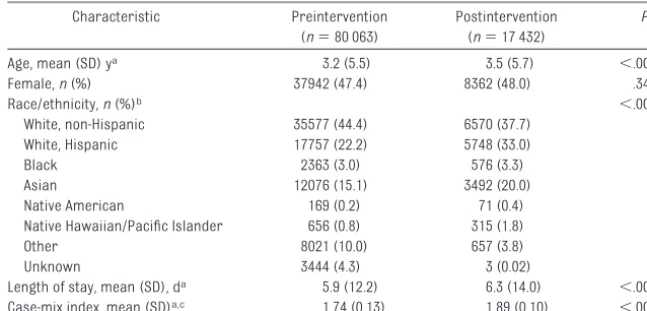
There was no significant difference be-tween pre-CPOE and post-CPOE popula-tions on the basis of patient gender (47.4% females versus 48.0% females; P⫽.34) (Table 1). Statistically signifi-cant differences were noted for age (mean [SD]: 3.2 [5.5] vs 3.5 [5.7] years), severity of illness as represented by case-mix index (mean [SD]: 1.74 [0.13] vs 1.89 [0.10]), and race/ethnicity, with fewer individuals identified as white or of unknown ethnicity and more His-panic and Asian individuals in the postintervention group. There was a significant increase in length of stay
during the postimplementation period (mean [SD]: 5.9 [12.2] vs 6.3 [14.0] days;P⬍.001).
As a result of participation in the PHIS database, the LPCH was able to com-pare local O:E mortality ratios before and after the intervention and com-pare LPCH mortality ratios to those of the 41 other not-for-profit tertiary care pediatric hospitals affiliated with the Child Health Corporation of America that contribute data to PHIS. O:E ratios at the LPCH decreased significantly be-tween the 82 months before and the 18 months after the intervention (0.89 – 0.45 [95% confidence interval (CI) for difference: 0.302– 0.591]; P ⬍ .001). Preintervention O:E ratios were similar for the LPCH and PHIS (0.89 vs 0.90;P⫽ .90). However, the postintervention LPCH O:E ratios were significantly lower than the postintervention PHIS O:E ratios (0.45 vs 0.72 [95% CI for dif-ference: 0.144 – 0.397];P⫽.0003).
Mean monthly unadjusted mortality rates before and after the intervention were 1.008 and 0.716 deaths per 100 discharges, respectively (Table 2). Re-sults of a simplettest that used only 18 months of pre– and post–CPOE-implementation data indicated a sig-nificant decrease of 24.5% in house-(n⫽80 063) (n⫽17 432)
Age, mean (SD) ya 3.2 (5.5) 3.5 (5.7) ⬍.001
Female,n(%) 37942 (47.4) 8362 (48.0) .3432
Race/ethnicity,n(%)b ⬍.001
White, non-Hispanic 35577 (44.4) 6570 (37.7)
White, Hispanic 17757 (22.2) 5748 (33.0)
Black 2363 (3.0) 576 (3.3)
Asian 12076 (15.1) 3492 (20.0)
Native American 169 (0.2) 71 (0.4)
Native Hawaiian/Pacific Islander 656 (0.8) 315 (1.8)
Other 8021 (10.0) 657 (3.8)
Unknown 3444 (4.3) 3 (0.02)
Length of stay, mean (SD), da 5.9 (12.2) 6.3 (14.0) ⬍.001
Case-mix index, mean (SD)a,c 1.74 (0.13) 1.89 (0.10) ⬍.001
The preintervention period was between January 1, 2001, and October 31, 2007, and the postintervention period was between November 1, 2007, and April 30, 2009.
aTwo-samplettest assuming equal variances was used for age, length of stay, and case-mix index. bThe2test was used for race/ethnicity.
wide mortality rate (P ⫽ .04). Evaluating mortality rates in just the units that went live during this time frame also revealed a significant de-crease (1.09 vs 0.61;P⫽.02). By using a more appropriate time-series analy-sis of the whole study period, which allowed adjustment for the RRT inter-vention and severity of illness when us-ing CMI, a significant decrease of 20% occurred after implementation of CPOE (95% CI: 0.8%– 40.0%; P⫽ .03) (Fig 1). The ARIMA (2,0,0)(1,0,0) model contained an intercept term, 2 auto-correlation terms, a yearly seasonal effect, and a significant step interven-tion that started in November 2007. Ex-amination of model fit showed small, normalized prediction errors; all were
⬍2.5 in magnitude. Results of predic-tor error autocorrelation, partial
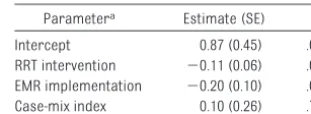
auto-correlation, and inverse autocorrela-tion were insignificant at all time lags, which indicates that the model predic-tion errors had no significant patterns that had not been modeled. The white-noise test indicated that no significant patterns in the model prediction er-rors existed, and stationarity of the prediction errors was observed by the unit root and seasonal root tests. There was no evidence of a linear trend before or after the intervention. Parameter estimates of the ARIMA in-tervention model are shown in Table 3. Given that previous studies that evalu-ated CPOE impacts on mortality rates focused on patients admitted to the PICU, we also stratified our crude mor-tality data by using the same criteria as Del Beccaro et al.16In this analysis,
there was no statistically significant
correlation between CPOE implemen-tation and PICU mortality rates for ei-ther the November 2007 CPOE imple-mentation in non-PICU areas (18 months pre [4.82] vs 10 months post [4.98] implementation;P⫽.91) or the September 2008 implementation in the PICU (28 months pre [4.88] vs 8 months post [3.77] implementation;P⫽.40).
The impact of the CPOE intervention, as evaluated by using statistical model-ing, was a decrease of 0.204 (95% CI: 0.008 – 0.400) deaths per 100 dis-charges or 2.04 deaths per 1000 discharges. The average number of discharges per month in our hospital during the entire study period was 975. Therefore, during the 18-month postintervention period, our findings suggest, when using statistical model-ing, that implementation of CPOE and
0.0 0.2 0.4 0.6 0.8 1.0 1.2 1.4 1.6 1.8 2.0
Jan 2001 Jan 2002 Jan 2003 Jan 2004 Jan 2005 Jan 2006 Jan 2007 Jan 2008 Jan 2009
Pre-EMR Post-EMR
M
o
rt
al
it
y
per 10
0 a
d
m
is
s
io
n
s
Mean mortality rate
FIGURE 1
Hospital-wide mortality rate per 100 discharges according to month (excluding the obstetrical population). The pre-EMR period was between January 1, 2001, and October 31, 2007, and the postintervention period was between November 1, 2007, and April 30, 2009.
TABLE 2 Outcomes Before and After EMR Implementation
Outcome Preintervention Postintervention P
No. of deaths 806 125 NA
No. of discharges 80063 17432 NA
Hospital-wide mortality rate per 100 dischargesa
1.008 0.716 .03b
The preintervention period was between January 1, 2001, and October 31, 2007, and the postintervention period was between November 1, 2007, and April 30, 2009.
aDefined as the mean of the number of deaths per calendar month divided by the number of discharges per calendar
month; excludes obstetric patients.
bARIMA model intervention analysis, adjusting for case-mix index and RRT implementation on September 1, 2005.
TABLE 3 Parameter Estimates of the Impact of the EMR Implementation on Mortality Rate
Parametera Estimate (SE) P
Intercept 0.87 (0.45) .06
RRT intervention ⫺0.11 (0.06) .08 EMR implementation ⫺0.20 (0.10) .03 Case-mix index 0.10 (0.26) .70
Autoregressive lags and seasonal autoregressive lags are not shown.
aARIMA model parameter estimates.
on the basis of expected versus ob-served mortality.
DISCUSSION
To our knowledge, these are the first published study results to show signif-icant reductions in hospital-wide mor-tality rate after implementation of CPOE. These data support the recom-mendations made by the IOM, the Leap-frog group, the US Department of Health and Human Services, and the National Coordinator for Health Infor-mation Technology to implement CPOE as a strategy for improving patient safety and quality of care at a national level.1,2,4,27,28 These recommendations
have not been without controversy, be-cause they are expensive10 and have
been challenged as a result of limited published evidence supporting qual-ity and safety-outcomes improve-ments.29,30 Our results add important
information to this debate by providing evidence that CPOE can have a signifi-cant impact in a relatively short time frame on hospital-wide mortality.
Multiple components of the EMR inter-vention could have contributed to the decrease in mortality rates witnessed at the LPCH. First, although we de-signed and deployed ⬃300 intranet-based standardized paper order sets to prepare for CPOE,31implementation
of the EMR “hard-wired” these order sets, which made them easier to use and drove consistency in care.32
Sec-ond, all patient care orders were stan-dardized. Although many authors have touted the safety benefits of CPOE with clinical decision support on medica-tion orders,5,6,33 fewer researchers
have investigated the effect of struc-turing information collection on pa-tient care orders and how the result-ing standardization may result in better communication with staff. Third, all orders, vital-sign
documenta-real time, which is a fundamental shift in basic care processes. Finally, intro-duction of CPOE eliminated the redun-dant transcription of medication or-ders by pharmacists, which improved accuracy and decreased turnaround times.9 Indeed, in our solid-organ
transplant unit and PICU, we found re-ductions of 19% and 5%, respectively, from stat medication order to ad-ministration. Because many au-thors12,18,19 now point to vasoactive
medication-administration delay as the most proximate cause of the mortality-rate increase described by Han et al, it seems highly plausible that such clinically tangible improvements in turnaround times could have the re-verse effect. The manifestations of these EMR-enabled interventions in-clude increased care standardization, enhanced communication, and in-creased access to more timely infor-mation at the point of care. All 3 of these outcomes have been identified by the Institute for Healthcare Im-provement as critical for decreasing mortality rates,34and all 3 were cited
as critical for promoting increased sit-uational awareness and highly reliable patient care.35,36
Although the manifestations discussed above could conceivably affect mortal-ity rates, no other groups have pub-lished a hospital-wide mortality-rate decrease similar to the one described here. The variation in CPOE outcomes has been hypothesized previously to be the direct result of the implementation process.16,18Similar to those who used
an evidence-based approach to EMR-system selection,37we actively sought
to undertake an evidence-based ap-proach to EMR implementation by closely adhering to published guide-lines for best-practice CPOE implemen-tation.38We focused on achieving
qual-ity improvement by designing an
and redesigning our care processes to help drive these desired benefits. At the same time, we actively worked to mitigate unintended consequences by considering evidence-based recom-mendations for recognizing and pre-venting these issues.39–41The
success-ful implementation of CPOE, at least on the basis of our mortality-rate declines, lends credence to these recommendations.
patients.42Furthermore, any
theoreti-cal age risk factors are adjusted for in the O:E mortality ratio where statisti-cal significance remains. Thus, the slightly higher percentage of minority patients and the marginal increase in patient age are not likely to be the cause of the improved mortality rate.
Second, it is possible that there were 1 or more other interventions im-plemented contemporaneously that might have decreased house-wide mortality rates. Indeed, over the past 9 years at the LPCH we have imple-mented multiple interventions based on recommendations from the Insti-tute for Healthcare Improvement, IOM, CMS, Agency for Healthcare Research and Quality, Joint Commission on Accreditation of Healthcare Organi-zations, and the Leapfrog Group. These interventions include catheter-associated bloodstream infection (CABSI) and surgical-site infection (SSI) reduction interventions, ADE-reduction interventions, hospitalist-program creation, and RRT implemen-tation. Our infection-reduction efforts have been somewhat successful over the years; however, with the exception of the NICU setting, no significant de-creases in CABSI or SSI rates have been witnessed (data not shown). Our ADE-reduction work has yielded out-standingly low rates of drug-related harm,43,44 yet local and national data
suggest that drug-related harm is a rare cause of mortality in the pedi-atric population44; thus, it is an
un-likely cause of the mortality decreases we have witnessed. Our hospitalist program, initiated in 2003, is an im-portant component of our quality-improvement program, yet our local data have shown no evidence of mortality-rate changes associated with
the program’s inception. It is impor-tant to note that the mortality-rate trends in our PICU suggest that our hospital-wide mortality-rate decrease was not a result of substantial changes in PICU mortality rates for the 10 months when other units had CPOE but the PICU did not. A nonsignificant de-crease in mortality rate occurred in the 8 months after CPOE implementa-tion in the PICU.
Finally, our RRT implementation was associated with a decreased mortality rate25; however, we adjusted for this
intervention in our model and statisti-cal significance remained. Although these other interventions remain a potential source of mortality-rate de-cline in combination, it would be an un-likely coincidence that they would have a profound effect on mortality rates at the exact time that the CPOE inter-vention was introduced. Also, results of a postintervention analysis of O:E ratios comparing the LPCH to 41 other children’s hospitals in the PHIS data-base suggest that secular trends can-not explain the significant declines witnessed. We recognize that these data represent a single center’s expe-rience; therefore, the results cannot necessarily be generalized to other hospitals.
CONCLUSIONS
Implementation of a locally modified CPOE system in our freestanding, qua-ternary care academic children’s hos-pital was associated with a statisti-cally significant reduction in the hospital-wide mortality rate. This re-duction cannot be explained by differ-ences in patient characteristics or se-verity of illness between the control and postintervention population, nor can it be explained by secular trends or the implementation of other
inter-ventions known to be associated with mortality-rate reduction. On the basis of our findings, we estimate that 36 children’s lives were saved in 18 months at the LPCH in association with the CPOE implementation. The poten-tial implications of these findings on national mortality statistics in chil-dren are dramatic. Future research should focus on replicating these find-ings in other inpatient settfind-ings and populations and evaluating the cost-effectiveness of this intervention.
ACKNOWLEDGMENTS
We gratefully acknowledge the entire LPCH Clinical Transformation Project team (led by program director Robert Schwyn, MBA [Technology Leadership Partners LLC]), the members of which are too numerous to mention but without whom CPOE would not have been implemented so successfully at the LPCH. We also thank specific people for their leadership in the CPOE implementation: at Stanford University School of Medicine, William Benitz, MD (chief of neonatology), David Cornfield, MD (chief of pediatric pulmonary and critical care medicine), and Maurice Druzin, MD (chief of maternal and fetal medicine); and at the LPCH, Susan Flanagan, RN (chief operating officer), Lisa Grisim, RN, MSN (director of In-formation Services operations), John McInally, RN, MSE, MBA (former chief information officer), Brad Toussaint (vice-president of process excellence), and Pam Wells, RN (vice-president of patient care services and chief nurs-ing officer). Special thanks go to Mary McIntyre, RN (director, Department of Decision Support Services, LPCH) and Meghna Patel (supervisor, Depart-ment of Clinical Informatics, LPCH), who provided some of the administra-tive data for this study.
of Health Care in America.To Err Is Human: Building a Safer Health System. Washing-ton, DC: National Academy Press; 1999
2. Institute of Medicine, Committee on Quality of Health Care in America.Crossing the Quality Chasm: A New Health System for the 21st Century. Washington, DC: National Academy Press; 2001
3. Menachemi N, Brooks RG, Schwalenstocker E, Simpson L. Use of health information technology by children’s hospitals in the United States.Pediatrics. 2009;123(suppl 2):S80 –S84
4. The Leapfrog Group. Computerized Physician Order Entry. Available at: www.leapfroggroup. org/for_hospitals/leapfrog_hospital_survey_ copy/leapfrog_safety_practices/cpoe. Ac-cessed September 28, 2009
5. Upperman JS, Staley P, Friend K, et al. The impact of hospital-wide computerized phy-sician order entry on medical errors in a pediatric hospital.J Pediatr Surg.2005; 40(1):57–59
6. Holdsworth MT, Fichtl RE, Raisch DW, et al. Impact of computerized prescriber order entry on the incidence of adverse drug events in pediatric inpatients.Pediatrics. 2007;120(5):1058 –1066
7. Poissant L, Pereira J, Tamblyn R, Kawasumi Y. The impact of electronic health records on time efficiency of physicians and nurses: a systematic review.J Am Med Inform As-soc.2005;12(5):505–516
8. Tierney WM, Miller ME, Overhage JM, Mc-Donald CJ. Physician inpatient order-writing on microcomputer workstations: effects on resource utilization.JAMA.1993; 269(3):379 –383
9. Mekhjian HS, Kumar RR, Kuehn L, et al. Im-mediate benefits realized following imple-mentation of physician order entry at an academic medical center.J Am Med Inform Assoc.2002;9(5):529 –539
10. Jha AK, DesRoches CM, Campbell EG, et al. Use of electronic health records in U.S. hospitals. N Engl J Med. 2009;360(16): 1628 –1638
11. Han YY, Carcillo JA, Venkataraman ST, et al. Unexpected increased mortality after im-plementation of a commercially sold com-puterized physician order entry system [published correction appears in Pediat-rics. 2006;117(2):594]. Pediatrics. 2005; 116(6):1506 –1512
12. Longhurst C, Sharek P, Hahn J, Sullivan J, Classen D. Perceived increase in mortality after process and policy changes
imple-entry.Pediatrics.2006;117(4):1450 –1451
13. Jacobs BR, Brilli RJ, Hart KW. Perceived in-crease in mortality after process and policy changes implemented with computerized physician order entry. Pediatrics. 2006; 117(4):1451–1452
14. Rosenbloom ST, Harrell FE Jr, Lehmann CU, Schneider JH, Spooner SA, Johnson KB. Per-ceived increase in mortality after process and policy changes implemented with com-puterized physician order entry.Pediatrics. 2006;117(4):1452–1455
15. Wachter RM. Expected and unanticipated consequences of the quality and informa-tion technology revoluinforma-tions. JAMA. 2006; 295(23):2780 –2783
16. Del Beccaro MA, Jeffries HE, Eisenberg MA, Harry ED. Computerized provider order en-try implementation: no association with in-creased mortality rates in an intensive care unit.Pediatrics.2006;118(1):290 –295
17. Keene A, Ashton L, Shure D, Napoleone D, Katyal C, Bellin E. Mortality before and after initiation of a computerized physician order entry system in a critically ill pediatric pop-ulation. Pediatr Crit Care Med.2007;8(3): 268 –271
18. Sittig DF, Ash JS, Zhang J, Osheroff JA, Shabot MM. Lessons from unexpected in-creased mortality after implementation of a commercially sold computerized physician order entry system.Pediatrics.2006;118(2): 797– 801
19. Ammenwerth E, Talmon J, Ash JS, et al. Im-pact of CPOE on mortality rates: contradic-tory findings, important messages. Meth-ods Inf Med.2006;45(6):586 –593
20. van Rosse F, Maat B, Rademaker CM, van Vught AJ, Egberts AC, Bollen CW. The effect of computerized physician order entry on medication prescription errors and clinical outcome in pediatric and intensive care: a systematic review.Pediatrics.2009;123(4): 1184 –1190
21. US Department of Health and Human Ser-vices, Centers for Medicare and Medicaid Services. Acute Inpatient PPS. Available at: www.cms.gov/AcuteInPatientPPS/FFD/. Ac-cessed April 14, 2010
22. Slonim AD, Khandelwal S, He J, et al. Char-acteristics associated with pediatric inpa-tient mortality.Pediatrics.2010; In press
23. Cook TD, Campbell DT.Quasi-Experimentation: Design and Analysis Issues for Field Settings. Chicago, IL: Rand McNally College Publishing Co; 1979
24. Box GEP, Jenkins GM.Time Series Analysis:
Holden Day Publishing; 1976
25. Sharek PJ, Parast LM, Leong K, et al. Effect of a rapid response team on hospital-wide mortality and code rates outside the ICU in a children’s hospital. JAMA.2007;298(19): 2267–274
26. Leonard M. Promotional analysis and forecast-ing for demand plannforecast-ing: a practical time series approach. Available at: http://support.sas.com/ rnd/app/papers/PromotionalAnalysis.pdf. Ac-cessed September 28, 2009
27. US Department of Health and Human Ser-vices. Federal health IT strategic plan. Avail-able at: http://healthit.hhs.gov/portal/ server.pt. Accessed September 28, 2009
28. Blumenthal D. Stimulating the adoption of health information technology. N Engl J Med.2009;360(15):1477–1479
29. Berger RG, Kichak JP. Computerized physi-cian order entry: helpful or harmful?J Am Med Inform Assoc.2004;11(2):100 –103
30. Garg AX, Adhikari NK, McDonald H, et al. Ef-fects of computerized clinical decision sup-port systems on practitioner performance and patient outcomes: a systematic review. JAMA.2005;293(10):1223–1238
31. Heffner JE, Brower K, Ellis R, Brown S. Using intranet-based order sets to standardize clinical care and prepare for computerized physician order entry.Jt Comm J Qual Saf. 2004;30(7):366 –376
32. Migita DS, Postetter L, Heath S, Hagan P, Del Beccaro M. Governing peripherally inserted central venous catheters by combining con-tinuous performance improvement and computerized physician order entry. Pedi-atrics.2009;123(4):1155–1161
33. Classen DC, Avery AJ, Bates DW. Evaluation and certification of computerized provider order entry systems.J Am Med Inform As-soc.2007;14(1):48 –55
34. Institute for Healthcare Improvement.Move Your Dot: Measuring, Evaluating, and Reducing Hospital Mortality Rates (Part 1). Boston, MA: stitute for Healthcare Improvement; 2003. IHI In-novation Series white paper. Available at: www. ihi.org/IHI/Results/WhitePapers/MoveYourDot MeasuringEvaluatingandReducingHospital MortalityRates.htm. Accessed April 14, 2010
35. Amalberti R, Auroy Y, Berwick D, Barach P. Five system barriers to achieving ultrasafe health care.Ann Intern Med.2005;142(9): 756 –764
37. Kannry J, Mukani S, Myers K. Using an evidence-based approach for system selec-tion at a large academic medical center. J Healthc Inf Manag.2006;20(2):84 –99
38. Ash JS, Stavri PZ, Kuperman GJ. A consen-sus statement on considerations for a suc-cessful CPOE implementation.J Am Med In-form Assoc.2003;10(3):229 –234
39. Ash JS, Berg M, Coiera E. Some unintended consequences of information technology in health care: the nature of patient care infor-mation system-related errors.J Am Med In-form Assoc.2004;11(2):104 –112
40. Koppel R, Metlay JP, Cohen A, et al. Role of computerized physician order entry sys-tems in facilitating medication errors. JAMA.2005;293(10):1197–1203
41. Ash JS, Sittig DF, Poon EG, Guappone K, Campbell E, Dykstra RH. The extent and im-portance of unintended consequences re-lated to computerized provider order entry. J Am Med Inform Assoc.2007;14(4):415– 423
42. Coffey RM, Andrews RM, Moy E. Racial, eth-nic, and socioeconomic disparities in esti-mates of AHRQ patient safety indicators. Med Care.2005;43(3 suppl):I48 –I57
43. Takata GS, Mason W, Taketomo C, Logsdon T, Sharek PJ. Pediatric-focused trigger tool to
identify medication-related harm in US chil-dren’s hospitals. Pediatrics. 2008;121(4). Available at: www.pediatrics.org/cgi/
content/full/121/4/e927
44. Sharek PJ, McClead RE Jr, Taketomo C, et al.
An intervention to decrease narcotic-related adverse drug events in children’s hospitals.Pediatrics.2008;122(4). Available
at: www.pediatrics.org/cgi/content/full/122/ 4/e861
Adult Primary Care Physicians Earn Millions Less Than Specialists: Doc-tors who choose adult primary care fields can expect to earn $2.7 million less over their lifetime than those who choose a specialty field—according to a Duke University study reported in theTriangle Business Journal(Gallagher J, May 4, 2010). The study modeled lifetime income of not just MDs but also physician’s assistants, MBAs and college graduates, factoring in years of schooling and work, student debt, income and investment income potential. Results showed that a cardiologist could potentially accumulate $5.2 million in lifetime wealth compared with only $2.5 million for physicians in family or internal medicine primary care. MBAs would amass $1.7 million, a physician’s assistant $850 000, and a college graduate $340 000 over their lifetimes. According to the study published inHealth Affairs(Vaughn B and De Vrieze S), cardiologists would need to take a $148 000 pay cut or primary care would need about a $122 000 pay increase to close the gap between these two different career pathways for physicians. Whether these numbers are as dramatic in pediatrics has yet to be studied.
Noted by JFL, MD
DOI: 10.1542/peds.2009-3271 originally published online May 3, 2010;
2010;126;14
Pediatrics
Sullivan, Jin S. Hahn, Christopher G. Dawes and Paul J. Sharek
Christopher A. Longhurst, Layla Parast, Christy I. Sandborg, Eric Widen, Jill
Services
Updated Information &
http://pediatrics.aappublications.org/content/126/1/14
including high resolution figures, can be found at:
References
http://pediatrics.aappublications.org/content/126/1/14#BIBL
This article cites 32 articles, 10 of which you can access for free at:
Subspecialty Collections
http://www.aappublications.org/cgi/collection/safety_sub Safety
_management_sub
http://www.aappublications.org/cgi/collection/administration:practice Administration/Practice Management
following collection(s):
This article, along with others on similar topics, appears in the
Permissions & Licensing
http://www.aappublications.org/site/misc/Permissions.xhtml
in its entirety can be found online at:
Information about reproducing this article in parts (figures, tables) or
Reprints
http://www.aappublications.org/site/misc/reprints.xhtml
DOI: 10.1542/peds.2009-3271 originally published online May 3, 2010;
2010;126;14
Pediatrics
Sullivan, Jin S. Hahn, Christopher G. Dawes and Paul J. Sharek
Christopher A. Longhurst, Layla Parast, Christy I. Sandborg, Eric Widen, Jill
Commercially Sold Computerized Physician Order Entry System
Decrease in Hospital-wide Mortality Rate After Implementation of a
http://pediatrics.aappublications.org/content/126/1/14
located on the World Wide Web at:
The online version of this article, along with updated information and services, is
by the American Academy of Pediatrics. All rights reserved. Print ISSN: 1073-0397.