TABLE 4: ACCURACY AND PRECISION EVALUATION IN WITHANOLIDE A AND BACOSIDE A ANALYSIS OF PHARMACEUTICAL FORMULATIONS (n=5)
Brand Drug Amount of drug added (ng) Amount of standard
added (ng) Amount found (ng)na=5
Recovery (%)
Herbocam Withanolide A 311.19 100 410.15 99.74
311.19 100 412.24 100.25
311.19 200 513.24 100.39
311.19 200 516.19 101.01
311.19 300 609.18 99.67
Mean 100.21
RSDb(%) 1.386
Bacoside A 70.69 100 169.80 99.47
70.69 100 171.60 100.5
70.69 200 268.64 99.24
70.69 200 269.80 99.67
70.69 300 368.70 98.46
Mean 99.46
RSDb(%) 1.926
an is number of determinations, bRSD is relative standard deviation.
calculated by using formula, % recovery= (T-A)/ S×100 where, T is total amount of drug estimated, A is amount of drug contributed by spansules powder and S is the amount of pure drug added. The result of recovery studies for both withanolide A and bacoside A was found to be around 99-100% (Table 4).
This method was developed for the first time on
HPTLC to estimate the two drugs in formulation, in order to analyze more samples at a time. The method is easy to perform, precise and accurate.
There is significant difference between the RF values of the withanolide A and bacoside A; therefore this analytical method can be utilizes for the simultaneous estimation of this substances.
ACKNOWLEDGEMENTS
Authors are very grateful to Unijules Life Sciences Nagpur, India for their valuable cooperation and guidance to carry out study on HPTLC.
REFERENCES
1. The Indian Herbal Pharmacoepia. Regional Research Laboratory and Indian Drug Manufacturers Association. Mumbai: IDMA; 2002. p. 467. 2. Archana R, Namasivayam A. Antistressor effect of Withania somnifera.
J Ethnopharmacol 1999;64:91-3.
3. Jha NK, Jha AK. Bacopa monnieri: Brahmi. Phytopharm 2005;11:3-14. 4. Gupta AP, Mathur S. High performance thin layer chromatography
method for determination of Bacoside A in Bacopa monnieri. J Med Arom Plant Sci 1998;20:1052-4.
5. Archana R, Mathur S. Quantitative determination of withaferine A, Total withanolides and alkaloid in Withania somnifera by TLC densitometry. J Med Arom Plant Sci 1998;18:788-9.
6. Shaila D, Kulkarni SM. Determination of Withaferine A in two Withania species by RP-HPLC method. Indian J Pharm Sci 2006;68:253-6.
7. ICH guidelines Q2A, Text on Validation of Analytical Procedure, International Conference of harmonization, Geneva 1994;11:1-5. 8. Mukherjee PK. Quality control of Herbal drugs. 1st ed. New Delhi:
Business Horizons; 2002. p. 57.
Accepted 20 March 2011 Revised 23 February 2011 Received 19 July 2010 Indian J. Pharm. Sci., 2011, 73 (1):240-243
In vitro Dissolution Studies on Solid Dispersions of
Mefenamic Acid
K. R. S. SAMBASIVA RAO1*, M. V. NAGABHUSHANAM2 AND K. P. R. CHOWDARY
University College of Pharmaceutical Sciences, Andhra University, Visakhpatnam-530 003, 1Achrya Nagarjuna University,
Nagarjunanagar-522 510, Guntur, 2Daggubati Chenchu Ramaiah Memorial (DCRM) Pharmacy College, Inkollu-523 167,
India
*Address for correspondence
Mefenamic acid (MA), an anthranilic acid derivative, is a non-steroidal antiinflammatory drig (NSAID)[1] and short (2 h) plasma half-life
drug. It is used as antipyretic analgesic[2], and
antirheumatic[3] for the treatment of headache,
dental pain, postoperative and postpartum pain, dysmenorrhea and osteoarthritis. The usual dose orally is 500 mg three times daily. Mefenamic acid is absorbed from the gastrointestinal tract. Peak plasma concentrations occur about 2 to 4 h after ingestion. Most of the NSAIDs belong to class
II category under biopharmaceutical classification
system, since they are inherently highly permeable through biological membranes, but exhibit low aqueous solubility. Rate of absorption and/or extent of bioavailability for such hydrophobic drugs are controlled by rate of dissolution in
gastrointestinal fluids[4]. Solid dispersions are one
of the most promising strategies to improve the oral bioavailability of poorly water-soluble drugs. By reducing drug particle size to the absolute minimum, and hence improving drug wettability,
bioavailability may be significantly improved[5]. The
present study aims at enhancing the dissolution rate and bioavailability of MA with solid dispersions[6] by
employing common solvent and solvent evaporation methods. Water dispersible super disintegrants, a new class of tablet excipients were evaluated as carriers, alone and in combination with polyvinyl
pyrrolidine (PVP), for enhancing the dissolution rate
and bioavailability of MA.
MA was a gift sample from M/s. Sigma Laboratories, Mumbai, India, methanol (Qualigens)
and polyvinyl pyrrolidone (PVP K30) was a gift sample from M/s. Sun Pharma Ind. Ltd., Mumbai, India. All other materials used were of pharmacopoeial grade and were procured from commercial sources.
Solid Dispersions of mefenamic Acid were prepared by common solvent method employing methanol as
solvent. The required quantities of MA and PVP were
weighed and dissolved in the corresponding solvent in a round bottom flask to get a clear solution. The solvent was then removed by evaporation under reduced pressure (vacuum) at 60° with constant mixing. The mass obtained was crushed, pulverized and shifted through mesh no. 100. In each case solid dispersions were prepared in the ratio of drug carrier namely 8:2. Solid dispersions of MA in superdisintegrate primojel were prepared by solvent evaporation method. The required quantities of MA were dissolved in methanol to get a clear solution in a dry mortar. The superdisintegrate primojel (PJ, passed through 120 No. mesh) was then added to clear drug solution and dispersed. The solvent was removed by continuous titration until a dry mass was obtained. The mass obtained was further dried at 50° for 4 h in an oven. The product was crushed, pulverized and shifted through mesh no. 100. In each case solid dispersions in the superdisintegrate primojel were prepared at three different ratios of MA, PJ namely 1:1, 1:2 and 1:4, respectively.
The required quantities of MA and water-soluble
carrier (PVP) were dissolved in the solvent to get a
clear solution in a dry mortar. The superdisintegrate (PJ) was then added to the drug solution and dispersed. The solvent was then evaporated by continuous titration until a dry mass was obtained. The mass obtained was further dried at 50° for 4 h in an oven. The product was crushed, pulverized and shifted
through mesh no. 100. Various solid dispersions
prepared with their composition are listed in Table 1.
A spectrophotmetric method based on the measurement of absorbance at 279 nm in phosphate
Rao, et al.: In vitro Dissolution Studies
Solid dispersions of mefanamic acid with a water-soluble polymer polyvinyl pyrrolidine and a super disintegrant, primojel were prepared by common solvent and solvent evaporation methods employing methanol as the solvent. The dissolution rate and dissolution efficiency of the prepared solid dispersions were evaluated in comparison to the corresponding pure drug. Solid dispersions of mefenamic acid showed a marked enhancement in dissolution rate and dissolution efficiency. At 1:4 ratio of mefenamic acid-primojel a 2.61 fold increase in the dissolution rate of mefenamic acid was observed with solid dispersion. The solid dispersions in combined carriers gave much higher rates of dissolution than super disintegrants alone. Mefanamic acid-primojel-polyvinyl pyrrolidine (1:3.2:0.8) solid dispersion gave a 4.11 fold increase in the dissolution rate of mefenamic acid. Super disintegrants alone or in combination with polyvinyl pyrrolidine could be used to enhance the dissolution rate of mefenamic acid.
buffer pH 7.4 was used in the present study for the estimation of mefenamic acid. The method was validated for reproducibility, accuracy, precision and linearity by analyzing six individually weighed samples of MA. The stock solution of MA was subsequently diluted to a series of dilution containing 5, 10, 15 and 20 µg/ml of solution, using phosphate buffer of pH 7.4. The absorbance of these solutions
was measured in UV/Vis spectrophotometer (ELICO
SL-159). The method obeyed Beer’s law in the concentration of 0-20 µg/ml.
From each batch, 4 samples of 50 mg each were taken and analyzed for the drug mefenamic acid. Fifty milligrans of dispersions were weighed into a
100 ml volumetric flask. Methanol was added and the
contents were mixed thoroughly to dissolve the drug from the dispersion. The solution was then filtered and collected carefully into another 100 ml volumetric flask. The solution was made up to volume with the solvent. The solution was suitably diluted with phosphate buffer of pH 7.4 and assayed at 279 nm for MA. The results are given in Table 2.
Dissolution rate of MA was studied using an USP XXIII six station dissolution rate test apparatus (Electro Lab). Paddle stirrer at a speed of 50 rpm and temperature of 37±1° were used in each test. Drug or solid dispersion of drug equivalent to 100 mg of MA was used in each dissolution rate test. Samples of dissolution medium i.e., phosphate
buffer pH 7.4 (5 ml) were withdrawn through a filter
(0.45 µ) at different time intervals, suitably diluted, and assayed for MA. The dissolution experiments were conducted in triplicate. The results are given in
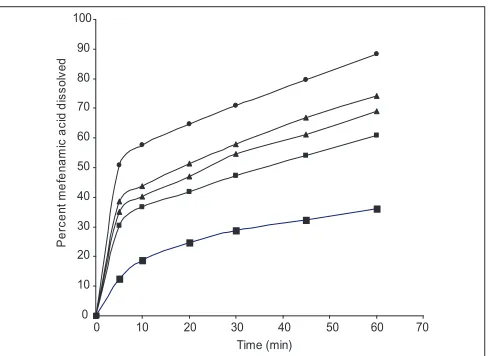
Table 3 and fig. 1. Dissolution rates of MA and its solid dispersions followed first order kinetics (Table 4 and fig. 2). Dissolution parameters such as T50, DE30, K1, Percent of MA dissolved in 10 minutesare given in Table 5.
The dissolution data of MA and their solid dispersions were also analyzed as per Hixson-Crowell’s[7] cube
root equation. Hixson-Crowell introduced the concept of changing surface area during dissolution and derived the “cube-root law” to nullify the effect of changing surface area and to linearize the dissolution curves. Hixson-Crowell’s cube root law is given by the following equation. (Wo)1/3–(W
t)1/3= Kt, where
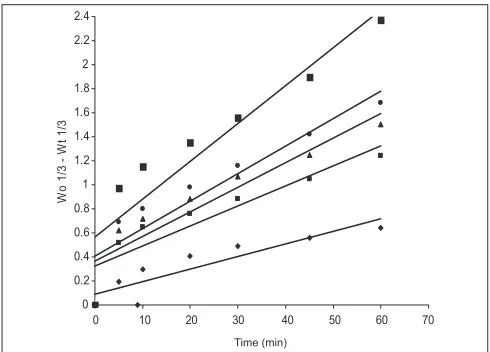
Wo is initial mass and Wt is the mass remained at time ‘t’. The cube root equation is applicable to the dissolution of monodisperse powder consisting of uniform sized particles. A plot of (Wo)1/3–(W
t)1/3
versus time will be linear when dissolution occurs from monodisperse particles of uniform size. Hixson-Crowell plots of the dissolution data were found to be linear (fig. 3) with all solid dispersions. This observation indicated the drug dissolution from all the solid dispersions is occurring from discretely suspended or deposited (monodisperse) particles. This might have also contributed to the enhanced dissolution rate of the solid dispersions. The correlation coefficient (r) values of the first order release model are found to be (0.9075 to 0.9940) slightly higher when compared to the Hixson-Crowell’s cube root model. Hence the release of drug from the preparations followed predominantly
TABLE 3: DISSOLUTION PROFILES OF MEFENAMIC ACID SOLID DISPERSIONS
Time (min) Percent MA dissolved (x±SD, n=3)
MA MA-PJ (1:1) MA-PJ (1:2) MA-PJ (1:4) MA-PJ-PVP (1:3.2:0.8)
5 10 20 30 45 60
12.39±0.63 18.66±0.38 24.2±0.56 28.83±0.69 32.25±0.71 36.05±0.54
30.42±1.04 36.72±1.70 41.91±1.33 47.26±1.82 54.04±2.23 60.84±1.69
35.11±1.66 40.17±2.82 47.11±1.11 54.53±2.22 61.08±1.13 69.12±1.06
38.58±1.48 43.77±0.66 51.31±1.25 57.99±1.32 66.75±1.48 74.07±1.75
50.82±1.11 57.62±1.67 64.65±1.65 70.86±1.33 79.51±1.49 88.42±1.36 TABLE 1: COMPOSITION OF VARIOUS SOLID
DISPERSIONS PREPARED Composition
Drug Carriers SD code Drug:
carriers
Mefenamic acid (8) PVP (2) MA-PVP 8:2
Mefenamic acid (1) PJ (1) MA-PJ 1:1
Mefenamic acid (1) PJ (2) MA-PJ 1:2
Mefenamic acid (1) PJ (4) MA-PJ 1:4
Mefenamic acid (1) PJ (3.2) PVP (0.8) MA-PJ-PVP 1:3.2:0.8 PVP: Polymer poly vinyl pyrrolidine, PJ: Primojel, SD Code: Solid dispersions code (Dissolution rate or ratio of the prepared formulation of drug and carrier).
TABLE 2: MEFENAMIC ACID CONTENT OF VARIOUS SOLID DISPERSIONS PREPARED
SD code Percent mefenamic acid content (x±SD) MA-PVP, (8:2)
MA-PJ, (1:1) MA-PJ, (1:2) MA-PJ, (1:4)
MA-PJ-PVP (1:3.2:0.8)
TABLE 4: THE CORRELATION COEFFICIENT (R) VALUES IN THE ANALYSIS OF DISSOLUTION DATA OF MEFENAMIC ACID SOLID DISPERSIONS AS PER ZERO ORDER, FIRST ORDER AND HIXSON CROWELL CUBE ROOT MODELS Solid dispersion Correlation coefficient (r) value
Zero order First order Hixson-crowell Pure drug MA-PVP, (8:2) MA-PJ, (1:1) MA-PJ, (1:2) MA-PJ, (1:4) MA–PJ-PVP, (1:3.2:0.8) 0.9875 0.8763 0.8615 0.8652 0.8601 0.8180 0.9940 0.9075 0.9282 0.9430 0.9451 0.9260 0.9920 0.9061 0.9090 0.9220 0.9262 0.9231
TABLE 5: DISSOLUTION PARAMETERS OF
MEFENAMIC ACID AND ITS SOLID DISPERSIONS IN SUPERDISINTEGRANTS
Solid dispersion Dissolution parameter T50
(min) % Dissolved in 10 min DE(%)30 (minK1–1)
Mefenamic acid MA-PJ, (1:1) MA-PJ, (1:2) MA-PJ, (1:4) MA-PJ-PVP, MA-PVP, (8:2) >60 36 24 14 4.57 >60 10.63 31.85 35.61 38.88 57.62 26.20 19.60 36.09 40.68 44.14 56.25 26.81 0.0072 0.0128 0.0164 0.0188 0.0296 0.0087 DE30: Dissolution efficiency index per 30 min, K1: Hixson-Crowell constant/min
Fig. 1: Dissolution profiles of mefenamic acid and its solid dispersions
Mefenamic Acid (MA) -▄-; Mefenamic Acid: Primojel (MA-PJ-1:1)
-■-; Mefenamic Acid: Primojel (MA-PJ-1:2) -▲-; Mefenamic Acid: Primojel (MA-PJ-1:4) -▲-; Mefenamic Acid: Primojel: Polymer poly Vinyl Pyrrolidine
-●-0 10 20 30 40 50 60 70 80 90 100
0 10 20 30 40 50 60 70 Time (min) Pe rc en t me fe na mi c ac id di sso lv ed
Fig. 2: First order dissolution plots of mefenamic acid and its solid dispersions
Mefenamic acid (MA, −♦−); Mefenamic acid: Primojel (MA-PJ-1:1,−▲−); Mefenamic acid: primojel (MA-PJ-1:2, −■−); Mefenamic acid: Primojel (MA-PJ-1:4, −■−); Mefenamic acid:Primojel: Poly vinyl pyrrolidine (MA-PJ-PVP-1:41:3.2:0.8, −●−)
0 0.2 0.4 0.6 0.8 1 1.2 1.4 1.6 1.8 2
0 10 20 30 40 50 60 70
Log pe rc en t me fa na mi c ac id re ma in in g Time (min)
first order kinetics compared to Hixson-Crowell cube root law. Correlation coefficient values in the analysis of dissolution data as per zero order, first order and Hixson-Crowell cube root are given in Table 3. Another parameter suitable for evaluation of in vitro dissolution has been suggested by Khan[8]
is, dissolution efficiency (DE). DE is defined as the area under the dissolution curve up to a certain time ‘t’ expressed as percentage of the area of the rectangle described by 100% dissolution in the same time. Dissolution efficiency (DE)=
˟
100 and the index DE30 would relate to the dissolution of drug from a particular formulation after 30 min and could be compared with DE30 of other formulations. Summation of the large dissolution data into a single figure DE enables ready comparison to be made between a large numbers of formulations.All the dissolution parameters given in Table 2 indicated rapid and higher dissolution of MA from all solid dispersions when compared to MA pure
drug. MA-PVP (8:2) solid dispersion gave rapid
and higher dissolution than the pure drug. A 1.21 fold increase in the dissolution rate of MA was obtained with this solid dispersion when compared to pure drug. Water dispersible superdisintegrants gave much higher enhancement in the dissolution rate of mefenamic acid than water-soluble carriers.
Solid dispersions of superdisintegrants gave rapid and higher dissolution of MA when compared to pure drug as well as its solid dispersion in
higher than the dissolution rate of pure drug. PVP
combined super disintegrants gave higher dissolution
rates than superdisintegrants alone. MA-PJ-PVP
solid dispersion gave a 4.11 fold increase in the dissolution rate of MA whereas solid dispersion of MA in PJ lone (MA-PJ 14 solid dispersion) gave only 2.61 fold increase. Thus combination of
superdisintegrants with water soluble carrier PVP
resulted in a greater enhancement in the dissolution rate of MA. Hladon et al.[9], the inclusion complex
of MA with b-cyclodextrin was obtained by the method of coprecipitation from diethyl ether. The
product was identified by the thermogravimetric and
X-ray methods. The complex stability constants were determined by the potentiometric method. The effect
of β-CD on the solubility and stability of MA was
analysed. Thus superdisintegrant, PJ was found to be useful as a carrier in MA solid dispersions alone and
in combination with PVP to enhance the solubility, dissolution rate and dissolution efficiency.
ACKNOWLEDGEMENTS
The authors would like to express sincere thanks to the Management of D. C. R. M. Pharmacy College for their encouragement and providing necessary facilities in carryout this research work. The authors would also express sincere thanks to M/s. Sigma Laboratories, Mumbai for generous gift of mefenamic acid samples.
REFERENCES
1. Sweetmann SC. Martindale- The Extra Pharmacopoeia, London: The Pharmaceutical Press; 2005.
2. Kato F, Otsuka M, Matsuda Y. Kinetic study of the transformation of mefenamic acid polymorphs in various solvents and under high humidity conditions. Int J Pharm 2006;321:18-26.
3. Fang L, Numajiri S, Kobayashi D, Ueda H, Nakayama K, Miyamae H, et al. Physicochemical and crystallographic characterization of mefenamic acid complexes with alkanolamines. J Pharm Sci 2004;93:144-54.
4. Guirguis M, Jammali F. Disease-drug interaction: Reduced response to propranolol despite increased concentration in the rat with inflammation. J Pharm Pharm Sci 2001;4:1077-84.
5. Vasconcelos T, Sarmento B, Costa P. Solid dispersions as strategy to improve oral bioavailability of poor water soluble drugs. Drug Discov Today 2007;12:1068-75.
6. Sekiguchi K, Obi N. Studies on absorption of eutectic mixture-I. Chem Pharm Bull 1961;9:866-72.
7. Hixon AW, Crowell JH. Dependence of reaction velocity upon surface and agitation: I-theoretical consideration. Ind Eng Chem 1931;23: 923-31.
8. Khan KA, Rhodes CT. Effect of compaction pressure on the dissolution efficiency of direct compression systems. Pharm Acta Helv 1972;47:594-607.
9. Hładoń T, Pawlaczyk J, Szafran B. Stability of mefenamic acid in the inclusion complex with β-cyclodextrin in the solid phase. J Inclusion Phenomena Macrocyclic Chem 1999;35:497-506.
Fig. 3: Hixson-crowell dissolution plots of mefenamic acid and its solid dispersions
Mefenamic acid (MA, −♦−); Mefenamic acid: Primojel (MA-PJ-1:1, −■−); Mefenamic acid: primojel (MA-PJ-1:2, −▲−); Mefenamic acid: Primojel (MA-PJ-1:4, −●−); Mefenamic acid:Primojel: Poly vinyl pyrrolidine (MA-PJ-PVP-1:41:3.2:0.8, −■−)
0 0.2 0.4 0.6 0.8 1 1.2 1.4 1.6 1.8 2 2.2 2.4
0 10 20 30 40 50 60 70
Wo
1/
3
- Wt
1/
3
Time (min)
Accepted 24 March 2011
Revised 28 February 2011 Received 10 December 2010 Indian J. Pharm. Sci., 2011, 73 (1):243-247
In vitro Evaluation of Antifungal Activity of the Seed
Extract of Embelia Ribes
A. SABITHA RANI*, K. SARITHA, V. NAGAMANI AND G. SULAKSHANA
Department of Botany, Osmania University College for Women, Koti, Hyderabad-500 095, India
Rani, et al.: Antifungal activity of Embelia ribes
*Address for correspondence