A Lagrangean Heuristic
For The Degree Constrained Minimal
Spanning Tree Problem
Rakesh Kawatra, Minnesota State University, USA
ABSTRACT
In this paper we present a new heuristic procedure to solve the degree constrained minimal spanning tree problem. This procedure uses Lagrangian relaxation of the integer programming formulation of the problem to get a lower bound for the optimal objective function value. A subgradient optimization method is used to find multipliers that give good lower bounds. A branch exchange procedure is used after each iteration of the subgradient optimization to generate a feasible solution from an infeasible Lagrangean solution. Computational results are given for problems with up to 300 nodes. The heuristic procedure presented here gives optimal solutions in most instances. For problem sets that were not solved optimally, the gap between the lower bound and the feasible solution was less than 10-2 percent.
Keywords: Degree-constrained trees, heuristic, Lagrangean relaxation
1. INTRODUCTION
he Degree Constrained Minimal Spanning Tree (DCMST) problem is frequently encountered in the design of communication and computer networks. It consists of finding transmission links to connect a set of geographically remote terminal sites to a central node. The number of ports available on a terminal node restricts the number of links incident on it. Garey and Johnson [5] have shown the DCMST problem to be NP-hard by reducing it to an equivalent symmetric Traveling Salesman Problem. Several methods for solving this difficult problem have been developed. A Lagrangian-based branch and bound algorithm was used by Volgenant [13] to find the optimal solution of this problem with up to 150 nodes. Gabow [4] used a branch exchange algorithm to find an approximate solution to the problem. Gavish [7] used a branch and bound heuristic to solve the problem with up to 200 nodes. Narula and Ho [10] also used a branch and bound heuristic to solve the DCMST problem with up to 100 nodes, while Yamamoto [14] developed an algorithm based upon finding the minimum common basis of two matroids. Other heuristic approaches suggested for solving this problem include a genetic algorithm by Zhou and Gen [15], a heuristic algorithm by Bolden, Deo, and Kumar [1] that was implemented on parallel processors, and a branch & bound method based on Lagrangean relaxation used by Savelsbergh and Volgenant [12] to solve problems with up to 150 nodes.
In this paper, we present a Lagrangean relaxation based heuristic to find a good feasible solution of the DCMST problem. We relax the DCMST problem using Lagrangean relaxation method. The solution to the relaxed problem gives a lower bound to the optimal solution value of the DCMST problem. This technique to get a lower bound of the DCMST problem has been used very successfully in [7], [12], and [13]. These lower bounds were used in the branch & bound procedures to get good heuristic solution to the DCMST problem. In this paper, we use a very different approach than used by [7], [12], and [13]. We use subgradient optimization method to get Lagrange multipliers that give good lower bounds. We use a new branch exchange procedure after each iteration of the subgradient procedure to get a feasible solution from the infeasible Lagrangean solution. The best lower bound and the best feasible solutions are retained when the subgradient method terminates. The lower bound value is used to estimate the quality of the solution given by the branch exchange procedure. We found that the gaps between the feasible solution and the lower bound using our algorithm are tighter than reported previously. Additionally, we have provided results for much larger networks.
The outline of the paper is as follows: In Section 2, we present the integer-programming formulation of the DCMST problem. A Lagrangean relaxation of the problem and a subgradient optimization method to find a lower bound of the problem is described in Section 3. A branch exchange procedure embedded in the subgradient optimization method is also described in Section 3. The results of the experiment are presented in Section 4. Finally, some concluding remarks are presented in section 5.
MODEL FORMULATION
We use the following notation in the model:
Cij = annual cost of the link directly connecting node i to node j;
S = [2,3...N] is a set of terminal nodes to be connected to the central node (node 1); rj = limit on the maximum number of links that can end at a terminal node j;
The decision variables are:
Xij = 1, if there is a directed link from node ito node j; 0 otherwise; Yij = flow on the link directed from node i to node j;
The integer programming formulation of the problem is given below.
C
ijX
ij N1 = j N
2 = i =
ZIP min (1)
subject to:
1
1
N
j ij
X i = 2,3....N (2)
1 = Y Y ji
N
= j ij N
1 = j
2
i = 2,3,....N (3)
ij ij N XY 1 i= 2,3....N, j = 1,2,....N (4)
j
r X
N
i ij
2
j = 2,3....N (5)
) 1 (
2 1
N X
N
i N
j
ij (6)
0
ij
Y i, j (7)
1 0or
In the above model, constraints (2) guarantee that there is exactly one link originating from each terminal. Constraints (3) are flow conservation constraints, where Yij is interpreted as the flow on the directed link from node i to node j. The central node has an aggregate demand of (N-1) units of a commodity, with a supply of 1 unit from each terminal node. Constraints (4) ensures that there would be traffic flowing directly from node i to node j only if there is a directed link from node i to node j. Constraints (5) are the degree constraints, which restrict the number of links terminating at each terminal node to a predetermined number. Constraint (6) guarantees that a total of (N-1) links will be installed in the network. Constraints (2), (3), (5)-(8) ensure that the Xij variables define a spanning tree rooted at node 1.
SOLUTION PROCEDURES
In this study we use a Lagrangian relaxation approach to generate lower bounds for the DCMST problem. This approach has been used very successfully to obtain tight lower bounds for this problem in [7], [12], and [13]. For an application-oriented survey of Lagrangean relaxation, see Fisher [3].
We form a relaxation of problem ZIP by multiplying constraint set (5) with a vector of non-negative Lagrangian multipliers µ = (µ 2, µ 3,.., µ N) and add it to the objective function. This results in the following problem.
N
j j j N
i
ij N
j
ijX r
C L
2
2 1
~ min
)
(
(9)subject to (2)-(4), (6)-(8),
where C~ijCijj i, j
Procedure for Evaluating L()
The function L() is evaluated by solving a minimal spanning tree problem rooted at the central node, which for a given vector of Lagrange multipliers can be accomplished very easily using Prim's algorithm [11].
We know that for a given vector of Lagrange multipliers 0, L() is a lower bound to ZIP.However, we are interested in finding the tightest bound, which can be calculated, by finding
L(*)=
max{L()}.
Computing * is very difficult; however, approximate values of these vectors can be found by using a subgradient optimization method [9]. In this method, we begin with an initial vector of multipliers 0, and at iteration p adjust the multipliers using the following rule:
s
+
= p
1 p
j p j p
j V
j = 2,3.... N
Where
j ij N
2 = i p
j = X r
V
j = 2,3.... Nand
2 p j
p * p
V ) ( L Z
In the above equation
2
denotes the Euclidean norm, Z* is the best available overestimate of the optimal solution value, and is a scalar multiplier which satisfies the condition 0<2. The value of is initially set to 2 and is reduced during the course of the search. This method for adjusting the Lagrange multipliers has been used very successfully in [6-8]. The subgradient optimization procedure is terminated when the total number of iterations exceed a prespecified number or when a feasible solution is found with ZIP = L (*) or when the gap between the lower bound and the best upper bound is less than a specified value.A Branch Exchange Procedure
In this section we describe a branch exchange procedure, which is used after each iteration of the subgradient optimization procedure to generate a feasible solution to ZIP from the infeasible Lagrangean solution. The best feasible solution is retained when the subgradient optimization algorithm is terminated.
For this procedure we define the following additional variables:
linkij = a directed link from node i to node j; if linkij is added to the network, then Xij = 1; fi = termination node of the link directed away from node i, i.e., if Xij = 1, then fi = j;
, :
2
i N
j
ji r
X i
G i.e., the set of terminal nodes for which the degree constraint is violated;
, :
2
i N
j
ji r
X i
G i.e., the set of terminal nodes for which the degree constraint is slack;
, ~ ~
ij i ij C C
R i f
i.e., the change in the total cost if linkij replaces
link i
fi
Procedure A
Step 1. If G , then STOP.
Step 2. Compute, for each iGand jG,Rij.
Step 3. Compute
ijj , i * *
R min Arg ) j , i
( .
Step 4. Remove
link
i f
i
*
*
from the network and replace it with
link
i j
* *
. Go to Step 1.NUMERICAL RESULTS
best-known Lagrangean relaxation, respectively) are maintained. The initial value of scalar was set to 2, and halved whenever L() did not improve in 20 successive iterations.
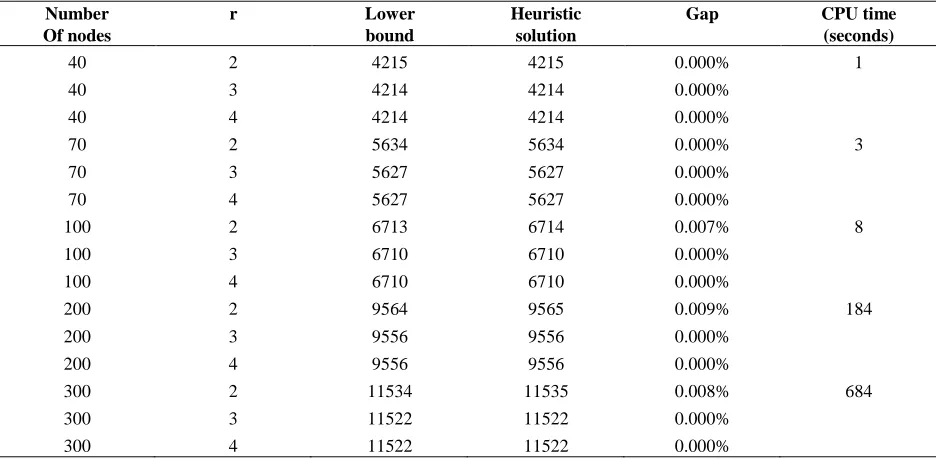
The search for the optimal Lagrangean multipliers was terminated if the total number of iterations exceeded 90 or if Zchanged by less than 0.004 in 30 successive iterations or when the gap between Z and Z was less than 0.01 percent of the value of Z. The subgradient optimization and the branch exchange procedures were coded in FORTRAN 77 and the experiments were performed on a VAX-4500 computer. The computational results are summarized in Table 1. In the table the lower bound and the heuristic solution reported for each set of Number of nodes and r parameter values represents the average of the lower bound and heuristic solution for the 10 problems solved for the set.
Table 1: Computation Results
Number r Lower Heuristic Gap CPU time
Of nodes bound solution (seconds)
40 2 4215 4215 0.000% 1
40 3 4214 4214 0.000%
40 4 4214 4214 0.000%
70 2 5634 5634 0.000% 3
70 3 5627 5627 0.000%
70 4 5627 5627 0.000%
100 2 6713 6714 0.007% 8
100 3 6710 6710 0.000%
100 4 6710 6710 0.000%
200 2 9564 9565 0.009% 184
200 3 9556 9556 0.000%
200 4 9556 9556 0.000%
300 2 11534 11535 0.008% 684
300 3 11522 11522 0.000%
300 4 11522 11522 0.000%
The computational results indicate that the heuristic solution finds optimal solutions most of the time. For problem sets that could not be solved optimally, the gap between the heuristic solution and the lower bound is less than 10-2 percent. Our heuristic solution takes very little CPU time. However, the CPU time required by the heuristic grows exponentially with the number of nodes in the network.
CONCLUSIONS
AUTHOR INFORMATION
Rakesh Kawatra is a professor of information systems at Minnesota State University, Mankato. He has a BTech. from IIT, Delhi, MBA from IIM, Bangalore, and PhD from The University of Iowa. His work has been published in European Journal of Operational Research, Computers and Operations Research, and other journals. His research focuses on topological design of communication networks.
REFERENCES
1. Boldon, B., Deo, N., and Kumar, N., "Minimum weight degree constrained spanning tree problem:
Heuristics and implementation on an SIMD parallel machine," Parallel Computing, vol. 22, 369-382, 1996. 2. Craig, G., Krishnamoorthy, M., and Palaniswami, M., "Comparison of heuristic algorithms for the degree
constrained minimum spanning tree," Metaheuristics: Theory and Applications, I.H. Osman and J.P. Kelly, Eds. Kluwer, Boston, 1996.
3. Fisher, M.L., "The Lagrangian relaxation method for solving integer programming problems," Management Science, vol. 27, 1-18, 1981.
4. Gabow, H.N., "A good algorithm for smallest spanning trees with a degree constraint," Networks, vol. 8, 201-208, 1978.
5. Garey, M.R., and Johnson, D.S., Computers and Intractability, A Guide to the Theory of NP-Completeness, Freeman, San Francisco, 1979.
6. Gavish, B., "Formulations and algorithms for the capacitated minimal directed tree problem," Journal of the ACM, vol. 30, 118-132, 1983.
7. Gavish, B., "Topological design of centralized computer networks-formulations and algorithms," Networks, vol.12, 355-377, 1982.
8. Gavish, B., "Augmented Lagrangian Based Algorithm for Centralized Network Design," IEEE Transaction
on Communications, vol. 33, 1247-1257, 1985.
9. Held, M., Wolfe, P., and Crowder, H.D., "Validation of Subgradient Optimization," Mathematical
Programming, vol. 6, 62-88, 1974.
10. Narula, S.C., and Ho, C.A., "Degree constrained minimum spanning tree," Computers and Operations Research, vol. 7, 239-249, 1980.
11. Prim, R.C., "Shortest Connection Networks and Some Generalizations," Bell Systems Technical Journal, vol. 36, 1389-1401, 1957.
12. Savelsbergh, M., and Volgenant, T., "Edge exchanges in the degree constrained minimum spanning tree problem," Computers and Operations Research, vol. 12, 341-348, 1985.
13. Volgenant, A., "A Lagrangean approach to the degree-constrained minimum spanning tree problem,"
European Journal of Operational Research, vol. 39, 325-331, 1989.
14. Yamamoto, Y., “The held-karp algorithm and degree-constrained minimum 1-trees," Mathematical
Programming, vol. 15, 228-231, 1978.