427 |
P a g e
CREATING A ENCRYPTION ALGORITHM BASED
ON NETWORK RFWKIDEA4-2 WITH THE USE THE
ROUND FUNCTION OF THE GOST 28147-89
Tuychiev G.
National University of Uzbekistan, Republic of Uzbekistan, Tashkent
ABSTRACT
In this article we create a block encryption algorithm based on network RFWKIDEA4-2, with the use the round
function of algorithm GOST 28147-89. The block length of created block encryption algorithm is 128 bits, the
number of rounds is 8, 12 and 16.
Keywords: Feystel Network, Network, Round Function, Round, Round Keys, Output
Transformation, Subblock, S-Box
I. INTRODUCTİON
GOST 28147-89 is a standard encryption algorithm of the Russian Federation. It is based on the basis of a
Feistel network. This encryption algorithm for hardware and software implementation, satisfies the necessary
requirements for cryptographic resistance and therefore imposes no restrictions on the degree of secrecy
protected information. Implements the encryption algorithm 64-bit blocks of data via a 256-bit key. In the round
function employed eight S-boxes a size 4x4 and cyclic shift operation on 11 bits. So far, GOST 28147-89 is
resistant to cryptographic attacks.
As the round function network IDEA4-2 [2] using the round function of the encryption algorithm GOST
28147-89 created by the encryption algorithm GOST28147-28147-89-IDEA4-2 [8]. In addition, by using transformations
SubBytes(), ShiftRows(), MixColumns(), and AddRoundKey() the AES encryption algorithm as round
functions of networks IDEA8-1 [4], RFWKIDEA8-1 [4], PES8-1 [5], RFWKPES8-1 [6], IDEA16-1 [7] created
encryption algorithms AES-IDEA8-1 [9], AES-RFWKIDEA8-1 [10], AES-PES8-1 [11], AES-RFWKPES8-1
[12], AES-IDEA16-1 [13].
The network RFWKIDEA4–2 presented in the paper [1] and as in a Feistel network, with encryption and
decryption using the same algorithm. In a network RFWKIDEA4–2 applied two round functions and as the
round function, you can use any transformation.
In this article, we applied round function encryption algorithm GOST 28147-89 as a round function network
RFWKIDEA4-2, designed encryption algorithm GOST28147-89- RFWKIDEA4-2, which has the advantage of
speed and resistance of encryption. The proposed encryption algorithm GOST28147-89-RFWKIDEA4-2 block
length is 128 bits, key length is changed from 256 bits to 1024 bits in steps 128 bits and the number of rounds n
is 8, 12, 16, that allows the user depending on the degree of secrecy of information and the speed select the
428 |
P a g e
II. THE STRUCTURE OF THE ENCRYPTION ALGORITHM GOST28147–89–
RFWKIDEA4–2
In the encryption algorithm GOST28147–89–RFWKIDEA4–2 the length of subblocks 0
X , X1, X2, X3,
length of round keys K4(i1), K4(i1)1, K4(i1)2, K4(i1)3, i1...n1, K4n4, K4n5, ..., K4n11 and the length of the
input and output blocks of round functions is 32 bits. This encryption algorithm round function GOST 28147-89
is applied twice and in each round function employed eight S-boxes, i.e. the total number of S-boxes is equal to
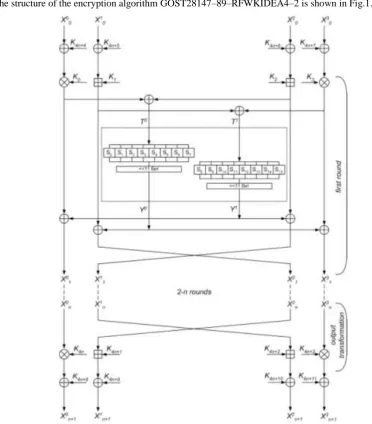
16. The structure of the encryption algorithm GOST28147–89–RFWKIDEA4–2 is shown in Fig.1.
Fig. 1. The Scheme
N
-Rounded Encryption Algorithm GOST28147–89–RFWKIDEA4–2
Consider the round function block encryption algorithm GOST28147–89–RFWKIDEA4–2. First to the 32-bit
subblock 0
T , 1
T divided into eight four-bit sub-blocks, i.e. 0 7 0 6 0 5 0 4 0 3 0 2 0 1 0 0 0
|| || || || || ||
||t t t t t t t
t
T ,
1 7 1 6 1 5 1 4 1 3 1 2 1 1 1 0 1
|| || || || || ||
||t t t t t t t
t
T . The four-bit subblocks 0
i
t , 1
i
t , i 0...7 converted to S-box:
|| ) ( || ) ( || ) ( || )
( 3 30
0 2 2 0 1 1 0 0 0 0
t S t S t S t S
R ( )|| ( )|| ( )|| 7( 70)
0 6 6 0 5 5 0 4
4 t S t S t S t
S ,
|| ) ( || ) ( || ) ( || ) ( || ) ( || )
( 10 9 11 10 21 11 13 12 14 13 51
8 1
t S t S t S t S t S t S
R S14(t61)||S15(t71). Received 32-bit subblocks 0
R , 1
429 |
P a g e
cyclically shifted to the left by 11 bits and get the subblocks 0
Y , Y1:Y0 R0 11, Y1R111. The S-box
encryption algorithm shown in Table 1.
Table 1. The S-box of Encryption Algorithm GOST28147–89–RFWKIDEA4–2
0x0 0x1 0x2 0x3 0x4 0x5 0x6 0x7 0x8 0x9 0xA 0xB 0xС 0xD 0xE 0xF S0 0xA 0x2 0x0 0xF 0x6 0x7 0x1 0x4 0x5 0x9 0xE 0xD 0xB 0xC 0x3 0x8 S1 0x1 0x7 0xF 0x2 0xE 0x4 0x5 0x6 0xC 0x3 0x8 0xA 0xB 0x0 0xD 0x9
S2 0xF 0xC 0xB 0x7 0xA 0x4 0x5 0xD 0x3 0x6 0x9 0x0 0x1 0xE 0x2 0x8 S3 0x1 0xA 0x4 0x5 0x7 0xE 0xD 0x9 0x0 0x6 0xC 0xB 0x8 0x2 0x3 0xF S4 0x9 0xC 0x2 0x4 0x0 0x1 0x3 0xE 0xF 0x6 0x5 0xA 0x8 0xB 0xD 0x7
S5 0x9 0x3 0xD 0x5 0x8 0xF 0xA 0x6 0x1 0x0 0x2 0xB 0xE 0xC 0x4 0x7 S6 0x9 0xF 0x6 0x5 0x8 0x3 0xD 0x1 0xA 0xB 0xE 0xC 0x2 0x7 0x4 0x0 S7 0xB 0x2 0x0 0x3 0xF 0xA 0x5 0xD 0x8 0xC 0x6 0x1 0xE 0x4 0x7 0x9
S8 0xB 0x3 0x5 0x8 0x7 0x0 0x2 0x1 0x6 0xA 0xF 0xE 0xC 0x9 0x4 0xD S9 0x4 0x1 0x5 0xC 0x7 0x9 0xB 0x3 0xD 0xE 0x2 0x8 0xA 0x6 0xF 0x0 S10 0x1 0x5 0xB 0xE 0x8 0xA 0x9 0x6 0x4 0xD 0xC 0x0 0x3 0x2 0x7 0xF S11 0xC 0xB 0x5 0x0 0x6 0x7 0x4 0x8 0x9 0x3 0x1 0xE 0xD 0xF 0xA 0x2
S12 0x2 0x1 0x7 0xB 0x9 0x8 0x6 0xF 0xE 0x5 0xA 0xD 0x3 0xC 0x0 0x4 S13 0x5 0xE 0xC 0xF 0x1 0x4 0x9 0x3 0x6 0x2 0xA 0xD 0x0 0x8 0xB 0x7 S14 0xE 0x3 0x2 0x0 0xA 0xD 0x5 0xB 0xC 0x8 0x7 0x1 0x9 0x6 0x4 0xF
S15 0xE 0xC 0x2 0x3 0x6 0x1 0x5 0x8 0xF 0x7 0x4 0xD 0x9 0xA 0xB 0x0
Consider the encryption process of encryption algorithm GOST28147–89–RFWKIDEA4–2. Initially the 128-bit
plaintext X partitioned into subblocks of 32 bits 0 0
X , 1
0
X , 2
0
X , 3
0
X , and performs the following steps:
1. subblocks 0 0
X , 1
0
X , 2
0
X , 3
0
X are summed to XOR with corresponding round keys K4n4, K4n5, K4n6,
7 4n
K : n i
i i
K X
X0 0 4 4 , j 0...3.
2. subblocks 0 0
X , 1
0
X , 2
0
X , 3
0
X respectively, multiplied and summed with the round keys K4(i1), K4(i1)1,
2 ) 1 ( 4i
K , K4(i1)3 and calculated 32-bit subblocks
0
T , T1. This step can be represented as follows:
) (
)
( 4( 1) 2
2 1 ) 1 ( 4 0
1 0
Xi K i Xi K i
T , ( ) ( 4( 1)3)
3 1 1 ) 1 ( 4 1
1 1
Xi K i Xi K i
T , i1.
3. to 32-bit subblocks 0
T , 1
T sublocks apply the round function and get the 32-bit subblocks 0
Y , Y1.
4. subblocks Y0, Y1 are summed to XOR with subblocks 0 1
i
X , Xi11, 2
1
i
X , Xi31, i.е.
1 0
1 0
1 X Y
Xi i ,
0 1
1 1
1 X Y
Xi i , 2 1
1 2
1 X Y
Xi i , 3 0
1 3
1 X Y
Xi i , i1.
5. at the end of the round subblocks swapped, i.e, 0 1 0
i
i X
X , X1i Xi21,
1 1 2
i
i X
X , Xi3 Xi31, i1.
6. repeating the steps 2–5 n time, i.e.i2...n, obtained the subblocks 0
n
X , X1n,
2
n
X , Xn3
7. in output transformation round keys are multiplied and summed into subblocks, i.e. Xn Xn K4n
0 0
1
,
1 4 2 1
1
n n
n X K
X , 4 2
1 2
1
n n
n X K
X , 4 3
3 3
1
n n
n X K
X .
8. subblocks 0
n
X , 1
n
X , 2
n
X , 3
n
X are summed to XOR with the round keys K4n8, K4n9, K4n10, K4n11:
j n j n j
n X K
X 1 1 4 8 , j 0...3. As ciphertext receives the combined 32-bit subblocks
3 1 2
1 1
1 0
1|| || ||
n n n
n X X X
430 |
P a g e
In the encryption algorithm GOST28147–89–RFWKIDEA4–2 with encryption and decryption is used the same
algorithm, only when decryption calculated inversion round keys depending on the operations and are applied in
reverse order. One important task of encryption is key generation.
III. KEY GENERATION ENCRYPTION ALGORITHM GOST28147–89–RFWKIDEA4–2
In the n-round encryption algorithm GOST28147–89–RFWKIDEA4–2 used in each round four round keys of
32 bits and the output transformation of four round keys of 32 bits. In addition, prior to the first round and after
the output transformation is applied four round keys on 32 bits. The total number of 32-bit round keys is equal
to 4n+12. Hence, if n=8 then need 44 to generate round keys, if n=12, you need to generate 60 round keys and if
n=16 need 76 to generate round keys. When encoding in Fig.1 instead Ki used the round keys c
i
K , and when
decrypting the round keys d i
K .
The key length of the encryption algorithm l (256 l 1024 ) bits is divided into 32-bit round keys K0c, c K1 ,
..., c Len g h t
K 1, Lenght l/32 , here K {k0,k1,...,kl1}, K0 {k0,k1,...,k31}
c
, K1c {k32,k33,..., k63}, ...,
} ,..., ,
{ 32 31 1
1
l l l
c
Lenght k k k
K . Then calculated c
Lenght c
c
L K K K
K 0 1 ... 1. If KL 0 then as KL selected
0xC5C31537, i.e, KL 0xC5C31537 . Round keys c i
K , i Lenght ...4n11 calculated as follows:
L c Lenght i c Lenght i c
i SBox K SBox RotWord K K
K 0( ) 1( ( 1)) . After each generation of round keys value KL
cyclically shifted left by 1 bit. Here RotWord32()–cyclic shift 32 bit subblock to the left by 1 bit, SubBytes32()–
convert 32-bit subblock S-box and SBox 0(A)S0(a0)|| S1(a1)|| S2(a2)|| S3(a3)|| S4(a4)||
) ( || ) ( || )
( 5 6 6 7 7
5 a S a S a
S , SBox 1(A)S7(a0)||S8(a1)|| S9(a2)||S10(a3)|| S11(a4)|| S12(a5)||S13(a6)||S14(a7),
7 6 5 4 3 2 1
0||a ||a ||a ||a ||a ||a ||a
a
A and ai– the four-bit sub-block.
The decryption round keys d i
K calculated on the basis of encryption round keys c i
K and decryption keys output
transformation associated with the encryption keys as follows:
) ) ( , , , ) (( ) , , ,
(K4dn K4dn1 K4dn2 K4dn3 K0c 1 K1c K2c K3c 1 1
Decryption round keys first round associated with the encryption round keys as follows:
) ) ( , , , ) (( ) , , ,
( 0 1 2 3 4 1 4 1 4 2 4 3 1
c n c n c n c n d d d d K K K K K K K
K 2
Likewise, decryption round keys second, third and n-round associated with the encryption round keys as
follows: . ... 2 ), ) ( , , , ) (( ) , , , ( 1 3 ) 1 ( 4 1 ) 1 ( 4 2 ) 1 ( 4 1 ) 1 ( 4 3 ) 1 ( 4 2 ) 1 ( 4 1 ) 1 ( 4 ) 1 ( 4 n i K K K K K K K K c i n c i n c i n c i n d i d i d i d i 3
Decryption round keys, applied to the first round and after output transformation connected with encryption
keys as follows: c j n d
j
n K
K4 4 4 8 ,
c j n d j n K
K4 8 4 4 , j 0...3.
For example, if the number of rounds encryption algorithm is 16, then (1) and (2) formula as follows:
) , , , , , ( ) , , , , ,
( 9 4 9 5
1 9 9 9 8 9 7 1 9 6 5 4 3 2 1 0 c c c c c c d d d d d d K K K K K K K K K K K K ) , , , ( ) , , ,
(K9 6d K9 7d K9 8d K9 9d K0c1 K1c K2c K3c1
431 |
P a g e
) , , , , , ( ) , , , , ,
(K6d K7d K8d K9d K1 0d K1 1d K9 0c 1 K9 2c K9 1c K9 3c 1 K8 8c K8 9c
,
) , , , , , ( ) , , , , ,
( 82 83
1 87 85 86 1 84 17
16 15 14 13 12
c c c c c c d d d d d d
K K K K K K K K K K K K
,
) , , , , , ( ) , , , , ,
( 4 5
1 9 7 8 1 6 95 94 93 92 91 90
c c c c c c d d d d d d
K K K K K K K K K K K K
.
Likewise, calculated decryption round keys when the number of rounds equal to 8 and 12.
IV. RESULTS
As a result of this study built a new block encryption algorithm called GOST28147–89–RFWKIDEA4–2. This
algorithm is based on a network RFWKIDEA4-2 using the round function of GOST 28147-89. Length of block
encryption algorithm is 128 bits, the number of rounds and key length is variable. Wherein the user depending
on the degree of secrecy of the information and speed of encryption can select the number of rounds and key
length.
It is known, that the S-box encryption algorithm GOST 28147-89 are secret and used as a long-term key. In
Table 2 below describes the options openly declared S-box such as: deg -degree of algebraic nonlinearity;
NL -nonlinearity; -resistance to linear cryptanalysis; -resistance to differential cryptanalysis; SAC-strict
avalanche criterion; BIC-bit independence criterion. To S-box was resistant to cryptanalysis it is necessary that
the values deg and NL were large, and the values , , SAC and BIC small.
In block cipher algorithm GOST28147–89–RFWKIDEA4–2 for all S-boxes, the following equation: deg 3,
4
NL , 0.5, 3/8, SAC=4, BIC=4, i.e. resistance is not lower than the algorithm GOST 28147-89.
Table2 Parameters of the S-Boxes Algorithm GOST 28147-89
№ Parameters S1 S2 S3 S4 S5 S6 S7 S8
1 deg 2 3 3 2 3 3 2 2
2 NL 4 2 2 2 2 2 2 2
3 0.5 3/4 3/4 3/4 3/4 3/4 3/4 3/4 4 3/8 3/8 3/8 3/8 1/4 3/8 0.5 0.5
5 SAC 2 2 2 4 2 4 2 2
6 BIC 4 2 4 4 4 4 2 4
Studies have shown that the speed of the encryption block cipher algorithm GOST28147–89–RFWKIDEA4–2
faster than the GOST 28147-89. Created 16-round algorithm encrypts 1.25 times faster than the 32-round GOST
28147-89.
In this way, built a new block encryption algorithm called GOST28147–89–RFWKIDEA4–2 network-based
RFWKIDEA4-2 using the round function of GOST 28147-89. Installed that the resistance offered by the author
block cipher algorithm not lower than the resistance of the algorithm GOST 28147-89.
REFERENCES
[1] GOST 28147–89. National Standard of the USSR. Information processing systems. Cryptographic
protection. Algorithm cryptographic transformation.
[2] Aripov M.M. Tuychiev G.N. The network IDEA4–2, consists from two round functions //
432 |
P a g e
[3] Tuychiev G.N. About networks PES4–1 and RFWKPES4–2, RFWKPES4–1 developed on the basis of
network PES4–2 // Uzbek journal of the problems of informatics and energetics. –Tashkent, 2015, №1, pp.
97–103.
[4] Tuychiev G.N. About networks IDEA8–2, IDEA8–1 and RFWKIDEA8–4, RFWKIDEA8–2,
RFWKIDEA8–1 developed on the basis of network IDEA8–4 // Uzbek mathematical journal, –Tashkent,
2014, №3, pp. 104–118
[5] Tuychiev G.N. About networks PES8–2 and PES8–1, developed on the basis of network PES8–4 //
Transactions of the international scientific conference «Modern problems of applied mathematics and
information technologies–Al–Khorezmiy 2012», Volume № II, –Samarkand, 2014, pp. 28–32.
[6] Tuychiev G.N. About networks RFWKPES8–4, RFWKPES8–2, RFWKPES8–1, developed on the basis of
network PES8–4 // Transactions of the international scientific conference «Modern problems of applied
mathematics and information technologies–Al–Khorezmiy 2012», Volume № 2, –Samarkand, 2014, pp.
32–36
[7] Tuychiev G.N. About networks IDEA16–4, IDEA16–2, IDEA16–1, created on the basis of network
IDEA16–8 // Compilation of theses and reports republican seminar «Information security in the sphere
communication and information. Problems and their solutions» –Tashkent, 2014
[8] Tuychiev G. Creating a data encryption algorithm based on network IDEA4-2, with the use the round
function of the encryption algorithm GOST 28147-89 // Infocommunications: Networks–Technologies–
Solutions. –Tashkent, 2014, №4 (32), pp. 49–54.
[9] Tuychiev G. New encryption algorithm based on network IDEA8-1 using of the transformation of the
encryption algorithm AES // IPASJ International Journal of Computer Science, 2015, Volume 3, Issue 1,
pp. 1-6
[10] Tuychiev G. New encryption algorithm based on network RFWKIDEA8-1 using transformation of AES
encryption algorithm // International Journal of Computer Networks and Communications Security, 2015,
Vol. 3, №. 2, pp. 43–47
[11] Tuychiev G. New encryption algorithm based on network PES8-1 using of the transformations of the
encryption algorithm AES // International Journal of Multidisciplinary in Cryptology and Information
Security, 2015, vol.4., №1, pp. 1-5
[12] Tuychiev G. New encryption algorithm based on network RFWKPES8-1 using of the transformations of
the encryption algorithm AES // International Journal of Multidisciplinary in Cryptology and Information
Security, 2014, vol.3., №6, pp. 31-34
[13] Tuychiev G. New encryption algorithm based on network IDEA16-1 using of the transformation of the
encryption algorithm AES // IPASJ International Journal of Information Technology, 2015, Volume 3, Issue