TEACHING METHODS AS A TOOL IN THE INDIVIDUAL'S TRAINING FOR A SOCIETY WITH A DYNAMIC EVOLUTION
Moroldo Madalina
Faculty of Psychology and Educational Sciences, University of Bucharest
Abstract
Starting from the premise that the teacher is the connection bridge of the students between: the present, the past (through the professional experience gained over time) and the future (in terms of the capacity to anticipate the situations that will arise), I intend to bring to the foreground the role for the social and cultural development held by the teaching methods adapted to the requirements of the new generation of students, as well as the careful selection of a series of values that are intended to be transmitted through the information provided.
In the same area of experiences, there is a brief analysis of the hazards to which students are exposed, and also of the high degree of vulnerability of the students coming from urban areas.
From the teachers’ perspective, the ability to adapt to modern methods of transmitting information, the use of new technologies, the interest and importance given to practical exercises is evident.
At the end of the work, the results of the questionnaires are analyzed and solutions aiming at improving teaching methods are presented.
Key words: teaching methods, adaptability, society, student, improvement
1. INTRODUCTION
Starting from the idea that every human being is driven by individualism and autonomy, this article aims to analyze the impact and effect that the two notions have on the teaching and learning process from two perspectives: the teacher’s and the student’s.
Teaching methods are tools through which teachers shape characters for a future society centered more on inclusion and integration rather than on labelling and prejudice.
It can be observed in the contents of the paper that the Romanian educational system is not focused on what the student gains, assimilates and applies from a social and moral point of view. This generates a mentality where labelling and prejudice are materialized as a lifestyle. Another problematic aspect is the inflexible way in which information is transmitted as well as the fact that education in Romania takes, as a reference axis, its provision in a subjective context, which favors the students’ predisposition to labelling and prejudice.
This brings into question how the individual behind the chair coordinates, more or less consciously, what students will become.
On the other hand, it is assessed what students assimilate, what they acquire and take on depending on the external environment factors.
Another series of factors that make the smooth running of the teaching - learning process difficult refers to the issue of risk behaviors, which is why it is necessary to also take into account the intervention strategies at institution level
The concept of social psycho-pedagogy emerged in 19th century Germany; its pioneers were Karl Mager (1844) and Friederich Diesterweg. Later on, it spread to the entire Europe and the United States of America, to eventually become known worldwide.
The starting point was an interpretation of education as generating behavior, but also social “circumstances”; that is why, how education is provided is the foundation upon which society develops.
Mallenhauer mentions the fact that social pedagogy is closely connected to urbanization and industrialization processes. This connection has functioned similar to a mechanism which reveals “new problems due to the fragmentation of social order, urban-rural imbalances, children’s social negligence conduct, the risk of marginalization, commuting, the stress to adjust to a new living and working environment” (Neacsu, 2010).
As a method of fighting problems related to the individual, the family, and how they interact with the society (the community), a well-structured program was developed, which is oriented on targets, but also on other activities with the aim of identifying various viable solutions.
Those mentioned above lead to the conclusion that social pedagogy focuses on community, on the idea of social inclusion and the fact that it favors access to and equal opportunities in education. The issues of equal education opportunities has long been debated upon, but, in my opinion, it should be very clear that complex and complete education which aims to be student-oriented should consider equal education opportunities from the perspective of opportunities of and access to learning and not how learners are treated. I want to emphasize that we, as individuals, are designed to be different, to have different values and principles and, implicitly, how we see society with all its events is different; therefore, the difference between a good education system and a complete, complex and result-oriented one resides in the customized and individualized treatment of learners.
In the same context, we can also bring to the fore the issue of positive discrimination.
The above-mentioned educational system may also determine a balance in the community, and from a certain perspective, it may lead to a high degree of tolerance and acceptance, or even integration. This is due to how we “educate” students to understand the idea of difference, to understand why some of their peers need more support, why others need more questions, why a given student needs a teaching method which relies on short and succinct information.
To conclude, if positive discrimination leaves its traces on a well-organized education system, there is the opportunity for it to become a lifestyle for the society of the future, which makes that education provided in education institutions reach its purpose of forming characters, and not simply bodies “filled with information”.
This paper focuses on a single category of students, namely teenagers, since adolescence is the age when individuals are faced with a series of opposing feelings, major emotional and physical transformations and are, most of the time, confused about decision making.
In the process of psychological human development, there are three independent factors which form the basis of our identity as individuals and which are a genuine landmark for a good social life.
In her book, “Human Psychological Development”, Magdalena Dumitrana refers to the French psychologist Rene Zazzo, who draws the attention onto “psychological heredity”, claiming that we should see this concept as “the role of psychological heredity in the psychic activity”. What Rene Zazzo wishes to say is that the individual is not only led by “psychological heredity”, but also by the fact that this is but one of the many elements which make up our personality, attitudes, character, how we select what we learn and how we do it.
The next factor which helps create our identity as individuals is the social type one. Research on twins, who, in the context of identical heredities, were subject to distinct environment influences, revealed that such influences had different effects on the subjects.
The third element and, in my opinion, the most important, is training. Education “shapes” hereditary influences, emphasizing behavioral characteristics deeply rooted in our genetic structure, while suppressing others. The training aimed at the individual bears effects on him on the long run since, in time, he will be capable to filter the quantity and quality of assimilated information, but also of factors from the various environments which may influence him.
This being said, I think that education carried out in a well-organized environment leads to a healthy and harmonious mental development.
Adolescence is a delicate period, because physical transformations are doubled by emotional changes. S. Freud claims that there occurs a “strong independence”, but also a renewal of dependence onto the parent of the opposite sex, in order to restore a mental balance.
As for Rose Vincent, she believed that this is the age of the “sentimental education”. Paradoxically, the teenager rejects any advice from the parents while looking for the “ideal individual to rely on and to follow” (M. Dumitrana, 2000).
Emil Verza calls adolescence the period of the older pupil and claims that, during this interval, the transformations which occur at mental level are “extremely fast, spectacular and of maximum complexity” ( E.Verza, 1994). But “crossing these periods involves much tension, with conflicts and dramatic feelings, with internal fragmentations meant to identify sources to satisfy needs and the tendency to avoid the fear of any obstacles which may appear in his future plans”.
In his book, “The Psychology of Ages”, Emil Verza brings to the fore the fact that the individual grows in a social and cultural environment, for which reason he displays great interest in “social activities”.
During this period, there is a tendency towards marital commitment, which leads to the idea of “adopting new responsibilities related to the creation of a family”.
How parents approach the issue of the young individual’s development is highly relevant for the avoidance of conflicts and frustration. Unless we consider the avoidance of these types of conflicts, the risk of adopting a “rigid or easy going behavior” is very high, and, in time, it will be easy to spot how it impacted the evolution of an individual’s personality.
If the particular interest that the teenager shows to abstract topics related to the world and life in general pushes him toward “his own style of memorization, with special effects on learning”, the dynamic manner in which society develops limits him to adopt the same personal memorization style. Therefore, the effect is the same, but the difference resides in the triggering element, which, unless controlled, may lead the teenager to resort to damaging means to satisfy his information needs.
From the perspective of intellectual evolution, Jean Rousselet mentions the teenager’s desire to become known and be unique as elements which could be categorized as “forms of behavior”.
Consequently, the first behavioral form is the “behavior of revolt”, which refers to a negativist attitude, a conduct which determines the teenager to reject everything related to the action of studying; he constantly contradicts the others, resorts to an improper language and attitude meant to patronize the others.
The “behavior of introversion”: which operates like a severe censorship of feelings, attitudes and actions, the analysis of the others’ behavior, which leads to shying away from the others and, implicitly, introversion.
In order to verify his own intellectual, physical and emotional abilities, he adopts extreme attitudes towards everything not contained in his system of values and principles – “the behavior of exultation and affirmation”.
During this period, students manifest the tendency to obtain as much information as possible and, due to the fact that abstract concepts appear in their vocabulary, Verza describes the teenager as an “informational leader”.
The element of utmost importance is the teenager’s attitude towards learning, which specialists consider specific for this period. Verza motivates that “there are various forms of intelligence, affection and motivation, which imprint the entire activity with a selective nature and a load of complex psychological investment.”
Three types of learning have been sketched: incidental learning (a type of learning which does not occur in an organized environment and relies on the personal desire and interest to assimilate information), social learning (a learning type which occurs following various experiences of the individual, whether active or passive), and formal learning (that type of learning which occurs in an organized, controlled and very well-structured environment).
Experts have formulated a hypothesis according to which the teenager is more interested in the form of incidental learning, although it is only the basis of preferences, decision-making process, the degree of involvement in social life and how we use logical thinking algorithms.
As claimed by Verza, in incidental learning “emotional and motivational structures are at play”. Social learning can be seen as a pillar which supports ideas, ideals, how we perceive the environment but also the way in which it influences the structure of our decision-making process. One may even say that “social learning” involves or, better said, offers teenagers the opportunity to use discrimination as a concept, whether positive or negative, during their entire existence, including in the learning process. What truly makes up the individual’s character is social learning. This form of learning forms and methods develops the individual socially (he belongs to the society and is actively involved in its life), with the purpose of reaching a certain ideal of “finished good”.
Gagne claims that there are generations increasingly interested in technology and information, which leads to higher requirements imposed on the teaching staff as to how to use the proper argumentation and deliver such information.
The paradox of this increased interest in information is that there is also an increased number of pupils abandoning school, which leads to the conclusion that teachers witness a dramatic situation. It not the contextual reasons (the impossibility to bear costs related to the learning process) which are responsible for this increase, but the difference between what motivates students to actively participate in the learning process and what the teaching staff present as motivation.
Considering the above-mentioned observations related to the teenager’s interest in the information which is more difficult to access, it may be possible to arrive at a teaching method which relies on the “stimulus-reaction” principle (the teacher does not focus on a large amount of information which needs to be delivered, but on short ideas meant to draw students’ attention) which should be effective and present results on a larger scale.
The benefits of a "stimulus-reaction" relationship between teacher and student are based on increasing the complexity of the teaching methods, not the complexity of the contents.
Some of the strong points of this method are the fact that the Internet can become a learning instrument, the spare time spent in front of the computer may have positive effects due to the fact that the user searches for data on a given topic. The Internet can be used as an incidental learning means, can become a place which allows exchanges of ideas on a certain topic with the help of on-line debate platforms.
Obviously, students will continue to benefit from formal learning, due to these platforms that will contain updated information originating in reliable sources etc.
There is the obvious risk of losing students who will not attend these “educational activities” either because of their lack of interest in studying or because of the fact that they are more introvert.
As a solution for these categories of students, I would propose individual assignments; for instance, to administer the on-line debate platform of the class or, in the beginning, to initiate individual debates where they should be asked to express their opinion on the proposed topic or on the conclusion reached by their peers: “This is what Vlad said on global warming. Do you agree?” It is extremely important that this period, together with all its stages, be very well-known and controlled by the teaching staff, who could assist teenagers in developing their creativity, thinking independence and a sense of responsibility.
2. RESEARCH, METHODS AND INTERPRETATION
Following my research, I have decided to conduct a small-scale study from the perspective of both sides.
With the following questionnaire, I wish to bring to the fore the relationship currently existing between the institution and the student’s family. Considering the delicate period which is adolescence, a close relationship between the institution and the teenager’s parents is absolutely necessary.
Research is conducted on two levels, that of the teacher and of the student, and in order to increase accuracy, both the questionnaire method and the individual interview method are used. It highlights the limitations of the teaching methods currently used, but also the degree of difficulty by which students take on the information received.
Certain issues approached by the questionnaire will also reveal the reasons why this relationship is currently considered with a sheer lack of interest and superficiality.
The starting hypotheses are as follows:
1) If teachers had enough time to deal, during their working hours, with the relationship with the parents, teenage students could be easier to supervise and, consequently, there would follow a decrease of the frequency of risk behaviors (drug addiction, alcoholism, etc.), but also of absenteeism and school abandon.
2) Starting from the idea that the teenager sends a constant flow of signals referring to the intentions and temptations he is faced with, one may say that the teaching staff need some form of support from the parents.
• Teachers’ questionnaire
Instructions
In order to better understand the relationship between the teenage student and the education institution, please read carefully the following statements and answer as honestly as possible, ticking the variant which suits you best in the empty box next to each answer.
This survey is anonymous and I will only use it as a reference in order to present certain aspects of current highschool education.
General data
1. Highschool:………..
2. Sex:………
3. Expertise:……… 4. Discipline:………
• Check with “X” the situation which suits you most.
No. Statement Totally
disagree
Disagree Agree Totally agree
This does not
concern me 1. The teenage student is difficult to
supervise.
2. The degree of freedom among teenage students increases from one year to another.
3. They do not communicate, it is difficult for me to connect with them.
4. Sometimes I find classes exhausting, and students are constantly distracted. 5. I have noticed that the main cause of
their lack of class participation is represented by mobile phones, text message exchanges etc.
6. I do not notice any positive initiative in their attitude.
7. I have noticed that abstract topics raise their interest.
8. As a teacher, I consider that I need a sound and open partnership with my students’ parents.
9. My students respond to my advice.
10. In the context of an incident which did not involve any physical violence, drug or alcohol consumption in the school yard, I look for the best solution to solve the situation.
11. If I happen to meet one of my students smoking in the street, I react immediately.
12. I understand teenagers’ emotional changes and I consider them with utmost care.
13. I consider that the media, through the messages they send, have negative effects on the formation of teenage students.
15. I have noticed in my students a higher interest in appearance, fashion, VIP events than the desire and will to study.
16. I am faced with more problems among teenagers than the previous years.
17. I consider that student motivation decreases every year.
18. I consider that a remuneration which does not match the teaching activity negatively influences the teaching process.
Fig. 1
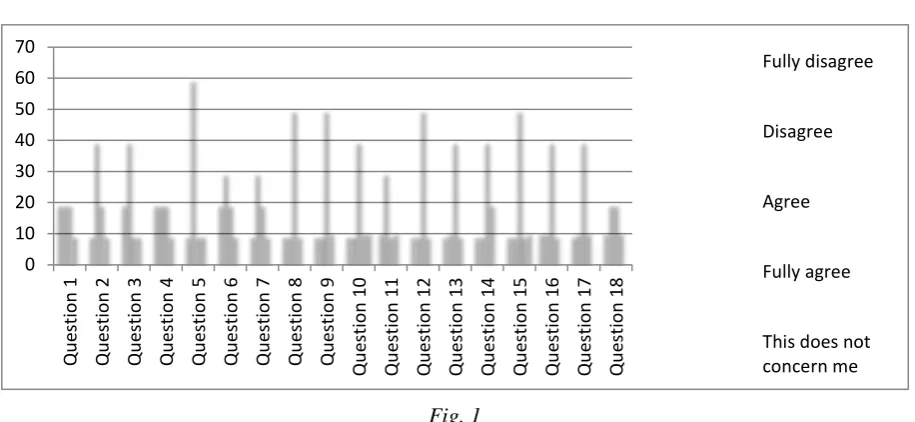
This questionnaire revealed that teachers are aware of students’ lack of interest during classes. They also realize that it is not their dependence on gadgets which is the main factor of this phenomenon. This leads to the idea that this is not the main cause why teenage students become more detached from formal learning. The situation also reflects teachers’ amount and degree of empathic involvement in how they transmit the information (as can be noticed from the students’ answers).
• Students’ questionnaire
Instructions
In order to better understand the relationship between the teenage student and the education institution, please read carefully the following statements and answer as honestly as possible, ticking the variant which suits you best in the empty box next to each answer.
This survey is anonymous and I will only use it as a reference in order to present certain aspects of current highschool education.
General data
5. Highschool:………
6. Sex:………
7. Class:……….
8. Age:………
• Check with “X” the situation which suits you most
No. II. Statement Totally
disagree
Disagree Agree Totally agree 1. There is at least one teacher to whom I can confess
regardless of the problem I have.
2. Regardless of my problem, I ask for advice from a teacher.
3. In the education institution, I am given the opportunity to explain my choices/actions.
4. I am receptive to criticism from the teaching staff. 0 10 20 30 40 50 60 70 Qu es tio n 1 Qu es tio n 2 Qu es tio n 3 Qu es tio n 4 Qu es tio n 5 Qu es tio n 6 Qu es tio n 7 Qu es tio n 8 Qu es tio n 9 Q ue st io n 10 Q ue st io n 11 Q ue st io n 12 Q ue st io n 13 Q ue st io n 14 Q ue st io n 15 Q ue st io n 16 Q ue st io n 17 Q ue st io n 18 Fully disagree Disagree Agree Fully agree
This does not concern me
5. When I make attitude and/or behavior mistakes, the teacher helps me understand why my action was wrong.
6. I consider that every time my answer is correct I should be rewarded.
7. If classes were interactive (more questions which lead to correct answers, video materials, etc.), I would not miss any classes.
8. I am glad when we have no classes.
9. There are disciplines which I do not like, I do not find useful, but the teachers are strict, which could affect my average.
10. If I were not forced in any way by my parents or by society, I would not go to school.
11. The method and quantity of delivered information do not influence my interest during classes.
12. I consider that teachers should keep up with the new technologies in the teaching process.
13. I would like to have more projects as assignments.
14. If the school organized actions to warn on the dangers facing teenagers, my entire perspective on drug and alcohol consumption, smoking etc. would change.
15. There is a large amount of delivered information.
Fig. 2
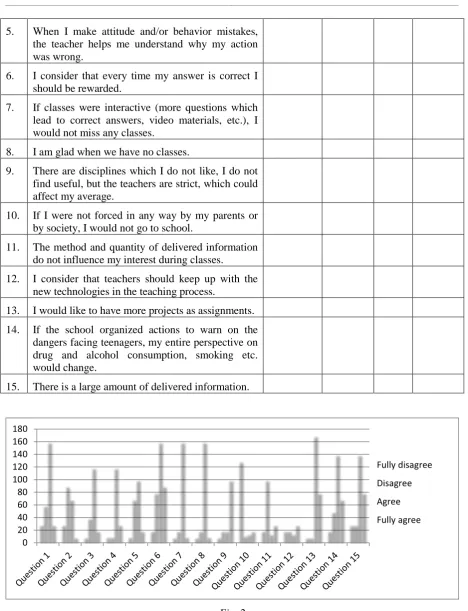
As can be noticed from the above chart, most questions with positive answers were related to the relationship students wish to have or already have with the teachers. This proves the need to find an ideal grown up among the persons around them.
Most negative answers were checked for questions related to how classes should be held. 0
20 40 60 80 100 120 140 160 180
Fully disagree Disagree Agree Fully agree
This questionnaire demonstrates that for students as well, the personality, the knowledge, how the teacher organizes his class are more important than the transmitted information.
3. CONCLUSIONS
To conclude, the teenage student does not need a strong hand to show him the road to follow, but an adult who can provide him with stability, trust, safety, support and, most important of all, the right instrument which he could use when making the right decisions for himself.
Another aspect to be revealed is that we are facing a truth about to become universally valid; the need for complexity that can be identified in the behavior of the current generations and how we can keep up with it.
Strengthening the relationship between teachers and students, a relationship relying on trust, is a must. This idea is also supported by Anna Freud who claims that “the teenager manifests an extremely high desire to think of abstract topics, to analyze them thoroughly and debate upon them”. I consider that these topics should be approached in an organized environment, in which the risk of negative attitudes, perceptions or desires can be reduced to the minimum or even prevented and explained at the same time.
Other solutions for preparing the individual for life in society can be of internal (close and constant connection between the family and the education institution) and external nature (attitude towards the quality of information transmitted by television shows).
References
Dumitrana., M. , 2000, “The psychology of human development”, V&I Integral, Bucharest. Geissler., E., 1977. “Methods of education”. Bucharest: E.D.P.
Maslow., A., 1954, “Motivation and Personality”, N.Y Harper & Row.
Muntean., A., 2009, “The Psychology of Human Development”, Polirom, Bucharest.
Neacsu, I., 1990, “Methods and Technics foran Efficient Learning”, Editura Militara, Bucharest. Neacsu, I., 2010, “Social Pedagogy”, Editura Universitara, Bucharest.
Rousselet, J., 1969, “ The Unknown, the Adolescent”, Editura Politica, Bucharest. Verza, E., 1994, “The Psychology of Ages”, Editura Prohumanitate, Bucharest.
Zazzo, R., 1970, “ The Child Evolution Fom Two to Six Years in Childs’ Psychology From Birth to Adolescence”, under the redaction of M. Debesse, E.D.P., Bucharest.