STUDYING OF THE SEMANTIC PRINCIPLE OF MUSIC IN THE MODERN HIGHER EDUCATIONAL INSTITUTION
Liudmila Р. Kazantseva
The Astrakhan Conservatory and Volgograd Institute of Art and Culture, The Laboratory of Musical Content,
414004 Sovetskaja str. 23, Astrakhan, Russia
Abstract
The semantic side of music has been long and successfully investigated by means of musicology. In recent decades it has become studied in the educational process. The article considers the prerequisites of studying of music content in Higher Educational Institution Nowadays, research and theoretical foundations of the new course, the main principles of the pedagogical methodology; it shows scientific and pedagogical perspectives for the research of music content.
Key words: musical content, meaning, musical institutions of higher education, sound, music intonation, music image, theme, idea, music dramaturgy, author principle
1. BACKGROUND FOR STUDYING OF THE MUSIC CONTENT IN THE TRAINING PROCESS
Semantic (figuratively-artistic) principle of music is constantly residing in sight of the Russian musicology. Nowadays problematics of the music content are not just studied productively. Academic schools were established, the centers of which were located in Moscow, Ufa and Astrakhan-Volgograd in order to study. An intensive research of the musical content and its introduction into the pedagogy were headed in these places respectively by V.N. Kholopova on the department of interdisciplinary musicologist specializations of the Moscow Conservatory (Холопова 2000, 2002), L.N. Shaimukhametova in the Laboratory of musical semantics at the Ufa Academy of Arts (Шаймухаметова 1998, 1999) and L.P. Kazantseva in the Laboratory of musical content at the Volgograd Institute of Art and Culture (Kaзанцева 2001а). The tendency towards studying of the "substantive" problematics was realized not only in production of the scientific ideas, but also in the formation of the complex study fields in these cities, and later in Tomsk, Maikop Kurgan, Penza, Bryansk, Syktyvkar, Krasnodar, Chita and elsewhere at the turn of the XXIth centuries. There appeared other subjects among traditional musicological subjects, designed to explore the substantive aspect of music: “Music Content” (for children’s music school and art school), “Theory of music content”, “Music Semantics”, “Fundamentals of music intoning” (for music colleges and universities) and “Music as an art form” (for higher educational institutions). They naturally became the practical adaptation of the scientific ideas being developed by the entire area of musicology.
Musical content as the scientific filed has the long-standing traditions, laid by lectures of B.L. Jaworskiy with the analysis of semantic units in the music of J.S. Bach and works on intonation of B.V. Asafyev (Асафьев 1971). They are successfully developed by their followers. Intonation and other aspects of music content are subjected to thorough research in major works (Арановский 1998; Вопросы музыкального содержания 1996; Мазель 1978; Медушевский 1976, 1993; Назайкинский 1982; Ручьевская 1987; Чернова 1984), including the works of foreign authors (Очеретовская 1985; Интонация и музыкальный образ 1965). The interest towards the semantic principle of music is evidenced not only by publications, but also research-to-practice conferences, dedicated to figurative art principle of music, such as “Musical content: science and pedagogy” (Moscow, 2000; Astrakhan, 2002; Ufa, 2004) and “Musical content: the modern scientific interpretation” (Rostov-on-Don, 2006), and the annual Scientific Readings on the musical content (Astrakhan, 2007; Volgograd, 2008-2013), attended by many like-minded persons.
Musicology together with aesthetics, philology, linguistics, art history, semiotics and other sciences have accumulated a lot of knowledge on the artistic opportunities of music. There are records on the
semantic musical sound and individual elements of music (melody, metrorhythm, texture, tone, etc.), musical emotion, musical intonation, semantics in music, musical imagery, musical drama, program, expressive potential of music as an art form among them. A huge fund or researches, dedicated to artistic patterns of music, embodies that valuable scientific information, which is not only useful, but also necessary for professional musicians. This knowledge of the music keystone – its content – allows the musician to rise above narrow-minded dilettante – conventional exchange of views on the level: “I like (dislike) this work” and judge the music more competently. For the performer it becomes the support for his professional activity in the search for the musical interpretation.
It is quite natural desire to introduce the accumulated body of knowledge into the widest circulation, including the training system of young musicians. The ordered (not random and episodic) knowledge become available to the training process, folding into a complete system, which can deepen an understanding of the essence of professional music. The first important reason is determined in this way, encouraging an introduction of subjects of music-substantial orientations – mastering of new, systematic knowledge of the content of the music into the training process.
It might be wrong to think that knowledge of the music content is necessary only for the student-musicologist, who is actually investigating the music. The performer equally needs it. Many musicians complain that recently the concert and competitive programs of the performers are suffering from monotony of interpretations, averaging, commonality and even stereotyping of interpretations. Technically, the well-trained musician sometimes detects helplessness towards the figurative artistic side of music, inability to identify independently various layers of content and offers his own semantic accent, finds his own personal understanding of the music. Lack of knowledge of the expressive possibilities of music hinders him in doing the same. The subjects of musical substantial orientation are bound to fill up and deepen the knowledge, helping the musician-performer to find and implement an impressive artistic interpretation of the musical work.
Another implication, associated with the first one, can be considered with the fact that fulfillment of the specific theoretical and aesthetic knowledge, not affected by other academic school subjects, is the real thing during studying of the music content. The reality is that some of the fundamental common factors of music, such as the golden section, rhetoric and symbolism, space and time, author’s background in the music, intertextuality, peculiarities of the music interaction with other forms of art, can hardly fit into the traditional disciplines of the theory and history of music and often remain almost unknown or completely unknown to the musician. Subjects of the musical-substantial orientation help to fill these gaps.
There is the third reason for introduction of serious disciplines of the musical-substantial content matter in the educational process. Introduced into the curricula of musical-educational institutions, subjects of the musical-substantial principle are directed not only on obtaining the knowledge on how the music piece has been arranged (as usually indicated in the traditional musicology courses). They are rather focused on the development of a fundamentally different view on the artistic phenomenon – an understanding of what “it is said” in the musical opus, what has been exactly “expressed” in it by the composer, as how the author “sees” of what has been “shown” or “expressed”. It is not a secret that the technological side has obviously prevailed in the theoretical segment of the modern curriculum. Detailed elaboration of questions on the structure of the piece of music is significant for it – what tonal-harmonic, polyphonic, compositional and other means have been used by the composer, what performing tricks have been programmed by him. We can note that the theoretical knowledge training is concentrated in the composing technology – what patterns have been developed by the compositional practice. This knowledge, absolutely necessary for any professional musician, however, gives a one-sided view of the music. However, the insufficiency of knowledge about other fields of music is clearly emerging – to the effect that what it is in fact expressing, what does the composer tell to his audience, and finally – for which purpose the piece of music has been composed and how it exists in the society. The subject of music-oriented content is just called to turn the musician to the artistic side of music, influencing on the listener. Academic disciplines, studying the way in which the music has been made, must be balanced by other disciplines, allowing the young musician to reach the idea, which has been suggested by the composer.
Requirement for the theoretically-analytical course, focused on the comprehension of the nature and essence of music, is also enhancing because of peculiarities of the modern socio-cultural situation which can be considered as the fifth compelling argument in favour of the new musical-substantial disciplines. At this point, original ways of expression of the avant-grade minded authors are presenting great complication, being back-breaking for the academic methods of music studying, but subordinating to the new analytical techniques, developed to penetrate the semantic aspect of music. In addition, the figurative artistic approach to the sound phenomenon opens the possibility for a young musician, being well-informed professionally, to get closer to many nonacademic phenomena of modernity, such as jazz, rock, and orient in the complex and diverse socio-cultural processes.
Realizing the socio-cultural challenges, faced to the modern musical pedagogy, introducers of the musical-substantial perspective respond to them differently. There can be revealed the general laws of music as an art form, traced the historical evolution, where the semantic aspect of music is subjected to it, before the students in Moscow “branch”. In the Ufa Center the fundamental perspective of music studying has been found in the semantics, the student comes to know the music through its practical implementation in the act of making music. “Theory of music content” – the author course, which will be discussed at a greater length – being taught in the high educational institution, has its own specifity.
2. EDUCATIONAL SUBJECT “THEORY OF MUSICAL CONTENT”: SCIENTIFIC FOUNDATIONS
The academic discipline is based on the scientific concept of the theory of music content. It involves understanding of the musical content as an artistic essence of work, on the embodiment and detection of which, directly or indirectly, there has been directed everything that it offers in a musical composition.
If you wonder about what is the essence of this art, you will likely have to talk about the spiritual aspect (in the philosophical sense of the word) of the music. It generates a system of ideas, which can be roughly grouped into three major areas: the person world (his emotions, thoughts, ideals, philosophy, his life and his relationships with other people), the macrocosm, being outside of the person (the world of nature, space, things, geographical space and historical time, society), and the microcosm (the music of his own knowledge resources). The objective side of the music lies in one of these areas or connects two of them or even three (let’s say, in the topics of “man and nature”, “man and fate”).
Musical content, however, is not confined to objectivity representations. These representations are adapted to the laws of music as an art form and are recorded in that “language” which the music is “speaking”, by that means, which it is affecting a person. The basis of musical content is generated by variously denounced representations.
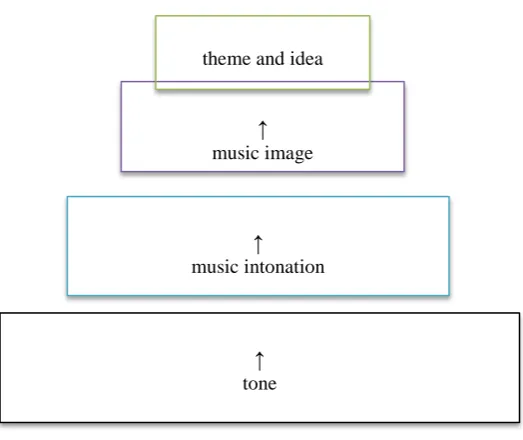
Musical content is understood as an unusually complex system, incorporating a number of components. Most of these components relate to this system as levels of hierarchy: the smallest – tone – musical unit of work has both physical (acoustic), and expressive qualities. Music intonation is generated on the basis of expressiveness of the toun – the smallest relatively limited and self-valuable semantic element of music. Intonation process (change and interaction of musical intonations) delineates by itself the contours of musical image. Interrelations of characters solve some artistic theme. In its turn, the theme, dropped-down under this or that point of view, crystallizes the artistic idea of work, closely associated with it. Thus the next hierarchical “bunch” of content elements of a musical work is lined up (Figure 1).
Figure 1
The “nest doll effect” has been applied in the mentioned “coupling” of elements – small elements are included to the larger one, larger ones are jointed to even greater one, etc. It also features the mechanisms of transformation of specificity of one level into the generalization, which occurs on the next level. Finally, the hierarchical model captures an important regularity of the music content: it, on the one hand (due to the nature of the acoustic sound), is “grounded”, rooted into the empiricism of the physical world and has the same strong physical base, as well as other phenomena of this world; on the other hand, it aspires to the heights, human ideas, and not only a purely musical, but also scientific, philosophical, religious and ethical ideas.
Besides elements, related hierarchically, musical content encompasses other components. Intermediate position between the components of two lower levels of the hierarchy is occupied by means of musical expression or the elements of music (melody, rhythm, meter, tempo, timbre, dynamics, mood, tone, etc.), partly characterizing the sound, but in some kind making out the musical intonation. Special part belongs to the musical dramaturgy, providing the movement, temporary deployment of musical images or a single musical image. This role can be called as transition one, targeting the musical imagery on solving of the artistic theme and proclaiming the idea. Revealed structural features of means of musical expression and musical dramaturgy alter the previous graphical view of the structure of music content as follows (Figure 2).
↑ tone
↑ music intonation
↑ music image theme and idea
Figure 2
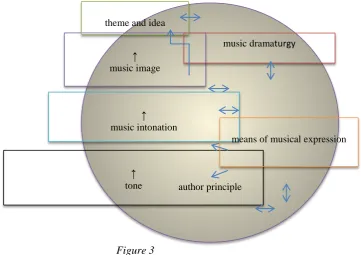
Finally, the structure component of the musical content behaves specifically, called by me as the author’s principle. Being a product of a human activity, music certainly includes subjective and personal principle, a reflection of the author (for more details refer to: Казанцева 1998). This feature significantly increases the volume, “stereometricity” of the structure of music content, absorbing the culture as a wealth of culture experience, and individual creative thinking of the composer (for more details about structuring the musical contents see: Казанцева 2001а).
Within the frames of a musical work, authorial persona has no rigidly fixed structural position and functions. Author principle can develop the ability to express itself in any previously called component or in few ones (all) at once that is spread throughout the structure of the musical content. Mobile, potentially “ubiquitous” author’s principle also irrevocably converts the lined up structure of the music content (Figure 3).
Figure 3 ↑ tone
↑ music intonation
↑ music image theme and idea
means of musical expression music dramaturgy
author principle ↑
tone ↑ music intonation
↑ music image theme and idea
means of musical expression music dramaturgy
The thematic plan of the course is shown according to the structure of the musical content. It includes the following sections:
• Expressiveness of the tone • Means of musical expression • Music intonation
• Music image • Music dramaturgy
• Theme and idea of the music work • Author principle in the music
Thus, the educational subject forms the view in the students not only on segmental fundamental semantic components, but also – and which is most important – on holistic figurative art system of music.
3. ACADEMIC DISCIPLINE “THEORY OF MUSICAL CONTENT”: PEDAGOGICAL METHODOLOGY
“Theory of musical content” faces important and responsible goals. They are seen as a) providing students with the knowledge in the field of musical content and b) obtaining practical skills of musical content analysis. They are achieved as follows.
The tasks of the course are defined as a) in-depth view on the laws of figurative and artistic world of music in different genres and styles (increased attention to the music of contemporary composers), b) giving the students the knowledge and skills aimed at improving their professional activity, and c) development of independent critical and historical thinking.
The lessons in musical content last two semesters and have a group character, but with a small number of students in a group. Every lesson combines lecture fragments with analytical practice. Individual lessons are not provided. As a standard form of practical work creative laboratory is established. This is a collective analysis of a music piece, revealing the laws of music content being studied at this stage. Creative laboratory allows organization of debate, discussion where all those present are entitled to voice. The process of collective creativity, starting during a joint study of music content by the students and the teacher, is natural and expedient because the lessons often have a group character. The discussion, which everyone is involved in spontaneously or thanks to the teacher, removes the obstacles on a way to free individual creativity. Widespread psychological “barriers” such as lack of common musicological knowledge, realized by the students, some personal qualities – uncommunicativeness, shyness, lack of self-confidence and professionalism, uncritical attitude to the world, inability to defend his/her position, inability to talk about music (especially apparent among the musicians) are overcome. Active, starting as a debate, penetration into the music allows us to solve one of the most important tasks of our course, i.e. the development of independent critical (along with analytical and historical) thinking of the students that, as we know, is paid very little attention to in a musical education process.
Such practical learning of the theory has a certain methodological support. Pedagogy has two fundamentally different models of communication at the lesson – authoritarian (a teacher, a holder of knowledge, is in the center of the system, transferring his/her knowledge to the students, submissive to his/her will) and individual and personal (a student, who is developed as a professional and as a person by a teacher, is in the center of the system). It is no secret that in the framework of academic disciplines, rich in theoretical material and lots of music to be mastered, it is almost impossible to find time for conversation and dialogue. It is not surprising that given the shortage of time preference is given to the authoritarian style of communication, transfer of knowledge from a teacher to a student. In our case, the second pedagogical paradigm, defined by the needs of a student rather than the knowledge and capabilities of a teacher, is more appropriate. The real problem consists not only in improvement of professionalism of a musician, but also in more complex, responsible, not always understood and solved by contemporary music pedagogy, problem of achievement of personhood of a
musician. Individual and personal model gives hope for approaching to the high ideals of pedagogy, yet formulated by Plutarch: “A student is not a vessel to be filled with knowledge, but a fire to be kindled”.
The preference given to the model of creative communication is stipulated by the peculiarities of theoretical material being studied. Figurative and artistic world of a piece of music that falls into focus of a student is specific. The completely objective frame elements (means of musical expression, intonation, musical drama, themes) a priori assume subjective “vision”. It is natural that the imposition of the only true knowledge of a piece of music to be learnt by a student is impossible, because it just does not exist. Vector flow of knowledge from a teacher to a student gives way to discussion, debate, thinking about music, sometimes beyond the boundaries of the analyzed composition. It goes without saying that an authoritarian style has to be refused. Being mobile and personal enough, musical content dictates other relationship between a teacher and a student at the lesson. A teacher initiates creativity of students. A student, put in an active position by a teacher, is forced to think independently about the music. When you shift from passive consumption of knowledge, declaratively presented by a teacher, to their understanding, it certainly awakens and develops the personal qualities of young musicians.
“Theory of musical content” has a problematic nature. It is generated not only by the way of acquiring knowledge, but also by the fact that each course theme requires its own, special approach to a piece of music. Subject-matter of the course stipulates the consideration of musical content in a variety of angles and volumes (from artistic expression of a sound to cultural interactions of a musical phenomenon with distanced musical or nonmusical phenomena), and it makes pattern formation of music analysis difficult. If the traditional disciplines (harmony, polyphony) offer students already tested analysis algorithm that needs to be learnt and that may be offered for different styles of music, a student, comprehending musical content, has to seek an optimal analysis algorithm almost in each case. The questions, appearing in each theme, and the answers to them are not polished up in typical methods of music analysis. They require certain mobility, constant active thinking about music from the students (and, of course, from a teacher). Put by a teacher in an active position, a student is forced to think independently about the music. Artur Schnabel’s behest becomes feasible while applied to music pedagogy: “Teachers open the door, but you must enter by yourself”.
The materials on the musical content of theoretical and historical nature, specific for a new discipline, yet prove to be insufficient for such a complicated phenomenon as music. To comprehend the essence of music we need to link existing knowledge from different scientific fields, and in the first place the knowledge, gained through traditional musicological disciplines – elementary music theory, harmony, polyphony, analysis of musical works musical form), music literature and history of music, study of instruments and history of orchestral styles.
Solving their own problems, “Theory of musical content” responds to a significant drawback, currently prevailing in the system of education, i.e. disunity, “kaleidoscopic” knowledge obtained in various disciplines, both theoretical and historical cycles. As you know, there is a “disciplinary approach”, formed in the present system of education of a musician, when each discipline carefully considers a piece of music from a different angle of view. Despite some achievements, such an approach to the study of music has a serious drawback – fragmentation, weak connections between disciplines and as a result the student’s knowledge of, for example, Beethoven’s music is different at the lesson of harmony, polyphony course, at the lessons of music history etc. No discipline contributes to their connection into a comprehensive picture. Hence we observe natural inability of a student to focus the information obtained from different sources, and thus to get a comprehensive view of a particular musical phenomenon.
The discipline of musical substantial orientation not only in its theoretical part is closely connected to virtually all other disciplines, but during the analysis of a piece of music requires activation of knowledge obtained at these courses. They complement each other and turn into a solid basis of thinking about music, and along with this the discipline acquires generalizable, synthetic character. Thus, by virtue of synthetic character, accumulating prior received knowledge, the discipline of musical substantial plan is able to counteract eclectic and mosaic consciousness of a student (“mosaic
culture” by Abraham A. Moles), neutralize pronounced centrifugal tendencies of modern music education.
“Theory of musical content” acquires the status of generalizing, structuring and centralizing knowledge about the nature of music discipline. However, the knowledge that the students possess is not just mobilized and activated, they are required in extraordinary, unfamiliar, unusual angles and matching that counteracts schematism and commonality that are inevitable for academic disciplines. Comprehensive, integrative nature of a discipline makes a student resort to using his/her thesaurus, and not mechanically provide objective, abstract and distanced information in a particular field, but what is far more important and valuable, match, complement, transform, and thus strengthen the existing knowledge and turn them in personally mastered one.
It should be specifically stated that the knowledge of music content acquired at the lessons does not overshadow the intuitions necessary for a musician. The latter are not replaced by scientific postulates, but combine with them. The experience positive in this regard is provided by a joint training in a united group of musicologists and performers, where the more profound knowledge of musicologists discipline the intuitive “insights”, to which the practicing performers are highly prone, and vice versa, get enriched by their finer direct response to music. Knowledge is not seen as an end in itself, but as a methodological basis and a tool for cognition. The goal of classes is the same – to prepare the student for independent communication with a musical phenomenon, to help the comprehension and interpretation of music.
The peculiarity of the course is the selection of music matter. While many traditional subjects are focused on the best artistic achievements of the European music, one of the objectives of our course, promoting independent thinking of the musician and his professional maturity, is considered to be an increase of the range of the music studied. Here the existing traditions in pedagogical practice of genre-style restrictions to the classic of XIX century are eliminated. In addition to the finest examples of academic music art, it is advisable to include in the study the works that are on the periphery or outside of traditional program of musical historical and theoretical disciplines.
A special place at the classes of musical content is allotted for the creative work of contemporary composers. Its presence certainly fills the gaps in the musical horizons of students, mainly oriented to the classical art. However, it is also justified because the works that have appeared in recent decades, sometimes quite sharply reveal the patterns of musical content (e.g., temporal and spatial parameters of the artistic image, especially the human incarnation of mental states, etc.), often elusive when analyzing the music of the past, and thus serve as a general comprehension of the basics of music. The works of our contemporaries – Béla Bartók, Luciano Berio, Leonard Bernstein, Viktor Ekimovsky, Sofia Gubaidulina, Charles Ives, Einojuhani Rautavaara, Steve Reich, Alfred Schnittke, Kazimierz Serocki, Rodion Shchedrin, Dmitriy Shostakovich, Georgy Sviridov, and others, being worthy of study themselves, can be a powerful heuristic impulse arousing interest not only to the analyzed piece, but also to the music of its author and even, having eventually turned into an urgent need – to the modern art of music itself. This feature of the music of our time lies in its high individualization.
Hardly anyone would dispute the idea that the creative work of composers of the past is rather normative, based on generally accepted laws and traditions. This circumstance in the learning process often leads to schematization, unification of ideas about music and as a result, inability to learn to recognize individual unique style of the composer in a single composition. The twentieth century music is characterized by multitude and individuality of genre solutions (sometimes invented for a particular opus), techniques, trends, composers’ styles and even opuses within a single author’s style. A sensitive musician perceives, for example, in the first of two plays of the piano cycle ‘A due’ by A. Knaifel two tonally contrasting “characters”, moving crosswise along the intersecting trajectories with the inevitability of formal logic. He won’t get lost in the fragile vibration of free pointillistic environment of the “sound fog” the first of the “Two solfeggios” for the chorus of Yu. Falik. He will appreciate the finest sensual soaring vibes, vibrating in the spirituals “We are climbing Jacob’s ladder” in the adaption of J.R. Johnson. The unique individuality, as a pronounced feature of the work, cannot
go unnoticed. Detectable in the analysis of work, it captivates the analyst, draws him in the depths of the music, ensuring its more profound comprehension.
When choosing an artistic material it is also taken into account that a prominent place in the repertoire of performers is occupied by all sorts of adaptations, treatments, versions, transcriptions, potpourris, fantasies , etc., and demands of a musician the ability to conceptualize them not only as an isolated phenomenon, but in the cultural correlations. Jazz, popular and rock music, musical phenomena of Eastern cultures also urge to analytical approach. Alongside with known compositions and authors the less familiar layers of music are constantly being analyzed, such as old-time music, religious music. The unchanged criterion for selection of music for the analysis is the relation of the theoretical subject with students’ performing specialty and educational and performing activities of the educational institution groups. Thus, the work with choral conductors naturally involves religious music, the work with folk musicians involves the compositions intended for playing folk instruments, with students of popular music department involves jazz, pop and rock music. The need of resorting to arrangements, treatments, adaptations, etc. is also dictated by the professional need to understand their artistic merits that is to solve a practical problem, especially relevant primarily for performers trained to be the managers or members of ensembles and groups. We should not forget that the aforementioned layers of music can be also of interest for other students, for example, for the musicologists.
The compositions selected for the analysis are analyzed carefully and thoroughly. This requirement is hardly feasible in an effort to cover a large number of works and major opuses. Much more efficient is to be limited with a small number of medium-sized works, thus providing an insight into them similar to what linguists call “slow reading”. The main concern is of a teacher is not to get a student acquainted with another albeit outstanding writing. Based on the goals and objectives of the discipline it is much more useful to learn the fundamental approaches and algorithms of thinking to be able to apply them in any situation.
One of the fundamental methodological principles of teaching music content is to study not only the composer’s opus, to which all known theoretical disciplines are traditionally reduced, but the “live” artistic phenomenon. The latter becomes “live” primarily due to the active practice of interpretation and perception, and what is most important, to the multiplicity of interpretations and perceptions, mobility and variability. Infinite variability of sound, opening through semantic beginning of the music is perceived as the only possible way – the law of real being of a piece of music.
The impulse of analytical creativity at the class of the theory of music content, as well as the factor correcting this process appears to be not an imaginary or remembered, but inevitably relevant (again “live”) sounding music. The practice shows that not only the new (albeit adapted and fragmentary) pieces for the students need to be sounded, but even the well-known ones, for example, included in the program on the history of music, performed by orchestral or choral creative teams of an educational establishment, learned in the classroom by specialty.
Direct sound produces more vivid impression than recalling, which is very important during immersion in such a delicate area as the conceptual principle of music. Besides, it can be preceded by questions of the teacher, focusing on the perception of certain regularities of a piece of music and concentrating listener's attention, as the student not only enjoys sounding music (which is absolutely necessary), but also thinks it over actively. Therefore, each analytical study is preceded and, where appropriate, is accompanied if appropriate, by the sound of music, presented in writing, or – by teacher’s and students’ playing the music. No wonder the students often come to lessons with a guitar, accordion and others instruments of their own and eagerly play piano in the classroom, singing to their own accompaniment, read choral and orchestral scores. Initiated by the music itself, the conversation does not slip into a seductive pointless verbal activity and subjective speculation, following the riverbed laid by a musical piece.
No doubt, the development of the course demanded certain methodical facilities. There were published the Program compendium (Казанцева 2001с); the textbooks on “Fundamentals of the theory of musical content” (Казанцева 2001а) and “Musical content in the context of culture” (Казанцева 2009), outlining the theoretical positions of the course, a book “Analysis of musical content”
(Казанцева. 2002), offering a methodology for analyzing the conceptual principle of music, the anthology, including music notation and the audio record on all topics; the textbook “Analysis of artistic content of vocal and choral works” (Казанцева. 2011), building an algorithm of analysis of the special synthetic-verbal and musical work of art, and other issues used in the educational process. As theoretical material numerous modern scientific works were referred to (Карпычев 1997; Кудряшов 2006 et cetera).
4. SCIENTIFIC AND PEDAGOGICAL PERSPECTIVES FOR THE STUDY OF MUSIC CONTENT
Scientific and educational development of the substantive aspect of music continues. Significant role here in particular is played by the activity of the Problem Scientific Research laboratory of musical
content to the Volgograd State Institute of Arts and Culture that I am leading. Its member researchers
and teachers from all over the country are preparing doctoral and master's theses, articles and reports, guidelines, and other materials, conduct training courses for teachers of music content.
The results of the Laboratory’s activities are reflected in the collections, compiled on the basis of annual scientific-pedagogical Readings on the musical content, the publication of books (Андрущак 2012; Бозина 2013; Васирук 2011, 2012; Волкова 2007, 2008; Луконина 2009, 2012; Мозгот 2008; Рахимова 2013; Шевченко 2007; Шепшелева 2012; Шмакова 2009а, 2009b) and articles, as well as on the website http://www.muzsoderjanie.ru. Scientific and methodological developments inspire teachers to introduce the subjects of musical content trend both in other regions of the country as well as in other sectors of musical education and training system – in secondary schools, music schools and art schools, as well as in postgraduate education (Еремина 2008; Казанцева 2001b; Казанцева & Максакова 2001; Рогозинская 2010; Шевченко (Бегичева) 2010-2012).
Usually the classes on music content are considered by the students at one and the same time both as promoting general developmental and mastering a certain musician's profession. Naturally a need for their continuation arises. In this regard, for many years of mastering musical content is continued at the request of the students up to the third semester, where the additional taken course “Musical content in the context of culture”. It emphasizes the fact that the content of musical work is not reduced to the composer’s opus. In the latter only a base rod is formed, which is further adjusted by the performer and the listener in the listening and performing layers of the content. The aggregate of the composer’s, performer’s and listener’s layers can only be rightfully called the content of music.
During the additional third semester, we also ensure that in the content of a musical piece not only three persons meet. The conceptual side of the music is powerfully affected by musical culture in the form of its genres, styles and laws of composition and, in its turn, it is actively working on it. A piece of music enters into conceptual intertextual dialogue with other musical and – in the broader context of artistic culture – not only musical works. Finally, the conceptual principle of music focuses on the intersection of the set of currents of spiritual culture emanating from the aesthetic, ethical, scientific, religious, philosophical ideas of culture. Thus, due to the content approach the perspectives of comprehension a single piece of music in a large-scale socio-cultural process arise.
Many years of practice show that the presently established college course “Theory of music content” equips students with knowledge about important aspect of music, the skills of its analysis and the need to treat music thoughtfully and professionally, and thus – effectively promotes development of personality of the musician.
REFERENCES
Андрущак, ТС 2012, Мемориальность в отечественной музыке последней трети ХХ века (к исследованию феномена, Волгогр. науч. изд-во, Волгоград.
Асафьев, БВ 1971, Музыкальная форма как процесс, Музыка, Ленинград.
Арановский, МГ 1998, Музыкальный текст. Структура и свойства, Композитор, Москва. Бозина, ОА 2013, Семантика тональности в оперном творчестве Н.А. Римского-Корсакова, КГАМиТ, Красноярск.
Васирук, ИИ 2011, Современная фуга: содержательные аспекты, Магарин О.Г., Волгоград. Васирук, ИИ 2012, Полифонические циклы XX века, Магарин О.Г., Волгоград.
Волкова, ПС 2007, Метафизика огня, или опыт философии искусства, КУКиИ, Краснодар. Волкова, ПС 2008, Реинтерпретация художественного текста (на материале искусства ХХ века), ХОРС, Краснодар.
Вопросы музыкального содержания 1996, вып. 136, РАМ им. Гнесиных, Москва.
Еремина, ВС 2008, ‘Проблемы методики преподавания музыкального содержания в выпускных классах ДМШ и ДШИ’, дипл. работа, Астраханская консерватория, Астрахань.
Интонация и музыкальный образ 1965, Музыка, Москва.
Казанцева, ЛП 1998, Автор в музыкальном содержании, РАМ им. Гнесиных, Москва. Казанцева, ЛП 2001a, Основы теории музыкального содержания, Факел, Астрахань.
Казанцева, ЛП (сост.) 2001b, Теория музыкального содержания. Программа для музыкальных училищ, Факел, Астрахань.
Казанцева, ЛП (сост.) 2001c, Теория музыкального содержания. Программа-конспект для историко-теоретико-композиторских факультетов музыкальных вузов, Факел, Астрахань. Казанцева, ЛП 2002, Анализ музыкального содержания, АГК, Астрахань.
Казанцева, ЛП 2006, Хрестоматия по теории музыкального содержания, Волга, Астрахань. Казанцева, ЛП 2009а, Музыкальное содержание в контексте культуры, Волга, Астрахань. Казанцева, ЛП (ред.) 2009b, Музыкальное содержание: пути исследования. Сб. материалов научных чтений, Изд. дом ХОРС, Краснодар.
Казанцева, ЛП 2011, Анализ художественного содержания вокального и хорового произведения, Волга, Астрахань.
Казанцева, ЛП (ред.) 2012, Музыкальное содержание: пути исследования. Сб. материалов научных чтений, вып. 2, Магарин О.Г., Майкоп.
Казанцева, ЛП & Максакова, ВС (сост.) 2001, Музыкальное содержание. Программа для ДМШ и ДШИ, Факел, Астрахань.
Карпычев, МГ 1997, Теоретические проблемы содержания музыки, НГК, Новосибирск. Кудряшов, АЮ 2006, Теория музыкального содержания, Лань, Санкт-Петербург.
Луконина, ОИ 2009, Музыкально-театральное творчество М.О. Штейнберга в культурном контексте Серебряного века, Волгогр. науч. изд-во, Волгоград.
Луконина, ОИ 2012, Максимилиан Штейнберг: художник и время, Волгогр. науч. изд-во, Волгоград.
Мазель, ЛА 1978, Вопросы анализа музыки, Сов. композитор, Москва.
Медушевский, ВВ 1976, О закономерностях и средствах художественного воздействия музыки, Музыка, Москва.
Медушевский, ВВ 1993, Интонационная форма музыки, Композитор, Москва.
Мозгот, СА 2008, Музыкальное пространство в творчестве Клода Дебюсси, Изд-во Адыгейск. госуниверситета, Майкоп.
Назайкинский, ЕВ 1982, Логика музыкальной композиции, Музыка, Москва. Очеретовская, НЛ 1985, Содержание и форма в музыке, Музыка, Москва.
Рогозинская, МЮ 2010, ‘Хрестоматия по музыкальному содержанию для учащихся ДМШ и ДШИ’, дипл. реферат, Астраханская консерватория, Астрахань.
Рахимова, ДА 2013, Ориентализм в музыке С.В. Рахманинова, Изд-во ВИИ им. П.А. Серебрякова, МИРИА, Волгоград.
Ручьевская, ЕА 1987, ‘Об анализе содержания музыкального произведения’, Критика и музыкознание, вып. 3, с. 60-96.
Холопова, ВН 2000, Музыка как вид искусства, Лань, Санкт-Петербург.
Холопова, ВН 2002, Специальное и неспециальное музыкальное содержание, ПРЕСТ, Москва. Чернова, ТЮ 1984, Драматургия в инструментальной музыке, Музыка, Москва.
Шаймухаметова, ЛН 1998, Семантический анализ музыкальной темы, РАМ им. Гнесиных, Москва.
Шаймухаметова, ЛН 1999, Мигрирующая интонационная формула и семантический контекст музыкальной темы, ГИИ, Москва.
Шевченко, ОВ 2007, Образно-содержательные линии музыкального искусства Серебряного века, Волгогр. науч. изд-во, Волгоград.
Шевченко (Бегичева), ОВ 2010-2012, Слушаем музыку вместе. Уч.-методич. пособие по слушанию музыки для детей старшего дошкольного возраста, ч. 1-3, Бланк, Волгоград.
Шепшелева, ОВ 2012, Современная отечественная хоровая музыка: выразительность звука, Волга, Астрахань.
Шмакова, ОВ 2009а, Из истории отечественной музыки ХХ века: симфонические циклы от Танеева до Шостаковича, ВМИИ им. П.А. Серебрякова, Волгоград.
Шмакова, ОВ 2009b, Финал в симфонических циклах Бартока, Онеггера и Хиндемита (1930 – 1950 годы), Мириа, Волгоград.