Local Fiscal
Capacity in the
New Members
of the European
Union:
Is It Eficient?
Local Fiscal Capacity in the New
Members of the European Union:
Is It Eficient?
Nikolay Patonov
Faculty of Economics,
South-West University “Neoit Rilski”, Blagoevgrad
[email protected], 2 Krali Marko Str., 2700 Blagoevgrad, Bulgaria.
Abstract
Purpose – This paper aims to analyze the eficiency of the iscal capacity of the local governments
in the new members of the EU.
Design/methodology/approach – The impact of the locally collected taxes on economic growth is analyzed by the means of regression analysis. The GDP growth rate is adopted as a dependent
variable in the model and its deviations are explained via tax instruments for building iscal
capacity.
Findings – Strong positive effects on economy, when property taxes come in local budgets.
Research limitations/implications – There are many factors affecting the economic growth, which are not included in the regression model. The effects of the charges levied by local governments also remain without estimation.
Originality/Value - The study ills in the gap of research on the beneits of local iscal capacity
in the countries of interest.
Key words: property taxes; shared taxes; total government expenditure; economic growth; research; new member states, synergy.
Paper type – Research paper
1. Introduction
According to the literature, the basic economic argument in favor of iscal decentralization
is based on two complementary assumptions: 1) decentralization will increase economic
eficiency because local governments are better positioned than the national government
to deliver public services as a result of information advantage; and 2) population mobility and competition among local governments for delivery of public services will ensure the matching of preferences of local communities and local governments (Tiebout, 1956;
Oates, 1972; Davoodi & Zou, 1998).
The establishment of a inancially decentralized government structure is related to
any outlays whose amount must be paid by society. Consequently, such kind of reform
must lead to higher proits than initial expenses. The deinition we have cited above insists on the increase in economic eficiency as a result of iscal decentralization. It means that public sector will realize an economy of resources because of a more eficient provision of public goods. Thus, the more eficient resources allocation will contribute to the
International Journal of Synergy and Research
Vol. 2, No. 1, 2013 p. 57–70
IJSR
2, 1
eficiency gains of total public sector. Other results from the decentralized public service
are a higher level of the quality of the public service and ensuring fuller compliance of the resident consumers. At least, an eventual reduction of the tax burden is also possible in terms of more effective public goods productivity.
The qualitative public service provided by the government in a local jurisdiction would
reduce the current costs of the resident irms. Thus, the local self-government unit will be
more attractive for nonresident business agents and high-income individuals. All the things
will inluence on the potentiality for economic development of the same jurisdiction. The central authority transfers inancial powers to the sub-national government levels in order to guarantee their iscal autonomy. Local budget is the “inancial expression” of local self-government. The tax revenues collection is a signiicant part of the inancial
powers. Thus, local governments are able to provide public goods and services linked to
the preferences and the inancial abilities of local communities. Consequently, we could expect the iscal capacity building contributes to the eficiency gains of the total public
sector as well as the total economy.
We can agree with the last assumptions as verify their practical conirmation. Hence, we must ind whether the practice supports the theoretical predictions by the means of
quantitative methods.
The purpose of this paper is to analyze the eficiency of the iscal capacity of the
local governments in the new members of the European Union. In the context, the purpose of research involves to be estimated the impact of the locally collected taxes on economic growth. The sample of interest includes the countries in Central and Eastern Europe as well as Cyprus and Malta. The criterion for selection of the countries is the admission to the European Union since 2004 and 2007.
The estimation of the eficiency of local iscal capacity covers the years of the period
from 2000 to 2010. Thus, the present analysis estimates the actual state of the reforms and their results immediately before and after the EU membership of the new member states. Moreover, there is a tendency among the EU members to achieve an approximately similar redistribution of GDP through state budget (Stoilova, 2010).
The deined goal requires an appropriate conceptual framework and empirical
methodology. They are developed in following sections.
The next sections of the paper are focused on the research. Firstly, the place of the research is outlined through an overview of the existing evidence on the topic of
iscal decentralization. The conceptual framework adopted for empirical research is developed in the section three. The empirical methodology and the speciics of data are presented in the section four. The section ive contains the regression results and their interpretation. At the inal, the suggestions for further research are included in the
section of conclusions.
2. Literature overview
Breuss and Eller (2004) note that the reasoning the inluence of iscal decentralization on
economic growth started with the publications of Tiebout (1956), Musgrave (1959) and Oates (1972). They also emphasize that conceptual predictions and empirical analyses
Local Fiscal
Capacity in the
New Members
of the European
Union:
Is It Eficient?
regarding the effects of economic growth on iscal decentralization are aroused at the end of the 1970s. The studies of Kee (1977) and Pommerehne (1977) are considered in
the comment of Breuss and Eller (2004). The signiicance of these fundamental studies
is undoubtedly great. The conclusions from the primordial analyses have become a base for the further empirical work on this topic.
The empirical research on the matter of the direct impact of iscal decentralization on economic growth is going on two directions. The irst one is concentrated on the
impact of the decentralization of government spending on economic growth. Thus, the
results from the empirical studies show the eficiency of the public expenditure carried
out at a subnational government level. Such kind of research has been done by Oates (1995), Devarajan, et al. (1996), Davoodi and Zou (1998), Woller and Phillips (1998).
Next signiicant attempts for research have been made in the studies of Yilmaz (1999), Thießen (2000; 2003), Zhang and Zou (2001), Akai and Sakata (2002) as well as the elaborate approach applied in the study of Desai, et al., (2003). The most recent analyses have been done by Malik, et al. (2006) on the provinces of Pakistan and Samimi, et al.
(2010) on provinces of Iran.
The second part of empirical research concerns the effects of the revenue collected by local governments. The studies of Woller and Phillips (1998), Zhang and Zou, (2001), Akai and Sakata (2002), Thießen (2003), Desai, et al., (2003), Malik, et al. (2006) and Samimi, et al. (2010) deal with the impact of subnational revenue on the economic growth. There are studies, which are completely concentrated on the revenue side of decentralization. An example for such kind of research is the study of Lin, and Liu (2000). The empirical work is further developed with the approach applied by Desai, et al. (2003), whose analysis is focused on the tax receipts collected by the governments in 80 regions of Russia.
Most of the investigations on relationship between the revenue decentralization and
the economic growth do not use the term “iscal capacity”. In the literature regarding the iscal capacity of local governments is emphasized the problem of its measuring.
There are many measures, which are characterized with pros and cons regarding their appliance. Martinez-Vasquez and Boex (1997) compare the most widely accepted
methods for measuring the iscal capacity and develop the method of representative
tax system. They introduce a multiple regression in the estimation procedure of the method of the representative tax system. The different measures are further compared
by the authors collective as the iscal capacity of the local governments in the Russian Federation is calculated through the each method (Martinez-Vasquez & Boex, 1997a).
Martinez-Vasquez and Boex (1997) note “the Russian Federation currently uses the level of revenue collections for a base year as its measure for iscal capacity, which is then adjusted for legislative changes”. The same approach for measuring the iscal
capacity of local governments in the new member states of the European Union will be applied in the present empirical analysis. Total revenue collections will be differentiated according the tax components. In this sense, the tax component is a group of taxes levied on a taxable resource.
Most of the studies use an empirical methodology based on regression analysis. The
regression models are speciied through a linkage of measures for iscal decentralization
and choosing appropriate variables from an endogenous model of economic growth. The
IJSR
2, 1
most widely accepted endogenous models are the Barro’s model of growth (Barro, 1990)
and the model of Solow (1956). Most of the empirical studies on the topic use the irst one.
3. Conceptual framework
According to the frame of the method of representative tax system, the second step in the
process of computing iscal capacity in the representative tax system is a classiication
of revenues into sources. That means arranging the revenue items into groups or tax
components. (Martinez-Vasquez & Boex, 1997)
The same approach of the classiication of the revenues into tax components is adopted in present research. Thus, the revenues spent by public authority to inance
the total amount of government expenditure are aggregated into groups. The special
emphasis in the classiication is put on the revenues from the tax components collected
by local governments. Therefore, the present research estimates whether the structure of tax revenues is consistent with the economic growth in the new member states. In other
words, the eficiency of structure of inancing the total government spending is a subject
of interest. The regression results express the quantitative effect of the distribution of the tax powers among the levels of government.
The analytical framework for empirical research on the relationship between iscal
decentralization and economic growth has been developed by Devarajan, et al. (1996) and Davoodi and Zou (1998). The same frame is adopted in the present analysis.
These irst attempts for research follow the endogenous growth model of Barro
(1990). According to the growth model, the production function has two inputs: private capital and public spending. However, Davoodi and Zou (1998) depart from the Barro’s model by assuming that public spending is carried out by three levels of government: federal, state, and local. Let k be private capital stock, g total government spending,
f federal government spending, s state government spending, and l local government spending, all measured on a per capita basis:
g = f + s + l, (1)
The production function is Cobb - Douglas:
y = kα f β sγ lω, (2)
where y is per capita output, 1 > α > 0; 1 > β > 0; 1 > γ >0; 1 > ω >0 and α + β + γ + ω = 1.
The allocation of consolidated or total government spending g among different levels of government takes the following form:
f = θf g; s = θs g; l = θl g, (3)
where θf + θs + θl = 1 and 0 < θi < 1 for i = f, s и l. Thus, if θf is the share of federal government in total spending, θs the share of state government and θl the share of local
government. Consolidated government spending g is inanced by a lat income tax at rate t:
Local Fiscal
Capacity in the
New Members
of the European
Union:
Is It Eficient?
g = τy, (4)
The representative agent’s preferences are given by
where c is per capita private consumption and p is the positive time discount rate. The dynamic budget constraint of the representative agent is
Davoodi and Zou (1998) further assume a constant tax rate along the balanced growth path.
Given total government spending g, a constant tax rate t, and the shares of spending by different levels of governments (θi’s, i = f, s, l) the representative agent’s choice of consumption is determined by maximizing (5) subject to (6) and the government’s budget allocation. Along the balanced growth path, the solution for the per capita growth rate of the economy is given by
The equation (7) shows that the long-run growth rate of per capita output is a function of the tax rate and the shares of spending by different levels of government. It forms
the basis for our empirical analysis of the relationship between iscal decentralization and growth. Following the literature on iscal federalism, we regard a country as more iscally centralized if it has a higher value of the federal spending share θf.
It is important to note that, for a given share of total government spending in GDP, a reallocation of public spending among different levels of governments can lead to higher economic growth if the existing allocation is different from the growth-maximizing expenditure shares. To show this point, we maximize the growth rate in (7) by choosing θf, θs,and θl subject to the constraint θf + θs + θl = 1. The growth-maximizing government budget shares are
ω γ β β θ
+ + =
f
, (8)
ω
γ
β
γ
θ
+ + =
s
, (9)
ω
γ
β
ω
θ
+ + =
l
, (10)
IJSR
2, 1
Davoodi and Zou (1998) conclude that as long as the actual government budget shares are different from growth-maximizing shares, the growth rate can always be
increased without altering the total budget’s share in GDP. (See more Davoodi & Zou,
1998)
4. Empirical methodology and data
The effects of the decentralization of tax collection on economic growth are quantitatively estimated by the means of the estimation procedure. It is applied in accordance with the
speciication of the regression model. The model is speciied through a combination
of variables expressing the revenue collections of central government, the revenue
collections of local governments, i.e. the instruments for iscal capacity building, and total government spending. Thus, the equation estimating the eficiency of the structure of inancing the total government spending is following:
yit = b1 + b2τit + b3θit + b4ξit + εit , (11)
where yit is the annual growth rate of the GDP for each country. The τitis the ratio of main revenue sources presented as a ratio to GDP for each country and year. This variable includes the revenues collected from value added taxes (VAT) and actual social contribution (ASC). This revenue is accumulated by central governments. The θit includes the revenues collected by local governments. These amounts are expensed by
councils to inance their spending programs and include the locally collected revenues
from: 1. corporate income taxes (CTR), 2. individual income taxes (ITR) and 3. taxes on land, buildings and other structures (TLBSR), which are presented as a ratio to GDP for each country and year. The variable ξit expresses the ratio of total budget expenditure to GDP for each country and year (TGS). The εit is the error term, i.e. the random (residual) component in the equation. The parameters of the regression equations are b1, b2, b3, b4.
The Ordinary Least Squares (OLS) method is adopted as an estimation procedure for
the regression coeficients. Initially, it is useful to be calculated the correlations between the pairs of independent variables included in the model. Normally, the coeficients of correlation are estimated in order to be identiied the phenomenon of multicollinearity.
This phenomenon affects the results from t-test and increases the p-value. The textbooks in econometrics remind that regression results remain unaffected by correlations whose values are nearly 0.2 (Ramanathan, 1995).
The procedure of the Ramsey Regression Equation Speciication Error Test
(RESET) is applied to identify non-linear relationships between the dependent and the explanatory variables in the equation. The test is developed by Ramsey (1969) as
a general speciication test for the linear regression models. The procedure of the test facilitates to be identiied whether non-linear combinations of the itted values have any
power in explaining the deviations of the dependent variable in the model.
The inal step of calculations is the descriptive statistic to the residuals. These are
deviations of dependent variable, which are not explained by the factors included in the regression equation. All the steps of the research are presented in Figure 1.
Local Fiscal
Capacity in the
New Members
of the European
Union:
Is It Eficient?
The estimation procedure (OLS) is applied to a panel which enlists annual data for each variable for the new member states of the European Union. The period covered by the panel is 2000-2010. Hence, the present research uses a classic regression of cross-sectional data in terms of a balanced panel.
1) An estimation of the correlations between the variables
2) Ramsey Regression Speciication Error Test
3) An estimation of the parameters of the regression model
4) Tests for normal distribution of the residuals
5. Regression results
Table 1 presents the coeficients of correlation between the independent variables included in the regression model. The complete version of speciication includes factors
whose correlations are higher than recommended by Ramanathan (1995). Thus, it is
expectable a decrease in the empirical values of the t-test on some regression coeficients
which are calculated in different variants of the model.
Variable TGS VAT ASC TLBSR ITR CTR TGS 1.000 0.247 0.477 0.212 0.305 0.157 VAT 0.247 1.000 -0.243 0.420 -0.152 -0.366 ASC 0.477 -0.243 1.000 -0.278 0.695 0.459 TLBSR 0.212 0.420 -0.278 1.000 -0.153 -0.352 ITR 0.305 -0.152 0.695 -0.156 1.000 0.580 CTR 0.157 -0.366 0.459 -0.352 0.580 1.000 Source: Eurostat, Author’s calculations
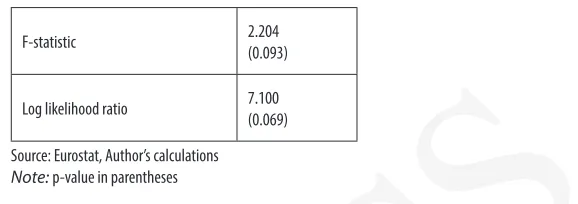
The results from the Ramsey Regression Speciication Error Test are presented in Table 2. The table shows very weak nonlinear relationships between the dependent variable and the factors included in the regression model. This fact could be explained
by the macroeconomic speciics of the new member states.
The parameters of the regression model estimated via the procedure of Ordinary Least Squares method are presented in the Table 3. The estimation procedure is applied to annual data for the new member states of the European Union. The separate variants
of speciication are constructed by excluding of explanatory variables from the complete
version of the regression equation. Models from 1 to 4 are constructed in this manner.
Figure 1:
Research Model
Table 1:
Correlations between the Independent Variables from Regression Equation
IJSR
2, 1
F-statistic 2.204 (0.093)Log likelihood ratio 7.100 (0.069)
Source: Eurostat, Author’s calculations
Note: p-value in parentheses
The speciication of Model 1 is consisted of the complete variant of the regression
equation. It is important to be noted, that the economic development of the new member
states has a set of traits affecting the regression coeficients. The variables included
in the regression model explain over 17 percent of the deviations of the dependent variable. These predictors are used not only in the present research, but also in most of empirical studies on this topic. The present analysis estimates the impact of the most widely accepted factors affecting the economic growth. The empirical value of the
F-test conirms the hypothesis for the adequacy of Model 1, i.e. the relationship between
the dependent variable and the total number of independent variables is statistically
signiicant. Another feature of Model 1 is the presence of nonlinear links, whose hypothesis is conirmed by the Ramsey RESET-test (See Table 2).
A considerable share of total government spending is inanced at subnational level
through receipts from taxes. Such kinds of taxes are imposed on corporate and individual
income, as well as on land, buildings and other structures, etc. According to the deinition accepted for iscal capacity, the transfer of powers to a lower government level to collect
or accumulate receipts from the bases of different taxes could be understood as local
iscal capacity building.
There is no indication for very eficient inancing of a share of total government
spending at local government level through receipts from corporate taxes. The
regression coeficient is positive, that means an economy of resource realized. The last
fact accelerates the economic growth. As we noted, the economy of resource expressed
via the value of the regression coeficient is not very high. The empirical value of t-test is less than the theoretical one. That means the coeficient is not statistically signiicant, which does not enable us for drawing out reliable conclusions. The weak inluence of
these revenues is a direct result of the limited appliance of the corporate income taxation
as an instrument for local iscal capacity building.
The receipts from individual income taxes coming in local budget exert a weak
negative inluence on the GDP growth rate. The weakness of the impact of this factor has been conirmed by the cubic form of the curve describing the relationship. The possible
conclusion is that there is any positive economic effect as a result of more effective
inancing of public spending through revenues from income tax. The coeficient is statistically signiicant in terms of ten percent of p-value. The high level of the p-value
and the low value of t-test are a direct result of multicollinearity in the model. The
values of the correlation coeficients between the receipts from income taxes and other explanatory variables included in the speciication vary from -0.156 to 0.695 (see Table 1). The unclear and ambiguous inluence of the income taxation on the economic activity
Table 2:
Ramsey RESET Test
Local Fiscal
Capacity in the
New Members
of the European
Union:
Is It Eficient?
is predicted by Zou (1996). According to his assumptions, “the direct impact of a rise in the local income tax is a reduction in private investment and an increase in local public investment”. He adds “the rising public investment also stimulates private investment due to the fact that these two capital inputs are complementary in production”. He thus concludes that “the net effect of a rise in the local income tax on output production is not clear”. (Zou, 1996)
Another possible explanation of this result is in line with the limited appliance of
the individual income taxation as an instrument for iscal capacity building in the new member states. Another possible explanation is related to the ineficient taxation of the
patent activities.
These results do not support the assumptions for effective income taxation at a local government level in the new member states of the EU. Hence, they are consistent with the results of most of the empirical studies on the topic of taxation. Kneller, et al. (1999) examine the experience of the OECD countries and ind the impact of tax structure on economic growth. They use the terms “distortionary taxes” and “ non-distortionary taxes”. The irst type of taxes includes these ones on income and property.
Table 3:
Regression Results for the New Member States for the period 2000–2010
Variable Model 1 Model 2 Model 3 Model 4 (Constant) 12.600*** (3.810) 8.903** (2.593) 16.712*** (6.033) 3.000*** (3.720) Receipts from corporate taxes 0.565
(0.570)
0.587 (0.550)
0.337 (0.315) Receipts from individual income
taxes^3 -0.068* (-1.928) -0.036 (-0.963) -0.038 (-1.003) Revenues from property taxes 2.818**
(1.992)
2.415* (1.687)
1.608 (1.172) Revenues from value added
taxes^2
0.045** (1.980) Revenues from actual social
contributions
0.650*** (4.027) Total government spending -0.474***
(-4.342)
-0.151* (-1.768)
-0.316*** (-4.742)
R-squared 0.222 0.066 0.121 0.035 Adjusted R-squared 0.171 0.026 0.116 0.004 Durbin-Watson statistic 1.281 1.179 1.231 1.196 F-statistic 4.337 1.646 22.486 1.127 Probability (F-statistic) 0.001 0.169 0.000 0.342 Observations 98 98 165 98 Source: Eurostat, Author’s calculations
Note: t-test in parentheses
IJSR
2, 1
The consumption taxes are deined as non-distortionary. They found a depressing effect
of direct taxes on the growth of economy. Such type of effect is not registered for consumption taxes. These relationships are also conirmed in the analysis of Gemmell,
et al. (2006). Similar results are found by Widmalm (2001). According to her study, the
revenues from income taxes negatively affect the economic growth in the developed OECD countries. More complex results about the impact of taxation on growth have been found by Arnold (2008). The results of his analysis suggest “that income taxes are generally associated with lower economic growth than taxes on consumption and property. Property taxes, and particularly recurrent taxes on immovable property, seem to be the most growthfriendly, followed immediately by consumption taxes. Personal
income taxes seem to be signiicantly inferior, and corporate income taxes have the most
negative effects on GDP per capita.” (Arnold, 2008)
The present research on the new member states proves that when the local governments collect revenues from property taxes, the economy reaches the highest
degree of eficiency. The form of relationship is linear that is a strong link. The coeficient is statistically signiicant at a ive-percent level of probability for an error
distribution. According to the sign, this factor positively affects the annual growth rate of the GDP.
All these facts show the revenues collected through wealth taxes have a clear positive impact on the economic growth in the new member states. The present result
is a reliable empirical evidence for the eficient property taxation at a local government
level. Some of the economists also emphasize the wealth taxes are the most reliable
source of revenue for local governments (Brown & Jackson, 1998; Popova & Nenkova,
2000). They deine the requirements to a tax to be a reliable revenue source of local
budget. The speciics of property taxes are the most accordant with the requirements. However, other economists ind that “the progress of market relations and scientiic
and technological progress make the wealth taxation to play a marginal role in the total amount of tax revenue” (Stoilova, 2011).
Since the property taxes are the main revenue source of the local budgets, the local citizens have the highest degree of control on the spending of the receipts from them. The managerial team of a typical company must know that paying the property taxes contributes to the improvement of local infrastructure and business environment. Normally, all that things exert a catalyzing effect on the economic development and growth. Moreover, the results remind that the local taxpayer compliance should be the highest with paying the property taxes.
These results are similar to the conclusions about the property taxes found by Arnold (2008). The speciics of present results are partly differing from the general result of the study of Kneller, et al. (1999) for the impact of the “distortionary taxes” on the economic growth.
The revenues from value added taxes weakly affect the GDP growth rate in the
new member states. The regression coeficient is statistically signiicant at 5 percent of p-value. A hypothesis for a quadratic form of relationship is also conirmed.
The positive inluence comes from the increase in the abilities of public authority to inance its spending. This kind of relationship also is due to intensifying the national production of goods as the imports are restrained because of taxes. The regression
Local Fiscal
Capacity in the
New Members
of the European
Union:
Is It Eficient?
coeficient expressing the impact of tax revenues accumulated by value added type taxes(VAT) on economic growth is consistent with the results of other empirical analyses on the relationship between indirect taxes and economic growth inding positive signs. Such kind of result is shown by Kneller, et al. (1999). According to the study of Widmalm (2001), the revenues from consumption taxes exert a weak positive effect on the economic growth in developed countries.
According to the results presented in Table 3, the increase in the revenues from social contributions should exert a positive impact on the economic growth in the new
member states. The coeficient is statistically signiicant at 1 percent of p-value that
makes the result reliable empirical evidence.
Reliable empirical evidence is available for the negative impact of public spending on the economic growth in the new member states. Possible explanations of the result
are in line with ineficiency or crowding out effect. This problem should be a subject of
more comprehensive research.
Other economists have found similar to the present empirical results. The regressions of Andersen and Jordan (1968) indicate that an increase in government expenditures is mildly stimulative in the quarters in which spending is increased, but in the other
quarters this increase in expenditures causes offsetting negative inluences. They explain
that the results are consistent with modern quantity theories which hold that government spending, taxing, and borrowing policies would have, through interest rate and wealth effects, different impacts on economic activity under varying circumstances (Andersen
& Jordan, 1968).
The deviations of the dependent variable in the regression model explained by the
factors included in the second variant of speciication are not statistically signiicant.
That makes impossible drawing out conclusions from the estimated parameters. Multicollinearity in the model contributes for this result.
The third speciication the model analyses the relationship between public spending and economic growth in the new member states. The sources of revenue for inancing of
the spending programs are not taken into account. This factor explains 12 percent of the deviations of the economic growth. The empirical value of the F-test is very high and
suficient for zero percent of p-value. That means the model is adequate.
Variable Model 1 Model 2 Model 3 Model 4 Mean 7.47e-16 -1.18e-15 9.41e-16 -4.85e-16 Median 0.483838 0.674094 1.138852 0.585359 Maximum 5.997155 6.475223 8.698658 7.481206 Minimum -10.09902 -12.22929 -20.44102 -11.80094 Std. Dev. 3.107076 3.404903 4.375060 3.461675 Skewness -1.232583 -1.407796 -1.925569 -1.280495 Kurtosis 4.714820 5.264627 8.114495 5.062860 Jarque-Bera 36.82207 53.31239 281.8017 44.15743 Probability 0.000000 0.000000 0.000000 0.000000 Source: Eurostat, Author’s calculations
Table 4:
Tests for normal residuals’ distribution of
the speciications from
Table 4
IJSR
2, 1
This variant of speciication does not estimate the eficiency of the structure of inancing of public expenditure. The effect of revenue collection at a local governmentlevel cannot be taken into account. The parameters of Model 3 do not differ from these
ones estimated in both the irst and the second model.
The fourth variant of speciication does not provide reliable empirical results. The
share of the dependent variable deviations explained by the factors is not statistically
signiicant. The last fact is due to the multicollinearity in the model.
The results from the test for normal distribution of residuals in the four models are
presented in Table 4. The hypothesis for normal distribution is not conirmed in terms
of each model. The most possible reason for this result is the existence of many factors affecting economic growth, which are not included in the regression model. The values and the signs of skewness suggest there are any factors negatively affecting the growth in the new member states, which are not taken into account in the model.
6. Conclusions
The results from the present research conirm the assumptions of conventional wisdom for the new member states of the European Union. The highest degree of eficiency is
achieved when the property taxes are collected by local governments. According to the
results, the iscal capacity equalization via shared taxes is not suficiently effective. It
is important to note that the potential of corporate income taxation is not completely used and the sharing of revenues from individual income taxes among the government levels is rather harmful for the economic growth in the countries of interest. Thus, it is necessary to be taken activities for the optimization of intergovernmental transfer mechanism.
The present empirical analysis is restricted to the effects of tax instruments for
building iscal capacity on economic growth. However, the effects of charges for
services, provided by the local governments to people and business remain without estimation.
The question related to the negative impact of total government spending in the new members of the European Union remains a subject of further discussions.
Since there are many factors affecting the economic growth, a more complete explanation can be achieved in more comprehensive econometric analyses. The last ones must include a wide specter of macroeconomic variables.
References
Akai, N., and Sakata, M. (2002), “Fiscal decentralization contributes to economic growth:
Evidence from state-level cross-section data for the United States”, Journal of Urban Economics, Vol. 52, pp. 93–108.
Andersen, L., and Jordan, J. (1968), “Monetary and Fiscal Actions: A Test of Their Relative
Importance in Economic Stabilization”, Federal Reserve Bank of St. Louis Review, Vol.50, pp. 24–44.
Local Fiscal
Capacity in the
New Members
of the European
Union:
Is It Eficient?
Arnold J., (2008), “Do Tax Structures Affect Aggregate Economic Growth? Empirical evidencefrom a panel of OECD Countries”. Economics Department Working Papers, No. 643, ECO/ WKP(2008)51, available at: http://search.oecd.org/oficialdocuments/ displaydocumentpdf/?
-doclanguage=en&cote=eco/wkp%282008%2951 (accessed 20 July 2013)
Barro, R. (1990), “Government Spending in a Simple Model of Endogenous Growth”, Journal of Political Economy, Vol. 98, pp. 108–125.
Breuss, F., and Eller, M. (2004), “Fiscal decentralization and economic growth: is there really
a link?”, Journal for Institutional Comparisons, Vol. 2, No.1, pp. 3–9.
Devarajan, S., Swaroop, V., and Zou, H. (1996), “The composition of public expenditure and economic growth”, Journal of Monetary Economics, Vol. 37, pp. 313–344.
Brown, C. V., and Jackson, P. M. (1998), Public sector economics, Publish-Sai-Set-Agrey Ltd., Sophia, Bulgaria. (published in Bulgarian)
Davoodi, H., and Zou, H. (1998), “Fiscal Decentralization and Economic Growth – A
Cross-Country Study”, Journal of Urban Economics, Vol. 43, pp. 244–257.
Desai, R. M., Freinkman, L. M., and Goldberg, I. (2003), „Fiscal Federalism and Regional Growth, Evidence from the Russian Federation in the 1990s”, Working paper No. 3138, 2003, World Bank Policy Research Working Papers, available at: http://www-wds.worldbank.org/servlet/ WDSContentServer/WDSP/IB/2003/10/09/000160016_20031009172913/Rendered/PDF/ wps3138.pdf (accessed 20 July 2013)
Eurostat: http://epp.eurostat.ec.europa.eu/portal/page/portal/eurostat/home/ ;
Gemmel, L. N., Kneller, R., and Sanz, I. (2006), “Fiscal Policy Impacts on Growth in the OECD:
Are They Long- or Short-Term?“, Mimeo, University of Nottingham.
Kee, W. S. (1977), “Fiscal Decentralization and Economic Development”, Public Finance Quarterly, Vol. 5, No. 1, pp. 79–97.
Kneller, R., Bleaney, M. F., and Gemmell, N. (1999), “Fiscal Policy and Growth: Evidence from
OECD Countries”, Journal of Public Economics, Vol. 74, pp. 171–190.
Lin, J. Y., and Liu, Z. (2000), “Fiscal Decentralization and Economic Growth in China”, Economic Development and Cultural Change, Vol. 49, No. 1, pp. 1–23.
Malik, S., Hassan, M., and Hussain, Sh. (2006), “Fiscal Decentralisation and Economic Growth in Pakistan”, The Pakistan Development Review, Vol. 45, No. 4, pp. 845–854.
Martinez-Vasquez, J., and Jameson Boex, L. F. (1997), “Fiscal capacity: An overview of concepts
and measurement issues and their applicability in the Russian federation”, Working paper 97–3, International studies program of Georgia state university, Georgia, June 1997, available at: http://aysps.gsu.edu/publications/1997/index.htm (accessed 20 July 2013)
Martinez-Vasquez, J., and Jameson, Boex, L. F. (1997a), “An analysis of Alternative Measures of Fiscal Capacity for Regions of the Russian Federation”, Working paper 97–4, International studies program of Georgia state university, Georgia, June 1997, available at: http://aysps.
gsu.edu/isp/iles/ispwp9704.pdf (accessed 20 July 2013)
Musgrave, R. A. (1959), The Theory of Public Finance, McGraw Hill, New York, NY. Oates, W. E. (1972), Fiscal Federalism, Harcourt, New York, NY.
Oates, W. E. (1995), “Comment on ‘Conlicts and Dilemmas of Decentralization’ by Rudolf Hommes”, in M. Bruno and B. Pleskovic (Ed.), Annual World Bank Conference on Development Economics, International Bank for Reconstruction and Development, Washington, pp. 351–353.
Pommerehne, W. W. (1977), “Quantitative Aspects of Federalism: A Study of Six Countries”, in W. Oates (Ed.), The Political Economy of Fiscal Federalism, Lexington Books, Lexington, MA, pp. 275–355.
Popova, T., and Nenkova, P. (2000), Fiscal decentralization, National Center of Public economics, Sophia, Bulgaria. (published in Bulgarian)
IJSR
2, 1
Ramanathan R. (1995), Introductory econometrics with applications (3d ed.), Dryden Press, Fort Worth, TX.
Ramsey, J.B. (1969) “Tests for Speciication Errors in Classical Linear Least Squares Regression
Analysis”, Journal of the Royal Statistical Society, Series B, Vol. 31, No.2, pp. 350–371 Samimi, A., Lar, S., Haddad, G., and Alizadeh, M. (2010), “Fiscal Decentralization and Economic
Growth in Iran”, Australian Journal of Basic and Applied Sciences, Vol. 4, No. 11, pp. 5490– 5495.
Solow, R. M. (1956), “A Contribution to the Theory of Economic Growth”, The Quarterly Journal of Economics, Vol. 70, No. 1, pp. 65–94.
Stoilova, D. (2010), Financial Decentralization in Bulgaria, Avangard Prima, Sophia, Bulgaria. (published in Bulgarian)
Stoilova, D. (2011), Municipal inance, BON, Blagoevgrad, Bulgaria. (published in Bulgarian)
Tiebout, Ch. (1956), “A pure theory of local expenditures”, Journal of Political Economy, Vol. 64, No. 5, pp. 416–424.
Thießen, U. (2000), “Fiscal federalism in Western European and selected other countries: centralization or decentralization? What is better for economic growth?”, Discussion Paper No. 224, Deutsches Institut für Wirtschaftsforschung, available at: http://www.diw.de/ documents/publikationen/73/diw_01.c.38643.de/dp224.pdf (accessed 20 July 2013)
Thießen, U. (2003), “Fiscal Decentralization and Economic Growth in High-Income OECD Countries”, Fiscal Studies, Vol. 24, pp. 237–274.
Widmalm, F. (2001), „Tax Structure and Growth: Are Some Taxes Better than Others?“, Public Choice, Vol. 107, pp. 199–219.
Woller, G. M., and Phillips, K. (1998), “Fiscal Decentralization and LDC Economic Growth:
An Empirical Investigation”, Journal of Development Studies, Vol. 34, No. 4, pp. 139–148. Yilmaz, S. (2000), “The Impact of Fiscal Decentralization on Macroeconomic Performance”, in
National Tax Association (Ed.), Proceedings of the 92nd Annual Conference on Taxation 1999, National Tax Association, Washington, pp. 251–260.
Zhang, T., and Zou, H. (2001), “The growth impact of intersectoral and intergovernmental
allocation of public expenditure: With applications to China and India”, China Economic Review, Vol. 12, No. 1, pp. 58–81.
Zou, H. F., (1996), “Taxes, Federal Grants, Local Public Spending, and Growth”,Journal of Urban Economics, Vol. 39, pp. 303–317.
Biographical Notes
The author is a PhD-student in Finance at the Faculty of Economics, SWU “Neoit Rilski” Blagoevgrad since 2011. The title of his PhD thesis is “Fiscal Decentralization and Economic Development of the European Union members”. His scientiic interests are in the scope of iscal decentralization, public economics and the mathematic design
of relationships in public sector. The author is an Assistant Professor in the Faculty since
2011. He is currently teaching corporate inancial management, inancial control and
control on taxation.