Secure Storage with Replication and Transparent Deduplication
Iraklis Leontiadis
∗Ecole Polytechnique Federale de Lausanne (EPFL) School of Computer and Communication Sciences
Lausanne, Switzerland [email protected]
Reza Curtmola
New Jersey Institute of Technology (NJIT) Department of Computer Science
Newark, NJ, USA [email protected]
ABSTRACT
We seek to answer the following question:To what extent can we deduplicate replicated storage ?To answer this question, we design
ReDup, a secure storage system that provides users with strong integrity, reliability, and transparency guarantees about data that is outsourced at cloud storage providers. Users store multiple replicas of their data at different storage servers, and the data at each storage server is deduplicated across users. Remote data integrity mech-anisms are used to check the integrity of replicas. We consider a strong adversarial model, in which collusions are allowed between storage servers and also between storage servers and dishonest users of the system. A cloud storage provider (CSP) could store less replicas than agreed upon by contract, unbeknownst to honest users.ReDupdefends against such adversaries by making replica generation to be time consuming so that a dishonest CSP cannot generate replicas on the fly when challenged by the users.
In addition,ReDupemploys transparent deduplication, which means that users get a proof attesting the deduplication level used for their files at each replica server, and thus are able to benefit from the storage savings provided by deduplication. The proof is obtained by aggregating individual proofs from replica servers, and has a constant size regardless of the number of replica servers. Our solution scales better than state of the art and is provably secure under standard assumptions.
CCS CONCEPTS
•Security and privacy→Database and storage security; Se-curity protocols; •Information systems→Deduplication; Dis-tributed storage; •Computer systems organization→ Reliabil-ity;Redundancy;
KEYWORDS
remote data integrity checking; RDIC; replication; deduplication ACM Reference Format:
Iraklis Leontiadis and Reza Curtmola. 2018. Secure Storage with Replication and Transparent Deduplication. InCODASPY ’18: Eighth ACM Conference
on Data and Application Security and Privacy, March 19–21, 2018, Tempe, AZ, ∗
This work was done while the author was affiliated with NJIT.
Permission to make digital or hard copies of all or part of this work for personal or classroom use is granted without fee provided that copies are not made or distributed for profit or commercial advantage and that copies bear this notice and the full citation on the first page. Copyrights for components of this work owned by others than ACM must be honored. Abstracting with credit is permitted. To copy otherwise, or republish, to post on servers or to redistribute to lists, requires prior specific permission and /or a fee. Request permissions from [email protected].
CODASPY ’18, March 19–21, 2018, Tempe, AZ, USA
© 2018 Association for Computing Machinery. ACM ISBN 978-1-4503-5632-9/18/03. . . $15.00 https://doi.org/10.1145/3176258.3176315
USA.ACM, New York, NY, USA, 11 pages. https://doi.org/10.1145/3176258. 3176315
1
INTRODUCTION
Outsourcing storage to cloud storage providers (CSPs) has become a popular and convenient practice. Despite its cost-saving bene-fits, cloud storage remains rife with security issues [16]. There are reported incidents of lost data or service unavailability due to power outages [15], hardware failure, software bugs [14], external or internal attacks, negligence, or administrator error. Moreover, cloud infrastructures lack transparency and data owners have to fully trust the CSPs. All these factors limit the suitability of cloud platforms for applications that require long-term data integrity and reliability. Of particular concern to data owners is that although storage can be outsourced, the liability in case data is lost, damaged, or stolen cannot be outsourced.
Several approaches can be used to ease these concerns. First, to improvereliability, data can be stored redundantly by replicating it across geographically dispersed cloud storage servers. Whenever data is damaged at one replica server (RS), data can be retrieved from healthy replication servers in order to repair the damaged data and restore the desired level of redundancy. Second, the transparency of cloud infrastructures can be improved by using an auditing mechanism such asremote data integrity checking(RDIC) [4, 5, 9, 22], which allows data owners to efficiently check the integrity of data stored at untrusted CSPs.
At the same time, a popular trend is that ofdata deduplication, which allows CSPs to reduce their storage costs by exploiting com-mon properties of files stored by different users. When different users upload the same file at a CSP, deduplication ensures that only one copy is stored. Recent studies show that cross-user data dedu-plication can lead to significant savings in storage costs, ranging from 50% to 95% [20, 21].
Although deduplication across multiple users’ files is economi-cally beneficial for CSPs, the individual users whose files get dedu-plicated do not benefit from these savings. Typically, each user gets charged an amount that is proportional with the amount of data stored and any savings due to deduplication with other users’ data are not passed to the end user. Recently, Armknecht et al. [3] introducedtransparent deduplication, which gives users full trans-parency on the storage savings achieved through deduplication. This enables a new pricing model which takes into account the level of deduplication of the data: The more users store the same piece of data, the lower each individual user gets charged for storing that piece of data.
We wish to design a system that provides both integrity and reliability (via RDIC and replication) as well as cost-efficient storage via transparent deduplication, when faced with an economically
motivated adversary that controls some or all of the storage servers. Adversarial servers will try to “cut corners” and gain an economic advantage as long as it remains undetected. This can be achieved either by using less storage than required to fulfill their contractual obligations for replication, or by charging users according to a deduplication level that is lower than the real one. To achieve this goal, we are faced with two main challenges that were not addressed by previous work:
Challenge 1:Overcoming the replicate on the fly (ROTF) attack. Previous work has established that the storage servers should be required to store different and incompressible replicas [10, 12]. Otherwise, if all replicas are identical, an economically motivated set of colluding servers may try to save storage by simply storing only one replica and redirecting all data owner’s RDIC challenges to the one server storing the replica. One approach to generate different replicas is by encrypting the original file with different keys. This mitigates the “redirection” attack described earlier: A storage system cannot successfully pass RDIC challenges for thet replicas without actually storing thetreplicas.
However, in order to enable deduplication across users, the repli-cas generated by two users for the same file for the same storage server should be identical. For example, two users must generate identical replicasH1for storage serverRS1, identical replicasH2 for storage serverRS2, etc. To achieve this, users should use the same keys to generate replicas for the same storage server. This introduces thereplicate on the fly (ROTF)attack, a novel attack unique to this setting: if at least one user shares with the CSP the keys used to generate replicas, then the CSP can recover and store only the original file instead of storing thetreplicas. The CSP can then generate on the fly a particular replica to pass an RDIC chal-lenge for that replica. This will hurt the reliability of the storage system, because the CSP does not storetreplicas, unbeknownst to the client.
Challenge 2:Efficient transparent deduplication for multiple replicas. Transparent deduplication has been investigated only when the data is stored at a single cloud server [3]. When data is replicated at multiple storage servers, the previous solution does not scale well and transparent deduplication becomes more challenging to achieve securely and efficiently.
Contributions:In this work, we proposeReDup, a secure storage solution withReplication and transparent deDuplication.ReDup provides users with strong integrity, reliability, and transparency guarantees about data that is outsourced at cloud storage providers. To the best of our knowledge, ours is the first proposal to provide all these guarantees at the same time. Specifically,ReDupoffers:
•Integrity:ReDupemploys a remote data integrity checking (RDIC) mechanism to allow users to check the integrity of their outsourced data. Each user runs periodically a RDIC protocol to check the health of her data at each replica server. Whenever data damage is detected at a replica, data from healthy replica servers can be used to restore the desired replication level. Such a RDIC mechanism allows users to assess the health of their data by periodically verifying the integrity and replication level of their data.
• Reliability:ReDupprovides data reliability by replicating a user’s data at multiple storage servers that are geograph-ically dispersed. Since different users may have different reliability needs,ReDupoffers multiple replication levels and allows users to choose a replication level suitable for their needs. We consider a more realistic adversarial model which includes not only collusions between storage servers, but also between storage servers and users of the system. This introduces a novel attack, thereplicate on the fly (ROTF) attack, which allows the CSP to store only one copy of the data and generate replicas on the fly to respond to RDIC challenges. To defend against the ROTF attack, we make the replica generation be time consuming and we enhance the standard RDIC challenge-response model to include an additional check regarding the time needed to generate the RDIC proof. In this way, dishonest CSPs that try to generate replicas on the fly will not be able to pass the RDIC chal-lenges. InReDup, replicas are generated from the original file by applying a novelshortcut-free time consuming function (SFTCF), which we define formally and then instantiate with a butterfly construction.
• Efficient and transparent deduplication for multiple replicas: When a user’s data is replicated at multiple servers,ReDup provides a proof to the user attesting the deduplication level that occurs at each replica server. The proof is obtained by ag-gregating individual deduplication level proofs from replica servers, and has a constant size regardless of the number of replica servers. Users are charged inversely proportional to the deduplication level of each of their replicas.ReDup reconciles the seemingly contradictory notions of replication and deduplication: The data of each user is replicated at mul-tiple servers to increase reliability, whereas deduplication is applied independently at each replication server across different users’ data to reduce storage costs.
• Collusion resistance: These guarantees hold even in the pres-ence of collusion between replica servers or between replica servers and users.
The remainder of the paper is organized as follows: In Section 2 we present background information and related work. We describe the system and adversarial model in Section 3, along with the secu-rity guarantees sought by the system. In Section 4 we provide some preliminaries for our basic building blocks. A solution overview of the protocol is depicted in Section 5 and its full description is described in Section 6. Section 7 analyses the security ofReDup and finally we conclude in Section 8.
2
BACKGROUND AND RELATED WORK
Remote data integrity checking for multiple replicas.Remote data integrity checking (RDIC) [4, 17, 22] is a mechanism that allows to check the integrity of data stored at an untrusted cloud storage provider (CSP). A data owner uploads at the CSP their data together with metadata consisting of a set of verification tags, and then periodically challenges the CSP to provide a proof about the health of the data. The CSP is able to create such a proof based on the data and the metadata initially uploaded by the owner.
To ensure data reliability over time, the data owner creates mul-tiple replicas of the data and stores them at mulmul-tiple storage servers. The data owner then uses RDIC to periodically check the health of each replica, and if a replica is found corrupt, data from the other healthy servers is used to restore the desired redundancy level in the system [10, 12]. Previous work has established that the storage servers should be required to store different and incompressible replicas [10, 12].
Transparent Deduplication.Armknechtet al.[3] introduced the notion oftransparencyfor deduplicated storage: The cloud provides to users proofs that attest the level of deduplication across users employed by the cloud over their files. This enables a new pric-ing model which takes into account the level of deduplication of the data, allowing end users to get the benefits of deduplication. Users are protected against a cloud provider that uses a certain deduplication level, but charges users based on a lower level.
The solution lies in a Merkle tree tailored for this application, which allows an honest user to verify a) how many users have also uploaded the same file and b) that information about the user’s file has been correctly incorporated in the bill issued by the cloud. Although this solution is efficient when files are stored at a single storage server, when translated to a multiple replica scenario it becomes inefficient as it would require multiple instances of the Merkle tree, one per each replica.
2.1
Other Related Work
Current literature in remote data integrity checking protocols either does not address deduplication in a multiple replica scenario, or does not consider the challenging multi-user scenario with collusions between users and economically-motivated replica servers.
Multi-User with Tags Deduplication. Vasilopouloset al.[24] proposed a combination of existing deduplication schemes with proofs of retrievability to further reduce the storage cost of tags for identical blocks. In their model, there is a single replica storage policy and users do not collude with the cloud provider. Armknecht et al.[2] considered the same model, whereby a single replica server stores only once tags coming from different users for the same data block. The solution lies on shared aggregated tags based on BLS signatures [8] incorporating the secret keys of all users and can tolerate collusions between users and a malicious cloud storage provider: Deleting a deduplicated block tag and obtaining the secret key from a malicious user cannot help the cloud to reconstruct the tag without the participation of all the other users. Their model, however, does not consider providing both multiple replica storage and deduplication.
Replicated Storage. Curtmolaet al.[12] considered a model in which a single user stores replicas of a file at multiple storage servers to tolerate faults. The user relies on an RDIC protocol to verify faithful storage at each replica server. However, this scenario does not consider multiple users nor the deduplication functionality. Armknechtet al.[1] considered a multiple replica storage scenario enhanced with proofs of correct replication by the user. This work differs in two fundamental aspects from ours: 1) its focus is towards delegating the replica computation to theCSP, and 2) the tunable puzzles used in the replication scheme rely on the assumption that computation is more expensive than storage, which may not always
H1 vt1 1 vt1 2 vt1 3 RS1 vt2 1 vt2 2 vt2 3 RS2 vt3 1 vt3 2 RS3 vt4 1 RS4 H1 H1 H2 H2 H2 H3 H3 H4
(a) Before Deduplication
vt1 1 vt1 2 vt1 3 RS1 vt2 1 vt2 2 vt2 3 RS2 vt3 1 vt3 2 RS3 vt4 1 RS4 H1 H2 H3 H4 (b) After Deduplication
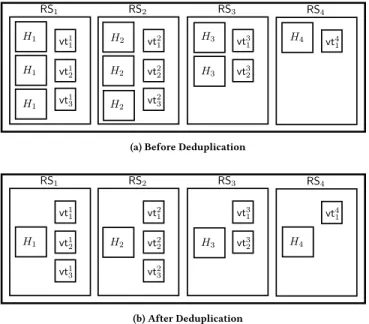
Figure 1: An example of deduplication applied to multiple replicas.
be applicable. Other work [7, 13, 25] seeks to establish the physical location of replicas. Our goal is different.
3
SYSTEM AND ADVERSARIAL MODEL
3.1
System Model
A set of users,U =U1,U2,U3, . . . ,Um, store their files at a cloud storage provider (CSP). To ensure data reliability and protect against data damage, the CSP exposes an interface that allows users to store multiple replicas of their files at different replication servers. Each user uses remote data integrity checking (RDIC) to check the integrity of their replicas stored at each replica server; in case data damage is detected at a replica server, the user leverages replicas from other healthy replica servers to restore the desired level of redundancy.
Replication level.As users have different budgets and needs, the CSP allows users to choose the desiredreplication level(rl) for their files. Without loss of generality, we assume the CSP offers a fixed number of replication levels (e.g., in practice it may offer three levels, corresponding to high, medium, and low reliability). Fig. 1(a) shows an example with three users choosing different replication levels,rl1 =4,rl2 =3,rl3 =2. UserU1, who choserl1 = 4, will generate four replicasH1,H2,H3,H4and the corresponding RDIC verification tagsvt1 1,vt 2 1,vt 3 1,vt 4
1, and will store them at replication serversRS1,RS2,RS3andRS4. Whereas userU3, who choserl3=2, will generate two replicasH1,H2and RDIC verification tagsvt1
3,vt 2 3 , and store them at serversRS1,RS2, respectively.
We assume identical files will result in identical encrypted ci-phertexts when stored at theCSP. This assumption is typical in the secure storage deduplication literature and ensures that if two users want to store the same file, the replicas generated for the file will be identical, thus allowing deduplication to be applied at each replica server. The mechanism used to achieve this is outside the
scope of the paper, but we enumerate here existing approaches: Users can rely on variants of convergent encryption to derive an encryption key securely with a multiparty computation protocol between users [19]. Or, deduplication can occur with the aid of a semi-trusted server andmessage lock encryption[18].
Deduplication level.Whenever possible, the CSP employs dedu-plication across different users’ files at each rededu-plication server: If multiple users store identical files, the CSP keeps only one copy. In the example of Fig. 1(b), serversRS1,RS2,RS3perform dedu-plication for the filesH1,H2,H3, and thededuplication level(dl) is
dl1=3,dl2=3,dl3=2, respectively. ServerRS4does not perform deduplication, as it already stores only one copy of fileH4. Notice that deduplication occurs at each replication server independently, meaning that different copies of the same file will be dispersed along replica servers to ensure reliability, but at each replica server deduplication is applied and only one copy of multiple identical files is stored.
Pricing model.The system divides time into epochs (e.g., one epoch is one day) and users get charged at the end of each epoch. A user’s bill for each epoch is directly proportional to the chosen replication level and inversely proportional to the deduplication level that occurs at each replica server. This means that if a user is uploading a file at a replica server and that file is already stored byrother users, then each of ther+1 users that store the file will get charged an amount that isr+1 smaller compared to the case when no deduplication occurs.
To prevent a dishonest CSP from charging users more by claim-ing a lower deduplication level, the system employs transparent deduplication: the CSP provides to each user at the end of each epoch a proof that attests to the deduplication level that occured at each replication server.
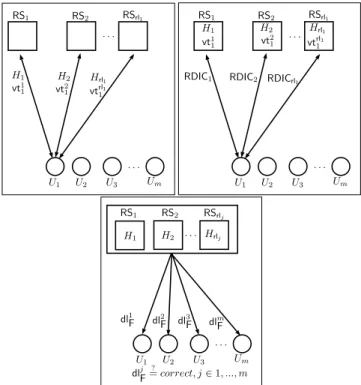
System overview.As depicted in Fig. 2, the system consists of four protocols:Setup,Replicate,RDIC, andAttestDedup. Each userUj, with 1≤j ≤m, runs these protocols. We give an overview of these protocols next:
Setup(1λ,n,rlj): DuringSetup, each userUj choosesrlj, the replication level for her files. Users also generate the secret keys
fk,kj, according to the security parameterλ, that will be used during the other protocols of the system.
Replicate(F,fk,kj,rlj): Each userUjruns theReplicateprotocol to generate replicasH1,H2,· · ·,Hrlj for fileF, using the keyfk. Identical files by different users are stored only once at each replica server, but are stored multiple times according to the replication level choicerlj to ensure reliability. UserUj also uses keykj to compute the set of RDIC verification tagsvti
jon top of each replica Hi, with 1≤i≤rlj. Finally,Uj uploads replicaHi and verification tagsvti
jat serverRSi.
RDIC(F, <Uj:Q>, <RSi :σi >): Each userUj engages in a remote data integrity checking protocol (RDIC) with replica server
RSito check faithful storage of the replica fileHi, for 1≤i≤rlj. In theRDICprotocol, the user issues a challengeQto a replica server, and the server responds with a proofσi that attests the integrity of the replica stored at that server (this proof is constructed using the challenged replica file and its corresponding verification tags). The user verifies the correctness of the proof received from the
U1 U2 U3 Um · · · RS1 RS2 RSrl1 H1 H2 Hrl1 · · · vt1 1 vt21 vtrl11 U1 U2 U3 Um · · · RDIC1 RDIC2 RDICrl1
RS1 RS2 RSrl1 H1 H2 Hrl1 · · · vt1 1 vt 2 1 vtrl11 U1 U2 U3 Um · · · dlj F ? =correct, j∈1, ..., m dl1 F dl2F dl3F dlmF H2 H1 RSrlj RS2 RS1 Hrlj · · ·
Figure 2:Setup,RDIC,AttestDedupfor a userU1storing a fileF.
server. Unlike in a standardRDICprotocol, the user performs an additional check in order to prevent the ROTF attack: whether the server’s response time is below a thresholdT.
AttestDedup(ep,Uj,F): Each userUj runs theAttestDedup pro-tocol during each epochepto verify the CSP’s claim about the deduplication level employed for the user’s replica files during that epoch. During each time epoch, the CSP issues a bill to each user based on the replication level chosen by the user for her files, and on whether the user’s replica files benefited from deduplication. The bill includes a proof that allows the client to verify the dedu-plication level of its replicas. TheAttestDedupprotocol prevents dishonest CSPs from claiming a lower deduplication level that the one deployed at its servers in order to charge users a higher bill.
3.2
Adversarial Model
We assume an adversary that controls some or all of the storage servers and is rational and economically motivated. Adversarial servers will try to cheat and “cut corners” as long as cheating re-mains undetected and it provides an economic benefit. For example, the CSP may use less storage than required to fulfill its contractual obligations for replication, or it may charge users according to a deduplication level that is lower than the real one. An economically motivated adversary captures many practical settings in which ma-licious servers will not cheat and risk their reputation, unless they can achieve a clear financial gain. Moreover, the communication between users and theCSPis done over an authenticated channel. The ROTF attack.In addition to controlling storage servers, the adversary may also corrupt users of the system. As such, users
may collude with the CSP to share their secret key material. For example, a user may share with the CSP the secret key material used to generate replicas. This allows the CSP to recover the original file and only store that file instead of storing multiple replicas as required by contract. Whenever a user sends an RDIC challenge to check a particular replica, the CSP can generate that replica on the fly based on the original file and on the key material obtained from the colluding user. As described in previous work [10, 11], a storage server that is challenged and does not possess its replica, can either forward the challenge to a server that stores the file (which will generate the needed replica on the fly), or can retrieve the file in order to generate the challenged replica on the fly. By allowing collusions between the CSP and its users, our adversarial model is stronger and more realistic compared to previous work.
We note that users are willing to collaborate in order to benefit from cost reduction due to deduplication. However, we want the system to be resilient to the possibility that some users may be malicious and may collude with the untrusted CSP.
Incorrect deduplication level.A CSP may advertise appealing costs for deduplicated files: Users are charged inversely propor-tional to the number of times a file has been stored. However, a dishonest CSP may try to claim a lower deduplication level in order to increase its revenue.
3.3
Security Guarantees
Inspired by the aforementioned adversarial model, we define the security guarantees of our system. They protect an honest user Uj from a coalition of malicious replica servers and users who will try not to follow the contractual agreement with respect to 1)faithful storage of file replicas atrlj replica servers and2)the correct deduplication level used forUj’s files.
3.3.1 Collusion Resistant Replica Integrity. The CSP must prove to a userUjthat it faithfully storesrlj replicas of the user’s files in their entirety. In contrast with multiple replica RDIC protocols designed for single users [1, 12],ReDup seeks to provide data integrity of each replica file when confronted with ROTF attacks that involve collusion between malicious users and dishonest replica servers. More specifically, we say thatReDup provides:
•SG1: Replica integrity, if each replica serverRSican convince a userUjwith high probability that the replicaHi remains intact in its entirety, for 1≤i≤rlj.
•SG2: Storage Allocation, if the amount of data stored by a
CSPfor a fileFof size|F|on a replication levelrlis at least
rl|F|.
SG1 protects the users from a CSP that does not store replica files in their entirety. SG2 protects users from a CSP that does not respect its contractual obligations of storingrljreplicas and tries to reduce its costs by storing less replicas. Together, SG1 and SG2 im-ply that theCSPfaithfully stores allrljreplica copies of a fileF. We capture these two guarantees under theCollusion Resistant Repli-cas Integrity(CR2P) property, formulated with a standard security game between the adversary and the challenger:
In our adversarial model, we assumeAcan collude with another userUor another replica serverRS. During the game, we allowA to have access to the oracles, which provide all the secret transcripts.
We denote byOabc(k,l,m;x,y,z)theabcoracle, which takes as inputs the parametersk,l,mand executes its code with local vari-ablesx,y,z, which are unknown to the caller–the adversaryA. We denote byai a list withielements. LetU′be the set of corrupted users andU − U′be the set of honest users. We useRS′to denote the corrupted replica servers andRS − RS′the faithful servers. We useUi → Uto denote the insertion of elementUi into the set U.Ahas access to the following oracles:
• U′,RS′← OSetup(uidm−1,sidt;m,rlj): Whenever invoked with parameters a list of users idsuidm−1and replica servers idssidt, theOSetuporacle stores the ids to the appropriate setsU′,RS′, denoting the list of corrupted users and replica servers, respectively.
•Hi← OGenReplica(F,j;fk,i): TheOGenReplicaoracle takes as input a fileF and a user idj. It first checks ifUj ∈ U′. If that user is corrupted then it outputs the replica copyHi for the replica serverRSifor that user on fileFusing the keyfk. The oracle keeps track of the uploaded files and for similar files it uses the same key in order to simulate the deduplication process. FinallyOGenReplicaalso storesHi →Hin the listH and sendsHi toA.
• vtij ← OTagFile(Hi,j;kj): TheOTagFile oracle on inputHi andjfirst checks ifUj ∈ U′andHi ∈H. If both hold, then computes the tagsvti
j usingkjand forwards them toA. •cj
F ← OChallenge(F,j;kj): TheOChallenge oracle outputs a challenge for fileF for the userUj ∈ U − U′.
• β← OVerify(proofjF,i,τi;T): TheOVerifyoracle takes as input a proofproofj,i
F and a response timeτi. It outputsβ =0 if either the proof is not valid orτi >T, otherwise it setsβ=1. During theGameCR2P
A game the adversary communicates with the oracles in order to create the environment to be challenged upon as follows:
GameCRA2P
1: U′,R S′← AOSetup//A compromises users and servers
2: fori=1...rljdo
3: Hi← AO
GenReplica(F,j;fk,i)
//A learns replica copies
4: vti
j← AO
TagFile(Hi,j;kj)//A
asks for verifications tags
5: cj F← A OChallenge(F,j;kj) //A is challenged 6: proofj,i F ,τi ← A(U ′,R S′,F,H i,vtij,cFj) 7: βi← OVerify(proofj,i F ,τi;T) 8: returnβ= ^ βi//Experiment is successful ifβ ? =1
Finally the game outputs a valueβ ∈ {0,1}. We define the success probabilities of an adversaryAplaying theGameCR
2P
A game as: SuccCRA2P=Pr[GameCR
2P
A =1]. The heuristic is that if the output of the experiment equals 1 thenAshould posses all replica copies H1. . .Hrlj. In order to formulate that heuristic we employ the no-tion of the extractorE, which can communicate with the adversary and rewind her at different steps in order to extract a fileF from all replica copiesH1. . .Hrlj. We define the success probability of the extractorEas follows:SuccExtract
A =Pr[F=Ffh|Ffh← E A
Definition 1. (CR2P: Collusion Resistant Replica Possession)ReDup system guarantees Collusion Resistant Replica Possession if under any collusions for a set users|U|who have stored the fileFinrlj replica serversRS1,RS2,RS3,· · ·,RSrlj and for anyPPTadversary A, for any security parameterλand a negligible quantitynegl(λ), it holds that: Pr[SuccExtract A ≤negl(λ)∧Succ CR2P A >negl(λ) :E U′,R S′,F,H i,vtij,cFj ←− A ↔GameCRA2P]≤γ Intuitively, theCR2Pdefinition establishes an upper boundγ on the event that an adversaryAwins theGameCR2P
A game with non-negligible probability and that an extractorE is not able to extract the file after interacting withA.
3.3.2 Deduplication Correctness. An economically motivated dishonest CSP may employ a certain deduplication level, but may charge users a higher amount by claiming a lower deduplication level. Previous work uses an authenticated data structure (ADS) to accumulate the users’ file deduplication levels, and provides to each user a proof of membership in this ADS. To ensure deduplication correctness, it suffices to provide:
•dc1: Proofs attesting that each of the user’s files has been included in the ADS.
•dc2: A proof attesting the correct size of the ADS. We capture these two guarantees under theDeduplication Correct-nessproperty:
Definition 2. (Deduplication Correctness) During an epochep, each userUjstores file replicas at replica serversRS1,RS2,RS3,· · ·,RSrlj and the deduplication level for a fileFat each replica serverRSiisdliF. The system guarantees Deduplication Correctness if, for any epoch ep, an honest userUwho runs theAttestDedup(ep,U,F)algorithm will detect with high probability if a dishonestCSPclaims a dedu-plication leveldliF′,dliFfor fileFat replica serverRSi.
4
PRELIMINARIES
In this section, we present building blocks that will be used in our construction.
4.1
Shortcut Free Time and Consuming
Function (
SFTCF
)
We put forward the definition of a Shortcut Free and Time Con-suming FunctionS.Sis a symmetric trapdoor function which takes inputIwithvblocks and outputsHwithv blocks. MoreoverS should adhere to the shortcut free property which states that the holder of any outputH′withv′<vblocks will not help her to recover the remainingv−v′output blocks in time less than a thresholdT, even when it knows the trapdoor ofS. Finally the running time ofSshould be considerably greater than the running time of a well known functionalityG. The properties of aSFTCF are:
(1) Shortcut Freeness: Storing any intermediate statest, which is smaller than the original sizev of the input, does not result in evaluation time smaller than the running time ofS
on the original input of sizev:Scannot be decomposed in S1,S2, . . . ,Sv, such thatS(v)=S1()◦S2()◦, . . . ,◦Sv() (2) G-Detectable Time Consumption: Evaluation of the
func-tion requires computafunc-tional resources, which results in a considerable detectable time for its evaluation. That is, for another functionGwhose complexity isΩG(v)we say that Sguarantees G-Detectable Time Consumption ifΩS(v)≫
ΩG(v).
Security.AnSFTCF is correct if it allows the recovery of the original inputIfrom the outputH. EvaluatingSandS−1cannot be done without having the secret key.
Definition 3. AnSFTCF Sis secure if it assures shortcut free-ness and is G-Detectable Time Consuming for any G withΩS(v)≫
ΩG(v).
For readers familiar with the hourglass function primitive [23], we clarify that our goal in the definition of theSFTCF function is to adapt the security requirements of the hourglass primitive in order to fit the needs of our protocol. The goal of the hourglass function in [23] is to ensure storage of a file in an appropriate format, whereas
ReDup’s goal is to attest faithful storage of all replicas in case of collusions between users and theCSP.
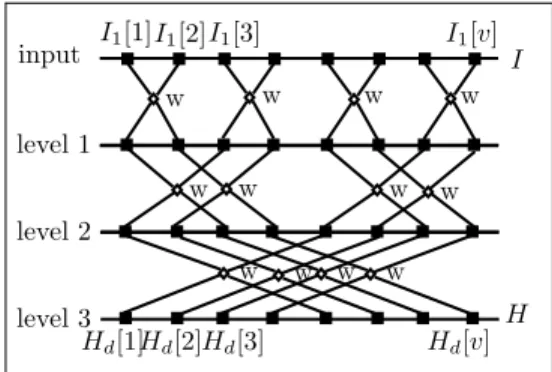
4.1.1 SFTCFInstantiation. We instantiate theSFTCF S with the butterfly construction proposed by Dijk et al. [23]. LetIand Hbe the input and output domain consisting ofvblock files. The output is computed ind=log
2vlevels. At each level, an atomic operationwtakes as input pairs of blocks and outputs another pair, acting as input for the next level. A PRP such as AES can be used forw. More formallyS:Iv→Hv. The input blocks are denoted asI1[u] and the final output blocks asHd[u], withu∈[1, . . . ,v]. Overall,wis invokedv
2log2vtimes ( v
2 times at each level). Shortcut Freeness: An example of aSFTCF instantiation is shown in Fig. 3, withv =8 blocks andd=3. Each of the blocks on the last level is the result of mixing all of thev input blocks. TheSFTCF meets the shortcut freeness requirements because a malicious cloud server that is missing even one block on the last level cannot evaluateSin less time thanO(v).
G-Detectability: As shown in [23], the butterfly-based hour-glass construction induces considerable computation overhead. More specifically, settingGbe the response time of a benign cloud,
r r r r r r r r r r r r r r r r r r r r r r r r r r r r r r r r input level 1 level 2 I H w w w w I1[v] Hd[1]Hd[2]Hd[3] Hd[v] w w w w w w w w level 3 I1[1]I1[2]I1[3]
Figure 3: Example ofSFTCFbased on a butterfly construction, with
aggrp1=RS1||RS2||RS3 W(F,aggrp1, U2,ep) root1 W(F,aggrp1, U1,ep) h13 h10 h4 h3 h2 h1 h6 root3 W(F,aggrp3, U3,ep) h13 h10 h9 h1 h5 h6 h6 h1 h2 h6 W(F,aggrp2, U2,ep) root2 W(F,aggrp2, U3,ep) aggrp2=RS4||RS5 aggrp3=RS6||RS7||RS8||RS9||RS10 H0=W(0) W(F,aggrp1, U3,ep) H0 H0 H0 H0 H0 H0 h5 h5
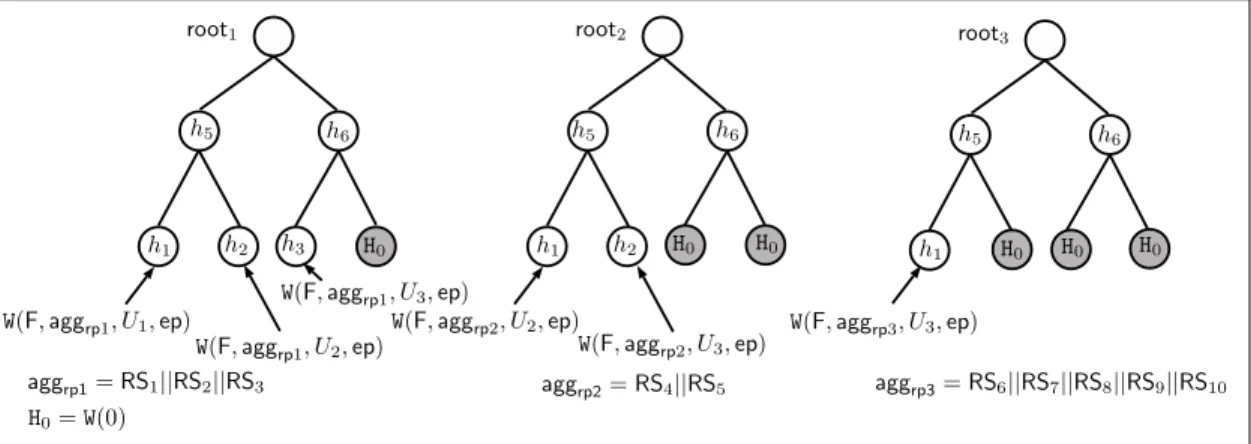
Figure 4:ReDupuses optimized Merkle trees for deduplication level proofs. TheCSPoffers 3 deduplication levels,rp1 =3,rp2 =5,rp3 =10.
Three usersU1,U2,U3choose replication levelsrl1=3,rl2=5andrl3=10, respectively. There will be 3 trees corresponding to 3 replica server
groups:aggrp1 ={RS1,RS2,RS3}forU1,U2andU3,aggrp2={RS4,RS5}forU2andU3, andaggrp3 ={RS6,RS7,RS8,RS9,RS10}forU3. Grey nodes
markedH0are “zero” leaves obtained by hashing the0value. During verification, for example,U2receives the following proofs for the file
corresponding to theroot1tree: for dc1h1,h6, and for dc2h5.
W(F, U2,ep) W(F, U1,ep) h6 h3 h2 h1 h6 W(F, U3,ep) H0 h5 h7
Figure 5: A CARDIAC example with deduplication level 3: leaves
h1,h2,h3correspond to three usersU1,U2,U3 who store the same
file. The tree contains one “zero” leafH0. The deduplication level
proof for userU2consists of: dc1) the sibling path forh2, and dc2)
the rightmost non-zero leafh3and the sibling path forh3.
the running time ofGis 0.077 seconds on average according to [23, Table 2] and the corresponding running time for a malicious cloud, who tries to run the butterfly hourglass function, equals 18.065 seconds on average for a 2GB file. This experimental evaluation supports the detectability property of ourSFTCF.
Alternatively, anSFTCF may be be instantiated with the con-struction based on tunable puzzles proposed by Armknechtet al.[1]. However, the design of their protocol does not explicitly provide provisions againstROT Fattacks, since the authors make certain assumptions regarding the higher price of computation costs com-pared with storage costs, which may not hold in all systems and is subject to change over time.
4.2
Merkle Hash Trees
We use a standard Merkle hash tree, which uses a collision resistant hash functionW:{0,1}∗→ {0,1}λto compute its root with theMHT algorithm. To prove membership for a leaf element, a prover calls
ProveMTwhich computes the corresponding sibling path and the verifier usesCheckPathto verify the membership proof.
5
ReDup
OVERVIEW
We give an overview ofReDup, focusing on the challenges ad-dressed by our system:
CH1a(Resiliency against collusions between servers):ReDup encrypts the replicas with different keys. As such, whenRSidoes not store its replica copyHi, it cannot use the replica copy from another serverRSjto answerRDICchallenges on the fly because
RSjstores a different replica copyHj.
CH1b(Resiliency against collusions between a user and replica servers): Each userUjgenerates each replica file by applying the
SFTCFfunctionS on the original fileFwith a different key for each replica. The user then computes verification tags over each replica and uploads the tags and replicas to the replica servers. The user runs anRDICprotocol with each replica server to ensure faithful storage of each replica file by each replica server. In contrast with previousRDICprotocols,ReDupuses anRDICverification procedure that succeeds only if the time to verify the integrity of each replica copy is below a threshold valueT, which is greater than the time to evaluateS(F). As such,Uj can detect malicious behavior of a replica serverRSithat colludes with a dishonest user to answer theRDICchallenges without storing the replica file.
CH2(Scalable transparent deduplication for multiple replicas): To ensure the correctness of the deduplication level, we adapt the solution based on accumulation Merkle trees used in CARDIAC( [3], Section 3.2.1). In CARDIAC, the CSP publishes in each epoch the root of a Merkle tree for each deduplicated file. The Merkle tree has two types of leaves: zero” and “zero” leaves. Each “non-zero” leaf corresponds to a user whose file has been deduplicated, and contains a hash of the user identifier, the file identifier and the epoch. The deduplication level equals the number of non-zero leaves. The rest of the leaves are “zero” leaves,i.e., hashes of the 0 value. The proof of deduplication level correctness for a user consists of two parts:dc1) a membership proof, which establishes that this user’s file was included in the Merkle tree anddc2) a proof attesting the correct number of non-zero leaves, which consists
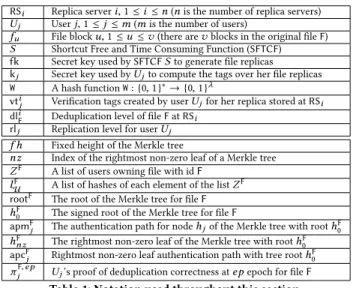
RSi Replica serveri,1≤i≤n(nis the number of replica servers)
Uj Userj,1≤j≤m(mis the number of users)
fu File blocku,1≤u≤v(there arevblocks in the original fileF)
S Shortcut Free and Time Consuming Function (SFTCF)
fk Secret key used bySFTCFSto generate file replicas
kj Secret key used byUjto compute the tags over her file replicas
W A hash functionW:{0,1}∗→ {0,1}λ
vtij Verification tags created by userUjfor her replica stored atRSi
dliF Deduplication level of fileFatRSi
rlj Replication level for userUj
f h Fixed height of the Merkle tree
nz Index of the rightmost non-zero leaf of a Merkle tree
ZF A list of users owning file with idF
lF
U A list of hashes of each element of the listZF
rootF The root of the Merkle tree for fileF
hF
0 The signed root of the Merkle tree for fileF
apmF
j The authentication path for nodehjof the Merkle tree with roothF
0 hF
nz The rightmost non-zero leaf of the Merkle tree with roothF
0
apcF
j Rightmost non-zero leaf authentication path with tree roothF
0 πF,ep
j Uj’s proof of deduplication correctness atepepoch for fileF
Table 1: Notation used throughout this section.
of the rightmost non-zero leaf and its sibling path. Fig. 5 shows a CARDIAC accumulation tree example.
Naive solution.A naive adaptation of CARDIAC to a multi-replica scenario does not scale well with different multi-replication level policies per user. Imagine 10 replica servers, one file and three users with three different replication levels:rl1=3,rl2=5,rl3=10 for usersU1,U2,U3. ACSPfollowing the naive CARDIAC approach has to maintain 10 different trees, one per each replica server. To check the deduplication level,U3has to obtain proofs for 10 different trees, which implies a tenfold increase in the communication bandwidth and in the proof computation and verification time.
Optimized solution. Recall that each userUjchooses her repli-cation levelrljout of a fixed number of replication levels,e.g., 3 levels corresponding to low, medium, and high reliability. Our so-lution reduces the number of Merkle trees per file fromrlj to a constant number (e.g., 3), which is the number of different repli-cation levels offered by theCSP. We aggregate different replica server Merkle trees which accumulate the same users and thus have the same structure. In the example provided in Fig. 4, userU3 who chose a replication level of 10 gets only 3 proofs instead of 10 proofs as in the naive application of CARDIAC.
6
THE
ReDup
SYSTEM
The full details of theReDupsystem are presented in Figures 6 and 7. We start by presenting in Table 1 commonly used notation throughout this section.
A fileFconsists of file blocksf1,f2, ...,fv. TheCSPkeeps track of two data structures,FLandRL.FLserves as a file log that records which users have stored a specific file.FLis abstracted as a dic-tionary keyed by the id of a fileF.FL[F].append(Uj)denotes the insertion of userUjunder the keyFandFL[F] returns a tuple set with the id of all users who have stored the fileF.RLis a log dictio-nary that contains the replication level choice of a user and the files stored by that user:RL[Uj]=(rl:rlj,f :()). We describe next the four phases of the protocol,Setup,Replicate,RDIC,AttestDedup.
Setup: Each userUj runs theSetupalgorithm, which outputs
RDICtagging keyskj(Fig. 6,Setupalgorithm, line 1). Users agree
on a keyfkto compute the replica copies. Furthermore, each user chooses its replication levelrljand forwards it to theCSP(line 2), which in turn stores it in theRLdictionary (line 3).
Replicate: Each user runs this algorithm, which outputs the replica copies and the corresponding verification tags to be stored at each replica serverRSi. A keyfki is derived fromfkfor each replica serverRSiwith the use of a PRF (Fig. 6,Replicatealgorithm, line 4). The replica copyHi forRSi is then obtained by applying theSFTCFSto the blocks of the original filef1,f2, . . . ,fv (line 5). To generate theRDICverification tags,ReDupcan use any ex-istingRDICprotocol with private verification [4, 17, 22] (line 6) using secret keyskj. However, unlike previousRDICprotocols, the
TagFileis not applied directly on the fileFbut on the outputHiof theSFTCFfunctionS.
RDIC:ReDupuses the standardChallenge,ProveandVerify al-gorithms of an interactiveRDICprotocol to check the integrity of the replicas. The user provides as input the challengeQand theCSP produces a proofσifor each replica server. In contrast with the pre-viousRDICprotocols,ReDupuses anRDIC Verifyprocedure that succeeds only if the time to verify the integrity of each replica copy is below a threshold valueT >Time(S(F)), whereTime(S(F))is the running time ofS(F). Assuming a computationally-boundedCSP and depending on the client needs,Tcan be set asT >>Time(S(F)) to detect large corruptions, or asT ≈Time(S(F))to detect small corruptions.
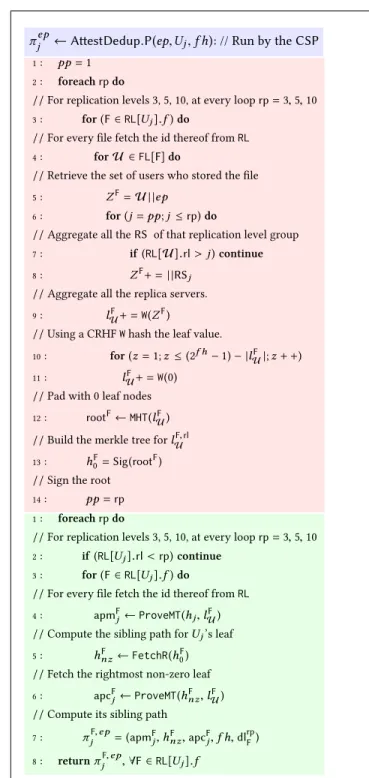
AttestDedup: TheCSPcomputes the Merkle trees in each epoch with theAttestDedup.Palgorithm (Fig. 7,AttestDedup.Palgorithm, lines 1-14 ). In lines 6-9 the correct symmetric replica servers for
rpare accumulated in the leaf of each user and finally the leafZF is being hashed with a collision resistant hash functionWto output the digestlF
U. For the remaining 2f h− |lFU|nodes, zero leaves are computed asW(0)to fill in the tree of heightf h. Once all the leaves of the tree have been computed, theCSPcalls theMHTalgorithm, which computes the root of the Merkle treerootF(line 12 ) and signs ithF
0=Sig(root
F)(line 13 ).
To compute the proof for a userUj, theCSPcomputes the sibling pathsapmFj for all the trees the user has been included in (line 4 ), using the standard Merkle tree membership proof (ProveMT algorithm). To establish a correct deduplication level for the file (i.e, number of non-zero leaves), theCSPfetches the rightmost non-zero leaf nodehFnzof each treeUj has been included in and computes its sibling pathapcF
j as well (lines 5-6 ). Finally, it sends the proof πF,ep
j =(apmFj,hFnz,apcFj,f h,|lUF |)toUj. Upon receipt of the proofπF,ep
j ,UjinvokesAttestDedup.V al-gorithm (cf. Fig. 8) to verify the proof. It first checks whether the claimed deduplication level is consistent with the zero leafs for a tree of heightf h(AttestDedup.Valgorithm, line 4). Fordc1, which ensures that the user id was included in the tree(s) of the corre-sponding files,UjcallsCheckPathto verify the consistency of the returned sibling pathapmFj (AttestDedup.Valgorithm, line 5). For dc2, which atests the deduplication level|lF
U|,Uj first verifies the paths of allhFnzwith theCheckPathMerkle tree algorithm (line 6). Afterwards,Ujchecks if theCheckPathalgorithm on input the
(2f h −1)− |lF
•Setup(1λ,n,rlj): // Run byUj
1: (kj,fk)←KeyGen(1λ,n)
2: UjsendsrljtoCSP
3: CSPsetsRL[Uj].rl=rlj
//CSPstores the replication level in the log fileRL
•Replicate(F,fk,kj,rlj): // Run byUj 1: for(i=1,i ≤rlj,i+ +)do 2: Hi←GenReplica(i,F,fk): 3: parse Fas f1,f2, . . . ,fv 4: fki=PRF fk(i)
//Derive the key for replica to be stored atRSi
5: Hi=Sfk
i(f1,f2, . . . ,fv)
//Run theSFTCFS on the original file blocks
6: vtij←TagFile(Hi,kj) 7: UjsendsHi,vtijtoRSi 8: CSPrunsFLi[F].append(Uj) •RDIC(F, <Uj :Q>, <RSi :σi >): 1: for(i=1,i ≤rlj,i+ +)do 2: Q←Challenge(l,n) 3: σi←Prove(Q,Hi,vtij) 4: τi←(Time(Verify(σi)≤T)): 1?0 5: if ^
τi=?1return1else return0
•AttestDedup(ep,Uj,F):// Run byUjandCSP
1: for(ep ∈ T ∧F∈FL∧Uj ∈ U)do
2: πjF,ep←AttestDedup.P(ep,Uj,F)
3: {0,1} ←AttestDedup.V(πF,ep
j )
Figure 6: TheReDupsystem.
their sibling nodes, verifies correctly the Merkle tree (line 7). If all the checks succeed,AttestDedup.Voutputs 1 for successful verifi-cation.
Discussion. InReDup, users encrypt their files before uploading them to theCSP. As such, there is no need for theCSP to encrypt data at rest. We note that, consistent with the secure deduplica-tion literature, the IND-CPA or IND-CCA definideduplica-tions for privacy cannot be achieved. Thus, we inherit the security guarantee for deduplicated messages: PRIV-CDA (privacy under chosen distribu-tion attacks) [6], which guarantees that encrypdistribu-tion of unpredictable messages should be indistinguishable from a random message of the same length. We also note that, if users choose weak keys to en-crypt their files, theCSPcan apply semantically secure encryption for data at rest independently on top ofReDup.
7
SECURITY ANALYSIS
Theorem 1. IfSis a Shortcut Free and G-Detectable Time Con-suming Function (SFTCF), thenReDupguarantees Collusion Resis-tant Replicas Possession (CR2P) against a rational and economically motivatedCSP and any colluding user.
πjep←AttestDedup.P(ep,Uj,f h): // Run by theCSP
1: pp=1
2: foreachrpdo
//For replication levels 3, 5, 10, at every looprp=3,5,10
3: for(F∈RL[Uj].f)do
//For every file fetch the id thereof fromRL
4: forU ∈FL[F]do
//Retrieve the set of users who stored the file
5: ZF=U | |ep
6: for(j=pp;j ≤rp)do
//Aggregate all theRS of that replication level group
7: if(RL[U].rl>j)continue
8: ZF+ =| |RSj
//Aggregate all the replica servers.
9: lF
U+ =W(ZF)
//Using a CRHFWhash the leaf value.
10: for(z=1;z≤(2f h−1)− |lF
U|;z+ +)
11: lF
U+ =W(0)
//Pad with 0 leaf nodes
12: rootF←MHT(lF
U)
//Build the merkle tree forlF,rl
U
13: hF
0=Sig(root F) //Sign the root
14: pp=rp
1: foreachrpdo
//For replication levels 3, 5, 10, at every looprp=3,5,10
2: if(RL[Uj].rl<rp)continue
3: for(F∈RL[Uj].f)do
//For every file fetch the id thereof fromRL
4: apmFj ←ProveMT(hj,lF
U)
//Compute the sibling path forUj’s leaf
5: hFnz←FetchR(hF
0)
//Fetch the rightmost non-zero leaf
6: apcFj←ProveMT(hnzF ,lF
U)
//Compute its sibling path
7: πF,ep
j =(apmFj,hFnz,apcFj,f h,dlrpF) 8: returnπjF,ep,∀F∈RL[Uj].f
Figure 7: TheAttestDedup.Palgorithm run by theCSP.
Proof. (Sketch) Letδu
i follow a Bernoulli distribution with suc-cess probabilityδiudenoting the probabilityAcorrupts blockfu at replica serverRSi and failure probability 1−δu
i . LetU uidbe the user who challenges theCSP. Then all thevrluidblocks have
{0,1} ←AttestDedup.V(πF,ep
j ): // Run byUj
1: foreachrpdo
//For replication levels 3, 5, 10, at every looprp=3,5,10
2: if(RL[Uj].rl<rp)continue
3: for(F∈RL[Uj].f)do
//For every file fetch the id thereof fromRL
4: dlrp F +|zero leafs| ? =2f h 5: {0,1} ←CheckPath(hj,apmFj,hF 0)
//Check ifUj’s fileFwas included
6: {0,1} ←CheckPath(hFnz,apcFj,hF
0)
//Test inclusion of rightmost non-zero leaf
7: {0,1} ←CheckZeroNodes(hF
0)
//Build up the tree starting from the zero nodes
8: return(all checks==1)?1 : 0
Figure 8: The verification algorithm for AttestDedup: The Client verifies the proof.
corruption probabilityδiuforu∈[1. . .vrluid]. The success proba-bilitySuccCR2P
A forAto pass a challenge of sizeldepends on the failure probability 1−δu
i and the success probabilityδu
i to corrupt fu by outputting the correct challenge on time less thanT. We assumeSis a secureSFTCF. The probability to correctly guess the challenged blocks equals the probability to randomly guess the output ofSfor each block of the challenge of sizel, and is equal to
SuccCRA2P=Ql u=1(1−δ u i +δ u iϵ
2v ), whereϵis a negligible probabil-ity that corresponds to the event of evaluatingSin time less than T. From that we conclude thatSuccCR
2P
A ≤negl(λ).
The extractorEsimulates theOTagFileoracle. WhenAqueries theOTagFile oracle with input (Hi,uid), E first checks ifuid ∈ U′andHi ∈H. If both hold then it computes the tagsvti
uidand forwards them toA. We assumeAstores onlys<vrl
uidblocks. By storing we mean both the blocks and the verifications tags. Thus, during the challenge,Ahas to correctly guess the blocks and tags of the challenge. Let somes′<l,sblocks of the totall-block challenge be stored byA. We denote byE1the eventAcorrectly guesses the remainingl−s′challenged blocks (which are not stored),E2the eventAcomputes the responses for that challenge correctly and E3the event theOTagFileoracle outputs a special malicious output
h∗, from whichAcan compute the remainingl−s′blocks and the responses on the fly. Accordingly, the probabilities forE1,E2,E3 arep1,p2,p3, respectively. Clearly,p1 =p2 = 2l−s ′ 2v ,p3 = 1
2q, whereqis the digest size of theOTagFileresponse. As such,SuccExtract
A =1−(p1p2+(1− p1p2)p3)=1−p3+p1p2(p3−1)=1− 1 2q+ 22(l−s′) 22v ( 1 2q−1), meaning thatSuccExtract
A >negl(λ). As such, Pr[Succ Extract
A ≤negl(λ)∧
SuccCRA2P>negl(λ)]≤negl(λ). □
Theorem 2. IfWis a collision-resistant hash function, thenReDup guarantees Deduplication Correctness against a rational and eco-nomically motivated adversaryAwho controls all the replica servers
RSi.
Proof. (Sketch) Assume the adversary claims an incorrect dedu-plication leveldli
′ F. Ifdli
′
F < dliF, an honest user will accept the server’s proof with negligible probabilityneg(λ)≤2−λ/2, whereλ is the image length of the collision resistant hash functionW. The collision resistance property ofWpreventsAof computing a set of leaveslF,rl
U′ different than the correct set of leavesl F,rl
U with the same root digesthF,rl
0 . Otherwise,Acan be used to breakW’s collision resistance.
An economically motivated adversary will never claimdli ′ F >dliF, as this implies a higher deduplication level than the real one, and individual users whose data are deduplicated will be charged less than they should.
□
8
CONCLUSION
We have demonstrated that two seemingly contradictory notions, replication and deduplication, can be reconciled without violating the security guarantees of outsourced storage. Our solution,ReDup, leverages time-consuming replica generation to tolerate collusions between users and a rationalCSPthat tries to cheat by storing less replicas than agreed upon with its clients. Moreover,ReDup provides transparent deduplication for multiple replicas, thus pre-venting a maliciousCSPfrom claiming that it deduplicates less files than it actually does.ReDupdoes this in a scalable manner by presenting to clients a proof that has a constant size regardless of the number of replica servers. This enables a new pricing model which takes into account the level of deduplication of the data: The more users store the same piece of data, the lower each individual user gets charged for storing that piece of data.
ACKNOWLEDGMENTS
This research was supported by the US National Science Founda-tion (NSF) under Grants No. CNS 1054754, CNS 1409523, and DGE 1565478, and by the Defense Advanced Research Projects Agency (DARPA) and the Air Force Research Laboratory (AFRL) under Contract No. A8650-15- C-7521. Any opinions, findings, and conclu-sions or recommendations expressed in this material are those of the authors and do not necessarily reflect the views of NSF, DARPA, and AFRL. The United States Government is authorized to repro-duce and distribute reprints notwithstanding any copyright notice herein.
REFERENCES
[1] Frederik Armknecht, Ludovic Barman, Jens-Matthias Bohli, and Ghassan O.
Karame. 2016. Mirror: Enabling Proofs of Data Replication and Retrievability in the Cloud. InProc. of the 25th USENIX Security Symposium (USENIX Security ’16). 1051–1068.
[2] Frederik Armknecht, Jens-Matthias Bohli, David Froelicher, and Ghassan O.
Karame. 2016. SPORT: Sharing Proofs of Retrievability across Tenants. Cryptol-ogy ePrint Archive, Report 2016/724. (2016).http://eprint.iacr.org/2016/724.
[3] Frederik Armknecht, Jens-Matthias Bohli, Ghassan O. Karame, and Franck
Youssef. 2015.Transparent Data Deduplication in the Cloud. InProc. of ACM
[4] Giuseppe Ateniese, Randal Burns, Reza Curtmola, Joseph Herring, Lea Kissner, Zachary Peterson, and Dawn Song. 2007. Provable data possession at untrusted stores. InProc. of ACM CCS 2007. 598–609.
[5] Giuseppe Ateniese, Randal Burns, Reza Curtmola, Joseph Herring, Lea Kissner,
Zachary Peterson, and Dawn Song. 2011. Remote Data Checking Using Provable
Data Possession.Transactions on Information and System Security (TISSEC)14, 1
(2011).
[6] Mihir Bellare, Sriram Keelveedhi, and Thomas Ristenpart. 2013.Message-Locked
Encryption and Secure Deduplication. Springer Berlin Heidelberg, Berlin, Heidel-berg.
[7] Karyn Benson, Rafael Dowsley, and Hovav Shacham. 2011. Do You Know Where
Your Cloud Files Are?. InProc. of ACM Cloud Computing Security Workshop
(CCSW ’11).
[8] Dan Boneh, Ben Lynn, and Hovav Shacham. 2001.Short Signatures from the
Weil Pairing. InProc. of ASIACRYPT 2001. Springer Berlin Heidelberg, Berlin,
Heidelberg, 514–532.
[9] Kevin D. Bowers, Ari Juels, and Alina Oprea. 2009. Proofs of Retrievability:
Theory and Implementation. InProc. of ACM Workshop on Cloud Computing
Security (CCSW ’09). 43–54.
[10] Bo Chen and Reza Curtmola. 2013.Towards Self-repairing Replication-based
Storage Systems Using Untrusted Clouds. InProc. of ACM CODASPY ’13. ACM,
377–388.
[11] Bo Chen and Reza Curtmola. 2017. Remote data integrity checking with
server-side repair.Journal of Computer Security25, 6 (2017).
[12] Reza Curtmola, Osama Khan, Randal Burns, and Giuseppe Ateniese. 2008.
MR-PDP: Multiple-Replica Provable Data Possession. InProc. of ICDCS 2008. IEEE
Computer Society, 411–420.
[13] Mark Gondree and Zachary N. J. Peterson. 2013. Geolocation of Data in the
Cloud. InProc. of ACM Conference on Data and Application Security and Privacy
(CODASPY ’13).
[14] http://www.computerworld.com/. 2015. OOPS: Google “loses” your cloud data.
(2015).https://goo.gl/zXRAdR.
[15] http://www.datacenterknowledge.com/. 2012. Amazon Data Center Loses Power
During Storm. (2012).https://goo.gl/anNoI.
[16] http://www.infoworld.com/. 2016.The dirty dozen: 12 cloud security threats.
(2016).ttps://goo.gl/i6tAsF.
[17] A. Juels and B. S. Kaliski. 2007. PORs: Proofs of Retrievability for Large Files. In
Proc. of ACM Conference on Computer and Communications Security (CCS ’07).
[18] Sriram Keelveedhi, Mihir Bellare, and Thomas Ristenpart. 2013. DupLESS:
server-aided encryption for deduplicated storage. InProc. of USENIX Security ’13. 179– 194.
[19] Jian Liu, N Asokan, and Benny Pinkas. 2015. Secure deduplication of encrypted
data without additional independent servers. InProc. of ACM CCS 2015. ACM,
874–885.
[20] Dutch T. Meyer and William J. Bolosky. 2011. A Study of Practical Deduplication.
InProceedings of the 9th USENIX Conference on File and Storage Technologies (FAST
’11). 1–1.
[21] Dutch T. Meyer and William J. Bolosky. 2012. A Study of Practical Deduplication.
ACM Trans. Storage7, 4 (Feb. 2012), 14:1–14:20.
[22] Hovav Shacham and Brent Waters. 2008. Compact Proofs of Retrievability. In
Proc. of ASIACRYPT 2008. Springer Berlin Heidelberg, 90–107.
[23] Marten van Dijk, Ari Juels, Alina Oprea, Ronald L. Rivest, Emil Stefanov, and
Nikos Triandopoulos. 2012. Hourglass Schemes: How to Prove That Cloud Files
Are Encrypted. InProc. of ACM CCS 2012. ACM, 265–280.
[24] Dimitrios Vasilopoulos, Melek Önen, Kaoutar Elkhiyaoui, and Refik Molva. 2016.
Message-Locked Proofs of Retrievability with Secure Deduplication. InProc. of
ACM CCSW ’16. 73–83.
[25] Gaven J. Watson, Reihaneh Safavi-Naini, Mohsen Alimomeni, Michael E. Locasto,
and Shrivaramakrishnan Narayan. 2012. LoSt: location based storage. InProc. of