DOI: 10.14738/abr.67.4884.
Hwihanus, H., Ratnawati, T., & Yuhertiana, I. (2018). Analysis of the Influence of Fundamental Macro and Fundamental Micro to Discolure of Corporate Social Responsibility, Ownership Structure, Financial Performance, Going Concern Audit Opinion and Value of the Firm at State-Owned Enterprises in Indonesia. Archives of Business Research, 6(7), 66-77.
Analysis of the Influence of Fundamental Macro and
Fundamental Micro to Discolure of Corporate Social
Responsibility, Ownership Structure, Financial Performance,
Going Concern Audit Opinion and Value of the Firm at
State-Owned Enterprises in Indonesia
Hwihanus
Economic Faculty,
Unversitas of 17 Agustus 1945 Surabaya
Tri Ratnawati
Economic Faculty,
University of 17Agustus1945 Surabaya
Indrawati Yuhertiana
Economic and Business Faculty,
University of Pembangunan Nasional Veteran Jawa Timur
ABSTRACT
This study aims to examine and analyze the relationship between the variables of micro-finance, macro fundamental fundamentals of disclosure of corporate social responsibility, ownership structure, financial performance, going concern audit opinion and the value of the firms in State-Owned Enterprises listed on the Indonesia Stock Exchange. Research population at 20 State-Owned Enterprises listed on Indonesia Stock Exchange. This research method uses purposive sampling with 12 companies in 2010 - 2016. Techniques of data analysis in this study using Partial Least Square (PLS) consists of Inner model, Outers model and Weight relation. The test results showed that all tested variables were influenced by other variables and were significant with t-statistics above 5% significant level with t-table 1,960 except macro fundamental against ownership structure showing the effect of 0.0031421 and t-statistics of 1.327460 so the research hypothesis (H3) of macro fundamentals have a not significant effect on the ownership structure is rejected whereas hypotheses other research accepted.
Keywords: macro fundamental, micro fundamental, corporate social responsibility disclosure, ownership structure, financial performance, audit opinion of going concern, value of the firm
INTRODUCTION
State-Owned Enterprises (SOEs) is a government company that attracts the attention of researchers where all the policies of the leadership are always related to the Minister's Decree (SKM) so that the managerial activities of SOEs are not independent. This lack of independence provides a weakening of providing information activities to investors.
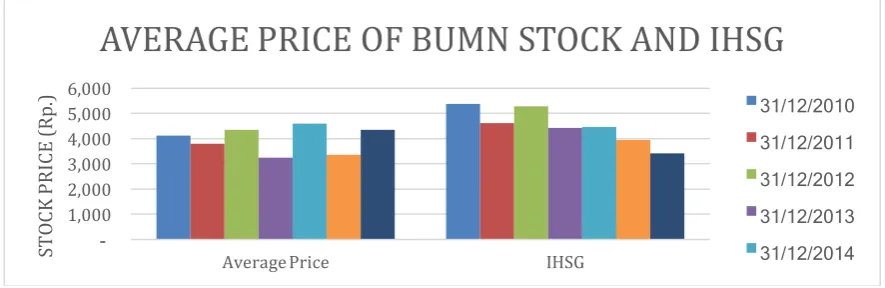
with the state of the country's economy and government decisions that provide sentiment for the stock market compared to the price of shares of non SOEs. The share price of SOEs and IHSG listed on the Indonesia Stock Exchange (IDX) is shown on December, 31 2010 – December, 31 2016 shown in the following figure
Figure 1. List of Share Price of State-Owned Enterprises in Indonesia Stock Exchange
Source: data processed
Stock price as a representation of value of the firm is determined internal and external factors of the company. Internal and external factors are fundamental factors that are often used as a basis by investors in the capital market to make investment decisions (Pater et al. 2014). In addition to fundamental factors, technical factors are also important factors that can affect the price of shares that are technical and psychological.
Establishment of companies including SOEs has a goal in optimizing the value of the firm reflected in properity of the owner. If the higher the value reflected in the stock market price, giving prosperity to the owner (Fama, 1978, McConnell and Muscarela, 1985). The unification of the interests of shareholders, debt holders, and management that in fact are parties that have interests against corporate goals that often cause problems (agency problem) or conflicts of interest known as agency theory (Jensen and Meckling, 1976).
Some researchers believe that the ownership structure is capable of influencing the company's way of maximizing corporate value (Chowdhury, 2010; Ruan et al. 2011; Khlif, 2015). Maximizing corporate value is also influenced on financial performance of manajamen (Ukhriyawati et.al. 2017) and influenced going concern audit opinion.
This research not only discusses the macro and micro fundamental factors but the researcher conducts a deeper empirical research and discussion on the value of firms affected by share ownership structure, managerial financial performance in company and going concern audit opinion on SOE as research model .
LITERATURE REVIEW Management Accounting
Management accounting is an accounting system that has a relationship with the provisions and use of management information in an organization with the aim to provide a benchmark to management in business decision-making, managing and performing supervisory functions of results that have been obtained a company.
Management accounting helps the preparation of effective planning as a violation, aids in the process of supervision and control and helps mangatasi issues related to irregularities in the company.
- 1,000 2,000 3,000 4,000 5,000 6,000
Average Price IHSG
ST
O
CK
P
R
IC
E
(R
p.
)
AVERAGE PRICE OF BUMN STOCK AND IHSG
Management accounting as an accounting type is a financial processing system used to generate information for the interests of internal users of the organization while management accounting as a type of quantitative information that uses money as a unit of measure in the implementation of corporate management.
Theory of Agency
Jensen and Meckling (1976) argue that the owner as principal and management as the recipient of authority have different interests in the employment relationship. The interest of each party seeks to enlarge the profits for itself. The owner wants maximum investment return as soon as possible, while management wants his interests to be accommodated as much as possible for the performance that has been done.
The conflict of interest between agent and principal in achieving prosperity can occur from the existence of information asymmetry. The asymmetry of this information occurs when managers have internal information that is relatively more and faster than external parties. This provides an opportunity for managers to manipulate financial reporting in an effort to maximize their prosperity (Cheng et al. 2012, Wasiuzzaman 2015).
Macro Fundamental Factors
Macro fundamental factors derived from outside the company can be economic, environmental, political, legal, social, cultural, security, education, etc. that can not be controlled by the company but the effect is very large for change. This study discusses macroeconomic conditions by looking at the movements of inflation, interest rates, exchange rates, and economic growth (Claude, et al. 1996; Eduardus, 1997).
Micro Fundamental Factors
Micro fundamentals come from within the company and are controlling and used in the development of the company in the future. Development of this company, management requires several policies namely investment decisions, funding decisions and dividend policy.
Corporate Social Responsibility Disclosure (CSRD)
Anggraini (2006) discloses CSRD is a requirement for the company to provide transparent information, an accountable organization with good corporate governance and provide information about its social activities that it has done. The public needs information on the extent to which the company has carried out its social activities so that the people right to live safe, secure, welfare, and safety of consuming food can be fulfilled.
Disclosure of CSR information in the annual report is the way companies build, maintain, and legitimize corporate contributions from the economic and political (Sayekti and Wondabio, 2007). Disclosure of CSR information is made voluntarily to comply with Undang-Undang Perseroan Terbatas (UUPT) no. 40 to 2007, to gain a competitive advantage, to meet the terms of the loan contract and public expectations, to legitimize the company's actions, and to attract investment. CSRD based on global reporting core (GRI) with 9 items of economic performance indicators, 34 items of environmental performance indicators and 48 items of social performance indicators.
Ownership Structure
structure can be viewed from the agency approach and the asymmetric information approach. The agency approach, ownership structure is a mechanism to reduce conflicts of interest between managers and shareholders. The asymmetric information approach considers the mechanism of ownership structure as a means of reducing information imbalances between insiders and outsiders through disclosure of information within the capital market.
The researcher uses all factors of ownership structure as indicator of managerial share ownership, institutional share ownership, public share ownership, government share ownership and foreign ownership in determining influence of value of the firm.
Financial Performance
For a company, maintaining and improving financial performance is one of the must that the company still exist and is in demand by investors as reflected in the financial statements. The purpose of measuring the company's financial performance is to know the level of liquidity, the level of profitability and level of laverage in the delivery of information and measurement of company performance.
Performance measurements are made over a period of time to assess the progress of the company and produce management decision-making information and are able to create firm value.
Audit Opinion of Going Concern
An audit opinion of going concern is an opinion published by the auditor in ensuring the company can maintain its viability (SA 570). Issue of audit opinion of going concern is very useful for users of financial statements in the precision of making investment decisions and knowing the condition of the company's survival. The granting of an audit opinion of going concern is an early warning of corporate financial failure (Chen and Church, 1992) and the auditor is responsible for issuing an audit opinion of going concern in the light of the circumstances.
The value of the firm
The book value in the financial statements is the limitation of measuring value of the firm and used in investments. Investors use perceptions based on share prices, the higher the stock price will make the value of the firms to be high or vice versa.
The main objective of the company (Sirmon et.al. 2007) is to maximize the value of the company with a broader meaning, not only to maximize the company's profit but to consider the effect of time on the value of money, to consider various risks to the company's revenue stream and the quality of expected cash flow in the future. The value of the firm as the stock market value (Bowman and Ambrosini, 2007) that can provide shareholder wealth.
RESEARCH HYPOTHESIS
Hypothesis that can be arranged in this research:
1. Macro fundamentals have a significant effect on disclosure of corporate social responsibility
2. Micro fundamentals have a significant effect on disclosure of corporate social responsibility
3. Macro fundamentals have a significant effect on the ownership structure
4. Disclosure of corporate social responsibility has a significant effect on financial performance
6. Macro fundamentals have a significant effect on financial performance 7. Micro fundamentals have a significant effect on the ownership structure
8. Disclosure of Corporate social responsibility has a significant effect on the ownership structure
9. disclosure of Corporate social responsibility significant effect on going concern audit opinion
10.Macro fundamentals significantly affect the value of the firm 11.Micro fundamentals have a significant effect on value of the firm
12.Macro fundamentals have a significant effect on audit opinion of going concern 13.Micro fundamentals have a significant effect on financial performance
14.The ownership structure has a significant effect on financial performance 15.Financial performance has a significant effect on audit opinion of going concern 16.Financial performance has significant effect on value of the firm
17.Ownership structure has significant effect on value of the company
18.Going concren audit opinion has a significant effect on value of the company
RESEARCH METHODS Sample Research
The technique of sampling used purposive sampling method with 12 out of 20 SOEs listed on IDX with observation year 2010 - 2016.
Variables and indicators
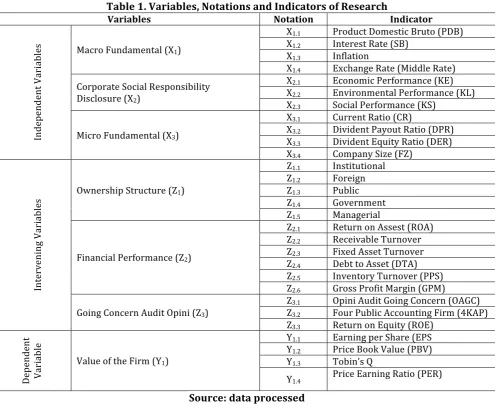
Table 1. Variables, Notations and Indicators of Research
Variables Notation Indicator
In de pe nd en t V ar ia bl es
Macro Fundamental (X1)
X1.1 Product Domestic Bruto (PDB) X1.2 Interest Rate (SB)
X1.3 Inflation
X1.4 Exchange Rate (Middle Rate) Corporate Social Responsibility
Disclosure (X2)
X2.1 Economic Performance (KE) X2.2 Environmental Performance (KL) X2.3 Social Performance (KS)
Micro Fundamental (X3)
X3.1 Current Ratio (CR)
X3.2 Divident Payout Ratio (DPR) X3.3 Divident Equity Ratio (DER) X3.4 Company Size (FZ)
In te rv en in g V ar ia bl es
Ownership Structure (Z1)
Z1.1 Institutional Z1.2 Foreign Z1.3 Public Z1.4 Government Z1.5 Managerial
Financial Performance (Z2)
Z2.1 Return on Assest (ROA) Z2.2 Receivable Turnover Z2.3 Fixed Asset Turnover Z2.4 Debt to Asset (DTA) Z2.5 Inventory Turnover (PPS) Z2.6 Gross Profit Margin (GPM)
Going Concern Audit Opini (Z3)
Z3.1 Opini Audit Going Concern (OAGC) Z3.2 Four Public Accounting Firm (4KAP) Z3.3 Return on Equity (ROE)
De pe nd en t Va ri abl e
Value of the Firm (Y1)
Y1.1 Earning per Share (EPS Y1.2 Price Book Value (PBV) Y1.3 Tobin’s Q
Y1.4 Price Earning Ratio (PER)
Source: data processed
Conceptual Framework
The relationship between research variable can be described conceptual framework as follows:
Figure 2. Conceptual Framework for Research and Indicators
Source: data processed
Analysis Technique
model using latent construct with mutiple indicator.
RESULTS AND DISCUSSION Testing Research Model
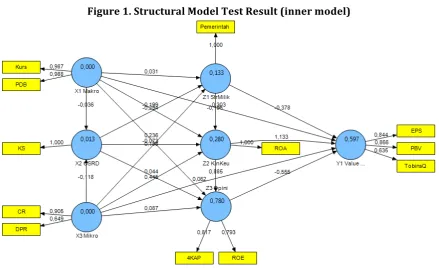
This study uses the limit factor of loading factor by reflecting the indicator based on the relation between each item score with construct score with the measurement scale which is felt enough at the loading value 0,5 so that the measurement scale that do not meet the provisions of the dropping.
Inner model test results can be shown with the following figure:
Figure 1. Structural Model Test Result (inner model)
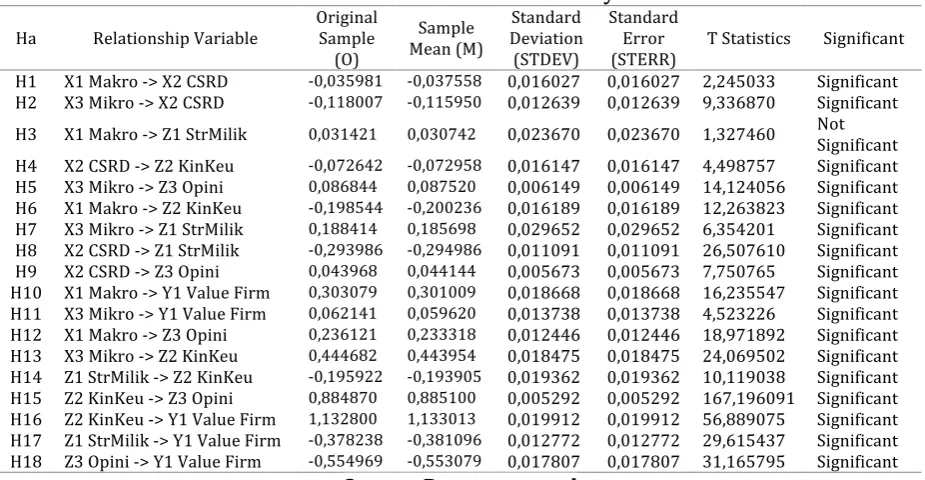
Table 2. Test Results of PLS Analysis
Ha Relationship Variable Original Sample (O)
Sample Mean (M)
Standard Deviation
(STDEV)
Standard Error
(STERR) T Statistics Significant H1 X1 Makro -> X2 CSRD -0,035981 -0,037558 0,016027 0,016027 2,245033 Significant H2 X3 Mikro -> X2 CSRD -0,118007 -0,115950 0,012639 0,012639 9,336870 Significant H3 X1 Makro -> Z1 StrMilik 0,031421 0,030742 0,023670 0,023670 1,327460 Not Significant H4 X2 CSRD -> Z2 KinKeu -0,072642 -0,072958 0,016147 0,016147 4,498757 Significant H5 X3 Mikro -> Z3 Opini 0,086844 0,087520 0,006149 0,006149 14,124056 Significant H6 X1 Makro -> Z2 KinKeu -0,198544 -0,200236 0,016189 0,016189 12,263823 Significant H7 X3 Mikro -> Z1 StrMilik 0,188414 0,185698 0,029652 0,029652 6,354201 Significant H8 X2 CSRD -> Z1 StrMilik -0,293986 -0,294986 0,011091 0,011091 26,507610 Significant H9 X2 CSRD -> Z3 Opini 0,043968 0,044144 0,005673 0,005673 7,750765 Significant H10 X1 Makro -> Y1 Value Firm 0,303079 0,301009 0,018668 0,018668 16,235547 Significant H11 X3 Mikro -> Y1 Value Firm 0,062141 0,059620 0,013738 0,013738 4,523226 Significant H12 X1 Makro -> Z3 Opini 0,236121 0,233318 0,012446 0,012446 18,971892 Significant H13 X3 Mikro -> Z2 KinKeu 0,444682 0,443954 0,018475 0,018475 24,069502 Significant H14 Z1 StrMilik -> Z2 KinKeu -0,195922 -0,193905 0,019362 0,019362 10,119038 Significant H15 Z2 KinKeu -> Z3 Opini 0,884870 0,885100 0,005292 0,005292 167,196091 Significant H16 Z2 KinKeu -> Y1 Value Firm 1,132800 1,133013 0,019912 0,019912 56,889075 Significant H17 Z1 StrMilik -> Y1 Value Firm -0,378238 -0,381096 0,012772 0,012772 29,615437 Significant H18 Z3 Opini -> Y1 Value Firm -0,554969 -0,553079 0,017807 0,017807 31,165795 Significant
Source: Data processed
Discussion
The results of hypothesis and relationship between variables in SOEs listed on the Indonesia Stock Exchange with observations of 2010 - 2016 as follows:
1. Macroeconomic fundamental factors (Brigham and Houston, 2015) use inflation indicators, interest rates, foreign exchange rates and economic growth. Fundamental macro indicators in the study are foreign exchange and GDP are negatively and significantly influenced by CSRD with social performance indicators.
2. Micro fundamentals have a negative and significant influence with the indicators that meet the model only CR and DPR to CSRD.
3. Macro fundamentals with foreign exchange rates and GDP have a positive and insignificant effect on the ownership structure with indicators of government ownership.
4. CSRD with social performance indicators has a negative and effect of significant on financial performance with ROA indicators. Researchers reject the research Boaventura et.al. (2012); Ahamed et.al. (2014); Uadiale and Fagbemi (2012) which stated a positive relationship between Performance of Corporate Social, Performance of Corporate Financial, CSR and management theory with financial performance, while Yaparto, et.al. (2013) states that CSR has no significant effect on ROA and ROE and EPS.
5. Micro Fundamentals with CR indicator and DPR have positive and significant effect to Going Concern Audit Opinion with ROE indicator and Big Four Public Accountant Office. 6. Macro fundamentals have a negative and significant effect on financial performance,
government regulation in macro fundamentals puts pressure on the company and result in financial performance. Researchers reject the research of Claude, et al (1996) and Eduardus (1997) who stated that macro fundamental factor is a very important factor related to the performance and value of the firm. Researchers also reject Opod's (2015) study suggesting that inflation, interest rates, exchange rates, economic growth have no significant effect on performance of financial.
7. Micro fundamentals have positive and significant impact on ownership structure.
9. CSRD positively and positively affect the going concern opinion audit in the future and can increase the value of the firm.
10.The macro fundamentals have a positive and significant effect with the indicators of foreign exchange rates and gross domestic income will increase the Company's Value on earning per share, price book value and Tobin's Q. Researchers receive Claude, et al (1996), Eduardus (1997), and Syahib (2000) indicate that the macro fundamental factor does have a positive and significant influence on value of the firm.
11.Micro fundamentals with CR indicator and DPR have positive and significant effect to firm value with earning per share indicator, price book value and Tobin's Q. Researcher rejects research of Putra (2014) shows EPS and DER has no effect on value of the firm. Researchers received the study of Arvianto et.al. (2014) which states that the micro fundamentals factor significantly influence the value of the company with the condition of the firm's fundamental factors give a strong influence on the value of the firm.
12.Macro fundamentals with exchange rates of foreign currencies and GDP have a positive and significant effect on going concern audit opinion.
13.Micro fundamentals have a positive and significant impact on financial performance. This research is different from Hardaningtyas research (2014) which connects the micro fundamentals to stock price, while the researcher discusses the influence of micro fundamentals on the financial performance of SOEs.
14.Structure Ownership of shares of more than 51% of government shares have a negative and significant impact on financial performance. This researcher refused Wahyudi and Pawesti (2006) research which stated that the ownership structure could influence the company's performance which ultimately affect the company's performance in achieving the company's goal of maximizing the company's value. The researcher states that government ownership in the ownership structure changes the policy direction in determining the performance of SOEs.
15.Financial performance has a positive and significant effect on audit opinion of going concern. The researcher receives Susanto research (2009) which states the giving of information to investor about financial ratios as a tool to predict the survival of a company, expressed in the form of auditor's opinion, then the management seeks to improve company performance and by looking at financial condition and company's ability in paying off debt.
16.Financial performance with ROA indicator has a positive and significant effect on value of the firm in the form of EPS, PBV and Tobin's Q will increase. Researchers received the study Ukhriyawati et.al. (2017) and Dwipartha et.al. (2013), which shows the financial performance of value of the firm has a positive and significant influence.
17.The ownership structure has a negative and significant effect on value of the firm. Researchers rejected Sugiharto et.al. (2016) suggests that managerial ownership has a positive and significant effect on value of the firm, but the reverse is that the ownership structure held by the government has a negative effect.
18.Going concern audit opinion with 4 Big Public Accounting Firm and ROE have a negative and significant effect on company value on EPS, PBV and Tobin's Q.
Theoretical Implications
Maximizing the value of a firm is influenced by the management controls that regulate the activity of the company in paying dividends on the profits of the company. The determination of value of the firm is influenced by financial performance factor, ownership structure factor and going concern audit opinion factor, macro and micro fundamental factor and several other factors outside of research object.
Managerial Implications
The policy implications according to the priorities that can be given as input for management in SOEs are as follows:
1. Economic exposure gives effect to the ownership structure where the government as the holder of state control can determine the policy and role for the SOEs in welfare of Indonesian society.
2. Economic exposure affects the value of the firm shown by the risk in managing the financial through financial performance in order to increase the value of the firm and investment decisions.
3. Economic exposure affects the financial performance of management considering the SOEs established for the development of the state and people in the fields of health, mining, services and transportation, transportation and telecommunications, housing and infrastructure development required by all Indonesian people.
4. Economic exposure affects going concern audit opinion in providing certainty of corporate financial records in accordance with accounting standards performed accountant.
5. The value of the firm in investor eyes as a consideration of the firm's operational activities as reflected in the auditor's opinion in the company's future survival and accountability management performance of SOEs.
Implications for Economics
The implications in the development of economics are to contribute to the study of value of the firm that connects the structure of ownership, financial performance, going concern audit opinion and macro and micro fundamentals in economic decision making by management, government and investors; the value of the firm can meet the needs and welfare for investors, the government and the welfare of society and the value of the company to be the determinant of the development of the Indonesian economy in accordance with the objectives of the SOEs company was established.
CONCLUSIONS AND SUGGESTION Conclusion
Based on analysis of data that has been done before, it can be concluded all testing hypothesis research accepted that shows the effect with a significant level of 5% with t-table 1,960 unless macro fundamental to the ownership structure that shows the influence of 0.0031421 and t- statistics of 1.327460 so the hypothesis (H3) of macro fundamentals have a not significant effect on the ownership structure is rejected.
Suggestion
BIBLIOGRAPHY
Ahamed, Wan Suhazeli Wan, Mahmoud Khalid Almsafir dan Arkan Walid Al-Smadi. 2014. Does Corporate Social Responsibility Lead to Improve in Firm Financial Performance? Evidence from Malaysia. International Journal of Economics and Finance. Vol. 6, No. 3; 2014
Anggraini, Fr. Reni Retno. 2006. Pengungkapan Informasi Sosial Dan Faktor-Faktor Yang Mempengaruhi
Pengungkapan Informasi Sosial Dalam Laporan Keuangan Tahunan (Studi Empiris Pada Perusahaan-Perusahaan Yang Terdaftar Bursa Efek Jakarta). Simposium Nasional Akuntansi IX, Padang, 23-26 Agustus 2006.
Arvianto. Rivan Andrie Sabi. Suhadak dan Topowijono. 2014. Pengaruh Faktor Fundamental Makro dan Mikro Terhadap Nilai Perusahaan (Studi pada Saham Perusahaan Sektor Perdagangan, Jasa dan Investiasi yang Terdaftar di BEI Periode 2010-2012). Jurnal Administrasi Bisnis (JAB). Vol. 13. No. 1 Agustus 2014. Hal. 1 – 10. Boaventura, João Maurício, Ralph Santos da Silva dan Rodrigo Bandeira-de-Mello. 2012. Corporate Financial Performance and Corporate Social Performance: Methodological Development and the Theoretical Contribution of Empirical Studies. R. Cont. Fin. – USP, São Paulo, v. 23, n. 60, p. 232-245, set./out./nov./dez. 2012
Bowman, Cliff and Veronique Ambrosini. 2007. Firm Value Creation and Levels of Strategy. Management Decision. Vol. 45 No. 3, pp. 360 – 371.
Brigham, Eugene F., and Houston Joel F, 2015, Dasar-Dasar Manajemen Keuangan. Essitials of Financial Manajement. Jakarta: Salemba Empat
Chen, K.C. and B.K. Church. 1992. Default on Debt Obligations and the Issuance of Going-Concern Report. Auditing: Journal Practice and Theory, 30-49
Cheng, C.S. Agnes., Bong-Soo Lee and Simon Yang. 2012. The Value Relevance of Earnings Levels in the Return-Earnings Relation. International Journal of Accounting and Information Management. Vol. 21 Issue 4 pp. 260 – 284. Chowdhury, Anup and Suman Paul Chowdhury. 2010. Impact of Capital Structure on Firm’s Value: Evidence from Bangladesh.BEH, Business and Economic Horizons Vol 3 Issue 3 October 2010 pp 111-122 ISSN: 1804-1205. Claude B. Erb., Campbell R. Harvey, and Tadas E. Viskanta. 1996, Political Risk, Economic Risk, and Financial Risk, Financial Analysis Journal, Nov-Dec, pg. 29-46
Dwipartha, Ni Made Witha. 2013. Pengaruh Faktor Ekonomi Makro dan Kinerja Keuangan Terhadap Nilai
Perusahaan Manufaktur di Bursa Efek Indonesia. E-Jurnal Ekonomi dan Bisnis Universitas Udayana. Vol. 02. No. 04. Pp. 226-248.
Eduardus Tandelilin, 1997, Determinants of Systematic Risk: The Experience of Some Indonesian Common Stock, Kelola, Gadjah Mada University Business Review, No. 16/VI/1997.
Fama, Eugene F. 1978. The Effect of a Firm Investment and Financing Decision on the Welfare of Its Security Holders. American Economic Review. Vol. 68 pp. 272-280.
Hardaningtyas, Prihati dan Khuzaini. 2014. Pengaruh Faktor Fundamental Mikro Makro Terhadap Harga Saham Perusahaan Semen Go Public. Jurnal Ilmu & Riset Manajemen. Vol. 3. No 10. Hal 1 – 16.
Jensen, M.C. and W.H. Meckling. 1976. Theory of the Firm: Managerial Behavior, Agency Costs and Ownership Structure. Journal of Financial Economics. Vol. 13. pp. 305-360.
Khlif, Hichem. 2015. Khaled Samaha and Islam Azzam. Disclosure, Ownership Structure, Earnings Announcement Lag and Cost of Equity Capital in Emerging Markets: The Case of the Egyptian Stock Exchange. Journal of Applied Accounting Research. Vol. 16. Issue 1 pp. 28 – 57.
Li, Wenjing dan Ran Zhang. 2010. Corporate Social Responsibility, Ownership Structure and Political Interference: Evidence from China. Journal of Business Ethics (2010) 96:631-645.
McConnell, John J. and Chris J Muscarela. 1985. Corporate Capital Expenditure Decisions and the Market Value of the Firm. Journal of Financial Economics 14, 1985 pp. 399-422.
Opod., Chrisna Riane. Analisis Pengaruh Faktor-Faktor Fundamental Makro ekonomi Terhadap Kinerja Keuangan Perusahaan Serta Nilai Perusahaan (Studi Kasus Pada Perusahaan Perbankan Yang Terdaftar Di BEI Periode 2009 – 2013). Jurnal Riset Bisnis dan manajemen. Vol 3. No. 2, 2015:127-140.
Putra, Nyoman Wedana Adi. 2014. Pengaruh Faktor Fundamental Pada Nilai Perusahaan Sektor Telekomunikasi Di Bursa Efek Indonesia. E-Jurnal Akuntansi Universitas Udayana. 8.3 (2014):385-407
Ruan, Wenjuan. Gary Tian and Shiguang Ma. 2011. Managerial Ownership, Capital Structure and Firm Value: Eviden from China’s Civilian-run Firms. Australian Accounting, Business and Finance Journal Vol. 5 Issue 3 Article 6.
Sayekti, Yosefa dan Ludovicus Sensi Wondabio. 2007. Pengaruh CSR Disclosure terhadap Earning Response Coefficient (Suatu Studi Empiris pada Perusahaan yang Terdaftar di Bursa Efek Jakarta).Simposium Nasional Akuntansi IX, Makassar, 26-28 Juli 2007
Sirmon, David G., Michael A. Hitt and R. Duane Ireland. 2007. Managing Firm Resources in Dynamic Environments to Create Value: Looking Inside the Black Box. Academy Of Management Review. Vol. 32, No. 1 273 – 292.
Sugiharto, Tri Ratnawati dan Srie Hartutie Moehaditoyo. 2016. Risk Management Mediates the Influence of Good Corporate Governance, Managerial Shareholder, and Leverage on Firm Value. IOSR Journal of Business and
Management (IOSR-JBM). E-ISSN 2278-478X p-ISSN 2319-7668. Vol. 18. Issue 11. Ver. VI (November 2016). Pp. 62 – 70.
Susanto, Yulius Kurnia. 2009. Faktor-Faktor Yang Mempengaruhi Penerimaan Opini Audit Going Concern. Jurnal Bisnis Dan Akuntansi. Vol. 11. No. 3 Des 2009. Hal. 155-173
Syahib Natarsyah, 2000, Analisis Pengaruh Beberapa Faktor Fundamental dan Risiko Sistematik Terhadap Harga Saham (Kasus Industri Barang Konsumsi yang Go-Publik di Pasar Modal Indonesia), Jurnal Ekonomi dan Bisnis Indonesia, Vol. 15, No. 3, Hal. 294-312
Uadiale, Olayinka Marte dan Temitope Olamide Fagbemi. 2012. Corporate Social Responsibility and Financial Performance in Developing Economies: The Nigerian Experience. Journal of Economics and Sustainable Development. Vol. 3. No. 4. 44-5
Ukhriyawati, Catur F. Tri Ratnawati dan Slamet Riyadi. 2017. The Influence of Asset Structure, Capital Structure, Risk Management and Good Corporate Governance of Financial Performance and Value of the Firm through Earnings and Free Cash Flow as an Intervening Variable in Banking Companies Listed in Indonesia Stock
Exchange. International Journal of Business and Management. Vol. 12. No.8. ISSN 1833-3850 E-ISSN 1833-8119. Pp. 249 – 260.
Wahyudi, U. dan Prawesti, HP. 2006. Implikasi Kepemilikan Terhadap Nilai Per-usahaan Dengan Keputusan Keuangan Sebagai Variabel Intervening. SNA Padang. 23-26.
Wasiuzzaman, Shaista. 2015. Working Capital and Firm Value in an Emerging Market. International Journal of Managerial Finance. Vol. 11 Issue 1 2015. pp. 60 – 79.