Electroporation-based methods for
in vivo
,
whole mount and primary culture analysis of
zebrafish brain development
Michael Hendricks and Suresh Jesuthasan
www.neuraldevelopment.com
BioMedCentral
Neural Development
Open Access
Methodology
Electroporation-based methods for
in vivo
, whole mount and
primary culture analysis of zebrafish brain development
Michael Hendricks
1,2and Suresh Jesuthasan*
1,2Address: 1Developmental Neurobiology Group, Temasek Life Sciences Laboratory, Research Link, National University of Singapore, 117604, Singapore and 2Department of Biological Sciences, National University of Singapore, Singapore
Email: Michael Hendricks - [email protected]; Suresh Jesuthasan* - [email protected] * Corresponding author
Abstract
Background: Electroporation is a technique for the introduction of nucleic acids and other macromolecules into cells. In chick embryos it has been a particularly powerful technique for the spatial and temporal control of gene expression in developmental studies. Electroporation methods have also been reported for Xenopus, zebrafish, and mouse.
Results: We present a new protocol for zebrafish brain electroporation. Using a simple set-up with fixed spaced electrodes and microinjection equipment, it is possible to electroporate 50 to 100 embryos in 1 hour with no lethality and consistently high levels of transgene expression in numerous cells. Transfected cells in the zebrafish brain are amenable to in vivo time lapse imaging. Explants containing transfected neurons can be cultured for in vitro analysis. We also present a simple enzymatic method to isolate whole brains from fixed zebrafish for immunocytochemistry.
Conclusion: Building on previously described methods, we have optimized several parameters to allow for highly efficient unilateral or bilateral transgenesis of a large number of cells in the zebrafish brain. This method is simple and provides consistently high levels of transgenesis for large numbers of embryos.
Background
Electroporation has been used successfully in chick embryos to perform gain of function (overexpression) and loss of function (dominant negative, small interfering RNA, morpholino) studies in various tissues, particularly the spinal cord [1,2]. More recently, similar protocols have been presented for use with Xenopus [3] and zebrafish [4-7], and somewhat more arduous technical methods can be used for in utero electroporation of mice [8,9]. All electroporation techniques are based on the application of an electric field to a tissue in the presence of a macromolecule of interest. The field induces transient pores in the plasma membrane of cells, as well as bulk
flow of charged molecules toward one of the electrodes (for example, toward the cathode for negatively charged nucleic acids). This directional aspect of electroporation has been taken advantage of to unilaterally transfect the neural tube of chick, Xenopus, and zebrafish.
We began experimenting with electroporation of zebrafish in order to examine the development of com-missural axon projections in the brain. Unilateral electro-poration is an ideal technique as it allows one to visualize in detail the midline and contralateral behavior of com-missural axons. In the transparent zebrafish embryo, it is possible to take time lapse movies of growth cone
migra-Published: 15 March 2007
Neural Development 2007, 2:6 doi:10.1186/1749-8104-2-6
Received: 7 December 2006 Accepted: 15 March 2007
This article is available from: http://www.neuraldevelopment.com/content/2/1/6
© 2007 Hendricks and Jesuthasan; licensee BioMed Central Ltd.
tion in transfected cells. In our studies we attempted to use existing electroporation techniques, but found them insufficient for our purposes for two reasons. First, we were examining the axonal projections of a mutant in which homozygous embryos could not be distinguished from wild-type siblings at the time of electroporation (1 day post fertilization (dpf)), thus only 25% of successful electroporations would be of interest. This meant a large number of embryos had to be electroporated, with the highest possible rate of success. Second, the axons of inter-est to us originated from small clusters of cells in the lat-eral forebrain, which necessitated a method that would reproducibly lead to the transfection of a large number of cells.
Results and discussion
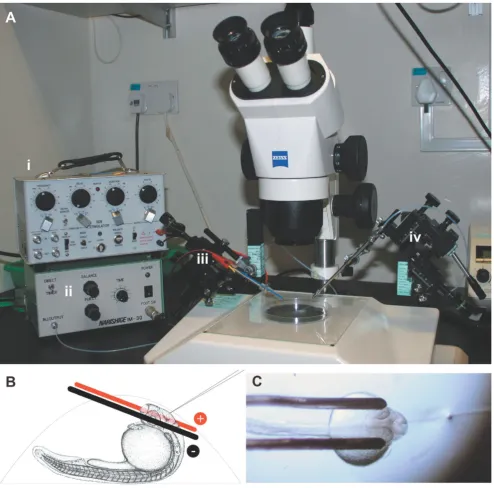
After experimenting with variations on existing protocols for zebrafish brain electroporation [4,5], we obtained the most consistent results with the experimental set-up shown in Figure 1. We found that the electrode design parameters, mounting method, voltage, and the use of the GAL4/UAS system (a bipartite expression system based on the yeast GAL4 transcription factor, which drives expres-sion of transgenes regulated by upstream activating sequences, UAS) were all critical to obtaining reproduci-bly high levels of expression in terms of number of cells, transgene levels within cells, and duration of expression. Pulse generation parameters did not seem to be critical to successful electroporation: single pulses and trains of pulses at various frequencies and durations gave similar results.
The equipment used (Figure 1a) is found in most develop-mental biology laboratories. The Grass SD9 stimulator is a basic, inexpensive square wave pulse generator that is simple to use. The electrodes are platinum iridium paral-lel bipolar electrodes built to custom specifications (see Materials and methods). Embryos electroporated at 20– 24 hpf gave more consistent results than older embryos (not shown). Embryos were mounted yolk-up such that the brain area of interest was accessible to both the elec-trodes and microinjection needle (Figure 1b). One or both of the electrodes may be in contact with the embryo's eye(s). It is critical that embryos be mounted in individual agarose drops rather than multiple embryos mounted together in a larger volume of agarose (Figure 1c). With some practice, it is possible to electroporate up to 100 embryos in 1 hour with no lethality. When embryos did not survive the procedure, it was normally due to exces-sive damage with the microinjection needle or during removal from the agarose.
We compared the use of single plasmids with a two plas-mid GAL4/UAS system, consisting of the neuronal HuC promoter driving GAL4 and enhanced green fluorescent
protein (EGFP) or a transgene of interest driven by tan-dem UAS elements upstream of a basal fish promoter [10]. Both expression level and number of cells expressing transgenes at detectable levels were increased several-fold when the two-component system was used, compared to EGFP driven directly by cytomegalovirus (CMV), HuC, or α-tubulin promoters (not shown).
Electroporation of the right forebrain with pHuC:GAL4/ pUAS:EGFP led to robust expression at 2 dpf and labeling of many contralaterally projecting axons (Figure 2a). Expression is visible under epifluorescence in most embryos as early as 3.5–4 hours after electroporation. If the injection site and electrode position are kept constant throughout an experiment, all embryos will show similar expression patterns. Table 1 shows results for a typical experiment. The voltage is important for high, reproduci-ble expression levels with minimal lethality, with sharp decreases in transfection rates below 30 V. Lower voltages may be useful when fewer transfected cells are desired. Using volume rendering software, confocal z-stacks can be assembled into high-resolution reconstructions of the transfected neurons and their projections (Additional file 1). To test if two transgenes can be coexpressed in the same cells, we coelectroporated three plasmids: pHuC:GAL4/pUAS:EGFP/pUAS:mCherry (Figure 2b). While the majority of transfected cells expressed both flu-orescent proteins, there is a wide range of relative expres-sion levels, as well as cells that express detectable levels of just one transgene. By sampling from two coelectropo-rated embryos we estimated that roughly 60% of cells express both transgenes at high levels (see Materials and methods for details).
We noted elevated levels of cell death, ascertained by staining with acridine orange, in electroporated embryos (Figure 2e). These cells were scattered bilaterally, suggest-ing that death was not a result of transfection but likely an effect of electric field application. Brain morphology and axon projections appeared normal in older electroporated embryos (Figures 2a–c and 4), suggesting that the increased cell death did not cause gross defects in brain development.
Zebrafish embryos are transparent, allowing for in vivo
Expres-Neural Development 2007, 2:6 http://www.neuraldevelopment.com/content/2/1/6
sion of various transgenes will allow us to test the require-ments of specific signaling pathways for midline crossing.
Our experimental objective was to test transgenes pre-dicted to affect axon guidance. To this end, we made a
Gateway expression vector to facilitate the rapid cloning and expression of genes of interest as carboxy-terminal EGFP fusion proteins under the control of UAS. We have tested dominant negative receptor constructs, where the cytoplasmic domain of a receptor of interest has been Electroporation apparatus
Figure 1
Results of electroporation at 2 dpf
Figure 2
Neural Development 2007, 2:6 http://www.neuraldevelopment.com/content/2/1/6
replaced with EGFP. We constructed receptor fusions for canonical axon guidance receptor classes including Ephs, Deleted in Colorectal Carcinoma (DCC), and Robos. Ryk, a vertebrate homolog of Drosophila Derailed, is a Wnt receptor with several functions in axon guidance, includ-ing the topographic mappinclud-ing of retinal axons [13,14]. We constructed a dominant negative zebrafish Ryk receptor fused to EGFP (dnRyk:EGFP) and used electroporation to
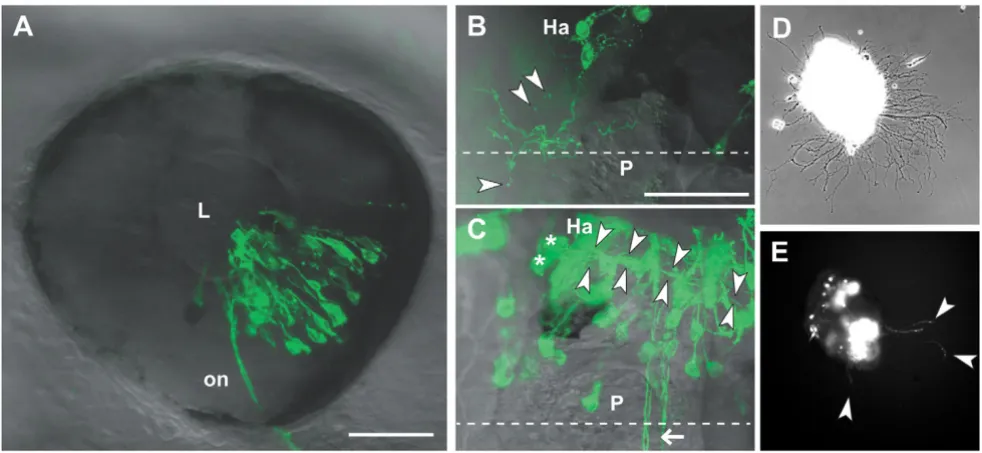
express it in a subset of retinal ganglion cells (Figure 3a). The resulting tectal projections (not shown) were easily observed in vivo.
The Eph receptor tyrosine kinases constitute a large class of axon guidance receptors. We made dominant negative Eph receptors, including EphB3. Expression of dnEphB3-EGFP in a habenular neuron affected axonal behavior.
Table 1: Electroporation results at 48 hpf
Transfection levels*
Voltage +++ ++ + None Dead
30 (n = 77†) 72 (94%) 3 (4%) - - 2 (3%)
20 (n = 16) 2 8 5 1
-10 (n = 16) - - 5 11
-Injection of 0.7 mg/ml each pHuc:GAL4/pUAS:EGFP into the lateral forebrain and ventricle was followed by two manually applied trains of five 1 ms pulses at the indicated voltage. Transfection levels were greatly decreased with voltages lower than 30 V. *Embryos were viewed dorsally under a compound fluorescence microscope and categorized according to extent of transgene expression: +++, similar to Figure 2a or higher; ++, intermediate levels; +, few enough cells to make out and count individually, fewer than 20. †Of 80 embryos electroporated in 2 experiments, 3 were killed by mechanical damage during removal from agarose and are not included.
Analysis of transfected neurons in vivo and in vitro
Figure 3
Analysis of transfected neurons in vivo and in vitro. (a) The eye of a 2 dpf embryo electroporated with pHuC:GAL4/
Whole mount immunocytochemistry of electroporated brains
Figure 4
Neural Development 2007, 2:6 http://www.neuraldevelopment.com/content/2/1/6
Habenular neurons normally project ventroposteriorly via the fasciculus retroflexus to the interpeduncular nucleus [15-17]. Figure 3b shows a habenular neuron expressing dnEphB3-EGFP, which caused abnormal proc-ess branching and elaboration over the epithalamus, including into the pineal organ. In other cases, we observed axons of normal morphology within the habenular commissure; however, axons of this commis-sure derive from the lateral diencephalon and not the habenulae [18]. Habenular neurons expressing EGFP project normally (Figure 3c). In cases of dnEphB3-EGFP expression, we observed small, fluorescently labeled vesi-cles that appeared to be derived from axons. We did not observe these vesicles with EGFP or with dnRyk-EGFP, but did see similar structure when axons were labeled with lipophilic membrane dyes such as DiI (not shown). Inter-estingly, EphB-containing vesicles derived from cultured hippocampal neurons have recently been reported [19]. Electroporation followed by in vivo imaging thus provides evidence that such vesicles are produced in the embryo and may be derived from specific domains of the axonal membrane.
Primary neuronal culture has been used successfully to explore axon guidance mechanisms. Growth cone migra-tion in vitro can be assayed in the presence of exogenously provided cues. We have tried lipofection-mediated trans-fection of zebrafish primary neuronal cultures without success (data not shown). The high transfection rate of electroporation, in this case performed bilaterally, allowed the easy identification of many transgene-expressing neurons in cultured brain explants (Figure 3d,e).
While the dorsal regions of the brain are easily viewed in vivo, ventral and some lateral structures are obscured by the eyes, jaw, and gills. Removing the brain followed by fixation and antibody staining allows for high resolution imaging of the entire brain, but is somewhat tedious for large numbers of embryos. Testing various fixation and permeabilization protocols for immunocytochemistry, we serendipitously found that large numbers of brains can be isolated easily from embryos by fixation in trichlorace-tic acid (TCA) followed by collagenase digestion. These brains are suitable for whole mount antibody staining, though not all antigens are well preserved after TCA fixa-tion and tissue morphology is indistinct under bright field optics. Labeling fixed whole mount brains with anti-GFP and anti-acetylated tubulin antibodies allows for compar-ison of the axonal projections of transfected neurons rela-tive to the overall neuroanatomy of the brain (Figure 4). A lateral view of the right side shows the transfected cell bodies, primarily in the telencephalon and diencephalon (Figure 4e). From the left, the resulting contralateral pro-jections can be analyzed (Figure 4h).
Some technical problems remain, which we are address-ing. Electroporation of embryos older than 24 hpf pro-duced inconsistent results and overall lower numbers of transfected cells. However, some transgenes we expressed appeared to disrupt neuronal differentiation or cell sur-vival and we would like to express them later. The use of heat shock promoters driving GAL4, either on a separate plasmid or in a stable transgenic background, so that expression can be temporally controlled is a promising solution.
Another issue is that some transgenes we tested appeared to be regulated post-transcriptionally and spatially, and were only found in particular subcellular compartments, within distinct puncta, or were present at low levels. In these cases, the entire morphology of a transfected neuron was difficult to image, and time lapse imaging was impractical. Ideally, we would like to coexpress a red flu-orescent protein to label the entire neuron. Because coe-lectroporating two UAS vectors with the GAL4 driver led to inconsistent coexpression, we are testing Gateway expression vectors that contain two independent UAS ele-ments: one driving the cytosolic red fluorescent protein while the other drives the EGFP fusion construct of inter-est.
Conclusion
The electroporation method presented here allows for the simple and efficient introduction of transgenes of interest into populations of neurons. Existing methods of electro-poration of zebrafish neurons are effective, but have sig-nificant rates of lethality and unsuccessful transgenesis. Cerda and colleagues [4] demonstrated the electropora-tion of mRNA and morpholinos in addielectropora-tion to DNA, and were able to transfect several different tissues, including brain, retina, somites, and trunk. In our hands, the inde-pendent manipulation of the electrodes and the insertion of one electrode into the embryo led to frequent lethality and difficulty in reproducibly transfecting the same cells in multiple embryos. On the other hand, the independent positioning of electrodes of this technique allows for bet-ter targeting of the electric field compared to our relatively large external electrodes. The protocol presented here has the advantage of simple electrode placement and of allow-ing a larger number of embryos to be transfected in a uni-form manner. As it relies on commercially available electrodes and basic equipment, it should be easily repro-ducible in any lab. We anticipate that it will be possible, with slight modifications, to transfect different tissues and to deliver charged morpholinos. It may also be possible to restrict expression to more precise areas by controlling the volume and position of plasmid injection.
use of the GAL4/UAS expression system. In these experi-ments, separate plasmids were used. There is increasing availability of stable transgenic zebrafish lines expressing GAL4 under various promoters. Use of these lines will allow for single UAS plasmid electroporation, which should increase efficiency.
In addition to in vivo still and time lapse imaging, we present two ways the electroporation method can be used with further analytical tools. Primary neuronal culture is a powerful system for studying the cell biology of axon growth and guidance. Electroporation allows these in vitro
techniques to be coupled with transgenesis. Transfected and non-transfected axons from the same explant can be compared in their responses to exogenously applied fac-tors. The enzymatic brain isolation technique is a useful way to collect large numbers of samples. In this case, we have used it to image in detail the results of a routine elec-troporation. It is also useful for the analysis of mutant phenotypes, screening, or other situations where the number of brains needed makes manual dissection impractical. The zebrafish is a well-established model for vertebrate developmental biology. The methods pre-sented here will extend its utility for studies of the devel-opment of the embryonic nervous system.
Materials and methods
Equipment
A Zeiss (Oberkochen, Germany) dissecting scope was fit-ted on opposite sides with two Narishige (Tokyo, Japan) micromanipulators, one to manipulate the electrodes (left) and the other the injection needle (right) (Figure 1). A Narishige air pressure injector was used for DNA deliv-ery. A Grass (West Warwick, Rhode Island, USA). Telefac-tor SD9 voltage stimulaTelefac-tor was connected to the electrodes to provide pulses. Custom platinum iridium parallel bipolar electrodes 125 μm in diameter and spaced 500 μm apart were used for electroporation (catalog #PB-SA0575, FHC, Bowdoinham, Maine, USA). During elec-troporation, the electrodes can develop deposits of dried agarose. Between or during long experiments the elec-trodes were cleaned with methanol and a soft brush, or using a commercially available ultrasonic jewellery cleaner.
Zebrafish
Zebrafish were maintained according to standard proce-dures and in accordance with Institutional Animal Care and Use Committee guidelines. Electroporation was done at 18–24 hpf. A significant reduction in efficiency of trans-fection was observed in older embryos. Some embryos were raised in E3 containing 0.003% 1-phenyl-2-thiourea to prevent melanin synthesis.
After being dechorionated with forceps, embryos were anesthetized in electroporation Ringer's (180 mM NaCl, 5
mM KCl, 1.8 mM CaCl2, 5 mM Hepes pH 7.2), as
described by Cerda et al. [4], containing 0.016% 3-amino benzoic acid ethyl ester (MS222; Sigma-Aldrich, St. Louis, Missouri, USA). Groups of 6–10 embryos were immersed briefly in 37°C 1% low melting point agarose (LMPA; Bio-Rad, Hercules, California, USA) in electroporation Ringer's. The embryos were removed from the agarose with a glass pipette and placed on an inverted plastic Petri dish lid in individual drops of LMPA. As the agarose cooled, they were maneuvered into the desired orienta-tion using a tungsten needle. It is essential that the embryos be in individual drops, the drops should be as small as possible, and the orientation consistent to facili-tate injections and electrode positioning.
Each group was immediately electroporated after orienta-tion so that the agarose was still somewhat soft, which eased the insertion of the electrodes. After electropora-tion, the embryos were covered with E3 embryo medium. At the end of the experiment, all embryos were covered with E3 for approximately 15–30 minutes to recover from anesthetic. The LMPA was peeled away from the head and yolk with a tungsten needle. The embryos often wriggle free at this stage, or can be removed by gentle aspiration with a glass pipette.
Plasmid DNA
The pHuC:GAL4-VP16 plasmid used to drive neuronal expression has been described [20]. pUAS:EGFP was made by replacing the CMV promoter from pEGFP-N1 (Invitrogen, Carlsbad, California, USA) with a promoter consisting of 14 UAS elements upstream of a basal fish promoter [10], and pUAS:mCherry by subsequent replacement of EGFP in this plasmid with mCherry from pRSETB-mCherry [21]. Gateway cloning products were from Invitrogen. The pUAS:rfC.1-EGFP Gateway expres-sion vector was made for expressing genes of interest fused to the amino terminus of EGFP. The RfC.1 cassette from the Gateway Vector Conversion kit was ligated into the
SmaI site of pUAS:EGFP. Entry clones were made using pENTR/D-TOPO and pCR8/GW/TOPO cloning kits using
Pfu (Stratagene, San Diego, California, USA or Taq
Neural Development 2007, 2:6 http://www.neuraldevelopment.com/content/2/1/6
pUAS:dnEphB3-EGFP was made by amplifying a segment
of the zebrafish ephb3 coding sequencing
(Gen-Bank:NM_131097) corresponding to the extracellular and transmembrane domains by RT-PCR from 3 dpf zebrafish RNA (forward primer, 5'-CACCATGGATTATTCGCTGT-TATTATAC-3'; reverse primer, 5'-CGGATCCTCGTAGGT-GAAAG-3'). The PCR product was cloned into a Gateway entry vector and confirmed by sequencing. The entry clone was used for LR recombination into pUAS:RfC.1-EGFP (see above). pUAS:dnRyk-pUAS:RfC.1-EGFP (GenBank: XM_678748) was made in the same way (forward primer, 5'-CACCATGTTTCTGCCAGCGCGG-3'; reverse primer, 5'-AAACACGTAGGCCCCCAAAGC-3').
DNA constructs were prepared using Qiagen (Hilden, Germany) mini or midi prep kits, followed by concentra-tion by either by sodium acetate/ethanol precipitaconcentra-tion or evaporation in a heated vacuum centrifuge to the desired concentration in 10 mM Tris. These constructs and their sequences are available upon request.
DNA injection and electroporation
Glass injection needles were pulled from capillaries (1.0 mm OD, 0.78 mm ID, with filament) on a Flaming-Brown P97 puller (Sutter Instruments, Novato, CA, USA) and back loaded with DNA solution. The needle tip was broken off with forceps, and oriented as in Figure 1. The electrodes were positioned first using the left manipula-tor, followed by insertion of the microinjection needle with the right manipulator. DNA was injected into the area of interest using a Narishige M30 air pressure injec-tor. Enough DNA was injected such that swelling of the brain ventricle was observed. Immediately, five 30 V pulses, each lasting 1 millisecond were applied manually using a Grass SD9 stimulator, leading to electroporation of the side of the brain near the cathode. Injection/pulsing was often repeated for other injection sites or to increase transfection rate. Likewise for bilateral electroporation, the polarity of the stimulator was reversed and injection/ pulsing was repeated. Electrode position was the same for retinal electroporation, but DNA was injected directly into the retina.
Brain explant culture
At 2 dpf, bilaterally electroporated embryos were anaes-thetized in Ringer's solution containing MS222 and 1 mg/ ml bovine serum albumin (BSA). Their brains were removed using electrolytically sharpened tungsten nee-dles and cut into small clumps. A fire-polished microin-jection needle with a wide bore opening was used to transfer brain clumps to a small drop of culture medium with a mouth pipette (as a washing step). The clumps were then transferred to a poly-lysine-coated cover slip bottom dish (Matek, Ashland, Massachussetts, USA) con-taining 2 ml of culture medium. Media reagents were
from Sigma: L15 containing 1% N1 neuronal growth sup-plement, 10 mM Hepes, and 1% GPS (glutamine/penicil-lin/streptomycin). Explants were cultured for 8 hours or overnight at 28°C.
Brain isolation
Embryos at 3 dpf or older were fixed in 2% TCA in PBST (phosphate-buffered saline + 1% Triton X-100) for several hours at room temperature or overnight at 4°C. After sev-eral washes in PBST, the embryos were treated with 1 mg/ ml collagenase (Sigma) in PBS for 10–20 minutes on a nutator. After 20 minutes or if they started to fall apart, embryos were washed several times with PBST to stop col-lagenase digestion. They were then transferred to a Petri dish and gently swirled in PBST. During this process, the embryos would fall apart, leaving individual eyes and brains intact. Brains often remained attached to the spinal cord.
Immunocytochemistry and staining
Isolated brains were washed in blocking solution (5% normal goat serum/2% BSA in PBST) for one hour. Pri-mary antibody incubation was done in blocking solution at 4°C overnight on a nutator, followed by several washes in PBST. Secondary labeling was done overnight at 4°C or several hours at room temperature. Anti-acetylated tubu-lin (Sigma) and anti-GFP (Torrey Pines, Houston, Texas, USA) were used at 1:1,000. Alexa488 anti-rabbit and Alexa568 anti-mouse secondary antibodies (Invitrogen) were used at 1:500. To detect cell death, embryos were incubated with 5 μg/ml acridine orange (Sigma) for 30 minutes, followed by washing in E3 and examination under epifluorescence.
Imaging and analysis
Cotransformation rates (Figure 2b) were estimated using NIH ImageJ. Confocal stacks were separated by channel and independent thresholds applied to allow for easy counting of high intensity cells (cells with contiguous label above threshold at a level that eliminates all back-ground). Colocalization of pixels above threshold was scored as a cotransfected cell. Four randomly chosen non-overlapping planes from confocal stacks of two embryos were analyzed (142 cells total).
Competing interests
The author(s) declare that they have no competing inter-ests.
Authors' contributions
MH performed the experiments. MH and SJ conceived of and designed the experiments, interpreted the results, and wrote and approved the manuscript.
Additional material
Acknowledgements
We would like to thank Cathleen Teh for tips on electroporation and Ajay Sriram for electrode advice. pRSETB-mCherry was kindly sent from the Tsien Lab. This work was supported by Temasek Life Sciences Laboratory. The zebrafish image used in Figure 1b is from the Zebrafish Information Network (ZFIN), the Zebrafish International Resource Center, University of Oregon, Eugene, OR 97403-5274, USA[23].
References
1. Krull CE: A primer on using in ovo electroporation to analyze gene function. Dev Dyn 2004, 229(3):433-439.
2. Nakamura H, Katahira T, Sato T, Watanabe Y, Funahashi J: Gain- and loss-of-function in chick embryos by electroporation. Mech Dev 2004, 121(9):1137-1143.
3. Haas K, Jensen K, Sin WC, Foa L, Cline HT: Targeted electropo-ration in Xenopus tadpoles in vivo--from single cells to the entire brain. Differentiation 2002, 70(4-5):148-154.
4. Cerda GA, Thomas JE, Allende ML, Karlstrom RO, Palma V: Electro-poration of DNA, RNA, and morpholinos into zebrafish embryos. Methods 2006, 39(3):207-211.
5. Teh C, Chong SW, Korzh V: DNA delivery into anterior neural tube of zebrafish embryos by electroporation. Biotechniques
2003, 35(5):950-954.
6. Thummel R, Bai S, Sarras MP Jr., Song P, McDermott J, Brewer J, Perry M, Zhang X, Hyde DR, Godwin AR: Inhibition of zebrafish fin regeneration using in vivo electroporation of morpholinos against fgfr1 and msxb. Dev Dyn 2006, 235(2):336-346. 7. Tawk M, Tuil D, Torrente Y, Vriz S, Paulin D: High-efficiency gene
transfer into adult fish: a new tool to study fin regeneration.
Genesis 2002, 32(1):27-31.
8. Saito T, Nakatsuji N: Efficient gene transfer into the embryonic mouse brain using in vivo electroporation. Dev Biol 2001,
240(1):237-246.
9. Tabata H, Nakajima K: Efficient in utero gene transfer system to the developing mouse brain using electroporation: visual-ization of neuronal migration in the developing cortex. Neu-roscience 2001, 103(4):865-872.
10. Koster RW, Fraser SE: Tracing transgene expression in living zebrafish embryos. Dev Biol 2001, 233(2):329-346.
11. Hutson LD, Chien CB: Pathfinding and error correction by ret-inal axons: the role of astray/robo2. Neuron 2002,
33(2):205-217.
12. Bak M, Fraser SE: Axon fasciculation and differences in midline kinetics between pioneer and follower axons within commis-sural fascicles. Development 2003, 130(20):4999-5008.
13. Keeble TR, Cooper HM: Ryk: a novel Wnt receptor regulating axon pathfinding. Int J Biochem Cell Biol 2006, 38(12):2011-2017. 14. Schmitt AM, Shi J, Wolf AM, Lu CC, King LA, Zou Y: Wnt-Ryk
sig-nalling mediates medial-lateral retinotectal topographic mapping. Nature 2006, 439(7072):31-37.
15. Gamse JT, Kuan YS, Macurak M, Brosamle C, Thisse B, Thisse C, Halpern ME: Directional asymmetry of the zebrafish epithala-mus guides dorsoventral innervation of the midbrain target.
Development 2005, 132(21):4869-4881.
16. Aizawa H, Bianco IH, Hamaoka T, Miyashita T, Uemura O, Concha ML, Russell C, Wilson SW, Okamoto H: Laterotopic representa-tion of left-right informarepresenta-tion onto the dorso-ventral axis of a zebrafish midbrain target nucleus. Curr Biol 2005,
15(3):238-243.
17. Yanez J, Anadon R: Afferent and efferent connections of the habenula in the rainbow trout (Oncorhynchus mykiss): an indocarbocyanine dye (DiI) study. J Comp Neurol 1996,
372(4):529-543.
18. Hendricks M, Jesuthasan S: Asymmetric innervation of the habenula in zebrafish. J Comp Neurol in press.
19. Lauterbach J, Klein R: Release of full-length EphB2 receptors from hippocampal neurons to cocultured glial cells. J Neurosci
2006, 26(45):11575-11581.
20. D'Souza J, Hendricks M, Le Guyader S, Subburaju S, Grunewald B, Scholich K, Jesuthasan S: Formation of the retinotectal projec-tion requires Esrom, an ortholog of PAM (protein associated with Myc). Development 2005, 132(2):247-256.
21. Shaner NC, Campbell RE, Steinbach PA, Giepmans BN, Palmer AE, Tsien RY: Improved monomeric red, orange and yellow fluo-rescent proteins derived from Discosoma sp. red fluofluo-rescent protein. Nat Biotechnol 2004, 22(12):1567-1572.
22. Rasband WS: ImageJ. 1997 [http://rsb.info.nih.gov/ij/]. Bethesda, Maryland, USA , U.S. National Institutes of Health
23. ZFIN: The Zebrafish Model Organism Database [http:// zfin.org]
Additional file 1
Three-dimensional volume rendering of electroporated neurons. A volume rendering of a confocal stack of a live 3 dpf embryo electroporated with pHuC:GAL4/pUAS:EGFP
Click here for file
[http://www.biomedcentral.com/content/supplementary/1749-8104-2-6-S1.mov]
Additional file 2
Time lapse of commissural axons. Time lapse series (7.5 minutes/frame) of confocal z-projections of habenular commissural axons crossing in a 2.5 dpf embryo unilaterally electroporated with pHuC:GAL4/pUAS:EGFP Click here for file