R E S E A R C H
Open Access
Polynomial algorithms for the Maximal Pairing
Problem: efficient phylogenetic targeting on
arbitrary trees
Christian Arnold
1,2, Peter F Stadler
1,3,4,5,6*Abstract
Background:TheMaximal Pairing Problem(MPP) is the prototype of a class of combinatorial optimization
problems that are of considerable interest in bioinformatics: Given an arbitrary phylogenetic treeTand weightsωxy
for the paths between any two pairs of leaves (x, y), what is the collection of edge-disjoint paths between pairs of leaves that maximizes the total weight? Special cases of the MPP for binary trees and equal weights have been described previously; algorithms to solve the general MPP are still missing, however.
Results:We describe a relatively simple dynamic programming algorithm for the special case of binary trees. We then show that the general case of multifurcating trees can be treated by interleaving solutions to certain auxiliary Maximum Weighted Matchingproblems with an extension of this dynamic programming approach, resulting in an overall polynomial-time solution of complexity (n4 logn) w.r.t. the number nof leaves. The source code of a C implementation can be obtained under the GNU Public License from http://www.bioinf.uni-leipzig.de/Software/ Targeting. For binary trees, we furthermore discuss several constrained variants of the MPP as well as a partition function approach to the probabilistic version of the MPP.
Conclusions:The algorithms introduced here make it possible to solve the MPP also for large trees with high-degree vertices. This has practical relevance in the field of comparative phylogenetics and, for example, in the context of phylogenetic targeting, i.e., data collection with resource limitations.
Background
Comparisons among species are fundamental to elucidate evolutionary history. In evolutionary biology, for exam-ple, they can be used to detect character associations [1-3]. In this context, it is important to use statistically independent comparisons, i.e., any two comparisons must have disjoint evolutionary histories(phylogenetic independence). TheMaximal Pairing Problem(MPP) is the prototype of a class of combinatorial optimization problems that models this situation: Given an arbitrary phylogenetic tree T and weights ωxy for the paths
between any two pairs of leaves (x,y) (representing a par-ticular comparison), what is the collection of pairs of leaves with maximum total weight so that the connecting paths do not intersect in edges?
Algorithms for special cases of the MPP that are restricted to binary trees and equal weights (which thus simply maximizes the number of pairs) have been described, but not implemented [2]. Since different pairs of taxa may contribute different amounts of information depending on various factors (e.g., their phylogenetic distance or the difference of particular character states), the weighted version is of considerable practical interest. A particular question of this type is addressed by phylo-genetic targeting, where one seeks to optimize the choice of species for which (usually expensive and time-con-suming) data should be collected [4]. Phylogenetic tar-geting boils down to two separate tasks: (1) estimation of the weight ωxy that measures the benefit or our
amount of information contributed by including the comparison of speciesxwith speciesyand (2) the iden-tification of an optimal collection of pairs of species such that they represent independent measurements, i.e., the solution of the corresponding MPP. To date, the
* Correspondence: [email protected] 1
Bioinformatics Group, Department of Computer Science, and
Interdisciplinary Center for Bioinformatics, University of Leipzig, Härtelstraße 16-18, D-04107 Leipzig, Germany
only publicly available software package for phylogenetic targeting [5] can handle multifurcating trees; however, the implementation uses a brute force enumeration of subsets of children and hence scales exponentially in the maximal degree.
As a consequence of the ever-increasing amount of available sequence data, phylogenetic trees of interest continue to increase in size, and large trees with hun-dreds or even thousands of vertices are not an exception any more [6-9]. Most large phylogenies contain a sub-stantial number of multifurcations that represent uncer-tainties in the actual phylogenetic relationships. It appears worthwhile, therefore, to extend previous approaches to efficiently solve the MPP for multifurcat-ing trees and arbitrary weights.
Algorithms
Definitions and Preliminaries
Let T(V, E) be a rooted (unordered) tree with a vertex set V=L ∪J (whereLare the leaves of T, Jits interior vertices, |L| the number of leaves, and |J| the number of interior vertices) and an edge setE=V×V.
Every vertexx, with the exception of the root r, has a uniquefather, fa(x), which is the neighbor ofxclosest to the root. We set fa(r) = ∅. Note that, given an unrooted tree without vertices with no father, we can obtain a rooted tree by subdividing an arbitrary edge with r. Furthermore, for each u Î J, let chd(u) be the set of children ofv(i.e., its descendants). Obviously, y Îchd(u) if and only if fa(y) =uand chd(u) =∅if and only ifvÎ L. We writeT[v] for the subtree rooted atv. Furthermore, we assume that |chd(u)|≠1 throughout this contribution. A tree is binary if |chd(u)| = 2 for all
vÎJ, and multifurcating if |chd(u)| > 2 holds for some interior vertices. Finally, letT[v, C] be the subtree ofT
rooted at an interior vertexvÎJ, but with only a subset
Cof its children. All subtreesT[v] withvÎchd(v)\Care thus excluded fromT[v,C].
For the purpose of this contribution, we interpret a
path πinT as a sequence {e1,...,el} of edgeseiÎ Esuch that ei= ej implies i =jand ei ∩ ei+1 = {xi} are single vertices for all 1 ≤i <l. The vertices x0 Îe1 and xl Îel
are the endpoints of π. For two vertices x, y Î V, we denote the unique path with endpoints xand y byπxy.
In the following, we will frequently be concerned with paths connecting an interior vertexuÎJwith a leaf xÎ L. This path contains exactly one child of u, which we denote by ux(u, x). In the following, the array n(u, x) will be used to allow efficient navigation inT.
Apath-system ϒonTis a set of pathsπ such that 1. Ifπ=πxy Îϒ, thenx, yÎ Landx ≠y, i.e., every
path connects two distinct leaves.
2. Ifπ′≠π′′, thenπ′∩π′′=∅, i.e., any two paths in
ϒare edge-disjoint.
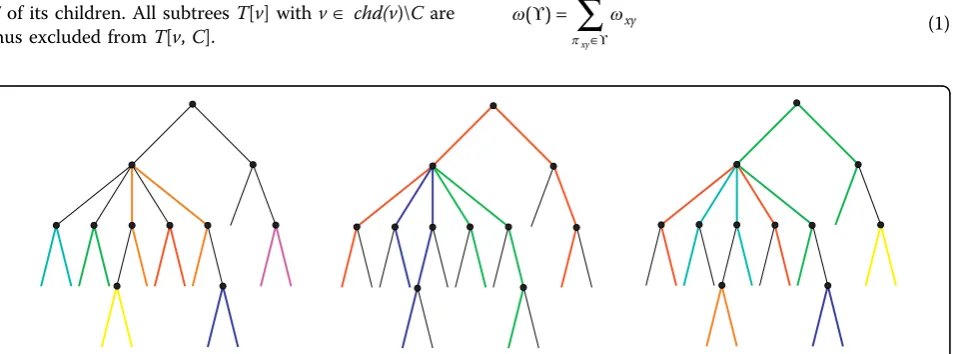
Note that two paths inϒ have at most one vertex in common (otherwise they would also share the sub-path, and therefore edges, between two common vertices). In binary trees, two edge-disjoint paths are also vertex-dis-joint, since two edge-disjoint paths can only run through an interior vertex uwith |chd(u)|≥ 3 (see Fig. 1). Two edge-disjoint paths can share a vertexu in two distinct situations: (1) if both paths haveu as the last common ancestor of their respective leaves, umust have at least four children, (2) ifu is the last common ancestor for one path, while the other path also includes an ancestor ofu, three children of uare sufficient. These two situa-tions will also lead to distinct cases in the algorithms that are presented next.
Furthermore, let ωxy : L × L ® R be an arbitrary
weight function on pairs of leaves of T. We define the weight of a path-systemϒas
( )ϒ
ϒ
=
∈
∑
xyxy
(1)
Figure 1Three different path-systems on a tree with 15 leaves. Each path is shown in a distinctive color, and unused edges of the tree are shown as thin black lines. Clearly, no two paths share an edge, i.e., the corresponding collection of pairs of leaves is phylogenetically
A path-system ϒthat maximizesω(ϒ), i.e., a solution of the MPP, will in the following be called optimal path-system. It conceptually corresponds to Maddison’s
“maximal pairing” [2], although we describe here a more general problem (see Background and Variants). In the following sections, our main objective is to compute optimal path-systems.
The Maximal Pairing Problem for binary trees
Forward recursion
In this section we reconsider the approach of [4] for the special case of binary trees. This subsumes also Maddi-son’s [2] discussion of the special unweighted case (see section Variants). We develop the dynamic program-ming solution for this class of MPP using a presentation that readily leads itself to the desired generalization to multifurcating trees.
For a given interior vertex uÎ Jwe use the abbrevia-tionCx=Cx(u) = chd(u)\uxfor the set of children of u
that are not contained in the path that connectsu with the leafx. Since Tis binary by assumption in this sub-section,Cxcontains a unique vertex Cx ={ }ux .
We will need two arrays (S,R) to store optimal solu-tions of partial problems. For each uÎ V, letSu be the score of an optimal path-system on the subtree T[u]. For each u Î V and leaf x Î T[u], we furthermore defineRux as the score of an optimal path-system on T
[u] that is edge-disjoint with the pathπux. Rux can be
decomposed as follows:
Rux =Ru xx +Sux (2)
For completeness, we set Sx = Rxx = 0 for all leaves
xÎL.
An optimal path-system on T [u] either consists of optimal path-systems on each of the two treesT[v] and
T[w] rooted at the two childrenv,wÎchd(u), or it con-tains a path πxywith endpoints xÎ T[v] and y ÎT[w].
Thus,Sucan be calculated as follows:
S
S S
R R
u
v w
x T v y T w xy vx wy = ⎧⎨⎪ +
{
+ +}
⎩⎪ ∈ ∈
max
max max [ ] [ ]
(3)
Recursion (3) can then be evaluated from the leaves towards the root.
In order to facilitate the backtracing part of the algo-rithm, it is convenient to introduce an auxiliary variable
Fu. If an optimal score in eq.(3) is obtained by the sec-ond alternative, the pair (x, y) that led to the highest score is recorded inFu; otherwise, we setFu=∅.
Backtracing
A computed optimal path-systemϒmaxonT=T[r] from the forward recursions can be reconstructed by
backtra-cing. For binary trees, this is straightforward. We start at the rootr. In the general set, at an interior vertexuwith
v,wÎchd(u), we first check whetherFu=∅. If this is the case, all pathsπxyÎϒmaxare contained within the subtreesT[v] andT[w], and we continue to backtrace in bothT[v] andT[w]. IfFu= (x, y), thenπxy is added to
ϒmax, and we need to backtrace an optimal path-system
for each of the subtrees“hanging off”πxy. In other words,
we need optimal path-systems for the subtrees rooted at the vertices ux and uy for u Î πxy. These can be
obtained recursively by following the decompositions of
RvxandRwy, respectively, given in eq.(2).
Time and Space complexity
All entriesSufor interior verticesucan be computed in (n3) time, because a total of n(n- 1)Î (n2) pairs of leaves have to be considered in eq.(3) and computation of eachSuentry takes at most (n) time. Since we need to store the quadratic arraysRuxandn(u,x) as well as the linear arraysSuandFu, we need (n2) memory.
The Maximal Pairing Problem for multifurcating trees
Forward recursion
In trees with multifurcations, for a path-systemϒ, more than one path can run through each vertex mÎ J with |chd(m)| > 2 without violating phylogenetic indepen-dence. In addition to an optimal score Su , we also define an optimal scoreQuxof all path-systems ϒ’u on T[u]\T[ux], i.e., of all path-systems that avoid not only the pathπux but the entire subtreeT[ux], whereuxis as
usual the child ofualongπux. We therefore have
Rux =Ru xx +Qux (4)
The computation of Su and Quxare analogous pro-blems. In general, consider an (interior) vertex u Î J
and a subsetC⊆chd(u) of children of u. Our task is to compute an optimal path-system on the subtree T[u,C] of T. We first observe that any path-system onT[u,C] contains 0 ≤ k≤ Î|C|/2˚paths πkthrough u. Each of
these paths runs through exactly two distinct children
v’k and vk’’ ofu. For fixed vk’ and vk’’, the path ends in leaves xk’ ∈T v[ ]’k and xk’’∈T v[ ]’’k (Fig. 1). The best pos-sible score contribution for the pathπx′x′′is
Qx x′ ′′, =Rv x′ ′+Rv x′′ ′′+x x′ ′′ (5) and the best possible score for a particular pair of childrenv′,v′′ ÎCis therefore
Qv v R R
x T v x T v v x v x x x ′ ′′, = ′∈ ′ ′′∈ ′′
{
′ ′+ ′′ ′′+ ′ ′′}
[ ] [ ]
max max (6)
(x, y), that maximized Qv v′ ′′, in eq.(6) in an auxiliary variableFv′,v′′.
Since there are kpaths throughucovering 2kof the |C| subtrees, there are |C| - 2kchildrenvlofu, with 1≤
l ≤ |C| - 2k, each of which contributes to an optimal path-system with a sub-path-system that is contained entirely within the subtree T[vl]. Since these contribu-tions are independent of each other, they are obtained by solving the MPP on T[vl], i.e., their contribution to the total score of an optimum path-system isSvl.
For each subtree T[u, C] we therefore face the pro-blem of determining the optimal combination of pairs and isolated children. This task can be reformulated as a weighted matching problem on an auxiliary graph Γ(C) whose vertex set consists of two copies of the elements of C, denotedv andv*. Within one copy of C, there is an edge between any two elements. The remaining |C| edges of Γ(C) connect eachvwith its copy v*. The asso-ciated edge weights are ωv’,v’’ = Qv v′ ′′, andωv,v* =Sv, respectively. An example is shown in Fig. 2.
Clearly, an optimal path of the formx′,...,v′, u,v′′,...,x′′
is represented by the edge (v′, v′′) of Γ(C), while a self-contained subtreeT[v] is represented by an edge of the form (v, v*). It remains to show that every maximum matching of the auxiliary graph Γ(C) corresponds to a legal conformation of paths, i.e., we have to demonstrate that in a maximum matchingℳ, each vertexvÎ Cis contained in an edge. First, note thatv* covered by an edge of ℳif and only if (v, v*)Î ℳ. Supposevis not covered in ℳ. Since ωv,v* is non-negative, we can
exclude matchings that do not cover all edges ofCfrom the solution set. We can thus compute the entries ofSu
and Qux, respectively, in polynomial time by solving maximum weighted matching problems with non-nega-tive weights. Introducing the symbol MWM(Γ) for the maximum weight of a matching on the auxiliary graph
Γ, we can write this as
S u
Q u u
u
ux x
= =
MWM( (chd(
MWM chd
Γ Γ
)))
( ( ( ) \ { })) (7)
Here we make use of the fact that the weight of a matching equals the sum of the weights of the path-systems that correspond to the edges of the auxiliary graphs. In order to facilitate backtracing, we keep tabulated not only the weights but also the corre-sponding maximum matchings for each Γ(chd(u)) and
Γ(chd(u)\{ux})).
Backtracing
Backtracing for multifurcating trees proceeds in analogy to the binary case. Again we start from the root towards the leaves, treating each interior vertexu. If |chd(u)| = 2, see the backtracing for the binary case. If |chd(u)| > 2, we first need the solutionℳ of the MWMfor chd(u). For each edge (v, v*) Î ℳ, vis called recursively to determine its optimal path-system. Each edge (v′,v′′)Î
ℳ, however, represents a path πxy that belongs to an
optimal path-system. Each of these pathsπxymaximizes
Qv v′ ′′, for a particular pair of children v′, v′′ Î chd(u) and therefore has been stored inFv′v′′during the forward
recursion. Thus, each of these pathsπxycan be added to
the optimal path-system.
As in the binary case, it remains to add the solutions from an optimal path-systems from the subtrees that are not on the path fromx tov′ and y tov″, respectively, for each particular edge (v′,v′′)Î ℳ. This can be done as follows. According to eqns.(2) and (4), Rv′x can be
decomposed into
R
vx
’ and either Qv′xor
S
v’x. If |chd(v′)| = 2, the child node vx’ =k that is not on the path
from v′to x is called recursively to obtain an optimal path-system inT[k]. If |chd(v′)| > 2, however, the solu-tion of theMWMfor Qv′xis needed to determine an
opti-mal path-system on the subtree T v[ ]′ T v[ ]′x , because multiple paths may go through V′.
R
vx’ can then beu
v1
v2
v3
v4
v5
v6
v7
v8
v1*
v8*
v4
v3
v8
v7
v1
v2
v6
v5
v2*
v7*
v6*
v5*
v4*
v3*
further decomposed untilRxxis reached. The same pro-cedure is employed forRv′′y.
Time and Space complexity
A maximum weighted matching on arbitrary graphs with |V| vertices and |E| edges can be computed in (|V||E| logE) time and (E) space by Gabow’s clas-sical algorithm [10] or one of several more recent alter-natives [11,12]. In our setting, |E| Î (|chd(u)|2), hence the total memory complexity of our dynamic pro-gramming algorithm is (n2).
All entries for Qv v′ ′′, (the edge weights for the
match-ing problems) can be computed in (n3) time, because a total of (n - 1) Î (n2) pairs of leaves have to be considered in eq.(6) and computation of each Qv v′ ′′,
entry takes at most (n) time. The effort for one of the (|chd(u)|) maximum weighted matching problems for a given interior vertexuwith more than two children is bounded by
(|chd(u)|3log(|chd(u)|)2). The total effort for all
MWMsis therefore bounded by
|chd( ) | log(|u ( ) | )u ( log ),n n
u
4 2 4
chd ∈
∑
which dominates the overall time complexity of the algorithm (see Appendix for a derivation).
As in the binary case, (n2) space is necessary and sufficient to store the arrays R and S. Furthermore, (n2) space is needed to save the arrayQand the end-points (x, y) of the path πxy that maximized each Q
entry. The latter is needed for the backtracing. In addi-tion, we keep the quadratic array n(u,x) to allow effi-cient navigation in T. For each interior vertex u with |chd(u)| > 2, |chd(u)| + 1 different maximal matchings have to be stored: one that corresponds toSuand |chd (u)| that correspond to Qux. Each of these solutions requires (|chd(u)|) space. The total space complexity of all MWMsolutions is therefore ∑u|chd(u)|2 Î (n2)
(see Appendix).
Algorithmic variants
Several variants and special cases of the general MPP algorithm are readily derived for related problems. In the following, we briefly touch upon some of them.
Special weight functions
It is worth noting that finding a path-system that sim-ply maximizes the number of pairs, as presented in [2] and applied in [13], for example, constitutes a special case of the MPP with unit weights. (Of course the same result is obtained by setting ωxy to any fixed
positive weight.) This case may be of practical use under certain circumstances, as it maximizes the num-ber of independent measurements, thus improving
power of subsequent statistical tests. Specifically, this
weight function selects a path-system with ⎢⎣ns⎥⎦ pairs.
In order to maximize the number of edges that are covered by an optimal path-system, we simply set ωxy
=d(x,y), where d(x, y) is the graph-theoretic distance, i.e., we interpret the edge lengths in the tree as unity. Alternatively, instead of assigning weights for pairs of leaves directly, edges e Î E can be weighted, and the weight for a particular pair of leaves (x, y) can then be
simply defined as xy e
e xy =
∈
∑
( ).
Fixed number of paths
A variant of practical interest is to limit an optimal path-system to leaf-pairs. This may be relevant in a phylogenetic targeting setting, for example, in cases where resources are limiting data acquisition efforts to a small number taxa so that it pays to make every effort to choose them optimally (see also [4]). Typically, will be small in this setting.
For binary trees, this variant can be implemented by conditioning the matricesRandS to a given number of paths. Eq.(2) thus becomes
Rux k R S
l k u x lx u k lx ,
, , ,
max
=
{
+}
∈{ }0 − (8)
for a given numberk≤kin the partial solutions. If an optimal path-system on T[u] is composed of optimal path-systems on the two trees rooted at its childrenv
andw, respectively, then thekpaths are arbitrarily con-tained within T [v] and T [w]. Thus, k + 1 different cases have to be considered, and the case with the high-est score has to be identified. This yields to the follow-ing extension of eq.(3) forSu,k:
S
S S
u k
l k v l w k l l x T v
k y T w ,
, , ,
[ ] max
max
max max
, [ ]
=
+
{
}
∈{ } −
∈ ∈
−
{ } ∈
0
0 1
xy+Rvx l +Rwy k l
{
}
⎧ ⎨ ⎪⎪
⎩ ⎪
⎪ , , −
(9)
We setSx=Rxx,l=Rux,0= 0 for allxÎL,uÎ J, andl
Î{0, k}. The latter condition ensures that if no path can be selected anymore in a particular subtree, its score must be 0.
Selecting paths or taxa in addition to already selected paths or taxa
In some applications it may be the case that a subset of taxa or paths is already given, e.g. because the corre-sponding data have already been acquired in the past. The question then becomes how additional resources should be allocated.
In the simpler case, we are given a partial path-system
∏. It then suffices to remove or mark the corresponding leaves from T (to ensure that they are not selected again) and to set the weight of all paths that have edges in common with ∏ to - ∞ to enforce independence from the prescribed pairs.
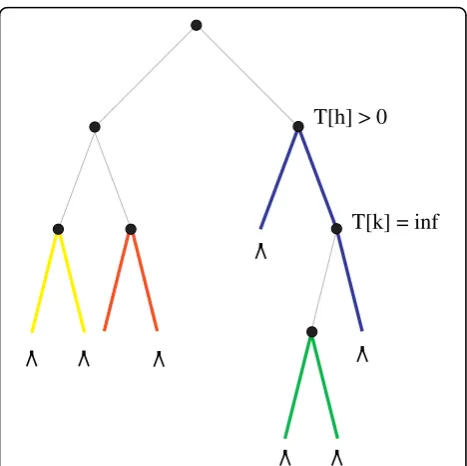
The situation is less simple if only the taxa are given and the pairs are not prescribed. Here, the goal is to find an optimal path-system that includes all z Î Z, where Z ⊂ L denotes the taxa that are required to appear in the output. First, we note that such a solution not necessarily exists, e.g. if |Z| = |L| and |L| is odd. As a simple example, consider a binary tree with three leaves. In that case, only one path and thus two leaves can be selected. This constraint also holds for the sub-tree rooted at any interior vertex uand thez ÎZ in T
[u], i.e., partial solutions of the MPP (see below). For binary trees, this variant can be implemented by conditioning the matricesRandSto a subset of all pos-sible paths and leaves. This is achieved by setting the score to -∞for a particular interior vertex if one of the preconditions cannot be met in eqns.(2) and (3). For example, if two leaves x,y Î Zhave the same fatheru, an optimal path-system of both T[u] and Tmust con-tain the pathπxy, because otherwise, either xorywould
not belong to the optimal path-system due to the requirement of independence. Similarly, if a particular pathπxy in the second alternative achieves the highest
score in eq.(3),πxymust not be selected if this conflicts
with the possibility to select other prescribed leaveszÎ Z(Fig. 3).
To derive the recursions for this variant, letZudenote the leaveszÎZwithzÎT[u] and letLbe the leaves of
T[u]. It is convenient to first check whether a solution exists forT[u]. IfL=Zuand |L| is odd,Su= -∞(i.e., no path-systems exists that selects all z Î Zu in T[u]). Otherwise, an optimal path-system forT[u] withv,wÎ
chd(u) can be calculated as follows:
S
S S v Z w Z
u
v w
x T v y T w =
+ ∉ ∉
−∞ ⎧ ⎨ ⎩
−∞
∈
∈
max
max [ ]
[ ]
if and
otherwise
iff
or
otherwise R
S
R S
u x u xy u x u
x
x
x x
= −∞ = −∞
+ +
⎧ ⎨ ⎪
⎩ ⎪ ⎧
⎨ ⎪ ⎪ ⎪
⎩ ⎪ ⎪
⎪
(10)
Furthermore,
R R S
R S
ux
u x u
u x u
x x
x x
=⎧⎨⎪ ⎩⎪
−∞ = −∞ = −∞
+
if or
otherwise (11)
and
Sx=⎧⎨ x Z ⎩
∉ −∞ 0 if
otherwise (12)
for any x Î L. In analogy to the algorithm for the unconstrained MPP, we initialize the recursions by
Rxx = 0 for x Î L. This variant does not change the overall time and space complexity, and backtracing is also identical to the unconstrained version of the MPP.
For multifurcating trees, the maximum weighted matching problems are replaced by finding matchings that maximize the weight with the constraint that parti-cular vertices must be included in the matching. Simi-larly to the variant introduced above, however, we are not aware that this particular problem has been studied in detail.
Probabilistic version
Sometimes, not only an optimal solution is of interest. As in the case of sequence alignments [14] or biopolymer
T[h] > 0
T[k] = inf
Figure 3A binary tree for which only one possible path-system exists that fulfills all constraints. Leaves that must appear in the output are highlighted with an arrow, and the (only) valid path-system is displayed in color. Note that the score of the subtree
structures [15], one may analyze the entire ensemble of solutions. Both for physical systems such as RNA, and for alignments with a log-odds based scoring system, one can show that individual configurationsϒwith scoreS(ϒ), in our case path-systems, contribute to the ensemble propor-tional its Boltzmann weight exp(-bS(ϒ)), where the
“inverse temperature”bdefines a natural scale that is implicitly given by the scoring or energy model. In the case of physical systemsb= 1/kTis linked to the ambient temperatureT;for log-odds scores,b= 1; if the scoring scheme is rescaled, as e.g. in the case of the Dayhoff matrix in protein alignments, thenbis the inverse of this scaling factor. In cases where schemes without a probabil-istic interpretation are used, suitable values ofbhave to be determined empirically. The largerb, the more an optimal path-system is emphasized in the ensemble. Thepartition functionof the system is
Z=
∑
exp(− S( )).ϒ
ϒ
(13)
The probability pϒ to pick ϒ from the ensemble is
pϒ= exp(-bS(ϒ))/Z.
The recursion in eq.(3) can be converted into a corre-sponding recursion for the partition functions Zu of path-systems on subtreesT=T[u], because the decom-position of the score-maximization is unambiguous in the sense that every conformation falls into exactly of the case of recursion. This is a generic feature of dynamic programming algorithms that is explored in some depth in the theory of Algebraic Dynamic Programming[16]. We find
Zu Z Zv w R R
y T w x T v
xy vx wy
= + −
∈
∈
∑
∑
· exp( )· ·
[ ] [ ]
(14)
withZu= 1 ifuÎLand
Rkx Rk x Zk
x x
= + (15)
for kÎ J. Note that these recursions are completely analogous to the score optimization in eqns.(2) and (3): the max operator is replaced by a sum, and addition of scores is replaced by multiplication of partition func-tions and Boltzmann factors.
In order to compute the probability Pxyof a particular path πxy in the ensemble we have to add up the
contri-butionspϒof all path-systems that containπxy Z xy
xy
( ) : exp( ( ))
=
∑
− ϒϒ (16)
and compute the ratioPxy =Z(πxy)/Z. The recursions
for the restricted partition function Z(πxy) can be
computed in analogy to eq.(14), but with two additional constraints. First, sinceπxy Îϒ by definition, the leaves i Î T[v] and j Î T[w] are constrained in eq.(14), because only paths πij that are edge-disjoint withπxy
can be considered. The recursion for the partition func-tion of the last common ancestor node of x and y, denoted k, is also constrained, because πxy must go
through k. Calculation of the partition functions for the children of kis therefore not needed to compute Zk . Thus,
Z
R R u k Z Z
R R
u
xy vx wy
v w
ij vi wj
=
− =
+ −
exp( )• •
•
exp( )• •
if
otherwwise
i T v j T w
xy ij
∈ ∈
∩ =∅
∑
⎧
⎨ ⎪ ⎪⎪
⎩ ⎪ ⎪
⎪ [ ], [ ]
(17)
In resource requirements, this backward recursion is comparable to the forward recursion in eq.(3):Z(πxy)
and thus also Pxy can be calculated in (n3) time, because the number of leaf-pairs that have to be consid-ered is still in (n2). There is an additional factor (n) arising from the need to determine if the pathπxy
is edge-disjoint with another path, which however does not increase overall time complexity. Furthermore,
(n2) space is needed.
The computation of partition functions is a much more complex problem for trees with multifurcations since it would require us in particular to compute parti-tion funcparti-tions for the interleaved matching problems. These are not solved by means of dynamic program-ming; instead, they use a greedy algorithm acting on augmenting paths in the auxiliary graphs. These algo-rithms therefore do not appear to give rise to efficient partition function versions.
TheTARGETINGsoftware
We implemented the polynomial algorithms for the
MPP in the program TARGETING. The TARGETING
program is written in C and uses Ed Rothberg’s imple-mentation [17] of the Gabow algorithm [10] to solve the
Maximum Weight Matching Problem on general graphs. The software also provides an user-friendly interface and can solve the special weight variants as well. The source code can be obtained under the GNU Public License at http://www.bioinf.uni-leipzig.de/Software/ Targeting/.
Concluding Remarks
multifurcations is non-trivial, since a straightforward approach yields run-times that are exponential in the maximal degree of the input tree. A polynomial-time algorithm can be constructed by interleaving the dynamic programming steps with the solution of auxili-ary maximum weighted matching problems. This gener-alized algorithm for the MPP is implemented in the software packageTARGETING, providing a user-friendly and efficient way to solve the MPP as well as some of its variants.
Future work in this area is likely to focus on develop-ing algorithms for the variants of the MPP on multifur-cating trees. In particular, the interleaving of dynamic programming for the MPP and the greedy approach for the auxiliary matching problems does not readily gener-alize to a partition function algorithm for multifurcating trees. The concept of unique matchings as discussed in [18] may be of relevance in this context.
The MPP solver presented here has applications in a broad variety of research areas. The method of phylo-genetically independent comparisons relies on relatively few assumptions [1-3] and is frequently used in evolu-tionary biology, in particular in anthropology, compara-tive phylogenetics and, more generally, in studies that test evolutionary hypotheses [19-22]. As highlighted ear-lier, another application area lies in the design of studies in which tedious and expensive data collection is the limiting factor, so that a careful selection (phylogenetic targeting) becomes an economic necessity [5]. As noted in [13], alternative applications can be found in molecu-lar phylogenetics, for example in the context of estimat-ing relative frequencies of different nucleotide substitutions or the determination of the fraction of invariant sites in a particular gene.
Appendix
Pseudocode
Below, we include some pseudocode for the computa-tion of an optimal path-system for an arbitrary treeT.
Require: ωxy ≥ 0 ∀ pairsx,y Î Land precomputed
arrayn(u,x)n(u,x)∀uÎJ andxÎL
1:Sx=Rxx=Qx,x= 0∀xÎL Rux Ru x Su
x x
= + if |chd(u)| = 2 and
Rux Ru x Qu x
x x
= + , if |chd(u)| > 2∀uÎJandxÎ L
2:for all uÎJin post-order tree traversal do
3: if|chd(u)| = 2then
4: {v,ω}¬chd(u) 5: Su1=Sv+Sw
6: for allpathsπxywithxÎT[v] andy ÎT[w]do
7: determine the pathπxythat maximizes
8: Su2=ωxy+Rv,x+Rw,y
9: end for
10: ifSu2>Su1 then 11: Fu= (x,y)
12: else
13: Fu=∅
14: end if
15: Su= max(Su1,Su2) 16: else
17: for allpairs v′,v′′Î chd(u)do
18: determine the path πxy that maximizes
Qv v′ ′′, and set Fv′v′′= (x,y) andωv′,v′′= Qv v′ ′′,
19: end for
20: for allpairs v,v*Îchd(u)do
21: ωv,v*=Sv
22: end for
23: use computed edge weights for the following
MWMproblems
24: Su=MWM(Γ(chd(u))) 25: fori= 1 to |chd(u)|do
26: k¬ i-th child fromu
27: computeδ=MWM(Γ(chd(u)\k)) 28: for allleavesxÎT[k]do
29: Qux=δ
30: end for
31: end for
32: tabulate solution of all MWMproblems 33: end if
34:end for
The following algorithm summarizes backtracing. It starts at the root of the tree, but consider any vertexu:
1:if |chd(u)| = 0then
2: return 3:end if
4:if |chd(u)| = 2then
5: {v, w}¬chd(u) 6: ifFu=∅then
7: call backtracing forT[v] (using the solution of theMWMforSvif |chd(v)| > 2)
8: repeat forT[w] 9: else
10: addFu= (x,y) =πxyto solution set
11: k=v{path fromvtox} 12: whilek≠xdo
13: *
14: if|chd(k)| = 2then
15: call backtracing for T k[ ]x
16: else
17: call backtracing forT[k]\T[kx] (using the solution of theMWMforQkx)
18: end if
19: *
20: k=kx
21: end while
22: repeat fork=w{path fromwtoy} 23: end if
24:else
26: take the appropriate tabulatedMWMM
27: for alledges (vi,vj)ofMdo
28: add Fv vi, j = (x,y) =πxyto solution set
29: k=vi{path fromvitox} 30: whilek≠xdo
31: see case differentiation for the binary case (lines between *)
32: k=kx
33: end while
34: repeat fork=vj{path fromvjtoy
35: end for
36: for alledges (vi,vl*)ofMdo
37: call backtracing forT[vi] (using the solution of theMWMfor Sv
i if |chd(vi)| > 2)
38: end for
39:end if
A useful inequality
Consider an algorithm that operates on a rooted tree with nleaves requiring ((du)a) time for each interior vertex with du children. A naive estimate immediately yields the upper bound (na+1). Using the following lemma, however, we can obtain a better upper bound. Although Lemma 0.1 is probably known, we could not find a reference and hence include a proof for completeness.
Lemma 0.1Let T be a phylogenetic tree with n leaves, u an interior vertex, du = |chd(u)| the out-degree of u, anda> 1.Then
( ) u
u
d n
∑
≤ (18)ProofLet hdenote the total number of interior ver-tices. Each leaf or interior vertex except the root is a child of exactly one interior vertex. Thus∑udu =n+
(h - 1). For fixed h, we can employ the method of Lagrange multipliers to maximize the objective function
F du du du d u
u h
( 1, 2,, )=
∑
( ) subject to the constraint∑udu=n+ (h- 1) =c≤2n- 1. The Lagrange function
is then
Λ(du,du , ,du , ) ( )d ( ( )d c). u
u
u u
h
1 2
=
∑
+∑
− (19)Setting the partial derivatives ofΛ= 0 yields the fol-lowing system of equations:
∂ ∂
∂ ∂
=
=
+ ∀ ∈
{ }
−
−
∑
Λ
Λ
dui d u i h
d c
u i
u u
i
•( ) , ,
( )
1 1
(20)
This system of equations is solved by
du du du d h
1 = 2 == = for all i Î {1, h}. The above
sum is maximal when T is a fulld-ary tree for somed. The constraint can thus be expressed as h· d =n +
h -1 and F= hda which is maximized by makingdas large as possible (i.e., n) and hence minimizing the numberhof interior vertices (i.e., 1). Hence, F(n)=na.
Author details
1Bioinformatics Group, Department of Computer Science, and
Interdisciplinary Center for Bioinformatics, University of Leipzig, Härtelstraße 16-18, D-04107 Leipzig, Germany.2Harvard University, Department of Human Evolutionary Biology, Peabody Museum, 11 Divinity Avenue, Cambridge MA 02138, USA.3Max Planck Institute for Mathematics in the Sciences, Inselstraße 22, D-04103 Leipzig, Germany.4Fraunhofer Institute for Cell Therapy and Immunology, Perlickstraße 1, D-04103 Leipzig, Germany.5Santa Fe Institute, 1399 Hyde Park Rd., Santa Fe, NM 87501, USA.6Institute for Theoretical Chemistry, University of Vienna, Währingerstraße 17, A-1090 Wien, Austria.
Authors’contributions
Both authors designed the study and developed the algorithms. CA implemented the TARGETING software. Both authors collaborated in writing the manuscript. All authors read and approved the final manuscript. Competing interests
The authors declare that they have no competing interests.
Received: 8 April 2010 Accepted: 2 June 2010 Published: 2 June 2010
References
1. Felsenstein J:Phylogenies and the comparative method.Amer Nat1985,
125:1-15.
2. Maddison WP:Testing Character Correlation using Pairwise Comparisons on a Phylogeny.J Theor Biol2000,202:195-204.
3. Ackerly DD:Taxon sampling, correlated evolution, and independent contrasts.Evolution2000,54:1480-1492.
4. Arnold C, Nunn CL:Phylogenetic Targeting of Research Effort in Evolutionary Biology.American Naturalist2010, In review. 5. Arnold C, Nunn CL:Phylogenetic Targeting Website.2010 [http://
phylotargeting.fas.harvard.edu].
6. Bininda-Emonds OR, Cardillo M, Jones KE, MacPhee RD, Beck RM, Grenyer R, Price SA, Vos RA, Gittleman JL, Purvis A:The delayed rise of present-day mammals.Nature2007,446:507-512.
7. Burleigh JG, Hilu KW, Soltis DE:Inferring phylogenies with incomplete data sets: a 5-gene, 567-taxon analysis of angiosperms.BMC Evol Biol
2009,9:61.
8. Arnold C, Matthews LJ, Nunn CL:The 10kTrees Website: A New Online Resource for Primate Phylogeny.Evol Anthropology2010.
9. Sanderson MJ, Driskell AC:The challenge of constructing large phylogenetic trees.Trends Plant Sci2003,8:374-379.
10. Gabow H:Implementation of Algorithms for Maximum Matching on Nonbipartite Graphs.PhD thesisStanford University 1973.
11. Galil Z, Micali S, Harold G:AnO(EVlogV) algorithm for finding a maximal weighted matching in general graphs.SIAM J Computing1986,
15:120-130.
12. Gabow HN, Tarjan RE:Faster scaling algorithms for general graph matching problems.J ACM1991,38:815-853.
13. Purvis A, Bromham L:Estimating the transition/transversion ratio from independent pairwise comparisons with an assumed phylogeny.J Mol Evol1997,44:112-119.
14. Mückstein U, Hofacker IL, Stadler PF:Stochastic Pairwise Alignments.
Bioinformatics2002,S153-S160:18.
15. McCaskill JS:The equilibrium partition function and base pair binding probabilities for RNA secondary structures.Biopolymers1990,
16. Steffen P, Giegerich R:Versatile and declarative dynamic programming using pair algebras.BMC Bioinformatics2005,6:224.
17. Rothenberg E:Solver for the Maximum Weight Matching Problem.1999 [http://elib.zib.de/pub/Packages/mathprog/matching/weighted/]. 18. Gabow HN, Kaplan H, Tarjan RE:Unique Maximum Matching Algorithms.
J Algorithms2001,40:159-183.
19. Nunn CL, Baton RA:Comparative Methods for Studying Primate Adaptation and Allometry.Evol Anthropology2001,10:81-98. 20. Goodwin NB, Dulvy NK, Reynolds JD:Life-history correlates of the
evolution of live bearing in fishes.Phil Trans R Soc B: Biol Sci2002,
357:259-267.
21. Vinyard CJ, Wall CE, Williams SH, Hylander WL:Comparative functional analysis of skull morphology of tree-gouging primates.Am J Phys Anthropology2003,120:153-170.
22. Poff NLR, Olden JD, Vieira NKM, Finn DS, Simmons MP, Kondratieff BC:
Functional trait niches of North American lotic insects: traits-based ecological applications in light of phylogenetic relationships.J North Am Benthological Soc2006,25:730-755.
doi:10.1186/1748-7188-5-25
Cite this article as:Arnold and Stadler:Polynomial algorithms for the Maximal Pairing Problem: efficient phylogenetic targeting on arbitrary trees.Algorithms for Molecular Biology20105:25.
Submit your next manuscript to BioMed Central and take full advantage of:
• Convenient online submission
• Thorough peer review
• No space constraints or color figure charges
• Immediate publication on acceptance
• Inclusion in PubMed, CAS, Scopus and Google Scholar • Research which is freely available for redistribution
![Figure 2 Translation of a path-system on T[u] into a matching on the auxiliary graph Γ(chd(u))](https://thumb-us.123doks.com/thumbv2/123dok_us/348943.1527431/4.595.56.546.560.711/figure-translation-path-matching-auxiliary-graph-g-chd.webp)