in Selective Maintenance Reliability Model
Neha Gupta
Department of Statistics & O.R. Aligarh Muslim University Aligarh-202002, India
Irfan Ali
Department of Statistics & O.R. Aligarh Muslim University Aligarh-202002, India
Abdul Bari
Department of Statistics & O.R. Aligarh Muslim University Aligarh-202002, India
Abstract
In the present paper, we have considered the allocation problem of repairable components for a parallel-series system as a multi-objective optimization problem and have discussed two different models. In first model the reliability of subsystems are considered as different objectives. In second model the cost and time spent on repairing the components are considered as two different objectives. These two models is formulated as multi-objective Nonlinear Programming Problem (MONLPP) and a Fuzzy goal programming method is used to work out the compromise allocation in multi-objective selective maintenance reliability model in which we define the membership functions of each objective function and then transform membership functions into equivalent linear membership functions by first order Taylor series and finally by forming a fuzzy goal programming model obtain a desired compromise allocation of maintenance components. A numerical example is also worked out to illustrate the computational details of the method.
Keywords: Reliability, Fuzzy Goal Programming, Compromise allocation, Selective Maintenance, Multi-objective programming.
1. Introduction
All the Industries depend on the reliable performance of repairable systems for the successful completion of missions. In every industry, systems are used in the production of goods. If such systems deteriorate or fail, the effect can be wide spread. Indeed, system deterioration is often reflected in higher production cost, time, lower product quality and also quantity. The system maintenance decision is taken on the basis of the state condition of the system (i.e. whether the system is good or bad). Due to the limitations in maintenance resources, a maintenance decision maker must decide how to allocate available resources. This allocation falls within the domain of selective maintenance. Selective maintenance is defined as the process of identifying the subset of maintenance activities to perform from a set of desired maintenance actions.
cannot be performed during missions; therefore, the decision-maker must decide which components to maintain prior to the next mission. The selective maintenance models considered to date treat decision-making relative to a single, future mission. If a system is required to perform a sequence of missions, then the selective maintenance decisions directly affect system reliability for the next mission and indirectly affect the system reliability for later missions.
The selective maintenance operation is an optimal decision-making activity for system consisting of several components under limited maintenance resources. The main objective of the selective maintenance operation is to select the most important component within subsystems. Rice et al. (1998) were the first to deal with the selective maintenance problem. They define a system that must complete a series of missions where maintenance is performed only during finite breaks between missions. Due to the limited maintenance time, it may not be possible to repair all failed components before the next mission. A nonlinear, discrete selective maintenance optimization model is developed which is designed to maximize system reliability for the next mission. The numbers of components to repair are the decision variables, and the limitation on maintenance time serves as the primary functional constraint.
Cassady et al. (2001a, 2001b) extend the work of Rice et al. (1998) in several ways. First, more complex systems are analyzed. Specifically, systems are comprised of independent subsystems connected in series with the individual components in each subsystem connected in any fashion. Next, the selective maintenance model is extended to consider the case where both time and cost are constrained. This leads to the development of three different selective maintenance models. These models include maximizing system reliability subject to both time and cost constraints; minimizing system repair costs subject to a time constraint and a minimum required reliability level; and minimizing total repair time subject to both cost and reliability constraints.
Cassady et al. (2001c) extend the work of Rice et al. (1998) in two other ways. First, system components are assumed to have Weibull life distributions. This assumption permits systems to experience an increasing failure rate (IFR) and requires monitoring of the age of components. Second, the selective maintenance model is formulated to include three maintenance actions: minimal repair of failed components, replacement of failed components, and preventive maintenance.
Chen et al. (1999) extend the work of Rice et al. (1998) and Cassady et al. (2001a) by considering systems in which each component and the system may be in K + 1 possible states, 0, 1, … , K. They use an optimization model to minimize the total cost of maintenance activities subject to minimum required system reliability.
model allows the user to maximize the expected value of the number of successful missions in the next set. The third model permits cancellation of a mission based on costs associated with the risk of failure. Recently Ali et al. (2011a, 2011b, 2011c, 2012a, 2012b, 2013), Faisal and Ali (2012) have been studied the problem of selective maintenance and solved it by various single and multi-objective optimization techniques. Fuzzy programming offers a powerful means of handling optimization problems with fuzzy parameters. Fuzzy programming has been used in different ways and in different fields in the past. In reliability Park (1987), Mahapatra and Roy (2006), Huang (1997), Dhingra (1992), Rao and Dhingra (1992) Ravi et al. (2000) and Ali and Hasan (2012c) have used fuzzy multi-objective optimization method to solve reliability optimization problem having several conflicting objectives and many others.
In the present paper the problem of finding the optimum compromise allocation of maintenance components is formulated as multi-objective Nonlinear Programming Problem (MONLPP) and a Fuzzy goal programming method is used to work out the compromise allocation in multi-objective selective maintenance reliability model in which we define the membership functions of each objective function and then transform them into equivalent linear membership functions by first order Taylor series and finally by forming a fuzzy goal programming model obtain a desired compromise allocation of maintenance components. A numerical example is also worked out to illustrate the computational details of the method. The numerical example is solved by “Fuzzy Goal programming algorithm” using software package LINGO. LINGO is a user’s friendly package for constrained optimization developed by LINDO Systems Inc. A user’s guide- LINGO User’s Guide (2001) is also available. For more information one can visit the site
http://www.lindo.com.
2. Hypothetical Series-Parallel System Problem
We consider a Hypothetical system which is a series arrangement of m subsystems and performing a sequence of identical production runs after every given (fixed) period.
Suppose that after completion of particular production runs, each component in the system is either functioning or failed. Ideally all the failed components in the subsystems are repaired and then replaced back prior to the beginning of the next production runs. However, due to the constraints on the time and cost, it may not be possible to repair all the failed components in the system. In such situation, a method is needed to decide which failed components should be repaired and replaced back prior to the next production run and the rest be left in a failed condition. This process is referred as selective maintenance (See Rice et al. 1998). In the selective maintenance the number of components available for the next production run in the ithsubsystem will be
i i
i a d
n )
( , i1,2,...,m (1)
The reliability of the given system is defined as
R =
m
i
d a n i
i i i
r
1
) 1 (
The repair time constraint for the system is given as
01
)
exp( d T
d t m i i i i
i
(3)
where ti is the time required to repair a component in ithsubsystem and exp(i ai)is
the additional time spent due to the interconnection between parallel components (Wang et al. (2009)).
The repair cost constraint for the system is defined as
01
)
exp( d C
d c m i i i i
i
(4)
where exp(iai)is the additional cost spent due to the interconnection between parallel components (Wang et al. (2009)).
Model 1: However, in the event when the reliability of each subsystems are of equally serious concern. Let us consider, for instance, the following multi-objective problem (see Ali et al. (2011c)):
) ( integers and ,..., 2 , 1 , 0 and ) ( ) exp( ) ( ) exp( to subject ) ( , , , 0 1 0 1 2 1 iv m i a d iii C d d c ii T d d t i R R R Maximize i i m i i i i i m i i i i i m (5)where Ri =
1 (1 r )
, i 1,2,...,m.i i i a d
n
i
Model 2: Ali et al. (2011c) also discussed the situation in which time taken and the cost spent on system maintenance are minimized simultaneously for the required reliability
*
R (say). The mathematical model of the problem is defined as:
2. The Fuzzy Goal Programming Approach
To solve multi-objective allocation problem of repairable components define in equation (5), we apply the fuzzy goal programming approach consideration of multi-objective vector maximum problem.
Algorithm:
The Fuzzy Goal Programming algorithm for solving MONLPP can be outlined as given below:
Step 1: Find the ideal solution of objective functions by optimizing each objective subject to the system constraints.
Step 2: Formulate the payoff matrix using the ideal solutions. Then define upper and lower tolerance limits of each objective function as
) ( max )
(
min * i i*
i i i
i i
i R d and U R d
L
Step 3: Construct non-linear membership function
i i
i i i i
i i i
i i
i i
U R
U R L L
U L R
L R
d
1 0 ) (
If i(di)1; then Riis perfectly achieved, = 0; Ri is nothing achieved,
1 ) (
0i di ; thenRiis partially achieved.
Step 4: Find the individual best solution of the non-linear membership functions )
( i i d
subject to the system constraints.
Step 5: Transform the non-linear membership functions i(di) into equivalent linear membership functions i respectively at the individual best solution point by first order
Taylor series as
Step 6: The maximum value of a membership function is unity (one), so for the defined membership functions in step (3), the flexible membership goals having the aspiration level unity can be presented as:
. ,..., 2 , 1 ,
1 i m
i
i
Now the FGP model can be formulated as follows:
) 7 (
) ( integers and
,..., 2 , 1 , 0
and
) ( )
exp(
) ( )
exp(
) ( 1
to subject
) (
0 1
0 1
1
v m
i a d
iv C
d d
c
iii T
d d
t
ii i Minimize
i i m
i
i i i
i m
i
i i i
i i i
m
i i
where Ri =
1 (1 r)ni ai di
, i 1,2,...,m.i
Step 7: Solve the FGP model using LINGO software.
In similar way, we solve multi-objective allocation problem of repairable components define in equation (6); we apply the fuzzy goal programming approach consideration of multi-objective vector minimum problem. At first, we find the lower bound Lr(best) and upper bound Ur(worst) for corresponding objective function Zr where r1,2,,k.
Let Lr= aspiration level of achievement for objectiver,
Ur= highest acceptable level of achievement for objectiver, r= Ur Lr= the degradation allowance for objectiver,
when the aspiration level and degradation allowance for each objective are specified.
Now construct membership function for model (2) define in equation (6) as,
r r
r r r r
r r r
r r
ij Z
U Z
U Z L L
U Z U
L Z
d
r
0 1 ) (
If Z (dij)
r 1; then Zris perfectly achieved,
0; Zris nothing achieved, 1
) (
Now transform the non-linear membership function as discussed in above algorithm and finally we get the desired FGP model for equation (6) as follows:
) 8 ( integers and ,..., 2 , 1 , 0 and ) ( 1 1 ) ( 1 to subject ) ( 1 * 1
m i a d iii R r ii i Minimize i i m i d a n i i i m i i i i i 3. Numerical Illustration
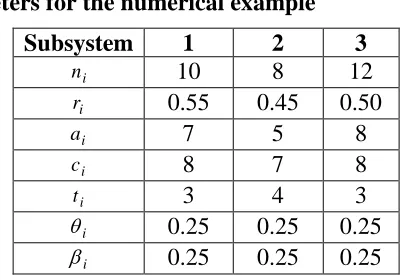
Consider a system consisting of 3 subsystems. The available time between two production runs for repairing and replacing back the components is 60 time units. Let the given maintenance cost of the system be 90 units. The other parameters for the various subsystems are given in table 1.
Table 1: The parameters for the numerical example
Subsystem 1 2 3
i
n 10 8 12
i
r 0.55 0.45 0.50
i
a 7 5 8
i
c 8 7 8
i
t 3 4 3
i
0.25 0.25 0.25
i
0.25 0.25 0.25
Solution by Using Fuzzy Goal Programming Approach
Model 1: Using the values given in Table 1 the NLPP (5) and their optimal solutions 3 2 , 1 ; ) ( and i
d i with the corresponding values of Ri are listed below. These values are obtained by software LINGO.
m i i a d d d c d d t r R Maximize i i i i i i i i i i i i d a n ii i i i
Using the equation (9) construct a pay-off matrix, according to every objective with respect to each solution the pay-off matrix in the main program gives the set of non dominated solution which shown in the following table
9998468 . 0 9084938 . 0 9589938 . 0 9589938 . 0 9916266 . 0 9589938 . 0 9589938 . 0 9084938 . 0 9996595 . 0 ) 3 ( ) 2 ( ) 1 ( 3 2 1 d d d Z Z Z
The upper bounds for the given model 1 are
9998486 . 0 , 9916266 . 0 , 9996595 .
0 2 3
1 U U
U and lower bound
9589938 . 0 , 9084938 . 0 , 9589938 .
0 2 3
1 L L
L .
Now the linearized membership functions are:
3 3 3 2 2 2 1 1 1 00005 . 0 ) 8 ( 1 ) 8 , 1 , 1 ( 00227 . 0 ) 5 ( 1 ) 1 , 5 , 1 ( 00012 . 0 ) 7 ( 1 ) 1 , 1 , 7 ( d d d
Using the equation (7), we can formulated the model 1 as
) 10 ( integers and ,..., 2 , 1 , 0 and ) exp( ) exp( 1 00005 . 0 ) 8 ( 1 1 00227 . 0 ) 5 ( 1 1 00012 . 0 ) 7 ( 1 to subject 0 1 0 1 3 3 2 2 1 1 3 1
m i a d C d d c T d d t d d d Minimize i i m i i i i i m i i i i i i i The above problem (10) is solved by the LINGO Software for obtaining the optimal solution of the problem. We get 1 0.00036,2 0,3 0.00009 and the compromise solution asd1 4, d2 5, d3 6. The optimal reliabilities of each subsystem are
9992433 . 0 , 9916266 . 0 , 9962633 .
0 2 3
1
R R R .
Model 2: Using the values given in Table 1 the NLPP (6) for the desired reliability requirement * 0.97
every objective with respect to each solution the pay-off matrix in the main program gives the set of non dominated solution which shown in the following table for
37 82010 . 95 06106 . 43 81 ) 2 ( ) 1 ( 2 1 d d Z Z
The upper bound and lower bond for the model 2 are 06106 . 43 , 82010 . 95 2
1 U
U and L181, L2 37.
Now the linearized membership functions are:
2 3 2 1 2 1 3 2 1 1 6398898 . 0 ) 3 ( 8636390 . 0 ) 4 ( 6477293 . 0 ) 4 ( 1 ) 3 , 4 , 4 ( 6978649 . 0 ) 3 ( 6259985 . 0 ) 5 ( 6978649 . 0 ) 3 ( 1 ) 3 , 5 , 3 ( d d d d d d
) 11 ( integers and ,..., 2 , 1 , 0 and 1 1 1 6398898 . 0 ) 3 ( 8636390 . 0 ) 4 ( 6477293 . 0 ) 4 ( 1 1 6978649 . 0 ) 3 ( 6259985 . 0 ) 5 ( 6978649 . 0 ) 3 ( 1 to subject 1 * 2 3 2 1 1 3 2 1 2 1
m i a d R r d d d d d d Minimize i i m i d a n i i i i i i The above problem (11) is solved by the LINGO Software for obtaining the optimal solution of the problem. We get the compromise solution as d1 4, d2 4, d3 3.
4. Conclusion
The main purpose of this manuscript is to demonstrate the practical utility of the Fuzzy Goal programming approach in multi-objective selective maintenance reliability model.
References
1. Ali, I., Raghav, Y. S., and Bari, A., (2011a). Allocating Repairable and Replaceable Components for a System availability using Selective Maintenance: An Integer Solution; Safety and Reliability society, 31(2), 9-18.
2. Ali, I., Khan, M. F., Raghav, Y.S., and Bari, A., (2011b). Allocating Repairable and Replaceable Components for a System Availability using Selective Maintenance with probabilistic constraints; American Journal of Operations Research, 1(3):147-154.
4. Ali, Irfan, Raghav, Y. S. and Bari, A. (2012a). Allocating Repairable Components for a System Reliability using Selective Maintenance with probabilistic time constraint, Safety and Reliability society (SaRs), 32(3), 51-59.
5. Ali, I, Khan, M. F., and Bari, A. (2012b) . A Lexicographic Goal Programming approach for a Compromise Allocation of Repairable Components, The Aligarh Journal Of Statistics, Vol. 32, 55-68.
6. Ali, Irfan and Hasan, S. S. (2012c). Fuzzy Programming Approach For A Compromise Allocation Of Repairable Components (IJSER),3(10), 1-6.
7. Ali, Irfan, Raghav, Y. S. Khan, M. Faisal, and Bari, A. (2013). Selective Maintenance in System Reliability with random costs of repairing and replacing the components, Communications in Statistics - Simulation and Computation, Doi/abs/10.1080/03610918.2012.
8. Cassady, C.R., W.P. Murdock and E.A. Pohl (2001a). “A Deterministic Selective Maintenance Model for Complex Systems”, Recent Advances in Reliability and Quality Engineering (H. Pham, Editor), World Scientific, Singapore, pp. 311-325. 9. Cassady, C.R., E.A. Pohl and W.P. Murdock (2001b). “Selective Maintenance Modeling for Industrial Systems”, Journal of Quality in Maintenance Engineering, Vol. 7, No. 2, pp. 104-117.
10. Cassady, C.R., W.P. Murdock and E.A. Pohl (2001c). “Selective Maintenance for Support Equipment Involving Multiple Maintenance Actions”, European Journal of Operational Research, Vol. 129, No. 2, pp. 252-258.
11. Chen, C., M. Q-H. Meng, and M.J. Zuo (1999). “Selective Maintenance Optimization for Multi-State Systems”, Proceedings of the 1999 IEEE Canadian Conference on Electrical and Computer Engineering.
12. Dhingra, A.K. (1992). optimal apportionment of reliability and redundancy in series systems under multiple objectives, IEEE Trans. Rel., 41, 576-582.
13. Huang, H.Z. (1997). Fuzzy multi-objective optimization decision-making of reliability of series system, Microelectronics Reliability, 37 (3), 447–449.
14. Khan, M. F. and Ali, I. (2012). Allocation Problem of Repairable and Replaceable Components for a System Reliability using Selective Maintenance: An Integer Solution, International Journal of Scientific and Engineering Research, 3(5), 1-4. 15. LINGO User’s Guide (2001). published by Lindo Systems Inc., 1415 North
Dayton Street, Chicago, Illinois-60622 (USA).
16. Mahapatra, D. R., Roy, S. K. and Biswal, M. P. (2010). Stochastic Based on Multi-Objective Transportation Problems Involving Normal Randomness, Advance Modeling and Optimization, 12 (2), 205-223.
17. Mahapatra, G. S. and Roy, T. K. (2006). Fuzzy Multi-Objective Mathematical Programming on Reliability Optimization Model, Applied Mathematics and Computation, 174 (1), 643-659.
18. Park, K. S. (1987). Fuzzy apportionment of system reliability, IEEE Transactions on Reliability, R-36, 129-132.
20. Rao, S. S. and Dhingra, A. K. (1992). Reliability and redundancy apportionment using crisp and fuzzy multi-objective Optimization approaches, Reliability Eng. Syst. Safety, 37, 253-261.
21. Ravi, V., Reddy, P. J. and Hans-Jurgen Zimmermann (2000). Fuzzy global optimization of complex system reliability, IEEE Trans. Rel., 8, 241-248.
22. Schneider, K. and Cassady, C. R. (2004). Fleet performance under selective maintenance,” in Proceedings Annual Reliability and MaintainabilitySymposium (RAMS), 571–576.