Programming Environment
for
Parallel Genetic Algorithms
José Luiz Ribeiro Filho
a thesis subm itted fo r the degree o f
Doctor of Philosophy in Computer Science
University o f London
Department o f Computer Science
University College London
ProQuest Number: 10106524
All rights reserved
INFORMATION TO ALL USERS
The quality of this reproduction is dependent upon the quality of the copy submitted.
In the unlikely event that the author did not send a complete manuscript and there are missing pages, these will be noted. Also, if material had to be removed,
a note will indicate the deletion.
uest.
ProQuest 10106524
Published by ProQuest LLC(2016). Copyright of the Dissertation is held by the Author.
All rights reserved.
This work is protected against unauthorized copying under Title 17, United States Code. Microform Edition © ProQuest LLC.
ProQuest LLC
789 East Eisenhower Parkway P.O. Box 1346
Abstract
This thesis investigates an object-oriented programming environment for building parallel applications based on genetic algorithms (GAs). It describes the design of the Genetic Algorithms M anipulation Environm ent (GAME), which focuses on three m ajor software development requirements: flexibility, expandability and portability. Rexibilitv is provided by GAME through a set of libraries containing pre-defmed and parameterised components such as genetic operators and algorithm s. Expandabilitv is offered by G A M E ’S o b je ct-o rie n ted design . It allow s applications, algorithms and genetic operators to be easily modified and adapted to satisfy diverse problem’s requirements. Lastly, portabilitv is achieved through the use of the standard C++ language, and by isolating machine and operating system dependencies into low-level modules, w hich are hidden from the application developer by G A M E’S application program m ing interfaces.
The development of GAME is central to the Programming Environment for Applications o f PA rallel G E N etic Algorithm s project (PAPAGENA). This is the principal European Community (ESPRIT III) funded parallel genetic algorithms project. It has two main goals: to provide a general-purpose tool kit, supporting the development and analysis of large-scale parallel genetic algorithms (PGAs) applications, and to demonstrate the potential of applying evolutionary computing in diverse problem domains.
The research reported in this thesis is divided in two parts: i) the analysis of GA models and the study o f existing GA program m ing environm ents from an application developer perspective; ii) the description of a general-purpose programming environment designed to help with the development of GA and PGA-based computer programs. The studies carried out in the first part provide the necessary understanding of G A s’ structure and operation to outline the requirements for the development o f complex computer programs. The second part presents GAME as the result o f combining development requirements, relevant features of existing environments and innovative ideas, into a powerful programming environment. The system is described in terms of its abstract data structures and sub-systems that allow the representation of problems independently of any particular GA model. GAM E’S programming model is also presented as general-purpose object-oriented framework for programming coarse-grained parallel applications.
GAME has a modular architecture comprising five modules: the Virtual Machine, the Parallel Execution Module, the Genetic Libraries, the Monitoring Control Module, and the G raphic User Interface. G AM E’S genetic-oriented abstract data structures, and the Virtual Machine, isolates genetic operators and algorithms from low-level operations such as memory management, exception handling, etc. The Parallel Execution Module supports GAME’S object- oriented parallel programming model. It defines an application programming interface and a runtime library that allow the same parallel application, created within the environment, to run on different hardware and operating system platforms. The Genetic Libraries outline a hierarchy of components implemented as parameterised versions of standard and custom genetic operators, algorithms and applications. The Monitoring Control Module supports dynamic control and monitoring o f simulations, whereas the Graphic User Interface defines a basic framework and graphic ‘widgets’ for displaying and entering data.
Acknowledgements
A Ph.D. thesis is, in my opinion, the result of a combination of efforts focused on one person, the student. W ithout the supervisor’s advice, institutional sponsorship, frien d s’ encouragement and, most of all, family support, it would be extremely hard, perhaps impossible, for a post-graduate student to successfully conclude such an enterprise. Therefore, it is very difficult for me to express, in these few paragraphs, my gratitude to everyone whose behind-the- scenes work contributed to the completion of this thesis.
In first place, I would like to express my greatest indebtedness to Professor Philip Treleaven, my supervisor. His continuous support, encouragement and concern were extremely im portant to the conclusion of this thesis. I also thank Professor Treleaven for the unique opportunity he granted me to take part on a European research project. The PAPAGENA project exposed my research to a wide audience and gave me the chance to leam from the feedback it provided. The understanding and experience I have gained in the project go far beyond the frontiers of the pure scientific knowledge I acquired in this thesis.
In the in stitution al area, I am very grateful to the B razilian governm ent for the sponsorship of this thesis, through the Coordenaçâo de Aperfeiçoamento de Pessoal de Ensino Superior (CAPES). I am also obliged to my employer, Universidade Federal do Rio de Janeiro, which supported me in this enterprise, and the Department o f Computer Science at University College London, which provided the means for me to pursue this thesis’ research.
I am also thankful to Dr. Peter Rounce and my friend Antonio Braga for their invaluable comments and suggestions, while reading the first draft of this thesis.
Very special thanks must go to colleagues and friends who worked in the PAPAGENA project: Cesare Alippi, who first introduced me to the Genetic Algorithms, Jason Kingdon and Laura Dekker. Laura, in special, for her immense patience and tireless disposition to hear and discuss design and implementation details throughout this research. Her constructive criticisms on this th e sis’ draft w ere also very m uch appreciated. I am m uch thankful, as w ell, to all PAPAGENA partners and the reviewers of the ESPRIT programme for their invaluable input and recommendations, which led to several improvements in GAME’S design.
I must also express my appreciation for the friendship of Celina Motta, Felipe, Priscila, Paulo Rocha, Marco Pacheco and Meyer Nigri, in particular, who gave me exceptional support throughout these years.
Table of Contents
Ab s t r a c t 3
Ac k n o w l e d g e m e n t s 7
Lis to f Fig u r e s 13
Lis to f Ta b l e s 15
Ch a p t e r 1 - In t r o d u c t io n 17
1.1. Motivations and Research Goals... 18
1.2. Research Contributions...21
1.3. Thesis Overview...22
Ch a p t e r 2 - Ge n e t ic Al g o r it h m s Re v i s it e d 25 2.1. Introduction... 25
2.2. Evolutionary Computing... 25
2.2.1. Classes of Search Techniques...26
2.3. Genetic Algorithms... 28
2.3.1. Representation and Coding... 30
2.3.2. Genetic Operators... 33
2.3.3. Fimess Evaluation...38
2.4. Parallel Genetic Algorithms...39
2.5. Summary...43
Ch a p t e r 3 - Pr o g r a m m in g En v ir o n m e n t sf o r Ge n e t ic Al g o r it h m s 45 3.1. Overview... 45
3.2. Taxonomy of GA Progranuning Environments...46
3.3. Application-oriented Systems...47
3.4. Algorithm-oriented Systems...49
3.4.1. Algorithm-specific Systems... 49
3.4.2. Algorithm Libraries... 53
3.5. Tool Kits... 55
3.5.1. Educational Systems... 55
3.5.2. General-purpose Programming Systems... 57
4.1. Introduction...63
4.2. GAME Architecture... 64
4.2.1. Genetic Representation...65
4.2.2. Programming M odel... 66
4.3. GAME Modules... 67
4.3.1. Virtual M achine...68
4.3.2. Parallel Execution Module... 69
4.3.3. Genetic Libraries...69
4.3.4. Monitoring Control Module... 70
4.3.5. Graphical User Interface...70
4.4. PAPAGENA Applications... 70
4.5. Summary... 72
Ch a p t e r 5 - Th e Ge n e t ic-Or ie n t e d Re p r e s e n t a t io n a n d THE Vir t u a l Ma c h in e 73 5.1. Overview... 73
5.2. Representing Genetic Data Structures in GAME... 74
5.2.1. GAME’S Genetic-Oriented Data Types...76
5.2.2. The Genetic type class hierarchy...81
5.2.3. The DnaCoUection...82
5.2.4. The DnaNode... 85
5.2.5. The Individual... 86
5.2.6. Commands to DnaCoUection objects... 88
5.2.7. The DnaNodeMsg class...89
5.3. The Virtual M achine... 90
5.3.1. Virtual Machine Commands... 92
5.4. The Population M anager... 94
5.4.1. Population Manager Commands...94
5.5. The Fitness Evaluator... 95
5.5.1. Fitness Evaluator Commands... 96
5.6. The ParaUel Support Module... 97
5.7.TheV M -AP I ... 98
5.8. Summary... 98
Ch a p t e r 6 - G A M E ’S Pr o g r a m m in g Mo d e la n d THE Pa r a l l e l Ex e c u t io n Mo d u l e 101 6.1. Introduction...101
6.2. Parallel Progranuning Software Strategies... 102
6.2.1. Language Based Mechanisms... 104
6.2.2. Operating System Based Mechanisms... 106
6.2.3. Language and Operating System Independent... 109
6.3. g a m e’s ParaUel Programming Model... 112
6.3.1. The Messaging Sub-System...113
6.4. The Parallel Execution M odule... 117
6.4.1. PEM Implementation...120
6.5. PEM Application Program Interface... 127
6.6. Summary...127
C h a p t e r
7
- T h eGAME
L i b r a r i e s129
7.1. Introduction... 1297.2. Parameterising GA Applications... 131
7.3. The Genetic Libraries... 132
7.4. The Service Libraries... 137
7.5. Summary...142
C h a p t e r
8
- A s s e s s m e n t145
8.1. Review of Objectives... 1458.2. Assessment of GAME’S M odules...146
8.2.1. Virtual Machine...146
8.2.2. Parallel Execution M odule... 148
8.2.3. GAME Libraries...149
8.3. Assessment of the Integral G AM E...150
8.3.1. Suitability for Applications’ Requirements... 150
8.3.2. Design and Implementation...151
8.3.3. Performance... 151
C h a p t e r
9
- C o n c l u s i o n s a n d F u t u r e W o r k167
9.1. Thesis Summary...1679.2. Research Contributions...168
9.3. Future Work... 169
9.4. Final Remarks... 170
R e f e r e n c e s
173
B i b l i o g r a p h y
181
A p p e n d ix
A
- P u b l i s h e d W o r k185
A p p e n d ix B -
VM-API
187
A p p e n d ix C -
PEM-API
205
A p p e n d ix
D
- C l a s s H i e r a r c h y215
List of Figures
Figure 2.1 - Classes of search techniques... 27
Figure 2.2 - The GA cycle... 29
Figure 2.3 - Crossover...29
Figure 2.4 - M utation...29
Figure 2.5 - The Schema Theorem ...32
Figure 2.6 - The GA hierarchy... 34
Figure 2.7 - Sequential and parallel genetic algorithm models...41
Figure 4.1 - A genetic-oriented representation...65
Figure 4.2 - Sequential and parallel GAME apphcations...67
Figure 4.3 - GAME’S modular architecture... 68
Figure 5.1 - A one-dimensional string representation...74
Figure 5.2 - Concatenating strings on multi-dimensional problems... 74
Figure 5.3 - A bi-dimensional genetic representation...75
Figure 5.4 - A GP tree mutation... 76
Figure 5.5 - The DataUnit base c la ss... 77
Figure 5.6 - A GAME data class (ga_int)... 78
Figure 5.7 - Simple and complex genetic representations in G A M E... 79
Figure 5.8 - The NodePath class... 81
Figure 5.9 - Class hierarchy of GAME’S genetic-oriented objects...82
Figure 5.10 - The DnaCoUection class... 83
Figure 5.11 - A DnaCoUection object... 84
Figure 5.12 - The DnaNode class...85
Figure 5.13 - The Individual class...87
Figure 5.14 - The DnaNodeMsg class... 89
Figure 5.15 - The Virtual Machine and its modules...91
Figure 5.16 - The VirtualMachine c lass...92
Figure 5.17 - The VmMsg package class...93
Figure 5.18 - The PopulationManager class... 94
Figure 5.19 - The FitnessEvaluator class...96
Figure 6.1 - The GameStreamObject base class...115
Figure 6.2 - GameStreamObject example...115
Figure 6.3 - Message package class hierarchy... 116
Figure 6.4 - Event driven-processing... 118
Figure 6.5 - Component’s interactions and PEM ...119
Figure 6.6 - PEM layers and low level support systems... 120
Figure 6.9 - GAME components class hierarchy... 124
Figure 6.10 - A GAME configuration file example... 126
Figure 6.11 - The component data base entry...127
Figure 7.1 - Application and libraries...130
Figure 7.2 - The Game component class... 133
Figure 7.3 - The Application component class...134
Figure 7.4 - The Algorithm component class...134
Figure 7.5 - The Operator component class... 135
Figure 8.1 - Relative execution times for 44 generations... 155
Figure 8.2 - Relative execution times for 1000 generations...156
Figure 8.3 - Relative execution times for a 5-bit representation... 158
Figure 8.4 - Relative execution times for a 30-bit representation... 158
Figure 8.5 - Total x Evaluation tim e...160
Figure D .l GAME Class Hierarchy...215
Figure D.2 PEM Class Hirarchy... 216
List of Tables
Table 2.1 - PGA Models... 42
Table 3.1 - Classes of GA programming environments... 46
Table 5.1 - GAME data types... 77
Table. 5.2a - DnaCoUection node commands...88
Table. 5.3b - DnaCoUection data commands...88
Table 5.4 - VM commands...94
Table 5.5 - Population Manager commands... 95
Table 5.6 - Fimess Evaluator commands... 97
Table 6.1 - PEM Interface functions... 121
Table 6.2 - IPC interface functions...122
Table 7.1 - Standard components of the Operators library... 135
Table 7.2 - GAs and PGAs modules... 137
Table 7.3 - Functions of the PEM A P I... 138
Table 7.4 - VM-API - Pool manipulation functions... 139
Table 7.5 - VM-API - Individual manipulation functions... 140
Table 7.6 - VM-API - DnaNode manipulation functions... 140
Table 7.7 - VM-API - Fimess evaluation and related functions... 141
Table 7.8 - VM-API - Error functions... 141
Table 7.9 - VM-API - DataUnit manipulation functions... 142
Table 8.1 - Total execution times(sec) x Number of generations... 154
Table 8.2 - Total and partial times (sec) for 44 generations... 154
Table 8.3 - Total and partial times (sec) for 74 generations... 154
Table 8.4 - Total and partial times (sec) for 550 generations... 154
Table 8.5 - Total and partial times (sec) for 1000 generations... 155
Table 8.6 - Total and partial times (sec) for a population of 50 individuals...156
Table 8.7 - Total and partial times (sec) for a population of 200 individuals... 157
Table 8.8 - Total and partial times (sec) for a 5 bit representation... 157
Table 8.9 - Total and partial times (sec.) for a 30 bit representation... 157
Table 8.10 - Total and partial times (sec.) for a simple (fast) evaluation function... 159
Table 8.11 - Total and partial times (sec.) for a complex (slow) evaluation function...159
Table 8.12 - Minimum evaluation time for 5 and 30-bit representations (millisecs.)...163
Chapter 1
Introduction
The work presented in this thesis represents an attempt to provide software developers
with a powerful programming environment for building applications based on genetic algorithms
(GAs). This research is based on an analysis of the characteristics of sequential and parallel
genetic algorithm (PGA) models, and on a detailed study of several classes of software systems
for programming GA applications. The analysis of different GA models revealed a number of
important characteristics and requirements. These, added to a selection o f features exhibited by
existing programming environments, provided the starting point for the definition of a general-
purpose programming environment. Three key requirements to support GA and PGA application
development emerged from these studies:
• flexibility is imperative for the construction of a wide range of GA and PGA-based applications. Software modules such as genetic algorithms and operators, already
built for an application (or algorithm) should be made available to be re-used in the
constmction of new algorithms and applications;
• expandability is important to allow any software module to be effortlessly enhanced or adapted to accommodate characteristics and requirements of new GAs or problems;
• portability is essential to provide seamless development and execution of applications on a variety of sequential, parallel and distributed computer architectures.
The Genetic Algorithms Manipulation Environment (GAME), presented in this thesis, is
the result of the combination of GAs’ programming requirements with the principal features of
existing programming environments. Moreover, to deliver the required degree of flexibility,
expandability and portability, GAME’S design is based on modem object-oriented concepts that
perm its applications built w ith the system to be executed in a heterogeneous distributed
computing environment.
From a strictly practical perspective, GAME has been helping with the dissemination of
the genetic algorithm technique through the facilities it offers for rapid configuration of
applications and im plem entation of complex GAs and PGAs. The system is central to the
P rogram m ing E n viron m ent for A p p lic a tio n s o f P A rallel G E N e tic Algorithms project
(PAPAGENA). This is the principal European Community (ESPRIT III) funded parallel genetic
algorithms project. PAPAGENA has two main goals: to provide a general-purpose tool kit,
supporting the development and analysis of large-scale parallel genetic algorithms (PGAs)
applications, and to demonstrate the potential of applying evolutionary computing in diverse
problem domains. The system is being developed by University College London, which has the
following PAPAGENA partners: CAP Volmac (Holland) and KiQ (England), developing a
decision support system for financial organisations; Brainware GmbH (Germany) working on the
prediction of stable protein structures and, in conjunction with IfP (Germany), building an
economic modelling application to support governmental planning and decisions. Other partners
are GMD (Germany), investigating parallel GAs theory and TELMAT Informatique (France),
responsible for porting GAME to parallel machines.
1.1. Motivations and Research Goais
Evolutionary computing in general, and genetic algorithms in particular, provide a
powerful mechanism to solve problems previously regarded as “intractable”. However, due to the
stochastic nature of these techniques, the execution of a number of simulations is required before
a final solution is obtained. Moreover, the user is often presented with a number of GA-related
parameters to configure, before running a simulation. The correct setup for GA parameters,
am ong other factors, has proven to be essen tial in obtaining fast and accurate results.
Nevertheless, parameter tuning is still an empirical operation. The common method to fine tune a
GA is based on the execution of the same algorithm, with small variations on the parameter set,
in order to identify their influence in the overall performance. This particular situation suggests
the use of several versions of the same GA, with different parameter sets, possibly running in
parallel.
Parallelism may also be applied to speedup the execution of GAs by simultaneously
evolving m ultiple sub-populations. An increasing num ber of parallel models for genetic
algorithms has appeared in the literature in recent years. Suitable support for developing and
running parallel genetic algorithms is therefore one of the most important requirements for a
comprehensive tool kit.
An interesting aspect of the GA model relates to its structure. A genetic algorithm
comprises a set of genetic operators, which are combined and “activated” in a particular way. A genetic operator can be described as a self-contained program module embodying specific
knowledge about the actions it has to perform over genetic data structures. Genetic operators are,
therefore, independent from any particular GA model, being able to be used in different models.
In fact, what characterises a genetic algorithm is the number, type and activation sequence of its
genetic operators. This implies that different GAs can be created by simply replacing one or more
Chapter 1_____________________________Introduction___________________________________ 19
possibility to parameterise a G A in terms of its genetic operators. This approach is very attractive
for experimenting with variations of a basic genetic operator, or quickly adapting a GA for
different problems. The same consideration can be extended to applications, permitting them to be
parameterised in terms of GAs.
Monitoring a GA simulation is important to identify and control anomalies in the GA
execution such as early convergence. It is even more important when a number of parallel GAs
are working in conjunction to solve a large problem. Performance bottlenecks and runtime
problems can be quickly identified by monitoring communication between co-operating processes
as well as hardware and operating system signals. The actual amount of information to monitor
depends on the size o f the problem and is, in many cases, very large. In such applications, text-
based displays may complicate even more the analysis of the algorithm’s progress. Therefore, a
monitoring system combined with a graphical interface to display intermediate results and control
the execution, is an essential tool to supervise the GA dynamics.
The above discussion highlights the importance of an in-depth understanding of the GA
structure and operation before any attempt to design any software system for helping with the
creation o f GA-based applications. It also provides the basis for outlining the requirements for
such software systems, which would include:
• the ability to execute multiple instances of the same algorithm in parallel,
• facilities for selective reconfiguration of GAs through the substitution of its modules
(e.g. genetic operators, string encoding and decoding functions and problem-dependent
objective function),
• the ability to implement classes of genetic algorithms and operators independently of
problem representation,
• facilities to dynamically monitor and control the GA execution.
Some desirable features to be added are:
• diverse param eterised algorithms and genetic operators grouped into libraries to
accelerate the creation of new apphcations;
• efficiency in executing algorithms, independent of machine and operating system
particularities - the same application should be able to run on either scalar or parallel
machines. Distributed systems consisting of heterogeneous computing elements, inter
connected by one or more networks, should also be supported.
A growing number of software systems ranging from specialised environments, targeted
at particular problem domains, to general-purpose programming environments [73] have been
are GENESIS from G refenstette [40], and GOG A from Davis [24], which were created to
demonstrate the use of GAs. Other programming systems have already reached a mature stage
and are becoming commercial products. Evolver from Axcelis and MicroGA from Emergent Behavior are successful examples. Their common aim is to provide an efficient tool to help in
applying GAs to com plex real-w orld problems. However, most o f the currently available
programming environments provide rather simple facilities and little support for programming
complex apphcations. Problem representation is often dependent on specific GA models, as well
as the genetic operators used to manipulate their genetic data. In general, it is very difficult to
adapt these systems to use algorithms and operators designed for different problem domains. Few
systems can be regarded as truly general-purpose tool kits. An example is Splicer (from NASA)
[65], which provides some facilities to describe data structures, create new operators and
algorithms, and m onitor the execution o f applications. However, Splicer does not address
parallelism. Other general-purpose systems such as PeGAsuS [38] and GAUCSD [85] provide
facilities for parallel execution, but applications created with them are not portable across
different hardware or operating system platforms.
The lack of a programming environment that could satisfy all the requirements previously
listed, and yet serve as a framework for developing real-world applications, experimenting with
new GAs, and comparing already existing ones, motivated this research. The main objectives
pursued being:
• to provide a flexible programming environment, allowing the user to rapidly configure
and run a broad range o f GA and PGA-based applications, as well as compare and
experiment with new genetic algorithms and operators;
• to define an expandable set of libraries containing parameterised genetic algorithms
and operators that could be combined into applications and algorithms, respectively.
Furthermore, application developers should be able to easily build new modules or
modify existing ones, and incorporate their new implementations into these Ubraries;
• to permit the development of portable applications by offering hardware and operating
system independence. The same application should be able to execute in diverse
sequential, parallel or distributed computing environments.
1.2. Research Contributions
The contributions of the research reported in this thesis can be listed along several lines.
Firstly, it organises the various types o f GA programming environments under a common
taxonom y. This e ffo rt has b een acknow ledged by the GA com m unity and is p art o f a
Chapter 1____________________________ Introduction___________________________________ 21
magazine [73]. The major contribution though, is the design and implementation of GAME itself,
which can be summarised in the following points:
• the design and implementation of a general-purpose tool kit supporting the essential
requirements of GAs and PGAs. GAME combines the most important features of
existing programming environments, with enhancements and new concepts, aimed at
helping with the creation of complex sequential and parallel apphcations.
• the definition of genetic-oriented abstractions that enable the representation of
complex problems’ data structures, independently of any sequential or paraUel genetic
algorithm model.
• the development of a manipulation engine that operates over the genetic representation
- the Virtual Machine. GAME’S Virtual Machine isolates the application developer from low-level operations such as memory management, via a high-level Application Program Interface (API).
• the definition of an object-oriented parallel programming model, as well as the design
of its portable communication and process control support - the Parallel Execution Module.
• the introduction o f an extra level o f param eterisation for genetic algorithms and
applications that facilitates their construction through the combination of stand-alone
executable components and dynamically linked library (DLL) components.
GAME is also the core of the major European Community funded ESPRIT III project,
PAPAGENA. As such, the system has been widely distributed to the industry and academia
(directly from UCL or electronically through the Internet) since its early versions.
In addition, this research has produced papers published in the proceedings of the IEEE
World Congress on Evolutionary Computing [75], the International Conference on Massively
Parallel Applications [74], the IMACS World Congress [95], the lEE Workshop on Apphcations
of Parallel Genetic Algorithms [76] and the W orld T ransputer C ongress ’94 [94]. It also
produced 4 research notes that have been published in two books [29,72,77,48]. Finally, a paper
on the exploitation of massively parallel genetic algorithms using GAME is due to appear in the
journal entitled Simulation Practice and Theory.
1.3. Thesis Overview
This thesis is divided in two main parts. The first part presents an overview of genetic
algorithms, emphasising the most important characteristics presented by a variety of GAs, from
description of Holland’s “traditional” GA computing model. Variations of this model are also
presented, highlighting their common characteristics. Special attention is given to parallel genetic
algorithms, where different levels of parallelism are identified. The first part also includes an
extensive survey of existing programming environments for programming GAs and PGAs. A
taxonomy is introduced, classifying the systems in three major categories:
• Application-oriented systems,
• Algorithms-oriented systems and
• Tool Kits
The second part presents GAME as a powerful environment for programming GA-based
applications. The system attempts to cover a broad spectrum of software development needs,
ranging from research to industrial applications. GAME can be used to create software
applications to solve many real-world problems commonly found in industry, or to perform
research experiments with new models for genetic algorithms and operators. It can also be
applied as a tool for evaluating and comparing different GAs and PGAs.
The description of the system starts with an overview of its modular architecture. The
importance of its object-oriented design is stressed as an effective means for simplifying the
creation of complex and sophisticated applications, where a minimum degree of intervention from
the user is desired. Special attention is dedicated to the presentation of the genetic-oriented
abstractions defined in GAME. They provide the means for representing complex problems and
GA independent manipulation of genetic data structures.
The Virtual Machine’s description emphasises the necessity to provide the application
developer with a general-purpose, genetic-oriented, manipulation engine. The Virtual Machine
operation is controlled via a standard application programming interface that isolates the user
from low-level tasks such as memory management and certain types of exception handling.
Another important element of GAME’S architecture is the Parallel Execution Module. It supports
the implementation of GAs and PGAs in terms of parameterised components (algorithms and operators). Genetic operators, for instance, can be combined in a variety of ways to configure a
number of different GAs. This approach is also the basis for parallelising GAs under GAME,
since it permits each component to execute as an independent process. Furthermore, GAME’S
parallel programming model was designed to be insensitive to any particularity of the GA model,
permitting it to be applied as a general-purpose method for programming other types of object-
oriented parallel applications. All this flexibility could be achieved thanks to the employment of a
distributed object-oriented computing philosophy.
The implementation of the whole system is described in terms of its two main sets of
Chapter 1_____________________________Introduction___________________________________ 23
hierarchically organised groups of parameterised applications, genetic algorithms and operators.
The Service libraries, on the other hand, bring together the various modules o f GAME that
implement the runtime support for the GA execution (the Virtual Machine), control of parallehsm
and communications (the Parallel Execution Module), as well as the graphic user interface and
monitoring modules.
The assessment of GAME’S design and implementation was conducted bearing in mind
the three main objectives of this research: flexibility, expandability and portability. Various tests
have also been carried out to evaluate the system’s performance.
Finally, it is important to stress that this research demonstrates not only the feasibility of
designing and implementing a sophisticated programming environment, but also the ability to
galvanise research groups and industry into promising new technologies such as evolutionary
computing.
1.4. Thesis Organisation
The remainder of this thesis is organised in eight chapters, ranging from a review of GAs
and PGAs to a detailed description of GAME’S architecture, design and implementation.
Chapter 2 begins with a b rief overview o f search techniques to introduce genetic
algorithms, in the random search class. It then presents a short review of the GA theory, stressing
the important characteristics and requirements from end-user and software developers’ point of
view. Special attention is dedicated to the discussion o f parallel GA models presented in the
hterature.
Chapter 3 examines existing genetic algorithms programming environments. It introduces
a taxonomy that classifies the various types of GA programming environments, based on their
common features.
C hapter 4 brings together the requirem ents derived from C hapter 2 and the most
important features described in Chapter 3 into the design of a general-purpose programming
environment for the construction o f GA and PGA-based applications. GAM E’S architecture is
in tro d u ced , w ith a sh o rt d escrip tio n o f its g e n e tic -o rie n te d ab strac tio n s fo r p roblem
representation, programming model and main modules.
Chapter 5 describes GAM E’S genetic-oriented abstractions for problem representation
and the V irtual M achine (VM) module. The VM design is presented as a problem and GA
independent engine, responsible for the manipulation of GAME’s genetic data structures. Each of
along with its additional ability to parallelise command execution. Finally the Virtual Machine’s
Applications Program Interface is presented.
Chapter 6 starts with an analysis o f three software strategies used to support inter
process communication and control of parallelism. It proceeds with the description of GAME’S
object-oriented parallel programming model, the design of the Parallel Execution Module (PEM)
and its apphcation programming interface.
Chapter 7 discusses the parameterisation of applications and genetic algorithms in the
Genetic libraries and the design and composition of the Service hbraries.
Chapter 8 assesses the research carried out in this thesis. The m ain elem ents are
discussed, investigating their strengths and weaknesses. It includes a judgement of the system’s
ability to fulfil the main requirements for GA programming. GAME’S ability to support the
creation of GA and PGA models are discussed along with the facilities it provides for expanding
its various libraries. The portability o f the applications created with GAM E and its own
portability are also assessed. Finally, various tests are conducted to assess the performance of
programs created with GAME, in comparison with other environments (GENESIS) and stand
alone versions.
The final chapter summarises the main results achieved during this thesis investigation. It
Chapter 2
Genetic Algorithms Revisited
This chapter reviews the genetic algorithms search and optimisation technique. It fo cu ses on the com putational m odels o f sequential and p arallel G A s to outline relevant characteristics and requirem ents fo r the design o f a general-purpose programming environment.
2.1. Introduction
A new class of search and optimisation techniques has been increasingly attracting the
attention of researchers from many diverse domains. These Evolutionary Techniques are based on
sim ple concepts that are easy to im plem ent - essentially natural evolution m echanism s.
Nevertheless, these techniques are very robust and efficient, having outperformed traditional
search techniques in many complex problems. Evolutionary Techniques are particularly strong on
multi-modal and noisy problems, which are not well suited to traditional numeric techniques.
They comprise Genetic Algorithms (GA), Evolutionsstrategie (ES) and Genetic Programming
(GP), with the first one being the most well known.
This chapter briefly introduces these techniques, discussing genetic algorithms in more
detail. The discussion presented in this thesis approaches the com puting models o f these
techniques from the application developer point of view. It is therefore, not concerned with
theoretical aspects or suitability o f these techniques to any particular domain or problem. The
theory behind these techniques has been evolving since the creation of the Genetic Algorithms and
Evolutionsstrategie, in the seventies. Several studies reported in the major conferences of the field
[106,107,108,109,110] discuss classes of problems these techniques may be apphed to, as well as
ways to find suitable representations for different problems.
2.2. Evolutionary Computing
Biologists have been intrigued with the mechanics of evolution, since the evolutionary
theory of biological change gained acceptance [24]. Many people are astonished that life at the
level of complexity we observe could have evolved in a relatively short time, as suggested by the
fossil record.
Natural evolution has also intrigued many scientists not directly involved in biological
research. Most of them are interested in understanding the mechanisms used by nature to solve
highly complex problems - such as those involving life and environment - and apply them in a
variety of human knowledge domains. These ideas inspired people like Holland [47], Rechenberg
[71], Schwefel [82] and K oza [51,52,53] among others, in creating search and optimisation
techniques that can be grouped under the term Evolutionary Techniques. The materialisation of
these techniques into computer programs is then known as Evolutionary Computing.
Each one of these techniques presents their own particularities, but they all have in
common the following characteristics:
• The search for the best solution to a given problem is carried out by testing a number
of potential solutions (the population) through a mechanism (evaluation function)
which returns a measure of their relative performance.
• The population evolves towards the best solution by means of m odifications on
selected population members. The way modifications are employed mimics nature’s
asexual and sexual reproduction mechanisms.
• They are all stochastic techniques and their best results are only valid within a user-
defined interval of confidence.
Genetic algorithms are the most prominent of these techniques and have been employed
to solve a variety of complex problems [15,21,43,91]. The following sections present an overview
of the genetic algorithm s technique. Starting with a brief description of classes of search
techniques, this chapter proceeds with the description of the traditional G A model, highlighting
important issues such as problem representation, algorithm structure and its parallehsation.
2.2.1. Classes of Search Techniques
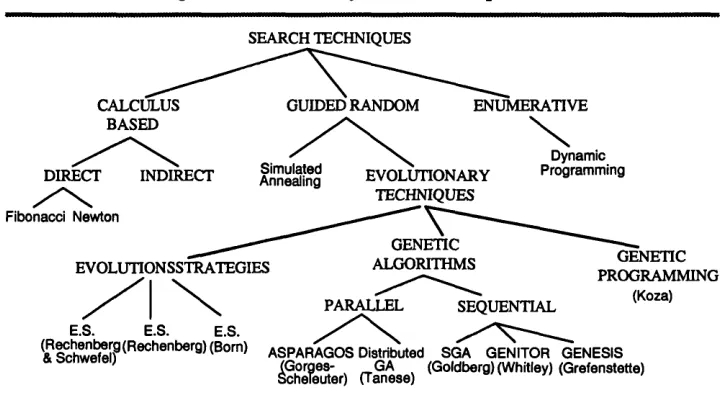
Search techniques, in general, can be grouped into three broad classes [36] (as illustrated
in Figure 2.1): Calculus-based, Enumerative and Guided Random search.
Calculus-based techniques use a set of necessary and sufficient conditions to be satisfied by the optimal solutions of an optimisation problem. These techniques sub-divide into indirect and direct
methods. Indirect methods look for local extrema by solving the usually non-linear set of
equations resulting from setting the gradient of the objective function equal to zero. The search
for possible solutions (function peaks) starts by restricting the search to points with zero slope in
Chapter 2 Genetic Algorithms Revisited 27
instance, seeks extrema by “hopping” around the search space and assessing the gradient of the
new point, which guides the direction of the search. This is simply the notion of Hill-Climbing,
which finds the best local point by “climbing” the steepest permissible gradient. However, these
techniques can only be employed on a restricted set of “well behaved” problems.
Figure 2.1 - Classes o f search techniques SEARCH TECHNIQUES
CALCULUS BASED
GUIDED RANDOM ENUMERATIVE
DIRECT
Fibonacci Newton
INDIRECT AnnealingSimulated EVOLUTIONARY TECHNIQUES
Dynamic Programming
GENETIC ALGORITHMS EVOLUnONSSTRATEGIES
PARALLEL SEQUENTIAL
GENETIC PROGRAMMING
(Koza)
E.S. E.S. E.S. ^ ^ _______ & ASPARAGOS Distributed SGA GENITOR GENESIS
(Gorges- GA (Goldt>erg) (Whitley) (Grefenstette) Schefeuter) (Tanese)
Enumerative techniques search every point related to an objective function's domain space (finite or discrete), one point at a time. They are very simple to implement but may require significant
com putation. The dom ain space o f many applications is too large to search using these
techniques. Dynamic programming is a good example of an enumerative technique.
Guided Random search techniques are based on enumerative techniques, but use additional information to guide the search. They are quite general on their scope, being able to solve very
com plex problem s. Tw o m ajor sub-classes are: Sim ulated A nnealing and E volutionary
T e c h n iq u e s, alth o u g h b o th are ev o lu tio n ary p ro cesses. S im u late d an n ea lin g uses a
thermodynamic evolution process to search minimum energy states. Evolutionary techniques, on
the other hand, are based on natural selection principles. This form of search evolves throughout
generations, improving the features of potential solutions by means o f biologically inspired
operations. These techniques sub-divide, in turn, into Evolutionsstrategie, Genetic Algorithms and
Genetic Programming. Evolutionsstrategie was proposed by Rechenberg [71] and Schwefel [82]
in the seventies. They present the ability to adapt the process of “artificial evolution” to the
requirements of the local response surface. This means that ESs are able to adapt their major
strategy parameters according to the local topology of the objective function [46] - this is very
different from traditional G As. Genetic programming, invented by John Koza, is based on the
genetic algorithms model but evolves more complex structures: computer programs. It is the
published in 1992) and has already attracted a vast number of interested researchers, due to the
ability of the technique to represent and manipulate complex abstract data structures.
2.3. Genetic Algorithms
A genetic algorithm emulates biological evolutionary theories to solve optimisation
problems. A genetic algorithm comprises a set of data elements - the population - and a set of biologically inspired operators defined over the population itself. According to evolutionary
theories, only the most suited elements in a population are likely to survive and produce offspring,
thus transmitting their biological heredity to new generations.
In computing terms, a genetic algorithm maps a problem onto a set of (binary) strings,
each string representing a potential solution. The GA then manipulates the most promising strings
searching for improved solutions. A GA operates typically through a simple cycle of four stages:
i) creation of a “population” of strings, ii) evaluation of each string,
iii) selection of “best” strings, and
iv) genetic manipulation, to create the new population of strings.
Figure 2.2 shows these four stages using the biologically inspired GA terminology. In
each cycle a new generation of possible solutions for a given problem is produced. At the first stage, an initial population of potential solutions is created as a starting point for the search process. Each element o f the population is encoded^ into a string (the chromosome), to be manipulated by the genetic operators. In the next stage, the performance {or fitnesi) o f each individual of the population is evaluated, with respect to the constraints imposed by the problem. Based on the fitness of each population member, a selection mechanism chooses “mates” for the
genetic manipulation process. The selection policy is ultimately responsible for assuring survival of the best fitted individuals. The combined evaluation/selection process is called reproduction.
The manipulation process employs genetic operators to produce a new population of
individuals (offspring) by manipulating the “genetic information”, referred to as genes, possessed by members (parents) of the current population. It comprises two operations, namely crossover and mutation. Crossover is responsible for recombining the genetic material of a population. The selection process associated with recombination assures that genetic structures, called “building
blocks”, are retained for future generations. The building blocks then represent the most fitted
genetic structures in a population. Nevertheless, the recombination process alone cannot avoid the
loss of promising building blocks in the presence of other genetic structures, which could lead to
Chapter 2 Genetic Algorithms Revisited 29
local minima. Also, it is not capable to explore search space sections not represented in the
population’s genetic structures. The mutation operator then comes into action. It introduces new genetic structures into the population by randomly modifying some of its building blocks. It helps
the search algorithm to escape from local minima’s traps. Since the modification introduced by
the mutation operator is not related to any previous genetic structure of the population, it allows
the creation of different structures representing other sections of the search space.
Figure 2.2 - The GA cycle
POPULATION
(chromosomes)
Decoded strinos
New Generation
Parents
G E N ETIC
O P E R A T O R S EVALUATION
(fitness)
Manipulation Reproduction
N/lotes SELECTION
(mating pool)
The crossover operator takes two chromosomes and swaps part of their genetic
information to produce new chromosomes. This operation is analogous to sexual reproduction in
nature. After the crossover point has been randomly chosen, the portions of the parent strings PI and P2 are swapped to produce the new offspring strings 01 and 0 2 . Figure 2.3 shows the crossover operator being applied to the fifth and sixth elements of the string.
Figure 2.3 - Crossover
PI P2
CI^G^CDGI)|CXXD
Parents crossover point crossover pointOrrspHng
01 02
Mutation is implemented by occasionally altering a random bit in a string. Figure 2.4
presents the mutation operator being applied to the fourth element of the string.
Figure 2.4 - Mutation
O O O C D O O
iA number of different genetic operators have been introduced since this basic model was
proposed by Holland. They are, in general, versions of the recombination and genetic alteration
processes adapted to the requirem ents o f particular problem s. Exam ples o f other genetic
operators are: inversion, dominance, genetic edge recombination, etc.
The offspring produced by the genetic m anipulation process constitute the next
po pulation to be evalu ated. G enetic algorithm s can eith er replace a w hole po pulation
(generational approach) or only the less-fit members (steady-state approach). The creation-evaluation-selection-manipulation cycle is repeated until an ending criterion is reached. A typical GA may include one or a combination of the following ending criteria: maximum number of
generations, maximum elapsed simulation time and convergence rate.
Following Holland’s traditional GA, many variations of the basic algorithm have been
introduced. However, an important and distinctive feature of all G As is the population handling
technique[36]. The traditional GA adopted a generational replacement policy where the whole
population is replaced in each generation. Conversely, the steady-state policy used by many
subsequent G As employ a selective replacement for the population. It is possible, for example, to
keep one or more individuals within the population for several generations, while they sustain a
better fimess than the rest of the population.
This description of the GA computational model reviews the steps needed to design a
genetic algorithm. Real im plem entations however, have to consider a number of problem-
dependent characteristics. Problem representation, for instance, is one of the most important
factors that determines the success or failure of applying genetic algorithms. A well-defined
evaluation function is equally important, since the decision process that selects the population
members that will survive is entirely based on the results provided by this function. Other aspects
of significance relate to various mechanisms employed to avoid premature convergence and to
assess the overall performance of an algorithm. The following sections briefly discuss some of
these factors, starting with the various representation and coding methods currently used in many
genetic algorithms.
2.3.1. Representation and Coding
Problem representation is one of the key factors for the success of a genetic algorithm. A
great deal of study has been conducted in this area, but the issue is still a matter of controversy in
the GA community. There are two main groups: those who defend Holland’s original binary
representation and those who argue that a GA should use the most appropriate representation
according to the problem’s characteristics and requirements. The latter approach accommodates
Chapter 2____________________ Genetic Algorithms Revisited___________________________ 31^
use of G As to tackle increasingly complex problems. This section presents both approaches to
stress the importance of supporting them in a general-purpose programming environment.
Binary representation, as originally proposed by Holland, uses the low est possible cardinality. Holland demonstrated, through the Schema theorem (see Figure 2.5), that fixed-
length strings of low cardinality alphabets provide an effective means to search a solution space.
Since genetic algorithms work essentially by promoting recombinations of genetic material, the
binary representation provides the largest possible number of building blocks, or schemata (per population member), to be recombined. The most common encoding method maps the original
representation of a problem variable - say an integer - into its binary value. This encoding
method, however, is very sensitive to the mutation operator since the effects of this operator are
very distinct, depending on the position of the bit being modified. An alteration in a high-order bit
produces large variations on the original value, whereas modifications in low-order bits produce
only slight variations. This tends to be a problem in the later stages of a simulation, when the
population of solutions is closer to the best value. Many researchers adopted Gray encoding
methods to overcome this problem. Gray encoding has the property that the binary coding of
adjacent values, in the original representation, differs in only one bit. For instance the Gray
representation for 7 is 0100 while 8 is coded as 1100. Some researchers [85] adopted this method
as standard in their G As, after performance improvements on the five De Jong [25] test suites
were reported in the literature. Goldberg, however, states that Gray encoding may reduce the
degree of implicit parallelism as demonstrated by the Schema theorem for the standard binary
encoding. Other forms of encoding have also been proposed including adaptive techniques, such
as dynamic parameter encoding (DPE) by Schraudolph and Belew [84], which addresses the
problem of representing floating-point numbers in a fixed length string, without loosing precision.
Binary strings have been shown to be capable of usefully encoding a wide variety of
information. The properties of binary representations for genetic algorithms have been extensively
studied, and a good deal is known about the genetic operators and parameters that work well with
them [23].
Real Value representation, on the other hand, emerged from the increasingly complex p ro b le m s b e in g a d d re s s e d by G A s. It is also th e s ta n d a rd re p r e s e n ta tio n used by
Evolutionsstrategie-based algorithms, and is the only means to effectively represent genetic
programming problems. GAs are extremely sensitive to different mappings, which added to the
overhead imposed by the string encoding and decoding process, may prevent their use on a large
number of real-world optimisation problems. Many industrial problems, for instance, already
using traditional techniques, have a well-defined representation and evaluation function. In most
cases, these functions would impose constraints on other representations, severely compromising
Figure 2.5 - The Schema Theorem
Holland introduced the notion of a schema as a collection of genomes that share certain gene values, or alleles. For instance, the schema 1**0* represents the set of chromosomes with a 1 at the first locus and a 0 at the fourth locus. A schema group, or schemata, provides a way of describing underlying similarities between successful strings. Since each schema is likely to be represented by many strings in the population, it is possible to work out an average score for each. Such explicit calculation is, nevertheless, unnecessary as the process is automatically handled by the selection o f whole strings. The net result of the selection process is the increase of the number of strings containing good schemata in the population. Therefore, the number of
copies of a schema in the next generation N g (^g + \) can be expressed in terms of its current number of copies its fitness the average fitness of the whole population / , and the
probability that the schema survives the genetic operators p { S ). It is given by the following expression:
Ns<g + l ) > N s ( g ) ^ p { S )
Before expanding p ( S ) into terms that express the influence o f the m utation and crossover operators, it is necessary to define the order ( ) of a schema and its defining length (d ^ ). The order of a schema is given by the number of bits that are not represented by the ‘*’ symbol. The defining length gives the distance between two extreme bits that define the schema - note that ‘*’ is not allowed at the extremes. Therefore, the schema 0**01 *1 has =4 and d^ =6.
A schema with defining length d^ would be destroyed by the crossover operator (assuming uniform distribution for choosing any point along the string length I) if the crossover point falls between the two extremes of the schema. Hence, the probability to survive crossover is given by:
P
‘
0-0
Where:
p^ = probabihty of applying the crossover operator
d^ = schema defining length
(/ — l ) = possible positions for a crossover site
If p ^ is the probability of applying the mutation operator, then the probability that a schema of order survives mutation (for the typical low values of p ^ ) is:
The Schema Theorem can then be finally re-written as follows:
Chapter 2____________________ Genetic Algorithms Revisited___________________________ 33
Other problems, specially those using genetic programming, cannot be easily represented
with flat, fixed-length, strings. In general, more complex representations are required involving
m ixed types of data (integers, floating-point, and even binary). Representations used in GP
problems, for instance, invariably assume a tree configuration, which has its width and depth
modified during simulation, expanding and shrinking many times. Therefore, Radcliffe [69] and
others consider that “if there is no benefit to be gained from changing to a special genetic representation, it would seem perverse to do so”.
From the theoretical point o f view , A ntonisse [2], R adcliffe [68] and V ose [97],
dem on strated that extensions o f the Schem a theorem can also be applied to real value
representation. Their arguments are based on the fact that GAs’ search is guided by the quality of
the information it collects about the space (through observed schema fitness averages in the
population). They have contributed to the demolition of strong beliefs that only low cardinality
(binary) representations offer intrinsic parallelism.
One of the major disadvantages of real value representations is the necessity to define
representation dependent genetic operators. This, however, does not seem to be considered a
problem by most of the people using this method, since the majority of problems already require
genetic operators specially designed to cope with their complexities.
The conclusion o f the above discussion is that a general-purpose program m ing
environment must support, at least, binary and some real value representations to satisfy the
requirements of diverse problems, using any of the three major evolutionary techniques. It would
be even m ore interesting, how ever, if the genetic m anipulations could take place over a
representation-independent data structure. This would allow the user to choose freely the most
suitable representation for a problem, and implement problem-independent genetic algorithms and
operators.
2.3.2. Genetic Operators
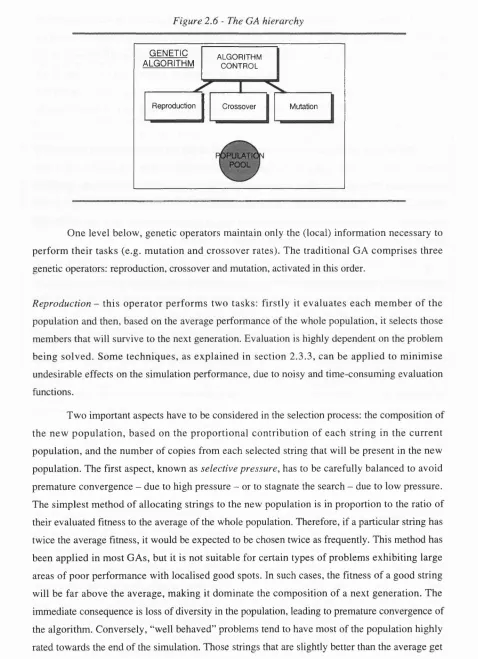
A genetic algorithm has a hierarchical structure where the algorithm (the control level)
determines the order and the sequence in which genetic operators are activated. It is also at the
algorithm level that the decision to terminate the GA loop is taken. Parallel genetic algorithms add
one extra level above the algorithm control level, which is responsible for starting several GAs
and collecting intermediate and final results. Figure 2.6 shows a block diagram of the traditional
GA. The algorithm level maintains global data - the population pool, population size, etc. - and
local data such as ending criteria (max. number o f generations, convergence rate and maximum
Figure 2.6 - The GA hierarchy
GENETIC ALGORITHM
A LG O RITHM C O N T R O L
Reproduction Crossover Mutation
One level below, genetic operators maintain only the (local) information necessary to
perform their tasks (e.g. mutation and crossover rates). The traditional GA comprises three
genetic operators: reproduction, crossover and mutation, activated in this order.
Reproduction - this operator performs two tasks: firstly it evaluates each member of the population and then, based on the average performance of the whole population, it selects those
members that will survive to the next generation. Evaluation is highly dependent on the problem
being solved. Some techniques, as explained in section 2.3.3, can be applied to minimise
undesirable effects on the simulation performance, due to noisy and time-consuming evaluation
functions.
Two important aspects have to be considered in the selection process: the composition of
the new population, based on the proportional contribution of each string in the current
population, and the number of copies from each selected string that will be present in the new
population. The first aspect, known as selective pressure, has to be carefully balanced to avoid premature convergence - due to high pressure - or to stagnate the search - due to low pressure.
The simplest method of allocating strings to the new population is in proportion to the ratio of
their evaluated fitness to the average of the whole population. Therefore, if a particular string has
twice the average fitness, it would be expected to be chosen twice as frequently. This method has
been applied in most GAs, but it is not suitable for certain types of problems exhibiting large
areas of poor performance with localised good spots. In such cases, the fitness of a good string
will be far above the average, making it dominate the composition of a next generation. The
immediate consequence is loss of diversity in the population, leading to premature convergence of
the algorithm. Conversely, “well behaved’’ problems tend to have most of the population highly
rated towards the end of the simulation. Those strings that are slightly better than the average get
Chapter 2____________________ Genetic Algorithms Revisited___________________________ 35
Several methods have been reported in the literature that help to avoid both situations
[8,24,36]; the most common being “fitness scaling”. This method ensures a constant fitness ratio,
typically about 2, between the best and the worst strings, thus preventing exceptionally good
strings from dominating the next generations. Adaptive methods have also been reported to
improve the quahty of the results. By dynamically changing the behavior of the selection process
according to the best, worst and average fitness, the algorithm adapts itself to different situations
presented by the search space.
The second aspect of reproduction entails determining the number of copies of selected
strings to be present in the new population. For a GA with fixed population size N, the reproduction operator dictates that future generations must contain the same number o f strings,
produced by copying (one or more times) selected members of a previous generation. The
simplest method, the “roulette-wheel”, samples the population N times, with the probability of any member being chosen equal to its relative fitness (whether scaled or not). Therefore, the
higher the relative fitness of a string, the bigger the probability of having more copies in the next
generation.
It is important to note that the reproduction operator works essentially on the phenotype
level, that is, it is not affected by the genetic representation of the problem. Other operators, such
as crossover and m utation, act only on the genotype level. This may lead to a prem ature
conclusion that these two operators are representation dependent. The objective of this discussion
is to assess the possibihty of defining a suitable abstraction for representing a variety of problems
(using either binary or real value) that could permit representation-independent implementations
of genetic operators.
Crossover - is considered the most important GA operator. In fact, crossover is unique to GAs (Evolutionsstrategie evolves populations only by the means of mutation). Crossover is responsible
for promoting useful recombinations of the genetic information that accelerate the search process.
It mimics sexual reproduction in which segments of two different strings (the parents) are
recom bined to form two other strings (the offspring). The standard one-point crossover, as
defined by Holland, chooses a random point (based on a normal distribution) between the two
extremes of the string. Several variations of this operator have been introduced, the most common
used being the two or n-point crossover, generally applied over a circular string [32].
In general, problems using real value representations are very complex, exhibiting
several param eters to be simultaneously optimised. The crossover operators used in these
problems work by swapping one or more parameters between two “strings” - the term individual,
as a referen c e to a m em ber o f the p o p u latio n , seem s m ore ap p ro p ria te fo r real value
A careful observation o f the ways the crossover operator acts over binary and real
value representations, suggests a common mechanism for its implementation, independently of the
problem representation. Instead o f storing the data in the data structure that represents a
population member (or string), one can store only references (or pointers) to the actual data.
Crossover can then be implemented as a simple swap of pointers; irrespective of the contents of
the in form atio n b ein g sw apped. T his is an im portant step tow ards the d efin itio n o f a
representation-independent abstraction for programming GAs, ESs and GPs.
Mutation - introduces “unexpected” variations in the population in order to increase its diversity. Without mutation a GA would be constrained to explore only regions of the search space present
in the schemata of the first (or initial) generation. If, by chance, the schema of the best solution is
not present in the initial population, it would not be possible to find that solution without
mutation.
The standard mutation operator works by simply flipping the value of a bit in the binary
string. Unlike crossover, which is generally applied at high rates (0.6 to 0.8) to maximise
recombination, mutation rates are typically very low (0.005 or less). High mutation rates can be
very detrimental, preventing algorithm convergence. This is especially important in the final
stages of a simulation, when the population is converging towards the best solution and large
genotype variations are undesirable. Some GAs employ adaptive mutation with relatively high
rates in the early stages of the simulation, and very low rates towards the end. This approach
increases the chance of exploring different areas of the search space in the beginning, when the
population needs diversity, without compromising algorithm’s convergence.
M utation operators used in problems with real value representation assume the most
varied implementations. Some implementations employ “creeping” techniques, introducing small
variations around the current value of the parameter being mutated. Others may produce large
variations by replacing the current value by an entirely new one, randomly chosen (generally
within certain constraints). D epending on the problem complexity, mutation may even be
implemented over a data base of possible values that each parameter is allowed to assume.
The conclusion then is that the choice of mutation operator is extremely dependent on a
problem’s representation, characteristics and requirements. Nevertheless, since it acts over the
genotype, it seems possible to embed the modification information (e.g. mutation rules and
param eters) into the representation data structure. This approach is also consistent with
Holland’s discussion about the mutation operator [47], permitting each member of the population