http://www.sciencepublishinggroup.com/j/jdmp doi: 10.11648/j.jdmp.20190506.12
ISSN: 2469-8202 (Print); ISSN: 2469-8210 (Online)
Study on the Optimization of Extraction Technology of
Anemonin from
Pulsatilla chinensis
and Its Inhibitory Effect
on
Alternaria panax
Xue Fang
†, Jinlei Liu
†, Lirui Yang, Xiangguo Li
*Agronomy Department Agricultural College of Yanbian University, Yanji, China
Email address:
*
Corresponding author †
Xue Fang and Jinlei Liu are co-first authors.
To cite this article:
Xue Fang, Jinlei Liu, Lirui Yang, Xiangguo Li. Study on the Optimization of Extraction Technology of Anemonin from Pulsatilla chinensis
and Its Inhibitory Effect on Alternaria panax. Journal of Diseases and Medicinal Plants. Vol. 5, No. 6, 2019, pp. 94-102. doi: 10.11648/j.jdmp.20190506.12
Received: October 21, 2019; Accepted: November 14, 2019; Published: November 21, 2019
Abstract:
Background: The main antibacterial component of Pulsatilla chinensis is anemonin, which has strong antibacterial effect, so it is studied. The Pulsatilla chinensis is one of the diseases that are difficult to solve in the growth of ginseng, but chemical control not only causes harm to the environment, but also has residues on ginseng itself. Pulsatilla is a good medicinal plant. It will have a certain effect on the prevention and treatment of ginseng disease, and it can do no residue, no harm to ginseng. Objective: This experiment can provide effective data support for the prevention and treatment of Pulsatilla chinensis. Method: In this experiment, Pulsatilla Chinensis was used as experimental materials to extract plant by reflux, ultrasonic extraction methods, the content of anemonin in each single factor experiment was determined by HPLC. According to the content, the response surface analysis method was used to find the best extraction process, and the mycelium growth rate method was further used to determine the antifungal effect of Alternaria panax. Results: The EC50 value of P. Chinensis extract to A. panax wasmethanol extract < acetone extract < ethanol extract in order from small to large; The optimum extraction conditions of anemonin, the effective component of P. Chinensis methanol extract, were as follows: methanol volume fraction 87%, extraction time 2 h, solid-liquid ratio 20 (V: m), the optimum extraction amount was 3.760 µg·g-1.
Keywords:
High Performance Liquid Chromatography, Response Surface Analysis, Anemonin, Alternaria panax1. Introduction
Pulsatilla chinensis (Bunge) Regel, ranunculaceae perennial herbs have the effect of clearing heat, detoxifying, cooling blood and stopping dysentery. Recent studies have shown that fresh juice, Decoction and ethanol extract of Pulsatilla chinensis have obvious antimicrobial effects [1]. Studies on pharmacology and pharmacochemistry of modern Chinese medicine have found that Pulsatilla chinensis mainly contains Ranunculin and its decomposition products, triterpenoid saponins, etc [2-3]. In which, under the action of enzymatic hydrolysis, Ranunculin is decomposed into proto-Pulsatillarin, which is rapidly polymerized into dimer Pulsatillarin in air; at the same time, the main antimicrobial components of Pulsatilla chinensis are protoanemonin and
anemonin [4-6], which have strong antimicrobial activity [7]. It is mainly manifested in the control of various bacteria [9-11] such as corn leaf spot pathogen [8], Staphylococcus aureus, etc.
Some scholars have used Ranunculus [12], Huihui garlic [13], huohuocao [14], Maozhaocao [15], Clematis northeast [16] as raw materials to extract and study anemone. However, there are few studies on extracting anemonin from plant Pulsatilla chinensis.
and utilization of Pulsatilla chinensis crude powder.
2. Materials and Methods
2.1. Test Material
Strain tested: Alternaria panax Whetz provided by the Department of Crop Cultivation and Farming, College of Agriculture, Yanbian University.
Pulsatilla chinensis powder: Purchased in Shaanxi Senfu Natural Products Co., Ltd.
Test medium: Potato glucose agar medium (PDA), Beijing Luqiao Technology Co., Ltd.
2.2. Testing Instruments and Drugs
Test instrument: Hitachi high performance liquid
chromatograph; chromatographic column: HITACHI
LaChrom C18 (250 mm×4.6 mm, 5 µm); Ultrasonic cleaning
machine; RE-2000B Rotary evaporator, DLSB-5/20 Low temperature cooling circulating pump; OSB-2100 Constant temperature water bath; Constant temperature light incubator. Test drugs: Petroleum ether, methanol, chloroform, ethyl acetate, acetone, n-butanol, anhydrous ethanol (all analytical pure), glucose (Tianjin comio Chemical Reagent Co., Ltd.); resveratrol standard (Keli technology development company of Guangzhou analysis and test center); methanol (Chromatographic grade) (SEMER Fisher Technology (China) Co., Ltd.).
2.3. Test Method
2.3.1. Preparation of the Mother Liquor of Pulsatilla Chinensis Extract
Weighing 5.00 g pulsatilla chinensis powder crude powder into 150 mL conical bottle, adding 50 mL methanol, acetone and ethanol to extract three times under the action of ultrasound, then filtering to get the filtrate. The filtrate is then concentrated and evaporated in a rotary evaporator at about 50 C in vacuum to obtain viscous liquid. The obtained viscous liquid was fully mixed with methanol, acetone and ethanol, and the extract was obtained after dissolution. Preservation of the extract in low temperature and dark.
2.3.2. Optimization of the Extraction Method of the Effective Components in the Extract of Pulsatilla Chinensis Extract
Conditions for high performance liquid chromatography of anemonin:
Chromatographic column: HITACHI LaChrom C18 (250
mm×4.6 mm, 5 µm); The mobile phase is methanol: water (25:75 volume fraction); ultraviolet detector, The detection wavelength was 220 nm, the flow rate was 0.8 mL/min, the column temperature was 34 C, and the injection volume was 10 mL.
Preparation of sample solution:
The extracts under different single factor extraction conditions were used as the original solution of the test sample, and then 0.5 mL of the original solution of the test sample was precisely measured in a 10 mL volume bottle, diluted and
volumed with methanol, which was used as the test solution of the test sample. The sample was filtered with 0.22 um filter before injection.
Preparation of reference solution:
Accurately weigh 1.8 mg of Anemonin reference substance and place it in a 100 mL capacity bottle. Dilute it with methanol and fix the volume. Prepare the original solution containing 18 UG of Anemonin per mL for reserve. The reference solution was diluted and volumed with methanol in a 10 mL volumetric bottle. Filtration with 0.22 um membrane before injection.
Investigation of linear relations:
Under this chromatographic condition, 10 L of each reference solution was precisely absorbed and injected into the liquid chromatography to determine the peak area. Drawing standard curve with mass concentration as abscissa X and peak area as ordinate Y.
Precision test:
Under this chromatographic condition, the same reference solution was weighed and sampled three times with a sample volume of 10 UL each time. RSD of the peak area of Anemonin was determined and calculated.
Repeatability test:
Under this chromatographic condition, the same sample solution was sampled for five repetitive tests, each sample volume was 10 L, the peak area was determined, and the content of Anemonin in the sample and the relative standard deviation (RSD) were calculated.
Single factor test:
(1) Effect of solvent on the extraction amount of anemonin Weigh 5.00g of the crude powder of pulsatilla chinensis, add 50ml of petroleum ether, methanol, ethyl acetate, acetone, n-butanol, ethanol (the ratio of material to liquid is 1:10) respectively, and extract it by ultrasonic for 30min. According to the preparation method of the test solution in 2.3.2, treat the extract, prepare the test solution, inject the sample according to the chromatographic conditions, and record the peak area.
(2) Effect of methanol volume fraction on the extraction amount of anemonin
Weigh 5.00g of the crude powder of pulsatilla chinensis, add 50ml of methanol with different volume fractions: 50%, 60%, 70%, 80%, 90%, and extract it by ultrasonic for 30min. According to the preparation method of the test solution in 2.3.2, treat the extract, prepare the test solution, inject the sample according to the chromatographic conditions, and record the peak area.
(3) Effect of extraction times on the extraction amount of anemonin
Weigh 5.00g of the crude powder of pulsatilla chinensis, add 80% methanol, and extract it once, twice and three times respectively by ultrasonic. According to the preparation method of the test solution in 2.3.2, treat the extract, prepare the test solution, inject the sample according to the chromatographic conditions, and record the peak area.
(4) Effect of material liquid ratio on the extraction amount of anemonin
5.00 g, and the ratio of feed to liquid was 1:5, 1:10, 1:15, 1:20 and 1:25. 80% methanol was added to the powder, respectively. The ultrasonic extraction time was 30 minutes. According to the preparation method of the test solution in 2.3.2, treat the extract, prepare the test solution, inject the sample according to the chromatographic conditions, and record the peak area.
(5) Effect of time on the extraction amount of anemonin Weigh 5.00 g of the crude powder of pulsatilla chinensis, add 50 ml of 80% methanol, and extract 0.25 h, 0.5 h, 1 h, 1.5 h and 2 h respectively under the condition of 60°C. According to the preparation method of the test solution in 2.3.2, treat the extract, prepare the test solution, inject the sample according to the chromatographic conditions, and record the peak area.
2.3.3. Inhibition of the Extract of Pulsatilla Chinensis on the Mycelial Growth of the Black Spot of Ginseng The mycelial growth rate method was used to determine the
bacteriostatic effect of different extracts on Ginseng black spot pathogen. After compounding each extract with different concentration, the potato agar-glucose medium sterilized by high temperature and high pressure was added into the super-clean workbench, and the extracts were added into the plate with the concentration of 2.08, 4.17, 8.33, 16.67, 33.33, 66.67 and 133.33µg·mL-1 respectively, three times per treatment. Repeat. The cake was made on the edge of the colony with a sterile perforator with an inner diameter of 7 mm and placed in the center of the plate containing the extract. The cake was cultured in a constant temperature incubator at 25°C without the extract as a control. After 6 days of culture, the colony diameter was measured, and the inhibition rate of mycelium growth was calculated according to the following formula.
Diameter of colony growth = mean diameter for 3 times-7 mm;
Inhibition rate of mycelium growth(%) =(Control colony growth diameter-Treat colony growth diameter)
Control colony growth diameter × 100
Using the logarithm of the treatment concentration as the abscissa, the inhibition growth rate under different concentrations is converted into the probability value as the ordinate to draw the virulence curve, and the linear regression equation, correlation coefficient and the value of inhibition medium concentration (EC50) of single agent are obtained.
2.4. Data Processing
Using Excel and SPSS statistical software to deal with variance, multiple comparison, standard curve drawing, etc.
3. Results and Analysis
3.1. Optimized Extraction Method of Effective Components from Pulsatilla Chinensis Extract Chinensis
3.1.1. Linear Relationship of Standard Curve
The regression equation of the standard concentration of anemonin to the peak area was y=57262x-99.234 (r = 0.9999, n = 5). Meet the requirements of analysis.
3.1.2. Precision Test
Take 18 µg·mL-1 standard mother liquor of anemonin and inject it for 5 times continuously. The average peak area of anemonin is 788435, and its RSD is 0.05%, less than 2%. It shows that the precision is good and meets the requirements of analysis.
3.1.3. Repeatability Test
Weigh accurately the crude powder of Pulsatilla chinensis, prepare the sample solution according to the single factor test of Pulsatilla chinensis, and determine it under the chromatographic conditions of 2.3.2, meeting the
requirements of analysis. See Table 1 for the results.
Table 1. The content of anemonin under different treatments.
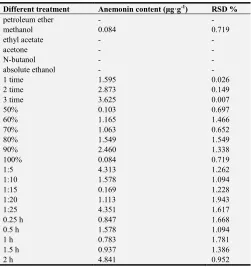
Different treatment Anemonin content (µg·g-1) RSD %
petroleum ether - -
methanol 0.084 0.719
ethyl acetate - -
acetone - -
N-butanol - -
absolute ethanol - -
1 time 1.595 0.026
2 time 2.873 0.149
3 time 3.625 0.007
50% 0.103 0.697
60% 1.165 1.466
70% 1.063 0.652
80% 1.549 1.549
90% 2.460 1.338
100% 0.084 0.719
1:5 4.313 1.262
1:10 1.578 1.094
1:15 0.169 1.228
1:20 1.113 1.943
1:25 4.351 1.617
0.25 h 0.847 1.668
0.5 h 1.578 1.094
1 h 0.783 1.781
1.5 h 0.937 1.386
2 h 4.841 0.952
3.1.4. Single Factor Test Results
In fact, the extraction amount of anemonin is affected by extraction temperature, extraction time, material liquid ratio, ethanol volume fraction and solvent. In order to determine the best extraction conditions, the following single factor experiment was designed, with extraction amount of anemonin as the final evaluation index, and multiple comparisons were carried out. The results are as follows
extraction amount of anemonin, and methanol is the largest, 0.084 µg·g-1. Through the analysis of variance of the average value of 5 times of extraction amount of anemonin, the results
showed that under the significant level of 0.05, P<0.05, different solvents had significant differences in the extraction amount of anemonin.
Figure 1. The extraction amount of anemonin under different solvents.
(2) Effect of methanol volume fraction on the extraction amount of anemonin
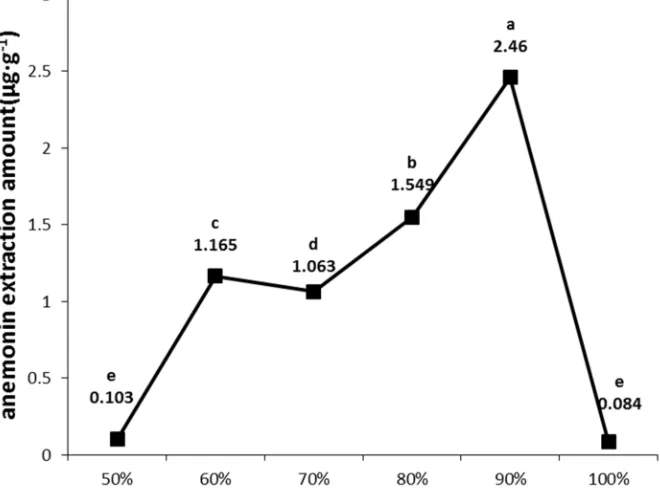
It can be seen from Figure 2 that when the volume fraction of methanol is 90%, the extraction amount of anemonin in the crude powder of pulsatilla chinensis (content of anemonin per gram of pulsatilla chinensis) is the highest, which is 2.460 µg·g-1, followed by the volume fraction of 80%, and the extraction
amount of anemonin is 1.549 µg·g-1. At the same time, the influence of different volume fractions on the extraction amount of anemonin is also different. Through the analysis of variance of the average value of 5 times of anemonin extraction amount, the results show that at the significant level of 0.05, P value is less than 0.05, and different methanol volume fractions have significant difference on the extraction amount of anemonin.
(3) Effect of extraction time on the extraction amount of anemonin
It can be seen from Figure 3 that the extraction amount of
anemonin is affected by the extraction time. At 2 hours, the extraction amount reaches the maximum value of 4.841 µg·g-1, and there is little difference in other extraction time.
Figure 3. The extraction amount of anemonin under different extraction time.
(4) Effect of the ratio of material to liquid on the extraction amount of anemonin
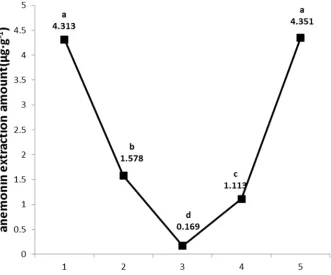
It can be seen from Figure 4 that when the solid-liquid ratio (the ratio of the mass of the crude powder of pulsatilla chinensis to the volume of the extraction solvent) is 1:25 and
1:5, the extraction amount of anemonin is larger, which is 4.351 and 4.313µg·g-1, respectively, and the extraction amount is significantly higher than that the extraction amount of anemonin when the ratio of material to liquid is 1:10, 1:15 and 1:20.
(Note: 1-5 means that the solid-liquid ratio is 1:5, 1:10, 1:15, 1:20 and 1:25 respectively.)
(5) Effect of extraction times on the extraction amount of anemonin
It can be seen from Figure 5 that the extraction amount of
anemonin increases with the increase of extraction times, among which the extraction amount of anemonin for three times is the most, which is 3.625 µg·g-1.
Figure 5. The extraction amount of anemonin under different extraction times.
3.1.5. Optimization of the Extraction Amount of Anemonin by Response Surface Experiments
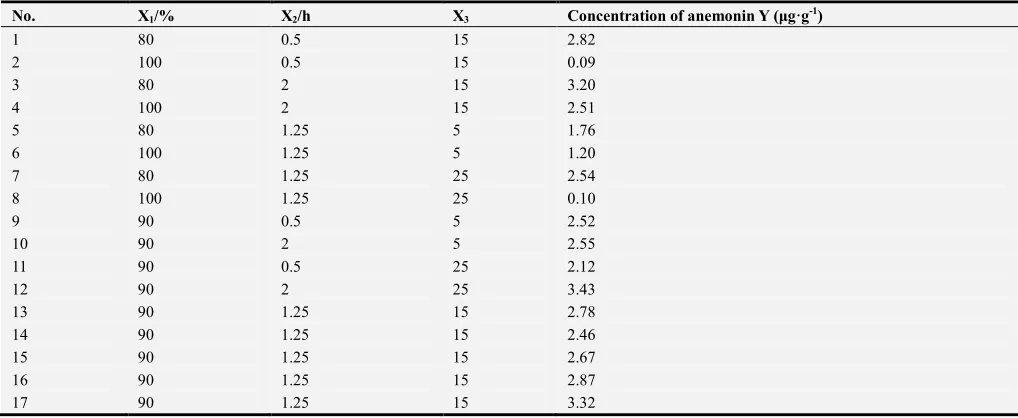
Through the regression analysis of Design-expert software, the quadratic multiple regression equation of the extraction amount of anemonin to the coded independent variable methanol volume fraction X1, extraction time X2 and material liquid ratio
X3 is:
Y=2.82-0.X1+0.52X2+0.02X3+0.51X1X2-0.47X1X3+0.32X2X3-0.96X12+0.29X22-0.46X32
Table 2. Results of response surface experiments.
No. X1/% X2/h X3 Concentration of anemonin Y (µg·g-1)
1 80 0.5 15 2.82
2 100 0.5 15 0.09
3 80 2 15 3.20
4 100 2 15 2.51
5 80 1.25 5 1.76
6 100 1.25 5 1.20
7 80 1.25 25 2.54
8 100 1.25 25 0.10
9 90 0.5 5 2.52
10 90 2 5 2.55
11 90 0.5 25 2.12
12 90 2 25 3.43
13 90 1.25 15 2.78
14 90 1.25 15 2.46
15 90 1.25 15 2.67
16 90 1.25 15 2.87
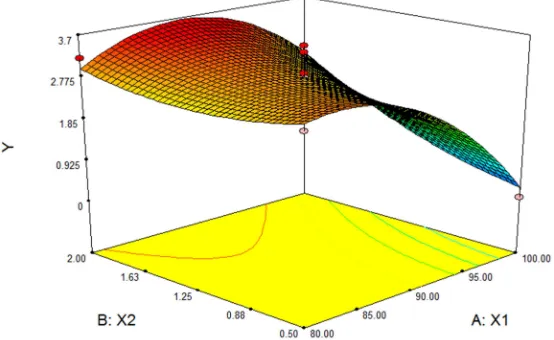
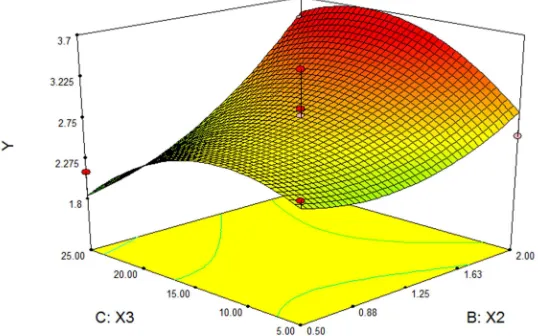
The regression analysis results are shown in Table 3, and the response surface map and isoline are made, as shown in Figures 6-8. It can be seen from table 3 that according to the software analysis, the regression equation is significant (P< 0.01), and the correlation coefficient R2=0.9502, indicating
that the method is reliable and can better describe the test results. The equation can be used to replace the real test points for analysis, and predict the extraction amount of anemonin under different extraction conditions.
Table 3. Regression analysis results.
Source Sum of squares df Mean square F value p-value
X1 5.160 1 5.160 46.510 < 0.010
X2 2.150 1 2.150 19.350 < 0.010
X3 0.003 1 0.003 0.029 0.870
X1X2 1.040 1 1.040 9.410 0.018
X1X3 0.880 1 0.880 7.970 0.026
X2X3 0.410 1 0.410 3.690 0.096
X1X1 3.880 1 3.880 35.030 < 0.010
X2X2 0.370 1 0.370 3.300 0.112
X3X3 0.890 1 0.890 8.020 0.025
regression 14.820 9 1.650 14.850 < 0.010
residual 0.780 7 0.110
Missing item 0.370 3 0.120 1.210 0.413
Pure error 0.410 4 0.100
Total deviation 15.600 16
The results of variance analysis showed that methanol volume fraction and extraction time had significant effect on the extraction of pulsatin (P < 0.01). The order of factors influencing the extraction amount of anemonin is methanol volume fraction > extraction time > solid-liquid ratio.
Figure 6. Response surface and contour map of Y=f (X1, X2).
Figure 8. Response surface and contour map of Y=f (X2, X3).
According to the regression equation to draw the analysis chart, examine the shape of the fitted response surface, Figures 6-8 intuitively gives the response surface 3D map and isoline map of the interaction of various factors. From the isoline and the highest point of the response surface, it can be seen that the highest point of the response surface in the selected range is the extreme value. From the response surface optimization diagram, it can be seen that the most important factor affecting the extraction amount of anemonin is the methanol volume fraction, followed by the extraction time. Selecting the appropriate methanol volume fraction and time can obtain a higher extraction amount of anemonin.
Based on the partial integration of the bivariate multiple equation, the coding values of X1, X2, X3 are X1=87.24%,
X2=2 h, X3=20 when the maximum response value (y) is
analyzed by Design-expert software. The corresponding extraction conditions were 87% methanol, 2 hours extraction time, 20 (V: m) material liquid ratio and 3.760 µg·g-1
theoretical optimum.
In order to verify the reliability of the above results, the above extraction process was adopted: ultrasonic extraction was carried out for 2 hours with 87% methanol as solvent and 20 (V: m) as the ratio of material to liquid, and the extraction amount of pulsatin measured by parallel test was 3.755 µg·g-1, which was close to the theoretical value, indicating that the model can better reflect the extraction conditions of anemonin.
3.2. Inhibitory Effect of the Extraction Amount of Pulsatilla Chinensis Against a. Panax
See Table 4 for the bacteriostatic test results of different extracts of pulsatilla chinensis by mycelial growth rate method. The EC50 values of the extracts of pulsatilla chinensis to the
pathogen were methanol extract(21.58 µg·mL-1)<acetone extract(28.84 µg·mL-1)<ethanol extract(35.71 µg·mL-1).
Table 4. Inhibitory effect of different extraction of Pulsatilla Chinensis against A. panax.
Test extract Regression equation EC50 value (µg·mL-1) Correlation coefficient (r)
Methanol extract y=2.4402+1.9188x 21.58 0.9153
Acetone extract y=2.5688+1.6652x 28.84 0.9010
Ethanol extract y=3.1510+1.1908x 35.71 0.8231
4. Discussion
According to the related literature, the main antibacterial component of pulsatilla chinensis is anemonin. Therefore, ultrasonic assisted extraction method is used to extract anemonin in this experiment. Single factor analysis and response surface analysis are carried out for the extraction process of solvent, solvent volume fraction, extraction time, material liquid ratio, extraction times, etc. the content is determined by HPLC, and the best extraction process is fitted. Art. This method has the advantages of simplicity and high sensitivity, and through the verification test of the best extraction process, it is found that it is close to the theoretical extraction value, which indicates that the extraction amount can be predicted by response surface analysis, thus proving the stability and rationality of the process, and providing the
theoretical basis for the process conditions of extracting anemonin from pulsatilla chinensis. But in this experiment, only ultrasonic assisted extraction method is used, and other extraction methods are not studied, which needs further study. The methods of inhibition circle and inhibition medium concentration are usually used to judge the bacteriostatic effect on plant pathogens. In this study, the crude powder of pulsatilla chinensis was used as the extraction material. The ultrasonic assisted extraction method and different solvents were used for extraction, and the indoor mycelial growth rate method was used for bacteriostatic study of the pathogen. The results showed that the bacteriostatic effect of different solvent extracts on the pathogen was different, among which the methanol extract of Pulsatilla chinensis had the best bacteriostatic effect, and the EC50 value was 21.58µg·g-1. The
effect, which is consistent with the study on the antibacterial effect of shenxiaohui et al [3] on the extract of pulsatilla chinensis. Due to the limited time, this experiment only carried out the mycelial growth rate test in the laboratory, but failed to carry out the field test. There was a certain difference in the bacteriostatic effect between this experiment and the field, so we should further study the field test.
5. Conclusion
The results showed that the EC50 value of the extract of
pulsatilla chinensis to the pathogen of black spot of ginseng was methanol extract < acetone extract < ethanol extract, and the best extraction condition of pulsatilla chinensis was 87% methanol volume fraction, 2 hours, 20 (V: m), 3.760µg·g-1.
Acknowledgements
This study was supported by a grant from "13th five year plan" scientific research planning project of Jilin Provincial Department of Education (JJKH20180886KJ) and the Jilin Province college students innovation and entrepreneurship training program (No.201910184013).
References
[1] Cao J H, Li Y L, Qiu S C, et al. The in Vitro Growth Inhibition Effect of Pulsatilla chinensis ( Bge.) Regel (PCR) on Bacteria [J]. Lishizhen Medicine and Materia Medica Research, 2003 (9): 528.
[2] Kim H J, Kim H T, Bae C I, et al. Studies on the hypoglycemic con-stituent of Pulsatillae radix (I) [J]. J Pharm Soc Korea, 1997, 41: 709-713.
[3] Mimaki Y, Yokosuka A, Kuroda M, et al. New bisdesmosidic triter-pene saponins from the roots of Pulsatilla chinensis [J]. Nat Prod, 2001, 64 (9): 1226-1229.
[4] Zhang X Q, Liu A R, Xu L X. Determin ation of ranunculin in Pulsatilla chinensis and Synthetic ranunculin by reversed phase HPLC [J]. Acta Pharmaceutica Sinica, 1990, 25 (12): 932-935.
[5] Ye W C, Qu B X, Ji N N, et al. Patensin, a saponin from Pulsatilla patens var. multifida [J]. Phytochemistry, 1995, 39 (4): 937-939.
[6] Ye W C, Ji N N, Zhao S X, et al. Triterpenoids from Pulsatilla chinensis [J]. Phytochemistry, 1996, 42 (3): 799-802.
[7] Wang B X. Modern Chinese Medicine Pharmacology [M]. Tianjin: Tianjin Science and Technology Press, 1999: 752-755. [8] Shen X H, Zhang J T, Jiang C, et al. Inhibitory effects of three extracts of pulsatilla on bipolarismaydis [J]. Crops, 2010 (1): 91-93.
[9] Zheng X F, Zhang J Y, Shao S J, et al. Study on the Bacteriostasis of Pulsatilla on Staphylococcus aureus and Enterobacter aerogenes [J]. Journal of Mudanjiang Normal University, 2011 (2): 29-30.
[10] Shi W J, Lu Z X, Li L S. Experimental study on Bacteriostasis of different extracts and compound compounds of Pulsatilla in vitro [J]. Chinese Journal of Traditional Medical Science and technology, 2006 (3): 166-168.
[11] Yang C W. Study on the extraction of saponins from Pulsatilla and their bacteriostasis in vitro [D]. Mudanjiang Normal College, 2016.
[12] Xiong J B. Content determination of anemonin in Ranunculus japonicas Thunb. by high-performance liquid chromatography: An experimental study [J]. Hunan Journal of Traditional Chinese Medcine, 2019, 35 (5): 152-154.
[13] Ma D S, Zhang H Q, Sha R, et al. Determination of Anemone in garlic after 7 hours of recovery by HPLC [J]. Journal of Ningxia Medical University, 2017, 39 (2): 237-239.
[14] Zeng Y, Hu X M, Zhai J H. Determination of Anemone in the roots of dahongcao in Wudang Mountain by ion pair chromatography [J]. Hubei Journal of TCM SEP, 2014, 36 (9): 65-66.
[15] Peng Y M, Xiao J, Yang Y. HPLC Determination of anemonin and protoanemonin in different parts of Ranunclus ternatus Thunb by HPLC [J]. Journal of Hunan Univ. of CM, 2013, 33 (9): 55-57, 72.