View All Proceedings Next Conference Join NZSAP
This paper is from the New Zealand Society for Animal Production online archive. NZSAP holds a regular
An invitation is extended to all those involved in the field of animal production to apply for membership of the New Zealand Society of Animal Production at our website www.nzsap.org.nz
The New Zealand Society of Animal Production in publishing the conference proceedings is engaged in disseminating information, not rendering professional advice or services. The views expressed herein do not necessarily represent the views of the New Zealand Society of Animal Production and the New Zealand Society of Animal Production expressly disclaims any form of liability with respect to anything done or omitted to be done in reliance upon the contents of these proceedings.
This work is licensed under a Creative Commons Attribution-NonCommercial-NoDerivatives 4.0 International License.
You are free to:
Share— copy and redistribute the material in any medium or format
Under the following terms:
Attribution — You must give appropriate credit, provide a link to the license, and indicate if changes were made. You may do so in any reasonable manner, but not in any way that suggests the licensor endorses you or your use.
NonCommercial — You may not use the material for commercial purposes.
NoDerivatives — If you remix, transform, or build upon the material, you may not distribute the modified material.
Stand-off pad wintering system: effect of surface types on cow comfort and urination behaviour
O Al-Marashdeha*, KC Camerona, RH Bryanta, L Boxa, A Arendsa, A Coveneya, J Chrystalb and GR EdwardsaaFaculty of Agriculture and Life Sciences, Lincoln University, Lincoln 7647, Christchurch, New Zealand; bAgResearch
Lim-ited, Invermay Agricultural Centre, Puddle Alley, Mosgiel, New Zealand
*Corresponding author. Email: [email protected]
Abstract
Two consecutive experiments were conducted over four weeks during winter to investigate the effect of different stand-off pad surface types on dairy cow lying behaviour, cleanness and lameness scores, and urination frequency. In experiment one, 350 Frie-sian × Jersey, pregnant non-lactating dairy cows were blocked and assigned to five treatments for two weeks: fodder beet grazed
in situ with no stand-off (control); fodder beet grazed in situ and cows spent 17 hours on a woodchip stand-off (WCG); harvested fodder beet bulb fed in paddock and cows spent 17 hours on a woodchip stand-off (WCH); fodder beet grazed in situ and cows spent 17 hours on a 70 mm round-stone stand-off (S70); fodder beet grazed in situ and cows spent 17 hours on a 50 mm round-stone stand-off (S50). In experiment two, 156 Friesian × Jersey, pregnant non-lactating dairy cows were blocked and assigned to three treatments for two weeks: control and WCG as described in experiment one, and a third geotextile ‘carpet’ stand-off for 17 hours (GC). In experiment one, surface type had no effect on lying time (average 10.1 hours), cleanness and lameness score, or urination behaviour. In experiment two, lying hours were greater (P=0.01) for cows on carpet (11.6) than for cows on woodchip (10.8). While current results showed a negligible effect of surface type on cow comfort and urination behaviour during winter, a longer study, covering the whole winter season, is required to confirm these results.
Keywords: dairy cows; stand-off pad; lying behaviour; comfort; urination behaviour
Introduction
In southern New Zealand dairy systems, wintering cows off pasture on forage crops grazed in situ is a common practice adopted by farmers (Judson et al. 2010). This is to overcome the shortfalls in pasture growth during winter, in order to provide cows with sufficient energy to regain their body condition score before calving (Edwards et al. 2014). However, the high stocking density at which the crop is grazed during winter, combined with high rainfall and subsequent drainage leads to large nitrate leaching losses (Monaghan et al. 2007; Chrystal et al. 2012). This nitrate leaching, during an eight-week winter period, accounts for 11-24% of annual farm N losses (Chrystal et al. 2012).
Moving dairy cows off the paddock onto a stand-off area is a potential method to mitigate nitrate leaching losses by reducing urination and dung deposition on the soil (De Klein 2001). Cows may stay on stand-off pads continuously, where forage is provided on a separate feeding pad, or graze on the paddock before being shifted to a stand-off area. In comparison with a standard grazing system, Christensen et al. (2012) reported a 36% reduction in total N losses when lactating dairy cows were removed from pasture for 20 hours per day. However, stand-off pad systems, and surface type in particular, can impact animal comfort and welfare. Previous studies reported a reduction in lying time and increases in lameness scores for cows placed on hard or muddy surfaces (Krohn & Munksgaard 1993; Fisher et al. 2003). Limited data is available to help farmers identify which stand-off pad surfaces meet both animal welfare and environmental regulations. Therefore, the objective of this study was to investigate the effect of different stand-off pad surface types, namely woodchips, round-stones and geotextile carpet, on dairy cow lying
behaviour, cleanness and lameness scores, and urination frequency.
Material and methods
Two consecutive experiments were conducted over four weeks at Lincoln University’s Ashley Dene Research and Development Station, located near Burnham, Canterbury (-43.65°N, 172.33°E). Experiment one occurred between 23 July and 7 August 2016, and experiment two between 8 and 22 August 2016. The study was carried out with permission of the Lincoln University Animal Ethics Committee (AEC 2016-17).
Experimental design and management
September±10.9 days) and assigned into three treatments: control and WCG as described in experiment one, and a third geotextile ‘carpet’ stand-off for 17 hours (GC) and fodder beet grazed in situ for 6 hours. To minimise any carry-over effect from experiment one, cows in experiment two were blocked to contain equal proportions of animals from stand-off treatments in experiment one. All cows were monitored daily for gestation status and cows close to calving (i.e. detected by observing udder and teats becoming enlarged due to milk filling them up) were removed from the experiment, resulting in an average number of cows of 59, 54, 51, 54 and 58 cows for control, WCG, WCH, S50 and S70, respectively, during experiment one, and 40, 37 and 40 cows for control, WCG and GC, respectively, during experiment two.
Cows were transitioned onto fodder beet approximately five weeks before the start of this study, following the method described by Edwards et al. (2014). The full daily diet was offered to all cows in the paddock. Each group was offered 8 kg DM/cow/day of fodder beet crop (Control, WCG, S50, S70 and GC) or harvested fodder beet bulb (WCH) over a period of approximately six hours from 0900 to 1500 h. One hour prior to allocation of fodder beet, all cows were offered 5 kg DM of barley and lucerne silage mixture (approximately 2 kg DM of barley silage to 1 kg DM of lucerne silage). Supplement was offered to the cows through a silage mixer wagon onto the ground in an area of fodder beet crop that had previously been grazed.
Stand-off area
Each stand-off pad had an impervious liner at the base and drainage pipes connected to the farm effluent pond. The woodchip size was 40 mm width and the woodchip layer was 500 mm deep above a gravel drainage base. The round-stone size ranged from 40 to 60 mm diameter (average 50 mm) for the S50 pad and 60 to 80 mm (average 70 mm) for the S70 pad and each stone pad was 300 mm deep above the drainage base. Both woodchip and stone stand-off areas were used in line with the recommendations of stocking density and surface management provided by DairyNZ (2014). The geotextile ‘carpet’ was designed for dairy-farm lane-way stabilization (CowmaxTM) and has
been previously used for cows as a surface of a portable wintering pad (Chrystal et al. 2016). The carpet was fitted over a 100 mm layer of sand to ensure drainage, and the carpet surface was scraped once a week to prevent build-up of dung. Cows had ad libitum access to water at all times and were allocated to 10 m2/cow on all pads.
Measurements
Lying behaviour and activity. Prior to the start of the
experiment, all cows were fitted with an AfiAct electronic pedometer (Afimilk, Kibbutz Afikim, Israel) above the rear fetlock joint. The pedometers remained affixed to the cows during the experiment, and also used through lactation to identify cows when coming into the milking shed. This pedometer measures the lying time and number of steps taken per hour. For validation, lying time was recorded
using AfiAct pedometers and were compared with direct visual observation, which took place over five days during one week before the start of the experiment by observing 25 cows for a minimum of two hours. The AfiAct pedometers were strongly correlated (r2 = 0.88; P<0.05) with visual
observations. Similar validation of AfiAct pedometer was shown by Borchers et al. (2016), suggesting the AfiAct pedometer is a reliable technology to measure the lying time of cows.
Cleanliness and lameness score. On two occasions
during the second week of each experiment, 25 cows from each treatment were randomly selected while walking down the race for visual assessment of cleanliness. Scores were on a 0-2 scale; where 0 = clean and 2 = very dirty (DairyNZ 2015). Lameness score (0-3 scale; 0 = no lameness and 3 = very lame; DairyNZ 2012) was performed on 20 cows randomly selected while walking down the race to the paddock or stand-off pad. This was conducted twice during the second week of each experiment. All cows on every occasion were scored by a single, trained, observer.
Urination frequency. Ten cows were randomly
selected from each treatment and observed for urination frequency (number of urination events per unit of time) while walking down the race and on the paddock (0800 - 1500 h). This was done on three occasions during the period of experiment one. The urination frequency was used as a proxy measure to evaluate the effectiveness of stand-off strategy as an approach to mitigating the environmental footprint of dairy cows during winter.
Surface temperature and moisture content of stand-off
pads. In experiment two, temperature and moisture of air, and
surface of paddock (control) and stand-off pads (carpet and woodchip) were measured daily (0800 – 0900 h) using an infrared thermometer (FLIR MR77 hand-held meter; www. flir.com.hk) by taking readings from 15 random locations per time that were either occupied or unoccupied by cows. Statistical analysis
Each experiment was analysed separately using GenStat 16. The lying, activity, cleanliness and lameness, and urination frequency data were analysed using one-way ANOVA with stand-off surface type as the treatment and observation day as the replicate. The surface temperature and moisture were analysed using repeated-measure ANOVA with stand-off surface type as treatment effect and days as the time effect. Air temperature and moisture readings were not included in the analysis. Results were declared significant when P<0.05.
Results
The effect of feeding management and stand-off surface type on cows lying behaviour, activity, cleanliness and lameness score, and urination frequency are presented in Table 1. In experiment one, neither feeding management nor stand-off surface type had a significant effect on lying behaviour, cleanliness or lameness score, or urination frequency of cows. Cow activity was lower (P<0.001) for WCH than for other treatments. In experiment two, lying hours were greater (P=0.01) for cows on carpet than for those on woodchip. Cow activity was lower (P<0.001) for WCG than control and GC, and lower for GC than control (3742, 3413 and 2816 steps per day for control, GC and WCG, respectively).
The average surface temperature and moisture during the period of experiment two for control, WCG and GC are presented in Table 2. The temperature was lower (P=0.009) for GC than for control and WCG. Moisture content (%) was lowest (P<0.001) for WCG, highest (P<0.001) for control and intermediate for GC. There was a treatment ×
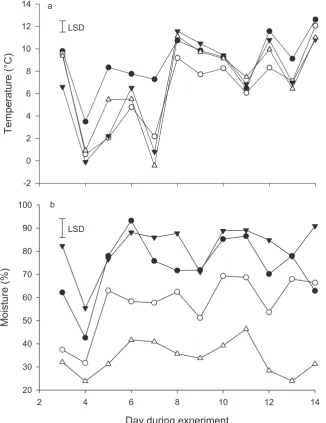
day of experiment interaction effect (P<0.001; Table 2) for temperature and moisture. Daily surface temperature was greater for WCG than for control and GC on day five of experiment, and lower for GC than control and WCH on days eight and nine of experiment two (Figure 1a). The surface moisture was greatest for control, lowest for WCG and intermediate for GC during the period from 5 to 14 day of experiment two (Figure 1b).
Discussion
In this study, the average daily lying time for the cows across experiments was 10.5 h, ranging from 9.6 to 11.6 h. This range of lying hours is within the range of 8 to 14 h reported for grazing dairy cows (Krohn & Munksgaard 1993), and similar to the average of 10.5 and 10.7 h/day reported by Dalley et al. (2012) and Davison et al. (2015), respectively, for cows wintered off pasture and allocated an area on the stand-off pad similar to that used for cows in this study (8-12 m2/cow). In experiment two, cows
Treatment1
Lying behaviour
Activity2 Cleanliness
score3
Lameness score4
Urination frequency5
(# per 7 h) Lying
down (h) bouts (# Lying per day)
% cows lying for ≤
5 h
% cows lying for > 5 but <
8 h
% cows lying for ≥
8 h
Experiment 1
Control 10.7 8.6 0.3 4.2 95.5 4110b 1.1 0.0 4.0
WCG 10.3 8.4 0.0 6.0 93.6 3812b 0.9 0.1 2.9
WCH 10.1 9.0 0.4 9.1 80.4 3156a 1.1 0.1 3.3
S50 9.6 8.0 2.2 15.2 82.6 3940b 1.0 0.1 4.1
S70 9.8 8.9 3.5 15.0 81.5 3989b 1.0 0.0 3.1
SEM 0.35 0.28 1.32 5.7 6.06 113.2 0.06 0.09 0.39 P-value 0.22 0.09 0.23 0.54 0.37 <0.001 0.71 0.56 0.19 Experiment 2
Control 11.3ab 8.2 0.2 3.2 96.6 3742c 0.9 0.0
WCG 10.8a 7.9 0.0 0.4 99.6 2816a 1.1 0.0
GC 11.6b 8.2 0.0 0.2 99.8 3413b 0.8 0.0
SEM 0.18 0.31 0.11 1.24 1.34 83.3 0.07 0.01 P-value 0.01 0.69 0.38 0.17 0.18 <0.001 0.06 0.98
-1Treatments: Control = cows grazed fodder beet and stayed on paddock 24 h; WCG = cows grazed fodder beet and shifted to woodchip
stand-off for 17 h; WCH = cows fed harvested fodder bulb and shifted to woodchip stand-off pad for 17 h; S50 = cows grazed fodder beet and shifted to stone (size 50 mm) stand-off pad for 17 h; S70 = cows grazed fodder beet and shifted to stone (size 70 mm) stand-off pad for 17 h; GC = cows grazed fodder beet and shifted to geotextile carpet stand-off pad for 17 h. 2Accumulative number of step counts
per 24 h. 3Scale 0-2, in which 0 = clean and 2 = very dirty. 4Scale 0-3, in which 0 = no lameness and 3 = very lame. 5Number of urination
events during feeding time, while all cows at paddock (7 h). a-cMeans within a column with different superscripts differ within experiment
(P < 0.05).
Table 1 The effect of feeding management and stand-off surface type on lying behaviour, activity, cleanliness and lameness score, and urination frequency of dairy cows
Item Treatment1 SEM P-Value
Control WCG GC Treatment Time Treatment × time Temperature (°C) 7.0b 7.1b 6.6a 0.12 0.009 <0.001 <0.001
Moisture (%) 83.0c 34.1a 58.3b 1.02 <0.001 <0.001 <0.001
1Treatments: Control = cows grazed fodder beet and stayed on paddock 24 h; WCG = cows grazed fodder beet and shifted to woodchip
stand-off pad for 17 h; GC = cows grazed fodder beet and shifted to geotextile carpet stand-off pad for 17 h. a-cMeans within a row with
different superscripts differ (P<0.05).
spent a longer time lying on the geotextile carpet (11.6 h) than woodchip (10.8 h). This may indicate that cows were slightly more comfortable on carpet than on woodchip surfaces. Fisher et al. (2003) reported a lying time of 11.9 h for cows on a woodchip surface and 12.5 h of lying time for cows on a geotextile carpet was reported by Chrystal et al. (2016). It is worth noting in this study that despite the lack of significant effect, the proportion of cows that lay down for > 5 but < 8 h was numerically higher for S50 and S70 (15.2 and 15.0%, respectively) than for the other treatments (average 3.9%). Dalley et al. (2012) reported that 63% of cows failed to meet the recommended average of lying time of 8 h/day when wintered in a loose-housed barn with slatted concrete flooring, despite that average lying time for these cows being 8 h/day. The high stocking density (3.7 m2/cow) for cows in the study of Dalley et al.
13
Figure 1 The average daily temperature (a) and moisture % (b) of air (●) and stand-off
pads surfaces for control (▼; cows on paddock with no stand-off), WCG (∆; cows on woodchip stand-off pad for 17 hr) and GC (○; cows on geotextile carpet stand-off pad for 17 hr). Bars indicate LSD for treatment effect within a day when α = 0.05. Air was not included in analysis.
Tem
peratu
re (
°C)
-2 0 2 4 6 8 10 12 14
Day during experiment
2 4 6 8 10 12 14
M
oisture (%
)
20 30 40 50 60 70 80 90 100
LSD
LSD a
b
Figure 1 The average daily temperature (a) and moisture % (b) of air (●) and stand-off pads surfaces for control (▼; cows on paddock with no stand-stand-off), WCG (∆; cows on woodchip stand-off pad for 17 hr) and GC (○; cows on geotextile carpet stand-off pad for 17 hr). Bars indicate LSD for treatment effect within a day when α = 0.05. Air was not included in analysis.
(2012) was suggested to be the major reason for this low number of lying hours. In the current study, the hardness and unevenness of the stone surface may have resulted in the variation of the amount of lying time within stone treatments. This was supported by a noticeable reluctance of the cows to enter the stone stand-off areas, and unstable footing when getting onto the pad. In addition, the lack of adaptation period to stand-off surfaces may also contribute to this result; cows may require a longer time to adapt to harder than soft surfaces. Cows required four days to lie down for 11.9 h on woodchip surface in the study of Fisher et al. (2003), but six weeks to lie down for 8.4 h on a concrete surface in the study of Singh et al. (1993).
The difference in activities between treatments may reflect the distances cows had to walk daily to get to the fodder-beet paddocks. This walking distance was shorter for cows on the WCH (384 m) and WCG (345 m) treatments in experiment one and two, respectively, than those on other treatments (average 668 m). Although, cows on the control treatment stayed in the paddock 24 h, they had the greatest activity. This may due to the difference in stocking density between control and stand-off cows, and the fact that the control cows had to walk a long distance to get to the water trough compared to those on stand-off treatments. Reduced lying time is usually associated with increased risk of lameness. In this study, although 17-19% of cows on the stones stand-off pads lay down for less than 8 hours, stand-off surface type did not affect lameness score. The short duration of each experiment most likely was the major reason for the similar and low lameness scores among treatments.
than woodchip surface. These differences in moisture content, however, were not enough to significantly impact cleanliness scores of the cows. We speculate that the dry weather during this study (24 and 39 mm rainfall during July and August, respectively), and the short period of each experiment (two weeks) may have contributed to these results.
The surface type had no effect on urination frequency of cows during the period of observation, averaging 3.4 urination events per cow on the race and paddock area. Farrell et al. (2016) reported a daily urination frequency of 8.5 urination events per cow for non-lactating dairy cows grazing fodder beet during winter. This may suggest that 60% of the daily urination events for cows on stand-off treatments in this study happened on the stand-off area, where it could be captured within the effluent system and returned to the soil in a controlled manner during drier months of the year, and thus, reduce the potential nitrate leaching loss. While these results confirm the usefulness of stand-off facilities in reducing N deposition onto the pasture or bare soil, a longer study covering the whole winter is required. This would enable the effect of stand-off strategy on cows performance, (i.e. live weight and body condition score) to be measured.
Conclusion
The results from this study showed a negligible effect of stand-off surface type on animal welfare or urination frequency. However, a longer study is required to assess the effect of stand-off strategy as well as surface type on animal performance, and to identify low-cost stand-off surface types that meet animal welfare as well as environmental regulations.
Acknowledgements
We are grateful for funding from the Pastoral 21 project, Phase 2 extension, which is jointly funded by the Ministry of Business, Innovation and Employment, DairyNZ, and AgResearch. We thank Helen Hague, Sarah Taylor, Charissa Thomas and Misato Iitaka for technical assistant during project.
References
Borchers MR, Chang YM, Tsai IC, Wadsworth BA, Bewley JM 2016. A validation of technologies monitoring dairy cow feeding, ruminating, and lying behaviors. Journal of Dairy Science 99: 7458-7466.
Christensen CL, Hedley MJ, Hanly JA, Horne DJ 2012. Nitrogen loss mitigation using duration-controlled grazing: Field observations compared to modelled outputs. Proceedings of the New Zealand Grassland Association 74: 115-120.
Chrystal J, Monaghan R, Hedley M, Horne D 2016. Design of a low cost winter stand-off pad for reducing nutrient losses to water from winter forage crops grazed by dairy cows. In: Currie LD, Singh R ed. Integrated nutrient and water management
for sustainable farming, Occasional Report No. 29. Fertilizer and Lime Research Centre, Massey University, 9 p.
Chrystal JM, Monaghan RM, Dalley D, Styles T 2012. Assessments of N leaching losses from six case study dairy farms using contrasting approaches to cow wintering. Proceedings of the New Zealand Grassland Association 74: 51-55.
DairyNZ 2012. Lameness scoring. https://www.dairynz. co.nz/animal/cow-health/lameness/lameness-scoring/ [accessed 25 January].
DairyNZ 2014. Stand-off pads: Your essential guide to planning, design and management. Stand-off pad booklet, DairyNZ Limited 2014. https://www. dairynz.co.nz/media/667797/dairynz_stand_off_ pads_booklet.pdf [accessed 25 January 2017] DairyNZ 2015. Cow cleanliness. https://www.dairynz.
co.nz/media/3200819/cow-cleanliness-score-card. pdf [accessed 25 January 2017].
Dalley DE, Verkerk GA, Geddes T, Irwin A, Garnett E 2012. Impact of wintering system in the southern South Island of New Zealand on the lying behaviour of dairy cows. Proceedings of the 5th Australasian Dairy Science Symposium. Pp. 251-254.
Davison LJ, Dalley DE, Chrystal J, Monaghan R, Laurenson S, Stevens D, Wall A, Pigou J, Gorton A 2015. The lying behaviour of non-lactating, pregnant dairy cows wintered in a loose-housed barn on woodchip bedding material. Proceedings of the New Zealand Society of Animal Production 75: 24-28.
De Klein CAM 2001. An analysis of environmental and economic implications of nil and restricted grazing systems designed to reduce nitrate leaching from New Zealand dairy farms. II. Pasture production and cost/benefit analysis. New Zealand Journal of Agricultural Research 44: 217-235.
Edwards GR, de Ruiter JM, Dalley DE, Pinxterhuis JB, Cameron KC, Bryant RH, Di HJ, Malcolm BJ, Chapman DF 2014. Dry matter intake and body condition score change of dairy cows grazing fodder beet, kale and kale-oat forage systems in winter. Proceedings of the New Zealand Grassland Association 76: 81-88.
Farrell LJ, Bryant RH, Hague H, Edwards GR 2016. Urine volume of non-lactating dairy cows in late gestation fed forage based diets in winter. Proceedings of the New Zealand Society of Animal Production 76: 22-25.
Fisher A, Stewart M, Verkerk G, Morrow C, Matthews L 2003. The effects of surface type on lying behaviour and stress responses of dairy cows during periodic weather-induced removal from pasture. Applied Animal Behaviour Science 81: 1-11.
Krohn CC, Munksgaard L 1993. Behaviour of dairy cows kept in extensive (loose housing/pasture) or intensive (tie stall) environments II. Lying and lying-down behaviour. Applied animal behaviour science 37: 1-16.
Monaghan RM, Wilcock RJ, Smith LC, Tikkisetty B, Thorrold BS, Costall D 2007. Linkages between land management activities and water quality in an intensively farmed catchment in southern New Zealand. Agriculture, ecosystems & environment 118: 211-222.
Schreiner DA, Ruegg PL 2002. Effects of tail docking on milk quality and cow cleanliness. Journal of Dairy Science 85: 2503-2511.