Volume 17, Number 1 (2019), 76-104
URL:https://doi.org/10.28924/2291-8639 DOI:10.28924/2291-8639-17-2019-76
DIMINISHING CHOQUET HESITANT 2-TUPLE LINGUISTIC AGGREGATION OPERATOR FOR MULTIPLE ATTRIBUTES GROUP DECISION MAKING
ISMAT BEG1∗, RAJA NOSHAD JAMIL2 AND TABASAM RASHID2
1Lahore School of Economics, Lahore-53200, Pakistan
2University of Management and Technology, Lahore-54770, Pakistan
∗Corresponding author: [email protected]
Abstract. In this article, we develop a diminishing hesitant 2-tuple averaging operator (DH2TA) for
hesi-tant 2-tuple linguistic arguments. DH2TA work in the way that it aggregate all hesihesi-tant 2-tuple linguistic elements and during the aggregation process it also controls the hesitation in translation of the resultant aggregated linguistic term. We develop a scalar product for hesitant 2-tuple linguistic elements and based on the scalar product a weighted diminishing hesitant 2-tuple averaging operator (DWH2TA) is introduced. Moreover, combining Choquet integral with hesitant 2-tuple linguistic information, the diminishing Chouqet hesitant 2-tuple average operator (DCH2TA) is defined. The proposed operators higher reflect the corre-lations among the elements. After investigating the properties of these operators, a multiple attribute decision making method based on DCH2TA operator is proposed. Finally, an example is given to illustrate the significance and usefulness of proposed method.
1. Introduction
Different procedures wherein problems that manage indefinite and vague data mostly involves the
vul-nerability of their definition structures. Utilizing numerical modelling to represent such indeterminate data
would not be reliably adequate. In these conditions wherein the vulnerability would not be of probabilistic
Received 2018-10-17; accepted 2018-11-26; published 2019-01-04.
2010Mathematics Subject Classification. 91B06; 94D05; 90B50; 91B10; 46S40; 03E72.
Key words and phrases. hesitant 2-tuple model; aggregation operator; choquet integral; multiple attribute group decision making; supply chain management.
c
2019 Authors retain the copyrights of their papers, and all open access articles are distributed under the terms of the Creative Commons Attribution License.
nature and the capacities are unclear, it is hard to give numerical specific information. Usually the decision
makers that take an interest in this kind of issues utilize linguistic descriptors to particular their evaluation
and identified with the uncertain potential they have concerning the issues [38,40]. Therefore, the utilization
of linguistic demonstration in problems managing non-probabilistic instability shows up justification and has
made effective result in particular fields, for example: situation realization [35], decision models [6,9,49,64],
information retrieval [25,30], risk evaluation [18], engineering analysis [39,40], sensory evaluation [10,36],
performance appraisal [1,2], data mining [27], social alternative [19] and waste management [51]. These
accomplishments have not been possible without systems to complete the improvement of computing with
words (CW) [34] that implies the utilization of linguistic knowledge. The accompanying algorithm indicates
how these translations to be functional.
Algorithm 1.1.
Step 1. Input data in the form of linguistic terms or 2-tuple linguistic terms
Step 2. Translation into equivalent numeric value
Step 3. Manipulation
Step 4. Retranslation into linguistic terms / 2-tuple linguistic terms accordingly
Step 5. Output data
These ideas for CW have an edge on probability theory [26,33], the uncertainty models, in these problems
are alternatively involving the imprecision and vagueness of the linguistic descriptors. For this reason other
tools as fuzzy logic [71] and the fuzzy linguistic process [72] used specific computational models for CW, for
instance:
• The linguistic computational model created on membership functions such as [13,37] these models
based on the fuzzy linguistic approach and makes the computations instantly on the membership
function of the linguistic terms by way of utilizing the extension principle [16,31].
• Foundation of the linguistic symbolic computational models are on ordinal scales [65]. These models
represent the understanding in keeping with the fuzzy linguistic technique and makes use of the
ordered structure of the linguistic term set to achieve symbolic computations in such ordered
lin-guistic scales. Equivalent tactics founded on this mode of computing has been discussed in [14,62].
It notable that this mannequin has been frequently applied to decision making practices due to its
easy adaptation and effortlessness for decision makers [65].
Linguistic models seek after the computational plan showed by means of Yager in [66,68] can be seen
in general algorithm 1.1, that features out the significance of the interpretation and translation approaches
in CW and likewise Mendel and Wu [42] highlighted similar techniques in computing with perceptions
tool for manipulative structure. In the second stage, incorporates taking the outcomes from the control,
computing device, arrange and change them into linguistic information as an approach to be reasonable by
method for individuals that is without uncertainty, one of the essential desire of CW [42]. These linguistic
computational units present a most important weak point, in view that they carried out the translation step
as an approximation method to precise the outcome in the usual expression area (initial term set) scary
a lack of accuracy [23]. To obstruct such inaccuracy in the translation step was once offered the 2-tuple
linguistic computational model [22,41]. It is a typical mannequin that broadens the utilization of records
adjusting the fuzzy linguistic strategy representation with including a parameter with essential linguistic
representation as an approach to show signs of improvement exactness of the linguistic calculations after the
re-interpretation step, holding the CW plan stated in algorithm 1.1 and the work out the capacity of the
result.
In recent times, numerous aggregation operators have been produced for the 2-tuple linguistic model
to assess diverse decision making issues [59]. Herrera and Mart´ınez [22] proposed the 2-tuple arithmetic
weighted averaging operator, the 2-tuple ordered weighted averaging operator and the extended 2-tuple
weighted averaging operator. Xu et al. [63] developed the extended geometric mean operator, the extended
arithmetic averaging operator, the extended ordered weighted averaging operator and the extended ordered
weighted geometric operator . Jiang and Fan [28], proposed the 2-tuple ordered weighted averaging operator
and the 2-tuple ordered weighted geometric operator. The extended 2-tuple ordered weighted averaging
operator was proposed in [73]. The extended 2-tuple weighted geometric operator and the extended 2-tuple
ordered weighted geometric operator have been developed in [60]. Herrera et al. [24] proposed an unbalanced
linguistic computational model that helpful for calculating the 2-tuple fuzzy linguistic computational model
to achieve processes of evaluating words for unbalanced term sets in an accurate mode without loss of
information. Furthermore, Dong et al. [15] proposed a consistency improving model which preserves the
utmost original knowledge and preferences in the process of improving consistency and it also guarantees
that the elements in the optimal adjusted unbalanced linguistic preference relation are all simple unbalanced
linguistic terms.
Aggregation operators examined over, the attributes are thought to be autonomous of each other, which
are differentiated by an independent axiom [43,44,57]. But in the real decision making practice, the
charac-teristics of the problem are often dependent or correlated to each other. Choquet integral [11] is one of the
valuable instrument to build up the model an issue, which utilize the properties as between reliance or
con-nection to each other. Choquet integral has examined and connected all the basic properties of the decision
making problems [32,50,67,69]. Yager [67] proposed the induced Choquet ordered averaging operator to
aggregate a group of real arguments while in [69], Yager combined the intuitionistic fuzzy sets with Choquet
the induced Choquet ordered averaging operator. Xu [64] proposed the intuitionistic fuzzy correlated
aver-aging operator, the intuitionistic fuzzy correlated geometric operator, the interval-valued intuitionistic fuzzy
correlated averaging operator and the interval-valued intuitionistic fuzzy correlated geometric operator to
aggregate the intuitionistic fuzzy information and the interval-valued intuitionistic fuzzy information. Beg
and Rashid [4] used Choquet integral, for selection of bike when the criteria include interactions among
each others. Yang and Zhiping [70] proposed, 2-tuple correlated averaging operator, the 2-tuple correlated
geometric operator and the generalized 2-tuple correlated averaging operator combined with Choquet
inte-gral. Joshi et al. [29] developed novel hesitant probabilistic fuzzy linguistic ordered weighted averaging and
hesitant probabilistic fuzzy linguistic ordered weighted geometric aggregation operators for ill structured and
complex decision making problems.
Torra [55] discussed that hesitant fuzzy set can deal with the conditions where the assessment of a selection
under each and every criterion is represented by several feasible values, not by a margin of error, or some
probability distribution on the possible values. For instance, decision maker gives the membership value of
xintoA, and so they wish to assign 0.23,0.26 and 0.31, which is a hesitant fuzzy element{0.23,0.26,0.31}
rather than the interval between 0.23 and 0.31. Use these qualities of the hesitant fuzzy set, Beg and
Rashid [5] proposed hesitant 2-tuple linguistic information to take care of marginal error. As we observed in
known literature for hesitant sets, the aggregation operators produced more hesitation during aggregation
process with respect to given hesitant elements [74]. Due to this we develop new operational laws for hesitant
2-tuple. These operational laws reduce the hesitation during aggregate process. We used these operational
laws to develop a diminishing hesitant 2-tuple averaging operator (DH2TA) for hesitant 2-tuple linguistic
arguments. DH2TA worked in two ways, firstly it aggregated all hesitant 2-tuple linguistic elements and
secondly it also reduces the hesitation in resultant 2-tuple linguistic term.
In this article, to check applicability of our method we apply it to supply chain management area. In
today globalization era, a suitable supplier selection is a core issue of supply chain management that effect
the overall performance as without efficient suppliers it is impossible to produce low-cost and high quality
products [3,56]. Especially for organizations that spend a high level of their business income on parts and
material supplies and whose material costs is a large part of aggregate costs. An organized and transparent
approach regarding the choice of supplier is essential for these organizations. Supplier selection is a procedure
by which suppliers are assessed, evaluated, and then selected to become a part of the company’s supply
chain [8]. To overcome the supply chain risk, reduced the production cost, optimize inventory levels and
the end profitability are major targets of supply chain management [12,21]. There exist some well known
method for supplier section for instant, matrix approach [20], vendor performance matrix approach [52],
vendor profile analysis [54], analytic hierarchy process (AHP) [47,48] and multiple objective programming
In this paper, we use the notion of hesitant 2-tuple linguistic information which was proposed by Beg
and Rashid [5] to develop a diminishing hesitant 2-tuple averaging operator (DH2TA) for hesitant 2-tuple
linguistic arguments. The rest of the paper is structured as follows: some basic concepts are presented to
understand our proposal in section 2. In section 3 we propose some definition which is ranking the hesitant
2-tuple linguistic information In Section 4, we define diminishing hesitant 2-2-tuple averaging (DH2TA) operator,
and discussed some properties of DH2TA. In Section 5, we merge Choquet integral with the operator DH2TA
and developed a new operator diminishing Choquet hesitant 2-tuple average operator (DCH2TA) and also
discussed different properties of DCH2TA. The multiple attribute decision making method based on DCH2TA
is proposed in Section 6. In Section 7, a numerical example is given to illustrate the developed approach
and to demonstrate its feasibility and practicality. Concluding remarks are given in last section.
2. Hesitant Fuzzy Sets
Some important preliminary concepts are given in this section to understand our proposed aggregation
operators.
Hesitant fuzzy set was defined by Torra [55] to match the vagueness of real life, when some one is hesitant
about membership value.
Definition 2.1. [55] For a reference set X. The hesitant fuzzy set on X is defined by function that will give a subset of[0,1]when applied toX.
To be easily understood, Xia et al. [61] expressed the HFS by a mathematical symbol:
E={< x, hE(x)>|x∈X},
where hE(x) is set of values form [0,1], known as the possible membership degrees of x to set E. Also
h=hE(x) is called hesitant fuzzy element (HFE).
To find order between two HFEs, Xia et al. [61] defined score function as follow:
Definition 2.2. [61] Lete be a HFE andh∈e then score function”S” of e is
S(e) = 1
n(e)
n(e) X
i=1 hi
wheren(e) be total number of elements ine.
Lete1ande2 be two HFEs then,
ifS(e1)< S(e2) thene1≺e2
and
Lete, e1 and e2 be elements of a hesitant fuzzy setAthen following basic operations are introduced by
Xia et al. [61]:
(1) eα=∪h∈e{hα}, α >0.
(2) αe=∪h∈e{1−(1−h) α
}, α >0.
(3) h1⊕h2=∪h1∈e1,h2∈e2{h1+h2−h1h2}.
(4) h1⊗h2=∪h1∈e1,h2∈e2{h1h2}.
Next we study concise review of 2-tuple linguistic information and some important basic concepts which are
necessary to develop the aggregation operator for hesitant 2-tuple linguistic information.
Assume thatL={li |i= 2n+ 1,∀n∈N}where N be the set of natural number andli be representation
of a possible value for linguistic variable. The setLhave the following properties by [22]:
P 1. The setLmust be ordered: li≥lj if i≥j,
P 2. The maximum of any two linguistic terms is max(li, lj) =li ifli≥lj,
P 3. The minimum of any two linguistic terms is min(li, lj) =li ifli≤lj.
The cardinality of the set L must be low enough that is not to impose unnecessary precision for users
and it should be rich enough to allow discrimination of the performance of the individual criteria in the
limited number of ranking. Psychologist [45] recommend the use of 7±2 labels. Due to this point of view,
a linguistic term set,Lwith seven labels can be defined as follows:
L={l0= extremely unattractive (EU), l1= fairly unattractive (F U), l2= unattractive (U), l3= normal
(N), l4= attractive (A), l5= fairly attractive (F A), l6= extremely attractive (EA)}.
In the literature different models have been recommended for processing of linguistic information. In this
paper, we have implemented 2-tuple linguistic representation model, which is based on symbolic translation
[22]. Symbolic translation is defined as follow:
Definition 2.3. [22] LetL={l0, l1, ..., lg}be the set of linguistic terms,δi ∈[0, g]for anyi∈ {0,1, ..., g}, j =round(δi) and ςj = δi−j =⇒ςj ∈[−0.5, 0.5), then ςj is called the value of the symbolic translation.
Whereround(δi)is the usual round operation on label index of set L.
Definition 2.4. [22] Let L = {l0, l1, l2, ..., lg} be the set of linguistic terms set and δi be the number representing the aggregation result of symbolic operation. The function4used to obtain the 2-tuple linguistic
information equivalent to δi is defined as:
4 : [0, g]−→L×[−0.5, 0.5),
4(δi) = (lj, ςj) with
lj j=round(δi)
Figure 1. Structure of different 2-tuple linguistic elements
Inverse function of4 is always exist and denoted by4−1.
4−1 : L×[−0.5, 0.5)−→[0, g],
4−1(lj, ςj) = ςj+j=δi
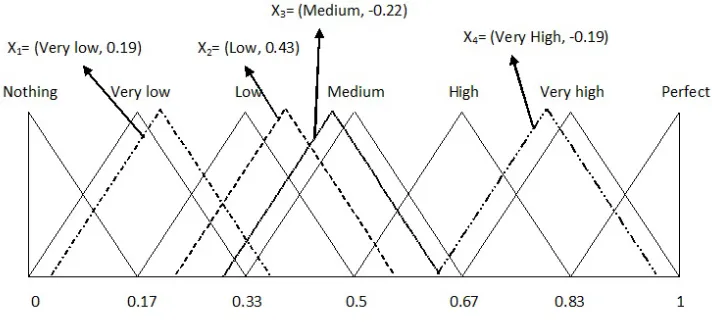
Example 2.1. Suppose we have different 2 −tuple elements x1 = (N othing,0.19), x2 = (Low,0.43), x3 = (M edium,−0.22) and x4 = (V ery high,−0.19) then the structure of these elements is described in
Figure 1.
Definition 2.5. [22] Let(li, ςi)and (lj, ςj)be two 2-tuple linguistic elements, then order between them is according to an ordinary lexicographic order:
(1) Ifi < j then (li, ςi)<(lj, ςj),
(2) Ifi=j then
• ifςi < ςj then (li, ςi)<(lj, ςj)
• ifςi =ςj then (li, ςi) = (lj, ςj)
Definition 2.6. [58] A fuzzy measure α on the set X is a set function α : P(X)→ [0,1] satisfying the following conditions:
(1) α(∅) = 0,α(X) = 1;
(2) IfB⊆C ⇒α(B)≤α(C),∀B, C ⊆X;
By parameterλthe interaction between criteria can be represented.
n S
i=1
xi=X for a finite setX.Theλ−fuzzy measure αsatisfied the following equation
α(X) =α n [
i=1 xi
!
=
1 λ
n
Q
i=1
(1 +λα(xi))−1
if λ6= 0
n P
i=1
α(xi) λ= 0
(2.1)
wherexi∩xj=∅ for alli, j= 1,2, ..., nandi6=j.The numberα(xi) for a subset with a single element
{xi}is called a fuzzy density.
α(A) =
1 λ
n
Q
i=1
(1 +λα(xi))−1
if λ6= 0
n P
i=1
α(xi) λ= 0
(2.2)
Based on above equation, the value ofλcan be find from the following equation, ifα(X) = 1 then,
1 = 1
λ ( n
Y
i=1
(1 +λα(xi))−1 )
(2.3)
In the above definition, ifλ= 0, then the third condition reduces to the axiom of the additive measure
i.e. α(B∪C) =α(B) +α(C)∀B, C⊆X andB∩C=∅
If the elements ofB are independent, thenα(B) = P xi∈B
α(xi)∀B⊆X.
3. Hesitant 2-tuple Linguistic Information
Hesitant 2-tuple linguistic information model is introduced by Beg and Rashid [5] to manage the conditions
in which information described is in linguistic term and decision maker has some hesitation to decide its
possible linguistic translations.
Let X be a universe of discourse and L = {l0, l1, l2, ..., lg} be the linguistic term set then a hesitant
2-tuple linguistic term set in X is an expression E = {(x, h(x)) :x∈X}, where h(x) = (li, ςi,j) be the
hesitant linguistic information by mean of 2-tuple, ςi,j is finite subset of [−0.5,0.5) which represent the
possible translations ofli andj be the cardinality ofςi,j andi∈ {0,1,2, ..., g}
Definition 3.1. Let h(x) = (li, ςi,j)be a H2TLE then score function S of h(x)is
S(h(x)) = 1
j X
γ∈ςi,j
γ where j is the cardinality ofςi,j
To find order between two H2TLE we use the score function defined in definition3.1
(1) Ifi < kthenh1(x)≺h2(x),
(2) Ifi=kand
• S(h1(x))< S(h2(x)) thenh1(x)≺h2(x)
• S(h1(x)) =S(h2(x)) thenh1(x) =h2(x)
Definition 3.3. Let lip, ςip,jp
be k H2TLEs. If k ∈ N,ip ∈ {0,1,2, ..., g} and jp be cardinality of ςip,jp,
thenminkp=1 lip, ςip,jp
is defined as follow:
(1) If all lip, ςip,jp
are different due to different ip then, let minkp=1(ip) =i ∈ {0,1,2, ..., g}. If ςi,j be
represent the translations ofli andj be the cardinality ofςi,j,then by definition3.2
k
min
p=1 lip, ςip,jp
= (li, ςi,j)
(2) If ip =i but ςip,jp are different for each lip, ςip,jp
. If ςi,j is represent the translations of lip = li
withS lip, ςip,jp
= minkp=1 jp1 P
γ∈ςip,jp γ
!
then
k
min
p=1 lip, ςip,jp
= (li, ςi,j)
(3) If all lip, ςip,jp
are equal, such thatip=iandςip,jp =ςi,j,then by definition3.2
k
min
p=1 lip, ςip,jp
= (li, ςi,j)
(4) If all lip, ςip,jp
H2TLEs are equal by definition 3.2 but still there is some possibility exist that
ςip,jp are different, but score are same then min k
p=1 lip, ςip,jp
is one with maximum hesitation.
Definition 3.4. Let lip, ςip,jp
be k H2TLEs. If k ∈N, ip ∈ {0,1,2, ..., g} and jp be cardinality of ςip,jp,
thenmaxkp=1 lip, ςip,jp
is defined as follow:
(1) If all lip, ςip,jp
are different due to different ip then, let maxkp=1(ip) =i∈ {0,1,2, ..., g}. If ςi,j be
represent the translations ofli andj be the cardinality ofςi,j,then by definition3.2
k
max
p=1 lip, ςip,jp
= (li, ςi,j)
(2) If ip =i but ςip,jp are different for each lip, ςip,jp
. If ςi,j is represent the translations of lip = li
withS lip, ςip,jp
= maxk p=1
1 jp
P
γ∈ςip,jp γ
!
then
k
max
p=1 lip, ςip,jp
= (li, ςi,j)
(3) If all lip, ςip,jp
are equal, such thatip=iandςip,jp =ςi,j,then by definition3.2
k
max
p=1 lip, ςip,jp
(4) If all lip, ςip,jp
H2TLEs are equal by definition 3.2 but still there is some possibility exist that
ςip,jp are different, but score are same then max k
p=1 lip, ςip,jp
is one with minimum hesitation.
Definition 3.5. If (lk1, ςk1,j1)is a hesitant 2-tuple linguistic element, g be the upper limit of the linguistic term set andλ≥0is any scalar. Then the scalar product for H2TLE is defined as follows:
λ(lk1, ςk1,j1) = (λlk1, λςk1,j1) = (li, ςi,j)
(li, ςi,j) is calculated as follow
Letβ1 =
(
µ|µ= ((g+ 1) 1−
1−g+γk1,j1
g+ 1
λ!
∀γk1,j1 ∈ςk1,j1
)
,
then β2 = [{θ1|θ1=round(µ), ∀µ∈β1}, i=
P
θ1∈β2
θ1+k1 !
|β2|+ 1 ,|β2| be cardinality ofβ2ςip,jp = {θ2|θ2=dif f erent(µ−θ1)}, jp be cardinality of eachςip,jp
ςi,j = {x|x∈ς1∩ς2 } for allrq ∈η= k [
p=1
ςip,jp, while
ς1 = |η| [ q=1 min
rq,max min k S p=1
max ςip,jp ! , max k S p=1 min ςip,jp !
and ς2 = |η| [ q=1 max
rq,min min k S p=1
max ςip,jp ! , max k S p=1
min ςip,jp ! ,
whereround(∗) is usual round operation.
4. Diminishing Hesitant 2-tuple Averaging Operator
Beg and Rashid [5] discussed a model which is characterized by a linguistic term and its possible symbolic
translations. This model is more suitable for dealing with fuzziness and uncertainty than the 2-tuple linguistic
arguments. In this section, we defined an operator for the hesitant 2-tuple linguistic elements to handle the
situation, where experts face some hesitation to present its possible linguistic translations.
defined as
DH2T A((li1, ςi1,j1),(li2, ςi2,j2), ...,(lik, ςik,jk))
= (li, ςi,j) wherei=round
i1+i2+...+ik k
and
ςi,j = {x|x∈ς1∩ς2 } for all rq ∈η= k [
p=1
ςip,jpwe have
ς1 = |η| [ q=1 min
rq,max min k S p=1
max ςip,jp ! , max k S p=1
min ςip,jp !
andς2 =
|η| [ q=1 max
rq,min min k S p=1
max ςip,jp ! , max k S p=1
min ςip,jp !
whereround(∗) be the round function and|η| be the cardinality ofη.
Example 4.1. Let h1= (l2,{−0.3,−0.25,−0.1,0.0,0.2}), h2= (l3,{−0.2,−0.1,0.1 ,0.2,0.25}) andh3= (l3,{0.1,0.23,0.3}) be 2-tuple hesitant linguistic terms, then,
DH2T A(h1, h2, h3) = (l3,{0.1,0.2}).
Theorem 4.1. Let(li1, ςi1,j1),(li2, ςi2,j2), ...,(lik, ςik,jk)bek2-tuple hesitant linguistic terms, wherej1, j2, ..., jk be the cardinality ofςi1,j1, ςi2,j2, ..., ςik,jk respectively,i1,i2, ..., ik ∈ {0,1,2, ..., m}If all k2-tuple hesitant
lin-guistic terms are equal i.e. li1=li2=...=lik =li and also ςi1,j1 =ςi2,j2 =...=ςik,jk=ςi,j then,
DH2T A((li1, ςi1,j1),(li2, ςi2,j2), ...,(lik, ςik,jk)) = (li, ςi,j).
Proof. Asli1=li2 =...=lik =li andςi1,j1 =ςi2,j2 =...=ςik,jk=ςi,j therefore,
i
1+i2+...+ik k
=
i+i+...+i k
=i.
and
ςi,j= k [
p=1
ςip,jp. (4.1)
Let
ε1 = min k [
p=1
max ςip,jp !
,ε2= max k [
p=1
min ςip,jp !
,
from equation4.1and4.2,
ς1 =
k [
p=1
{min (rp, r1)}=ςi,j andς2= k [
p=1
{max (rp, r2)}=ςi,j
=⇒ ςi,j=ς1∩ς2 whererp∈ςi,j
HenceDH2T A((li1, ςi1,j1),(li2, ςi2,j2), ...,(lik, ςik,jk)) = (li, ςi,j).
Theorem 4.2. Let (li1, ςi1,j1),(li2, ςi2,j2), ...,(lik, ςik,jk) be k, 2-tuple hesitant linguistic terms where jp be the cardinality ofςip,jp forip= 0,1,2, ..., g, jp= 1,2, ..., nandp= 1,2, ..., k,then
min((li1, ςi1,j1),(li2, ςi2,j2), ...,(lik, ςik,jk))≤DH2T A
((li1, ςi1,j1),(li2, ςi2,j2), ...,(lik, ςik,jk))≤max ((li1, ςi1,j1),(li2, ςi2,j2), ...,(lik, ςik,jk)).
Proof. As each 2-tuple hesitant linguistic term lip, ςip,jp
consist of two parts such that lip be the hesitant
linguistic information by mean of 2-tuple andςip,jpis a finite subset of [−0.5,0.5) which represent the possible
translations oflip,where jp be the cardinality ofςip,jp andip∈ {0,1,2, ..., g},then
Case 1. If all lip, ςip,jp
are different due to different ip then, by definition4.1
DH2T A((li1, ςi1,j1),(li2, ςi2,j2), ...,(lik, ςik,jk)) = (li, ςi,j)
i = round i
1+i2+...+ik k
clearly mink
p=1(ip)≤i≤ k
max
p=1(ip)
therefore by definitions3.2,3.3,3.4and4.1we have
min((li1, ςi1,j1),(li2, ςi2,j2), ...,(lik, ςik,jk)) (4.3)
≤ DH2T A((li1, ςi1,j1),(li2, ςi2,j2), ...,(lik, ςik,jk))
≤ max ((li1, ςi1,j1),(li2, ςi2,j2), ...,(lik, ςik,jk))
Case 2. Ifip =ifor all lip, ςip,jp
butςip,jp are different for eachp= 1,2,3..., k, then,
round i
1+i2+...+ik k
=round
i+i+...+i k
=i (4.4)
Let
DH2T A((li1, ςi1,j1),(li2, ςi2,j2), ...,(lik, ςik,jk)) = (li, ςi,j),
min((li1, ςi1,j1),(li2, ςi2,j2), ...,(lik, ςik,jk)) = (li, ς
min
i,j ),
and
max((li1, ςi1,j1),(li2, ςi2,j2), ...,(lik, ςik,jk)) = (li, ς max i,j ).
Consider S(li, ςi,j), S
li, ς
min
i,j
and S li, ςi,jmax
are scores of (li, ςi,j),
li, ς
min
i,j
and li, ςi,jmax
Case 2.1. Let max(ςi,jmin)≤min(ςmax
i,j ) =⇒ max(ς
min
i,j )≤r≤min(ςi,jmax)∀r∈ςi,j =⇒S
li, ς
min
i,j
≤S(li, ςi,j)≤
S li, ςi,jmax
. Therefore,
li, ς
min
i,j
≤DH2T A((li1, ςi1,j1),(li2, ςi2,j2), ...,(lik, ςik,jk))≤ li, ς max i,j
(4.5)
Case 2.2. Let max(ςi,jmin)≥min(ςmax
i,j ) =⇒ min(ςi,jmax)≤r≤max(ςi,jmin)∀r∈ςi,j=⇒S
li, ς
min
i,j
≤S(li, ςi,j)≤
S li, ςi,jmax
.Therefore,
li, ς
min
i,j
≤DH2T A((li1, ςi1,j1),(li2, ςi2,j2), ...,(lik, ςik,jk))≤ li, ς max i,j
(4.6)
Case 2.3. Let min(ςi,jmin)≤max(ςi,jmax)≤max(ςi,jmin) =⇒ ςi,j =ςi,jmax=⇒S li, ςi,jmax
=S(li, ςi,j). Therefore,
DH2T A((li1, ςi1,j1),(li2, ςi2,j2), ...,(lik, ςik,jk)) = li, ς
max i,j
(4.7)
Equations4.3,4.4,4.5,4.6and4.7provide the required result.
Theorem 4.3. If lip, ςip,jp
≤l0i0
p , ςi00
p,j
0
p
forip, i
0
p∈ {0,1,2, ..., g}, jp, j
0
p∈ {1,2, ..., n} andp= 1,2, ..., k,then
DH2T A((li1, ςi1,j1),(li2, ςi2,j2), ...,(lik, ςik,jk))
≤ DH2T Al0i1, ςi01,j1,l0i2, ςi02,j2, ...,l0ik, ςik,jk0
Proof. Given that lip, ςip,jp
≤lip0 , ςip,jp0 for allp= 1,2, ..., k,
Case 1. If,
∀p = 1,2, ..., k, ip< i
0
p=⇒ Pk
p=1ip k
!
< Pk
p=1i 0
p k
!
=⇒ DH2T A((li1, ςi1,j1),(li2, ςi2,j2), ...,(lik, ςik,jk)) (4.8)
< DH2T Ali01, ς
0
i1,j1
,l0i2, ς
0
i2,j2
, ...,li0k, ς
0
ik,jk
Case 2. Ifip=i
0
p which implies that Pk
p=1ip k
=
Pk p=1i
0 p k =i. Let
DH2T A((li1, ςi1,j1),(li2, ςi2,j2), ...,(lik, ςik,jk)) = (li, ςi,j),
DH2T A((li01, ςi01,j1),(l0i2, ςi02,j2), ...,(l0ik, ςik,jk0 )) = (li0, ςi,j0 ),
min((li1, ςi1,j1),(li2, ςi2,j2), ...,(lik, ςik,jk)) = (li, ς
min
i,j ),
min((l0i
1, ς
0
i1,j1),(l
0
i2, ς
0
i2,j2), ...,(l
0
ik, ς
0
ik,jk)) = (l
0
i, ς
0min
i,j ),
max((li1, ςi1,j1),(li2, ςi2,j2), ...,(lik, ςik,jk)) = (li, ς
max i,j ) and
max((l0i1, ςi01,j1),(l0i2, ςi02,j2), ...,(l0i k, ς
0
ik,jk)) = (l
0
i, ς
0max
therefore by theorem4.2,
li, ς
min
i,j
≤DH2T A((li1, ςi1,j1),(li2, ςi2,j2), ...,(lik, ςik,jk))≤ li, ς max i,j , (4.9) and
li0, ςi,j0min≤DH2T Al0i
1, ς
0
i1,j1
,l0i
2, ς
0
i2,j2
, ...,l0i
k, ς
0
ik,jk
≤l0i, ςi,j0max. (4.10)
As,li, ς
min
i,j
≤li0, ς0min i,j
, li, ς
max
i,j
≤li0, ς0max i,j
and
lip, ςip,jp
≤ lip0 , ςip,jp0 , therefore Sli, ς
min
i,j
≤ Sl0i, ςi,j0min, S li, ς
max
i,j
≤ Sli0, ςi,j0max and
S lip, ςip,jp
≤Sl0i p, ς
0
ip,jp
for eachp.Therefore by Theorem4.2
DH2T A((li1, ςi1,j1),(li2, ςi2,j2), ...,(lik, ςik,jk))
≤ DH2T A((l0i1, ς
0
i1,j1),(l
0
i2, ς
0
i2,j2), ...,(l
0
ik, ς
0
ik,jk)),
which is required result.
Theorem 4.4. Letli0
p, ςi
0
p,jp
be a permutation ofphesitant 2-tupleslinguistic elements of lip, ςip,jp
,where
ip, i
0
p∈ {0,1,2, ..., g}, jp, j
0
p={1,2, ..., n}andp= 1,2, ..., k then,
DH2T A((li1, ςi1,j1),(li2, ςi2,j2), ...,(lik, ςik,jk))
= DH2T Al0i
1, ς
0
i1,j1
,l0i
2, ς
0
i2,j2
, ...,l0i
k, ς
0
ik,jk
Proof. Let us consider (σ(1), σ(2), ..., σ(k)) be permutation of (1,2, ..., k) such that
lip, ςip,jp
σ(1)≤ lip, ςip,jp
σ(2)≤...≤ lip, ςip,jp
σ(k)then,
lip, ςip,jp
σ(p)=
li0
p, ςi
0
p,jp
σ(p)∀p= 1,2, ..., k
therefore,
(ip)σ(p)=
i0p σ(p)
=⇒
Pk p=1ip
k !
=
Pk p=1i
0
p k
!
∀p= 1,2, ..., k (4.11)
also,
S (lip, ςip,jp)σ(p)
=S
li0
p, ςi
0
p,jp
σ(p)
∀p= 1,2, ..., k (4.12)
from equation4.11and4.12
DH2T A((li1, ςi1,j1),(li2, ςi2,j2), ...,(lik, ςik,jk))
= DH2T Al0i1, ς
0
i1,j1
,li02, ς
0
i2,j2
, ...,l0ik, ς
0
ik,jk
.
5. Hesitant 2-tuple Linguistic Information Aggregation Operators Based on the Choquet
Integral
In this section, we develop diminishing Choquet hesitant 2-tuple average operator (DCH2T A) by selecting
Choquet integral to find the weights forDW H2T A.We also discussed different properties ofDCH2T A.
Definition 5.1. Let h1 = (li1, ςi1,j1), h2 = (li2, ςi2,j2), ..., hk = (lik, ςik,jk) be k, 2-tuple hesitant linguistic terms wherejp be the cardinality ofςip,jp for any finite natural numberp. X be the set of attributes andαbe
the fuzzy measure onX, then diminishing Choquet hesitant 2-tuple average operator(DCH2T A) is defined
as follow:
DCH2T Aα(h1, h2, ..., hk) (5.1)
=DH2T An α Hσ(p)
−α Hσ(p−1)(li, ςi,j)σ(p)|p= 1,2, ..., k o
,
here (σ(1), σ(2), ..., σ(k)) be the permutation of (1,2, ..., k) such that (li, ςi,j)σ(1) ≥ (li, ςi,j)σ(2) ≥ ... ≥
(li, ςi,j)σ(k), Xσ(p)is the attribute corresponding to (li, ςi,j)σ(p)andHσ(p)=
xσ(l)|l≤p forp≥1, Hσ(0)=
∅.
Theorem 5.1. Let (li1, ςi1,j1) = (li2, ςi2,j2) = ... = (lik, ςik,jk) be all equal k, hesitant 2-tuples linguistic elements such that i1 =i2 =... =ik and ςi1,j1 =ςi2,j2 =... =ςik,jk. If ip ∈ {0,1,2, ..., g}, jp ∈ {1,2, ..., n}
and p= 1,2, ..., k, X is the set of attributes and α be the fuzzy measure on X, then diminishing Choquet
hesitant 2-tuple average operator (DCH2T A)is always
DCH2T Aα((li1, ςi1,j1),(li2, ςi2,j2), ...,(lik, ςik,jk)) = (li, ςi,j),
where(li, ςi,j) =wp lip, ςip,jp
p,wp =α Hσ(p)
−α Hσ(p−1)=1k and
(σ(1), σ(2), ..., σ(k))be the permutation of(1,2, ..., k).
Proof. Given that,
lip, ςip,jp
σ(p) = lip, ςip,jp
σ(p−1) ∀p= 1,2,3, ..., k, therefore lip
σ(p) = lip
σ(p−1) also ςip,jp
σ(p)= ςip,jp
σ(p−1) ∀p= 1,2,3, ..., k
by definition3.5scalar product for wp−1 andwp are
A1 =
(µ)
σ(p)|(µ)σ(p) = (g+ 1)
1−
1−g+(γip,jp)σ(p)
g+1
wp
|∀ γip,jp
σ(p)∈ ςip,jp
σ(p)
andB1 =
(µ)
σ(p−1)|(µ)σ(p−1)= (g+ 1)
1−
1−g+(γip,jp)σ(p−1)
g+1
wp−1
|∀ γip,jp
σ(p−1)∈ ςip,jp
σ(p−1)
this implies that,
A1=B1 aswp−1=wp and lip, ςip,jp
σ(p)= lip, ςip,jp
σ(p−1) ∀p= 1,2,3, ..., k. (5.2)
Let,
A2 = [ n
θ1σ(p)|θ1σ(p) =round((µ)σ(p)), ∀(µ)σ(p)∈A1 o
and
B2 = [ nθ1
σ(p−1)|θ1σ(p−1) =round((µ)σ(p−1)), ∀(µ)σ(p−1) ∈B1
o .
By equation5.2
A2=B2. (5.3)
As (ip)σ(p)= (ip)σ(p−1) therefore by equation5.3,
P
θ1σ(p)∈A2
θ1
σ(p) + (ip)σ(p)
(|A2|+ 1) =
P
θ1σ(p−1)∈B2
θ1
σ(p−1) + (ip)σ(p−1)
(|B2|+ 1) =i
and
ςip,jp
σ(p)
= ςip,jp
σ(p−1)
for allp,
=⇒
k [
p=1 ςip,jp
σ(p) =
k [
p=1 ςip,jp
σ(p−1)
=η1(say) (5.4)
where,
ςip,jp
σ(p) =nθ2
σ(p)|θ2σ(p) =dif f erent((µ)σ(p)−θ1σ(p))
o
and
ςip,jp
σ(p−1)
=nθ2σ(p−1)|θ2σ(p−1) =dif f erent((µ)σ(p−1)−θ1σ(p−1)) o
.
As
ςip,jp
σ(p)
= ςip,jp
σ(p−1)
for allp,
=⇒ max ςip,jp
σ(p)
= max ςip,jp
σ(p−1)
for allp
therefore
min
k [
p=1
max ςip,jp
σ(p)
!
= min
k [
p=1
max ςip,jp
σ(p−1)
!
and
max
k [
p=1
min ςip,jp
σ(p)
!
= max
k [
p=1
min ςip,jp
σ(p−1)
By equation5.4 letrq ∈η1 then,
(ς1) σ(p)
=
|η1|
[ q=1 min
rq,max min k S p=1
max ςip,jp
σ(p)
! , max k S p=1
min ςip,jp
σ(p)
!
(ς1)
σ(p−1) =
|η1|
[ q=1 min
rq,max min k S p=1
max ςip,jp
σ(p−1)
! , max k S p=1
min ςip,jp
σ(p−1)
! and
(ς2)
σ(p) =
|η1|
[ q=1 max
rq,min min k S p=1
max ςip,jp
σ(p)
! , max k S p=1
min ςip,jp
σ(p)
!
(ς2) σ(p−1)
=
|η1|
[ q=1 max
rq,min min k S p=1
max ςip,jp
σ(p−1)
! , max k S p=1
min ςip,jp
σ(p−1)
!
by equations5.2,5.3and5.4we have, (ς1)
σ(p) = (ς1)
σ(p−1)
and (ς2)
σ(p) = (ς2)
σ(p−1)
therefore,
(ς1)
σ(p)
∩(ς2)
σ(p) = (ς1)
σ(p−1)
∩(ς2)
σ(p−1)
=ςi,j. (5.5)
Given thatwp=α Hσ(p)
−α Hσ(p−1)
= 1k for allp,therefore by definition3.5and equation5.5we have,
wp lip, ςip,jp
p=wp−1 lip, ςip,jp
p−1= (li, ςi,j) (say)
Therefore by theorem4.1we have required result,
DCH2T Aα((li1, ςi1,j1),(li2, ςi2,j2), ...,(lik, ςik,jk)) = (li, ςi,j)
Theorem 5.2. Let lip, ςip,jp
be k, hesitant 2-tuples linguistic elements, if ip ∈ {0,1,2, ..., g}, jp ∈
{1,2, ..., n} and p = 1,2, ..., k. X be the set of attributes and α be the fuzzy measure on X, then for any
g use as upper limit of the linguistic term set, then diminishing Choquet hesitant 2-tuple average operator
(DCH2T A) must satisfied,
lip,min ςip,jp
σ(k)≤DCH2T Aα(h1, h2, ..., hk)≤ lip,max(ςip,jp)
σ(1)
where (σ(1), σ(2), ..., σ(k)) be the permutation of (1,2, ..., k) such that (lip, ςip,jp)σ(k)≤(lip, ςip,jp)σ(k−1)≤
Proof. As,
(lip, ςip,jp)σ(k)≤(lip, ςip,jp)σ(k−1)≤...≤(lip, ςip,jp)σ(1)
also
lip,min ςip,jp
σ(k)≤ lip, ςip,jp
σ(k) and lip, ςip,jp
σ(1)≤ lip,max ςip,jp
σ(1).
Therefore
lip,min ςip,jp
σ(k) ≤ (lip, ςip,jp)σ(k)≤(lip, ςip,jp)σ(k−1) ≤ ...≤(lip, ςip,jp)σ(1) ≤ lip,max ςip,jp
σ(1).
Because,
0≤α Hσ(p)
−α Hσ(p−1)
≤1 ∀p= 1,2,3, ..., k
Therefore by definition3.5we have,
Letτp = α Hσ(p)
−α Hσ(p−1) lip, ςip,jp
∀p= 1,2, ..., k
τp =
µ2|µ2= (g+ 1) 1−
1−g+(γip,jp) g+1
α(Hσ(p))−α(Hσ(p−1))!
∀ γip,jp
∈ ςip,jp
wherep= 1,2, ...k
andβp = [
{θ2|θ2=round(µ2),∀µ2∈τp}
=⇒ λp= P
θ2∈βp θ2+ip
!
|βp|+ 1
, |βp|be cardinality ofβp.
Clearly,
(ip)σ(k) ≤round P
λp k
=i0 ≤(ip)σ(1). (5.6)
Letli0 be the linguistic term ofDCH2T Aα((li
1, ςi1,j1),(li2, ςi2,j2), ...,(lik, ςik,jk)).By definition 5.1we ob-serve that translation ofli0,
sayςi0,j0
may truncate the extreme values of ςip,jp
σ(k)and ςip,jp
σ(1) i.e.
it must satisfied the following condition,
min (ςip,jp)σ(k)
≤γ0i
p,jp≤max (ςip,jp)σ(1)
∀γi0
p,jp ∈ςi0,j0 (5.7)
therefore, from equation5.6and5.7we have,
lip,min ςip,jp
σ(k)≤DCH2T Aα((li1, ςi1,j1),(li2, ςi2,j2), ...,(lik, ςik,jk))
≤ lip,max(ςip,jp)
σ(1)
Theorem 5.3. Let lip, ςip,jp
≤ l0 i0p, ς
0
i0p,j0p
for all p = 1,2, ..., k if for ip, i
0
p ∈ {0,1,2, ..., g}, jp, j
0
p ∈
{1,2, ..., n}.Let X be the set of attributes and αbe the fuzzy measure onX, then,
DCH2T Aα((li1, ςi1,j1),(li2, ςi2,j2), ...,(lik, ςik,jk))
≤ DCH2T Aα((l
0
i01, ς
0
i01,j10),(l
0
i2, ςi02,j20), ...,(l
0
i0k, ςi0k,jk0))
Proof. Iflip=l
0
i0pthen order of lip, ςip,jp
andl0i0
p , ςi00
p,j
0
p
depend on possible translations oflip andl
0
i0p.As, lip, ςip,jp
σ(p)≤
li00
p , ςi00
p,j
0
p
σ(p)
∀p= 1,2,3, ..., k.Therefore,
P
γip ,jp∈ςip ,jp σ(p)
γip,jp
n ≤ P γ0 i0 p,j 0 p ∈ ς0
i0 p,j
0
p
!
σ(p)
γ0 i0p,jp0
n ∀p= 1,2,3, ..., k (5.8)
We also know that
0 ≤ α Hσ(p)
−α Hσ(p−1)≤1∀p= 1,2,3, ..., kalso
0 ≤ αHσ0(p)−αHσ0(p−1)≤1 ∀p= 1,2,3, ..., k
Implies that
β1 = α Hσ(p)
−α Hσ(p−1) lip, ςip,jp
σ(p)
=
µ|µ= (g+ 1) 1−
1−g+(γip,jp)σ(p)
g+1
α(Hσ(p))−α(Hσ(p−1))!
∀ γip,jp
σ(p)∈ ςip,jp
σ(p)
Let
β2 = [{θ1|θ1=round(µ),∀µ∈β1}
=⇒ (i)σ(p)=
P
θ1∈β2
θ1+ (ip)σ(p) !
|β2|+ 1 , |β2|be cardinality ofβ2 (5.9)
β10 = α Hσ(p)
−α Hσ(p−1)
lip, ςip,jp =
µ0|µ0 = (g+ 1)
1−
1− g+
γ0 i0p ,jp0
σ(p)
g+1
αH0σ(p)−αH0σ(p−1)
∀γi00
p,j
0
p
σ(p) ∈ςi00
p,j
0
p
σ(p)
Let
β20 = [ nθ01|θ01=round(µ0),∀µ0 ∈β10o
=⇒ i0 σ(p)
=
P
θ01∈β02
θ10 +i0p σ(p)
!
|β20|+ 1 , |β
0
2|be cardinality ofβ 0
2 (5.10)
From equations5.8,5.9and 5.10we have,
DCH2T Aα(h1, h2, ..., hk)≤DCH2T Aα
h01, h 0 2, ..., h
0
k
Ifip< i
0
p then obviously from equation5.9 and5.10we have
(i)σ(p)≤i0
σ(p)=⇒DCH2T Aα(h1, h2, ..., hk)≤DCH2T Aα
h01, h02, ..., h0k
Theorem 5.4. Let h0p =l0 i0p, ς
0
i0p,jp
p
be a permutation of p hesitant 2-tuples linguistic elements of hp =
lip, ςip,jp
p. Where ip = 0,1,2, ..., g, jp = 1,2, ..., n and p= 1,2, ..., k. X be the set of attributes and α be the fuzzy measure onX, then,
DCH2T Aα(h1, h2, ..., hk) =DCH2T Aα
h01, h 0 2, ..., h
0
k
Proof. Let us consider (σ(1), σ(2), ..., σ(k)) be permutation of (1,2, ..., k) such that
lip, ςip,jp
σ(1)≤ lip, ςip,jp
σ(2)≤...≤ lip, ςip,jp
σ(k)then,
lip, ςip,jp
σ(p)=
l0i0
p, ς
0
i0p,jp0
σ(p) such thatip=i 0
p andςip,jp=ς
0
i0p,jp0 ∀p= 1,2,3, ..., k (5.11)
We also know that
0≤ α Hσ(p)
−α Hσ(p−1)
≤1∀p= 1,2,3, ..., k
Implies that
β1 = α Hσ(p)
−α Hσ(p−1) lip, ςip,jp
σ(k)
=
µ|µ= (g+ 1) 1−
1−g+(γip,jp)σ(p)
g+1
α(Hσ(p))−α(Hσ(p−1))!
∀ γip,jp
σ(p)∈ ςip,jp
σ(p)
.
Letβ2 = [{θ1|θ1=round(µ),∀µ∈β1}
=⇒ (i)σ(p)=
P
θ1∈β2
θ1+ (ip)σ(k) !
|β2|+ 1
β10 = α Hσ(p)
−α Hσ(p−1) lip, ςip,jp
=
µ0|µ0 = (g+ 1)
1−
1− g+
γ0 i0p ,j0p
σ(p)
g+1
αHσ0(p)−αHσ0(p−1)
∀γ0i0
p,j
0
p
σ(p) ∈ςi00
p,j
0
p
σ(p)
.
Letβ20 = [ nθ01|θ01=round(µ0),∀µ0 ∈β10o
=⇒ i0 σ(p)
=
P
θ01∈β02
θ10 +i0p σ(p)
!
|β20|+ 1 , |β
0
2|be cardinality ofβ 0
2. (5.13)
From equations5.11,5.12and5.13
β1=β01andβ2=β 0
2∀p= 1,2,3, ..., k
=⇒DCH2T Aα(h1, h2, ..., hk) =CH2T Nα
h01, h 0 2, ..., h
0
k
which is required proof.
6. An Application of DCH2T AOperators to Multiple Attribute Decision Making
In this section DCH2T A operator is applied to multiple attribute decision making problems based on
hesitant 2-tuple linguistic information. Firstly, we developed a decision making method for utilization of
DCH2T Aoperator.
LetD={D1, D2, ..., Dr}be the set of ”r” decision makers, X={x1, x2, ..., xm}be the set of alternatives
andY ={y1, y2, ..., yn} be the set of attributes.
Step 1. The decision makers developed the decision matricesMp= h
lijkp , ςpi m×n
,wherelijkp , ςpbe the
hesitant evaluation of the alternativesxidetermined by the decision makersDp based on attributes
yj,wherei= 1,2, ..., m, j= 1,2, ..., n,andp= 1,2, .., r,whereςp ⊂[−0.5,0.5) andk∈ {0,1,2, ...g}.
Step 2. Find the matrixM agg =hDH2T Alijkp , ςpi m×n
,where, DH2T Alpijk, ςpis an aggregate value
oflijkp , ςp(i= 1,2, ..., m, j= 1,2, ..., n) for all decision maker’s evaluation as follow:
DH2T A (lijk1
1, ς
1),(l2 ijk2, ς
2), ...,(ln ijkn, ς
n)
= (lk, ςk) where k=round k
1+k2+...+kn n
and
ςk = {x|x∈ς1∩ς2} for allrq ∈η= n [
j=1
ς1= |η| [ q=1 min
rq,max min n S j=1
{max (ςp)} ! , max n S j=1
min{(ςp)}
! and ς2= |η| [ q=1 max
rq,min min n S j=1
{max (ςp)} ! , max j S j=1
{min (ςp)} !
whereround(∗) be the round function and|η| be the cardinality ofη.
Step 3. Confirm the fuzzy measures of attributes sets ofB.We use theDCH2T Aoperator define in definition
5.1to aggregate the values to find overall values (l, ς)i (i= 1,2, ..., m) of alternatives Ai.
(l, ς)i = DCH2T Aα((li1, ςi1),(li2, ςi2), ...,(lin, ςin))
= DH2T A wi1(liσ(1), ςiσ(1)), wi2(liσ(2), ςiσ(2)), ..., win(liσ(n), ςiσ(n))
where (σ(1), σ(2), ..., σ(n)) be the permutation of (1,2, ..., n) such that
(liσ(1), ςiσ(1))≥(liσ(2), ςiσ(2))≥...≥(liσ(n), ςiσ(n))
andwij=α(Hiσ(j))−α(Hiσ(j−1)) is the set of attributes corresponding to (liσ(1),
ςiσ(1)),(liσ(2), ςiσ(2)),...,(liσ(n), ςiσ(n)).
Step 4. Rank these aggregate values (l, ς)i (i = 1,2, ..., m) in descending order according to the rule in
definition3.2and select (l, ς)i with the largest value.
7. Illustrative example
In order to demonstrate the significance of our newly proposed method, we consider an example where
Mr. Robert, a food chain owner, wants to hire a supplier for raw food material for his chain. To save hedge
risks, a three member committee (decision makers),D ={D1, D2, D3} has been created to select the most
suitable supplier. Decision makers short listed five potential suppliers after initial analysis for supplier’s
capabilities. LetS ={s1, s2, s3, s4, s5} be the set of short listed suppliers. During the supplier selection
process, decision maker decide to consider the following set of attributes for judgments Y = {Y1(price),
Y2(quality), Y3(delivery time), Y4(financial status of the company)}.
In numerous practical group decision making problems in supply chain management, the contractor
se-lection or determination of an accomplice for an endeavor in the field of production network administration,
military framework effectiveness assessment, etc. decision makers normally need to give their preferences
to hesitations, uncertainty or vagueness about preferences as a decision should be made under time pressure
and lack of information or knowledge processing capacities especially when financial condition turns out to
be more complex. The best choice for decision maker is to handle data in hesitant 2-tuple elements due to
effectiveness of them in these particular situations.
Consider that decision makers evaluate the alternatives with respect to the attributes in 2-tuple linguistic
arguments to form decision matricesMp wherep={1,2,3}.
Step 1. Develop decision matricesMp= h
lijkp , ςpi 5×4, ς
p⊂[−0.5,0.5)
M1
=
(M,{−0.3,0.0,0.2}) (G,{0.45,0.32,0.2}) (P,{0.2,0.3}) (P,{−0.3,0.1})
(P,{0.0,0.2,0.1}) (M,{−0.48,−0.2,0.0}) (M,{−0.45,0.1}) (G,{−0.2,0.1,0.2})
(G,{−0.3,0.1,0.2}) (M,{−0.0,0.2}) (V G,{−0.2.0.0,0.4}) (P,{−0.3,0.1,0.2})
(V G,{−0.1,0.0,0.2}) (P,{0.0,0.2,0.4}) (P,{−0.5,−0.3}) (M,{−0.45,−0.25})
(EG,{−0.4,−0.3,0.1}) (P,{−0.1,0.2,0.3}) (V P,{−0.45,−0.2}) (G,{−0.4,−0.1,0.0})
M2=
(P,{−0.3,−0.1}) (V G,{−0.1,0.0,0.1}) (V P,{−0.2,0.3}) (M,{0.1,0.2,0.4})
(V P,{0.4}) (P,{0.2,0.3}) (G,{0.3,0.4}) (V G,{−0.1,−0.45,−0.2})
(M,{0.0,0.3}) (P,{−0.1,0.2}) (G,{0.1,0.3}) (V P,{−0.3,−0.2,0.0})
(EG,{0.2,0.4}) (M,{−0.4,0.3}) (P,{0.2,0.4}) (G,{0.1,0.3,0.4})
(G,{−0.2,0.1}) (M,{−0.2,0.15}) (P,{−0.1,0.2}) (V G,{−0.1,0.3})
M3=
(G,{−0.5,0.1,0.2}) (V G,{0.2,0.3}) (M,{0.1,0.2}) (V P,{0.0,0.1,0.2})
(M,{−0.4,−0.1}) (P,{0.0,0.2,0.4}) (V G,{−0.3,−0.2}) (M,{−0.2,−0.1,0.0})
(P,{−0.2,0.0,0.1}) (V G,{−0.05,0.2}) (G,{0.0,0.1,0.25}) (V P,{−0.3,−0.2,0.0})
(G,{−0.3,−0.1,0.0}) (G,{0.0,0.25,0.45}) (P,{0.1,0.2,0.3}) (M,{−0.1,0.2,0.3})
(M,{−0.1,0.1,0.3}) (P,{−0.2,−0.1,0.0}) (M,{0.1,0.4,0.45}) (EG,{−0.05,0.25})
Step 2 Use the DH2T Aoperator to aggregate value of lpijk, ςp (i= 1,2,3,4,5, j = 1,2,3,4, p= 1,2,3
andk∈ {0,1,2, ...,6}) for all decision maker’s evaluation as follow:
Magg=
(M,{−0.3,−0.1}) (V G,{−0.1,0.1,0.2}) (P,{0.2}) (P,{0.1})
(P,{−0.1,0.0,0.1,0.2,0.4}) (P,{0.0,0.2}) (G,{−0.2,0.1,0.3}) (G,{−0.2,−0.1})
(M,{0.1}) (M,{−0.05,0.2}) (G,{0.1,0.25}) (V P,{−0.3,−0.2,0.0})
(V G,{0.0,0.2}) (M,{0.0,0.2,0.25,0.3}) (P,{−0.3,0.1,0.2}) (M,{−0.25,−0.1,0.1})
(G,{−0.1,0.1}) (P,{−0.1,0.0) (P,{−0.2,−0.1,0.1}) (V G,{−0.05,0.0})
Step 3. To find the fuzzy measures for attributes ofY ={Y1(Price), Y2(Quality), Y3(Delivery time), Y4(Financial
status of company)} and parameterλ. Letα(Y1) = 0.3, α(Y2) = 0.25 ,α(Y3) = 0.15 andα(Y4) =
0.29.Then by equation2.3,λ= 0.00277 and by equation2.2,α(Y1, Y2) = 0.5502, α(Y1, Y3) = 0.4501,
α(Y1, Y4) = 0.5902, α(Y2, Y3) = 0.4001, α(Y2, Y4) = 0.5402, α(Y3, Y4) = 0.4401, α(Y1, Y2, Y3) =
0.7004, α(Y1, Y2, Y4) = 0.8406, α(Y1, Y3, Y4) = 0.7405, α(Y2, Y3, Y4) = 0.6904, α(Y1, Y2, Y3, Y4) = 1.
To findDCH2T Aaggregate value for the following elements, firstly we usewij =α(Hiσ(j))−α(Hiσ(j−1))
weight for each element.
(l1σ(1), ς1σ(1)) = (V G,{−0.1,0.1,0.2})
(l1σ(2), ς1σ(2)) = (M,{−0.3,−0.1})
(l1σ(3), ς1σ(3)) = (P,{0.2})
(l1σ(4), ς1σ(4)) = (P,{0.1})
As H1σ(1) = {Y2}, H1σ(2) = {Y1, Y2} and H1σ(3) = {Y1, Y2, Y3}, H1σ(4) = {Y1, Y2, Y3, Y4} we can get
w11= 0.25, w12= 0.3002 andw13= 0.1502, w14= 0.2996.
(l, ς)1 = DCH2T Aα (l1σ(1), ς1σ(1)),(l1σ(2), ς1σ(2)),(l1σ(3), ς1σ(3)),(l1σ(4), ς1σ(4))
= (M,{−0.0700,−0.0537,−0.0163,0.2138})
S((l, ς)1) = 0.0184
Similarly, find the values of (l, ς)2,(l, ς)3, (l, ς)4 and (l, ς)5are
(l, ς)2 = DCH2T Aα (l1σ(1), ς1σ(1)),(l1σ(2), ς1σ(2)),(l1σ(3), ς1σ(3)),(l1σ(4), ς1σ(4))
(l, ς)2 = (M,{−0.1967,−0.146,−0.0921})
S((l, ς)2) = −0.1449
(l, ς)3 = DCH2T Aα (l1σ(1), ς1σ(1)),(l1σ(2), ς1σ(2)),(l1σ(3), ς1σ(3)),(l1σ(4), ς1σ(4))
(l, ς)3 = (M,{−0.0674,−0.0072,0.0924,0.2177})
S((l, ς)3) = 0.0589
(l, ς)4 = DCH2T Aα (l1σ(1), ς1σ(1)),(l1σ(2), ς1σ(2)),(l1σ(3), ς1σ(3)),(l1σ(4), ς1σ(4))
and
(l, ς)5 = DCH2T Aα (l1σ(1), ς1σ(1)),(l1σ(2), ς1σ(2)),(l1σ(3), ς1σ(3)),(l1σ(4), ς1σ(4))
(l, ς)5 = (M,{−0.3002,−0.2846,−0.2118,−0.0477,−0.0380,−0.0163})
S((l, ς)5) = −0.1498
As by definition3.2(l, ς)4>(l, ς)3>(l, ς)1>(l, ς)2 >(l, ς)5,hences4s3s1s2s5.Therefore, the
most suitable supplier’s option iss4, second, third and four position suppliers ares3, s1ands2 respectively,
while the worst suppliers option iss5 .
8. Discussion and conclusion
Herrera and Mart´ınez [22], discussed a symbolic model and name it 2-tuple linguistic representation model.
The 2-tuple linguistic model use words toward processing without loss of any information. In their proposed
2-tuple model, the linguistic term sets were consistent and symmetrically distributed. In view of the Herrera
and Mart´ınez [22], the following models have been considered afterward:
• Wang and Hao model [59],
• Herrera et al. model [24],
• Numerical scale model [15].
In each of these models, linguistic term sets examined consistently and symmetrically scattered. Moreover,
the symbolic proportions over linguistic terms are precise qualities, and just a single linguistic term set
is considered for translation of these qualities. But these models did not address where hesitation occurs
between the translation of arguments. Beg and Rashid [5] introduced the concept of hesitant 2-tuple linguistic
model to merge Herrera and Mart´ınez’s [22], 2-tuple linguistic model with Torra’s [55], hesitant fuzzy set.
Hesitant 2-tuple linguistic model is very helpful for the situation where decision maker may hesitant to
pick a possible value of translation for a linguistic term as it will not cause any loss of information in the
process. Beg and Rashid [5] used hesitant 2-tuple linguistic model for the situation where the attributes in
the decision making problem are evaluated by hesitant 2-tuple linguistic arguments and they used TOPSIS
technique to illustrate hesitant 2-tuple linguistic model’s efficiency and feasibility in real-world decision
making applications. As TOPSIS technique use maximum and minimum distance or similarity from all
terms provide the best option accordingly. Some time the resultant value did not reflect the true picture
and fail to find the best result over the argument. Particularly, where we have an interrelation between the
arguments. Choquet integral [11] is the best choice where interrelationship is required.
In today globalization era, choice of a suitable supplier for the business in the sense of supply chain
management has become a key strategic consideration. But due to natural human hesitation, incomplete
complicated. Due to this, it is difficult for decision makers to express their conclusion on the suppliers with
exact and crisp values and the evaluations are often expressed in linguistic terms. In such circumstances
fuzzy set theory is a very appropriate tool to deal with this kind of problems. In this paper, we have
observed a situation that the attributes within the selection for decision making problems are interactive
or interdependent and analyze the values in the form of 2 tuple hesitant linguistic arguments. By utilizing
the Choquet integral, we have developedDH2T AandDCH2T Aaggregation operators. The properties of
both operators are studied, such as commutativity, boundedness and monotonicity. We proved thatDH2T A
operator is an idempotent operator. We also utilized DCH2T A operator to the more than one attribute
group decision making problems for hesitant 2-tuple linguistic understanding and proposed a method for
group decision making problems. An illustrative example has been given to demonstrate the proposed
decision making approach. We observe that DCH2T A is suitable for conditions where decision making
problems are interdependent. The operatorDCH2T Ahas the properties to reduce hesitation in aggregated
value of hesitant 2-tuple linguistic elements.
In real decision making problem, there involve the interrelationships between the arguments. Often
Bonfeeroni mean operators (BM) [7] and Muirhead mean operators (MM) [46] used as the tools where
interrelationships between arguments exist. As we observed that diminishing operational laws have the
ability to reduce hesitation in resultant argument. In future, we will use this capability of diminishing
operational laws and will purpose BM and MM for hesitant 2-tuple linguistic model.
Conflict of interest. The authors declare that they have no conflict of interest.
References
[1] R. D. Andr´es, M. Espinilla and L. Mart´ınez, An extended hierarchical linguistic model for managing integral evaluation, Int. J. Comput. Intell. Syst. 3 (4) (2010), 486–500.
[2] R. D. Andr´es, J.L. Garc´ıa-Lapresta and L. Mart´ınez, A multi-granular linguistic model for management decision-making in performance appraisal, Soft Computing, 14 (1) (2010), 21–34.
[3] C. Araz and I. Ozkarahan, Supplier evaluation and management system for strategic sourcing based on a new multicriteria sorting procedure, Int. J. Production Economics, 106 (2) (2007), 585–606.
[4] I. Beg and T. Rashid, Multi-criteria of bike purchasing using fuzzy choquet integral, J. Fuzzy Math. 22 (3)(2014), 677-694. [5] I. Beg and T. Rashid, Hesitant 2-tuple linguistic information in multiple attributes group decision making, J. Intell. Fuzzy
Syst. 30 (2016), 109–116.
[6] I. Beg and T. Rashid, Modelling uncertainties in multi-criteria decision making using distance measure and TOPSIS for hesitant fuzzy sets, J. Artif. Intell. Soft Comput. Res. 7(2)(2017), 103-109.
[7] C. Bonferroni, Sulle medie multiple di potenze, Bolletino Matematica Italiana, 5 (1950), 267–270.
[8] C. T. Chen, C. T. Lin, and S. F. Huang, A fuzzy approach for supplier evaluation and selection in supply chain management, Int. J. Production Economics, 102 (2) (2006), 289–301.
[10] Y. Chen, X. Zeng M. Happiette, P. Bruniaux, R. Ng and W. Yu, Optimisation of garment design using fuzzy logic and sensory evaluation techniques, Eng. Appl. Artif. Intell. 22 (2) (2009), 272–282.
[11] G. Choquet, Theory of capacities. Ann. Inst. Fourier, 5 (1953), 131–295.
[12] S. Y. Chou and Y. H. Chang, A decision support system for supplier selection based on a strategy-aligned fuzzy SMART approach, Expert Syst. Appl. 34 (4) (2008), 2241–2253.
[13] R. Degani and G. Bortolan, The problem of linguistic approximation in clinical decision making, Int. J. Approx. Reason. 2 (1988), 143–162.
[14] M. Delgado, J.L. Verdegay and M.A. Vila, On aggregation operations of linguistic labels, Int. J. Intell. Syst. 8 (3) (1993), 351–370.
[15] Y.C. Dong, C.C. Li and F. Herrera, An optimization-based approach to adjusting the unbalanced linguistic preference relations to obtain a required consistency level, Inf. Sci. 292 (2015), 27–38.
[16] D. Dubois and H. Prade, Fuzzy Sets and Systems: Theory and Applications, Kluwer Academic, New York, 1980. [17] C. X. Feng, J. Wang, and J. S. Wang, An optimization model for concurrent selection of tolerances and suppliers, Comput.
Ind. Eng. 40 (1-2) (2001), 15–33.
[18] N. Fenton and W. Wang, Risk and confidence analysis for fuzzy multicriteria decision making, Knowl.based Syst. 19 (6) (2006), 430–437.
[19] J.L. Garc´ıa-Lapresta, B. Llamazares and M. Mart´ınez-Panero, A social choice analysis of the Borda rule in a general linguistic framework, Int. J. Comput. Intell. Syst. 3 (4) (2010), 501–513.
[20] R. E. Gregory, Source selection: a matrix approach, J. Purchas. Mater. Manag. 22 (2) (1986), 24–29.
[21] S. H. Ha and R. Krishnan, A hybrid approach to supplier selection for the maintenance of a competitive supply chain, Expert Syst. Appl. 34 (2) (2008), 1303–1311.
[22] F. Herrera and L. Mart´ınez, A 2-tuple fuzzy linguistic representation model for computing with words, IEEE Trans. Fuzzy Syst. 8 (2000), 746–752.
[23] F. Herrera and L. Mart´ınez, The 2-tuple linguistic computational model advantages of its linguistic description, accuracy and consistency, Int. J. Uncertain. Fuzziness Knowl.-Based Syst. 9 (2001), 33–48.
[24] F. Herrera, E. Herrera-Viedma and L. Mart´ınez, A fuzzy linguistic methodology to deal with unbalanced linguistic term sets, IEEE Trans. Fuzzy Syst. 16(2) (2008), 354–370.
[25] E. Herrera-Viedma, A.G. L´opez-Herrera, M. Luque and C. Porcel, A fuzzy linguistic IRS model based on a 2-tuple fuzzy linguistic approach, Int. J. Uncertain. Fuzziness Knowl.-Based Syst. 15 (2) (2007), 225–250.
[26] V.N. Huynh and Y. Nakamori, A satisfactory-oriented approach to multi-expert decision-making under linguistic assess-ments, IEEE Trans. Syst. Man Cybern. 35 (2) (2005), 184–196.
[27] H. Ishibuchi, T. Nakashima and M. Nii, Classification and Modeling with Linguistic Information Granules: Advanced Approaches to Linguistic Data Mining, Springer, Berlin, 2004.
[28] Y.P. Jiang and Z.P. Fan, Property analysis of the aggregation operators for 2-tuple linguistic information, Control Decision, 18(6) (2003), 754–757.
[29] D.K. Joshi, I. Beg and S. Kumar, Hesitant probabilistic fuzzy linguistic sets with applications in multi-criteria group decision making problems, Mathematics 6(4)(2018), Article ID 47.
[30] A. Khalid and I. Beg, Incomplete hesitant fuzzy preference relations in group decision making, Int. J. Fuzzy Syst. 19(3)(2017), 637-645.
[32] C. Labreuche and M. Grabisch, Generalized Choquet-like aggregation functions for handling bipolar scales, Eur. J. Oper. Res. 172 (3) (2006), 931–955.
[33] J. Lawry, A framework for linguistic modelling, Artif. Intell. 155 (1–2) (2004), 1–39.
[34] C. C. Li, Y. Donga, F. Herrera, E. H. Viedm and L. Mart´ınez, Personalized individual semantics in computing with words for supporting linguistic group decision making. An application on consensus reaching, Inf. Fusion, 33 (2017), 29-40. [35] J. Lu, G. Zhang and F. Wu, Team situation awareness using web-based fuzzy group decision support systems, Int. J.
Comput. Intell. Syst. 1 (1) (2008), 51–60.
[36] J. Lu, Y. Zhu, X. Zeng, L. Koehl, J. Ma and G. Zhang, A linguistic multi-criteria group decision support system for fabric hand evaluation, Fuzzy Optim. Decis. Mak. 8 (4) (2009), 395–413.
[37] O. Martin and G.J. Klir, On the problem of retranslation in computing with perceptions, Int. J. General Syst. 35 (6) (2006), 655–674.
[38] L. Mart´ınez, D. Ruan, F. Herrera, E. Herrera-Viedma and P.P. Wang, Linguistic decision making: tools and applications, Inf. Sci. 179 (14) (2009), 2297–2298.
[39] L. Mart´ınez, J. Liu, D. Ruan and J.B. Yang, Dealing with heterogeneous information in engineering evaluation processes, Inf. Sci. 177 (7) (2007), 1533–1542.
[40] L. Mart´ınez, J. Liu, J. B. Yang and F. Herrera, A multigranular hierarchical linguistic model for design evaluation based on safety and cost analysis, Int. J. Intell. Syst. 20 (12) (2005), 1161–1194.
[41] L. Mart´ınez, R. M. Rodr´ıguez and F. Herrera, 2-tuple Linguistic Model Computing with words in Decision Making, Springer (2015).
[42] J.M. Mendel and D. Wu, Perceptual Computing: Aiding People in Making Subjective Judgments, IEEE-Wiley, (2010). [43] R. Mesiar and A. Kolesarova, On the fuzzy set theory and aggregation functions: Histor and some recent advances, Iran.
J. Fuzzy Syst. in press.
[44] W.R.W. Mohd and L. Abdullah, Aggregation methods in group decision making: A decade survey, Informatica 41 (2017), 71–86.
[45] G.A. Miller, The magical number seven, plus or minus two: some limits on our capacity of processing information, Psychol. Rev. 63 (1956), 81–97.
[46] R. F. Muirhead, Some methods applicable to identities and inequalities of symmetric algebraic functions of n letters, Proc. Edinburgh Math. Soc. 21(3) (1902), 144–162.
[47] R. Narasimhan, An analytic approach to supplier selection, J. Purchas. Supply Manag. 1 (1983), 27–32.
[48] R. L. Nydick and R. P. Hill, Using the Analytic Hierarchy Process to structure the supplier selection procedure, Int. J. Purchas. Mat. Manag. 28 (2) (1992), 31–36.
[49] L. P´erez-Dom´ınguez, L. Rodr´ıguez-Pic´on, A. Alvarado-Iniesta, D.L. Cruz and Z.S. Xu, MOORA under Pythagorean fuzzy set for multiple criteria decision making, Complexity, 2018 (2008), Article ID 2602376, 10 pages
[50] I. Saad, S. Hammadi, M. Benrejeb and P. Borne, Choquet integral for criteria aggregation in the flexible job-shop scheduling problems, Math. Comput. Simul. 76 (2008), 447–462.
[51] H. Shi, H. C. Liu, P. Li, X. and G. Xu, An integrated decision making approach for assessing healthcare waste treatment technologies from a multiple stakeholder, Waste Manag. 59 (2017), 508-517.
[52] W. R. Soukup, Supplier selection strategies, J. Purchas. Mat. Manag. 23 (3) (1987), 7–12.
[53] C. Q. Tan and X. H. Chen, Intuitionistic fuzzy Choquet integral operator for multi-criteira decision making, Expert Syst. Appl. 37 (2010), 149–157.