INTRODUCTION
Nowadays, cancer threatens the public health substan-tially and is accepted as the plague of our century. Th e num-ber of people who lose their lives annually in the world due to cancer is about 7.6 million [1]. Th is includes approximately 170,000 to 175,000 solely in Turkey [2]. It is estimated that the number of annual deaths in the world linked with cancer of the digestive system is approximately 920,000 [1]. In Turkey, the number of deaths due to gastric cancer is estimated to be about 64,000 [2].
It is estimated that the human genome includes between 23,000 and 25,000 genes [3]. More than 400 genes are found to be related to cancer formation. Th e proto-oncogenes responsible for cancer in the human genome can be classifi ed as tumor suppressor genes and DNA repair genes [4]. Th e
connections between genes, the environment, and cancer for-mation are an attractive research venue [5]. In all organisms, DNA repair mechanisms work to prevent the changes in the genome during the replication of the DNA with an aim to pre-vent unintended changes. Th e DNA repair is also realized via the enzymes produced from the genes [5,6]. Th ese enzymes that prevent DNA damage perform the enzymatic operations that decrease cell death rate, mutations occurring in DNA, replication errors, and genomic instability. In this biological process, any change in the enzymes responsible for the DNA repair mechanism may cause the acceleration of the cell death and thus a formation of a cancer. Some genes that infl uence DNA repair are XRCC1, XRCC2, XRCC3, XPC, XPD/ ERCC2, XPF and RAD51 [7]. Narter et al. (2009) conducted a study on SF mice, and observed that the XRCC2 and XRCC3 genes might have a vital importance in DNA repair and chro-mosome arrangements [8]. Th e chromosomal region that carries the XRCC2 and XRCC3 genes in the human genome was transformed to the mice cells, which was deformed by the mutation and a repair of the region was observed proving the role of XRCC2 and XRCC3 genes [9]. In the cell, the DNA repair genes can direct the functions of the proteins and can * Corresponding author: İlhami Gok,
Department of Bioengineering, Faculty of Engineering & Architecture, Kafkas University, Kars, Turkey,
Phone: +90 474 225 12 79 Fax: +90 474 225 12 82 E-mail: [email protected]
Submitted: 15 July 2014 / Accepted: 09 September 2014
XRCC3 risk of gastric cancer in Turkey
İlhami Gök1*, Meryem Baday2, Süleyman Çetinkünar3, Kemal Kiliç4, Bülent Çağlar Bilgin5
1Department of Bioengineering, Faculty of Engineering & Architecture, Kafkas University, Kars, Turkey. 2Department of Biology, Faculty
of Science & Literature, Kafkas University, Kars, Turkey. 3Department of Surgery, Adana Numune Training and Research Hospital, Adana,
Turkey. 4Department of Surgery, Kartal Training and Research Hospital, İstanbul, Turkey. 5Department of Surgery, School of Medicine,
Kafkas University, Kars, Turkey
Abstract
We studied the prevalence of polymorphisms in genes XRCC2 and XRCC3 in stomach cancer patients who lived in North Eastern Turkey. A total of 61 cancer patients and 78 controls were included in this study. Single nucleotide changes were studied in XRCC2 and XRCC3 genes at locus Arg188His and Th r241Met. Blood samples were taken from the patients and controls, and DNA was isolated. Th e regions of interest were amplifi ed using a polymerase chain reaction method. After amplifi cation, we used restriction enzymes (HphI and NcoI) to digest the ampli-fi ed product. Digested product was then run through gel electrophoresis. We identiampli-fi ed changes in the nucleotides in these speciampli-fi c regions. It was found that the Arg188His polymorphism of the XRCC2 gene was about 39 (24 out of the 61) among cancer patients. However, only 15 (12 out of 78) of the control group indicated this polymorphism. We also observed that 18 of the 61 cancer patients (29) carried the Th r241Met polymorphism of the XRCC3 gene whereas 11 of the 78 (14) individuals in the control group had the polymorphism. Our results showed a signifi cant diff erence in polymorphism ratios between the cancer patients and health control group for the regions of interest. Th is result clearly showed that these polymorphisms increase the risk of stomach cancer and might be a strong marker for early diagnosis of gastric cancer.
KEY WORDS: gastric cancer, XRCC2 and XRCC3 genes, polymorphism, Turkey
manage repair of the damaged DNA in the cell. Th e lack of repairing capacity and genetic instability in diff erent cells can cause a cancer formation [9].Gastric cancer is known as the third most common can-cer type in the world among the known cancan-cer types [10,11]. It represents approximately 10 of all cancers encountered worldwide. Especially in Japan, the disease is considered at epidemic dimensions by scientists. Th e regions with a high risk of cancer are Asia, Southern America, and Western Europe, and the low-risk regions are North America, north-ern Europe, and some African countries [12]. Th ere are 10 to 20 times diff erence between the low and high-risk regions in terms of encountering of gastric cancer [13]. Such a big diff er-ence among the regions might provide strong clues regarding the fact that this disease is linked with genetics. According to the Lauran criteria revised in 1997, many gastric cancers are classifi ed as intestinal and diff use system [14]. In reality depicted in genome studies, it is observed that genetic poly-morphisms and mutations that occur are linked with the geo-graphic origin of patients and could be important triggers for cancer [15]. Th e general acceptance is that if the frequency of the allele which is less encountered in the population is less than one percent and if the polymorphism is more rare, it can be interpreted as a mutation [16]. In addition to the formation of cancer in the cell with the delay of the repair duties of the DNA repair proteins, the other genes and proteins which have close relations are also aff ected, the mechanisms repairing the DNA can be impaired [17]. In this study we have investigated the polymorphism variations in DNA repair genes XRCC2 and XRCC3 in patients suff ering from gastric cancer and in healthy control group.
MATERIAL AND METHODS
Subjects
In this study we have researched the polymorphism prev-alence of the XRCC2 and XRCC3 genes in patients diagnosed with gastric cancer who are admitted to Kafkas University Medicine Faculty Surgery Polyclinics and Adana Numune Oncology Hospital between March 2011 and May 2013. Th e clinical diagnosis of the gastric cancer was offi cially set using histopathological, biochemical, and radiological meth-ods, and 61 such individual was included in a gastric cancer group. About 78 people, that were tested similar to the cancer
patients and declared as healthy, were included in control group. Th e gastric cancer patients were selected from the second and third phase patients, and their previous gastric disorders were not considered. From each of the study’s par-ticipants, both patients and controls, 8 ml of blood was taken into tubes with EDTA. Th e demographical structure of the examination groups are given in Table 1.
Genotyping
DNA isolation was performed according to the Salting-Out method from all the individuals [18]. Th e isolated DNA samples were measured at the Nanodrop Spectrophotometer (Th ermo ND1000) and kept at -80 degrees Celsius. Th e primer pairs selected were as follows: XRCC2 gene: F5’-TGTAGTCACCCATCTCTCTGC-3’andR 5’- AG
TTGCTGCCATGCCTTACA-3’; XRCC3 gene: F 5’-G
CCTGGTGGTCATCGACTC-3’ and R 5’-AC AGGG CTCT GGAAGGCACTGCTCAGCTCAC GCACC-3’ [19]. A fi nal volume 25 μl PCR protocol that included 2.5 μl 10X Taq poly-merase buff er solution, 1μl magnesium chloride (2 mM), 2 μl dNTP mix (0.2 mM), 2.5 μl forward primer (10 pmol), 2.5 μl reverse primer (10 pmol), 1μl genomic DNA (100ng/μl), 0.2 μl DNA taq polymerase enzyme (5u/μl), and 8.3 μl distilled water; a total volume of 25 μl was used [20]. PCR conditions were as follows: an initial denaturation for 3 min at 95oC, then
35 cycles at 94oC for 30 s, at 57oC for 30 s, at 72oC for 45 s, and
a fi nal extension at 1 cycle 72oC for 7 min. Th e PCR products
were detected by agarose gel electrophoresis (at 90V, 300 A for 1.5 h) on 2 agarose gel containing ethidium bromide, and the fl uorescent intensity of each band was evaluated with a UV transilluminator (Gel Logic Pro 2200, Montreal,Canada). For the XRCC2 (Arg188His) polymorphism, the PCR ampli-fi cation bands were observed as 290 bp, and the XRCC3 (Th r241Met) amplifi cation bands as 136bp. Amplifi ed products were digested: XRCC2 (Arg188His) with 3U Haemophilus parahaemolyticus (HphI), and XRCC3 (Th r241Met) was digested with 3U Nocardia corallina (NcoI) (New England Biolabs, INC UK) [21]. Digestion products were visualized, and resulting fragments were separated on 2.5 agarose gels and with ethidium bromide staining under ultraviolet illumination (Gel Logic Pro 2200, Canada).
Th e single amplicon of 290 bp as a result of the section of the XRCC2 (Arg188His) polymorphism with the restriction enzyme was separated into two DNA fragments as 148 bp and
TABLE 1. Gender and age distribution of gastric cancer patients and control group
Gastric cancer patients (N=61) Control group (N=78)
Age Female (n) % Male (n) % SD Age Female (n) % Male (n) % SD
40-60 8 30.76 18 69.24 7.1 20-40 17 27.86 42 72.13 17.7
>60 7 20.00 28 80.00 14.9 40-60 7 29.41 12 70.58 3.5
142 bp. In the evaluation, XRCC2 (Arg188His) was analyzed as having the HphI enzyme (290 bp bands Arg/Arg [homozygote wild tip] genotype; 148 bp+142 bp bands as having the Arg/His [heterozygote] genotype; 290 bp + 148 bp + 142 bp bands as hav-ing the His/His [homozygote mutant genotype]). As a result of the section of XRCC3 (Th r241Met) with NcoI enzyme, the 136 bp bands were observed as having 97 bp + 39 bpTh r/Th r (homozygote genotype), 139 bp + 97 bp + 36 bp bands as hav-ing Th r/Met (heterozygote genotype), and single band 136 bp as having Met/Met (homozygote [mutant] genotype) [19].Statistical Analysis
In this study, statistical analyses were made with the GraphPad Prism 6 package program. In the evaluation of the data, in addition to the descriptive statistical methods (mean, standard deviation), the χ2 goodness of fi t test was used in the
comparison of the patient and control groups, and the Fisher exact test was used in the comparisons of the qualitative data. Th e signifi cance level of α=0.05 was used for signifi cance level. In the calculation of the genotypes and allele frequencies, Hardy-Weinberg equality was tested.
RESULTS
Th e sampled population used in this study was composed of 61 gastric cancer patients (15 females and 46 males) and
78 healthy individuals (24 females and 54 males). When our fi ndings were evaluated in terms of the XRCC2 gene, in the gastric cancer patients, the Arg188His polymorphism was observed at the rate of 39 (24 of 61 patients), and the nucleo-tide change was observed in the control group at the rate of 15 (12 of 78 controls). Th e change rate of the XRCC3 gene in the Th r241Met polymorphism was observed in the rate of 29 (18 of 61) in patients, and the nucleotide change was observed in the rate of 14 (11 of 78) in the controls. When evaluated in terms of the general population, the rate of encounter in females was observed to be less frequent than in males in terms of the polymorphism prevalence of the XRCC2 and XRCC3 genes. Th e general distribution of the XRCC2 and XRCC3 gene polymorphisms in the patients and controls is given in Table 2.
Th e overall diff erence in the frequency of the polymor-phisms in the patients and controls as a result of the genomic evaluations are given in Table 3.
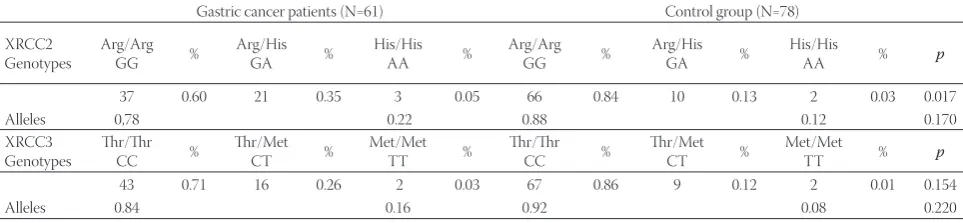
Th e genotypic and allelic frequencies of the patients and control group are provided in Table 4.
DISCUSSION
In the present study, we researched the diff erences in the polymorphism rates of the XRCC2 and XRCC3 genes in gas-tric cancer patients in the northeastern population of Turkey.
TABLE 2. Prevalence of XRCC2 and XRCC3 gene polymorphisms in the patients and controls (With SNP: Expresses a nucleotide change. Without SNP: Expresses no nucleotide change)
Gene Gastric cancer patients (n=61) Control group (n=78)
With SNP % Without SNP % With SNP % Without SNP % p
XRCC2 24 (39.34) 37 (60.66) 12 (15.38) 66 (84.62) 0.050
XRCC3 18 (29.50) 43 (70.50) 11 (14.10) 67 (85.59) 0.003
TABLE 3. Frequency of SNP of XRCC2 and XRCC3 genes according to the gender in the patients and controls (With SNP: Explains a nucleotide change)
Gene Gastric cancer patients (n: 24 with SNP) Control group (n: 12 with SNP)
Female (n) % Male (n) % Female (n) % Male (n) % p
XRCC2 8 (33.33) 16 (66.66) 4 (33.33) 8 (66.66) 0.135
Gene Gastric cancer patients (n: 18 with SNP) Control group (n: 11 with SNP)
Female (n) % Male (n) % Female (n) % Male (n) % p
XRCC3 7 (14.28) 11 (61.12) 4 (36.36) 7 (63.63) 0.129
TABLE 4. Genotype and allele frequency of XRCC2 and XRCC3 gene polymorphisms in the patients and controls
Gastric cancer patients (N=61) Control group (N=78)
XRCC2 Genotypes
Arg/Arg
GG %
Arg/His
GA %
His/His
AA %
Arg/Arg
GG %
Arg/His
GA %
His/His
AA % p
37 0.60 21 0.35 3 0.05 66 0.84 10 0.13 2 0.03 0.017
Alleles 0,78 0.22 0.88 0.12 0.170
XRCC3 Genotypes
Th r/Th r
CC %
Th r/Met
CT %
Met/Met
TT %
Th r/Th r
CC %
Th r/Met
CT %
Met/Met
TT % p
43 0.71 16 0.26 2 0.03 67 0.86 9 0.12 2 0.01 0.154
Linking variation in polymorphic sites of the XRCC2 and XRCC3 has been conducted for various cancer types [22-24]. It was found that the XRCC3 Th r241Met polymorphism was associated with the risk of breast cancer [25]. In a study con-ducted in Turkey in 2009, variations in the XRCC3 gene were estimated for 85 bladder cancer patients and 45 controls and compared. Th e frequency of T allele was reported to be fi ve times more prevalent in the controls compared to the cancer patients [21,26-27]. In this study, we found that the frequency of the T allele was twofold higher in gastric cancer patients. Also, the G allele of the APE gene family was observed more frequently in patients with common digestive system cancer types [24,28]. In the present study, the frequency of the G allele was 0.78 and therefore high. Zhao et al. (2012) argued that the XRCC1 and XRCC3 polymorphisms aff ected the tumor formation in the nerve system, and the XRCC1 and XRCC3 polymorphisms were not related to the diges-tive system cancers [6,29,30]. Our research indicated that the XRCC3 polymorphism may be sensitive in cancer cases linked to the digestive system. On the other hand, Zhang et al. (2005) determined that there were polymorphic regions that were more frequently associated with melanoma skin cancer than cancer occurring in head, neck, bladder, and breast can-cer. Th erefore, the eff ect of the XRCC3 gene varies in diff er-ent cancer types [31-35]. A recer-ent study conducted in Poland focused on same genomic regions and cancer type, and has shown that the regions of interest are associated with can-cer [19,20]. Concordance between our research and Krupa et al. study (2011) [19], provides grounds for discussion that polymorphic variations are not necessarily population depen-dent or local, the results are rather consistent and should be further evaluated across other populations.CONCLUSION
In this study, we found that there were signifi cant varia-tions in certain polymorphic regions of two DNA repair genes XRCC2 and XRCC3 between gastric cancer patients and control group among Turkish population. Results obtained from this study were concordant with the previous reports in other populations implying a true causative polymorphism, and more importantly, a possibility to be used in early diagno-sis of the cancer. In order to extrapolate fi ndings of our study to a global pattern, further research should be taken in diff er-ent populations with a larger sample size.
ACKNOWLEDGEMENTS
We are grateful to the Kafkas University Scientifi c Research Project unit (Kars, Turkey, Grant No: MMF: 2011-60) for fi nancially supporting this study.
DECLARATION OF INTEREST
Th e authors declare no confl ict of interest.
REFERENCES
[1] Jing-Jing Jing J, Hui-Yuan Liu HY, Jin-Kuan Hao JK, Li-Na Wang LN, Yun-Ping Wang YP, Li-Hua Sun LH et al. Gastric cancer incidence and mortality in Zhuanghe, China, between 2005 and 2010. World J Gastroenterol 2012;18:1262-1269. http://dx.doi.org/10.3748/wjg.v18. i11.1262.
[2] Yücetürk G, Sabah D, Keçeci B, Kara AD, Yalçinkaya S. Prevalence of bone and soft tissue tumors. Acta Orthop Traumatol Turc 2011;45(3):135-43. http://dx.doi.org/10.3944/AOTT.2011.2504. [3] Vineis P, Manuguerra M, Kavvoura FK. A fi eld synopsis on
low-pen-etrance variants in DNA repair genes and cancer susceptibility. J Natl Cancer Inst 2009;101(1):24-36. http://dx.doi.org/10.1093/ jnci/djn437.
[4] Loeb LA, Bielas JH, Beckman RA. Cancers exhibit a mutator phe-notype: clinical implications. Cancer Res 2008;68(10):3551-7. http:// dx.doi.org/10.1158/0008-5472.CAN-07-5835.
[5] Varki A,Geschwind DH, Eichhler EE. Explaining human unique-ness: genome interactions with environment,behaviour and cul-ture. Nat Rev Gen 2008;(10):749-63.
[6] Zhao Y, Deng X, Wang Z, Wang Q, Liu Y. Genetic polymorphisms of DNA repair genes XRCC1 and XRCC3 and risk of colorectal can-cer in Chinese population. Asian Pac J Cancan-cer Prev 2012;13(2):665-9. http://dx.doi.org/10.7314/APJCP.2012.13.2.665.
[7] Shin WG, Kim HU, Song HJ, Hong SJ, Shim KN, Sung IK et al. Surveillance strategy of atrophic gastritis and intestinal metaplasia in a country with a high prevalence of gastric cancer. Dig Dis Sci 2012;57(3):746-520. http://dx.doi.org/10.1007/s10620-011-1919-0. [8] Narter KF, Ergen A, Agaçhan B, Görmüs U, Timirci O, Isbir T.
Bladder cancer and polymorphisms of DNA repair genes (XRCC1, XRCC3, XPD, XPG, APE1, hOGG1). Anticancer Res 2009;29(4):1389-93.
[9] Silva SN, Tomar M, Paulo C. Breast cancer risk and common sin-gle nucleotide polymorphisms in homologous recombination DNA repair pathway genes XRCC2, XRCC3, NBS1 and RAD51. Cancer Epidemiol 2010;34(1):85-92. http://dx.doi.org/10.1016/j. canep.2009.11.002.
[10] Benhamou S, Tuimala J, Bouchardy C, Dayer P, Sarasin A, Hirvonen A. DNA repair gene XRCC2 and XRCC3 polymor-phisms and susceptibility to cancers of the upper aero digestive tract. Int J Cancer 20048;112(5):901-4.
[11] Yen CY, Liu SY, Chen CH. Combinational polymor-phisms of four DNA repair genes XRCC1, XRCC2, XRCC3, and XRCC4 and their association with oral cancer in Taiwan. J Oral Pathol Med 2008;37(5):271-7. http://dx.doi. org/10.1111/j.1600-0714.2007.00608.x.
[12] Inoue M, Tsugane S. Epidemiology of gastric cancer in Japan. Postgrad Med J 2005;81(957):419-24. http://dx.doi.org/10.1136/ pgmj.2004.029330.
[13] Loizidou MA, Michael T, Neuhausen SL. Genetic polymorphisms in the DNA repair genes XRCC1, XRCC2 and XRCC3 and risk of breast cancer in Cyprus. Breast Cancer Res Treat 2008;112(3):575-9. http://dx.doi.org/10.1007/s10549-007-9881-4.
[14] Popanda O, Tan XL, Ambrosone CB. Genetic polymorphisms in the DNA double-strand break repair genes XRCC3, XRCC2, and NBS1 are not associated with acute side eff ects of radio-therapy in breast cancer patients. Cancer Epidemiol Biomarkers Prev 2006;15(5):1048-50. http://dx.doi.org/10.1158/1055-9965. EPI-06-0046.
[15] Hussain S, Wilson JB, Blom E. Tetratricopeptide-motif-mediated interaction of FANCG with recombination proteins XRCC3 and BRCA2.DNA Repair (Amst) 2006;5(5):629-40. http://dx.doi. org/10.1016/j.dnarep.2006.02.007.
L, Chanock S et al. Polymorphisms in DNA double-strand break repair genes and risk of breast cancer: two population-based studies in USA and Poland, and meta-analyses. Hum Genet 2006;119(4):376-88. http://dx.doi.org/10.1007/s00439-006-0135-z.[17] Tan P. Germline polymorphisms as modulators of cancer pheno-types. BMC Med 2008; 6:27,-6-12.
[18] Rapley R, Walker JM. Th e Nucleic Acid Protocol Handbook.
Humana Press, Ottowa, New Jersey 2008;(1-2):3-29.
[19] Krupa R, Sliwinski T, Wisniewska-Jarosinska M, Chojnacki J, Wasylecka M, Dziki L et al. Polymorphisms in RAD51, XRCC2 and XRCC3 genes of the homologous recombination repair in colorec-tal cancer a case control study. MolBiol Rep 2011;38(4):2849-54. http://dx.doi.org/10.1007/s11033-010-0430-6.
[20] Sliwinski T, Krupa R, Majsterek I. Polymorphisms of the BRCA2 and RAD51 genes in breast cancer. Breast Cancer Res Treat 2005;94(2):105-9. http://dx.doi.org/10.1007/s10549-005-0672-5. [21] Brooks J, Shore RE, Zeleniuch-Jacquotte A. Polymorphisms in
RAD51, XRCC2, and XRCC3 are not related to breast cancer risk. Cancer Epidemiol Biomarkers Prev 2008;17(4):1016-9. http://dx. doi.org/10.1158/1055-9965.EPI-08-0065.
[22] Romanowicz-Makowska H, Smolarz B, Zadrozny M, Westfal B, Baszczynski J, Polac I et al. Single nucleotide polymorphisms in the homologous recombination repair genes and breast cancer risk in Polish women. Tohoku J Exp Med 2011;224(3):201-8. http://dx.doi. org/10.1620/tjem.224.20.1
[23] Griffi n CS, Simpson PJ, Wilson CR, Th acker J. Mammalian recom-bination-repair genes XRCC2 and XRCC3 promote correct chro-mosome segregation. Nat Cell Biol 2000;2(10):757-61. http://dx.doi. org/10.1038/35036399.
[24] Zhang Z, Wan J, Jin X, Jin T, Shen H, Lu D et al. Genetic polymor-phisms in XRCC1, APE1, ADPRT, XRCC2, and XRCC3 and risk of chronic benzene poisoning in a Chinese occupational population. Cancer Epidemiol Biomarkers Prev 2005;14(11 Pt 1):2614-9. http:// dx.doi.org/10.1158/1055-9965.EPI-05-014.3.
[25] Jacobsen NR, Nexøt BA, Olsen A, Overvad K, Wallin H, Tjønneland A, et alVogel U. No association between the DNA repair gene XRCC3 T241M polymorphism and risk of skin cancer and breast cancer. Cancer Epidemiol Biomarkers Prev 2003;12(6):584-5.
[26] Bignell GR, Greenman CD, Davies H. Signatures of mutation and selection in the cancer genome. Nature2010;463(7283):893-8. http://dx.doi.org/10.1038/nature08768.
[27] Suvà ML, Riggi N, Bernstein BE. Epigenetic reprogramming in cancer. Science 2013 Mar 29;339(6127):1567-70. http://dx.doi. org/10.1126/science.1230184.
[28] Kilpivaara O, Aaltonen LA. Diagnostic cancer genome sequencing and the contribution of germlinevariants. Science 2013; 339:1559-62. http://dx.doi.org/10.1126/science.1233899.
[29] Larrea AA, Lujan SA, Kunkel TA. SnapShot: DNA mismatch repair. Cell 2010;14:141(4)-4730e1.
[30] Sjödahl K, Lu Y, Nilsen TI, Ye W, Hveem K, Vatten L et al. Smoking and alcohol drinking in relation to risk of gastric cancer: a popula-tion-based, prospective cohort study. Int J Cancer 2007;120(1):128-32. http://dx.doi.org/10.1002/ijc.22157.
[31] Zhang Z, Wan J, Jin X, Jin T, Shen H, Lu D et al. Genetic polymor-phisms in XRCC1, APE1, ADPRT, XRCC2, and XRCC3 and risk of chronic benzene poisoning in a Chinese occupational population. CancerEpidemiol Biomarkers Prev 2005 Nov;14(11 Pt 1):2614-9. http://dx.doi.org/10.1158/1055-9965.EPI-05-0143.
[32] Butkiewicz D, Rusin M, Enewold L, Shields PG, Chorazy M, Harris CC. Genetic polymorphisms in DNA repair genes and risk of lung cancer. Carciogenesis 2001;22(4):593-7. http://dx.doi. org/10.1093/carcin/22.4.593.
[33] Pérez LO, Crivaro A, Barbisan G, Poleri L, Golijow CD. XRCC2 R188H (rs3218536), XRCC3 T241M (rs861539) and R243H (rs77381814) single nucleotide polymorphisms in cervical cancer risk. Pathol Oncol Res 2013;19(3):553-8. http://dx.doi.org/10.1007/ s12253-013-9616-2.
[34] Mates IN, Jinga V, Csiki IE, Mates D, Dinu D, Constantin A et al. Single nucleotide polymorphisms in colorectal cancer: associa-tions with tumor site and TNM stage. J Gastrointestin Liver Dis 2012;21(1):45-52.