DRIVERS’ ACCEPTANCE OF ADVANCED DRIVER ASSISTANCE
SYSTEMS – WHAT TO CONSIDER?
Lucie Viktorová1, Matúš Šucha2
1,2 Department of Psychology, Faculty of Arts, Palacký University in Olomouc, Olomouc, Czech Republic
Received 9 May 2018; accepted 6 June 2018
Abstract: Advanced Driver Assistance Systems (ADAS) proved a potential to save lives and reduce serious injury in traffic accidents. But if they are not known and accepted by the drivers, they will not deliver the benefits intended by their designers. The aim of the current research was to assess the awareness and acceptance of selected advanced driver assistance systems among a sample of Czech drivers, as well as the factors that might influence it. Together, 526 drivers participated in the questionnaire study. About a half of them was not aware of any further information besides the existence of various ADAS and more than 70 % did not drive with such systems yet. As for the acceptance, most of the systems were desired by at least 50 % of the respondents, but the majority was not willing to pay any extra money for the systems. A perceived safety benefit might increase the acceptance, but in the end, a thorough driver education about the systems’ function and limitations is needed.
Keywords: advanced driver assistance systems, ADAS, acceptance, traffic safety.
2Corresponding author: [email protected]
1. Introduction
There is much evidence that Advanced Driver Assistance Systems (ADAS) have the potential to prevent or mitigate the impact of traffic accidents (Anderson et al., 2011; Benmimoun et al., 2013; Jermakian, 2011; Najm et al., 2006; US DOT, 2008). Yet for their potential to be realized, they would first have to penetrate the car pool, meaning that they would have to be accepted by the drivers (Planing, 2016; Regan et al., 2014). As for the actual ADAS penetration, a problem could arise from the average age of the cars currently in use. According to the recent study by the European Automobile Manufacturers Association (ACEA, 2017), in the European Union, the average age of passenger cars in 2015 was approximately
depends on the brand of the vehicle, with premium vehicles being more equipped with different systems. These findings suggest that, at least in part, a low ADAS deployment rate may be due to the unwillingness (or inability) of the drivers to invest in new cars and/or such systems, a hypothesis that can further be supported by the authors’ survey among 5.000 European drivers (Kyriakidis et al., 2014) or by a representative study of the European Commission - Eurobarometer (2006).
Willingness to pay for (or to purchase) a system also represents one of the indicators in the assessment of drivers’ acceptance of a technology. The others comprise the willingness or intention to use a system (as indicated by the driver, usually on a Likert-scale), actual use of that system, or an indirect measurement of the drivers’ perceived ease of use and usefulness of the system (Adell et al., 2014; Ghazizadeh & Lee, 2014; Planing, 2016). Besides a high purchasing and/or maintenance price, the barriers for using ADAS as stated by the drivers in various studies (Choi et al., 2016; European Commission – Eurobarometer, 2006; Ghazizadeh & Lee, 2014; Kyriakidis et al., 2014; Trübswetter & Bengler, 2013) are, indeed, a lack of perceived usefulness, difficulty of system operation, undesired system feedback (discussed later in this text), a lack of trust in the system and unwillingness to hand over the control over the situation.
Interestingly, many concerns about the systems’ performance and functional limitations were also expressed by drivers without any experience with A DAS. Therefore, some of the authors argue that the actual problem while discussing drivers’ acceptance of the technologies lies in the
lack of awareness and knowledge drivers have about ADAS. In a study among older car drivers (Trübswetter & Bengler, 2013), 66 % heard about ACC, about a half was aware of the existence of systems such as the FCW, LDW, Blind Spot Monitoring, Driver Drowsiness Detection or Traffic Sign Recognition and only about 31 % knew of High Beam Assist. The main sources of information were acquaintances, media and car dealers – these sources were also found to be the most frequent among Czech ADAS owners (Viktorová & Šucha, 2017); however, significantly less than 20 % of the drivers have ever tested or owned the ADAS under study themselves (Trübswetter & Bengler, 2013). Similar results were yielded by the German Road Safety Council (2010), with only 12–32 % of German drivers being aware of ACC, FCW and LDW, and only 1–3 % of the cars being equipped with the systems in 2010. A more recent study among car buyers from US, China, Japan, South Korea and Germany (Choi et al., 2016) showed a slightly more promising results, with 49–77 % of car buyers being aware of ADAS (12–34 % of which tried at least one of the systems), but only 5–10 % of drivers who actually purchased a car with ADAS.
km/h, whereas others can bring the vehicle to a complete stop and accelerate again if the vehicle in front does (Burnett & Diels, 2014; Larsson, 2012; Sullivan et al., 2016). Similar problems also arise for systems relying on a good visibility and quality of road markings, such as LDW or Traffic Sign Recognition, which might not be fully functional if the sensors or the markings/signs themselves are covered with, for example, snow (Kozak et al., 2006). Although the above mentioned limitations are usually described in the user’s manual, this does not necessarily mean that drivers are aware of them. In a survey of 370 ACC owners, although 67 % claimed they learned to use the system by reading the manual, 72 % did not know about any limitations or manufacturer’s warnings about ACC (Jennes et al., 2008). Similar results were obtained by (Llaneras, 2007) and (Dickie & Boyle, 2009), with approx. 66–99 % of ACC owners not being aware of the aforementioned system limitations. These numbers are especially alarming because of the possible over-reliance on the systems, which could be counterproductive in respect to traffic safety. At the same time, it is important to note that prior knowledge of system limitations was not found to negatively affect user acceptance and trust in the system in the long term. On the contrary, drivers who were not informed about situations in which the system is not fully operational beforehand showed more negative affect after they encountered them in the field test, and their trust in the system decreased over time without recovery (Beggiato & Krems, 2013).
Another aspect of ADAS acceptance concerns the systems’ behavior and feedback to the driver, as the evaluation of a system’s effectiveness (or the degree of annoyance induced by the system) often depends on the
feedback’s content, style, timing, frequency, precision and method of delivery (Ghazizadeh & Lee, 2014). Some authors (Källhammer et al., 2014) suggest that a high rate of false alarms (i.e. system’s reactions in situations perceived by the driver as “not threatening” or “under control”) can lower the trust and willingness to use the system. At the same time, ADAS was primarily designed to prevent rather rare, yet potentially dangerous situations, so a higher false-positive detection rate could be more acceptable by the manufacturers than a higher number of “misses” in such situations. Furthermore, if the drivers did not encounter the system’s signaling often enough, they could be confused in the actual (dangerous) situation when such signaling occurs.
As can be seen from the previous text, drivers’ ADAS acceptance seems to be influenced by a lot of various factors, and it might be the subject of a trade-off between the designers’ and manufacturers’ ideas about factors promoting traffic safety and the drivers’ actual understanding of the systems’ purposes and limitations. Due to the tendency of the automotive industry towards automated driving (Kyriakidis et al., 2014), we wanted to assess the awareness and acceptance of Czech drivers towards selected systems and ADAS in general, as well as the factors that might influence it.
2. Methodology
A quantitative approach was chosen. A questionnaire was developed to assess the amount of experience Czech drivers have with various ADAS systems, their attitudes towards ADAS and driving in general, as well as their general knowledge/ need for information about the systems. Following systems with a very brief description (in brackets) were asked about:
• ACC – adaptive cruise control (“ACC monitors the distance from the vehicle ahead and maintains the set distance and/or speed.”);
• FCW – forward collision warning (“FCW monitors the distance from the vehicle ahead and the speed of approach; in case of imminent danger, it alerts the driver and/or activates the brakes.”); • LDW – lane departure warning (“LDW
tracks the vehicle’s position within a lane; in case of leaving the lane without the turn signal, it alerts the driver and/ or corrects the movement.”);
• Blind spot monitoring (“Alerts the driver if a vehicle in adjacent lane is detected in the blind spot of the car.”);
• Driver drowsiness detection system (“Monitors driver’s behavior and alerts the driver to take a break.”);
• Traf f ic sign recognition system (“Recognizes traffic signs and displays them on the display or the navigation system’s monitor.”);
• Automatic high beams (“High beams are automatically turned on/off, so that other drivers are not blinded.”).
For each system, drivers should indicate the amount of information they have (1 – “I don’t know anything about the system”; 2 – “I know the system exists, that’s all”; 3 – “I have basic information about how the system works”; 4 – “I can describe the systems’ reaction from my own experience”), and their level of experience (1 – “I did not drive with the system yet”; 2 – “I drove with the system a few times, but I don’t have it in my own car”; 3 – “I have the system in my own/my company car, but I don’t use it”; 4 – “I have the system in my own/my company car and I use it quite often.”). As a measure of acceptance, the respondents should indicate if they wanted the system in their car (“Yes, for safety purposes”; “Yes, for comfort”; “No, it wouldn’t be useful for me”; “No, I wouldn’t rely on it”; “Other response”) and how much would they be willing to pay for it (1 – “nothing”; 2 – “up to 5.000 CZK (approx. $200)”; 3 – “up to 15.000 CZK (approx. $650)”; 4 – “up to 30.000 CZK (approx. $1300)”; 5 – “up to 50.000 CZK (approx. $2200)”; 6 – “more than 50.000 CZK (approx. $2200)”).
Likert-type items using a 6-point scale (0 – “not at all true for me”; 5 – “completely true for me”). Three multiple-choice items were devoted to the drivers’ reaction on specific system feedback: beeping, visual signaling and steering correction. In the end, demographic and driving-related information were collected (gender, age, education, region of residence, the year of obtaining a driving permit, average monthly mileage and if the driver uses mostly his/her own or the company car).
The questionnaire was distributed during November 2016 – April 2017 in form of: a. an online survey using the snowball
method – a brief description of the research and its purpose, as well as the link for the survey and the request to send the e-mail to family members, friends and colleagues, was distributed via e-mail among the students and employees of the researchers’ university; also, similar requests were sent to companies interested in automotive and to departments for traffic and infrastructure of different municipal authorities of the Czech republic via e-mail and facebook pages, and posted on facebook pages designated for automotive fans (the administrators’ responses of these channels were mostly negative, so that the request was posted on two municipal web-pages, distributed
to employees of a third department of infrastructure and posted on approx. 5 facebook pages); together, 435 participants filled out the online survey; b. in electronic form, the questionnaire was
also distributed as a part of a larger testing at Škoda Auto research center and 54 completed questionnaires were collected; c. in printed form, the questionnaire was
distributed at a trade fair for electronics and automation, and respondents were promised a small present (consisting mostly of stationery) for filling out the questionnaire; 40 questionnaires were collected this way and transcribed into an electronic form.
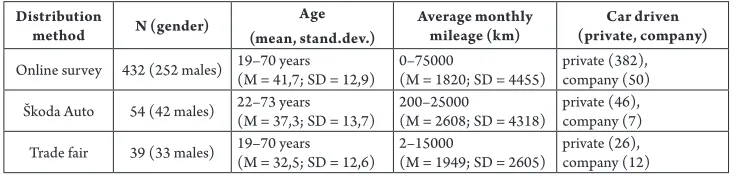
After initial screening for invalid responses, 3 questionnaires were dropped out of the analysis due to a suspiciously short overall response time (< 300 s). Invalid values of the year of obtaining the driving permit (the difference between this date and year of birth were less than 17 years, which is the lowest possible in the Czech republic) were deleted (N = 6), as well as one extreme value in average monthly mileage (1.000.000 km). Missing values were retained. In total, 526 questionnaires were analyzed further, using the means of descriptive univariate and bivariate statistics. Table 1 gives a more detailed overview for the sample characteristics based on the method the responses were obtained.
Table 1
Questionnaire Sample Characteristics
Distribution
method N (gender)
Age (mean, stand.dev.)
Average monthly
mileage (km) (private, company)Car driven
Online survey 432 (252 males) 19–70 years(M = 41,7; SD = 12,9) 0–75000 (M = 1820; SD = 4455) private (382), company (50)
Škoda Auto 54 (42 males) 22–73 years(M = 37,3; SD = 13,7) 200–25000(M = 2608; SD = 4318) private (46), company (7)
3. Results
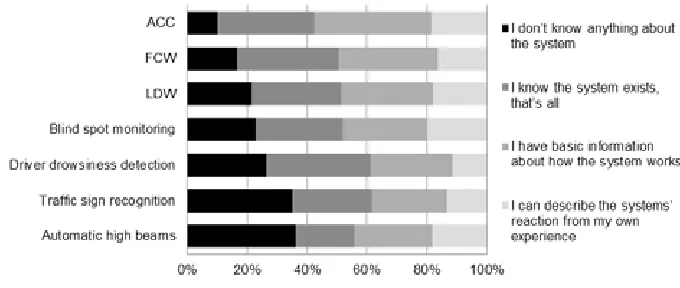
Figure 1 shows the familiarity of the drivers with the respective systems. As can be seen, about a half of the drivers was fairly
unfamiliar with ADAS, knowing, at best, about the systems’ existence. Mostly, less than 20 % of the drivers felt they could describe the systems’ behavior from their own experience.
Fig. 1.
Familiarity with ADAS
Nevertheless, on average, more than 70 % of the drivers did not drive with any ADAS yet. Only about 9 % of the drivers admitted using at least
one of the systems quite often; the least used system being Driver Drowsiness Detection, followed by Traffic Sign Recognition (Figure 2).
Fig. 2.
Experience with ADAS
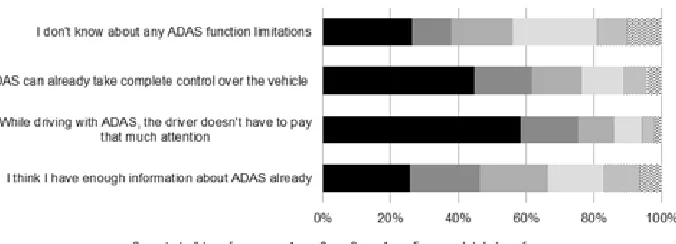
As for the declared knowledge about ADAS in general, less than 20 % of the drivers felt that they have enough information already;
ADAS may have, another 43 % could be described as “unsure”. Although most of the drivers did not believe that ADAS relieves the driver from paying attention or is able
to take full control over the vehicle (about 75 % and 61 %, respectively), a significant proportion of the respondents still remained unsure at best (Figure 3).
Fig. 3.
Information and Misconceptions about ADAS
Regarding the factors that might influence the drivers’ acceptance of ADAS, following aspects were rated based on the subjective importance for the driver in the decision making process, whether or not to use an assistance system (sorted from the most important to the least important, based on median values):
1. feeling of increased safety; 2. ease of use;
3. increased comfort; 4. trust in system;
5. previous experience with the system; 6. other aspects.
Among the “other aspects”, price was explicitly mentioned by 5 % of the drivers. Good references, perceived usefulness, reliability and functioning of the system were also seen as important by a part of the drivers, while others focused on the amount of control they could keep over
the driving (also, in connection with the enjoyment of driving) or on the social norms and trends (such as the behavior of other drivers and whether they have such systems, etc.). A general interest in new technology was mentioned by 4 drivers, whereas the same amount was skeptical about ADAS in general.
Fig. 4.
Absolute Frequencies for Answers to “If an Icon Starts Lighting up on my Car’s Dashboard/Display,…”
Fig. 5.
Absolute Frequencies for Answers to “If Something in my Car Starts Beeping,…”
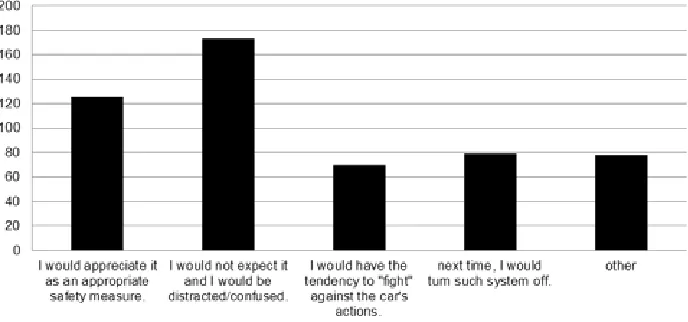
The tendency for confusion seemed to be even stronger in the case of steering correction or other active driving action performed by the system/car, such as automated braking. In this case, most of the drivers felt they would be confused or distracted (Figure 6). Although a large proportion would have appreciated such
by the car (e.g., “I don’t mind if the car brakes, but turning the steering wheel, I would probably not appreciate.”), while others focused on the predictability of such actions – resulting either from their knowledge and experience with the system, or from their consideration as a driver
(e.g. “whether the system would react in the manner I would, myself ”). Also, 5 drivers stressed their own corrective actions (e.g. “I would try to minimize such situations myself”), and 13 could not tell their reaction, declaring that they do not have the necessary experience.
Fig. 6.
Absolute Frequencies for Answers to “If a System in my car Actively Interfered in my Driving (Turned the Steering Wheel, Started Braking atc.),…”
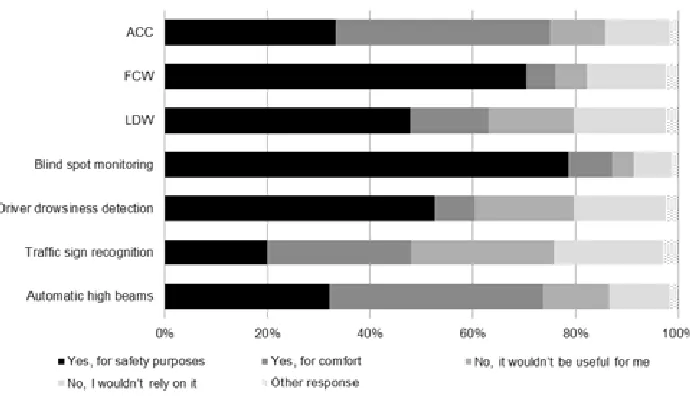
Per t a i n i ng to t he d r ivers’ genera l acceptance of the ADAS under study, based on their declared interest in having the systems in their car, a positive attitude can be observed (Figure 7). With the exception of Traffic Sign Recognition, at least 60 % of the drivers would want the respective systems, should they be
Fig. 7.
Drivers’ Reasons for (not) Wanting Various ADAS in a New Car
Nevertheless, the drivers’ willingness to pay for ADAS was considerably lower, ranging from 9% (Traffic Sign Recognition) to 31% (FCW) of drivers willing to pay more than
5.000 CZK (approx. $200) for the systems (Figure 8). A slightly higher proportion was also willing to pay more for ACC than for Blind Spot Monitoring.
Fig. 8.
4. Discussion
The awareness of various ADAS among Czech drivers seems to resemble the results of (Choi et al., 2016), with 64–90 % of the drivers having at least heard of the respective systems under study. Similarly to (Trübswetter & Bengler, 2013), the most “known” system was ACC, followed by FCW, LDW, Blind Spot Monitoring, Driver Drowsiness Detection, Traffic Sign Recognition, and the least known system was Automatic High Beams. Of course, “having heard of” ADAS does not mean that the drivers actually know (nor fully understand) the purpose, behavior and limitations of the systems, although only about 20 % of the respondents openly admitted a lack of such knowledge. This number seems to be particularly low compared to the findings of previous studies among ADAS owners themselves (Dickie & Boyle, 2009; Jennes et al., 2008; Llaneras, 2007). It would therefore be interesting to find out more about the nature and quality of information drivers have about ADAS, e.g. whether this pertains to the principles on which the systems operate or rather to the availability or cost of the systems, or whether there are any misconceptions prevailing about the systems’ capabilities. Although the drivers in our study mostly do not believe that ADAS are capable to take complete control over the vehicle, nor that they relieve the driver from paying attention, they might not be aware of other, more specific, ADAS characteristics and limitations.
Likewise, the proportion of drivers who have at least tested the systems varied from 20–33 %, similarly to those found by (Trübswetter & Bengler, 2013). But contrary to the findings of the German Road Safety Council (2010) and van Calker & Flemming (2012), it seems
that 9–16 % of the Czech drivers’ cars are equipped with at least one advanced driver assistance system (without regard to the actual use of such system, which seems to be less frequent). These proportions are even slightly higher than the ones found by (Choi et al., 2016). Yet, a bias resulting from the sampling methods used in our study is of concern in this matter. It is possible that more drivers interested in or experienced with ADAS chose to fill out the questionnaire, and especially at the Škoda Auto research center and the trade fair, more such drivers could have been present. Therefore, objective data such as that from nation-wide car register statistics would be more accurate to determine the actual penetration rate of ADAS in the Czech car pool.
Despite the lack of experience, there seems to be a positive attitude regarding the acceptance of ADAS among Czech drivers. Especially those systems that are perceived as safety-increasing (such as FCW or Blind Spot Monitoring) are indicated as desirable, which is consistent with the value drivers place upon their feeling of increased safety. Contrary to actual Czech ADAS owners (Viktorová & Šucha, 2017), drivers in general also see a high safety benefit in the Driver Drowsiness Detection systems. Yet the owners of the system were usually disappointed by its limited function, or, to be more precise, did not understand the principles on which the system actually “detects” their drowsiness and often considered the warnings delivered as unnecessary (Viktorová & Šucha, 2017). Both of these findings further support the importance of knowledge and driver education, when it comes to ADAS functioning.
or not to use an assistance system, the results show it may nevertheless play an important role in the deployment process of ADAS in the car pool. Depending on the specific system, 29–60 % of the car drivers’ are not willing to pay any extra money for such equipment. These proportions are higher than those found by (Kyriakidis et al., (2014) in respect to willingness to pay for partially, highly and fully automated vehicles. Again, the perceived safety benefit might convince the drivers to invest in the systems, but the expectancy of increased comfort (or, maybe, usefulness) may be an argument for paying a higher price as well, as suggested by the facts that a slightly higher proportion of drivers is willing to pay more for ACC (which is purchased rather for comfort) than for Blind Spot Monitoring. This would be in accord with the findings of previous studies (Choi et al., 2016; European Commission – Eurobarometer, 2006; Ghazizadeh & Lee, 2014; Kyriakidis et al., 2014; Trübswetter & Bengler, 2013). Czech drivers, too, stress the importance of trust in the system, ease of use, perceived usefulness and positive references/previous experience with the system, and they express some concerns regarding the amount of control they could keep over the vehicle and driving.
As for undesired system feedback, this was not explicitly mentioned as one of the main reasons not to use ADAS. This may be due to the feeling of the drivers that they usually know what a visual or acoustic signaling in their car means and what they are supposed to do. Nevertheless, about 10 % of the drivers admit being surprised by a sudden signalization, not knowing what it means and what to do. Even more drivers expressed such feelings, should it come to an active interference of the systems into the driving, such as turning the steering wheel or active
braking. A lot of the respondents would have the tendency to “fight” these actions and may incline towards turning the system off for the next time. These findings suggest, for one thing, that the drivers’ knowledge of ADAS capabilities and manifestations in the driving situation is not as extensive as they may think, and for other, that the drivers are still not willing to hand over the control over the vehicle to a system. Both of these facts could present serious barriers to ADAS acceptance and deployment.
5. Conclusion
The findings of this study address the importance of raising awareness and increasing the knowledge of drivers about ADAS, when it comes to increasing the acceptance of ADAS in general. In order for the systems to “spread” (and, consequently, exercise their benefits for traffic safety), drivers have to be aware of their potential, but, also, of their limitations. Therefore, a timely education of the drivers seems appropriate, starting with information about ADAS in driving schools, through the education of car dealers (who can, than, educate the drivers), up to larger informational campaigns aimed at all driver groups. Only then could the drivers’ acceptance of ADAS be based on solid, informed decision. Measuring the acceptance of ADAS purely by means of indicated “willingness to pay” may be biased by a general “unwillingness to pay extra money” for optional systems by the drivers, even if they show an interest in having the systems in their cars.
Acknowledgement
References
Adell, E.; Várhelyi, A.; Nilsson L. 2014. The Definition of Acceptance and Acceptability. In Regan, M. A.; Horberry, T.; Stevens, A. (Eds.), Driver Acceptance of new Technology: theory, measurement and optimization, Ashgate Publishing, UK, 11–21.
Anderson, R. W. G.; Hutchinson, T. P.; Linke, B.; Ponte, G. 2011. Analysis of crash data to estimate the benefits
of emerging vehicle technology. University of Adelaide,
Adelaida, Australia. Available from Internet: <http:// casr.adelaide.edu.au/casrpubfile/1081/CASR094.pdf>.
Beggiato, M.; Krems, J. F. 2013. The evolution of mental model, trust and acceptance of adaptive cruise control in relation to initial information, Transportation Research Part F: Traffic Psychology and Behaviour 18: 47-57.
Benmimoun, M.; Zlocki, A.; Eckstein, L. 2013. Behavioral changes and user acceptance of Adaptive cruise control (ACC) and Forward collision warning (FCW): Key findings within an European naturalistic field operational test. In The 23rd International Technical Conference on the Enhanced Safety of Vehicles (ESV), Seoul, Republic of Korea. Available from Internet: <https://www-esv.nhtsa.dot. gov/Proceedings/23/files/23ESV-000025.PDF>.
Biondi, F.; Rossi, R.; Gastaldi, M.; Mulatti, C. 2014. Beeping ADAS: Reflexive effect on drivers’ behavior,
Transportation Research Part F: Traffic Psychology and
Behaviour 25 :27–33.
Burnett, G.; Diels, C. 2014. Driver Acceptance of In-Vehicle Information, Assistance and Automated Systems: An Overview. In Regan, M. A.; Horberry, T.; Stevens, A. (Eds.), Driver Acceptance of new Technology: theory, measurement and optimization, Ashgate Publishing, UK, 137–151.
Choi, S.; Thalmayr, F.; Wee, D.; Weig, F. 2016. Advanced driver-assistance systems: Challenges and opportunities ahead. Available from Internet: <http://www.mckinsey.com/ industries/semiconductors/our-insights/advanced-driver-assistance-systems-challenges-and-opportunities-ahead>.
Dickie, D. A.; Boyle, L. N. 2009. Drivers’ Understanding of Adaptive Cruise Control Limitations. In Proceedings of the Human Factors and Ergonomics Society Annual Meeting, 53(23): 1806–1810.
European Automobile Manufacturers Association (ACEA). 2017. The Automobile Industry Pocket Guide 2017/2018. Available from Internet: <http://www.acea. be/publications/article/acea-pocket-guide>.
European Commision – Eurobarometer. 2006. Use of Intelligent Systems in Vehicles – Special Eurobarometer 267/ Wave 65.4 – TNS Opinion & Social. Available from Internet: <ec.europa.eu/commfrontoffice/publicopinion/ archives/ebs/ebs_267_en.pdf>.
Fagerlonn, J. 2010. Distracting effects of auditory warnings on experienced drivers. In Proceedings of the 16th international conference on auditory display (ICAD-2010),
Washington D.C., 127–132.
German Road Safety Council e.V. (DVR). 2010. Fahrerassistenten: bekannt, aber wenig verbreitet. DVR-Umfrage: Jeder zweite Autofahrer pro Jahr in gefährlicher
Situation. [Driver Assistance Systems: known, but
limitedly used. DVR-poll: Every second driver per year in a dangerous situation.]. Available from Internet: <http://www.presseportal.de/pm/17147/1546605>.
Ghazizadeh, M.; Lee, J. D. 2014. Modeling Driver Acceptance:
From Feedback to Monitoring and Mentoring Systems. In
Regan, M. A.; Horberry, T.; Stevens, A. (Eds.), Driver Acceptance of new Technology: theory, measurement and optimization, Ashgate Publishing, UK, 51–70.
Jenness, J. W.; Lerner, N. D.; Mazor, S.; Osberg, J. S.; Tefft, B. C. 2008. Use of Advanced In-Vehicle Technology by Young and Older Early Adopters. Survey Results on Adaptive
Cruise Control Systems. Report No. DOT HS 810 917.
NHTSA, Washington D.C.
Källhammer, J.-E.; Smith, K.; Hollnagel, E. 2014. An Empirical Method for Quantifying Drivers’ Level of Acceptance of Alerts Issued by Automotive Active Safety Systems. In Regan, M. A.; Horberry, T.; Stevens, A. (Eds.), Driver Acceptance of new Technology: theory, measurement and optimization, Ashgate Publishing, UK, 121 – 134.
Kozak, K.; Pohl, J.; Birk, W.; Greenberg, J.; Artz, B.; Blommer, M.; Cathey, L.; Curry, R. 2006. Evaluation of lane departure warnings for drowsy drivers. In
Proceedings of the Human Factors and Ergonomics Society
Annual Meeting, 50(22) :2400–2404.
Kyriakidis, M.; Happee, R.; De Winter, J. C. F. 2014. Public opinion on automated driving: Results of an international questionnaire among 5,000 respondents,
Transportation Research Part F: Traffic Psychology and Behaviour 32: 127-140.
Kyriakidis, M.; van de Weijer, C.; van Arem, B.; Happee, R. 2015. The Deployment of Advanced Driver Assistance Systems in Europe. In 22nd ITS World Congress Proceedings,
Bordeaux, France. Available from Internet: <https://
proceedings.itsworldcongress.com/files/papers/565>.
Larsson, A. F. L. 2012. Driver usage and understanding of adaptive cruise control, Applied Ergonomics 43: 501-506.
Llaneras, R. E. 2007. Safety Related Misconceptions and Self-Reported Behavioral Adaptations Associated With Advanced In-Vehicle Systems: Lessons Learned From Early Technology Adopters. In Proceedings of the 4th International Driving Symposium on Human Factors in Driver Assessment, Training, and Vehicle Design, 299–305. Available from Internet: <drivingassessment.uiowa. edu/DA2007/PDF/051_Llaneras.pdf>.
Najm, W. G.; Stearns, M. D.; Howarth, H.; Koopmann, J.; Hitz, J. 2006. Evaluation of an Automotive Rear-End
Collision Avoidance System (chapter 5). U.S. Department
of Transportation, National Highway Traffic Safety Administration, DOT HS 810 569. Research and Innovative Technology Administration, Volpe National Transportation Systems Center, Cambridge, MA.
Planing, P. 2016. Innovation Acceptance. The Case of Advanced Driver-Assistance Systems. Springer, Stuttgart. 326p.
Regan, M. A.; Stevens, A.; Horberry, T. 2014. Driver Acceptance of New Technology: Overview. In Regan, M. A.; Horberry, T.; Stevens, A. (Eds.), Driver Acceptance of new Technology: theory, measurement and optimization, Ashgate Publishing, UK, 3–8.
Sullivan, J. M.; Flannagan, M. J.; Pradhan, A. K.; Bao, S. 2016. Literature Review of Behavioral Adaptation to Advanced
Driver Assistance Systems. March 2016. AAA Foundation
for Traffic Safety, Washington, DC.
Trübswetter, N.; Bengler, K. 2013. Why Should I Use ADAS? Advanced Driver Assistance Systems and the Elderly: Knowledge, Experience and Usage Barriers. In Proceedings of the 7th International Driving Symposium on Human Factors in Driver Assessment, Training, and Vehicle Design, University of Iowa, Iowa city, 495-501.
US Department of Transportation (DOT). 2008.
Intelligent Transport Systems Benefits, Costs, Deployment,
and Lessons Learned: 2008 Update. Report No.
FHWA-JPO-08-032. US DOT, Washington D.C.
van Calker, J. R.; Flemming, A. 2012. iCar - implementation status survey by use of OEM data 2012, Deployment state in EU member states, WP5 Final report, version 21st October 2012. FSD Fahrzeugsystemdaten GmbH, Dresden, Germany.
Viktorová, L.; Šucha, M. 2017. Jak se čeští řidiči seznamují s pokročilými asistenčními systémy v osobních automobilech? [How do Czech drivers familiarize themselves with Advanced Driver Assistance Systems?], Silniční obzor 78(4): 111-114.