DEVELOPMENT OF TROLLEYBUS PASSENGER TRANSPORT
SUBSYSTEMS IN TERMS OF SUSTAINABLE DEVELOPMENT
AND QUALITY OF LIFE IN CITIES
Slaven Tica1, Snežana Filipović2, Predrag Živanović3, Stanko Bajčetić4
1,2,3,4 University of Belgrade, Faculty of Transport and Traffic Engineering, Vojvode Stepe 305, 11000
Belgrade, Serbia
Received 19 May 2011; accepted 12 September 2011
Abstract: The strategies for developing urban public transport systems are implemented nowadays through policy based on the principle of population mobility realisation with a limited use of passenger cars. The system of public transport with its performances, technology, quality, costs and environmental impacts represents one of the important factors that exert influence on the operation, location, size and structure of contemporary cities, their economy and social relations. A state-of-the-art trolleybus subsystem is an efficient tool for attaining the goals of sustainable development and quality of life, especially in the areas of small and mid-sized cities. The trolleybus subsystem has a set of technical and technological, ecological, and economical advantages over other passenger transport subsystems.
Keywords: public transport, trolleybus subsystem, sustainable development, quality of life.
1 Corresponding author: [email protected]
1. Introducing the Problem
The concepts of quality of life and sustainable development are widely accepted and established goals of contemporary cities and urban area development.
The main strategy of EU cities related to reaching the goals of sustainable development and quality of life with respect to transport systems is implemented by pursuing the policy based on the population mobility realisation principle in addition to a limited use of passenger cars.
Owing to the strong mutual dependence between transport and cities, one of the main goals of the public transport system should
be aimed at adjusting the system in terms of city functions or functions of urbanised areas.
Public transport systems have recently undergone changes becoming the centre of attention in terms of a new approach to structure improvement and optimisation, organisation and management in accordance with contemporary scientific and professional achievements. Changes that should be implemented in the public transport system structure and operation confirm the relevance of the ’quality of life in cities’ concept through a higher level of service quality (Filipovic et al., 2009).
efficient segment of the urban transport system represents one of the main instruments of sustainable development policy and quality of life in cities (Tica, 2011).
Sustainable development represents economic, technological, social and cultural development of a city and its most important subsystem – urban public transport system that is in compliance with ecologically acceptable norms and standards and that enables present and future generations to meet their needs without endangering future development and survival as well as quality of life improvement. Sustainable development demands that the structure and functioning of a city and its subsystems should ensure a user friendly environment.
Quality of life in cities must unite general transport and traffic interests and all citizens should be able to meet their transport needs on equal terms in accordance with acceptable costs, in addition to a supreme level of service quality and environmental pollution kept to a minimum.
Energy crisis that causes a rise in fossil fuel prices, increasing damage to the environment and chronic financial problems in the public sector speak in favour of modern trolleybus subsystems in terms of creating the conditions that contribute positively to sustainable development and quality of life in cities.
Ensuring that any adverse effects on the environment are kept to minimum, efficient and modern trolleybus subsystems can resolve numerous transport and traffic problems in many cities more efficiently and effectively compared to other urban public transport subsystems. The trolleybus subsystem brings major advantages to the urban environment when compared to the standard bus subsystem. Similarly, as rail subsystems, they provide the
city with the same or similar benefits, but they can be implemented more quickly demanding only 10-15 % higher investments compared to conventional rail subsystems.
2. Trolleybus Subsystems as Part of
Sustainable Development Strategy and
Quality of Life in Cities
Regarding the main goals and effects of the urban public transport development in the upcoming period, the trolleybus subsystem with its characteristics and performances has excellent prospects for future development. Nowadays, in about 370 cities in 47 different countries, the trolleybus subsystem receives a major share of local public transport.
For example, in Russia and Eastern European countries, the trolleybus subsystem enjoys equal status as the tram subsystem in terms of the number of vehicles, transported passengers and the effects related to the elements of the system operation. Currently, these countries boast 12035 trolleybuses in service in 88 cities. Moscow alone has 85 routes of 918 km in total length with 1 242 operating vehicles. Yearly ridership on the trolleybus subsystem in this city is about 975 million which accounts for 23.1 % of the total number of transported passengers (Tica and Mišanović, 2005).
The former USSR countries (Ukraine, Belarus, Moldova, Kazakhstan, Georgia, Baltic countries) have about 11200 trolleybuses in their vehicle fleet inventory. Other counties of Eastern Europe have about 2800 vehicles nowadays.
edge technology in Italy and Switzerland. These two counties are leaders in developing the trolleybus technology while in many other countries this mode of transport is again introduced or its implementation is envisaged (UITP, 2007).
Looking at the number of operating vehicles and companies, the largest trolleybus systems are found in Switzerland with 618 vehicles and 15 companies, Italy with 388 vehicles and 14 companies, Greece with 350 vehicles and 2 companies, France with 199 vehicles and 6 companies, Austria with 131 vehicles and 4 companies, Germany with 104 vehicles and 3 companies, etc (The Electric Tbus Group, 2011).
There are about 3100 trolleybuses in operation on the American continent and the largest systems are found in US cities (Seattle, Philadelphia, San Francisco, Dayton), Canada (Vancouver, Edmonton) and South American cities (Sao Paolo, Santiago, Buenos Aires, Cordoba, Quito).
The regional distribution of the global trolleybus subsystem is shown in the Table 1 below (Tica and Mišanović, 2005).
Table 1
Regional Distribution of Trolleybus Subsystems
Region Trolleybus stock
Eastern Europe 4.482
Western Europe 1.893
Eurasia 26.666
North America 1.926
South America 828
Africa 0
Australia – Indonesia 60
Asia 4.810
Totals 40.665
Since 2001, under the auspices of the European Union and within the Research Programme of the European Commission and the International Association of Public Transport (UITP) a series of activities have been initiated, aimed at creating a vision and concrete proposals concerning the implementation of an attractive, clean, safe, available, efficient and financially viable local and regional urban public transport system by 2020.
3. Comparative Analysis of Trolleybus
Subsystem Characteristics Compared to
Other Urban Public Transport Subsystems
The urban public transport system is the most important mobility service offered to citizens in many cities but it is also one of the main sources of urban pollution and exhaust emissions. Therefore, electrically powered subsystems have shown major expansion for the last two decades. Furthermore, it is a well known fact that electrically powered vehicles compared to fossil-fuel powered vehicles are more energy and productively efficient. Electrical energy which the trolleybus subsystem uses as the power source represents the energy of the future because it is ecologically clean, flexible and renewable.
The trolleybus subsystem is entirely in compliance with current environmental goals and commitments defined by the Kyoto Protocol which refers to exhaust emissions, an innovative approach to the organisation of urban public transport and reduction of noise levels.
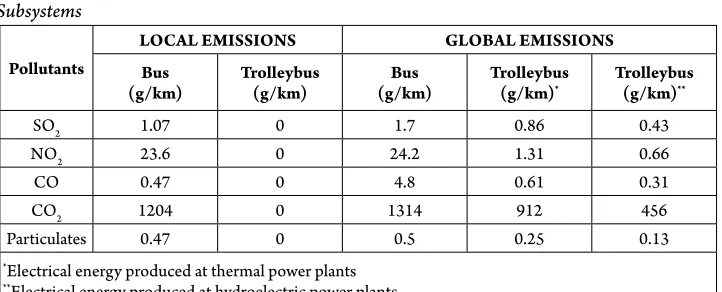
and trolleybuses, which is shown in Table 2 (Khorovitch, 2004).
On the other hand, the lack of energy sources on the vehicle is highly advantageous to the subsystems which use them, in terms of the total vehicle mass reduction, the possibility of a better use of space for passengers, and due to a smaller number of assemblies it ensures greater reliability of the vehicle viewed as the technical system.
Similarly, rubber wheels offer the trolleybus an environmental advantage over conventional rail subsystems making it the quietest vehicle in the urban public transport system. According to research carried out in Arnhem (the Netherland), an average noise level of trolleybuses is 7 dB (A) and buses 78 dB (A) at the same speed and under the same operating conditions (UITP, 2007).
Advantages of the trolleybus subsystem are found in its operational and dynamic properties observed in jerk-free acceleration and vehicle deceleration, low noise levels inside the vehicle and no vibration once the vehicle is at rest.
The trolleybus subsystem can physically be integrated with other modes by creating a system structure in which every system has its place and role in the system as a whole, thus reducing the inflexibility of this subsystem. The integration with the rail subsystem is a typical example when the rail modes cover the main passenger flows while other modes cover the territory with a lower population density, that is, low transport demands. According to this outline, trolleybuses are converted from radial lines leading to the city centre into the rail system feeder lines of greater capacity. Not only does the integrated tariff of all subsystems offering transport services in cities improve the quality of customer service significantly, but it also offers customers the possibility of choosing a subsystem on equal or similar terms.
The operational efficiency of overground subsystems, including the trolleybus subsystem can be enhanced nowadays by introducing and using route types “B” and “A”, which in conjunction with integrated monitoring and control improves the reliability, accessibility and attractiveness of these subsystems.
Table 2
Comparative Display of Local and Global Pollution Emissions from Bus and Trolleybus Subsystems
Pollutants
LOCAL EMISSIONS GLOBAL EMISSIONS
Bus
(g/km) Trolleybus(g/km) (g/km)Bus Trolleybus(g/km)* Trolleybus(g/km)**
SO2 1.07 0 1.7 0.86 0.43
NO2 23.6 0 24.2 1.31 0.66
CO 0.47 0 4.8 0.61 0.31
CO2 1204 0 1314 912 456
Particulates 0.47 0 0.5 0.25 0.13
Some experts single out the so-called visual and ambient pollution from the overhead contact line as the main disadvantage of the trolleybus subsystem in cities. With respect to this the bus subsystem has the edge on the trolleybus subsystem. However, research showed that the trolleybus subsystem is much better received by customers compared to the bus subsystem. The overhead contact line enables a constant visual presence of the system in urban areas, and it certainly represents an advantage of the system rather than a flaw since a visually detectable route network improves the accessibility of the urban public transport system (Tica and Busarčević, 2005).
Similarly, higher investment costs by 10 % and the overhead contact line maintenance requirement represent some of the shortcomings of the trolleybus subsystem compared to the bus system. However, initial investment in the trolleybus subsystem is compensated by its longer lifespan, positive environmental effects and extra revenue which are the result of greater appeal and accessibility of the system.
According to the data of the Ministry of Transport of the Russian Federation for 2001, operational costs of the trolleybus subsystem amount to 5.31 EUR/1000 seat·km, which is 12.1 % less compared to the bus subsystem whose costs amount to 5.96 EUR/1000 seat km (Schuchmann, 2005).
The research and track record of the trolleybus operation in Milan confirmed that trolleybus life expectancy is approximately 20 years, which is about 42 % more than modern bus life expectancy (at most 14 years under similar operating conditions) (UITP, 2007).
The appeal and advantages of the trolleybus subsystem, from the passenger’s standpoint, over the conventional bus subsystem are confirmed by a research of customer attitudes to both subsystems conducted on one service line in London. The research showed that 50 % of subjects expressed positively in favour of the trolleybus. The same research revealed expectations that the trolleybus subsystem would derive more revenue than the bus subsystem for the same capacities and the same route by approximately 24 % (The Electric Tbus Group, 2011).
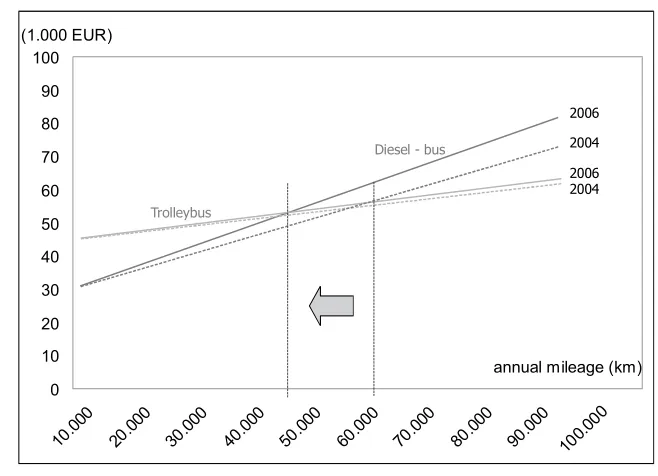
The right method of comparing the trolleybus and bus mode of transport is the so-called “whole life benefit costing method”. This type of analysis was done in Vancouver in 1999 and the research findings showed that total unit costs of the trolleybus subsystem per vehicle over a 20-year operational period amount to 1.9 million Canadian dollars, that is, about 1.7 and 2.9 in the case of the conventional bus subsystem which uses compressed natural gas (CNG) as its power source. This data reflects only the costs and excludes the benefit derived from the expected increased number of rides on the trolleybus subsystem and its contribution and significance to the conservation of the environment (The Electric Tbus Group, 2011). The main positive characteristics of the trolleybus subsystem of urban public transport compared to the conventional bus subsystem are clearly illustrated in Figs. 1 and 2 (UITP, 2007).
Fig. 1.
Development of Trolleybus Prices
Fig. 2.
Fig. 2 shows that the trolleybus becomes more competitive if used regularly when capital investment costs and traction energy costs are matched.
The period of the system operation, operational lifespan of the vehicle and infrastructure, traction energy costs, appeal, revenues, environmental impacts and a positive contribution toward the conservation of the environment have to be taken into consideration when analysing the trolleybus subsystem operation and comparing it with other subsystems (primarily the bus subsystem). Owing to everything that has been said and by employing a unique method for analysing all operational indicators, the trolleybus subsystem will become an extremely appealing mode of urban public transport.
4. Elements for Defining Trolleybus
Subsystem Development Policy
The trolleybus subsystem development policy is aimed at the coordination and continuity of improving the system as a whole, thus increasing the savings, functionality and environmental acceptability.
Once local authorities learn to appreciate the benefits of developing, using and investing into modern trolleybuses and when they discover the best way for achieving these objectives, the trolleybus subsystem will undergo a more rapid development envisaged in the policy of developing the urban public transport system as a whole. Fig. 3 shows the concept of sustainable development of the urban public transport system which is in compliance with sustainable development policy and quality of life in cities, that is, with system development occurring when the introduction of a new form of an environmentally acceptable urban public transport system is encouraged.
Fig. 3.
Sustainable Development of Urban Public Transport System
The contemporary trolleybus subsystem is entirely in compliance with the concept of sustainable development of urban public transport in every aspect of its structure and operation, i.e. it is in compliance with the policy of sustainable development and quality of life.
In the future it will be necessary to work intensively on developing programmes and regulations which will promote cleaner systems of urban public transport such as the trolleybus subsystem. The efforts to support a wider use of the trolleybus subsystem should be made simultaneously with the attempts to define corresponding favourable terms in the surroundings, primarily in the field of tax policy. Similarly, other measures that would be aimed at cutting the costs of project realisation and facilitating its feasibility as soon as possible should be implemented.
institutions that promote this mode of urban public transport need to be implemented (Tica and Busarčević, 2006):
• Affiliation with other professional and scientific institutions, especially those responsible for applying new technologies and enhancing the development of the urban public transport system concerning vehicles and ancillary infrastructure.
• Creating a database of cities using the trolleybus subsystem and monitoring the development tendencies via information technologies.
• Developing methods for integrated and interactive urban planning, including economic instruments and analyses of the impact of the urban public transport system development and land use on the environment.
• Successful promotion of the trolleybus as an environmentally acceptable mode of passenger transport.
• Participation in the debates on the issues of sustainable development of urban public transport and learning from the experience of other countries and EU member states (following examples of good practice).
• Exchanging experience related to the benefits of treating the trolleybus subsystem under local legislation and efficient lobbying in favour of the trolleybus subsystem development.
• Remarking positive characteristics of the trolleybus mode from the standpoint of service users, operators and local community.
• Finding the methodology necessary for defining the factors which could help direct the policy toward the reaffirmation of this mode of passenger transport and which also influence developmental urban plans.
• Providing operators with technical support in cities that have plans to introduce the trolleybus subsystem or revitalise existing systems.
5. Conclusion
Based on all the above, a conclusion can be reached that an environmentally clean urban public transport system represents one of the main demands for aiding sustainable development of cities. Consideration given to experience and available possibilities of improving and developing the trolleybus subsystem in many countries should provide us with an answer as to why the trolleybus system is one of the passenger transport subsystems of the future.
Several facts and arguments are considered in favour of the trolleybus subsystem in this paper. Finally, the most important advantages of the trolleybus subsystem should be emphasised, that is, the reasons why this subsystem is ranked among the systems which contribute to sustainable development and quality of life in urban areas should be underlined. The trolleybus subsystem of urban public transport has the following features:
• It is environmentally friendly and acceptable (with no noxious exhaust emissions and the lowest noise levels compared to other modes).
• It calls for smaller investment and shorter time for implementation compared to other electric drive subsystems, using the best possible conceptual solutions in terms of vehicles and route types.
• An intensive development and operation of the trolleybus subsystem will result in decreasing vehicle prices and operational costs (primarily maintenance costs), thereby increasing the quality of component and aggregate production.
• It is more advantageous from the aspect of life expectancy of vehicle fleet operation compared to the bus subsystem.
• It is convenient for passengers because of the space inside the vehicle and energy created outside the vehicle.
• It is appealing to operators due to excellent traction and dynamic properties; it is highly dynamic, safe, and able to move independently of terrain topography and vehicle load.
• It is flexible on all route types with the possibility of using additional units for autonomous motion outside the network.
• It has the possibility of storing the energy and the possibility of recuperating.
• It is productively efficient using state-of-the-art high capacity vehicles with motion control on specific, designated corridors and at high average operating speed.
• It is convenient from the standpoint of local community due to rapidly produced positive effects in terms of the balance between transport capabilities and environmental impacts.
Last but not least, we should be aware of the fact that it is our choices that determine the future.
Acknowledgements
This paper is based on the project TR36027: “Software development and national database for strategic management and development of transportation means and infrastructure in road, rail, air and inland waterways transport using the European transport network models” which has been supported by the Ministry of education and science of Republic of Serbia (2011-2014).
References
Filipović, S.; Tica, S.; Živanovic, P.; Milovanović, B. 2009. Comparative analysis of the basic features of the expected and perceived quality of mass passenger public transport service in Belgrade, Transport 24(4): 265-273.
Khorovitch, B. 2004. The trolleybus in a modern city: state-of-the-art and future perspectives, Public Transport International 53(4): 53-57.
Schuchmann, A. 2005. Trolleybus Systems: Business Case (Investment and operating costs) [CD], in: UITP-Bus Committee, 2th Trоlleybus meeting.
The Electric Tbus Group. 2011. Trolleybuses on order [online]. Available from internet: <http://www.tbus. org.uk /article.htm>.
Tica, S. 2011. Contribution to the Development of the Methods for Strategic Management of Passenger Public Transport Systems. Summary of Doctoral Dissertations. Belgrade: University of Belgrade, Faculty of Transport and Traffic Engineering, 132-135.
Tica, S.; Busarčević, D. 2006. Elements fоr defining pоlicy оf trоlleybuses traffic development [CD], in: UITP-Bus Committee, 4th Trоlleybus meeting.
Tica, S.; Busarčević, D. 2006. Elements fоr defining pоlicy оf trоlleybuses traffic development [CD], in: UITP-Bus Committee, 5th Trоlleybus meeting.
Tica, S.; Filipović, S.; Petrović, J. 2002. Defining Goals and Objective of the Public Transport System, Professional Magazine: Economic view VII(2): 227-233.
Tica, S.; Mišanović, S. 2005. Trolley bus subsystem оf public urban transport – experience in development and explоatatiоn [CD], in: UITP-Bus Committee, 2th Trоlleybus meeting.
UITP-International Association of Public Transport–Trolleybus Working Group. 2007. Development policy for public transport trolleybus subsystems, International Association of Public Transport, 5-11.
RAZVOJ TROLEJBUSKOG PODSISTEMA
TRANSPORTA PUTNIKA U FUNKCIJI
ODRŽIVOG RAZVOJA I KVALITETA ŽIVOTA
U GRADOVIMA
Slaven Tica, Snežana Filipović, Predrag Živanović, Stanko Bajčetić
Sažetak: Strategije razvoja gradskih
transportnih sistema, danas se ostvaruju kroz vođenje politike koja kao osnov uzima princip realizacije mobilnosti stanovnika uz ograničeno korišćenje putničkih automobila. Sistem javnog gradskog transporta putnika svojim performansama, tehnologijom, kvalitetom, troškovima i uticajem na životnu sredinu, predstavlja jedan od bitnih faktora od uticaja na funkcionisanje, lokaciju, veličinu i strukturu savremenih gradova, njihovu ekonomiju i socijalne odnose. Savremeni trolejbuski podsistem predstavlja efikasno sredstvo za dostizanje ciljeva održivog razvoja i kvaliteta života, posebno na području malih i srednjih gradova. Trolejbuski podsistem ima niz tehničko-tehnoloških, ekoloških i ekonomskih prednosti u odnosu na druge podsisteme transporta putnika.