SCIENCES
A SURVEY ON ROUTING PERFORMANCE IN VANET
Shilpa R*, Dr. B R Prasad Babu, Mr. Ravi Kumar M
*
M. Tech Student Dept. of CSE, R&D Centre EPCET, Bangalore
Prof. & Head Dept. of CSE EPCET, Bangalore
Associate Professor Dept. of CSE EPCET, Bangalore
ABSTRACT
Vehicular Ad-Hoc Networks (VANET) emerge from the principles of Mobile Ad-Hoc Networks (MANET). VANET considers vehicles as nodes in a network and transmits messages between these vehicles. Routing in VANET is a key challenge due to the unique features of the network which includes node movement and dynamic change in the network topology. Security is a major issue in VANET because it should provide a safety environment by transmitting warning message to the neighboring vehicles about road accidents, traffic jam or any type of attacks caused to the vehicles. The behavior of routing protocols rely on a variety of internal factors and external factors includes node movement, road topology and various hurdles that block the signals respectively. This needs an extremely flexible approach to deal with dynamic situations by choosing the best routing path and forwarding strategies and by using the appropriate models.
KEYWORDS: Vehicular Ad-Hoc Networks (VANET), Mobile Ad-hoc Networks (MANET), Routing Protocols, Security.
INTRODUCTION
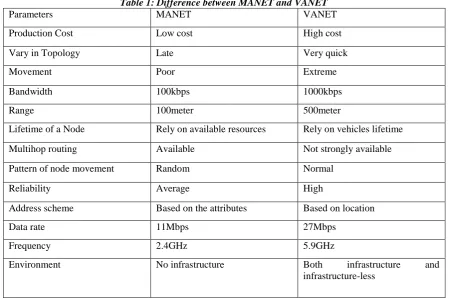
Vehicular Ad-Hoc Networks (VANET) are the wireless networks which are formed by vehicles that act as nodes in the networks. These vehicles communicate with each other through a wireless channel. VANET’s are the sub-class of Mobile Ad-Hoc Networks(MANET’s) which inherits some features which includes movement of a node in a network, time varying density of nodes, regular disconnections, partition of a network and dynamic change in the network topology [iv]. VANET is a decentralized network in which each and every node present in the network act as host and router. Security and routing are the major challenges in VANET. The differences between VANET and MANET are as shown in table 1.
Table 1: Difference between MANET and VANET
Parameters MANET VANET
Production Cost Low cost High cost
Vary in Topology Late Very quick
Movement Poor Extreme
Bandwidth 100kbps 1000kbps
Range 100meter 500meter
Lifetime of a Node Rely on available resources Rely on vehicles lifetime
Multihop routing Available Not strongly available
Pattern of node movement Random Normal
Reliability Average High
Address scheme Based on the attributes Based on location
Data rate 11Mbps 27Mbps
Frequency 2.4GHz 5.9GHz
Environment No infrastructure Both infrastructure and
infrastructure-less
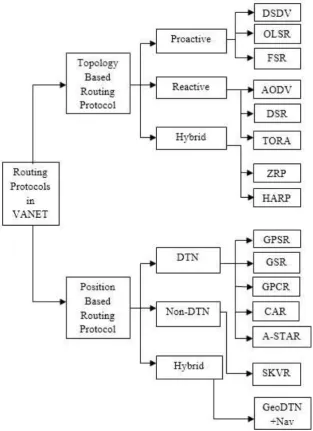
Figure 1: Classification of Routing Protocols in VANET
Topology based routing protocol
Topology based routing protocol sends the packet from the source to destination using the information of a link [viii]. In order to make the routing decisions, these routing protocols make use of the information of the communicating link and the global information of network topology. Best route in a network is identified by using IP address to identify nodes and for the route setup to forward the data.
Topology-based routing protocols can be further classified as follows 1. Proactive Routing Protocol
2. Reactive/Ad-Hoc Based Routing Protocol 3. Hybrid Routing Protocol
Proactive Routing Protocol
Proactive Routing Protocol maintains the routing information in the background regardless of communication requests. Because the destination route is saved in the background, route discovery is not possible. Each node in the network have to maintain the current routing information.
Destination-Sequenced Distance-Vector Routing (DSDV)
flooding process is optimized for setting up a route or to maintain the route. Updating and maintaining the information are the main operations involved in OLSR.
Fisheye State Routing (FSR) protocol
It maintains the node topology table and updates network information to the neighboring nodes in the network. It decreases the size of the updated message.
Routing Protocol Proactive Routing Protocol
Reactive Routing Protocol
Forwarding method Wireless multi hop forwarding
Wireless
Digital map requirement
No No
Virtual infrastructure requirement
No No
Realistic traffic flow Yes Yes Recovery strategy Multihop
forwarding
Carry and forward
Scenario Urban urban
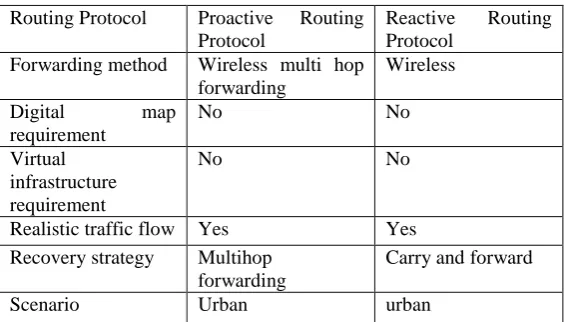
Table 2: Comparison of topology based routing protocol
Reactive/Ad-Hoc Based Routing Protocol Ad-Hoc On-Demand Distance Vector (AODV)
It is a reactive routing protocol that functions in a hop-by-hop pattern. It allows dynamic, self-starting, multi-hop routing between participating nodes. AODV also allows the nodes to maintain paths to destination which are not in active communication.
Dynamic Source Routing (DSR) Protocol
DSR is an on-demand routing protocol in which route discovery takes place when needed. Each node will have a cache, which the route to the node is stored instead of updating the routing table of the nodes. [i]
Temporally Ordered Routing (TORA) Protocol
It is an on-demand protocol. TORA generates a Direct Acyclic Graph (DAG) which consists of nodes between the source and the destination. Data in TORA will not be able to flow backwards.
Position Based Routing Protocol
Greedy Perimeter Stateless Routing (GPSR)
It is a position-based routing protocol. This protocol forwards packets using the greedy algorithm. In this the packets are forwarded through the neighboring nodes which has the shortest distance to the destination.
Geographic Source Routing (GSR) Protocol
It is a routing protocol which is used in VANET in which the algorithm receives a digital map through the GPS device and then it finds the nearest distance from source to destination on the digital map using Dijkstra algorithm and forwards the packets in the selected path. [iii]
Greedy Perimeter Coordinator Routing (GPCR) Protocol
It will search for the next hop node in order to construct the planarized graphs at the street intersection.
Anchor-Based Street and Traffic Aware Routing (A-STAR) Protocol
It combines the auxiliary anchor information in order to help the routing of packets in a network.
Connectivity-Aware Routing (CAR) Protocol
Routing Protocol
GPSR GSR GPCR CAR A-STAR GeoDTN+Nav
Forwarding Strategy
Greedy Greedy Greedy Trajectory Greedy Hybrid
Street Map Requirement
Yes Yes Yes Yes Yes Yes
Simulation Scenario
Highway City City Both city and highway
City Highway
Delivery Rate Performance
Low Low Better - - -
Real Time Communication
Traffic Use
No No No - - -
Recovery Strategy
Flooding Flooding Flooding Node awareness
Flooding Perimeter forward
Mobility Models
- M-Grid VANET MobSim
MTS M-Grid VANET
MobSim
Propagation Models
Road blocking
- Road
blocking 2-ray ground Road blocking Road blocking
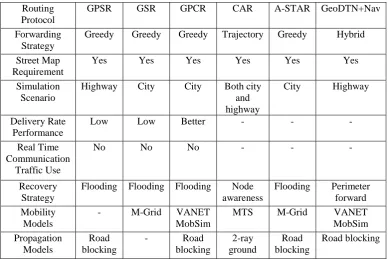
Table 3: Comparison of Position based Routing Protocol
CONCLUSION
One of the important challenges in VANET is forwarding data securely throughout the network. If forwarding the message is not secure, it might lead to malicious nodes in the network which causes traffic. After the study of multiple routing protocols in VANET, it is clear that few of the routing protocols does not provide security for data transmission.
REFERENCES
[1] Rajinder kaur, Dr. Shashi B.Rana, “Overview on Routing Protocols in VANET”, International Research Journal of Engineering and Technology, Vol.2, June 2015.
[2] Sheetal Negi, Sudesh Rani, “Comparative Study of Topology Based Routing Protocols in VANET”, International Journal of Computer Science and Information Technology and Security, Vol.5, No.3, June 2015.
[3] Sanjay Batish, Manisha Chahal and Sanjeev Sofat, “Comparative Study of Position Based Routing Protocols in VANET”, ARPN Journal of Engineering and Applied Sciences, Vol.10, No.15, August 2015.
[4] Venkatesh, A Indra, R Murali, “Routing Protocols for Vehicular Ad-Hoc Networks (VANETs): A Review”, Journal of Emerging Trends in Computing and Information Science, Vol.5, No. 1, January 2014.
[5] Chandrabhaga Pati, Dr. K R Nataraj, “A Secure Routing Protocol for VANET”, International Journal of Engineering Research and Technology, vol.3, May 2014.
[6] Rajni Singla, Namisha Sharma, “A Survey on Data Routing and Security Aspects in VANETs”, International Journal of Application or Innovation in Engineering and Management, vol.3, May 2014. [7] R Nirmala, R Subha, “A Relative Cram between MANET and VANET Background Along Routing
Protocols”, International Journal of Advanced Information Science and Technology, Vol.26, No.26, June 2014.
[8] Ms. Vimmi A Gajbhiye, “A Review and Comparative Study of Routing Protocols For VANET”, `IJACKD Journal of Research, Vol.2, February 2013.
[9] Kashif Naseer Qureshi, Abdul Hanan Abdullah, “Topology Based Routing Protocols for VANET and their Comparison with MANET”, Journal of Theoretical and Applied Information Technology, Vol.58, No.3, December 2013.
[10]Annu Kurien, A.Diana, “Survey on Various Position Based Routing Protocols in Vehicular Ad-Hoc Network”, International Journal of Engineering Research and Technology, Vol.2, December 2013. [11]Omkar Shete, Sachin Godse, “VANET: A Survey on Secure Routing”, International Journal of Science
[14]A.Shastri, R Dadhich, Ramesh C Poonia, “Performance Analysis of On-Demand Routing Protocols for Vehicular Ad-Hoc Networks, International Journal of Wireless and Mobile Networks, Vol.3, No.4, August 2011.
[15]Yun-Wei Lin, Yuh-Shyan Chen, Sing-Ling Lee, “Routing Protocols in Vehicular Ad-Hoc Networks: A Survey and Future Perspectives”, 2009.
[16]James Bernsen, D.Manivannam, “Review: Unicast Routing Protocols for Vehicular Ad-Hoc Networks: A Critical Comparison and Classification”, 2009.
ACKNOWLEDGEMENT
Ms. Shilpa R is M.Tech Scholar in Computer Science and Engineering at East Point College of Engineering and Technology, VTU. I attended and presented more than 3 papers in National and International Conference in various collages. I had attended the Handson workshop in CSI Bangalore Chapter and also attended the Handsone workshop on Big Data. My research areas are Cloud Computing, Big Data and VANET.
Mr. Ravi Kumar M is working as Associate Professor R & D Dept of Computer Science and Engineering at East Point Collage of Engineering and Technology. His research areas are Vehicular Adhoc Networks. He published more than 10 papers in various International Journals.