Original Research Article
A cross-sectional study among defaulters of DOTS under RNTCP
in tuberculosis units of Solapur city
Anand D. Gosavi
1, Viresh A. Nandimath
2*, Suresh K. Mangulikar
2INTRODUCTION
Tuberculosis (TB) is also called Koch's disease, after the scientist Koch. The bacillus causing TB, Mycobacterium tuberculosis, was identified and described on 24 March 1882 by Robert Koch.1 The DOTS (Directly Observed Treatment Short course) strategy of tuberculosis treatment recommended by WHO was based on clinical trials done in the 1970s by Tuberculosis Research Centre, Chennai, India.2 Studies in India and other developing countries have focused on various causes and risk factors for default. Gender, alcoholism, treatment after default, poor knowledge of tuberculosis, irregular treatment and
socioeconomic status are some of the factors which have been found to be associated with higher default rates3-6. The adoption of DOTS has given impressive results with higher treatment success being reported from developing7 and industrialized countries.8 Yet, default continues to occur is a matter of concern, obstacles to treatment management and an important challenge for TB control9. A comprehensive understanding of patient perceived barriers to adherence is required to develop effective patient centered programme strategies to reduce treatment default. The present study aimed to find out the various factors that influences the default among TB patients under DOTS in RNTCP. Further, corrective measures can ABSTRACT
Background: Tuberculosis (TB) is a specific infectious disease caused by mycobacterium tuberculosis affecting pulmonary and extra-pulmonary organs. Default is one of the unfavorable outcomes for patients on DOTS and represents an important challenge for the control programme. Inadequate treatment adherence is considered as a potential cause of drug resistance. This study was conducted ascertain causes of defaults & to study socio-demographic corelates of defaulters.
Methods: A cross-sectional study was conducted from 1st January 2014 to 31st December 2014. All default patients registered from 1st January 2014 to 31st December 2014 under RNTCP in both Tuberculosis Units of Municipal Corporation are considered for this study.
Results: Total 104 cases of defaulters were registered under RNTCP in both TB units; 83 (79.8%) defaulters were males and remaining 21 (21.2%) were females and difference was statistically significant. Side effects of DOTS drugs were the most common reason of defaulting the treatment. Default of DOTS was significantly associated with socioeconomic status, educational status, addiction, religion and marital status of the patients.
Conclusions: Poverty has effect on illness and completion of treatment.
Keywords: Defaulter, DOTS, Employment, Poverty, Socio-economic status
1
District Training Team, Palghar, Maharashtra, India
2
Department of Community Medicine, Dr. Vaishampayan Memorial Government Medical College, Solapur, Maharashtra, India
Received: 19 December 2018
Revised: 21 January 2019
Accepted: 31 January 2019
*Correspondence:
Dr. Viresh A. Nandimath, E-mail: [email protected]
Copyright: © the author(s), publisher and licensee Medip Academy. This is an open-access article distributed under the terms of the Creative Commons Attribution Non-Commercial License, which permits unrestricted non-commercial use, distribution, and reproduction in any medium, provided the original work is properly cited.
METHODS
Study design: A cross-sectional study.
Sample size: All the patients diagnosed and registered for DOTs under RNTCP in two.
Tuberculosis units (TU) of Municipal Corporation between 1st January 2014 to 31st December 2014 and have defaulted from treatment.
Procedure of the study
A pre-designed semi-structured questionnaire was developed and questionnaire was standardized and used for the main study. Consent was obtained from the Chief Health Officer of Municipal Corporation. The MO-TC (Medical Officer- Tuberculosis Center) conducts the weekly meeting in each tuberculosis units. The investigator attended such meetings in all the tuberculosis units and briefed the STS (Senior Treatment Supervisor) and health visitors about the study sought their co-operation for tracking the defaulters. The defaulters thus traced were visited at their residences through the address obtained from the tuberculosis units, were interviewed at their residences using the standardized questionnaire.
Inclusion criteria
All patients registered from 1st January 2014 to 31st December 2014under RNTCP in two tuberculosis units of Municipal Corporation who meet the criteria of default and willing to participate in the study and given a written consent.
Exclusion criteria
Patients registered from 1st January 2014 to 31st December 2014under RNTCP in two tuberculosis units of Municipal Corporation who meet the criteria of default but neither willing to participate in the study nor given a written consent.
Ethical consideration
This study was conducted with due permission from ethical committee of a tertiary health care center; Privacy, confidentiality and rights of patients were ensured during and after the conduct of the study. Written informed consent was obtained from the patient after detailed explanation of the objective of the study and the planned use of the information were explained.
Definition of defaulter
A patient who has not taken anti-TB drugs for two months or moreconsecutively after starting the treatment.
RESULTS
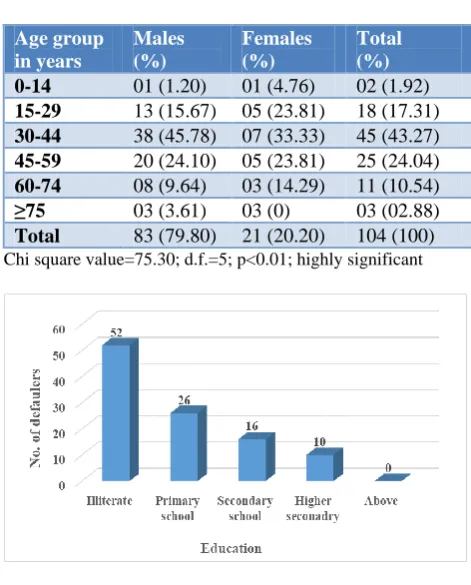
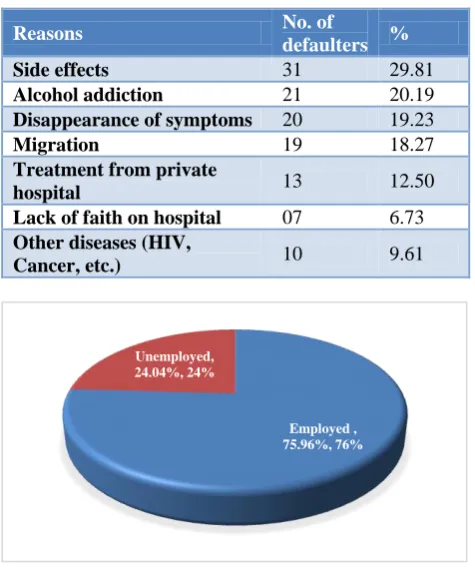
In the present study out of 104 defaulters’ maximum proportion of defaulters were in the age group of 30-44 years (43.2%) followed by 45-59 years of age group (24%). this probably could be explained by the fact that 30-44 years is considered as productive age group and their employment status could be the reason for default. Difference in the proportion was found to be statistically highly significant (Table 1). Male defaulters (79.8%) are statistically significantly more than females (20.2%). Defaulters were significantly belonged to lower socio-economic status and it shows that poverty has effect on completion of the DOTS treatment (Table 2). Illiterate patients (50%) were significantly more defaulters than other patients having higher educational status. The behavior of defaulting was found to be least (9.61%) among the patients who were educated up to the higher secondary to degree (Figure 1). It was observed that the proportion of defaulters was high amongst employed (75.96%) as compared to those unemployed (24.04%). The difference in the proportion observed was statistically highly significant (Figure 2). Side effects of DOTS medicines was the most common reason of becoming defaulter among TB patients followed by alcohol addiction and others (Table 3). Out of 104 total defaulters, 66 (63.46) were defaulted when registered for category I and 38 (36.54%) were from category II, the difference was statistically highly significant (Figure 3).
Table 1: Age and gender wise distribution of DOTS defaulters.
Age group in years
Males (%)
Females (%)
Total (%)
0-14 01 (1.20) 01 (4.76) 02 (1.92)
15-29 13 (15.67) 05 (23.81) 18 (17.31)
30-44 38 (45.78) 07 (33.33) 45 (43.27)
45-59 20 (24.10) 05 (23.81) 25 (24.04)
60-74 08 (9.64) 03 (14.29) 11 (10.54)
≥75 03 (3.61) 03 (0) 03 (02.88)
Total 83 (79.80) 21 (20.20) 104 (100)
Chi square value=75.30; d.f.=5; p<0.01; highly significant
Table 2: Socio-economic status wise distribution of DOTS defaulters.
Socio-economic status No. (%)
Class I 0 (0)
Class II 05 (04.80)
Class III 11 (10.58)
Class IV 56 (53.85)
Class V 32 (30.77)
Total 104 (100)
Chi square value=61.61; p≤0.01; highly significant.
Table 3: Distribution of DOTS defaulters as per reason of defaulting DOTS.
Reasons No. of
defaulters %
Side effects 31 29.81
Alcohol addiction 21 20.19
Disappearance of symptoms 20 19.23
Migration 19 18.27
Treatment from private
hospital 13 12.50
Lack of faith on hospital 07 6.73
Other diseases (HIV,
Cancer, etc.) 10 9.61
Figure 2: Distribution of DOTS defaulters as per employment status.
Z value=7.4885; p≤0.01; highly significant.
Figure 3: Distribution of DOTS defaulters as per DOTS category.
DISCUSSION
Present study was carried out in a Municipal corporation area comprising of population of approximate-10,00,000. Study was conducted for a period of 1 year on defaulters on DOTs under two tuberculosis units coming under the purview of Municipal corporation area. Total registered patients under these 2 TUs were 1065 out of them 104 were defaulters. In the present study default rate in two TUs was 15% which is comparable with study done by Amoran et al (14.4%) and Chandrashekaran et al (15%).10,11 The present study showed maximum number of defaulters in the age group (30-44 years) than other age group, this probably could be due to the fact that 30-44 years is considered as productive age group and their employment status could be the reason for default. A study conducted by Chadha et al showed maximum defaulters were between 21-40 years of age; while Dodor et al and Navaratnasingam et alstudy observed maximum defaulters in 15 to 30 years of age group.12-14 Our study showed male defaulters (79.80%) were significantly more than female defaulters (20.20%). Chadha et al and Dodor et al study also showed more defaulters in males as compared to females.12,13 Men tend to leave their homes quite early for work for their families and therefore may find it difficult to go regularly at health care facility and resulted in defaulter. In our study it was observed that class IV socio-economic status people were significantly more defaulters than other socio-economic status class people. Maximum proportion of defaulters was observed in lower socioeconomic classes i.e. class IV (53.84%) and class V (30.76%), class III (10.57%) as compared to defaulters in class I and class II (4.80%). So, poverty has direct effect on TB disease and completion of DOTS treatment. Karim observed in their study that default rate was more in lower socio-economical group as compared to higher classes.15 Our study observed that maximum number of defaulters were illiterate which was statistically significant as compared to educated patients. Similarly, Sophia et al and Frank et al study observed that literacy rate was significantly lower among defaulters.16,17 In our study maximum proportion of employed patients became defaulter than unemployed patients and difference in proportion was statistically significant. This difference observed was probably due fear of losing daily wages during their working hours. Lamsal study in 2008 showed patients having their own jobs found it difficult in going to DOTs centers defaulted more than jobless.18 Jain observed employment and loss of wages as one of the cause of defaulting in patients taking anti-TB treatment.19 We observed that side effects of DOTS drugs were the main reason for patients becoming defaulter and results were comparable to study done by Vijay et al, Pandit et al, Chandrashekaran et al and Jaiswal et al.6,11,20,21 In our study alcohol addiction second most-common reason for patients becoming defaulter, similarly study done by Santa et al, Epco et al and Vijay et al observed that alcohol addiction was one of the important reasons of becoming DOTS defaulter.20,22,23 It was
Employed , 75.96%, 76% Unemployed,
24.04%, 24%
64.46%
36.54%
0.00% 10.00% 20.00% 30.00% 40.00% 50.00% 60.00% 70.00%
Propo
rtion
Category
taking the treatment as they experienced improvement in the symptoms with the DOTS treatment. Chadha et al study showed that out of 639 registered cases 49 defaulters as they were feeling better after initiation of the treatment and defaulted.24 Symptoms of TB disappear usually within 2 to 4 weeks of treatment initiation and thus patient no longer perceive them sick and get defaulted (Suarez).25 In our study migration (19.26%) was one more reason of defaulting DOTS, similarly Jaggarajamma et al and Chandrashekharan et al study observed that migration was one of the reasons of becoming defaulter.11,26
CONCLUSION
It is clear that irregularity in drug intake is mainly due to multitude of certain social factors such as poverty, illiteracy, and addictions etc. which are deeply entrenched and always govern the attitude of the people towards drug intake. To tackle this problem, it is suggested firstly to improve the general standards of living, eliminate poverty, illiteracy, and few customs secondly, the patients should be fully educated after taking them into confidence and explaining the details of drug intake, gravity of the disease, adverse effect of drugs and their treatment and effect of addictions on health etc.
ACKNOWLEDGEMENTS
Authors duly acknowledge Dr. S. K. Mangulikar, Ex Professor and HOD, Community Medicine Department, Dr. V. M. Government Medical College, Solapur for their support and giving permission for conducting the present study.
Funding: No funding sources Conflict of interest: None declared
Ethical approval: The study was approved by the Institutional Ethics Committee
REFERENCES
1. Al-Sharrah YA. The Arab Tradition of Medical
Education and its Relationship with the European Tradition. Springer. 2003;33(4):413-25.
2. Kishore J. National Health Programs of India. 10th ed. Century publications; 2013.
3. Balasubramanian R, Garg R, Santha T, Gopi PG, Subramani R, Chandrasekaran V, et al. Gender disparities in tuberculosis: Report from a rural DOTS programme in South India. Int J Tuberc Lung Dis. 2004;8:323-32.
4. Arora VK, Singla N, Sarin R. Profile of geriatric patients under DOTS in Revised National Tuberculosis Control Programme. Indian J Chest Dis Allied Sci. 2003;45:2315.
5. Santha T, Garg R, Frieden TR, Chandrasekaran V, Subramani R, Gopi PG, et al. Risk factors
associated with default, failure and death
amontuberculosis patients treated in a DOTS
programme in Tiruvallur District, South India, 2000. Int J Tuberc Lung Dis. 2002;6:780-8.
6. Jaiswal A, Singh V, Ogden JA, Porter JD, Sharma PP, Sarin R, et al. Adherence to tuberculosis treatment: Lessons from the urban setting of Delhi, India. Trop Med Int Health. Delhi, India. Trop Med Int Health. 2003;8:625-33.
7. Kang CI, Choi CM, Kim DH, Kim CH, Lee DJ,
Kim HB, et al. Pulmonary tuberculosis in young Korean soldiers: incidence, drug resistance and treatment outcomes. Int J Tuberc Lung Dis. 2006;10(9):970-4.
8. Achanta S, Jaju J, Kumar AMV, Nagaraja SB,
Shamrao SRM, Bandi SK, et al. Tuberculosis Management Practices by Private Practitioners in Andhra Pradesh, India. PLOS ONE. 2013;8(8):1-10.
9. Selvam JM, Wares F, Perumal M, Gopi PG, Sudha
G, Chandrasekaran V, et al. Health-seeking behaviour of new smear-positive TB patients under a DOTS programme in Tamil Nadu, 2003. Int J Tuberc Lung Dis. 2007;11(2):161-7.
10. Amoran OE, Osiyale OO, Lawal KM. Pattern of default among tuberculosis patients on directly observed therapy in rural primary health care centres in Ogun State, Nigeria. J Infect Dis Immunity. 2011;3(5):90-5.
11. Chandrasekaran V, Gopi PG, Subramani R, Thomas
A, Jaggarajamma K, Narayanan PR. Default during the intensive phase of treatment under DOTS programme. Indian J Tuberc. 2002;52:197-202.
12. Chadha SL, Bhagi RP. Treatment outcome in
Tuberculosis patients placed under directly observed treatment short course (DOTS)- A cohort Study. Ind J Tub. 2000;47:155-8.
13. Dodor EA, Afenyadu GY. Factors associated with tuberculosis treatment default and completion at the Effia-Nkwanta Regional Hospital in Ghana. Trans R Soc Trop Med Hyg. 2005;99(11):827-32.
14. Navaratnasingam J, Seneviratne RA. Factors
contributing to medication non-compliance of newly diagnosed smear-positive pulmonary tuberculosis patients in the district of Colombo, Sri Lanka. Asia Pac J Public Health. 2008;20(3):214-23.
15. Karim F. Socio-economic Divides in Tuberculosis Control Study of Smear-Positive TB Prevalence, Care Seeking Behaviour and Role of Informal Healthcare Providers, Research and Evaluation Division, BRAC 2009, Research Monograph Series No. 41, 2009.
16. Sophia VVH, Balasangameswara PS, Jagannatha
VN, Saroja, Kumar P. Defaults among tuberculosis patients treated under DOTS in Bangalore city: A search for solution. Ind J Tub. 2003;50:185.
17. Frank R. Spencer MD. A review of tuberculosis. Bri J Community Med. 2005;55(1):5.
Tuberculosis, Lung Dis HIV/AIDS. 2009;6(1):47-55.
19. Jain RF. Faulty prescription, an avoidable cause of MDR and compliance with treatment. Indian J TB. 1998;45:141-4.
20. Vijay S, Kumar P, Chauhan LS, Vollepore BH, Kizhakkethil UP, Rao SG. Risk factors associated with default among new smear positive TB patients treated under DOTS in India. 2010;4(5):e10043. 21. Pandit N, Choudhary SK. A study of treatment
compliance in directly observed therapy for
tuberculosis. Indian J Community Med.
2006;31(4):10-2.
22. Hasker E, Khodjikhanov M, Usarova S, Umi,
Asamidinov, Yuldashova U, et al. Default from tuberculosis treatment in Tashkent, Uzbekistan; Who are these defaulters and why do they default? BMC Infect Dis. 2008;8:97.
23. Santha T, Garg R, Frieden TR, Chandrasekaran V, Subramani R, Gopi PG, et al. Risk factors associated with default, failure and death among
tuberculosis patients treated in a DOTS programme in Tiruvallur District, South India, 2000. Int J Tuberc Lung Dis. 2002;6:780-8.
24. Chadha SL, Bhagi RP. Treatment outcome in
Tuberculosis patients placed under directly observed treatment short course (DOTS)- A cohort Study. Ind J Tub. 2000;(47):155-8.
25. Pedro Suarez G. Second-line treatment for chronic tuberculosis. Lancet. 2002;360(9343):1430-2.
26. Jaggarajamma K, Sudha G, Chandrasekaran V,
Nirupa C, Thomas A, Santha T, et al. Reasons for non-compliance among patients treated under Revised National Tuberculosis Control Programme, Tiruvallur district, South India. Indian J Tuberc. 2007;54:130-5.