LAN Modeling in Rural Areas Based on
Variable Metrics Using Fuzzy Logic
Ak. Ashakumar Singh
Department of Computer Science,Thoubal College, Manipur University, India Email: [email protected]
---ABSTRACT--- The global scenario of the present world highly needs the communication between the urban areas and the rural areas. To motivate a new system for rural broadband access, there needs the integration of LAN and IEEE 802.11 WLAN technologies. The variable metrics such as Access Protocol, User traffic profile, Buffer size and Data collision and retransmission are involved in the modeling of such LAN. In the paper, a fuzzy logic based LAN modeling technique is designed for which the variable metrics are imprecise. The technique involves the fuzzification of the variable metrics to be input, rule evaluation, and aggregation of the rule outputs. The implementation is done using Fuzzy Inference System (FIS) based on Mamdani style in MatLab 7.6 for the representation of the reasoning and effective analysis. Four LAN systems are tested to analyze potential variable metrics to bring a smooth communication in the rural societies.
Keywords: Fuzzy logic, linguistic variable, performance rating, fuzzy inference system.
Date of Submission: 23, January 2013 Date of Acceptance: 31, March 2013 --- 1. INTRODUCTION
R
ural community development is the process of allocating for resources in rural areas to optimally utilize the existing local resources and raise standard of living of rural folk. The usage of information and communication technology in most part of the rural communities is extremely low as compared to the urban communities. [1] It is widely accepted that new information and telecommunication technologies are needed to alleviate wide range of obstacles for economic and social development in rural areas. The internet accessibility offers a global platform for retrieving and sharing information. There are still important handicaps outside the main urban areas that make internet connectivity a complex and costly task [2].The Internet Service Providers (ISPs) do not assume the high cost technologies designed for the urban areas, as in rural areas. Low population density and high deployment costs discourage ISP investments since the return of investment is unattractive. Nowadays, new wireless technologies are offering a very effective and low-cost solution in the rural areas for getting internet facilities. The rural community network of North Ireland is highlighting the assets of rural communities, the inequalities that currently exist and how local people must
be allowed play an important part in the future sustainability of their communities. In the year 2000 the Ph.D. thesis of Robert Conte of Blacksburg, Virginia Polytechnique Institute and State University- “ Satellite Rural Telephone Network design: A methodology for performance optimization” – it shows that important parameters have been identified in order to improve the process of effective and cost-efficient satellite rural telephone network design.
David Johnson, Meraka Institute Council for Scientific and Industrial Research Pretoria, South Africa, in his research paper “Evaluation of a Single Radio Rural Mesh Network in South Africa” – evaluates the ability of a low cost wireless mesh network to provide internet access to a rural area in South Africa with limited broadband connectivity. The designed LAN is based on the integration of a fixed LAN and IEEE 802.11 WLAN technology [3]. The service of each fixed LAN is connected to IEEE 802.11 WLAN and each LAN has appropriate design. The optimal combination of the technologies depends on the physical layout of the deployment area.
characteristics and higher buffer size (1024Kb). In [6] they developed a predictive method using fuzzy logic in order to adapt to the requirements of constraining time applications like Voice over IP.
The performance indicators of LAN may be grouped into fixed metrics, variable metrics, and performance measurement metrics [7]. The paper focused on the performance rating of the variable metrics of the performance indicators. The variable metrics in LAN performance are as follows.
1) Access protocol: The type of access protocol used by a LAN is probably the most influential metric that affects performance. IBM’s token uses a proprietary token access control scheme in which a circulating token is passed a sequentially from node to node to grant transmission. A node waits for a free channel to transmit data with a probability of 1.
2) User traffic profile: The factors that constitute a user’s traffic profile are message per data arrival rate, message size distribution (small, medium, and large), type of messages, and the number of simultaneous users (all active, 50% active, or 10% active). These user profiles are measurable in different potentialities (imprecise).
3) Buffer size: Data delayed or data discarded depends on the size of buffer (small, medium, and large). LAN internetworking devices are likely sources of buffer problems.
4) Data Collision and retransmission: The factors such as how long it takes nodes to detect a data collision and how long it takes to transmit the collided messages are considerable matter. These time variations are scaled into minimum, medium and maximum.
These imprecise terms such as small, medium, large, minimum, maximum, and waiting time are generally linguistic variables.
In the paper, a fuzzy logic-based technique is designed for effective LAN modeling in rural areas.
The rest of the paper is organized as follows. Section 2 presents methodology of the design works. The implementation and evaluation is discussed in section 3. Section 4 presents the results of the work. The last section 5 presents the conclusion of the paper.
2. DESIGN METHODOLOGY
The system is designed using fuzzy inference system which is a popular computing framework based on the concepts
of fuzzy is set theory, fuzzy if-then rules and fuzzy reasoning.
2.1 THE MODEL
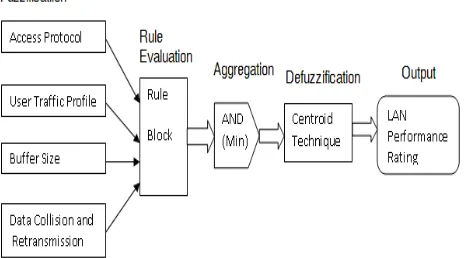
The fuzzy logic–based LAN modeling architecture is given below.
Figure 1: FIS Structure for LAN classification
(i) Fuzzification: The first phase generates the membership values for a fuzzy variable using membership functions. It is to take the crisp inputs (Access Protocol, User Traffic Profile, Buffer Size, and Data Collision and Retransmission) and determine the degree to which these inputs belong to each appropriate fuzzy set. The crisp input is always a numeric value limited to the universe of discourse. Then they are fuzzified against the appropriate linguistic fuzzy sets. Membership function is designed for each potential performance rating which is a curve that defines how each point in the input space is mapped to a membership value or degree of membership between [0,1]. Linguistic values are assigned for each variable metrics as small, medium and large while for LAN performance rating as very small, small, rather small, medium, rather large and very large. For each input their values ranges from 0 to 10 while for output ranges from 0 to 100.
(ii) Rule Evaluation: This is the second step where the fuzzified inputs are applied to the antecedents of the fuzzy rules has multiple operator (AND or OR) is used to obtain a single number that represents the result of the antecedent evaluation. We apply the AND fuzzy operation (intersection) to evaluate the conjunction of the rule antecedents. Rules added to this system are about 139, which were derived by mapping the 4 inputs to one output by using conjunction (AND). (iii) Aggregation of the rule outputs: This is the
the rules consequents previously scaled and combine them into single fuzzy sets (output). Thus, input of the aggregation process is the list of scaled consequent membership functions, and the output is the one fuzzy set got each output variable.
(iv)Defuzzification: This is the last step in the fuzzy inference process, which is the process of transforming a fuzzy output of a fuzzy inference system into a crisp output. Fuzziness helps to evaluate the rules, but the final output of this system has to be crisp number. The input for the defuzzification process is the aggregate output fuzzy set and the output is a number. This step was done using Centroid technique because it is most commonly used method of defuzzification.
Definition 1: Fuzzy Set: Fuzzy sets are an extension of classical set theory and used in fuzzy logic. In classical set theory, the membership of elements in relation to a set is accessed in binary items to crisp conditions-an element either belongs to or does not belong to the set [8].
Definition 2: Linguistic variable: A linguistic variable, whose values are linguistic terms, enables its value to be described both qualitatively by a linguistic term (i.e. a symbol serving as the name of a fuzzy set) and quantitatively by a corresponding membership function (which express the meaning of the fuzzy set) [9].
Definition 3: Fuzzy Set Theory: The Theory of fuzzy sets is, basically, a theory of graded concepts- a theory in which everything is a matter of degree or to put it figuratively, everything has elasticity. The theory has matured into a wide-ranging collection of concepts and techniques for dealing with complex phenomena, which do not lend themselves to analysis by classical methods based on probability theory and bivalent. It can represent linguistic knowledge and describe qualitative information [8].
Definition 4: Fuzzy Logic: The Japanese in numerous commercial products such as vacuum cleaners, washing machine, rice cookers, and photo cameras have successfully implemented fuzzy Logic, showers etc. resulting in energy efficiency and increased convenience for the consumer. With these valuations of fuzzy logic, many-values logic extended to allow for fuzzy premises from which graded conclusions may be drawn. It provides a formal framework for constructing systems exhibiting both good numeric performance (precision) and linguistic representation (interpretability).
Table 1: Input Linguistic variable and their membership value
INPUT VALUES Linguistic variable Linguistic
Value
Membership Value Access Protocol
small [0, 0, 3, 6] medium [4, 6, 8] large [6, 8, 10, 10] User Traffic
Profile
Small [0, 0, 2.5, 5] medium [4, 6, 8] large [7, 8.5, 10, 10] Buffer Size
small [0, 0, 2, 5] medium [3.5, 6, 7.5] Large [6, 8, 10, 10] Data Collision and
Retransmission
Small [0, 0, 2, 4.5] Medium [3.5, 5.5, 7.5] large [6.5, 8, 10, 10]
Table 2: Output Linguistic variable and its membership value
OUTPUT VALUES Linguistic variable Linguistic
Value
Membership Value
LAN Performance rating
Very small [0, 0, 30]
Small [0, 20, 40]
medium [40, 50, 70] large [60, 80, 100] Very large [75, 100, 100]
3. IMPLEMENTATION AND EVALUATION
IMPLEMENTATION
Definition 5:
Fuzzy Inference System:
As the data transmission from one node to another node is varying, a better classification is as obtained through human imprecise collections. Fuzzy logic is probably the most suitable tool for this purpose. It also maps the human decision-making capabilities using a subjective rule base. FIS translate the heuristics from human experts into tangible quantitative data and consequently into useful estimates. The proposed FIS is as shown in Fig.1.
Definition 6:
Rule Base:
decision surface as shown in Figure 9. represent statements such as the following:
If (Access protocol is low) and (user tr medium) and (buffer size is low) and (data retransmission is large), then (LAN Pe medium).
The Design of the LAN Performance is using MatLab fuzzy logic toolbox as given be a) FIS Editor: Fig. 2 is the window through FIS type with the particular model is sel can be added, and input and output varia be changed.
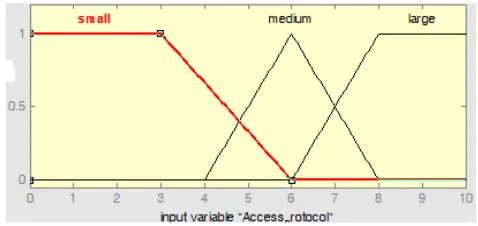
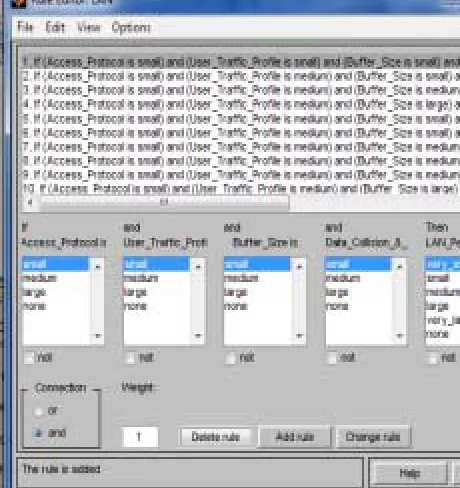
b) Membership function Editor: Fig. 3a to windows through which the input or the of the membership function is changed an function can be added or removed. It ranges of each variables and membership c) Rule Editor and Rule viewer: Fig.5a & F
windows of the rules editor and rules various membership functions of Performance. The rules can be changed or requirement parameters. It changed the co weight applied to the rules. It shows the of output values from the defuzzification crisp output value of the designed system d) Surface Viewer: It examined the output of the designed FIS. Input variables ca from three x, y, and z-axes respectivel output value as shown in Fig.6.
Figure 2: Fuzzy Inference Edito
. These rules
raffic profile is a collision and erformance is
s implemented elow:-
h which a new lected, variable able names can Fig. 4 are the e output values nd membership specified the functions. Fig. 5b are the
viewer of the
f the LAN
r deleted as the onnections and representation and shows the .
surface viewer an be selected ly yielding an
or
Figure 3a: Membership function for in Protocol”
Figure 3b: Membership function for i Traffic Profile”
Figure 3c: Membership function for in Size”
Figure 3d: Membership function for i Collision and Transmis
nput variable “Access
input variable “User
nput variable “Buffer
Figure 4: Membership function for Output variable “LAN Performance Rating”
Figure 5a: FIS Rules Editor when the output variable is very small.
Figure 5b: FIS Rules Editor when LAN Performance Rating=20.
.
Figure 6: Surface Viewer of input and output variable of LAN
4. RESULT
analyze the different assumptions and the output value shows the system is robust enough for the evaluation of the performance ratings. The output value ranged from 0 to 100 each corresponding to the input variables. The results of four LAN systems are shown in Table 3.
Table 3: Results of LAN performance Rating LAN systems Performance Rating Implication
LAN1 20 Very Small
LAN2 54.2 medium
LAN3 80 large
LAN4 89.2 Very large
5. CONCLUSION
The paper is highly emphasizes in modeling the performance ratings of different LAN input variable metrics. It is impossible to provide assurance for the LAN system and justify performance measures incorporated unless the system is analyzed during the designing state of the different LAN systems.
REFERENCES
[1]. H.Galperin, Wireless networks, and Rural Development. The Massachusetts Institute of Technology, Information Technologies, and International Developments, Vol 2(3), 2005.
[2]. Khairuddin Ab Hamid Al-Khalid Othman Jing- Hong Liew, Alvin W. Yeo, Implementation of wireless networks in rural areas. Damai Sciences Sdn Bhd, 2004. Universiti Malaysia Sarawak.
[3]. IEEE/IEC Std 802.11, Wireless LAN Medium Access Control (MAC) and Physical Layer (PHY)
specifications, The Institute of Electrical and Electronics Engineers, Inc., August 1999.
[4]. Teuber, Andreas, Eissfeller, Bernd, Pany, Thomas, "A Two-Stage Fuzzy Logic Approach for Wireless LAN Indoor Positioning," Proceedings of IEEE/ION PLANS 2006, San Diego, CA, pp. 730- 738, April 2006. [5].Rahul Malhotra, Vikas Gupta, R. K. Bansal,
Simulation & Performance Analysis of Wired and Wireless Computer Networks, International Journal of Computer Applications (0975 – 8887),Vol 14(7), February 2011.
[6]. http://www.engineeringletters.com/issues_v20 /issue_1/ EL20114.pdf accessed dt. 22 Aug, 2012. [7]. K. Terplan, Effective Management of Local Area
Networks, 2nd Edition, McGraw-Hill, New York, 1996.
[8]. L.A.Zadeh, Fuzzy Sets, Information and Control, Vol.8, pp.338-353, 1965.
[9]. J.Yen, R.Langari, Fuzzy Logic, Intelligence Control and Information, First Indian Reprint, Pearson Education Private Ltd, 2003.
Authors Biography: