Categorization and Rating the Privacy
Maintaining Data Mining Proficiencies by
Applying a Data Change–based Model
1Dheeraj Agarwal, 2Jitendra Nath Srivastava
1Research Scholar Invertis University, Bareilly-Email:[email protected] 2Associate Prof. Invertis University, Bareilly.
---
ABSTRACT---
In recent years, the data mining proficiencies have met a dangerous challenge due to the altered regarding and concerns of the privacy that is, defending the secrecy of the vital and sore data. Different proficiencies and algorithms have been already demonstrated for Privacy Preserving data mining, which could be assorted in three common approaches: Data modification approach, Data sanitization approach and Secure Multi-party Calculation approach. This paper demonstrates a Data modification– based Framework for categorization and valuation of the privacy maintaining data mining techniques. Based on our model the proficiencies are divided into two major groups, namely perturbation approach and anonymization approach. Also in proposed model, eight functional criteria will be used to examine and analogically judgment of the proficiencies in these two major groups. The suggested framework furnishes a good basis for more accurate comparison of the given proficiencies to privacy maintaining data mining. In addition, this framework permits distinguishing the overlapping quantity for different approaches and describing modern approaches in this field.Keywords - Privacy Preserving Data Mining, Data Modification, Perturbation, Anonymization
---
Date of Submission: December 09, 2012 Date of Acceptance: January 21, 2013---
1.
Introduction
A
lthough data mining can be worthful in many applications, it may grounds to ravishment of secrecy in case of no plenty protection and misusing private data for other ends. The main factor of privacy landing in data mining is data misuse. In fact, if the data consists of critical and private characteristics and/or this technique is abused, data mining can be risky for individuals and establishments. Hence, it is necessary to prevent revealing not only the personal confidential information but also the knowledge, which is critical in a given field [1].The main attention to Privacy Preserving Data Mining (PPDM) is growth of those algorithms, which - by defending subsisted private data and knowledge in datasets and accessing the valid outcomes of data mining-provide the possibility to share the critical and private data for analytical intentions.
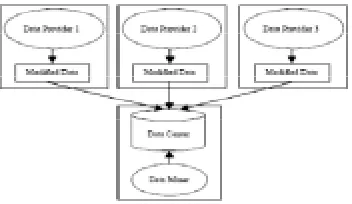
There are two universal assumptions in Privacy Preserving Data Mining: the Multi-party coactions scenario and Data publishing scenario. In the former, the accumulation of data is distributed between two or more sites, each one owns a part of the private data and these sites cooperate to calculate a data mining algorithm on the union of their databases without
disclosing the data at their individual sites and the results of data mining will only be disclosed. The major approach for this scenario is the Secure Multi-party Calculation.
Figure 1. PPDM based on Data printing scenario
This paper tries to furnish a good ground for categorization and more exact rating of data adjustment–based proficiencies for Privacy Preserving Data Mining. The rest of the paper is coordinated as follows. In section 2, the commended classification framework for data modification techniques in PPDM will be given and then we put in these techniques. In section 3 we suggest the evaluation framework and analyze these techniques under this framework and finally, in section 4, the paper will be settled by conclusion as well.
II.CLASSIFICATION FRAMEWORK
Data alteration techniques analyze and review for PPDM demonstrates that these proficiencies can be assorted in two principle groups of perturbation-based and anonymization-based techniques according to how the protection of privacy. The advocated classification framework is shown in figure 2.
Figure 2. Data Modification-based framework for classification the PPDM Techniques
Anonymous proficiencies are holding from separating the critical data's qualities and identity to maintain the privacy while disruption approach change a part of data or the whole dataset by means of determined techniques and in a manner to save the particular properties, which are meaningful and
significant for creating data mining models. The current proficiencies in disruption approach are assorted in two categories based on how they perturb datasets and special Properties that will be maintained in data: Value-based Disruption and Multi-Dimensional Perturbation. In the Value-based Disruption the intention is to maintain statistical characteristics and columns distribution while Multi-Dimensional Perturbation aims to hold Multi-Dimensional information.
A. Anonym ization Techniques
First natural solution to publish raw-critical data with privacy preserving is de-identification in which the raw-critical dataset is spread after removing the key identities of the records. But, in combination with an external database, there might be some other attributes to be used for identifying the personal details, called "Quasi-Identifier" (QI). To solve re-identifying problem, anonymization approach was brought up, in which the values of the QI attributes become modified so that they no longer uniquely represent individuals.
1) K-anonymity Technique
In this proficiency each record within an anonymized table must be identical with at least k-1 other record among the dataset, with respect to a set of QI attributes. Particularly, a table is K-anonymous if the QI attributes values of each record are identical to those of at least k-1 other records. To accomplish the K-anonymity demand, generalization or suppression could be used [2, 3].
However, this proficiency comprises of some limitations. First, it is very hard for a database owner to decide which of the attributes are or are not available in external tables. Second, this model considers a certain type of attack (Linkage attack) and cannot preserve sufficiently the sensitive attributes against Homogeneity attack (similarity of the sensitive attributes values in an anonymized group) and Background Knowledge attack (awareness about the relationship between sensitive and QI attributes).
2) L-diversity Proficiency
As it was discussed, L-diversity technique's deficiency is that it deals all values of a given dimension in a same way regardless of its distribution in the data, while this rarely happens for real datasets in which the values of the sensitive attributes are not probably in the same sensitivity level; in this way, the precise values of sensitive attributes might be inferred by the use of Background Knowledge Attack. In T-Closeness Technique [5] the distance between the distribution of a sensitive attribute in an anonymized group and its distribution in the whole table should not be more than t threshold. The main challenge of this task is how to show the distance criterion which can reflect the semantic gap between the quantities.
Overall, anonymization techniques are simple and their main advantage is scalability toward privacy preservation (choosing greater K); however, they have an inherent weakness that they cannot always prevent the records' critical values deduction against attacks efficiently. Moreover, it has been shown that optimal anonymization is an "NP-Hard" problem [6]. Furthermore, this technique is not even effective with increasing dimensionality, since the data can typically be combined with either public or background information to reveal the identity of the underlying record owners [7].
B. Value-based Perturbation Techniques
The main idea of this approach is to add random noise to the data values. This approach is actually, based on this fact that some data mining problems do not need the individual records necessarily and they just need their distribution. Since the perturbing distribution is known, they can reach data mining goals by reconstructing their required aggregate distributions. However, due to reconstructing each data dimension's distribution independently, they have the inherent disadvantage of missing the implicit information available in multi-dimensional records and on the other hand it is required to develop new distribution-based data mining algorithms.
1) Random Noise Addition Technique
This technique is described in [8] as follows: Consider n original data X1,X2…….,XN, where X i are
Variables following the same independent and identical distribution (i.i.d). The distribution function of X i is denoted as FX , n random variables Y1,Y2,……..YN are
generated to hide the real values of Xi by perturbation. Similarly, Yi are i.i.d variables. Disturbed data will be generated as follows:
w1 …wnwhere wiXi Yi, i=1,...,n (1)
It is also assumed that the added noise variance is large enough to let an accurate estimation of main data
Values take place. Then, according to the perturbed datasetw1,…….,wn, known distributional function FY and
using a reconstruction procedure based on Bayes rule, the density function ' X f will be estimated by Equation (2).
Although fX isn't really known, we can estimate it by using the normal distribution as the initial estimate and iteratively refine this estimate by applying Equation (2). In [9], to minimize the information loss of this technique and improve the reconstruction procedure, a new distribution reconstruction algorithm called Maximizing Algorithm for the Expectation of Mathematics (EM) is represented. In [8] a new decision-tree algorithm is developed according to this technique. This technique is also used in privacy preserving association rule mining [10, 11].
However, in [12] it is presented that privacy breaches as one of the major problems with the random noise addition technique and observed that the spectral properties of the randomized data can be utilized to separate noise from the private data. The filtering algorithms based on random matrix theory are used to approximately reconstruct the private data from the perturbed data. Thus, establishing a balance between Privacy preservation and accuracy of data mining result is hard because more we want privacy preservation, more we should lose information.
2) Randomized Responses Technique
The main idea for this technique [13] is to scramble data so that the data collector cannot express, with a probabilities better than of the defined threshold, whether the data sent back by the respondent is correct or not. There are two models in this technique: Related– Question and Unrelated- Question models. In the former, the interviewer asks every respondent a couple of questions related together, of each the reply is opposite the other one. For example, the questions can be as follows:
1) I have the sensitive attribute A. 2) I do not have the sensitive attribute A. The respondent will answer randomly and with θ probability to the first question and with 1- θto the second question. Although the interviewer finds out the answers (yes or no), he does not know which question has been answered by the respondent; hence, the respondent's privacy preserving will be saved. The collector uses the following equations in order to estimate the percentage of the people who have characteristic A:
answers to sensitive questions. The purpose is to gainP(A=yes)P(A=no).
Although in this method, information from each individual user is scrambled, if the number of users is significantly large, the aggregate information of these users can be estimated with decent accuracy. Randomized response technique used to provide information with response model, so are used for processing categorical data. Note that the technique can be extended to multi-dimensional, i.e., the techniques are applied to several dimensions altogether [23]. *
C. Data Mining Task-based Perturbation Techniques
The purpose of these techniques is to modify the original data so that the properties preserved in perturbed dataset to be task specific information data mining tasks and even a particular model. Thus, it is possible to preserve the privacy without missing any particular information of data mining tasks and make a more suitable balance between privacy and data mining results accuracy. Furthermore, in these techniques, data mining algorithms can be applied directly and without developing new data mining algorithms on the perturbed dataset.
1) Condensation Technique
The purpose of this technique is to modify the original dataset into anonymized datasets so that this anonymized dataset preserves the covariance matrix for multiple columns. In this technique first the data will be condensed into groups with pre-defined size K, and a series of statistical information related to the mean and correlations across the different dimensions will be preserved for each group of records. In the server, this statistical information is used to generate anonymized data with similar statistical characteristics to the original dataset. This technique has been used to create simple classifier for the K Nearest Neighbor (KNN) [14].
However in [15] it is presented that this technique is weak in protecting the private data. The KNN-based data groups result in some serious conflicts between preserving covariance information and preserving privacy.
2) Random Rotation Perturbation Technique
The main idea is as if the original dataset with d columns and N records represented Xdxn , the rotation
perturbation of the dataset X will be defined as G (X)= RX . Where Rdxd is a random rotation orthonormal
matrix.
A key feature of rotation transformation is preserving the Euclidean distance, inner product and geometric shape hyper in a multi-dimensional space. Also, kernel methods, SVM classifiers with certain kernels and hyper plane-based classifiers, are invariant to rotation perturbation, i.e. if trained and tested with rotation perturbed data, will have similar model accuracy to that trained and tested with the original data. [15].
But researches show that having previous knowledge, the random rotation perturbation may become involved in privacy violations against different attacks including Independent Component Analysis (ICA), attack to rotation center and distance-inference attack [16, 17].
3) Geometric Perturbation Technique
This perturbation technique is a combination of Rotation, Translation and Noise addition perturbation techniques. The additional components ψ and ∆ are used to address the weakness of rotation perturbation while still preserving the data quality for classification modeling. Concretely, the random translation matrix addresses the attack to rotation center and adds additional difficulty to ICA-based attacks and the noise addition addresses the distance-inference attack. If the matrix Xdxn indicates original dataset with d
columns and N records, Rdxd be a orthonormal random
matrix, ψ be a translation random matrix and ∆dxn be a
random noise matrix, where each element is Independently and Identically Distributed (iid) variable like Gaussian distribution N(0,σ2), the geometrical perturbation will be defined as following [17]:
Definition: let tdX1 represent a random vector and l1Xna
vector of "N" '1's. Matrix ψis a translation matrix If ψ= [t,t…….,t]dXn
i.e.
This perturbation technique is invariant against geometrical modification and is fixed for Kernel, SVM and linear classifiers. Geometrical perturbation technique also has, rather than Rotation perturbation and condensation, high-great Privacy Preserving guarantees.
D. Dimension Reduction-based Perturbation Techniques
and the exact value of each element of the original data are kept confidential.
1. Random Projection Perturbation Technique
Random projection [16] refers to the technique of projecting a set of data points from a high-dimensional space to a randomly chosen lower-dimensional subspace. If the matrix X mXn (or Y mXn ) indicates original dataset,
RnXk (k<n)( or R’kXm (k< m) ) ) be a random matrix such
that each entry riXj of R (or R’ ) is independent and
identically chosen from some unknown distribution with mean zero and variance , the Column-wise Projection G(X) and Row-wise Projection G(Y) will be defined as below:
The key idea of random projection arises from the Johnson-Lindenstrauss Lemma [18]. According to this lemma, it is possible to maintain distance-related statistical properties simultaneously with dimension reduction for a dataset. Therefore, this perturbation technique can be used for different data mining tasks like including inner product/Euclidean distance estimation, correlation matrix computation, clustering, outlier detection, linear classification, etc.
However, this technique can hardly preserve the distance and inner product during the modification in comparison with geometric and random rotation techniques. It has been also clarified that having previous knowledge about this perturbation technique may be caught into privacy breach against the attacks [17].
2. Singular Value Decomposition (SVD) Technique
The SVD [19] is a well-known method of dimension reduction in data mining process. If AnXm matrix indicates
the original dataset, then SVD for data matrix A will be as:
Where Unxn is an orthonormal matrix, VTmxm is an
orthonormal matrix and Σnxm is a diagonal matrix whose
nonnegative diagonal entries are the singular values in a descending order,
Due to the arrangement of the singular values in the matrix Σ (in a descending order), the SVD transformation has the property that the maximum variation among the objects is captured in the first dimension. Similarly, much of the remaining variations are captured in the second dimension, and so on. Thus,
a transformed matrix with a much lower dimension can be constructed to represent the structure of the original matrix faithfully, defined as below:
In data mining applications the omitted part Ek= A -Ak
could be considered as the noise in the original dataset. Hence, in many of conditions, mining over the reduced dataset Ak can produce better results than mining on the
original dataset. When this technique is applied for Privacy Preserving purposes, the distorted dataset Akcan
protect the privacy and simultaneously, keeps the utility of the original data as it can faithfully represent the original data structure. [20].
3) Non-negative Matrix Factorization (NMF) Technique
NMF [21] is a matrix factorization method to obtain a representation of data using nonnegative constraints. Considering a nxm nonnegative matrix dataset A with Aij >= 0 and a pre-specified positive integer k<=min{n,m} , nonnegative matrix factorization (NMF) finds two non-negative matrixes
with Wij >= 0 and , such that A=WH and the objective function is minimized:
W and H matrixes have many mostly-desired Properties in data mining applications. In [22] the NMF technique is used for Privacy Preserving in Data mining applications.
Recently, accordance with classification algorithms, it has been shown that SVD and NMF provide much higher degree of data distortion than the standard data distortion techniques based on adding uniformly distributed noise or normally distributed noise. Moreover, these techniques consist of a high-level accuracy in data mining results as well as high-level privacy preserving.
III. EV A L U A T I O N FR A M E W O R K The evaluation framework recommended for assessing and evaluating data modification-based techniques, is in accordance with the following eight criteria:
• Privacy Loss: is defined as difficulty level in estimating the original values from the perturbed data values.
mining task, which contains the possibility to mine it, after applying the privacy preserving techniques.
• Modifying the Data Mining Algorithms: based on the needs, notifies the change for the existed data mining algorithms, in order to mine over the modified dataset.
• Preserved Property: that is, data information, which was already saved after applying the privacy preservation techniques.
• Data Type: it points out the types of data, which could be numerical, binary, or categorical.
• Indistinguishability Level: it is in accordance with level of indistinguishability of different records of the original dataset.
• Data Dimension: it is defined based on the purpose of PPDM technique for preserve Dimensional information, which could be single-Dimensional or Multi-single-Dimensional.
The techniques based on data modification in Privacy Preserving Data Mining were already analyzed and assessed based on the above-mentioned criteria, as shown in table (1).
IV CONCLUSION
In this paper, a data modification-based framework was presented for classification and evaluation the Privacy Preserving Data Mining techniques. At first, these techniques classified into two classes of anonymization and perturbation approaches and after analyzing each approach, their significant characteristics were given. The main challenge of anonymization approach was insufficient protection of critical values deduction against different attacks and being NP-Hard optimal anonymization. Instead, in perturbation process although it has a great efficiency from computation cost point of view, creating a suitable and stable balance between privacy and data mining results accuracy in that, is difficult.
Hence how to create a better balance between privacy and accuracy, how to further improve the algorithms efficiency and privacy preserving generality in different types and different Data mining tasks are some of the research aspects in the future.
REFERENCES:-
[1]. Stanley R. M. Oliveira, and Osmar R. Zaïane1, "Towards Standardization in Privacy-Preserving Data Mining", In ACM SIGKDD 3rd Workshop on Data Mining Standards, 2004, pp. 7–17.
[2]. P. Samarati and L. Sweeney, “Protecting privacy when disclosing information: k-anonymity and its enforcement through generalization and suppression”, In Technical Report SRI-CSL-98-04, SRI Computer Science Laboratory, 1998.
[3]. L. Sweeney, “k-anonymity: a model for protecting privacy”, International Journal on Uncertainty, Fuzziness and Knowledgebased Systems, 2002, pp. 557-570.
[4]. A.Machanavajjhala, J.Gehrke, and D.Kifer, “~-diversity: Privacy beyond k-anonymity”, In Proc. of ICDE, Apr.2006.
[5]. N. Li, T. Li, and S. Venkatasubramanian, “t-Closeness: Privacy Beyond k-anonymity and ~-Diversity”, In Proc. of ICDE, 2007, pp. 106-115 [6]. Meyerson and R. Williams. "On the complexity of
optimal k-anonymity", In Proceedings of PODS’04, pages 223–228, New York, NY, USA, 2004. ACM. [7]. Aggarwal. "On k-anonymity and the curse of
dimensionality", In Proceedings of VLDB’05, pages 901–909. VLDB Endowment, 2005.
[8]. R. Agrawal and R. Srikant. "Privacy-preserving data mining," In Proc. SIGMOD00, 2000, pp. 439-450. [9]. D. Agrawal and C. Aggarwal. "On the design and
quantification of privacy pre-serving data mining algorithms", In Proc. of the Twentieth ACM SIGACT-SIGMOD-SIGART Symposium on Principles of Database Systems, Santa Barbara, California,USA, May 2001.
Data Bases (VLDB’02), Hong Kong, China, 2002,pp. 682–693.
[11]. Evfimievski, A., Srikant, R., Agrawal, R., and Gehrke, J, "Privacy Preserving Mining of Association Rules", In Proc. KDD02, 2002, pp. 217-228.
[12]. H. Kargupta, S. Datta, Q. Wang, and K. Sivakumar, “On the Privacy Preserving Properties of Random Data Perturbation Techniques,” Proc. IEEE Int’l Conf. Data Mining, Nov. 2003.
[13]. L. Warner. "Randomized response: A survey technique for eliminating evasive answer bias," The American Statistical Association, 60(309):63–69, March 1965.
[14]. AGGARWAL, C. C., AND YU, P. S. " A condensation approach to privacy preserving data mining." Proc. of Intl. Conf. on Extending Database Technology (EDBT) (2004).
[15]. Chen, K., and Liu, L. “Privacy Preserving Data Classification with Rotation Pertubation”, Proc. ICDM, 2005, pp.589-592.
[16]. K. Liu, H. Kargupta, and J. Ryan, “Random projection-based multiplicative data perturbation for privacy preserving distributed data mining,” IEEE Transactions on Knowledge and Data Engineering, January 2006, pp. 92– 106.
[17]. Keke Chen, Gordon Sun, and Ling Liu. Towards attack-resilient geometric data perturbation.In Proceedings of the 2007 SIAM International Conference on Data Mining.,April 2007.
[18]. W.B. Johnson and J. Lindenstrauss, “Extensions of Lipshitz Mapping into Hilbert Space,” Contemporary Math., vol. 26,pp. 189-206, 1984.
[19]. Golub GH, van Loan CF (1996) Matrix computations, 3rd edn. John Hopkins University, Columbia, MD
[20]. Xu, S., Zhang, J., Han, D., & Wang, J. (2006). Singular value decomposition based data distortion strategy for privacy protection. Knowledge and Information Systems, 10(3), 383-397.
[21]. D. D. Lee and H. S. Seung, “Algorithms for non-negative matrix factorization,” In NIPS, Neural Information Processing Systems, pp:556-562, 2000
[22]. Wang, J., Zhong, W. J., & Zhang, J. (2006). NNMF-based factorization techniques for high-accuracy privacy protection on nonnegative-valued datasets. Proceedings of the IEEE Conference on Data Mining 2006, International Workshop on Privacy Aspects of Date Mining (PADM 2006), pp. 513-517, Hong Kong, China.
[23]. W. Du and Z. Zhan. Using randomized response techniques for privacy-preserving data