Original Research Article
Availability and utilization of sanitation facilities amongst the tea
garden population of Jorhat district, Assam
Parash Jyoti Bora, Bishnu Ram Das*, Netri Das
INTRODUCTION
Adequate sanitation, together with good hygiene and safe drinking water are essential for good health and also for social and economic development.1 Basic sanitation is described as having access to facilities for the safe disposal of human waste (feces and urine), as well as having the ability to maintain hygienic conditions, through services such as garbage collection, industrial/hazardous waste management, and wastewater treatment and disposal.2 Globally, 2.3 billion human beings still do not have access to basic sanitation facilities such as toilets or latrines. Of these, 892 million
still defecate in the open field, for example in street gutters, behind bushes or into open bodies of water. Inadequate sanitation is estimated to cause 280 000 diarrhoeal deaths annually and is a major factor for causing numerous neglected tropical diseases, including intestinal worms, schistosomiasis and trachoma.3
WHO has introduced Global Strategy 2015-2020 which includes Water, Sanitation and Hygiene (WASH) that is critical for prevention and care of all the neglected tropical diseases (NTDs) scheduled for intensified control or elimination by 2020.4 Provision of safe drinking water, sanitation and hygiene are key interventions within
ABSTRACT
Background: Globally, 2.3 billion people still do not have basic sanitation facilities such as toilets or latrines. Inadequate sanitation is estimated to cause 280 000 diarrhoeal deaths annually. Tea garden population belonging mostly to lower socio economic class, often lacks access to basic safe drinking water and sanitation. This study aims to assess the availability and utilization of sanitation facilities amongst the tea garden population.
Methods: A Community based descriptive cross sectional study was conducted among the people residing in the lines of tea gardens of Jorhat district. Using multistage cluster sampling a total of 540 eligible subjects were selected for our study and they were interviewed using a pre-designed pre-tested schedule.
Results: In our study, sanitation facilities were available in 58.9% households of which 83.1% were sanitary type and 69.7% latrines were functional. Out of the 318 respondents who have latrine, 61.1% reported that they use latrine regularly while 64.1% study respondents had the practice of open air defecation.
Conclusions: The availability of sanitation facility and latrine utilization rate of the households were not satisfactory. This reflects that various schemes related to sanitation that are planned and implemented by Government have not been reached to the majority of tea tribe population. So an urgent call has to be made to all stakeholders to work in close collaboration to ensure access and utilization of sanitation facilities among the vulnerable tea plantation community.
Keywords: Latrine, Availability, Utilization, Tea garden, Assam
Department of Community Medicine, Jorhat Medical College, Jorhat, Assam, India
Received: 27 March 2018
Accepted: 03 May 2018
*Correspondence:
Dr. Bishnu Ram Das,
E-mail: [email protected]
Copyright: © the author(s), publisher and licensee Medip Academy. This is an open-access article distributed under the terms of the Creative Commons Attribution Non-Commercial License, which permits unrestricted non-commercial use, distribution, and reproduction in any medium, provided the original work is properly cited.
the global NTD roadmap. Yet to date, the WASH component of the strategy has received little attention and the potential to link efforts on WASH and NTDs has been largely untapped. 5
Having a latrine at home is found to be a protective factor for the prevention of communicable diseases.6 Only, 31.9% and 63.9% households in rural India and urban India respectively had access to latrine facility for its exclusive use. More than half of the rural population of the country still defecates in open.7 India accounts for 90 % of the people in South Asia and 59 % of the 1.1 billion people in the world who practice open defecation.8 Improper utilization of sanitary facilities leads to the contamination of the water sources. Contaminated or infected water along with poor sanitation are linked to transmission of diseases such as cholera, diarrhoea, dysentery, hepatitis A, typhoid and polio. Proper utilization of sanitary facilities helps to interrupt diseases transmitted through the faecal-oral route. Absent, inadequate, or inappropriately controlled water and sanitation offerings expose individuals to preventable health risks.9
The tea gardens workers of Assam happens to be the most exploited class in the organised sector of economy. They mostly belong to lower socio economic group, lives in an unhygienic environment and often lack access to basic safe drinking water and sanitation. The poor socio-economic condition, illiteracy, over-crowded and unhygienic living conditions in the residential colonies makes tea garden populations vulnerable to various communicable diseases.10 Therefore it was decided to carry out a research study for assessing the availability and utilization of sanitation facilities amongst the tea garden population of Jorhat district, Assam.
METHODS
The present study is a community based descriptive cross sectional study conducted among the people residing in the lines of tea gardens of Jorhat district from July 2016 to June 2017.
According to Census 2011, the prevalence of access to safe drinking water in rural households of Assam was found to be 68.3%.11 So considering prevalence rate as 68.3%, with 5% allowable error and design effect of 1.5, the sample size was calculated to be 525.
A multistage cluster sampling was used in the study to select the required number of samples from the study universe. In the first stage, out of the 70 registered tea gardens of Jorhat district, 30 Clusters (tea garden) were selected using Probability Proportion to Size (PPS) cluster sampling technique. In the second stage, from each selected cluster (tea garden) a tea garden line was selected using simple random sampling technique. A tea garden line consists of around 40-100 households. In the third stage from the selected line, 18 households were
selected by using systematic random sampling (SRS) technique. A list of the households was made in the selected line. Thereafter, a random number was chosen by taking first digit of a currency note and subsequently every 3rd household was visited till the 18 household were completed. From the each selected household, an adult member who was willing to participate in the study was considered as study participant. If no adult member was found in the selected household or household found locked, then the adjacent household was selected for the study. In case the required number of respondent could not be completed in the selected line, then the adjacent line was incorporated to complete the requisite number. A total of 540 households were thus visited during the study period.
Data from the selected household was collected in a pre-designed pre-tested semi-structured interview schedule. A written informed consent was obtained from all the study participants.
The data entry was done in MS Excel 2010 and result obtained was presented in the form of Tables and Diagrams. Mean, Standard Deviation, Percentage (%), Proportion were calculated. Statistical analysis was done using SPSS version 23.0 using standard statistical test like Chi square test, Odds ratio was used to measure the association between variables. Statistical significance was done at 95% confidence interval i.e. p-value<0.05
RESULTS
Of the total 540 study respondents, majority (67.4%) belonged to the age group of 30 to 50 years, 62.2% were males and 78.3% followed Hinduism. 93.3% of the study respondents belonged to other backward caste (OBC) and 74.4% were from nuclear family. In our study majority of head of the household were educated up to the Primary school level (63.3%) and were permanent tea garden workers (62.8%). We have also observed that majority (57.2%) study respondents were from lower middle socioeconomic status (SES) (Class IV) as per Modified B.G. Prasad’s scale. None of the respondents were from upper SES.
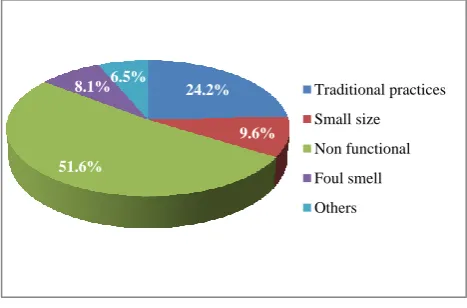
Figure 1: Reasons for not using latrine.
24.2%
9.6%
51.6%
8.1% 6.5% Traditional practices Small size
Non functional
Foul smell
Of the total 540 study households sanitation facilities were available in 318 (58.9%) households. These sanitation facilities in the form of latrine were constructed majority by Government authority (52.2%). While enquiring about the type of latrines available it was found that 83.1% were sanitary type. We examined the functionality of the sanitary latrine and observed that 69.7% were functional of them water flushing facility was available in 96.2% households and hand washing facility with soap was available in 94.1% households (Table 1).
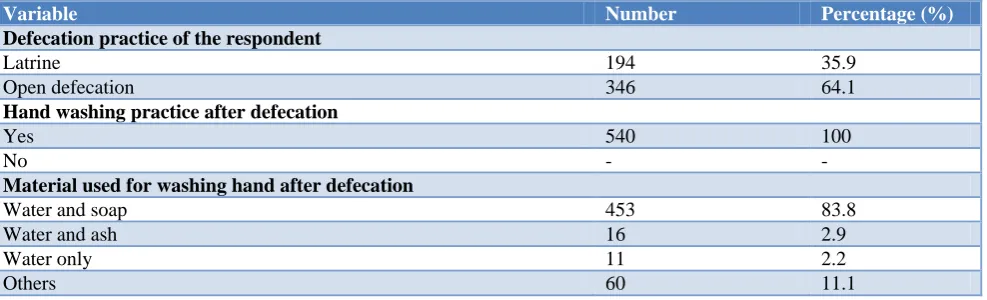
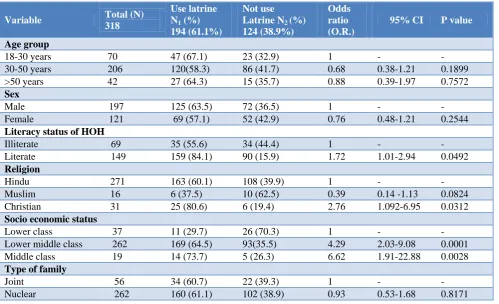
In the present study 64.1% study respondents had the practice of open sky defecation (Table 2). Out of the 318 respondents who have latrine, 61.1% reported that they use latrine regularly and 124 (38.9%) did not use latrine at all (Table 3). The reasons for not using the household latrine were due non-functional latrine (51.6%), followed by use of traditional practices (24.2%), small size of latrine (9.6%), foul smell (8.1%) and few a respondents
stated as others (6.5%) which include fear of closed room and psychological discomfort (inability to defecate) (Figure 1).
We have compared the literacy status of the HOH with that of the respondents practice of using latrine and it was observed that majority of the respondents where HOH is literate use latrine (84.1%). This higher practice of using latrine was found to be statistically significant (p<0.05). On comparing the use of household latrine with religion, it was found that practice of using household latrine is significantly higher in Christian respondents (80.6%) than in Hindu respondents (60.1%) (p<0.05). Again, in our study it was also observed that use of household latrine was higher among respondent belonging to middle SES (73.7%), followed by lower middle SES (64.5%) and lower class SES (29.7%). This increasing trend on the part of higher SES was found to be statistically significant (p<0.05) (Table 3).
Table 1: Availability of the sanitation facilities at household.
Variable Number Percentage (%)
Sanitation facility available at household (N=540)
Yes 318 58.9
No 222 41.1
Provider of latrine facility at household (N=318)
Govt. 166 52.2
Company 110 34.6
Self 42 13.2
Type of latrine available at household (N=318)
Sanitary 264 83.1
Insanitary 54 16.9
Functionality of sanitary latrine (N=264)
Functional 184 69.7
Non-functional 80 30.3
Availability of water arrangement facility near latrine for flushing (N=184)
Yes 176 96.2
No 8 3.8
Total 184 100
Availability of hand washing sanitizer facility near latrine (N=184)
Yes 173 94.1
No 11 5.9
Table 2: Sanitation practices of respondent (N=540).
Variable Number Percentage (%)
Defecation practice of the respondent
Latrine 194 35.9
Open defecation 346 64.1
Hand washing practice after defecation
Yes 540 100
No - -
Material used for washing hand after defecation
Water and soap 453 83.8
Water and ash 16 2.9
Water only 11 2.2
Table 3: Relationship of various socio demographic factors with use of latrine (N=318).
Variable Total (N)
318
Use latrine N1 (%)
194 (61.1%)
Not use Latrine N2 (%)
124 (38.9%)
Odds ratio (O.R.)
95% CI P value
Age group
18-30 years 70 47 (67.1) 23 (32.9) 1 - -
30-50 years 206 120(58.3) 86 (41.7) 0.68 0.38-1.21 0.1899 >50 years 42 27 (64.3) 15 (35.7) 0.88 0.39-1.97 0.7572
Sex
Male 197 125 (63.5) 72 (36.5) 1 - -
Female 121 69 (57.1) 52 (42.9) 0.76 0.48-1.21 0.2544
Literacy status of HOH
Illiterate 69 35 (55.6) 34 (44.4) 1 -
-Literate 149 159 (84.1) 90 (15.9) 1.72 1.01-2.94 0.0492
Religion
Hindu 271 163 (60.1) 108 (39.9) 1 - -
Muslim 16 6 (37.5) 10 (62.5) 0.39 0.14 -1.13 0.0824 Christian 31 25 (80.6) 6 (19.4) 2.76 1.092-6.95 0.0312
Socio economic status
Lower class 37 11 (29.7) 26 (70.3) 1 - -
Lower middle class 262 169 (64.5) 93(35.5) 4.29 2.03-9.08 0.0001 Middle class 19 14 (73.7) 5 (26.3) 6.62 1.91-22.88 0.0028
Type of family
Joint 56 34 (60.7) 22 (39.3) 1 - -
Nuclear 262 160 (61.1) 102 (38.9) 0.93 0.53-1.68 0.8171
We have also observed that all the study respondents had the practice of hand washing after defecation and majority of them used water and soap for hand washing after defecation (83.8%) (Table 2).
DISCUSSION
In our present study it was observed that sanitation facilities were available in 318 (58.9%) households. However, the results are lower when compared to similar study done by Oljira, et al (88.2%).12 This may be explained by the fact that there is no homogeneous allocation of latrine in many tea garden lines by the garden management. Further there is no provision in respect to availability of community latrine. We have noticed in tea garden had constructed community latrine for the people. However, those were later destroyed due to some uneventful social activities.
While enquiring about the type of latrines available it was found that 83.1% were sanitary type. Similar distribution was observed in study done by Ojira et al and Panchori.12,13 However, sizeable proportions (16.9%) of households from the tea garden communities were still found to be using insanitary latrines. The exposed excreta from insanitary latrines are prone to contaminate food and drinking water sources leading to various water-borne diseases. Therefore, these insanitary latrines should be identified and be converted to sanitary type. Policy makers should take initiative to make provisions for
recommending the conversion of insanitary latrine to sanitary one to reduce the food and water borne disease burden among the tea tribe communities.
Our study revealed that 346 (64.1%) study respondents had the practice of open air defecation. As per the most recent Swachhta status report more than half of the rural population (52.1%) of the country still defecates in open.7 Our findings are higher than National average. The reasons for higher practice of open defecation are possibly due to non-availability of household latrine and strong traditional cultural practice.
In the current study out of the 318 respondents who have latrine, 194 (61.1%) reported that they use latrine regularly and 124 (38.9%) did not use latrine at all. A similar result was observed in a study done by Chaine et al where majority (63.8%) use latrine.14 On the contrary a study conducted by Asfaw et al showed that (98.5%) study households were found to be using latrine.15 This difference may be attributed by different factors which include poorly constructed non-functional latrines and existing traditional practices etc.
On comparing the utilization of household latrine with religion we found that practice of using household latrine is significantly higher among Christian respondents (80.6%) than in Hindu respondents (60.1%). Study conducted by Banerjee et al showed a similar association.16 This corroborates the fact that Christian Missionaries are indeed responsible for changing the way of living of the tea garden people to a great extent and thus a higher utilization of latrine facilities.17
Our study also showed that use of household latrine is significantly higher in respondents belonging to middle SES class (73.7%) compared to respondents who belonged to lower SES (29.7%). Similar association was observed in study conducted by Jeratagi et al.18 As the socio-economic class increases, standard of living increases and there is more likely to follow good toilet practices.
Washing hands after defection with soap and water is one of the most effective ways to prevent gastrointestinal parasitic infection. In our current study we found that all the study respondents had the practice of hand washing after defecation and majority used water and soap (83.8%) for hand washing after defecation. Earlier study done by Kuberun et al observed similar finding.19 However, from our observation we have seen that 16.2% study respondents washed hands with Ash, Mud and Plain Water after defection. The reasons may be due to lack of soap at home, toilet facility at premises and ignorance of the importance of using soap
CONCLUSION
We can conclude from the present study that only 58.9% study households have sanitation facilities of which almost one third were found to be non-functional. This is mostly due to the fact that the various schemes related to safe drinking water and sanitation planned and implemented out by the Union Government have not been reached to the majority of tea tribe population residing in tea garden areas. Those who were fortunate enough of having the infrastructure installed, many could not avail the facilities due to the poor quality of structure and also due to a weighted preference given to the traditional method of open defecation. It is noteworthy that the practice of open defecation was found to be higher than the national average even after 70 years of independence. Existence of such detrimental practice in an important community who are adding work force to the economic development of the country needs to be viewed sensibly. So an urgent call has to be made out to those concerned authorities namely Ministry of Drinking Water and Sanitation, Ministry of Labour, Ministry of Health and Family Welfare and Tea Board of India to work in close collaboration in order to ensure access to safe drinking water and sanitation and sustain it through the years to come.
Funding: No funding sources Conflict of interest: None declared
Ethical approval: The study was approved by the Institutional Ethics Committee of Jorhat Medical College, Jorhat
REFERENCES
1. Mara D, Lane J, Scott B, Trouba D. Sanitation and Health. PLoS Medicine. 2010;7(11):e1000363. 2. Centers for Disease Control and Prevention.Global
Water, Sanitation, & Hygiene (WASH). Available at: https://www.cdc.gov/healthywater/global/ sanitation/index.html. Accessed 24 July 2017. 3. World Health Organization. Factsheet: Sanitation,
2017. Available at: http://www.who.int/mediacentre /factsheets/fs392/en/. Accessed 12 August 2017. 4. World Health Organization. Water, sanitation &
hygiene for accelerating and sustaining progress on neglected tropical diseases. A global strategy 2015-2020. Available at: http://apps.who.int/iris/ bitstream/10665/182735/1/WHO_FWC_WSH_15.1 2_eng.pdf. Accessed 13 August 2017.
5. World Health Organization. Water, sanitation and hygiene, 2017. Available at: http://www.who.int/ neglected_diseases/water-sanitation/more/en/. Accessed August 13 2017.
6. Budhathoki S, Shrestha G, Bhattachan M, Singh S, Jha N, Pokharel P. Latrine coverage and its utilisation in a rural village of Eastern Nepal: a community-based cross-sectional study. BMC Res Notes. 2017;10(1):209.
7. National Sample Survey Office. Swachhta Status Report 2016. Available at: http://mospi.nic.in/sites/default/files/publication_rep orts/Swachhta_Status_Report%202016_17apr17. pdf. Accessed August 13 2017.
8. UNICEF .Water, Environment and Sanitation, 2017. Available at: http://unicef.in/Story/1125/Water--Environment-and-Sanitation. Assessed August 12 2017.
9. World Health Organization. Factsheet: Drinking-water, 2017. Available at: http://www.who.int/mediacentre/factsheets/fs391/e. Assessed on August 12 2017.
10. Saikia S, Misra S, Misra B. Tea Garden Labours and Their Living Conditions: A study on Sarusarai Tea Garden of Jorhat District of Assam. XV Annual International Seminar On Economy, Enterprise and Employment. 2014: 509-517.
11. Office of the Registrar General & Census Commissioner, India. Census of India; 2011. Available at: http://censusindia.gov.in/. Accessed on June 2, 2016.
12. Oljira D, Berkessa TS. Latrine use and Determinant Factors in Southwest Ethiopia. J Epidemiol Public Health Reviews. 2016;1(6).
Magudanchavadi, Salem district, India. Int J Community Med Public Health. 2016;3(7):1820-8. 14. Chanie T, Gedefaw M, Ketema K. Latrine
Utilization and Associated Factors in Rural Community of Aneded District, North West Ethiopia, 2014. J Community Med Health Educ. 2016;6:478.
15. Asfaw G, Molla E, Vata PK, Assessing Privy (Latrine’s) Utilization and Associated Factors among Households in Dilla Town, Ethiopia. International J Health Sci Res. 2015;5(6):537-44. 16. Banarjee AM, Dalmia A, Banik N. Demand for
household sanitation in India using NFHS-3 data. Empir Econ. 2017;53:307–27.
17. Blair CF. Christian Mission in India: Contribution of mission to social change. Simon Fraser University. 2008.
18. Jeratagi S, Kumar Y, Mallapur MD. Awareness about sanitary toilets in a rural area of north Karnataka, India: a cross sectional study. Int J Comm Me Pub Health. 2017;4(2):363-9.
19. Kuberan A, Singh AK, Kasav JB, Prasad S, Surapaneni KM, Upadhyay V, et al. Water and sanitation hygiene knowledge, attitude, and practices among household members living in rural setting of India. J Nat Sci Biol Medicine. 2015;6(3):69.