VOLUME 14 | ISSUE 2 | 2019 | 281
Self-related quality of life of elderly submitted to a
12-week aquatic training program
BRUNO TEIXEIRA BARBOSA1,2 , ROSANE LETÍCIA SANTOS DA SILVA1, ANTÔNIO BATISTA
CHAVES DE MENESES1, WANDUY BRINDEIRO-NETO1, TARCIARA PEREIRA BACURAU1, ANDERSON
IGOR SILVA DE SOUZA ROCHA2, LARISSA ISABELLE SOARES DE SOUZA2, MARIA DO SOCORRO
BRASILEIRO-SANTOS2
1Study Group on Physical Exercise applied to Health, University Centre of João Pessoa, Brazil 2Associate Graduate Program in Physical Education UPE/UFPB, Federal University of Paraiba, Brazil
ABSTRACT
Background: The aging process commonly affects the quality of life of the elderly. Group physical exercise appears as a conservative and cheap method to improve the quality of life in this population. Aim: To evaluate the self-reported quality of life in a group of elderly submitted to a 12-week aquatic training program. Methods: Twenty-eight elderly (66.0 ± 5.8 years, 29.6 ± 3.6 kg/m²) were enrolled and submitted to a 12-week aquatic training program (02 times/week, 01 hour/session). The quality of life in the elderly was assessed by the World Health Organization Quality of Life for Older Persons (WHOQOL-OLD). Results: The aquatic training program promoted significant improvements in overall quality of life score (baseline vs 12-wk: 83.2±8.5 vs 86.6±10.3, p = 0.02) and in aspects related to "past, present and future activities" (baseline vs 12-wk: 79.9±16.4 vs 85.7±16.6, p = 0.04) and "death and dying" (baseline vs 12-wk: 74.3±23.0 vs 83.0±20.1, p = 0.04). None of the other aspects that assess the quality of life presented improvement after the aquatic training program, except for the aspect related to "social participation" which showed a tendency to improve after 12 weeks of an aquatic training program (baseline vs 12-wk: 74.8±19.1 vs 77.7±21.5, p = 0.05). Also, an improvement in the waist-hip ratio of the elderly was observed after the aquatic training program (baseline vs 12-wk: 0.90±0.07 vs 0.89±0.08; p <0.05). Conclusion: An aquatic training program performed twice a
1Corresponding author. University Centre of João Pessoa, Brazil.
E-mail: [email protected]
Submitted for publication April 2018 Accepted for publication July 2018
PublishedJune 2019 (in press October 2018)
JOURNAL OF HUMAN SPORT & EXERCISE ISSN 1988-5202 © Faculty of Education. University of Alicante
282 | 2019 | ISSUE 2 | VOLUME 14 © 2019 University of Alicante
week for 12 weeks improved self-related quality of life in an elderly population. Keywords: Quality of life; Exercise; Aged; Water-based exercise.
Cite this article as:
VOLUME 14 | ISSUE 2 | 2019 | 283 INTRODUCTION
Scientific studies and recent medical advances have led to an increase in the life expectancy of the population in developed and developing countries, so that by 2050 the world's elderly population will be more than twice as high as in 2013. It is known that population aging has social and economic consequences such as the prevalence of chronic degenerative diseases which increase proportionally with advancing years (Tardif, 2014; United Nations, 2013).
Just as important as living for many years is living with quality. In this sense, it is understood that the quality of life comprises the individual's self-perception about their physical, social, mental and spiritual well-being conditions, in which negative health perception comprises one of the main predictors of quality of life in elderly persons. For this reason, quality of life is considered as an important indicator for developing programs and actions to improve elderly health (Paiva et al., 2016; Tourani et al., 2018). For this, studies suggest the inclusion of physical activity practice as a strategy to improve domains related to the quality of life of the elderly population (American College of Sports Medicine, 2009).
Previous studies have focused on the effect of physical exercise programs on the quality of life of the elderly (Barker et al., 2016; Bocalini et al., 2010; Cancela Carral and Ayán Pérez 2008; Dechamps et al., 2010; Dehi et al., 2014; Devereux et al., 2005; Dias et al., 2003; Fraga et al., 2011; Geirsdottir et al., 2012; Haraldstad et al., 2017; King et al., 2000; Krist et al., 2013; Madureira et al., 2010; Mura et al., 2014; Oh et al., 2015; Sato et al., 2009; Sun et al., 2017; Tamari, 2011), alternating between educational approaches (Sun et al., 2017), recreation and walking programs (Fraga et al., 2011), Tai chi (Dechamps et al., 2010) and physical exercise in aquatic (Barker et al., 2016; Bocalini et al., 2010; Cancela Carral and Ayán Pérez 2008; Devereux et al., 2005; Oh et al., 2015; Sato et al., 2009) and land (Dehi et al., 2014; Dias et al., 2003; Geirsdottir et al., 2012; Haraldstad et al., 2017; King et al., 2000; Krist et al., 2013; Madureira et al., 2010; Mura et al., 2014; Tamari, 2011) environments.
However, regular physical exercise, although important in promoting quality of life, should be performed with low health risks. Therefore, it is known that aging promotes the reduction of muscular strength and physical capacity, consequently increasing the risk of falls in the elderly. In addition, the prevalence of osteomioarticular disorders such as knee and hip osteoarthritis in the elderly is high (American College of Sports Medicine, 2009; Cross et al., 2014; Frontera et al., 2000; Grundstrom et al., 2012). Therefore, physical exercise in the aquatic environment is considered a promising strategy for the elderly population, since it exposes them to a situation of reduced joint stress due to the physical properties of the water, in addition to allowing development of physical exercise in a group, thereby cooperating for the socialization of its practitioners (Teixeira et al., 2007; Torres-Ronda and Del Alcázar, 2014).
Thus, the present study aimed to evaluate the self-reported quality of life in a group of elderly submitted to a 12-week aquatic training program.
MATERIAL AND METHODS
Study design and subjects
284 | 2019 | ISSUE 2 | VOLUME 14 © 2019 University of Alicante
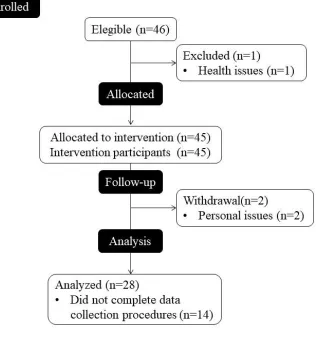
participants were recruited from the university extension program "Hidroginástica na Terceira Idade" held at the Centro Universitário de João Pessoa - Unipê. The flowchart of the study design in the present study is described in Figure 1.
Figure 1. Flowchart
Procedures
The study respected the ethical norms of research with human beings of resolution 466/12 of the National Health Council and of the declaration of Helsinki in 1964; it was also submitted to the research ethics committee of the Centro de Ciências da Saúde of the Universidade Federal da Paraíba and was approved and registered under CAAE number: 79609117.0.0000.5188. The volunteers signed the informed consent form and were informed about the risks and benefits of participating in the research. The experimental procedures were performed at Unipê.
Aquatic Training Program
VOLUME 14 | ISSUE 2 | 2019 | 285
Warm-up and calm down lasted approximately 10 minutes each and the main part lasted about 40 minutes. The warm-up phase counted with exercises as stationary running and the movements prescribed for the main part of the session in order to familiarize the participant with the exercises. The main part of the aquatic training sessions was composed of 04 series of 06 exercises, where each exercise lasted approximately 1 (one) minute and 30 seconds. The cool down was accomplished with aquatic recreation aiming for greater social interaction among the participants of the aquatic training program. All the exercises prescribed in this study aimed at the simultaneous work of lower and upper limbs. Spatula floats were used to increase the resistance to aquatic exercises. The evolution of the aquatic training program is set out in Table 1.
Table 1. Evolution of aquatic training program
Week Warm-up Main part Cool down
1-2 No accessory use No accessory use Accessory was optional
2-4 Accessory was optional With accessory use Accessory was optional
5-8 Accessory was optional With accessory use Accessory was optional
9-12 Accessory was optional With accessory use Accessory was optional
Self-related quality of life
Self-related quality of life was assessed by the World Health Organization Quality of Life for Older Persons (WHOQOL-OLD) questionnaire adapted and validated for the elderly population (Fleck et al., 2006). This questionnaire consists of 24 items on a Likert scale attributed to 6 aspects of: 1) Sensory functioning; 2) Autonomy; 3) Past, present and future activities; 4) Social participation; 5) Death and dying; and 6) Intimacy. Each aspect is composed of 4 items, so aspect the score can range from 4 to 20 for each aspect. The aspect "sensory functioning" evaluates sensory functioning and the impact of the loss of sensory abilities on quality of life. The "autonomy" aspect refers to independence in old age and therefore describes the extent to which one is able to live autonomously and make their own decisions. The "past, present, and future activities" aspect describes the satisfaction over achievements in life and things that you yearn for. The "social participation" aspect delineates participation in everyday activities, especially in the community. The "death and dying" aspect relates to concerns, worries and fears about death and dying, while the "intimacy" aspect assesses the ability to have personal and intimate relationships. For this evaluation, the higher the score, the higher the quality of life; however, for aspect analysis and the overall quality of life score, the scores were transformed on a scale from 0 to 100 so as to express the values on a percentage scale where 0 is the lowest value and 100 is as high as possible.
Statistical analysis
286 | 2019 | ISSUE 2 | VOLUME 14 © 2019 University of Alicante
RESULTS
The elderly enrolled in the study (n = 28; 66.0±5.8 years) presented overweight and obesity grade I according to body mass index presented at the beginning of the research (29.6 ± 3.6 kg/m²); none of them were smokers. Furthermore, the aquatic training program promoted a significant reduction in the waist-hip ratio (p = 0.04) in the elderly. The characteristics of the sample are described in Table 2.
Table 2. Subject characteristics
Variables Pre-intervention Post-intervention
Gender, M/F 3/25
Age, years 66.0 ± 5.8 -
Height, m 1.55 ± 0.10 -
Weight, kg 71.1 ± 12.1 -
BMI, kg/m² 29.6 ± 3.6 29.7 ± 3.9
WHR, score 0.90 ± 0.07 0.89 ± 0.08*
Disease presence, n (%)
Hypertension 20 (71.4)
Diabetes Mellitus 6 (21.4)
BMI, body mass index; WHR, waist-hip ratio. * p<0.05 (student's t-test for related samples) compared to baseline.
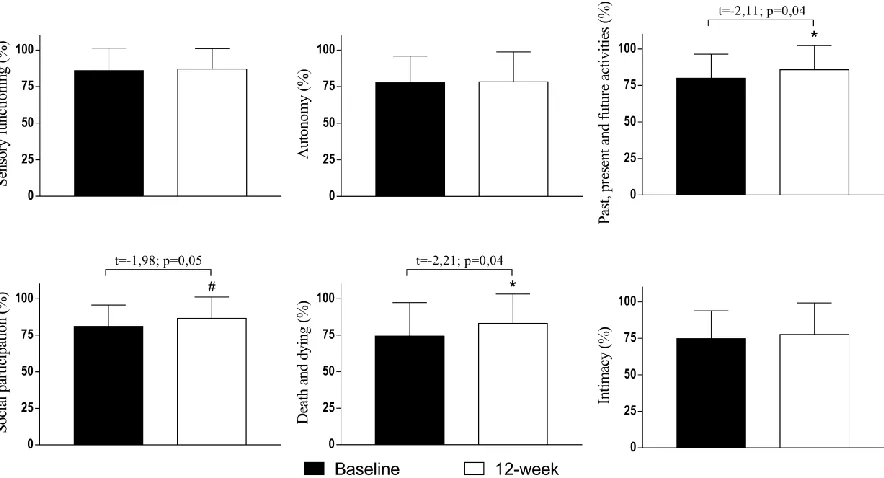
*p <0.05, statistically significant difference between baseline and 12 weeks. #p = 0.05, tendency to a statistically significant difference
between baseline and 12 weeks
VOLUME 14 | ISSUE 2 | 2019 | 287 The aquatic training program promoted statistically significant improvements in the aspects related to “past,
present and future activities” (baseline vs 12-wk: 79.9±16.4 vs 85.7±16.6, p = 0.04) and “death and dying”
(baseline vs 12-wk: 74.3±23.0 vs 83.0±20.1, p = 0.04); in addition, there was an improvement trend for the
aspect related to “social participation” (baseline vs 12-wk: 74.8±19.1 vs 77.7±21.5, p = 0.05). The effect of
the aquatic training program on the aspects of quality of life is described in Figure 2.
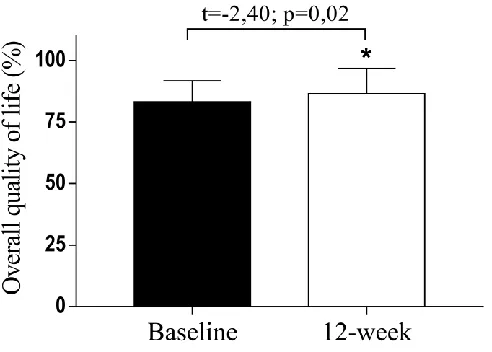
In addition to improvements in aspects, a statistically significant improvement in overall quality of life (Figure 3) was observed in the elderly who participated in the 12-week aquatic training program (baseline vs 12-wk: 83.2±8.5 vs 86.6±10.3, p = 0.02).
*p < 0.05, statistically significant difference between baseline and 12 weeks
Figure 3. Analysis of the overall quality of life of the elderly submitted to a 12-week aquatic training program
DISCUSSION
The main findings of the present study indicate that a 12-week aquatic training program promotes improvement in the overall quality of life in elderly. Regarding the aspects evaluated by the World Health Organization Quality of Life for Older Persons, improvements were perceived in aspects related to "past, present and future activities" and "death and dying"; in addition, an improvement trend was identified for the "social participation" aspect in the elderly submitted to a 12-week aquatic training program. Also, aquatic training promoted a reduction in the waist-hip ratio of the elderly.
288 | 2019 | ISSUE 2 | VOLUME 14 © 2019 University of Alicante
Regular physical exercise is associated with well-being and good quality of life in the elderly (American College of Sports Medicine, 2009). One of the main findings of the present study indicates an improvement in the overall quality of life in elderly after 12 weeks of an aquatic training program, thus corroborating with studies that analysed protocols of 8 (Baena-Beato et al., 2013, 2014), 10 (Oh et al., 2015), 12 (Barker et al., 2016; Bocalini et al., 2010) and 20 (Cancela Carral & Ayán Pérez, 2008) weeks of aquatic training in the same population, showing the importance of regular practice of aquatic exercise in order to guarantee better quality of life for elderly persons.
Paiva et al. (2016) analysed the health factors associated with the quality of life of 3430 elderly people and observed that self-reported morbidities related to functional disability and health perception are associated with low scores of the "death and dying" and "past, present and future activities" aspects. In this sense, the present study verified that the aquatic training program promoted an improvement in the aspects of "death and dying" and "past, present and future activities"; yet other studies suggest that in addition to promoting improvements in quality of life, regular physical exercise in the aquatic environment is capable of improving functional aspects in the elderly (Barker et al., 2016; Bocalini et al., 2010; Cancela Carral and Ayán Pérez 2008; Devereux et al., 2005; Oh et al., 2015; Sato et al., 2009; Torres-Ronda and Del Alcázar 2014).
The improvement trend in the "social participation" aspect found in the present study is possibly related to the benefits found in the collective practice of physical exercise which leads to greater social interaction among the practitioners. This effect was observed by Cancela Carral et al. (2007), since they verified a significant improvement in the aspect related to social aspects in 62 elderly women after the application of a combined water exercise program for strength training (group 1) or classic training (group 2) five times a week for five months. Bocalini et al. (2010) also observed that for elderly women undergoing a similar protocol to the one in the present study with 12 weeks of aquatic exercises, maintaining physical activity is essential for improvement in social domains, as well as in the physical, psychological and environmental domains.
In this study, a 12-week aquatic training program did not promote improvement in the aspects related to "sensory functioning", "autonomy" or "intimacy", due to a possible correlation with the aging process. This fact was already observed in a previous study which assessed the quality of life in elderly participants through the WHOQOL-OLD, affirming that the variable advanced age is associated with the low scores of the "sensory functioning" and "autonomy" aspects, as well as a relation with negative health perception and functional disability (Paiva et al., 2016). Participation in collective programs such as the present study may limit the development of autonomy by the practitioners, since there is mutual support among the participants themselves during the activities and there is no personalized training, which could stimulate their individual independence. In addition, the "intimacy" aspect could present more expressive values if the aquatic training had the support of a multidisciplinary team involving the psychological area. Psychological accompaniment during the training program in order to support the emotional issues that require greater attention in this phase of life could further benefit elderly participants.
CONCLUSIONS
VOLUME 14 | ISSUE 2 | 2019 | 289 REFERENCES
American College of Sports Medicine, Chodzko-Zajko, W. J., Proctor, D. N., Fiatarone Singh, M. a,
Minson, C. T., Nigg, C. R., … Skinner, J. S. (2009). American College of Sports Medicine position
stand. Exercise and physical activity for older adults. Medicine and Science in Sports and Exercise, 41(7), 1510–30. https://doi.org/10.1249/MSS.0b013e3181a0c95c
Baena-Beato, P. A., Arroyo-Morales, M., Delgado-Fernández, M., Gatto-Cardia, M. C., & Artero, E. G. (2013). Effects of different frequencies (2-3 days/week) of aquatic therapy program in adults with chronic low back pain. A non-randomized comparison trial. Pain Medicine (Malden, Mass.), 14(1), 145–58. https://doi.org/10.1111/pme.12002
Baena-Beato, P. Á., Artero, E. G., Arroyo-Morales, M., Robles-Fuentes, A., Gatto-Cardia, M. C., & Delgado-Fernández, M. (2014). Aquatic therapy improves pain, disability, quality of life, body composition and fitness in sedentary adults with chronic low back pain. A controlled clinical trial. Clinical Rehabilitation, 28(4), 350–60. https://doi.org/10.1177/0269215513504943
Barker, A. L., Talevski, J., Morello, R. T., Nolan, G. A., De Silva, R. D., & Briggs, A. M. (2016). Jumping into the deep-end: results from a pilot impact evaluation of a community-based aquatic exercise program. Clinical Rheumatology, 35(6), 1593–1601. https://doi.org/10.1007/s10067-015-3096-6 Bocalini, D. S., Serra, A. J., Rica, R. L., & Dos Santos, L. (2010). Repercussions of training and detraining
by water-based exercise on functional fitness and quality of life: a short-term follow-up in healthy older women. Clinics (Sao Paulo, Brazil), 65(12), 1305–9. https://doi.org/10.1590/S1807-59322010001200013
Cancela Carral, J. M., & Ayán Pérez, C. (2008). Effects of high-intensity combined training on women over 65. Gerontology, 53(6), 340–346. https://doi.org/10.1159/000104098
Cross, M., Smith, E., Hoy, D., Nolte, S., Ackerman, I., Fransen, M., … March, L. (2014). The global
burden of hip and knee osteoarthritis: Estimates from the Global Burden of Disease 2010 study. Annals of the Rheumatic Diseases, 73(7), 1323–1330. https://doi.org/10.1136/annrheumdis-2013-204763
Dechamps, A., Diolez, P., Thiaudière, E., Tulon, A., Onifade, C., Vuong, T., … Bourdel-Marchasson, I.
(2010). Effects of exercise programs to prevent decline in health-related quality of life in highly deconditioned institutionalized elderly persons: a randomized controlled trial. Archives of Internal Medicine, 170(2), 162–9. https://doi.org/10.1001/archinternmed.2009.489
Dehi, M., Aghajari, P., Shahshahani, M., Takfallah, L., & Jahangiri, L. (2014). The effect of stationary walking on the quality of life of the elderly women: a randomized controlled trial. Journal of Caring Sciences, 3(2), 103–111. https://doi.org/10.5681/jcs.2014.011
Devereux, K., Robertson, D., & Briffa, N. K. (2005). Effects of a water-based program on women 65 years and over: A randomised controlled trial. Australian Journal of Physiotherapy, 51(2), 102–108. https://doi.org/10.1016/S0004-9514(05)70038-6
Dias, R. C., Dias, J. M. D., & Ramos, L. R. (2003). Impact of an exercise and walking protocol on quality of life for elderly people with OA of the knee. Physiotherapy Research International : The Journal for Researchers and Clinicians in Physical Therapy, 8(3), 121–30. https://doi.org/10.1002/pri.280 Fleck, M. P., Chachamovich, E., & Trentini, C. (2006). Development and validation of the Portuguese
version of the WHOQOL-OLD module. Revista de Saude Publica, 40(5), 785–91. https://doi.org/10.1590/S0034-89102006000600007
290 | 2019 | ISSUE 2 | VOLUME 14 © 2019 University of Alicante
Frontera, W. R., Hughes, V. A., Fielding, R. A., Fiatarone, M. A., Evans, W. J., & Roubenoff, R. (2000). Aging of skeletal muscle: a 12-yr longitudinal study. Journal of Applied Physiology (Bethesda, Md. : 1985), 88(4), 1321–6.
Geirsdottir, O. G., Arnarson, A., Briem, K., Ramel, A., Tomasson, K., Jonsson, P. V, & Thorsdottir, I. (2012). Physical function predicts improvement in quality of life in elderly Icelanders after 12 weeks of resistance exercise. The Journal of Nutrition, Health & Aging, 16(1), 62–6. https://doi.org/10.1007/s12603-011-0076-7
Grundstrom, A. C., Guse, C. E., & Layde, P. M. (2012). Risk factors for falls and fall-related injuries in adults 85 years of age and older. Archives of Gerontology and Geriatrics, 54(3), 421–428. https://doi.org/10.1016/j.archger.2011.06.008
Haraldstad, K., Rohde, G., Stea, T. H., Lohne-Seiler, H., Hetlelid, K., Paulsen, G., & Berntsen, S. (2017). Changes in health-related quality of life in elderly men after 12 weeks of strength training. European Review of Aging and Physical Activity, 14(1), 10–15. https://doi.org/10.1186/s11556-017-0177-3 King, A. C., Pruitt, L. A., Phillips, W., Oka, R., Rodenburg, A., & Haskell, W. L. (2000). Comparative
effects of two physical activity programs on measured and perceived physical functioning and other health-related quality of life outcomes in older adults. The Journals of Gerontology. Series A, Biological Sciences and Medical Sciences, 55(2), M74-83. https://doi.org/10.1093/gerona/55.2.M74 Krist, L., Dimeo, F., & Keil, T. (2013). Can progressive resistance training twice a week improve mobility, muscle strength, and quality of life in very elderly nursing-home residents with impaired mobility? A pilot study. Clinical Interventions in Aging, 8, 443–448. https://doi.org/10.2147/CIA.S42136
Madureira, M. M., Bonfá, E., Takayama, L., & Pereira, R. M. R. (2010). A 12-month randomized controlled trial of balance training in elderly women with osteoporosis: Improvement of quality of life. Maturitas, 66(2), 206–211. https://doi.org/10.1016/j.maturitas.2010.03.009
Mura, G., Sancassiani, F., Migliaccio, G. M., Collu, G., & Carta, M. G. (2014). The association between different kinds of exercise and quality of life in the long term. Results of a randomized controlled trial on the elderly. Clinical Practice and Epidemiology in Mental Health : CP & EMH, 10, 36–41. https://doi.org/10.2174/1745017901410010036
Oh, S., Lim, J.-M., Kim, Y., Kim, M., Song, W., & Yoon, B. (2015). Comparison of the effects of water- and land-based exercises on the physical function and quality of life in community-dwelling elderly people with history of falling: a single-blind, randomized controlled trial. Archives of Gerontology and Geriatrics, 60(2), 288–93. https://doi.org/10.1016/j.archger.2014.11.001
Paiva, M. H. P. de, Pegorari, M. S., Nascimento, J. S., & Santos, Á. da S. (2016). Fatores associados à qualidade de vida de idosos comunitários da macrorregião do Triângulo do Sul, Minas Gerais, Brasil. Ciência & Saúde Coletiva, 21(11), 3347–3356. https://doi.org/10.1590/1413-812320152111.14822015
Sato, D., Kaneda, K., Wakabayashi, H., & Nomura, T. (2009). Comparison two-year effects of once-weekly and twice-once-weekly water exercise on health-related quality of life of community-dwelling frail elderly people at a day-service facility. Disability and Rehabilitation, 31(2), 84–93. https://doi.org/10.1080/09638280701817552
Sun, Y.-Q., Jiang, A.-L., Chen, S.-M., Li, H., Xing, H.-Y., & Wang, F. (2017). Quality of life and self-care in elderly patients with cardiovascular diseases: The effect of a Traditional Chinese Medicine health educational intervention. Applied Nursing Research : ANR, 38(800), 134–140. https://doi.org/10.1016/j.apnr.2017.10.003
VOLUME 14 | ISSUE 2 | 2019 | 291
Tardif, D. (2014). Editorial: Global elderly care in crisis. The Lancet, 383(9921), 927. https://doi.org/10.1016/S0140-6736(14)60463-3
Teixeira, C. S., Pereira, É. F., & Rossi, A. G. (2007). A hidroginástica como meio para manutenção da qualidade de vida e saúde do idoso. Acta Fisiatr, 14(4), 226–232. Retrieved from http://www.scielo.br/pdf/rbti/v21n3/a12v21n3
Torres-Ronda, L., & Schelling I Del Alcázar, X. (2014). The properties of water and their applications for training. Journal of Human Kinetics, 44(1), 237–248. https://doi.org/10.2478/hukin-2014-0129
Tourani, S., Behzadifar, M., Martini, M., Aryankhesal, A., Taheri Mirghaed, M., Salemi, M., … Bragazzi,
N. L. (2018). Health-related quality of life among healthy elderly Iranians: a systematic review and meta-analysis of the literature. Health and Quality of Life Outcomes, 16(1), 18. https://doi.org/10.1186/s12955-018-0845-7
United Nations. (2013). World Population Ageing 2013. World Population Ageing 2013, 114. https://doi.org/ST/ESA/SER.A/348