SERVICE DESIGN OF A PREGNANCY SIMULATION DRESS EXPERIENCE – FROM THE PERSPECTIVE OF SOCIAL DESIGN
Chi-Ying Hung1 and RungTai Lin2
ABSTRACT
This study has two subjects, one is the design of a pregnancy simulation dress, and the other is the service design for visitors to wear the pregnancy simulation dress in a tourism factory. The core issues of this study are people-oriented social design and experiential value. The case study approach is adopted and an experiential product simulating pregnancy is provided in the setting of a tourism factory. The setting, products and experience are observed as a whole, and the research perspective is based on the transformation process of emotional design and cultural design, which is the basis for deconstructing the design of the pregnancy simulation dress. A service blueprint is used to examine the case’s experiential service design, which is used as an example of experience planning that applies social design to commercial services. Research conclusions summarize and analyze design, marketing, service, and management aspects, hoping to further extend the social value of enterprises and social education work.
Keywords - Experience Economy, Social Design, Emotional Design, Service Design, Tourism Factory
INTRODUCTION
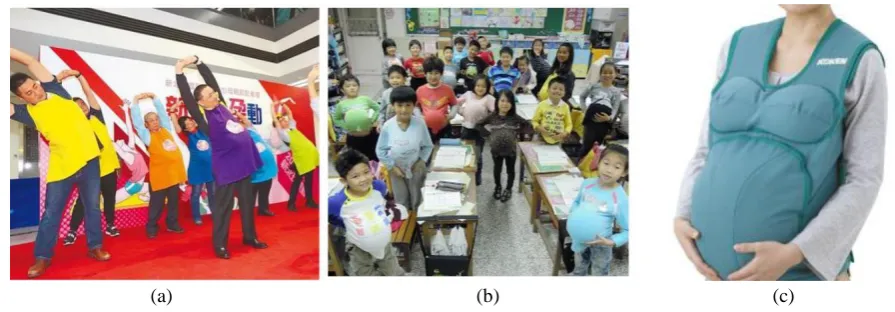
The concept of social design has long been promoted in Taiwan, but there are very few examples and studies on its practices. This is due to the difficulty of using commercial indicators, such as price, mass production, and sales channels, on products with social design characteristics. Furthermore, the attitude and support of consumers and investors for social responsibility is crucial to whether or not social design can be implemented (Hung, Chen & Lin, 2017). This study examines the case of Yumeeiren Garments Tourism Factory in New Taipei City. The case was originally an apparel factory that mass produced maternity outfits, but transformed into a tourism factory under the impact of industry changes. Facing this change in business model and based on the principle of retaining its unique industry culture and the brand story, it developed a pregnancy simulation dress with the design concept of creating a warm experience and atmosphere. The pregnancy simulation dress is shown in Figure 1-(a) and can be worn by visitors as part of a package along with a DIY experience. The package is sold on a group buying website (http://www.gomaji.com/p38450.html). Hence, the case’s design and development of customer experience and the pregnancy simulation dress can provide reference for social design by deconstructing product characteristics and commercialization.
From the perspective of clothing, like other clothing props, there is nothing special about a pregnancy simulation dress, and it is neither aesthetic nor fashionable. However, observations and interpretation of the appearance of visitors who wear the pregnancy simulation dress have found that it seems to carry a special emotional value. The Design of Everyday Things: Emotional Design by Donald A. Norman pointed out that there are three layers to practical design, namely instinct, behavior, and reflection. Reflection refers to the memories of the experiencer or viewer that is brought back, and memories are able to trigger strong and persistent emotions. Dressing up as a pregnant woman may make someone remember a pregnant woman from the past or arouse other emotions, and will cause the motion to be projected into the scenario. What makes it special is not the pregnancy simulation dress, but rather the story of the experiencer.
Children simulating pregnant woman is common in courses of many elementary schools and nurseries in Taiwan. The teacher gives children instructions to stuff balloons in their clothes to pretend it is a baby (as shown in Figure 1-b). The purpose of this exercise is to let children know the hardship their mothers endured during pregnancy. The schools used balloons to simulate being pregnant, but this only provides visual effects and lacks the actual weight. The advantage is that balloons are cheap and easy to buy, and allow many children to experience it at the
1Chi-Ying Hung, CEO in Yumeeiren Tourism Factory, New Taipei City, Taiwan, 5F., No.10, Ln. 16, Sec. 2,
Sichuan Rd., Banqiao Dist., New Taipei City 220, Taiwan (R.O.C.)
Email: [email protected]
2RungTai Lin ,Professor, Graduate School of Creative Industry Design, National Taiwan
University of Arts, Taiwan, No.59, Sec. 1, Daguan Rd., Banqiao Dist., New Taipei City 220, Taiwan
same time. For a more realistic experience, there are also companies that make props, using plastic molds to develop a pregnancy simulation prop (as shown in Figure 1-c). Yet, the pregnancy simulation prop is a medical device that is not only expensive, but also limited to units that require it, and is not available to the general public. In contrast, the case’s pregnancy simulation dress not only has the appearance of a pregnant woman and different weights, the parts are module for mass production and suitable for people of different genders, ages and body types. This satisfies visitors of tourism factories and increases interaction. This is an innovative approach that finds a balance between using a balloon and props model.
A common idea for experiencing what it is like being pregnant is that the physical changes in woman to continue life of mankind is worth our attention. It is the social design concept of caring for women. Pregnancy is a natural physiological phenomenon, but pregnant woman or their family members often neglect the difficult 10 months of pregnancy and mostly focus on the new life. The design of a pregnancy simulation dress experience service shows the motive of caring for pregnant women. This is a people centric design concept that cause people to introspect. Based on the background above, this study uses a tourism factory and an experiential product for simulating pregnancy, and uses content analysis to deconstruct the design content of the pregnancy simulation dress. A service blueprint is also used to examine the framework of the experiential service design.
(a) (b) (c)
Figure 1. Props for experiencing being pregnant
Photograph : (a) Chinatimes.com|(b) EPAPER@MOE |(c) Koken CO., LTD.
FEATURES OF SOCIAL DESIGN AND EXPERIENTIAL SERVICE DESIGN Social Design Practices Based on Design Thinking
The concept of social design originated from American design expert Victor Papanek. As pointed out in the book Design for the Real World, design must become an innovative, creative interdisciplinary tool that responds to humanity’s real needs, and is research-oriented. About half a century ago, he advocated design for the third world and the masses, and design concepts for the disadvantaged and education, for medical equipment, for experiments and research, and to maintain life changed the way designers think, guiding innovation and breakthrough in social design, which remains applicable to this day (Papanek, 1985). Furthermore, social design and civic education are similar in that they are practice oriented, and are design processes that improve humanity’s well-being and life. They set out based on what people need and their lifestyles, solve the issues of the majority of people or society, and exert their influence (Yeh, Chen, & Perng, 2017). In other words, design projects should not overlook what people truly need and must be based on high social and moral standards to influence society (Wu, 2016). As to how to achieve the purpose of social design, this study believes that people oriented design thinking are a way of implementing social design. Tim Brown, CEO of IDEO, once gave the definition in Harvard Business Review: “Design thinking are the people-oriented spirit and method of design. They take into consideration people’s needs and actions, and also consider their technology or business opportunities.” Hence, social design should not be categorized as design for charity, but rather the use of commercial design to achieve the purpose of social design.
Design of the simulation dress is similar to a cultural conversion design based on the culture of reproduction. It is no longer simply design for pregnant women, but rather designed for the public to experience the role of a pregnant woman. Hsu & Lin (2011) once used Taiwan’s rich ethnic cultural features for a cultural product design process that uses scenarios and product semantics, and further proposed four design stages for cultural products, specifically setting a scenario, telling a story, writing a script, and designing a product. In terms of the overall design process, the first two stages are applicable to the concept of product design, and the latter two design stages are the core of cultural product design conversion (Lin, 2007; Lin, Chen, Hsiao & Lin, 2016). Conversion of the simulation dress’ cultural elements from the perspective of design thinking not only requires attention on basic characteristics of clothing, but even more on the development and design of functional aspects, such as weight simulation and planning the structure for wearing the dress. External clothing elements must be combined with the presentation of internal functions to highlight the requirement of social design.
Emotional Design of the Pregnancy Simulation Dress
Ortony, Norman and Revelle (2005) believed that attributes of human beings is the result of different levels of brain functions in a study on emotions. The pre-set level for automation is called the visceral level; the level that controls daily behavior is called the behavioral level; the level of deep thought is called the reflective level; each level plays a different role in human beings’ overall functionality. If we take a closer look at the three levels of emotional design, the visceral level is a rule of nature and fixed in place, it is consistent in all cultures of humanity, and actual characteristics include appearance, touch and voice. Design at the behavioral level focuses on whether or not function and performance are accepted by the public; if the designer’s product design concept is easy to understand, easy to use, and matches the user’s psychological model, which will make it the best behavioral design. Hence, a good behavioral design is people centric and emphasizes understanding and satisfying the true needs of the product user. Design at the reflective level emphasizes the message, culture and customs, and product effect. The presentation of products may be meaningless to some people, but the answer may be apparent to others (Norman, 2004).
The essence of reflective design is that it reflects on the viewer’s heart, and perception of beauty originates from reflective design. It goes beyond consciousness reflection and experience of the appearance and is affected by knowledge, learning and culture. A work can bring people pleasure even if its appearance is not appealing (Norman, 2004). For the pregnancy simulation dress’s design to successfully deliver a message to the experiencer about the correct expected effects, it is necessary to use emotions as a medium for the experiencer to understand the physical coordination of pregnant women when their body changes. This has a key effect in learning how to care about pregnant women, such as gravity makes the experiencer walk awkwardly or feel closer to what pregnant women feel. This is how the friendliness of objects is design for users to form an emotional connection.
Service Design
Service design is design of interactions, experiences and relationships in the value co-creation system, and it efficiently and effectively delivers the value proposition together with internal and external stakeholders to service receivers, so as to achieve long-term strategic interests. It is a type of design practice that creates service value (Sung, 2014). Services have many characteristics, such as products or processes, intangible know-hows or models, including information processing, finances and business models, and the knowledge and technical capabilities of individuals or groups, or the effect of making people feel happy and friendly (Gallouj & Weinstein, 1997). Therefore, services involve an extensive number of fields and scope. From a practical perspective, service design is the creation of useful, available and needed services that make organizations more efficient and effective. For example, employee and customer management information systems are all important elements of service-oriented organizations. The effectiveness of service design determines the success or failure of service (Frances, 2008). From this perspective, service design serves the same function of a bridge and links together numerous software and hardware facilities, integrating input and output information flows for the overall process to operate smoothly and achieve maximum effects.
experience and solution provided by services are where profits are. S-D Logic emphasizes that the value of service is in its use and not transaction. For example: in the DIY course of a tourism factory, service is not provided by consumers purchase the materials pack (textiles, food, metals, etc.), and truly experience the value of service when the technicians gives them instructions on how to make and operate tools; value is created when consumers experience personally completing works.
Shostack (1987) proposed the concept of service blueprint for examining the service output process, and as a tool for analyzing service processes. According to Zeithaml, Bitner and Gremle (2006), a service blueprint uses three baselines to separate front, middle and end, the first is the line of interaction between service personnel and customers, the second is the line of visibility, and the third is the line of internal interaction. This blueprint illustrates the service delivery process, in which the line of interaction separates consumers and service personnel, the line of visibility covers supplies passed between service personnel and logistics personnel, and the line of internal interaction is the support for the overall service system and technology provider. The service blueprint allows the service scenario to be examined and separates customer activities, front-end contact points and personnel actions, and back-end contact points and personnel actions, as well as support procedures. It helps organizations clarify the design framework used during service operations.
Summary
Experience is a hedonic consumption, and provides customer satisfaction through the pleasant and happy feelings from using products (Hirschman & Holbrook, 1982). Pine Ⅱ & Gilmore believed that products and services are nowhere near enough to continue sustaining economic growth, and the greatest chance at maintaining economic prosperity is to create experiences (Pine & Gilmore, 1999). Service design and product planning are crucial to creating the atmosphere of a site that provides the experience. Hence, this study analyzes products, site and experience and proposes the research framework shown in Figure 2 based on literature (Yin, 2013; Lin & Kreifeldt, 2001).
DESIGN FEATURES OF THE PREGNANCY SIMULATION DRESS Cultural Transformation Design of the Pregnancy Simulation Dress
This study examines the design process for the pregnancy simulation dress experience based on procedures of cultural transformation design. A social design perspective is adopted, which means that it is designed for most people, so that more people, especially men, can experience what it is like being a pregnant woman. The experiencer’s care for pregnant women or women in general is awakened through the warm atmosphere of the tourism factory, as shown in the four procedures of Figure 3.
2. Write a Script: Everyone has a story about how they grew up, and it is the experience of all parents who gave birth to and nurtured children. The pregnancy simulation dress is only a medium. Assuming that people without any response at all are excluded, the purpose of design is to gain different responses and feelings when worn by different people. This feeling belongs to the experiencer’s own story, and other can only see the appearance, but the ripples in their hearts may be connections between them and different people. The main character of the story may be a family member or someone who helped us.
3. Tell a Story: The ideal situation is for multiple to jointly experience and achieve co-creation effects, allowing everyone to visit the tourism factory to experience pregnancy. They can experience the inconvenience of pregnancy walking, sitting, lying down, and during daily activities, such as going to the restroom, picking up things, or bearing the weight of carrying a life around. On the outside it looks like the person is wearing a maternity outfit and is not too casual when simply stuffing a balloon or awkward when wearing a prop.
4. Design a Product: The three cultural transformation procedures above are combined to deconstruct the
product design: The appearance of a pregnant woman with the weight of a child and adjustable belly position. This pregnancy simulation dress can be mass produced and must be easy to take off, clean, and fill. It must be able to simulate the softness of a person’s belly and provide options of different weights and sizes for different stages of pregnancy. This makes it a product with educational meaning.
Figure 3. Cultural transformation design procedures of the pregnancy simulation dress
Photograph: Yumeeiren CO., LTD & GMA NEWS (Megumi, 2016)
Design Features of the Pregnancy Simulation Dress
A B C D E F G H I J
Item Front Back Inner layer Behind Belly Belt Velcro/B Fundoshi Velcro Notch
length 37.7 32.6 31.7 15.5 18 15 4.1 11.8 9 25.25
Width 36 15 22.1 12 18 3.7 3.6 5.2 3.7 5
Figure 4. Simulation Dress Modeling Image: Wen-Ting Fang Unit: Inch
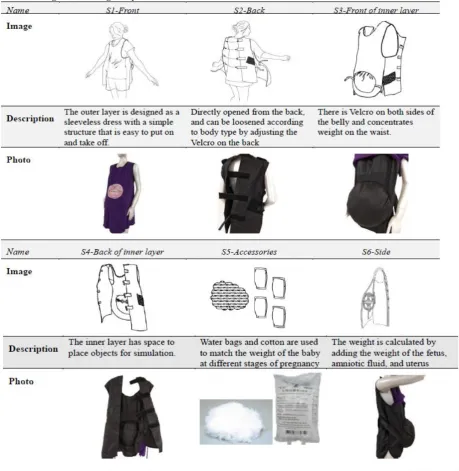
Summarizing advantages and disadvantages to highlight the characteristics of the pregnancy experience, the innovative method to make the pregnancy simulation dress both aesthetic and functional is to use a layered design. The outer layer is like a typical maternity outfit and emphasizes the aesthetics; the functional design is on the inner layer, and the front of the inner layer has a storage space (as shown in Table 2-S4) to place sufficient soft material. The appearance looks like a belly and it is flexible when touched. The inner layer must support weight, so the fabric is the stronger canvas for supporting objects. The total weight of the fetus, amniotic fluid, and uterus is estimated based on the pregnancy cycle, such as: 1,100 grams at 3 months, 2,300 grams at 7 months, and 4,100 grams at 10 months (as shown in Table 1-S6), and then saline bags and cotton is filled to simulate the weight (as shown in Table 1-S5).
Velcro is sowed in front of the storage space, on the left and right of the waist, and on the closely fitting part of the back (as shown in Table 2-S2). This allows the belly to be adjusted up/down and left/right (as shown in Table 1-S3). The fastening function of Velcro fixes the weight at the waist and effectively provides a realistic experience. Fo and taken off, the design is a sleeveless short dress (as shown in Table 1-S1), and knitted fabric is selected for a better fit at the belly, making it easier to cover the props inside that are not aesthetic. The experiencer directly opens the Velcro from the back to wear or take off the dress (as shown in Table 1-S2).
The design of the pregnancy simulation dress should have greater space for imagination, such as the loaded weight and if the position of the belly when worn by people with different body types is like a real pregnant woman. Furthermore, the experiencer’s height, age, and body type all need to be considered in modeling. The planning and design of the simulation dress is analyzed from visceral, behavioral, and reflective levels of design below.
2. Behavioral level: The protruding belly women have when they are pregnant is an appearance characteristic, while the weight of the baby is the design aspect that is most easily felt by the experiencer. Different weights corresponding to different stages of pregnancy are loaded in the dress to simulate different months of pregnancy, and extend the experience of the simulation dress, allowing the experiencer to feel what it is like during different stages of pregnancy. Furthermore, the design should emphasize easy to put on and take off and simple operation for experiencers to more easily understand and use the simulation dress, increasing the acceptance of the experience. 3. Reflective level: Men and women, more or less, all think about childbirth, and people who are not married, are married, or will not get married think about it from different perspectives due to their different backgrounds. The purpose of the pregnancy simulation dress is not only to achieve education through entertainment, but also to create ripples in the hearts of experiencers. Whether it may be noticing the inconvenience of pregnant women in daily life, or thinking about their hardship of 10 months pregnancy of their mother or wife, the simulation dress aims to bring back positive memories in the experiencer.
Table 1. Design of the Pregnancy Simulation Dress
Pregnancy Simulation Dress Experience Service Design
Design of the experience service is an important foundation to whether or not characteristics of the simulation dress can be expressed. Experiential activities play a key role in the business of tourism factories, and are the most important design items for differentiating features of tourism factories in different industries. Hence, an excellent experience design is the main marketing strategy for attracting tourists. The case is a tourism factory that features the design theme of pregnancy. It utilizes knowledge of pregnancy and clothing production technologies to create a place that achieves education through entertainment, so that customers who never thought about getting pregnant can experience what it is like being pregnant. The clothing production process of the case are also displayed through interpretations by tour guides and DIY activities, providing visitors with a sense of simple happiness. This service design creates a unique experiential model that increases customer value. It fulfills corporate social responsibility and also reflects on social interest.
Figure 5. Service blueprint for the pregnancy simulation dress
Service Blueprint for the Pregnancy Simulation Dress
The service blueprint for the pregnancy simulation dress experience is drawn based on analysis using the three baselines. The service process is divided into three stages, before service, during service and after service. Before service refers to service procedures before visitors experience the service, including payment for the visit and reception; during service refers to when a tour guide begins the tour for visitors, who follow the factory’s visit route and participate in the simulation dress experience activity; after service refers to logistics personnel cleaning and organizing in preparation of the next tour group to provide services to. The service blueprint is centered on the customer service experience, starting from confirmation before starting a tour until the experience is over and the visitor leaves. The interactions and relations between customers and service personnel or between service personnel and the logistics or organization system at each action point, as well as important tasks at each time point are shown in Figure 5.
personnel replacements; 2. Plan different scripts for different types of customers to meet their requirements; 3. Estimate the time consumption of each service stage to control entry time and match the itinerary of tour groups; 4. Standardize the collection of photo highlights for the experience, and upload the photos onto the website for customers to download, which will increase the effects of online marketing and word-of-mouth; 5. Effectively increase the work efficiency of service personnel for self-examination of work performance. These six applications service as a guideline for managing services and internal management.
Value of the Pregnancy Simulation Dress Experience
The case attempts to create a warm atmosphere that will give customers a pleasant feeling and an encouraging good experience, as shown in Figure 6, leaving a good memory. The key to whether or not this is successful is the contents of the experience. Hence, this study uses the five aspects of experience marketing proposed by Bernd H. Schmitt, including sense, feel, think, act, and relate, for analysis (Schmitt, 2000), and observes whether if the experience activity achieves expected results. The following characteristics were summarized on this basis: (1) Realistic pregnancy simulation: The experience satisfies the senses vision and touch; (2) Humorous role play: Brings out emotions in customers through group interactions, which may be happy or nervous; (3) Reflection on care for life: The experience makes customers think about the reproduction of mankind and increases the possibility of caring for life; (4) Better understanding of pregnant woman: The act allows customers to understand physical changes of woman during pregnancy, so that they care about the inconvenience of pregnant woman and support the social care system; (5) Cherish family: The customer experience causes customers to relate, such as the emotional connection with family members and friends, and causes them to make self-improvements.
The experience activity’s effects brought numerous news outlets to report on the activity. Hence, when the pregnancy simulation dress is applied to role play in the customer experience provided by a tourism factory, it transforms simple emotional value to new value for a company providing an experience. The simulation dress is a medium for experience marketing that creates emotional value, which is transformed into the experience’s economic value. This is consistent with the opportunity for innovative value perceived by Pine & Gilmore in an experience economy (Lenderman, 2010; Pine & Gilmore, 2011). Summarizing the service design process and experience value analysis, the pregnancy simulation dress has the following managerial implications:
1. The pregnancy simulation dress can be customized and mass produced. It gives consideration to social design and cost-effectiveness of production.
2. The pregnancy simulation dress successfully attracted the attention of teachers, especially nursery school teachers.
3. When a group experiences the pregnancy simulation dress, it provides entertainment and causes them
to reflect on themselves.
4. Experiencers learn and simulate the heavy burden carried by pregnant women, and further understand
what it is like for women to be pregnant.
5. The experience activity creates a stage for organization members, and allows them to satisfy their desire to perform in role play.
6. The experience activity is charged by each time in the tourism factory, allowing the experience to create economic value and maintain commercial operations.
The successful implementation of social design is determined by the designer’s design concept, as well as the professional knowledge and execution method for transforming the design. It needs a simple toolkit to replace the complex design model (Kang, 2016). This study deconstructs the design model of the pregnancy simulation dress, and applies clothing technologies and material functions based on contents of emotional design to care for women while meeting experience requirements of the masses, meeting requirements for standardized production. This study then examines the arrangements of the site from the perspective of service design and experience marketing to show the economic value of the experience. It retraces the thought process of the designer and transforms production of the simulation dress into a simple toolkit, which can be shared for production by even more people, achieving the purpose of promoting social design.
CONCLUSION
Under the framework of capitalism, social design is a dilemma in business. There is a conflict between the two values of fulfilling social responsibility of design while attempting to maximize profits (Whiteley, 1997). Therefore, this study uses the social design of the case’s pregnancy simulation dress to analyze its emotional design characteristics, and then uses cultural transformation design procedures to examine its design process. Finally, this study unfolds the operations of the simulation dress in the experience site using a service blueprint, and utilizes the content analysis method to analyze service subjects and design motive. Research findings are divided into the four aspects below.
1. Design: The pregnancy simulation dress has a few key design elements, including appearance, desirable, draws attention, natural laws, creative and innovative, functional, activism, easy to understand and use, reflects on the observer, brings back private memories, personal factors, and educational meaning, providing a basis for proposing social design related products.
2. Service: Complete standard operating procedures are established using the service blueprint, and several service scripts are prepared to meet the requirements of different customers. The service time can be precisely controlled to satisfy the itinerary of tour groups, and photos of the experience service are systematically stored on the website, increasing online marketing and word-of-mouth effects, and encouraging all employees to achieve better work performance.
3. Marketing: From the perspective of marketing experience, the simulation dress provides the experiential value of realistic simulation of being a pregnant woman, humorous role play, shows care for life, provides better understanding of pregnant woman, and cherish family relations. It is the best promotional material for cause marketing.
4. Management: The simulation dress can be mass produced and gives consideration to both economic benefits and social value. Cause marketing successfully attracted many preschool teachers to bring their students. The simulation dress resonates among experiencers, especially when they are in a group, allowing them to know what it is like when women become pregnant. It also creates a stage for the organization’s personnel to perform. The fee charged for the experience activity combined with DIY course keeps it a business and benefits and keeps it a business benefits the case’s brand value and service revenue.
Subsequent studies can conduct a questionnaire survey on experiencers to determine if they recognize the social elements and experiential value of the product, and the correlation can be compared using quantified statistical methods. A customer satisfaction survey can be carried out for the experience process of the service design, and provide improvement recommendations for related services. This study attempts to create a model where social responsibility and business profits can co-exist based on social design and service design, and hopes to thus create social value while maintaining business operations.
REFERENCES
1. Chuang, Y. H. (2011).Gender Image and Fan Culture: A Case Study on Pili PuppetShow(2000-2009).
Unpublished master’s thesis. National ChungHsing University,Taichung, Taiwan.
2. Frances X. F. (2008). The four things a service business must get right. HarvardBusiness Review, 86(4), 70-80.
3. Gallouj, F., & Weinstein, O. (1997). Innovation in services. Research Policy, 26(4), 537-556.
4. Hirschman, E. C., & Holbrook, M. B. (1982). Hedonic consumption: emerging concepts, methods and
propositions. The Journal of Marketing, 92-101.
6. Hung, C. Y., & Chen, J. L., Lin, R. T. (2017). The Qualia Experience Model of Tourism Factory from Social Design Perspective. Journal of Design, 22(3), 69-92.
7. Kang, L. (2016). Social design as a creative device in developing Countries: The case of a handcraft pottery community in Cambodia. International Journal of Design, 10(3), 65-74.
8. Lenderman, M. (2010). Experience the Message: How experiential marketing is changing the brand
world. McClelland & Stewart.
9. Lin, C. L., Chen, S. J., Hsiao, W. H., & Lin, R. (2016). Cultural ergonomics in interactional and experiential design: Conceptual framework and case study of the Taiwanese twin cup. Applied ergonomics, 52, 242-252.
10. Lin, R. T. (2007). Transforming Taiwan aboriginal cultural features into modern product design: A case study of a cross-cultural product design model. InternationalJournal of Design, 1(2). 45-53.
11. Lin, R., & Kreifeldt, J. G. (2001). Ergonomics in wearable computer design. International Journal of
Industrial Ergonomics, 27(4), 259-269.
12. Megumi Lim (2016, September 30). Japanese politicians wear ‘pregnancy’ vests to urge men to help at
home. GMA NEWS. Retrieved February 15,2018,from
http://www.gmanetwork.com/news/lifestyle/content/583369/japanese-politicians-wear-pregnancy-vests-to-urge-men-to-help-at-home/story/
13. Norman, D. A. (2004). Emotional design: Why we love (or hate) everyday things. Newts the case’s
brand value and service revenue. York: Basic Books.
14. Ortony, A., Norman, D. A., & Revelle, W. (2005). Affect and proto-affect in effective functioning. Who needs emotions, 173-202.
15. Papanek, V. (1985).Design for the Real World: Human Ecology and Social Change. Chicago Review.
16. Pine, B. J., & Gilmore, J. H. (1999). The experience economy: work is theatre & everybusiness a
stage. Harvard Business Press.
17. Pine, B. J., & Gilmore, J. H. (2011). The experience economy. Harvard Business Press. 18. Rathmell, J. M. (1966). What is meant by services? Journal of Marketing, 30(4), 32-36.
19. Schmitt, B. H. (2000). Experiential marketing: How to get customers to sense, feel, think, act, relate. Simon and Schuster.
20. Shostack, C. L.(1987). Service positioning through structural change. Journal ofMarketing, 51, 34-43. 21. Sung, T. J. (2014). Preface-The essence of service design and process tools]. Journal of Design, 19(2). 22. Vargo, S. L., & Lusch, R. F. (2004). Evolving to a new dominant logic for marketing. Journal of
marketing, 68(1), 1-17.
23. Vargo, S. L., & Lusch, R. F. (2008). Service-dominant logic: continuing the evolution. Journal of the
Academy of marketing Science, 36(1), 1-10.
24. Whiteley, N. (1997). Design for society. Reaktion books.
25. Wu, C. Y. (2016). Observation and reflection on 2015 Taipei design and city exhibition. Journal of Design. 21(3), 45-67.
26. Yeh, W. L., Chen, L. H. & Perng, T. L. (2017). Social Design as a Practical Model for Civic Education: Case Analysis of an Elementary School. Curriculum & InstructionQuarterly. 20(3), 59-84.
27. Yin, R. K. (2013). Case study research: Design and methods. Thousand Oaks, CA: Sage.